2 Kings 14:29

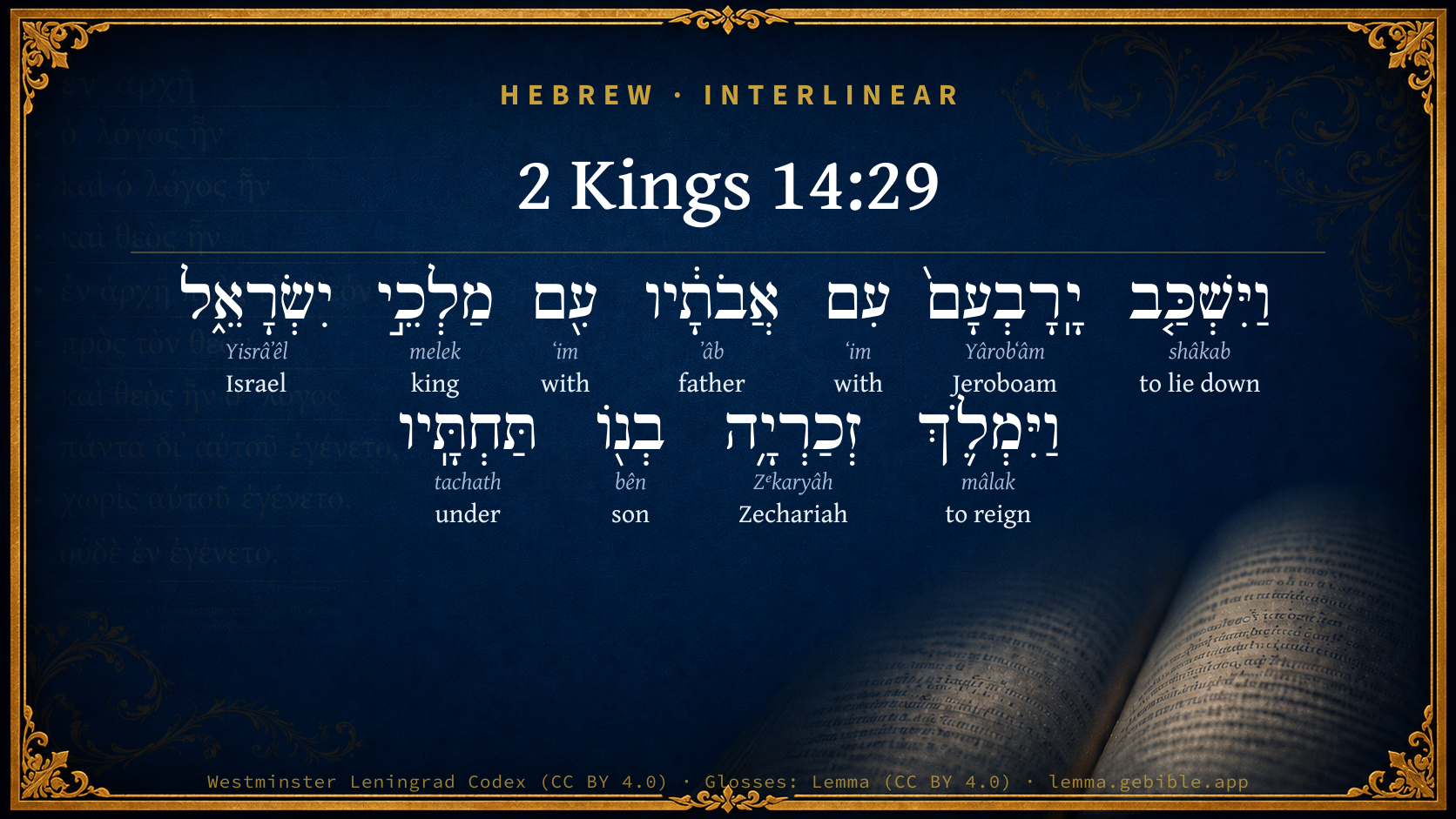
Hebrew (Westminster Leningrad Codex) 2 Kings 14:29 appears in the Hebrew Old Testament. The text above is from the Westminster Leningrad Codex. Each word links to its Strong’s number, a concise gloss, and parsing drawn from the Open Scriptures Hebrew Bible morphology. Click any word for its full Brown-Driver-Briggs (BDB) entry.
Download image
Cite this verse

2 Kings 14:29 (World English Bible). Public Domain. Lemma interlinear Bible study tool, https://lemma.gebible.app/v/2-kings/14/29.

Show BibTeX & RIS
BibTeX
RIS
English Translation
Jeroboam slept with his fathers, even with the kings of Israel; and Zechariah his son reigned in his place.
World English Bible · Public Domain
Highlights
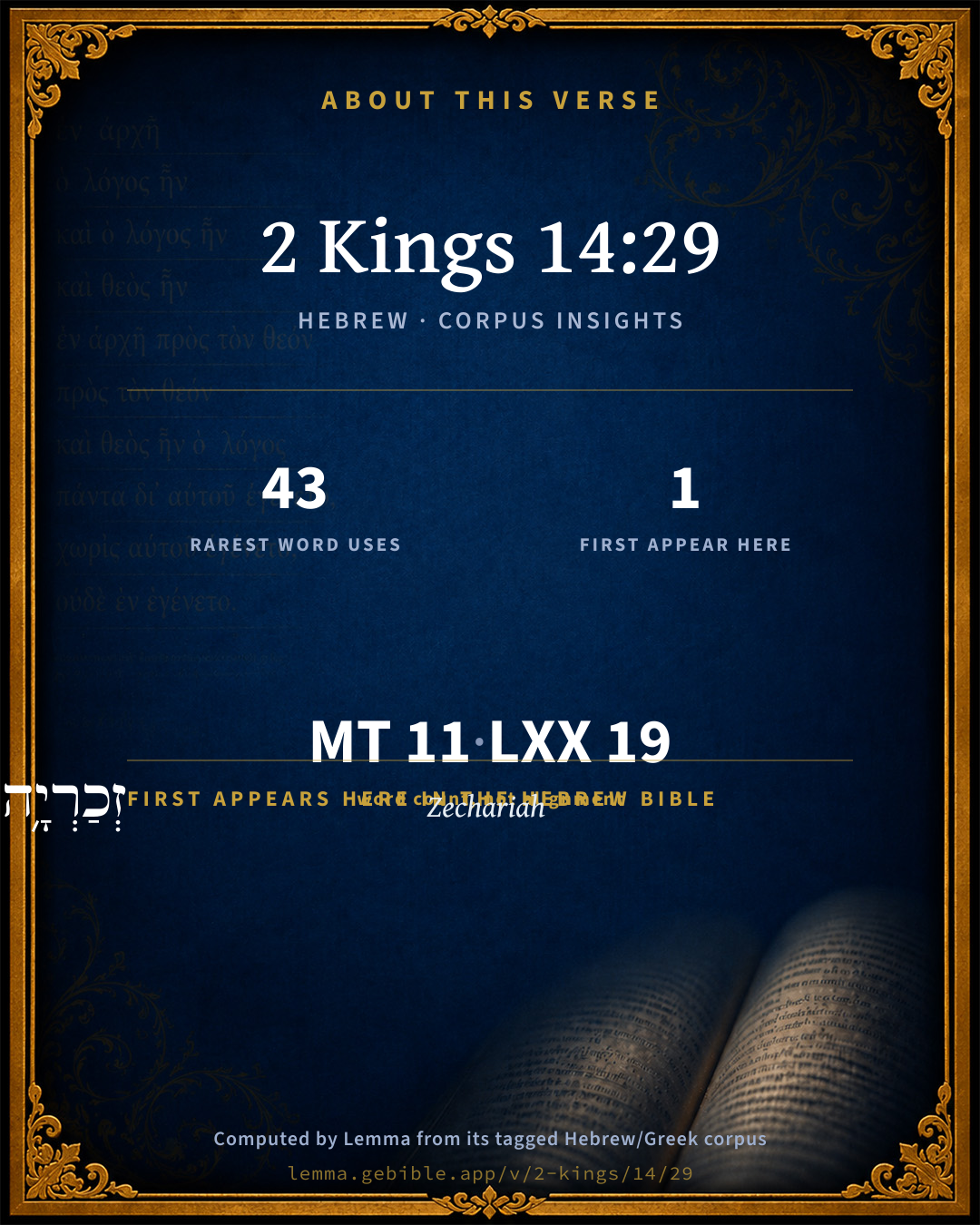
  • 1 first appearance in the Hebrew Bible
Full analysis ↓
Download a study sheet

One document with this verse’s original text, its word-by-word gloss line, the meaning frame, cross-references with their text, attributed commentary, and full source and license credits — printable, and it pastes into notes with its structure intact.

This verse Autodidact and up

Study sheet (.html) Plain text (.txt)

A passage Seminary Student

Up to 50 verses in one chapter. A passage sheet keeps up to 6 commentary sources and 12 cross-references per verse, in the order this page ranks them, and says so on the sheet whenever that leaves anything out. Ask for a single verse and you get the Autodidact verse sheet above.

Everything on this page stays free to read, with no account — the sheet is a download of what is already on screen, not access to it.

Want to remove ads? Support Godless Engineer
Compare translations 3

The same verse in 3 English versions, stacked beneath the original-language interlinear above. Click any original word for its lexicon entry.

Each is an independent rendering of the whole verse — the interlinear is not word-aligned to these translations.

Highlighted words mark where these versions differ — a whole-verse word diff, not a word-by-word alignment.

  • World English Bible Public Domain
    Jeroboam slept with his fathers, even with the kings of Israel; and Zechariah his son reigned in his place.
  • King James Version Public Domain
    And Jeroboam slept with his fathers, even with the kings of Israel; and Zachariah his son reigned in his stead.
  • unfoldingWord Literal Text CC BY-SA 4.0
    And Jeroboam lay down with his fathers, with the kings of Israel, and Zechariah his son reigned in his place.

unfoldingWord Literal Text — © unfoldingWord, licensed CC BY-SA 4.0. Word-aligned USFM3 via Door43 (git.door43.org/unfoldingWord/en_ult).

Versions to compare (up to 4)

3 of 4 selected

Show all 18 translations

Every available English version of this verse, each an independent rendering of the whole verse.

  • World English Bible Public Domain
    Jeroboam slept with his fathers, even with the kings of Israel; and Zechariah his son reigned in his place.
  • Berean Standard Bible Public Domain
    And Jeroboam rested with his fathers, the kings of Israel. And his son Zechariah reigned in his place.
  • Majority Standard Bible Public Domain
    And Jeroboam rested with his fathers, the kings of Israel. And his son Zechariah reigned in his place.
  • King James Version Public Domain
    And Jeroboam slept with his fathers, even with the kings of Israel; and Zachariah his son reigned in his stead.
  • American Standard Version (1901) Public Domain
    And Jeroboam slept with his fathers, even with the kings of Israel; and Zechariah his son reigned in his stead.
  • Revised Version (1885) Public Domain
    And Jeroboam slept with his fathers, even with the kings of Israel; and Zechariah his son reigned in his stead.
  • Geneva Bible (1599) Public Domain
    So Ieroboam slept with his fathers, euen with the Kings of Israel, and Zachariah his sonne reigned in his steade.
  • Douay-Rheims (1899) Public Domain
    And Jeroboam slept with his fathers the kings of Israel, and Zacharias his son reigned in his stead.
  • Young's Literal Translation Public Domain
    And Jeroboam lieth with his fathers, with the kings of Israel, and reign doth Zechariah his son in his stead.
  • Literal Standard Version CC BY-SA 4.0
    And Jeroboam lies with his fathers, with the kings of Israel, and his son Zechariah reigns in his stead.
  • Unlocked Literal Bible CC BY-SA 4.0
    Jeroboam slept with his ancestors, with the kings of Israel, and Zechariah his son became king in his place.
  • unfoldingWord Literal Text CC BY-SA 4.0
    And Jeroboam lay down with his fathers, with the kings of Israel, and Zechariah his son reigned in his place.
  • Darby Bible Public Domain
    And Jeroboam slept with his fathers, with the kings of Israel; and Zechariah his son reigned in his stead.
  • World Messianic Bible Public Domain
    Jeroboam slept with his fathers, even with the kings of Israel; and Zechariah his son reigned in his place.
  • Webster's Bible Public Domain
    And Jeroboam slept with his fathers, even with the kings of Israel; and Zachariah his son reigned in his stead.
  • Free Bible Version CC BY-SA 4.0
    Jeroboam died and was buried with the kings of Israel. His son Zechariah succeeded him as king.
  • Bible in Basic English Public Domain
    And Jeroboam went to rest with his fathers, and was put into the earth with the kings of Israel; and Zechariah his son became king in his place.
  • JPS Tanakh (1917) Public Domain
    And Jeroboam slept with his fathers, even with the kings of Israel; and Zechariah his son reigned in his stead.

Literal Standard Version (2020), Covenant Press — licensed CC BY-SA 4.0. Text via the HelloAO Bible API (eBible.org). Unlocked Literal Bible (unfoldingWord) — licensed CC BY-SA 4.0. Text via the HelloAO Bible API (eBible.org). unfoldingWord Literal Text — © unfoldingWord, licensed CC BY-SA 4.0. Word-aligned USFM3 via Door43 (git.door43.org/unfoldingWord/en_ult). Free Bible Version, Dr. Jonathan Gallagher — licensed CC BY-SA 4.0. Text via the HelloAO Bible API (eBible.org).

Word by word

More ways to search: Search by grammar → Find every occurrence → Compare this word →

Practice this passage: Drill this verse → Learn its vocabulary →

זְכַרְיָ֥ה
Zᵉkaryâh
H2148
“Zechariah”
Noun, Proper
Part of Speech
Noun
Type
Proper
Full BDB Definition

Origin: from H2142 and H3050

TWOT: None

Zechariah = "Jehovah remembers" - 11th in order of the minor prophets; a priest, son of Berechiah and grandson of Iddo, who, along with Haggai, directed the rebuilding of the temple in the days of Zerubbabel - king of Israel, son of Jeroboam II - son of Meshelemiah of Shelemiah, a Korhite, and keeper of the north gate of the tabernacle of the congregation - one of the sons of Jehiel - a Levite of the second order in the temple band in the time of David - one of the princes of Judah in the reign of Jehoshaphat - son of the high priest Jehoiada, in the reign of Joash king of Judah, who was stoned in the court of the temple - a Kohathite Levite in the reign of Josiah - the leader of the sons of Pharosh who returned with Ezra - son of Bebai - one of the chiefs of the people whom Ezra summoned in council at the river Ahava; stood at Ezra's left hand when Ezra expounded the law to the people - one of the family of Elam who had married a foreign wife after the captivity - ancestor of Athaiah or Uthai - a Shilonite, descendant of Perez, grandfather of Athaiah - a priest, son of Pashur - the representative of the priestly family of Iddo in the days of Joiakim the son of Jeshua; possibly the same as 1 above - one of the priests, son of Jonathan, who blew with the trumpets at the dedication of the city wall by Ezra and Nehemiah - a chief of the Reubenites at the time of the captivity by Tiglath-pileser - one of the priests who accompanied the ark from the house of Obed-edom - son of Isshiah of Jesiah, a Kohathite Levite descended from Uzziel - 4th son of Hosah, of the children of Merari - a Manassite, father of Iddo - father of Jahaziel. He prophesied in the spirit - one of the sons of Jehoshaphat - a prophet in the reign of Uzziah, who appears to have acted as the king's counsellor, but of whom nothing is known - father of Abijah or Abi, Hezekiah's mother - one of the family of Asaph in the reign of Hezekiah - one of the rulers of the temple in the reign of Josiah - son of Jeberechiah who was taken by the prophet Isaiah as one of the 'faithful witnesses to record' when he wrote concerning Maher-shalal-hash-baz

  1. וַיִּשְׁכַּ֤ב shâkab H7901 “and · to lie down” Conjunction + Verb, Qal, Sequential Imperfect, 3rd Person, Masculine, Singular
  2. יָֽרָבְעָם֙ Yârobʻâm H3379 “Jeroboam” Noun, Proper
  3. עִם ʻim H5973 “with” Preposition
  4. אֲבֹתָ֔יו ʼâb H1 “fathers · his” Noun, Common, Masculine, Plural, Construct + Suffix, Personal, 3rd Person, Masculine, Singular
  5. עִ֖ם ʻim H5973 “with” Preposition
  6. מַלְכֵ֣י melek H4428 “kings of” Noun, Common, Masculine, Plural, Construct
  7. יִשְׂרָאֵ֑ל Yisrâʼêl H3478 “Israel” Noun, Proper
  8. וַיִּמְלֹ֛ךְ mâlak H4427 “and · to reign” Conjunction + Verb, Qal, Sequential Imperfect, 3rd Person, Masculine, Singular
  9. בְנ֖וֹ bên H1121 “son · his” Noun, Common, Masculine, Singular, Construct + Suffix, Personal, 3rd Person, Masculine, Singular
  10. תַּחְתָּֽיו tachath H8478 “under · him” Preposition + Suffix, Personal, 3rd Person, Masculine, Singular

About this verse

These counts appear in no published source. They are computed here, from the morphology-tagged text and Lemma’s own curated glosses. What Lemma adds →

11
words
10
distinct lemmas
Historical
section

First appearance in Scripture

This word makes its first canonical appearance in the Hebrew Bible here:

  • זְכַרְיָ֥ה Zechariah H2148

Shared distinctive vocabulary

זְכַרְיָ֥ה Zechariah H2148 occurs in 43 verses of the Hebrew Bible. Also found in:

Grammatical profile

  • 2 verbs
  • 6 nouns
  • 3 prepositions

Verb forms

  • וַיִּשְׁכַּ֤ב Qal · Sequential Imperfect
  • וַיִּמְלֹ֛ךְ Qal · Sequential Imperfect

Repetition

A word recurs within this verse — often emphatic in Hebrew:

Hebrew & Septuagint length

In English translation the verse runs 19 words from the Hebrew and 20 from the Septuagint (LXX English) — closely comparable.

A rough comparison of the two English renderings, which tokenize alike — not a word-level alignment.

Word counts can differ between the Hebrew and the Greek without any difference in meaning — e.g. the Hebrew direct-object marker אֵת has no separate Greek word, and Greek often adds the article ὁ.

In the original languages it is 11 Hebrew tokens and 19 Greek tokens — but the two are counted differently (Hebrew bundles its prefixes and suffixes into one token; the Greek is in lemma form), so that isn’t a like-for-like length.

Cross-references

1

Topical passages linked to 2 Kings 14:29 in the Treasury of Scripture Knowledge — connected by theme and wording, ordered by reader-vote popularity; previews shown in the World English Bible.

  • 2 Kings 15:8 In the thirty-eighth year of Azariah king of Judah did Zechariah the son of Jeroboam reign over Israel in Samaria six months.

Cross-references courtesy of OpenBible.info (CC BY 4.0).

Hebrew and Greek witnesses Masoretic Hebrew ↔ Greek Septuagint

The same verse in the two great witnesses to the Old Testament, shown verse-for-verse.

These are two independent witnesses, not word-aligned to each other, and the Septuagint is shown in lemma (dictionary) form.

Hebrew 2 Kings 14:29 Masoretic · Westminster Leningrad Codex

וַיִּשְׁכַּ֤ב יָֽרָבְעָם֙ עִם אֲבֹתָ֔יו עִ֖ם מַלְכֵ֣י יִשְׂרָאֵ֑ל וַיִּמְלֹ֛ךְ זְכַרְיָ֥ה בְנ֖וֹ תַּחְתָּֽיו

Jeroboam slept with his fathers, even with the kings of Israel; and Zechariah his son reigned in his place.

World English Bible · Public Domain

Greek LXX 2 Kings 14:29 Septuagint · lemma form

καί κοιμάω ιεροβοαμ μετά ὁ πατήρ αὐτός μετά βασιλεύς ἰσραήλ καί βασιλεύω αζαριας υἱός αμεσσιας ἀντί ὁ πατήρ αὐτός

And Jeroboam slept with his fathers, even with the kings of Israel; and Zacharias his son reigned in his stead.

LXX2012 (modern English Septuagint) · Public Domain

Hebrew: Westminster Leningrad Codex (CC BY 4.0). Greek: Septuagint (public domain); English from LXX2012 (modern English Septuagint) (Public Domain). How the Septuagint differs from the Hebrew →

Targum (Aramaic paraphrase)

1

The Targum is the ancient Jewish Aramaic paraphrase of the Hebrew Scriptures — an interpretive translation, not the Hebrew text itself. Onkelos (literal) and Pseudo-Jonathan (expansive) render the Torah, and Jonathan the Prophets. Coverage is partial: where no permissively-licensed English translation exists for a verse, only the Aramaic is shown. This is verse-level text, not a word-by-word alignment to the Hebrew.

  1. Targum Jonathan Prophets (Joshua–Malachi)
    וּשְׁכִיב יָרָבְעָם עִם אֲבָהָתוֹהִי עִם מַלְכֵי יִשְׂרָאֵל וּמְלַךְ זְכַרְיָה בְּרֵיהּ תְּחוֹתוֹהִי:

    (no public-domain English translation for this verse)

    Targum Jonathan — Aramaic: “Mikraot Gedolot” (public domain). English: “Sefaria Community Translation” (CC0 1.0 (public-domain dedication)); “London "Chaldee Paraphrase," 1871” (public domain). Text via Sefaria.

Commentary

Notes on 2 Kings 14:29 from classic Christian and Jewish commentators (each source and its license shown beneath its notes). The classic Christian expositions comment on the surrounding passage and are grouped to its opening verse, so a note may address several verses; the Jewish commentaries on the Tanakh (Rashi and others) are per-verse, so they appear only where the commentator wrote on this verse.

Lemma curates 59 commentaries, every one of them public domain or Creative Commons licensed, each selected and text-cleaned for this edition rather than reprinted as found. About our sources →

Trapp's Complete Commentary

John Trapp

2Ki 14:29 And Jeroboam slept with his fathers, [even] with the kings of Israel; and Zachariah his son reigned in his stead.

Ver. 29. And Jeroboam slept.] {Amo 7:11} "Jeroboam shall die by the sword": but who said so? Not Amos, but Amaziah, the priest of Bethel, who belied him to Jeroboam.

John Trapp, A Commentary or Exposition upon All the Books of the Old and New Testament (1647–1656) — public domain. Text from a community e-Sword module.

Joseph Benson's Commentary

2Ki 14:29. And Jeroboam slept with his fathers, &c. — It was in the reign of this Jeroboam, that Hosea (who continued very long a prophet) began to prophesy, and he was the first that wrote his prophecies. At the same time Amos prophesied, and wrote his prophecy, and soon after Micah, and then Isaiah, in the days of Ahaz and Hezekiah. Thus God never left himself without witness: but, in the darkest ages of the church, raised up some to be burning and shining lights to their own age by their preaching and living; and a few by their writings to reflect light upon us, on whom the ends of the world are come.

Joseph Benson's Commentary on the Old and New Testaments (1811–1818) — public domain. Text from a community e-Sword module.

Adam Clarke's Commentary

Verse 29. Jeroboam slept with his fathers] He died a natural death; and was regularly succeeded by his son Zachariah, who, reigning badly, was, after six months, slain by Shallum, who succeeded him, and reigned but one month, being slain by Menahem, who succeeded him, and reigned ten years over Israel. Amos the prophet lived in the reign of Jeroboam; and was accused by Amaziah, one of the idolatrous priests of Beth-el, of having predicted the death of Jeroboam by the sword, but this was a slander: what he did predict, and which came afterwards to pass, may be seen Am 7:10-17. The interregnum referred to in the margin cannot be accounted for in a satisfactory manner.

Adam Clarke's Commentary on the Bible (1810–1826) — public domain. Text from a community e-Sword/MySword module.

The Cambridge Bible for Schools and Colleges

gen. ed. J. J. S. Perowne

29. Zachariah [R.V. Zechariah] his son] This was the fourth in descent from Jehu, and according to the promise of God (2Ki_10:30) that family was allowed so long a rule, but now the dynasty came to an end.

The Cambridge Bible for Schools and Colleges (gen. ed. J. J. S. Perowne; Cambridge University Press, 1878–1918) — public domain. Text from a community e-Sword module.

Haydock's Catholic Bible Commentary

Slept, dying a natural death; though the idolatrous priests of Bethel falsely asserted, that Amos had foretold he should fall by the sword, Amos vii. 11.

George Leo Haydock (1774–1849), Haydock's Catholic Family Bible and Commentary, 1859 edition — public domain. Excludes Psalms (Douay-Rheims chapter numbering differs from Protestant) and Deuterocanonical books (Catholic canon only).

The Pulpit Commentary

And Jeroboam slept with his fathers, oven with the kings of Israel his father, grandfather, and great-grandfather had been actually among the kings of Israel; but all the kings, his predecessors, were probably reckoned among his ancestorsand Zachariah his son reigned in his stead. (see the comment on 2Ki_15:8) By Zachariah"s accession the promise given to Jehu, (2Ki_10:30) that his "children to the fourth generation should sit on the throne of Israel," was literally fulfilled. No other royal house occupied the Israelitish throne for more than three generations.

The Pulpit Commentary (1880–1919), ed. H.D.M. Spence-Jones & Joseph S. Exell — public domain. Text from a community e-Sword module.

John Wesley's Explanatory Notes

Jeroboam - It was in the reign of this Jeroboam, that Hosea began to prophesy, and he was the first that wrote his prophecies. At the same time Amos prophesied, soon after Micah, and then Isaiah in the days of Ahaz and Hezekiah. Thus God never left himself without witness, but in the darkest ages of the church, raised up some to be burning and shining lights, to their own age, by their preaching and living; and a few by their writings to reflect light upon us, on whom the ends of the world are come.

John Wesley, Explanatory Notes Upon the Whole Bible (1754–1765) — public domain. Text via the GEBible commentary corpus.

Scofield Reference Notes

C. I. Scofield

Zachariah

After an interregnum of 11 years. 2Ki 15:8.

The Scofield Reference Bible (1917 edition), notes by C. I. Scofield — public domain. Text from a community e-Sword module.

Lesson kit

Teaching starters — assembled from the data on this page, not authored interpretation. Every prompt links to the verse data it draws on. Edit before teaching.

2 Kings, in the Historical, opens this verse with 11 words (10 distinct Hebrew lemmas). Its most distinctive word is Zᵉkaryâh (“Zechariah”). A historical commentator’s framing appears above. Read the whole chapter for the surrounding context.

Discussion questions

  1. What does “Zechariah” (Zᵉkaryâh) contribute to the verse as a whole?
  2. The word “Zechariah” first appears here in Scripture. What is being introduced at this debut?
  3. 2 Kings 15:8 shares the word «Zechariah» with this verse. How do the two illuminate each other?
  4. “with” occurs 2× in this one verse. What is the effect of the repetition?
  5. The translations on this page render this verse differently — a whole-verse word diff, not a word-by-word alignment. What might account for the different wordings?
  6. The verb «וַיִּשְׁכַּ֤ב» is Qal Sequential Imperfect. How does its form color the action?
  7. Reading how Trapp's Complete Commentary and Joseph Benson's Commentary read this verse, where do the two commentators agree and where do they part?

Things to notice

Reading settings

Reading text

Shown beneath each verse's original-language words.

Old Testament
Old Testament edition

Read the OT as the Masoretic Hebrew (MT) or the Greek Septuagint (LXX).

English shown for the Greek Septuagint (in the Hebrew ↔ Greek comparison).

Comparing translations? Open the Compare panel on any verse page to stack up to four side by side.