Genesis 22:8

Hebrew (Westminster Leningrad Codex) Genesis 22:8 appears in the Hebrew Old Testament. The text above is from the Westminster Leningrad Codex. Each word links to its Strong’s number, a concise gloss, and parsing drawn from the Open Scriptures Hebrew Bible morphology. Click any word for its full Brown-Driver-Briggs (BDB) entry.
Download image
Cite this verse

Genesis 22:8 (World English Bible). Public Domain. Lemma interlinear Bible study tool, https://lemma.gebible.app/v/genesis/22/8.

Show BibTeX & RIS
BibTeX
RIS
English Translation
Abraham said, "God will provide himself the lamb for a burnt offering, my son." So they both went together.
World English Bible · Public Domain
Download a study sheet

One document with this verse’s original text, its word-by-word gloss line, the meaning frame, cross-references with their text, attributed commentary, and full source and license credits — printable, and it pastes into notes with its structure intact.

This verse Autodidact and up

Study sheet (.html) Plain text (.txt)

A passage Seminary Student

Up to 50 verses in one chapter. A passage sheet keeps up to 6 commentary sources and 12 cross-references per verse, in the order this page ranks them, and says so on the sheet whenever that leaves anything out. Ask for a single verse and you get the Autodidact verse sheet above.

Everything on this page stays free to read, with no account — the sheet is a download of what is already on screen, not access to it.

Want to remove ads? Support Godless Engineer
Compare translations 3

The same verse in 3 English versions, stacked beneath the original-language interlinear above. Click any original word for its lexicon entry.

Each is an independent rendering of the whole verse — the interlinear is not word-aligned to these translations.

Highlighted words mark where these versions differ — a whole-verse word diff, not a word-by-word alignment.

  • World English Bible Public Domain
    Abraham said, "God will provide himself the lamb for a burnt offering, my son." So they both went together.
  • King James Version Public Domain
    And Abraham said, My son, God will provide himself a lamb for a burnt offering: so they went both of them together.
  • unfoldingWord Literal Text CC BY-SA 4.0
    And Abraham said, “God will see for himself the lamb for the burnt offering, my son.” Then the two of them went on together.

unfoldingWord Literal Text — © unfoldingWord, licensed CC BY-SA 4.0. Word-aligned USFM3 via Door43 (git.door43.org/unfoldingWord/en_ult).

Versions to compare (up to 4)

3 of 4 selected

Show all 18 translations

Every available English version of this verse, each an independent rendering of the whole verse.

  • World English Bible Public Domain
    Abraham said, "God will provide himself the lamb for a burnt offering, my son." So they both went together.
  • Berean Standard Bible Public Domain
    Abraham answered, “God Himself will provide the lamb for the burnt offering, my son.” And the two walked on together.
  • Majority Standard Bible Public Domain
    Abraham answered, “God Himself will provide the lamb for the burnt offering, my son.” And the two walked on together.
  • King James Version Public Domain
    And Abraham said, My son, God will provide himself a lamb for a burnt offering: so they went both of them together.
  • American Standard Version (1901) Public Domain
    And Abraham said, God will provide himself the lamb for a burnt-offering, my son. So they went both of them together.
  • Revised Version (1885) Public Domain
    And Abraham said, God will provide himself the lamb for a burnt offering, my son: so they went both of them together.
  • Geneva Bible (1599) Public Domain
    Then Abraham answered, My sonne, God will prouide him a lambe for a burnt offering: so they went both together.
  • Douay-Rheims (1899) Public Domain
    And Abraham said: God will provide himself a victim for an holocaust, my son. So they went on together.
  • Young's Literal Translation Public Domain
    and Abraham saith, `God doth provide for Himself the lamb for a burnt-offering, my son;' and they go on both of them together.
  • Literal Standard Version CC BY-SA 4.0
    And Abraham says, “God provides for Himself the lamb for a burnt-offering, my son”; and they go on both of them together.
  • Unlocked Literal Bible CC BY-SA 4.0
    Abraham said, “God himself will provide the lamb for the burnt offering, my son.” So they went on, both of them together.
  • unfoldingWord Literal Text CC BY-SA 4.0
    And Abraham said, “God will see for himself the lamb for the burnt offering, my son.” Then the two of them went on together.
  • Darby Bible Public Domain
    And Abraham said, My son, God will provide himself with the sheep for a burnt-offering. And they went both of them together.
  • World Messianic Bible Public Domain
    Abraham said, “God will provide himself the lamb for a burnt offering, my son.” So they both went together.
  • Webster's Bible Public Domain
    And Abraham said, My son, God will provide himself a lamb for a burnt-offering: so they went both of them together.
  • Free Bible Version CC BY-SA 4.0
    “God will provide the lamb for the burnt offering, my son,” Abraham replied, and they went on walking up together.
  • Bible in Basic English Public Domain
    And Abraham said, God himself will give the lamb for the burned offering: so they went on together.
  • JPS Tanakh (1917) Public Domain
    And Abraham said: 'God will provide Himself the lamb for a burnt-offering, my son.' So they went both of them together.

Literal Standard Version (2020), Covenant Press — licensed CC BY-SA 4.0. Text via the HelloAO Bible API (eBible.org). Unlocked Literal Bible (unfoldingWord) — licensed CC BY-SA 4.0. Text via the HelloAO Bible API (eBible.org). unfoldingWord Literal Text — © unfoldingWord, licensed CC BY-SA 4.0. Word-aligned USFM3 via Door43 (git.door43.org/unfoldingWord/en_ult). Free Bible Version, Dr. Jonathan Gallagher — licensed CC BY-SA 4.0. Text via the HelloAO Bible API (eBible.org).

Word by word

More ways to search: Search by grammar → Find every occurrence → Compare this word →

Practice this passage: Drill this verse → Learn its vocabulary →

הַשֶּׂ֛ה
seh
H7716
“the · sheep”
Particle, Definite Article + Noun, Common, Both, Singular, Absolute
Part of Speech
Particle + Noun
Type
Common
Gender
Both
Number
Singular
State
Absolute
Full BDB Definition

Origin: probably from H7582 through the idea of pushing out to graze

TWOT: 2237

one of a flock, lamb, sheep, goat, young sheep, young goat - sheep, goat - flock (collective)
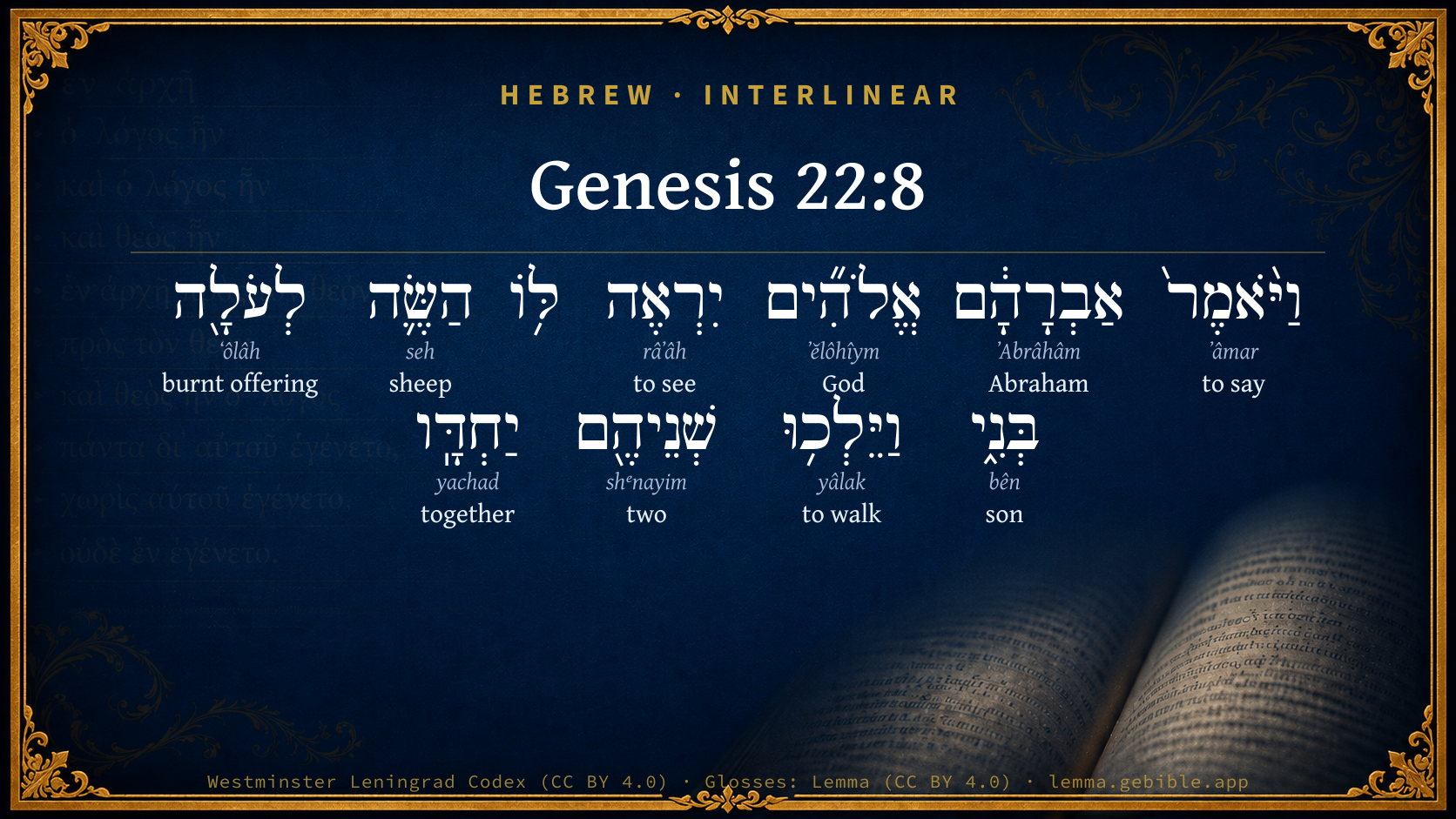
  1. וַיֹּ֨אמֶר֙ ʼâmar H559 “and · to say” Conjunction + Verb, Qal, Sequential Imperfect, 3rd Person, Masculine, Singular
  2. אַבְרָהָ֔ם ʼAbrâhâm H85 “Abraham” Noun, Proper
  3. אֱלֹהִ֞ים ʼĕlôhîym H430 “God(s)” Noun, Common, Masculine, Plural, Absolute
  4. יִרְאֶה râʼâh H7200 “to see” Verb, Qal, Imperfect, 3rd Person, Masculine, Singular
  5. לְעֹלָ֖ה ʻôlâh H5930 “to/for · burnt offering” Preposition + Noun, Common, Feminine, Singular, Absolute
  6. בְּנִ֑י bên H1121 “son · my” Noun, Common, Masculine, Singular, Construct + Suffix, Personal, 1st Person, Common, Singular
  7. וַיֵּלְכ֥וּ yâlak H3212 “and · to walk” Conjunction + Verb, Qal, Sequential Imperfect, 3rd Person, Masculine, Plural
  8. שְׁנֵיהֶ֖ם shᵉnayim H8147 “two · their” Adjective, Cardinal number, Masculine, Dual, Construct + Suffix, Personal, 3rd Person, Masculine, Plural
  9. יַחְדָּֽו yachad H3162 “together” Adverb

About this verse

These counts appear in no published source. They are computed here, from the morphology-tagged text and Lemma’s own curated glosses. What Lemma adds →

11
words
10
distinct lemmas
Pentateuch
section

Shared distinctive vocabulary

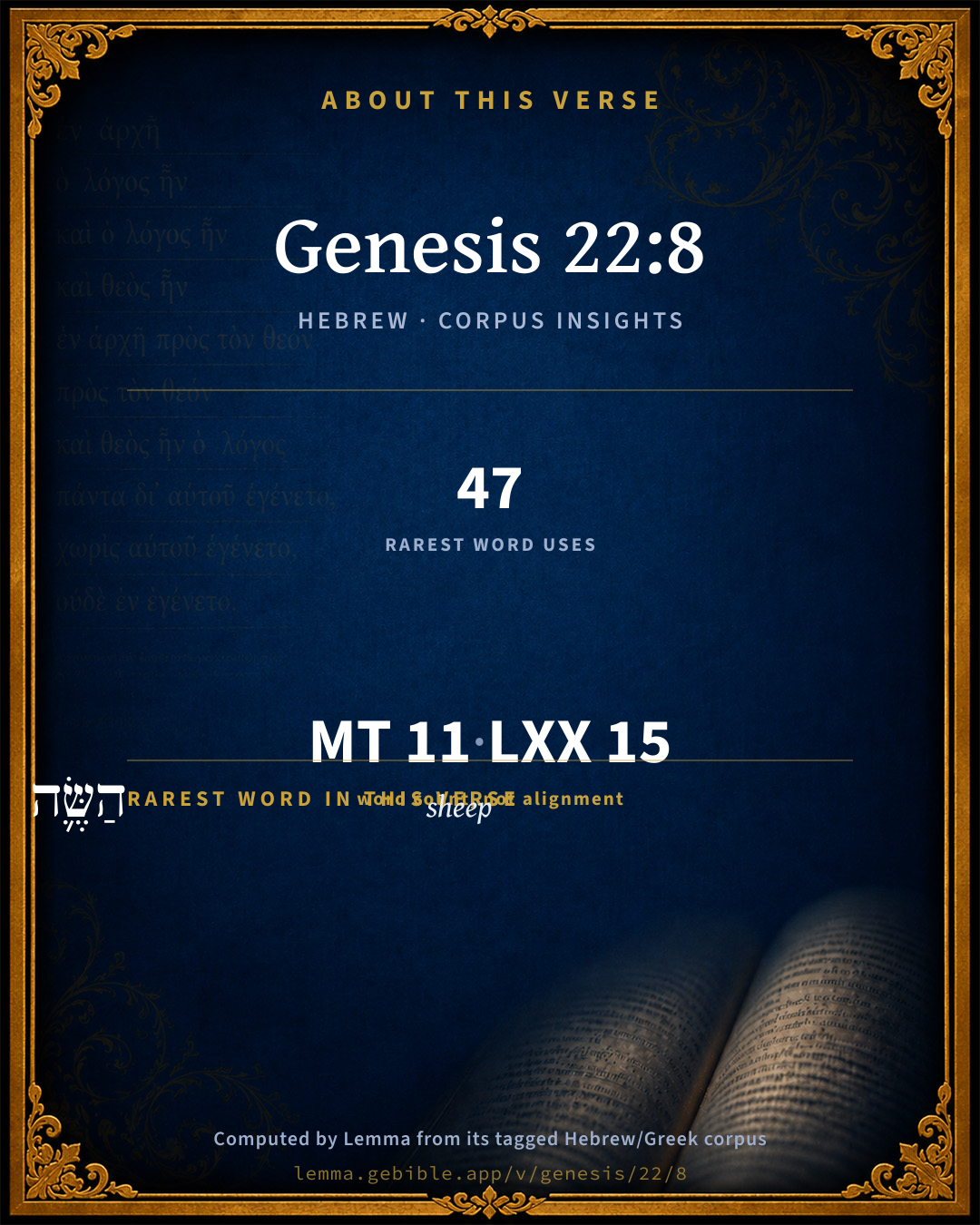
הַשֶּׂ֛ה sheep H7716 occurs in 39 verses of the Hebrew Bible. Also found in:

Grammatical profile

  • 3 verbs
  • 5 nouns
  • 1 adjective
  • 1 preposition
  • 1 adverb

Verb forms

  • וַיֹּ֨אמֶר֙ Qal · Sequential Imperfect
  • יִרְאֶה Qal · Imperfect
  • וַיֵּלְכ֥וּ Qal · Sequential Imperfect

Hebrew & Septuagint length

In English translation the verse runs 19 words from the Hebrew and 21 from the Septuagint (LXX English) — closely comparable.

A rough comparison of the two English renderings, which tokenize alike — not a word-level alignment.

Word counts can differ between the Hebrew and the Greek without any difference in meaning — e.g. the Hebrew direct-object marker אֵת has no separate Greek word, and Greek often adds the article ὁ.

In the original languages it is 11 Hebrew tokens and 15 Greek tokens — but the two are counted differently (Hebrew bundles its prefixes and suffixes into one token; the Greek is in lemma form), so that isn’t a like-for-like length.

Cross-references

10

Topical passages linked to Genesis 22:8 in the Treasury of Scripture Knowledge — connected by theme and wording, ordered by reader-vote popularity; previews shown in the World English Bible.

  • John 1:36 and he looked at Jesus as he walked, and said, "Behold, the Lamb of God!"
  • John 1:29 The next day, he saw Jesus coming to him, and said, "Behold, the Lamb of God, who takes away the sin of the world!
  • Revelation 5:12 saying with a loud voice, "Worthy is the Lamb who has been killed to receive the power, wealth, wisdom, strength, honor, glory, and blessing!"
  • Revelation 13:8 All who dwell on the earth will worship him, everyone whose name has not been written from the foundation of the world in the book of life of the Lamb who has been killed.
  • Genesis 18:14 Is anything too hard for Yahweh? At the set time I will return to you, when the season comes round, and Sarah will have a son."
  • Matthew 19:26 Looking at them, Jesus said, "With men this is impossible, but with God all things are possible."
  • Revelation 7:14 I told him, "My lord, you know." He said to me, "These are those who came out of the great tribulation. They washed their robes, and made them white in the Lamb's blood.
  • 1 Peter 1:19–20 but with precious blood, as of a lamb without spot, the blood of Christ;
  • 2 Chronicles 25:9 Amaziah said to the man of God, But what shall we do for the hundred talents which I have given to the army of Israel? The man of God answered, Yahweh is able to give you much more than this.
  • Revelation 5:6 I saw in the midst of the throne and of the four living creatures, and in the midst of the elders, a Lamb standing, as though it had been slain, having seven horns, and seven eyes, which are the seven Spirits of God, sent out into all the earth.

Cross-references courtesy of OpenBible.info (CC BY 4.0).

Hebrew and Greek witnesses Masoretic Hebrew ↔ Greek Septuagint

The same verse in the two great witnesses to the Old Testament, shown verse-for-verse.

These are two independent witnesses, not word-aligned to each other, and the Septuagint is shown in lemma (dictionary) form.

Hebrew Genesis 22:8 Masoretic · Westminster Leningrad Codex

וַיֹּ֨אמֶר֙ אַבְרָהָ֔ם אֱלֹהִ֞ים יִרְאֶה לּ֥וֹ הַשֶּׂ֛ה לְעֹלָ֖ה בְּנִ֑י וַיֵּלְכ֥וּ שְׁנֵיהֶ֖ם יַחְדָּֽו

Abraham said, "God will provide himself the lamb for a burnt offering, my son." So they both went together.

World English Bible · Public Domain

Greek LXX Genesis 22:8 Septuagint · lemma form

εἶπον δέ αβρααμ ὁ θεός ὁράω ἑαυτοῦ πρόβατον εἰς ὁλοκάρπωσις τέκνον πορεύομαι δέ ἀμφότεροι ἅμα

And Abraam said, God will provide himself a sheep for a whole burnt offering, my son. And both having gone together,

LXX2012 (modern English Septuagint) · Public Domain

Hebrew: Westminster Leningrad Codex (CC BY 4.0). Greek: Septuagint (public domain); English from LXX2012 (modern English Septuagint) (Public Domain). How the Septuagint differs from the Hebrew →

Targum (Aramaic paraphrase)

2

The Targum is the ancient Jewish Aramaic paraphrase of the Hebrew Scriptures — an interpretive translation, not the Hebrew text itself. Onkelos (literal) and Pseudo-Jonathan (expansive) render the Torah, and Jonathan the Prophets. Coverage is partial: where no permissively-licensed English translation exists for a verse, only the Aramaic is shown. This is verse-level text, not a word-by-word alignment to the Hebrew.

  1. Targum Onkelos Torah (Genesis–Deuteronomy)
    וַאֲמַר אַבְרָהָם קֳדָם יְיָ גְּלֵי לֵהּ אִימְרָא לַעֲלָתָא בְּרִי וַאֲזָלוּ תַרְוֵיהוֹן כַּחֲדָא

    (no public-domain English translation for this verse)

    Targum Onkelos — Aramaic: “Onkelos Genesis” (public domain); “Onkelos Exodus” (public domain); “Onkelos Leviticus” (public domain); “Onkelos Numbers” (public domain); “Onkelos Deuteronomy” (public domain). English: “Sefaria Community Translation” (CC0 1.0 (public-domain dedication)); “J.W. Etheridge. The Targums of Onkelos and Jonathan Ben Uzziel on the Pentateuch. London: Longmans, Green, 1862” (public domain). Text via Sefaria.

  2. Targum Pseudo-Jonathan Torah (Genesis–Deuteronomy)
    וַאֲמַר אַבְרָהָם יְיָ יִבְחַר לֵיהּ אִמְרָא לְעָלָתָא וַאֲזָלוּ תַּרְוֵיהוֹן בְּלֵב שְׁלִים כַּחֲדָא

    And Abraham said, The Lord will choose for Himself a lamb for the offering. And they went both of them in heart entirely as one.

    Targum Pseudo-Jonathan — Aramaic: “Targum Jonathan on Genesis” (public domain); “Targum Jonathan on Exodus” (public domain); “Targum Jonathan on Leviticus” (public domain); “Targum Jonathan on Numbers” (public domain); “Targum Jonathan on Deuteronomy” (public domain). English: “The Targum of Jonathan ben Uzziel, trans. J. W. Etheridge, London, 1862” (public domain). Text via Sefaria.

Commentary

Notes on Genesis 22:8 from classic Christian and Jewish commentators (each source and its license shown beneath its notes). The classic Christian expositions comment on the surrounding passage and are grouped to its opening verse, so a note may address several verses; the Jewish commentaries on the Tanakh (Rashi and others) are per-verse, so they appear only where the commentator wrote on this verse.

Lemma curates 59 commentaries, every one of them public domain or Creative Commons licensed, each selected and text-cleaned for this edition rather than reprinted as found. About our sources →

Trapp's Complete Commentary

John Trapp

Gen 22:8 And Abraham said, My son, God will provide himself a lamb for a burnt offering: so they went both of them together.

Ver. 8. God will provide himself a lamb.] A pious and precious proverb; {a} much to be mused on, and made use of, when we are in an exigent, and see not whither to turn us. Then say, Deus viderit . God will with the temptation also give an issue. {1Co 10:13} Necesse est adesse divinum, ubi humanum cessat auxilium , saith Philo. Sciat etiam Celsitudo vestra , saith Luther in a letter to the Prince Elector of Saxony; {b} I would your Highness should well know that businesses are far otherwise carried and concluded in heaven than at the Diet at Noringberg, &c. And to Philip Melancthon he writes thus: Si nos ruemus, ruet Christus una, ille regnator mundi: et esto ruat, &c. Sed scribo haec frustra, quia tu secundum philosophiam vestram, has res ratione rogere, hoc est, ut ait ille, cum ratione insanire pergis, et occidis teipsum; nec vides prorsus extra manum tuam et consilium positam esse causam, etiam extra curam tuam velle agi. {c}

{a} Qui finxit alas papilioni, is curabit omnia .

{b} Scultet. Ann.

{c} Idem.

John Trapp, A Commentary or Exposition upon All the Books of the Old and New Testament (1647–1656) — public domain. Text from a community e-Sword module.

The Biblical Illustrator

Joseph S. Exell

Gen_22:8

God will provide Himself a lamb

Gods provision of a lamb in Christ

This incident shows us in what lies the value of that sacrifice, and with what feelings we should regard it.

I. THE SACRIFICE WHICH GOD APPROVES MUST RE OF HIS OWN APPOINTING.

II. THE SACRIFICE WHICH GOD HAS PROVIDED IS SUPREMELY WORTHY OF ACCEPTANCE, AND GRACIOUSLY SUITED TO OUR CONDITION.

1. It has reconciled us to God.

2. It has procured the forgiveness of sins.

3. It opens the way to endless bliss.

III. THE ACCEPTANCE OF THE SACRIFICE GOD HAS PROVIDED IS THE TURNING POINT OF A MANS SPIRITUAL HISTORY.

1. It includes all the rest--repentance, faith, love, obedience.

2. It gives efficiency to all the rest.

3. It is the true test of spiritual character.

Abrahams answer to his sons question

I. THERE IS THE IDEA OF SUBSTITUTION. This is the pivotal fact in the scheme of redemption.

II. THIS WAS AN ACT OF DIVINE SOVEREIGNTY,

III. THE FUNDAMENTAL DEFECT IN THE RELIGION OF NATURE. It affords no lamb to complete the sacrifice.

IV. THE IMMINENCE OF ISAACS PERIL SUGGESTS THE DANGER IN WHICH UNGODLY SINNERS CONSTANTLY LIVE.

V. MUCH MIGHT BE SAID OF ISAACS FAITH IN THIS TRANSACTION--his weakness, his submission to parental authority, &c.

VI. HERE IS THE FIRE GODS UNAPPEASED JUSTICE; AND HERE IS THE WOOD: YOUR UNHOLY MEAT AND LIFE; BUT WHERE IS THE LAMB? God demands worship. A sacrifice He will have; but, with those two factors, justice and sin, no acceptable offering can be made. Bring the Lamb of God to the altar of worship, or expect yourself to be immolated on that altar, a victim of His offended justice and His broken law! (E. O. Frierson, D. D.)

The Biblical Illustrator, edited by Joseph S. Exell (c. 1880s–1900s) — public domain. Text from a community e-Sword module.

Joseph Benson's Commentary

Gen 22:8. My son, God will provide himself a lamb — This was the language either, 1st, Of his obedience; we must offer the lamb which God has appointed now to be offered; thus giving Isaac this general rule of submission to the divine will, to prepare him for the application of it to himself: or, 2d, Of his faith; whether he intended them so or not, the meaning of his words proved to be that a sacrifice was provided instead of Isaac. Thus, 1st, Christ, the great sacrifice of atonement, was of God’s providing: when none in heaven or earth could have found a lamb for that burnt-offering, God himself found the ransom. 2d, All our “sacrifices of acknowledgment” are of God’s providing too; it is he that “prepares the heart.” The broken and contrite spirit is a sacrifice of God, of his providing.

Joseph Benson's Commentary on the Old and New Testaments (1811–1818) — public domain. Text from a community e-Sword module.

Geneva Bible (1599)

Geneva Bible translators

The only way to overcome all tentation, is to rest upon God’s providence.

Geneva Bible (1599) marginal notes — public domain. Text via Bolls.life.

Adam Clarke's Commentary

Verse 8. My son, God will provide himself a lamb] Here we find the same obedient unshaken faith for which this pattern of practical piety was ever remarkable. But we must not suppose that this was the language merely of faith and obedience; the patriarch spoke prophetically, and referred to that Lamb of God which HE had provided for himself, who in the fulness of time should take away the sin of the world, and of whom Isaac was a most expressive type. All the other lambs which had been offered from the foundation of the world had been such as MEN chose and MEN offered; but THIS was the Lamb which GOD had provided - emphatically, THE LAMB OF GOD.

Adam Clarke's Commentary on the Bible (1810–1826) — public domain. Text from a community e-Sword/MySword module.

John Calvin's Commentaries

8. So they went both of them together. Here we perceive both the constancy of Abraham, and the modesty of his son. For Abraham is not rendered more remiss by this obstacle and the son does not persist in replying to his father’s answer. For he might easily have objected, Wherefore have we brought wood and the knife without a lamb, if God has commanded sacrifices to be made to him? But because he supposes that the victim has been omitted, for some valid reason, and not through his father’s forgetfulness, he acquiesces, and is silent.

John Calvin's Commentaries (1540-1563) — public domain. Text from the Calvin Translation Society English edition (1840s-50s) via the Christian Classics Ethereal Library (ccel.org). Calvin's coverage is partial (roughly two-thirds of the Bible); uncommented books and verses are honest gaps, never fabricated. The 19th-century editor's footnotes and remarks are omitted so the notes are faithfully Calvin's own voice.

The Cambridge Bible for Schools and Colleges

gen. ed. J. J. S. Perowne

8. provide himself] Heb. see for himself, cf. Gen_41:33. Abraham’s words express his self-control and his faith, and have a reference to Gen_22:14. The provision by God of a lamb for a burnt-offering lies at the root of the interpretation of the present passage in its typical application to the Sacrifice of Christ. Cf. the mention of the Lamb in Joh_1:29; Joh_1:36; 1Pe_1:19; Rev_5:12. The present passage is the first Lesson for the morning of Good Friday.

so they went … together] In the brief words of this simple and moving description is compressed a world of intense feeling. Cf. a similar phrase in 2Ki_2:6; 2Ki_2:8.

The Cambridge Bible for Schools and Colleges (gen. ed. J. J. S. Perowne; Cambridge University Press, 1878–1918) — public domain. Text from a community e-Sword module.

John Gill's Exposition

And Abraham said, my son, God will provide himself a lamb for a burnt offering,.... In which answer Abraham may have respect to the Messiah, the Lamb of God, Joh 1:29, whom he had provided in council and covenant before the world was; and who in promise, and type, and figure, was slain from the foundation of the world, Rev 13:8; and whom in due time God would send into the world, Joh 10:36, and make him an offering for sin, Isa 53:10, and accept of him in the room and stead of his people: and this was a provision that could only be made by the Lord, and was the produce of his infinite wisdom, and the fruit of his grace, favour, and good will and of which Abraham had a clear sight and strong persuasion, see Joh 8:56; though as the words may be considered as a more direct answer to Isaac's question, which related to the sacrifice now about to be offered, they may be regarded as a prophecy of Abraham's, and of his faith in it, that God would, as in fact he did, provide a lamb or ram in the room of that he was called to offer; or he may mean Isaac himself, whom he was bid to take and offer, and so was a lamb of God's providing; though he did not choose directly to say this, but puts him off with such an answer, suggesting that it was best for him to leave it with God, who, as he had called them to such service, would supply them with a proper sacrifice; and in speaking in this manner he might give room for Isaac to suspect what was intended, and so by degrees bring him to the knowledge of it. Some Jewish writers (e) say, that Abraham to this answer added in express terms,"my son, thou art the lamb:"

so they went both of them together; they proceeded on in their journey until they came to the place they were directed to go. The Targum of Jonathan says,"they went both of them with a perfect heart as one;''the Jerusalem Targum is,"with a quiet, easy, and composed mind or heart;''and Jarchi,"with a like heart;''all intimating that Isaac was thoroughly acquainted with what was to be done, that he was to be the sacrifice, and that he heartily agreed to it, and that he and his father were of one mind in it, and that he went with the same will to be offered up, as his father did to offer him; and indeed the expression being repeated from Gen 22:6, seems to suggest something remarkable and worthy of attention.

(e) Pirke Eliezer, ut supra. (c. 31.)

John Gill's Exposition of the Whole Bible (1746–1763) — public domain (CC PDM 1.0). Text via the HelloAO Bible API.

Matthew Poole's English Annotations

God will provide himself a lamb; either,

1. Literally, though I know not how; for his wisdom and power are infinite: or,

2. Mystically, as Christ, whose type Isaac was, is called a Lamb. Thus Abraham prudently reveals the matter to him by degrees, not all at once.

Matthew Poole's English Annotations on the Holy Bible (1683–1685) — public domain. Text from a community e-Sword/MySword module.

Whedon's Commentary on the Bible

Daniel D. Whedon

8. God will provide — Hebrews, Elohim-jireh, God will see. See on Gen_22:14.

Daniel D. Whedon (gen. ed.), Commentary on the Old and New Testaments (1874–1909) — public domain. Text from a community e-Sword module.

The Pulpit Commentary

And Abraham said, My son, God will provide himself a lamb for a burnt offering: the utterance of heroic faith rather than the language of pious dissimulation (vide on Ver. 5)so they went both of them together. To see in this twice-repeated expression a type of the concurrence of the Father and the Son in the work of redemption (Wordsworth) is not exegesis.

The Pulpit Commentary (1880–1919), ed. H.D.M. Spence-Jones & Joseph S. Exell — public domain. Text from a community e-Sword module.

John Wesley's Explanatory Notes

My son, God will provide himself a lamb - This was the language either,

1. Of his obedience; we must offer the lamb which God has appointed now to be offered; thus giving him this general rule of submission to the divine will to prepare him for the application of it to himself. Or,

2. Of his faith; whether he meant it so or no, this proved to be the meaning of it; a sacrifice was provided instead of Isaac. Thus,

1. Christ the great sacrifice of atonement was of God's providing: when none in heaven or earth could have found a lamb for that burnt-offering, God himself found the ransom.

2. All our sacrifices of acknowledgement are of God's providing too; 'tis he that prepares the heart. The broken and contrite spirit is a sacrifice of God, of his providing.

John Wesley, Explanatory Notes Upon the Whole Bible (1754–1765) — public domain. Text via the GEBible commentary corpus.

Rashi

Rabbi Shlomo Yitzchaki (Rashi)

יראה לו השה — this means as much as: He will look out for and choose a lamb for Himself, and if there will be no lamb for a burnt offering, then, בני MY SON will be the offering. Although Isaac then understood that he was travelling on to be slain, yet.

וילכו שניהם יחדיו THEY WENT BOTH OF THEM TOGETHER — with the same ready heart (Genesis Rabbah 56:4).

Rashi on the Tanakh — English translations: “The Judaica Press complete Tanach with Rashi, translated by A. J. Rosenberg” (CC BY 4.0); “Pentateuch with Rashi's commentary by M. Rosenbaum and A.M. Silbermann, 1929-1934” (public domain); “The Metsudah Tanach series, Lakewood, N.J” (CC BY 4.0); and “The Book of Joshua, Metsudah Publications, 1997” (CC BY 4.0). Text via Sefaria.

Radak

Rabbi David Kimhi (Radak)

ויאמר...אלוקים יראה לו השה לעולה בני, Avraham’s reply to his son is capable of two interpretations. One interpretation would be that the word בני is a response to Yitzchok’s cry or question, meaning “I am here my son; G’d will select the lamb for the burnt offering.” In other words: “don’t worry G’d already knows who is going to be the lamb for the offering. He will put it at our disposal.” The second interpretation of Avraham’s answer would arrange the words as follows: “G’d will select the lamb for the offering; who is the lamb? It is my son.” Yitzchok understood from this that he had been chosen to be the offering. This is why the Torah continues, significantly: וילכו שניהם יחד, “they continued walking together,” i.e. of one mind and of one spirit.

Radak on the Tanakh — English translations: “Sefaria Community Translation” (CC0 1.0 (public-domain dedication)); “Eliyahu Munk, HaChut Hameshulash” (CC BY 4.0); “Rabbi Mike Feuer, Jerusalem Anthology” (CC BY 4.0); and “R. David Kimhi on the first book of Psalms, Translated by R.G. Finch, London, 1919” (public domain). Text via Sefaria.

Lesson kit

Teaching starters — assembled from the data on this page, not authored interpretation. Every prompt links to the verse data it draws on. Edit before teaching.

Genesis, in the Pentateuch, opens this verse with 11 words (10 distinct Hebrew lemmas). Its most distinctive word is seh (“sheep”). A historical commentator’s framing appears above. Read the whole chapter for the surrounding context.

Discussion questions

  1. The word seh carries the sense “sheep.” How does it shape the verse?
  2. Genesis 22:7 shares the word «sheep» with this verse. How do the two illuminate each other?
  3. The translations on this page render this verse differently — a whole-verse word diff, not a word-by-word alignment. What might account for the different wordings?
  4. The verb «וַיֹּ֨אמֶר֙» is Qal Sequential Imperfect. How does its form color the action?
  5. Reading how Trapp's Complete Commentary and The Biblical Illustrator read this verse, where do the two commentators agree and where do they part?

Things to notice

Reading settings

Reading text

Shown beneath each verse's original-language words.

Old Testament
Old Testament edition

Read the OT as the Masoretic Hebrew (MT) or the Greek Septuagint (LXX).

English shown for the Greek Septuagint (in the Hebrew ↔ Greek comparison).

Comparing translations? Open the Compare panel on any verse page to stack up to four side by side.