
Leviticus 22:28

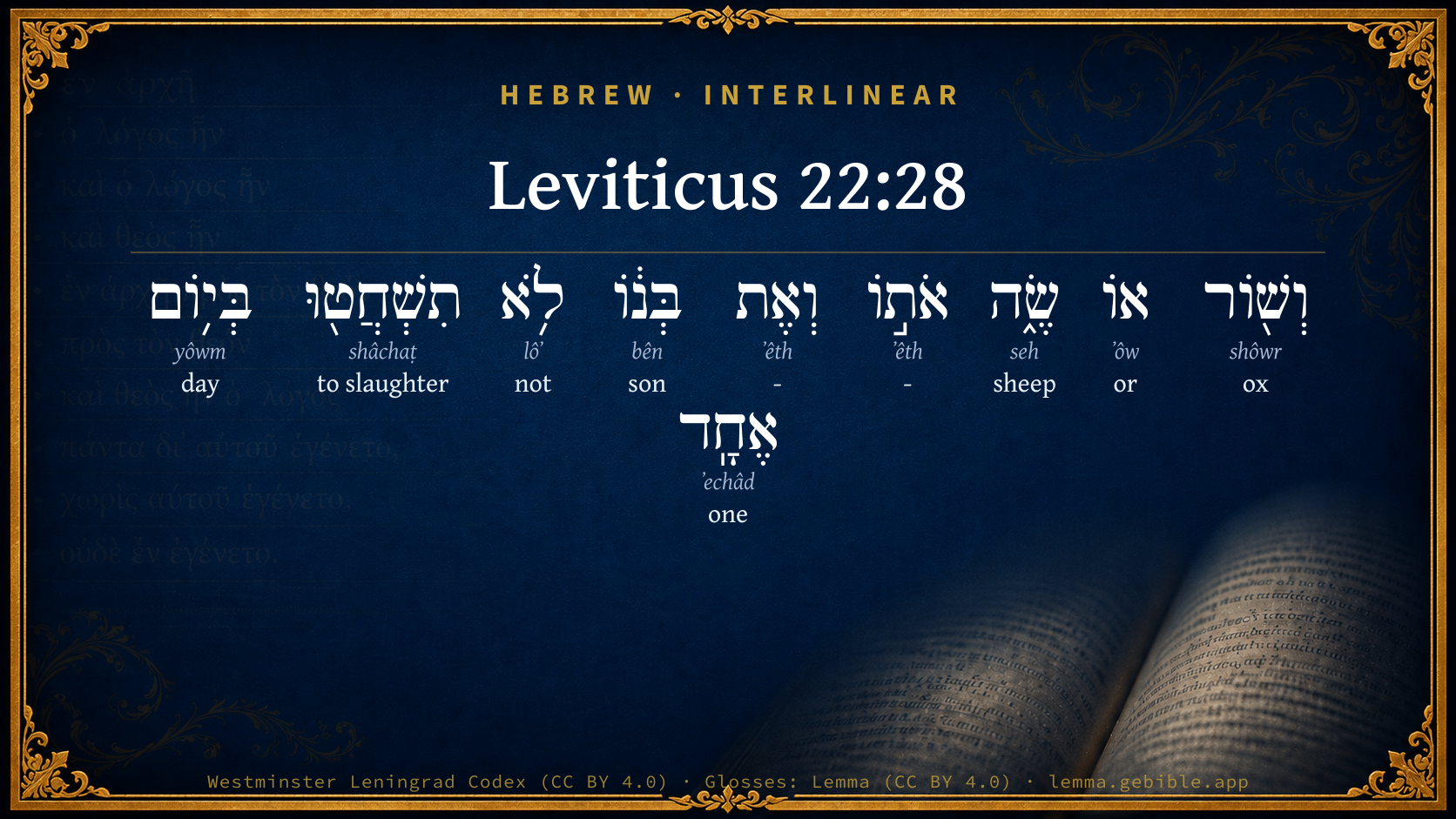
Hebrew (Westminster Leningrad Codex) Leviticus 22:28 appears in the Hebrew Old Testament. The text above is from the Westminster Leningrad Codex. Each word links to its Strong’s number, a concise gloss, and parsing drawn from the Open Scriptures Hebrew Bible morphology. Click any word for its full Brown-Driver-Briggs (BDB) entry.
Download image
Cite this verse

Leviticus 22:28 (World English Bible). Public Domain. Lemma interlinear Bible study tool, https://lemma.gebible.app/v/leviticus/22/28.

Show BibTeX & RIS
BibTeX
RIS
English Translation
Whether it is a cow or ewe, you shall not kill it and its young both in one day.
World English Bible · Public Domain
Download a study sheet

One document with this verse’s original text, its word-by-word gloss line, the meaning frame, cross-references with their text, attributed commentary, and full source and license credits — printable, and it pastes into notes with its structure intact.

This verse Autodidact and up

Study sheet (.html) Plain text (.txt)

A passage Seminary Student

Up to 50 verses in one chapter. A passage sheet keeps up to 6 commentary sources and 12 cross-references per verse, in the order this page ranks them, and says so on the sheet whenever that leaves anything out. Ask for a single verse and you get the Autodidact verse sheet above.

Everything on this page stays free to read, with no account — the sheet is a download of what is already on screen, not access to it.

Want to remove ads? Support Godless Engineer
Compare translations 3

The same verse in 3 English versions, stacked beneath the original-language interlinear above. Click any original word for its lexicon entry.

Each is an independent rendering of the whole verse — the interlinear is not word-aligned to these translations.

Highlighted words mark where these versions differ — a whole-verse word diff, not a word-by-word alignment.

  • World English Bible Public Domain
    Whether it is a cow or ewe, you shall not kill it and its young both in one day.
  • King James Version Public Domain
    And whether it be cow, or ewe, ye shall not kill it and her young both in one day.
  • unfoldingWord Literal Text CC BY-SA 4.0
    But an ox or a flock, it and its son you shall not slaughter on one day.

unfoldingWord Literal Text — © unfoldingWord, licensed CC BY-SA 4.0. Word-aligned USFM3 via Door43 (git.door43.org/unfoldingWord/en_ult).

Versions to compare (up to 4)

3 of 4 selected

Show all 18 translations

Every available English version of this verse, each an independent rendering of the whole verse.

  • World English Bible Public Domain
    Whether it is a cow or ewe, you shall not kill it and its young both in one day.
  • Berean Standard Bible Public Domain
    But you must not slaughter an ox or a sheep on the same day as its young.
  • Majority Standard Bible Public Domain
    But you must not slaughter an ox or a sheep on the same day as its young.
  • King James Version Public Domain
    And whether it be cow, or ewe, ye shall not kill it and her young both in one day.
  • American Standard Version (1901) Public Domain
    And whether it be cow or ewe, ye shall not kill it and its young both in one day.
  • Revised Version (1885) Public Domain
    And whether it be cow or ewe, ye shall not kill it and her young both in one day.
  • Geneva Bible (1599) Public Domain
    As for the cowe or the ewe, yee shall not kill her, and her yong both in one day.
  • Douay-Rheims (1899) Public Domain
    Whether it be a cow, or a sheep, they shall not be sacrificed the same day with their young ones.
  • Young's Literal Translation Public Domain
    but an ox or sheep -- it and its young one, ye do not slaughter in one day.
  • Literal Standard Version CC BY-SA 4.0
    but an ox or sheep—you do not slaughter it and its young one in one day.
  • Unlocked Literal Bible CC BY-SA 4.0
    Do not kill a cow or ewe along with its young, both on the same day.
  • unfoldingWord Literal Text CC BY-SA 4.0
    But an ox or a flock, it and its son you shall not slaughter on one day.
  • Darby Bible Public Domain
    A cow, or sheep -- it and its young shall ye not slaughter in one day.
  • World Messianic Bible Public Domain
    Whether it is a cow or ewe, you shall not kill it and its young both in one day.
  • Webster's Bible Public Domain
    And whether it is cow, or ewe, ye shall not kill it and her young both in one day.
  • Free Bible Version CC BY-SA 4.0
    However, don't kill a bull or a sheep and its young on the same day.
  • Bible in Basic English Public Domain
    A cow or a sheep may not be put to death with its young on the same day.
  • JPS Tanakh (1917) Public Domain
    And whether it be cow or ewe, ye shall not kill it and its young both in one day.

Literal Standard Version (2020), Covenant Press — licensed CC BY-SA 4.0. Text via the HelloAO Bible API (eBible.org). Unlocked Literal Bible (unfoldingWord) — licensed CC BY-SA 4.0. Text via the HelloAO Bible API (eBible.org). unfoldingWord Literal Text — © unfoldingWord, licensed CC BY-SA 4.0. Word-aligned USFM3 via Door43 (git.door43.org/unfoldingWord/en_ult). Free Bible Version, Dr. Jonathan Gallagher — licensed CC BY-SA 4.0. Text via the HelloAO Bible API (eBible.org).

Word by word

More ways to search: Search by grammar → Find every occurrence → Compare this word →

Practice this passage: Drill this verse → Learn its vocabulary →

About this verse

These counts appear in no published source. They are computed here, from the morphology-tagged text and Lemma’s own curated glosses. What Lemma adds →

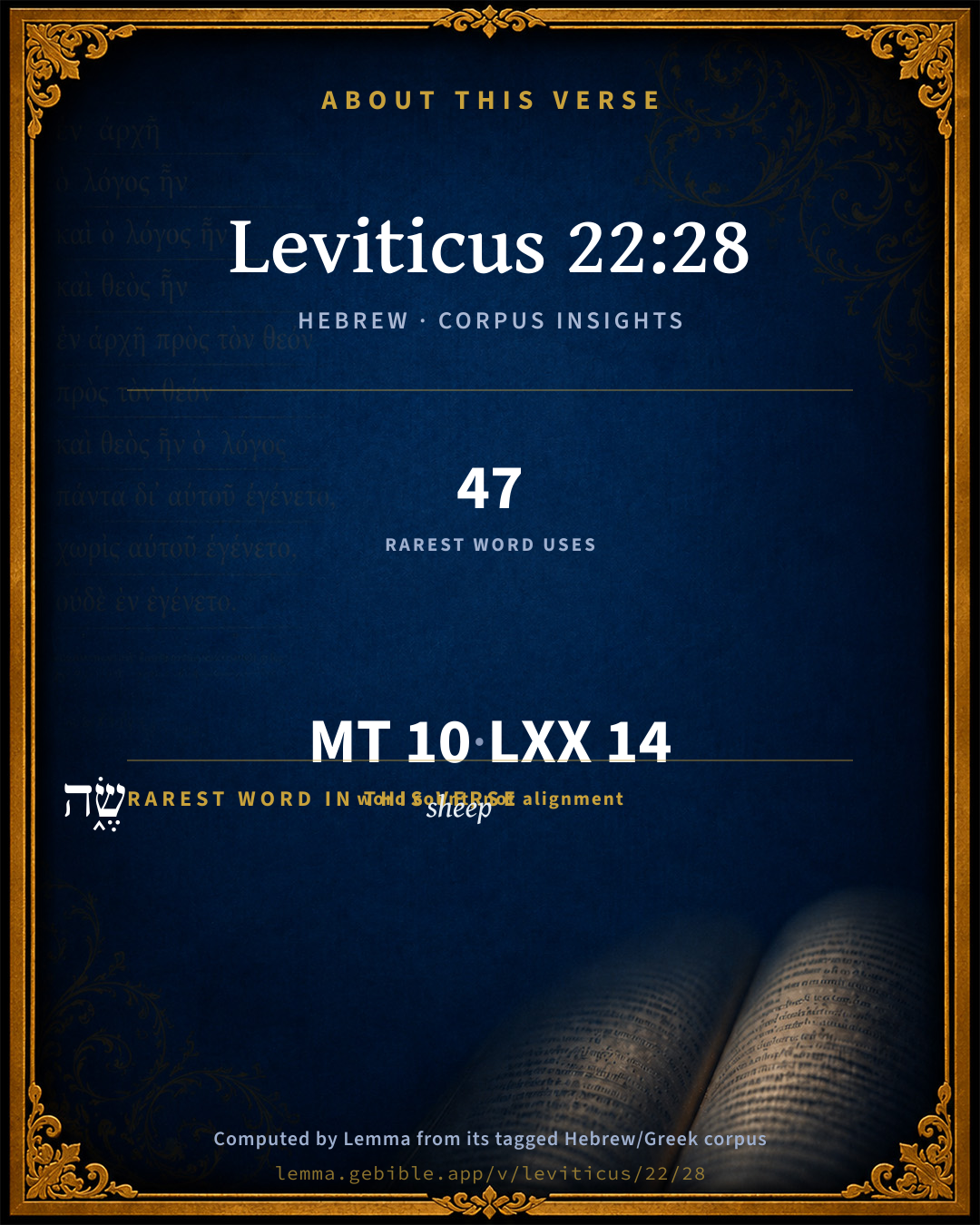
10
words
9
distinct lemmas
Pentateuch
section

Shared distinctive vocabulary

שֶׂ֑ה sheep H7716 occurs in 39 verses of the Hebrew Bible. Also found in:

Grammatical profile

  • 1 verb
  • 4 nouns
  • 1 adjective
  • 1 conjunction
  • 3 particles

Verb forms

  • תִשְׁחֲט֖וּ Qal · Imperfect

Hebrew & Septuagint length

In English translation the verse runs 19 words from the Hebrew and 17 from the Septuagint (LXX English) — closely comparable.

A rough comparison of the two English renderings, which tokenize alike — not a word-level alignment.

Word counts can differ between the Hebrew and the Greek without any difference in meaning — e.g. the Hebrew direct-object marker אֵת has no separate Greek word, and Greek often adds the article ὁ.

In the original languages it is 10 Hebrew tokens and 14 Greek tokens — but the two are counted differently (Hebrew bundles its prefixes and suffixes into one token; the Greek is in lemma form), so that isn’t a like-for-like length.

Cross-references

4

Topical passages linked to Leviticus 22:28 in the Treasury of Scripture Knowledge — connected by theme and wording, ordered by reader-vote popularity; previews shown in the World English Bible.

  • Deuteronomy 22:6–7 If a bird's nest chance to be before you in the way, in any tree or on the ground, with young ones or eggs, and the hen sitting on the young, or on the eggs, you shall not take the hen with the young:
  • Deuteronomy 14:21 You shall not eat of anything that dies of itself: you may give it to the foreigner living among you who is within your gates, that he may eat it; or you may sell it to a foreigner: for you are a holy people to Yahweh your God. You shall not boil a kid in its mother's milk.
  • Exodus 23:19 The first of the first fruits of your ground you shall bring into the house of Yahweh your God. "You shall not boil a kid in its mother's milk.
  • Exodus 34:26 You shall bring the first of the first fruits of your ground to the house of Yahweh your God. You shall not boil a young goat in its mother's milk."

Cross-references courtesy of OpenBible.info (CC BY 4.0).

Hebrew and Greek witnesses Masoretic Hebrew ↔ Greek Septuagint

The same verse in the two great witnesses to the Old Testament, shown verse-for-verse.

These are two independent witnesses, not word-aligned to each other, and the Septuagint is shown in lemma (dictionary) form.

Hebrew Leviticus 22:28 Masoretic · Westminster Leningrad Codex

וְשׁ֖וֹר אוֹ שֶׂ֑ה אֹת֣וֹ וְאֶת בְּנ֔וֹ לֹ֥א תִשְׁחֲט֖וּ בְּי֥וֹם אֶחָֽד

Whether it is a cow or ewe, you shall not kill it and its young both in one day.

World English Bible · Public Domain

Greek LXX Leviticus 22:28 Septuagint · lemma form

καί μόσχος ἤ πρόβατον αὐτός καί ὁ παιδίον αὐτός οὐ σφάζω ἐν ἡμέρα εἷς

And a bullock and a ewe, it and its young, you shall not kill in one day.

LXX2012 (modern English Septuagint) · Public Domain

Hebrew: Westminster Leningrad Codex (CC BY 4.0). Greek: Septuagint (public domain); English from LXX2012 (modern English Septuagint) (Public Domain). How the Septuagint differs from the Hebrew →

Targum (Aramaic paraphrase)

2

The Targum is the ancient Jewish Aramaic paraphrase of the Hebrew Scriptures — an interpretive translation, not the Hebrew text itself. Onkelos (literal) and Pseudo-Jonathan (expansive) render the Torah, and Jonathan the Prophets. Coverage is partial: where no permissively-licensed English translation exists for a verse, only the Aramaic is shown. This is verse-level text, not a word-by-word alignment to the Hebrew.

  1. Targum Onkelos Torah (Genesis–Deuteronomy)
    וְתוֹרְתָּא אוֹ שֵׂיתָא לֵהּ וְלִבְרֵהּ לָא תִכְּסוּן בְּיוֹמָא חָד

    (no public-domain English translation for this verse)

    Targum Onkelos — Aramaic: “Onkelos Genesis” (public domain); “Onkelos Exodus” (public domain); “Onkelos Leviticus” (public domain); “Onkelos Numbers” (public domain); “Onkelos Deuteronomy” (public domain). English: “Sefaria Community Translation” (CC0 1.0 (public-domain dedication)); “J.W. Etheridge. The Targums of Onkelos and Jonathan Ben Uzziel on the Pentateuch. London: Longmans, Green, 1862” (public domain). Text via Sefaria.

  2. Targum Pseudo-Jonathan Torah (Genesis–Deuteronomy)
    עַמִי בְּנֵי יִשְרָאֵל הֵיכְמָא דְאָבוּנָן רַחֲמָן בִּשְׁמַיָא כֵּן תֶּהֱוֹן רַחֲמָנִין בְּאַרְעָא תּוֹרָתָא אוֹ רְחֵילָא יָתָהּ וְיַת בְּרָהּ לָא תִיכְסוּן בְּיוֹמָא חָד

    Sons of Israel, my people, as our Father in heaven is merciful, so shall you be merciful on earth: neither cow, nor ewe, shall you sacrifice along with her young on the same day.

    Targum Pseudo-Jonathan — Aramaic: “Targum Jonathan on Genesis” (public domain); “Targum Jonathan on Exodus” (public domain); “Targum Jonathan on Leviticus” (public domain); “Targum Jonathan on Numbers” (public domain); “Targum Jonathan on Deuteronomy” (public domain). English: “The Targum of Jonathan ben Uzziel, trans. J. W. Etheridge, London, 1862” (public domain). Text via Sefaria.

Commentary

Notes on Leviticus 22:28 from classic Christian and Jewish commentators (each source and its license shown beneath its notes). The classic Christian expositions comment on the surrounding passage and are grouped to its opening verse, so a note may address several verses; the Jewish commentaries on the Tanakh (Rashi and others) are per-verse, so they appear only where the commentator wrote on this verse.

Lemma curates 59 commentaries, every one of them public domain or Creative Commons licensed, each selected and text-cleaned for this edition rather than reprinted as found. About our sources →

Trapp's Complete Commentary

John Trapp

Lev 22:28 And [whether it be] cow or ewe, ye shall not kill it and her young both in one day.

Ver. 28. Ye shall not kill it and her young.] Because it bears a show of cruelty, and of adding affliction to the afflicted. See Gen 32:11 Hos 10:14.

John Trapp, A Commentary or Exposition upon All the Books of the Old and New Testament (1647–1656) — public domain. Text from a community e-Sword module.

Joseph Benson's Commentary

Lev 22:28. The cow or ewe, and her young, in one day — This Maimonides considers as a precaution of humanity, lest the dam should be brought to the altar while she is yet mourning the loss of her young, slain perhaps before her eyes. And, indeed, there is a degree of cruelty in the very idea of imbruing the hand in the blood of both parent and offspring at the same time. Therefore Jonathan, in his paraphrase, considers this as a symbolical precept, to teach the Israelites to be merciful, as their Father in heaven is merciful.

Joseph Benson's Commentary on the Old and New Testaments (1811–1818) — public domain. Text from a community e-Sword module.

Tyndale Open Study Notes

Tyndale Open Resources

22:28 on the same day: There are several possible explanations for this command, although none is certain: (1) Senseless slaughtering would leave nothing of the herd; (2) it would be inhumane to slaughter the young and the mother at the same time; or (3) it would be too similar to pagan worship rites, where the newborn animal was cooked in the milk of its slain mother (see Exod 23:19).

Tyndale Open Study Notes — © Tyndale Open Resources, licensed CC BY-SA 4.0. Text via the HelloAO Bible API.

Adam Clarke's Commentary

Verse 28. Ye shall not kill it and her young in one day] This precept was certainly intended to inculcate mercy and tenderness of heart; and so the Jews understood it. When it is necessary to take away the lives of innocent animals for the support of our own, we should do it in such a way as not to blunt our moral feelings; and deplore the necessity, while we feel an express gratitude to God for permission, to do it.

Adam Clarke's Commentary on the Bible (1810–1826) — public domain. Text from a community e-Sword/MySword module.

Ellicott's Commentary for English Readers

(28) Not kill it and her young both in one day.—According to the ancient canons, this prohibition to slaughter the dam and its youngling the same day was not only designed to remind the Israelites of the sacred relations which exist between parent and offspring, but was especially intended to keep up feelings of humanity. Hence the ancient Chaldee version begins this injunction with the words, “My people the children of Israel, as our Father is merciful in heaven, so be ye merciful on earth.”

A Bible Commentary for English Readers, edited by Charles John Ellicott (1878–1897) — public domain. Text from a community e-Sword module.

The Cambridge Bible for Schools and Colleges

gen. ed. J. J. S. Perowne

28. Cp. Deu_22:6.

The Cambridge Bible for Schools and Colleges (gen. ed. J. J. S. Perowne; Cambridge University Press, 1878–1918) — public domain. Text from a community e-Sword module.

John Gill's Exposition

And when ye will offer a sacrifice of thanksgiving unto the Lord,.... Which was a sort of peace offering, distinct from freewill offerings and vows before spoken of:

offer it at your own will; just what they pleased, whether a bullock, a sheep, or a goat, and whether a male or female; these were left to their own option, or for acceptation to you, as the Targum of Jonathan, and so Jarchi; that is, it was right in them, and they ought to be careful to offer it in such manner, that it might be acceptable to God, by observing the rules given concerning it, particularly what follows.

John Gill's Exposition of the Whole Bible (1746–1763) — public domain (CC PDM 1.0). Text via the HelloAO Bible API.

Albert Barnes' Notes on the Bible

A law intended to remind the Israelites of the sacredness of the relation between the parent and its offspring. Compare Exo 23:19 note.

Albert Barnes' Notes on the Bible (1834–1885) — public domain. Text from a community e-Sword/MySword module.

Matthew Poole's English Annotations

Because it savoured of cruelty. See Poole Deu 22:6.

Matthew Poole's English Annotations on the Holy Bible (1683–1685) — public domain. Text from a community e-Sword/MySword module.

Whedon's Commentary on the Bible

Daniel D. Whedon

28. In one day — This prohibition regards both the natural affection of the brute and the tender sentiments of man’s better nature. It is akin to that command which forbids “to seethe a kid in his mother’s milk.” The principle has higher applications.

Daniel D. Whedon (gen. ed.), Commentary on the Old and New Testaments (1874–1909) — public domain. Text from a community e-Sword module.

The Pulpit Commentary

A lesson of charity is added. A young animal and its mother are not to be killed (though reference is specially made to sacrifice, the general word, not the sacrificial term, for slaying is used) on the same day, just as the kid is not to be seethed in its mother"s milk, (Exo_23:19 Deu_14:21) nor the mother bird be taken from the nest with the young. (Deu_22:6) Thus we see that the feelings of the human heart arc not to be rudely shocked by an act of apparent cruelty, even when no harm is thereby done to the object of that act. Mercy is to be taught by forbidding anything which may blunt the sentiment of mercy in the human heart.

Vers. 27, 28. The culture of kindness.

The words of the text remind us, by contrast, of two truths which are of value to us as disciples of Christ.

1. That the human spirit is never too young to be offered to God, whether

a. in parental devotion or

b. in self-dedication (verse 27).

2. That two generations of the same family may offer themselves simultaneously to the service of God. Parent and child have not unfrequently made profession, in the same hour, of attachment to Christ, and have simultaneously "given themselves unto the Lord." But the main lesson to be learnt is the culture of kindness. This was the end of the Divine precept. There would be an apparent ruthlessness in taking away the young immediately from its dam, and also in slaying mother and offspring together on the same day. Therefore these acts must be avoided. Everything should be done to foster kindness of heart, considerateness of feeling, as well as justice, purity, righteousness of life. The culture of kindness is an act of piety. It is well to consider

I THE TWO SPHERES IN WHICH IT SHOULD BE EXHIBITED.

1. The human world: the home; the social circle; mankind at large.

2. The animal world. Everything that has life has feeling, and has a claim on our considerateness. We may add to its pleasure or may multiply its pain; may prolong or shorten life.

II THE TWO MOTIVES BY WHICH WE SHOULD BE ACTUATED.

1. The inherent; excellency of kindness. Unkindness is a shameful, shocking, deteriorating thing; kindness is intrinsically beautiful, admirable.

2. The will of God. These his laws (and see Deu_22:6 Deu_25:4) are an indication of his will; and we may be sure it is the will of him who creates and sustains sentient life that his human children should be kind to the dumb creatures of his thought and skill.

III THE TWO SOURCES OF CULTIVATION.

1. That of our own minds. We must impress on ourselves that it is no less a tyrannical and cruel thing to use our great power to oppress the feeble creatures at our feet than it would be for others of vastly superior size and strength to our own to oppress and injure us. We must remind ourselves of those obvious considerations which will foster kind feelings and. restrain from hurtful actions.

2. That of those who teach us. The parents and teachers of youth who do not inculcate kindness toward the feeble, whether of the animal or the human world, sadly neglect their duty to their charge. Young people may grow up ignorant of languages or sciences, and they may yet be admirable and useful men and women; but those who have not learnt to hate cruelly and to admire kindness will have a blot on their character which no attainments will hide. C.

The Pulpit Commentary (1880–1919), ed. H.D.M. Spence-Jones & Joseph S. Exell — public domain. Text from a community e-Sword module.

John Wesley's Explanatory Notes

In one day - Because it favoured of cruelty.

John Wesley, Explanatory Notes Upon the Whole Bible (1754–1765) — public domain. Text via the GEBible commentary corpus.

Keil & Delitzsch

C. F. Keil & F. Delitzsch

The command not to kill an ox or sheep at the same time as its young is related to the law in Exo 23:19 and Deu 22:6-7, and was intended to lay it down as a duty on the part of the Israelites to keep sacred the relation which God had established between parent and offspring. - In Lev 22:29, Lev 22:30, the command to eat the flesh of the animal on the day on which it was offered (Lev 7:15; Lev 19:5-6) is repeated with special reference to the praise-offering.

Keil & Delitzsch — Biblical Commentary on the Old Testament (1861–1891) — public domain (CC PDM 1.0). Text via the HelloAO Bible API. (Old Testament only.)

unfoldingWord translationNotes

Door43 World Missions Community

It must be eaten

This can be stated in active form. AT: "You must eat it" (See: Active or Passive)

that it is sacrificed

This can be stated in active form. AT: "that you sacrificed it" (See: Active or Passive)

translationWords

cow

ewe

sacrifice

Yahweh

unfoldingWord translationNotes — © Distant Shores Media and the Door43 World Missions Community, licensed CC BY-SA 4.0. Source: git.door43.org/Door43/en_tn.

Rashi

Rabbi Shlomo Yitzchaki (Rashi)

אתו ואת בנו [AND WHETHER IT BE AN OX OR A SHEEP YE SHALL NOT SLAUGHTER] IT AND ITS YOUNG [BOTH IN ONE DAY] — This law applies only to the female parent, although Scripture uses the masculine term אתו — that it is forbidden to slaughter the dam and its male or female young in one day, but it does not apply to the male parent, and it is permissible to slaughter the father animal and its young whether male or female in one day (Chullin 78b; cf. also Onkelos).

אתו ואת בנו IT AND ITS YOUNG — The prohibition of slaughtering the young first and then it (the dam) in one day is also implied (Chullin 82a).

Rashi on the Tanakh — English translations: “The Judaica Press complete Tanach with Rashi, translated by A. J. Rosenberg” (CC BY 4.0); “Pentateuch with Rashi's commentary by M. Rosenbaum and A.M. Silbermann, 1929-1934” (public domain); “The Metsudah Tanach series, Lakewood, N.J” (CC BY 4.0); and “The Book of Joshua, Metsudah Publications, 1997” (CC BY 4.0). Text via Sefaria.

Ramban (Nachmanides)

Rabbi Moshe ben Nachman (Ramban / Nachmanides)

AND WHETHER IT BE OF THE HERD OR FLOCK, ‘OTHO V’ETH B’NO’ (IT AND ITS YOUNG) YE SHALL NOT SLAUGHTER IN ONE DAY. “[The law] applies only in the case of the female parent, it being forbidden to slaughter the dam and its male young, or the dam and its female young, but it does not apply to the male parent, and it is therefore permissible to slaughter the male parent and his young.” This is Rashi’s language.The Rabbi [Rashi] thus decided that the conclusive decision of the law is in accordance with the opinion of the Sage who says that we do not take into consideration the male parentage [of animals]. And such also is the opinion of Onkelos [who translated: “and whether it be the dam or the ewe, her and her young ye shall not slaughter in one day”]. This is the correct decision [reached] in the Gemara [of Tractate Chullin] concerning the law of “It and its young.” But the way of Scripture when mentioning specifically the female [of the herd], is to call it parah (cow), and if so it would have been proper that Scripture say, “and whether it be parah (cow) or ewe, her and her young.” But since He had mentioned [at the beginning of this section], When any of the herd, or a sheep or a goat is brought forth, and He mentioned the dam and its young by saying, then it shall be seven days under its dam, He therefore states [in the verse before us] that concerning these kinds of animals mentioned, namely, the herd and the flock, there is yet another commandment that it and its young mentioned above, must not be slaughtered in one day [and thus it is self-evident that the law applies only to the female parent].

Ramban (Nachmanides) on the Tanakh — English translation: “Commentary on the Torah by Ramban (Nachmanides). Translated and annotated by Charles B. Chavel. New York, Shilo Pub. House, 1971-1976” (CC BY 4.0). Text via Sefaria.

Lesson kit

Teaching starters — assembled from the data on this page, not authored interpretation. Every prompt links to the verse data it draws on. Edit before teaching.

Leviticus, in the Pentateuch, opens this verse with 10 words (9 distinct Hebrew lemmas). Its most distinctive word is seh (“sheep”). A historical commentator’s framing appears above. Read the whole chapter for the surrounding context.

Discussion questions

  1. The word seh carries the sense “sheep.” How does it shape the verse?
  2. Genesis 22:7 shares the word «sheep» with this verse. How do the two illuminate each other?
  3. These translations render this verse differently; the difference is in the English rendering, not the original. What questions does that raise?
  4. The verb «תִשְׁחֲט֖וּ» is Qal Imperfect. How does its form color the action?
  5. Reading how Trapp's Complete Commentary and Joseph Benson's Commentary read this verse, where do the two commentators agree and where do they part?

Things to notice

Reading settings

Reading text

Shown beneath each verse's original-language words.

Old Testament
Old Testament edition

Read the OT as the Masoretic Hebrew (MT) or the Greek Septuagint (LXX).

English shown for the Greek Septuagint (in the Hebrew ↔ Greek comparison).

Comparing translations? Open the Compare panel on any verse page to stack up to four side by side.