1 Chronicles 2:18

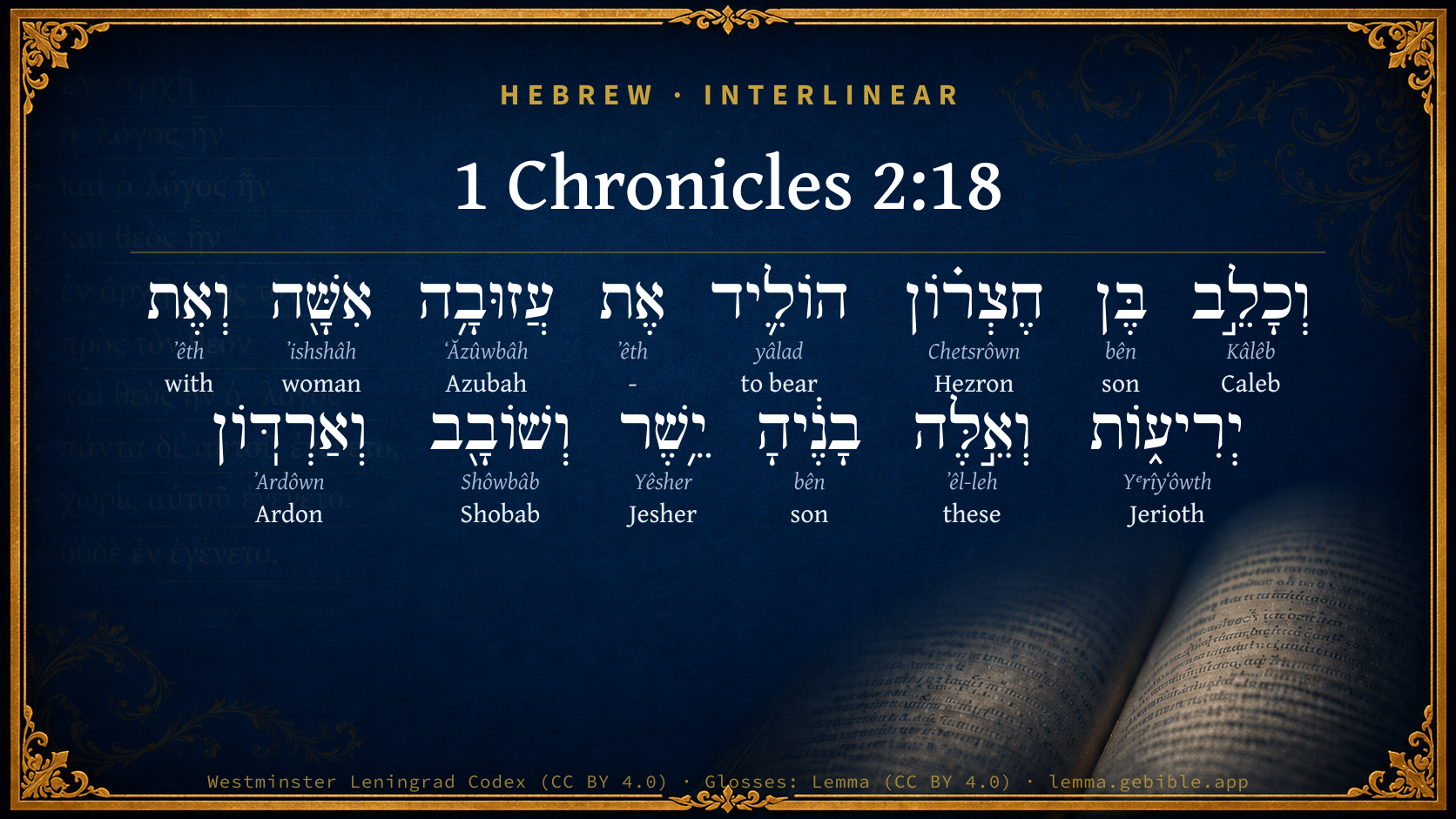
Hebrew (Westminster Leningrad Codex) 1 Chronicles 2:18 appears in the Hebrew Old Testament. The text above is from the Westminster Leningrad Codex. Each word links to its Strong’s number, a concise gloss, and parsing drawn from the Open Scriptures Hebrew Bible morphology. Click any word for its full Brown-Driver-Briggs (BDB) entry.
Download image
Cite this verse

1 Chronicles 2:18 (World English Bible). Public Domain. Lemma interlinear Bible study tool, https://lemma.gebible.app/v/1-chronicles/2/18.

Show BibTeX & RIS
BibTeX
RIS
English Translation
Caleb the son of Hezron became the father of [children] of Azubah [his] wife, and of Jerioth; and these were her sons: Jesher, and Shobab, and Ardon.
World English Bible · Public Domain
Highlights
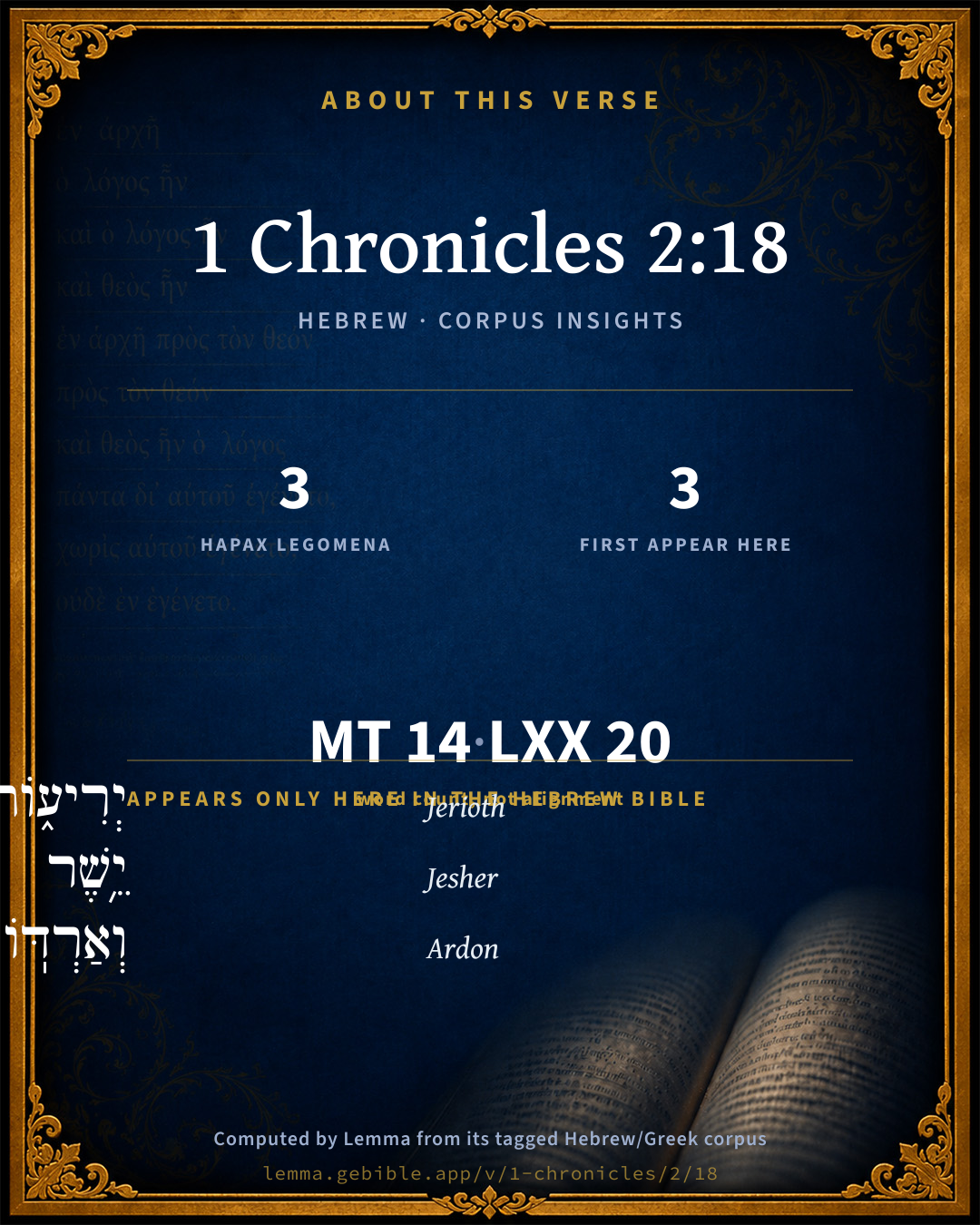
  • 3 hapax legomena — only here in the Hebrew Bible
  • 3 first appearances in the Hebrew Bible
Full analysis ↓
Download a study sheet

One document with this verse’s original text, its word-by-word gloss line, the meaning frame, cross-references with their text, attributed commentary, and full source and license credits — printable, and it pastes into notes with its structure intact.

This verse Autodidact and up

Study sheet (.html) Plain text (.txt)

A passage Seminary Student

Up to 50 verses in one chapter. A passage sheet keeps up to 6 commentary sources and 12 cross-references per verse, in the order this page ranks them, and says so on the sheet whenever that leaves anything out. Ask for a single verse and you get the Autodidact verse sheet above.

Everything on this page stays free to read, with no account — the sheet is a download of what is already on screen, not access to it.

Want to remove ads? Support Godless Engineer
Compare translations 3

The same verse in 3 English versions, stacked beneath the original-language interlinear above. Click any original word for its lexicon entry.

Each is an independent rendering of the whole verse — the interlinear is not word-aligned to these translations.

Highlighted words mark where these versions differ — a whole-verse word diff, not a word-by-word alignment.

  • World English Bible Public Domain
    Caleb the son of Hezron became the father of [children] of Azubah [his] wife, and of Jerioth; and these were her sons: Jesher, and Shobab, and Ardon.
  • King James Version Public Domain
    And Caleb the son of Hezron begat children of Azubah his wife, and of Jerioth: her sons are these; Jesher, and Shobab, and Ardon.
  • unfoldingWord Literal Text CC BY-SA 4.0
    And Caleb, the son of Hezron, fathered with Azubah, a wife, and with Jerioth. And these her sons: Jesher and Shobab and Ardon.

unfoldingWord Literal Text — © unfoldingWord, licensed CC BY-SA 4.0. Word-aligned USFM3 via Door43 (git.door43.org/unfoldingWord/en_ult).

Versions to compare (up to 4)

3 of 4 selected

Show all 18 translations

Every available English version of this verse, each an independent rendering of the whole verse.

  • World English Bible Public Domain
    Caleb the son of Hezron became the father of [children] of Azubah [his] wife, and of Jerioth; and these were her sons: Jesher, and Shobab, and Ardon.
  • Berean Standard Bible Public Domain
    Caleb son of Hezron had children by his wife Azubah and by Jerioth. These were the sons of Azubah: Jesher, Shobab, and Ardon.
  • Majority Standard Bible Public Domain
    Caleb son of Hezron had children by his wife Azubah and by Jerioth. These were the sons of Azubah: Jesher, Shobab, and Ardon.
  • King James Version Public Domain
    And Caleb the son of Hezron begat children of Azubah his wife, and of Jerioth: her sons are these; Jesher, and Shobab, and Ardon.
  • American Standard Version (1901) Public Domain
    And Caleb the son of Hezron begat `children' of Azubah `his' wife, and of Jerioth; and these were her sons: Jesher, and Shobab, and Ardon.
  • Revised Version (1885) Public Domain
    And Caleb the son of Hezron begat children of Azubah his wife, and of Jerioth: and these were her sons; Jesher, and Shobab, and Ardon.
  • Geneva Bible (1599) Public Domain
    And Caleb the sonne of Hezron begate Ierioth of Azubah his wife, and her sonnes are these, Iesher, and Shobab, and Ardon.
  • Douay-Rheims (1899) Public Domain
    And Caleb the son of Hesron took a wife named Azuba, of whom he had Jerioth: and her sons were Jaser, and Sobab, and Ardon.
  • Young's Literal Translation Public Domain
    And Caleb son of Hezron hath begotten Azubah, Isshah, and Jerioth; and these `are' her sons: Jesher, and Shobab, and Ardon.
  • Literal Standard Version CC BY-SA 4.0
    And Caleb son of Hezron has begotten Azubah, Isshah, and Jerioth; and these [are] her sons: Jesher, and Shobab, and Ardon.
  • Unlocked Literal Bible CC BY-SA 4.0
    Caleb son of Hezron became the father of children by Azubah, his wife, and by Jerioth. His sons were Jesher, Shobab, and Ardon.
  • unfoldingWord Literal Text CC BY-SA 4.0
    And Caleb, the son of Hezron, fathered with Azubah, a wife, and with Jerioth. And these her sons: Jesher and Shobab and Ardon.
  • Darby Bible Public Domain
    And Caleb the son of Hezron had children by Azubah [his] wife, and by Jerioth: her sons are these: Jesher, and Shobab, and Ardon.
  • World Messianic Bible Public Domain
    Caleb the son of Hezron became the father of children by Azubah his wife, and by Jerioth; and these were her sons: Jesher, Shobab, and Ardon.
  • Webster's Bible Public Domain
    And Caleb the son of Hezron begat children of Azubah his wife, and of Jerioth: her sons are these; Jesher, and Shobab, and Ardon.
  • Free Bible Version CC BY-SA 4.0
    Caleb son of Hezron had children by his wife Azubah, and also by Jerioth. These were her sons: Jesher, Shobab, and Ardon.
  • Bible in Basic English Public Domain
    And Caleb, the son of Hezron, had children by Azubah his wife, the daughter of Jerioth; and these were her sons: Jesher and Shobab and Ardon.
  • JPS Tanakh (1917) Public Domain
    And Caleb the son of Hezron begot children of Azubah his wife — and of Jerioth — and these were her sons: Jesher, and Shobab, and Ardon.

Literal Standard Version (2020), Covenant Press — licensed CC BY-SA 4.0. Text via the HelloAO Bible API (eBible.org). Unlocked Literal Bible (unfoldingWord) — licensed CC BY-SA 4.0. Text via the HelloAO Bible API (eBible.org). unfoldingWord Literal Text — © unfoldingWord, licensed CC BY-SA 4.0. Word-aligned USFM3 via Door43 (git.door43.org/unfoldingWord/en_ult). Free Bible Version, Dr. Jonathan Gallagher — licensed CC BY-SA 4.0. Text via the HelloAO Bible API (eBible.org).

Word by word

More ways to search: Search by grammar → Find every occurrence → Compare this word →

Practice this passage: Drill this verse → Learn its vocabulary →

יְרִיע֑וֹת
Yᵉrîyʻôwth
H3408
“Jerioth”
Noun, Proper
Part of Speech
Noun
Type
Proper
Full BDB Definition

Origin: plural of H3407

TWOT: None

Jerioth = "curtains" - the wife or concubine of Caleb, the son of Hezron of the descendants of Judah
  1. וְכָלֵ֣ב Kâlêb H3612 “and · Caleb” Conjunction + Noun, Proper
  2. בֶּן bên H1121 “son of” Noun, Common, Masculine, Singular, Construct
  3. חֶצְר֗וֹן Chetsrôwn H2696 “Hezron” Noun, Proper
  4. הוֹלִ֛יד yâlad H3205 “to bear” Verb, Hiphil, Perfect, 3rd Person, Masculine, Singular
  5. אֶת ʼêth H853 “-” Particle, Direct Object
  6. עֲזוּבָ֥ה ʻĂzûwbâh H5806 “Azubah” Noun, Proper
  7. אִשָּׁ֖ה ʼishshâh H802 “woman” Noun, Common, Feminine, Singular, Absolute
  8. וְאֶת ʼêth H854 “and · with” Conjunction + Preposition
  9. וְאֵ֣לֶּה ʼêl-leh H428 “and · these” Conjunction + Pronoun, Demonstrative, Common, Plural
  10. בָנֶ֔יהָ bên H1121 “sons · her” Noun, Common, Masculine, Plural, Construct + Suffix, Personal, 3rd Person, Feminine, Singular
  11. יֵ֥שֶׁר Yêsher H3475 “Jesher” Noun, Proper
  12. וְשׁוֹבָ֖ב Shôwbâb H7727 “and · Shobab” Conjunction + Noun, Proper
  13. וְאַרְדּֽוֹן ʼArdôwn H715 “and · Ardon” Conjunction + Noun, Proper

About this verse

These counts appear in no published source. They are computed here, from the morphology-tagged text and Lemma’s own curated glosses. What Lemma adds →

14
words
13
distinct lemmas
Historical
section

Notable vocabulary

3 hapax legomena — words that appear only here in the entire Hebrew Bible:

  • יְרִיע֑וֹת Jerioth H3408
  • יֵ֥שֶׁר Jesher H3475
  • וְאַרְדּֽוֹן Ardon H715

First appearance in Scripture

These words make their first canonical appearance in the Hebrew Bible here:

  • יְרִיע֑וֹת Jerioth H3408
  • יֵ֥שֶׁר Jesher H3475
  • וְאַרְדּֽוֹן Ardon H715

Shared distinctive vocabulary

עֲזוּבָ֥ה Azubah H5806 occurs in 4 verses of the Hebrew Bible. Also found in:

Grammatical profile

  • 1 verb
  • 10 nouns
  • 1 pronoun
  • 1 preposition
  • 1 particle

Verb forms

  • הוֹלִ֛יד Hiphil · Perfect

Repetition

A word recurs within this verse — often emphatic in Hebrew:

Hebrew & Septuagint length

In English translation the verse runs 27 words from the Hebrew and 22 from the Septuagint (LXX English) — closely comparable.

A rough comparison of the two English renderings, which tokenize alike — not a word-level alignment.

Word counts can differ between the Hebrew and the Greek without any difference in meaning — e.g. the Hebrew direct-object marker אֵת has no separate Greek word, and Greek often adds the article ὁ.

In the original languages it is 14 Hebrew tokens and 20 Greek tokens — but the two are counted differently (Hebrew bundles its prefixes and suffixes into one token; the Greek is in lemma form), so that isn’t a like-for-like length.

Hebrew and Greek witnesses Masoretic Hebrew ↔ Greek Septuagint

The same verse in the two great witnesses to the Old Testament, shown verse-for-verse.

These are two independent witnesses, not word-aligned to each other, and the Septuagint is shown in lemma (dictionary) form.

Hebrew 1 Chronicles 2:18 Masoretic · Westminster Leningrad Codex

וְכָלֵ֣ב בֶּן חֶצְר֗וֹן הוֹלִ֛יד אֶת עֲזוּבָ֥ה אִשָּׁ֖ה וְאֶת יְרִיע֑וֹת וְאֵ֣לֶּה בָנֶ֔יהָ יֵ֥שֶׁר וְשׁוֹבָ֖ב וְאַרְדּֽוֹן

Caleb the son of Hezron became the father of [children] of Azubah [his] wife, and of Jerioth; and these were her sons: Jesher, and Shobab, and Ardon.

World English Bible · Public Domain

Greek LXX 1 Chronicles 2:18 Septuagint · lemma form

καί χαλεβ υἱός εσερων γεννάω ὁ γαζουβα γυνή καί ὁ ιεριωθ καί οὗτος υἱός αὐτός ιωασαρ καί σωβαβ καί ορνα

And Chaleb the son of Esrom took Gazuba to wife, and Jerioth: and these were her sons; Jasar, and Subab, and Ardon.

LXX2012 (modern English Septuagint) · Public Domain

On this verse, Ellicott's Commentary for English Readers discusses the Septuagint’s reading. Read the note in Commentary ↓

Hebrew: Westminster Leningrad Codex (CC BY 4.0). Greek: Septuagint (public domain); English from LXX2012 (modern English Septuagint) (Public Domain). How the Septuagint differs from the Hebrew →

Commentary

Notes on 1 Chronicles 2:18 from classic Christian and Jewish commentators (each source and its license shown beneath its notes). The classic Christian expositions comment on the surrounding passage and are grouped to its opening verse, so a note may address several verses; the Jewish commentaries on the Tanakh (Rashi and others) are per-verse, so they appear only where the commentator wrote on this verse.

Lemma curates 59 commentaries, every one of them public domain or Creative Commons licensed, each selected and text-cleaned for this edition rather than reprinted as found. About our sources →

Jamieson, Fausset & Brown

Robert Jamieson, A. R. Fausset & David Brown

POSTERITY OF CALEB. (1Ch. 2:18-55)

Caleb the son of Hezron--The notices concerning this person appear confused in our version. In Ch1 2:19 he is said to be the father of Hur, whereas in Ch1 2:50 he is called "the son of Hur." The words in this latter passage have been transposed in the copying, and should be read thus, "Hur the son of Caleb."

begat children of Azubah his wife, and of Jerioth--The former was his spouse, while Jerioth seems to have been a secondary wife, and the mother of the children whose names are here given. On the death of his principal wife, he married Ephrath, and by her had Hur [Ch1 2:19].

Jamieson, Fausset & Brown — Commentary Critical and Explanatory on the Whole Bible (1871) — public domain (CC PDM 1.0). Text via the HelloAO Bible API.

Ellicott's Commentary for English Readers

(18) And Caleb the son of Hezron begat children of Azubah his wife.—The Heb. text, as it stands, does not say this. The primâ facie rendering is, “And Caleb son of Hezron begat Azubah a woman, and Jerioth: and these (are) her sons; Jesher, and Shobab, and Ardon.” But 1Ch_2:19 continues: “And Azubah died, and Caleb took to himself (as wife) Ephrath,” which of course suggests that Azubah was not daughter but a former wife of Caleb. 1Ch_2:18 has also been translated, “And Caleb son of Hezron caused Azubah a wife and Jerioth to bear children.” (Comp. Isa_66:9.) It seems best to read, “his wife, daughter of Jerioth (’ishtô -bath.Ierioth), instead of the text (ishshah ve’eth Ierioth); and to render: And Caleb son of Hezron begat sons with Azubah daughter of Jerioth” (eth, the particle before Azubah, is ambiguous, and might be either the mere sign of the accusative, or the prep. “with,” cum, μετὰ). The Syriac partly supports this version, for it reads: “And Caleb begat of Azubah, his wife, Jerioth,” making Jerioth Azubah’s daughter. The LXX. has, “And Caleb took Azubah a wife and Jerioth,” which only shows that the corruption of the text is ancient.

A Bible Commentary for English Readers, edited by Charles John Ellicott (1878–1897) — public domain. Text from a community e-Sword module.

Geneva Bible (1599)

Geneva Bible translators

Who was called Chelubai the son of Hezron, verse 9.

Geneva Bible (1599) marginal notes — public domain. Text via Bolls.life.

Matthew Henry's Commentary

The persons mentioned in the former paragraph are most of them such as we read of, and most of them such as we read much of, in other scriptures; but very few of those to whom this paragraph relates are mentioned any where else. It should seem, the tribe of Judah were more full and exact in their genealogies than any other of the tribes, in which we must acknowledge a special providence, for the clearing of the genealogy of Christ. 1. Here we find Bezaleel, who was head-workman in building the tabernacle, Exo 31:2. 2. Hezron, who was the son of Pharez (Ch1 2:5), was the father of all this progeny, his sons, Caleb and Jerahmeel, being very fruitful, and he himself likewise, even in his old age, for he left his wife pregnant when he died, Ch1 2:24. This Hezron was one of the seventy that went down with Jacob into Egypt, Gen 46:12. There his family thus increased, as other oppressed families there did. We cannot but suppose that he died during the Israelites' bondage in Egypt; and yet it is here said he died in Caleb-Ephratah (that is, Bethlehem), in the land of Canaan, Ch1 2:24. Perhaps, though the body of the people continued in Egypt, yet some that were more active than the rest, at least before their bondage came to be extreme, visited Canaan sometimes and got footing there, though afterwards they lost it. The achievements of Jair, here mentioned (Ch1 2:22, Ch1 2:23), we had an account of in Num 32:41; and, it is supposed, they were long after the conquest of Canaan. The Jews say, Hezron married his third wife when he was sixty years old (Ch1 2:21), and another afterwards (Ch1 2:24), because he had a great desire of posterity in the family of Pharez, from whom the Messiah was to descend. 3. Here is mention of one that died without children (Ch1 2:30), and another (Ch1 2:32), and of one that had no sons, but daughters, Ch1 2:34. Let those that are in any of these ways afflicted not think their case new or singular. Providence orders these affairs of families by an incontestable sovereignty, as pleaseth him, giving children, or withholding them, or giving all of one sex. He is not bound to please us, but we are bound to acquiesce in his good pleasure. To those that love him he will himself be better than ten sons, and give them in his house a place and a name better than of sons and daughters. Let not those therefore that are written childless envy the families that are built up and replenished. Shall our eye be evil because God's is good? 4. Here is mention of one who had an only daughter, and married her to his servant an Egyptian, Ch1 2:34, Ch1 2:35. If it be mentioned to his praise, we must suppose that this Egyptian was proselyted to the Jewish religion and that he was very eminent for wisdom and virtue, otherwise it would not have become a true-born Israelite to match a daughter to him, especially an only daughter. If Egyptians become converts, and servants do worthily, neither their parentage nor their servitude should be a bar to their preferment. Such a one this Egyptian servant might be that she who married him might live as happily with him as if she had married one of the rulers of her tribe. 5. The pedigree of several of these terminates, not in a person, but in a place or country, as one is said to be the father of Kirjath-jearim (Ch1 2:50), another of Bethlehem (Ch1 2:51), which was afterwards David's city, because these places fell to their lot in the division of the land. 6. here are some that are said to be families of scribes (Ch1 2:55), such as kept up learning in their family, especially scripture-learning, and taught the people the good knowledge of God. Among all these great families we are glad to find some that were families of scribes. Would to God that all the Lord's people were prophets - all the families of Israel families of scribes, well instructed to the kingdom of heaven, and able to bring out of their treasury things new and old!

Matthew Henry's Commentary on the Whole Bible (1708–1710) — public domain (CC PDM 1.0). Text via the HelloAO Bible API.

Adam Clarke's Commentary

Verse 18. Azubah] "And why was she called Azubah? Because she was barren and despised. But her injury was manifested before the Lord; and she was comforted, and adorned with wisdom; and she span, skilfully, goats' hair for the court of the tabernacle." - T.

Adam Clarke's Commentary on the Bible (1810–1826) — public domain. Text from a community e-Sword/MySword module.

The Cambridge Bible for Schools and Colleges

gen. ed. J. J. S. Perowne

18. begat children of Azubah his wife and of Jerioth] So R.V., but the Heb. seems to be corrupt. Probably we should read, took Azubah the wife of Jerioth. LXX. gives no help.

18–20. The Genealogy of Bezaleel

It is quite in accordance with the mind of the Chronicler to single out the artificer of the Tabernacle (“Tent of Meeting”) and tell his family history (cp. Exo_31:2 ff.).

The Cambridge Bible for Schools and Colleges (gen. ed. J. J. S. Perowne; Cambridge University Press, 1878–1918) — public domain. Text from a community e-Sword module.

John Gill's Exposition

And after that Hezron was dead in Calebephratah,.... Supposed to be the same with Bethlehem; and was so called, both from Caleb the son of Hezron, and Ephrath his wife, Ch1 2:19,

then Abiah, Hezron's wife, bare him Ashur the father of Tekoa; being left with child by him at his death; the whole verse is paraphrased thus in the Targum,"and after Hezron died in the house of Caleb his son in Ephrath, the wife of Hezron the daughter of Machir was left with child, and she bare to him after his death Ashur the prince of the Tekoites;''whose son gave name very probably to the city of Tekoa, Sa2 14:2.

John Gill's Exposition of the Whole Bible (1746–1763) — public domain (CC PDM 1.0). Text via the HelloAO Bible API.

Albert Barnes' Notes on the Bible

In the remainder of this chapter the writer obtains scarcely any assistance from the earlier Scriptures, and must have drawn almost entirely from genealogical sources, accessible to him, which have since perished.

Azubah was Caleb’s wife; Jerioth his concubine. He had children by both; but those of Azubah are alone recorded.

Albert Barnes' Notes on the Bible (1834–1885) — public domain. Text from a community e-Sword/MySword module.

Haydock's Catholic Bible Commentary

Caleb, alias Calubi, ver. 9. (Challoner) (Worthington) --- He is different from Caleb, the son of Jephone. --- Took, &c. Hebrew, "begot Azuba, Ischa, and Jerioth;" or rather with the Septuagint, "took to wife Gazuba and Jerioth." (Calmet) --- Syriac and Arabic, "Caleb had Jerioth by his wife Azuba." We know that the latter was his wife, (ver. 19.) and this seems to be the true reading. As ath signifies "of or from," (Noldius) the Hebrew only requires a small correction. As it stands at present, it means, "Caleb begot Azuba, a woman, (or wife) and Jerioth." Protestants supply, "begat children of Azuba, his wife, and of Jerioth." (Kennicott) --- Her sons. The original determines us to read her, instead of "his," as ejus would as naturally be understood. If Jerioth was not the wife, she seems to have been the daughter of Caleb; as Jaser, &c., were his sons. (Haydock)

George Leo Haydock (1774–1849), Haydock's Catholic Family Bible and Commentary, 1859 edition — public domain. Excludes Psalms (Douay-Rheims chapter numbering differs from Protestant) and Deuterocanonical books (Catholic canon only).

Matthew Poole's English Annotations

Not that Caleb, Num 13:6, for he was the son of Jephunneh, of whom he speaks, 1Ch 4:15; but another Caleb.

Her sons, i.e. the sons, either,

1. Of Jerioth, she being last mentioned; or rather,

2. Of Azubah, who is by way of distinction called his wife, when Jerioth probably was only his concubine, and, as it may seem, barren; and therefore upon Azubah’s death he married another wife, 1Ch 2:19. And those other sons of this Caleb, mentioned below, 1Ch 2:42, are his sons by some other wife distinct from all these.

Matthew Poole's English Annotations on the Holy Bible (1683–1685) — public domain. Text from a community e-Sword/MySword module.

The Pulpit Commentary

Vers. 18-20. (C) Chelubai. The descendants of Caleb (Chelubai), placed third of Hezron"s sons, are next dealt with; but the subject is almost immediately interrupted by resumed reference to Hezron (vers. 21-24), and by the table of Jemh-meel and his descendants (vers. 25-41); after which the table of Caleb, apparently the same Caleb, is carried on (vers. 42-49). Taking these broken portions, however, just as they come, we are immediately met by a series of uncertainties and surprises. Ver. 18 is obscure in that it says Caleb had children by Azubah (the Hebrew construction also unusual), a wife, or indeed strictly a woman (not even using the ordinary formula "his wife"), and by Jerioth, of whom nothing is said; and the verse adds obscurity by saying, her sons are these, without plainly indicating to which woman reference is made. It may be safely presumed, however, from what follows, that Azubah is intended, though no other part of Scripture helps us By so much as a mention of the sons" names to determine it certainly. Meantime one Hebrew manuscript and the Chaldee Paraphrase are found to omit the words "and by Jerioth." The Vulgate, and the Syriac and Arabic versions, make Jerioth one of the children possibly a daughter of Caleb and Azubah, and this view is supported by Kennicott and Houbigant (Barrington"s "Genealogies," 1:210). The tone of ver. 19 may certainly he held to offer some countenance to the assumption that either Jerioth"s name ought to appear as that of a child or not at all. The name Ephrath in this verse abounds with interest. The ancient name of the town of Bethlehem, and also apparently of a district round it, is the same word which is found here as the name of a woman. In either case it is more generally written htrpa, as even in the two other appearances of it in this very chapter. Two manuscripts, followed by two ancient editions, and apparently by the Vulgate, substitute aleph for the above final he. In Mic_5:1, Bethlehem is found united with Ephratah in one compound word. The mother Ephrath is here interesting for her descendants given, her son Hur , grandson Uri, and great-grandson Bezaleel. Further reference to these is made in ver. 50.

The Pulpit Commentary (1880–1919), ed. H.D.M. Spence-Jones & Joseph S. Exell — public domain. Text from a community e-Sword module.

John Wesley's Explanatory Notes

Her sons - The sons of Azubah, who is by way of distinction called his wife, when Jerioth probably was only his concubine, and, it may seem, barren: therefore upon Azubah's death he married another wife. And those other sons of this Caleb mentioned, ver. 42, are his sons by some other wife distinct from all these.

John Wesley, Explanatory Notes Upon the Whole Bible (1754–1765) — public domain. Text via the GEBible commentary corpus.

Keil & Delitzsch

C. F. Keil & F. Delitzsch

And after that Hezron was dead in Calebephratah,.... Supposed to be the same with Bethlehem; and was so called, both from Caleb the son of Hezron, and Ephrath his wife, Ch1 2:19,

then Abiah, Hezron's wife, bare him Ashur the father of Tekoa; being left with child by him at his death; the whole verse is paraphrased thus in the Targum,"and after Hezron died in the house of Caleb his son in Ephrath, the wife of Hezron the daughter of Machir was left with child, and she bare to him after his death Ashur the prince of the Tekoites;''whose son gave name very probably to the city of Tekoa, Sa2 14:2.

Keil & Delitzsch — Biblical Commentary on the Old Testament (1861–1891) — public domain (CC PDM 1.0). Text via the HelloAO Bible API. (Old Testament only.)

Kretzmann's Popular Commentary

Paul E. Kretzmann

The Genealogy of Caleb

v. 18. And Caleb, the son of Hezron, v. 9, begat children of Azubah, his wife, and of Jerioth, who seems to have been a secondary wife, whose children were reckoned as those of Azubah; her sons are these: Jesher, and Shobab, and Ardon.

v. 19. And when Azubah, his rightful spouse, was dead, Caleb took unto him Ephrath, which bare him Hur.

v. 20. And Hur begat Uri, and Uri begat Bezaleel.

v. 21. And afterward Hezron went in to the daughter of Machir, the father of Gilead, grandson of Joseph and chief of that city east of Jordan, with its adjacent territory, whom he married when he was threescore years old; and she bare him Segub.

v. 22. And Segub begat Jair, who had three and twenty cities in the land of Gilead, Num 32:41; Deu 3:14; Jos 13:30; 1Ki 4:13. On his father’s side Jair belonged to the tribe of Judah, but on the side of his mother he was rightly called a son of Manasseh.

v. 23. And he took Geshur and Aram, with the towns of Jair, from them, from the heathen inhabitants, Num 32:39-41, with Kenath and the towns thereof, even threescore cities. All these belonged to the sons of Machir, the father of Gilead, Deu 3:14; Jos 13:30.

v. 24. And after that Hezron was dead in Caleb-ephratah, probably the same as was afterward called Bethlehem-ephratah, then Abiah, Hezron’s wife, bare him Ashur, the father of Tekoa, a posthumous son, chief of this little town south of Bethlehem, later the home of Amos, the prophet.

v. 25. And the sons of Jerahmeel, the first-born of Hezron, were Ram, the first-born, and Bunah, and Oren, and Ozem, and Ahijah.

v. 26. Jerahmeel had also another wife, whose name was Atarah; she was the mother of Onam.

v. 27. And the sons of Ram, the first-born of Jerahmeel, were Maaz, and Jamin, and Eker.

v. 28. And the sons of Onam were Shammai, and Jada. And the sons of Shammai: Nadab and Abishur.

v. 29. And the name of the wife of Abishur was Abihail, and she bare him Ahban and Molid.

v. 30. And the sons of Nadab: Seled and Appaim; but Seled died without children.

v. 31. And the sons of Appaim: Ishi. And the sons of Ishi: Sheshan. And the children of Sheshan, the name of only one daughter being mentioned, since his sons were evidently not living at his death and had no issue: Ahlai.

v. 32. And the sons of Jada, the brother of Shammai: Jether and Jonathan; and Jether died without children.

v. 33. And the sons of Jonathan: Peleth and Zaza. These were the sons of Jerahmeel. This traces the genealogy in one branch of the family.

v. 34. Now Sheshan, the son of Ishi, v. 31. had no sons, but daughters. And Sheshan had a servant, an Egyptian, whose name was Jarha.

v. 35. And Sheshan gave his daughter, very likely the Ahlai named in v. 31. to Jarha, his servant, who doubtless had embraced the Jewish faith and was now adopted into the tribe of Judah, to wife; and she bare him Attai.

v. 36. And Attai begat Nathan, and Nathan begat Zabad,

v. 37. and Zabad begat Ephlal, and Ephlal begat Obed,

v. 38. and Obed begat Jehu, and Jehu begat Azariah,

v. 39. and Azariah begat Helez, and Helez begat Eleasah,

v. 40. and Eleasah begat Sisamai, and Sisamai begat Shallum,

v. 41. and Shallum begat Jekamiah, and Jekamiah begat Elishama.

v. 42. Now the sons of Caleb, the brother of Jerahmeel, those of his third wife, were Mesha, his first-born, which was the father of Ziph, and the sons of Mareshah, the father of Hebron.

v. 43. And the sons of Hebron: Korah, and Tappuah, and Rekem, and Shema.

v. 44. And Shema begat Raham, the father of Jorkoam; and Rekem begat Shammai.

v. 45. And the son of Shammai was Maon; and Maon was the father of Beth-zur. Maon founded a city named after him, and then founded the colony of Beth-zur.

v. 46. And Ephah, Caleb’s concubine, bare Haran, and Mozah, and Gazez; and Haran begat Gazez. The last sentence is either a fuller explanation of the foregoing words, or indicates that son and grandson bore the same name.

v. 47. And the sons of Jahdai: Regem, and Jotham, and Gesham, and Pelet, and Ephah, and Shaaph.

v. 48. Maachah, Caleb’s concubine, bare Sheber and Tirhanah.

v. 49. She bare also Shaaph, the father of Madmannah, Sheva, the father of Machbenah, and the father of Gibea. And the daughter of Caleb was Achsa, Jos 15:17.

v. 50. These were the sons of Caleb, who himself was a son of Hezron, v. 18, the son of Hur, the first-born of Ephratah: Shobal, the father of Kirjath-jearim; he founded this old Gibeonite town, formerly the heathen Baalah, in the northwest corner of Judah;

v. 51. Salma, the father, the founder or chief, of Bethlehem; Hareph, the father of Beth-gader, formerly known as Geder, Jos 12:13.

v. 52. And Shobal, the father of Kirjath-jearim, had sons: Haroeh (or Reaiah) and half of the Manahethites, his descendants making up half of the inhabitants of the town Manahath, near the border of Judah, toward Dan.

v. 53. And the families of Kirjath-jearim: the Ithrites, and the Puhites, and the Shumathites, and the Mishraites, four leading families of that territory; of them came the Zareathites and the Eshtaulites.

v. 54. The sons of Salma: Bethlehem, and the Netophathites, the people of Netophah, near Bethlehem, Ataroth, the house of Joab, another town, whose location, however, is unknown, and half of the Manahethites, the other half, Cf v. 52, the Zorites, of the border city of Zorah.

v. 55. And the families of the scribes which dwelt at Jabez, either church or state officers belonging to the Kenite clan: the Tirathites, the Shimeathites, and Suchathites, these words describing the functions of the three classes of scribes, all connected with divine worship, chiefly the liturgical part. These are the Kenites that came of Hemath, people settling in Judah and thereby distinguished from the Kenite clan in Manasseh, the father of the house of Rechab, for the Rechabites were well known among the Jews. So wonderfully did the Lord bless the posterity of Caleb on account of his faithful stand for Jehovah in the wilderness, when ten of the spies Alled the hearts of the people with fear, Num 14:24.

Paul E. Kretzmann, Popular Commentary of the Bible (1921–1924) — public domain. Text from a community e-Sword module.

unfoldingWord translationNotes

Door43 World Missions Community

Caleb ... Hezron ... Jesher ... Shobab ... Ardon ... Hur ... Uri ... Bezalel

These are the names of men. (See: How to Translate Names)

Azubah ... Jerioth ... Ephrath

These are the names of women. (See: How to Translate Names)

translationWords

children

die

unfoldingWord translationNotes — © Distant Shores Media and the Door43 World Missions Community, licensed CC BY-SA 4.0. Source: git.door43.org/Door43/en_tn.

Rashi

Rabbi Shlomo Yitzchaki (Rashi)

And Caleb the son of Hezron begot Azubah Ishah Because he had a wife named Azubah, he named his daughter Azubah Ishah, as it is written (v. 19): “... and Azubah died, and Caleb took to himself Ephrath.” From here is deduced that he had a wife named Azubah.

Rashi on the Tanakh — English translations: “The Judaica Press complete Tanach with Rashi, translated by A. J. Rosenberg” (CC BY 4.0); “Pentateuch with Rashi's commentary by M. Rosenbaum and A.M. Silbermann, 1929-1934” (public domain); “The Metsudah Tanach series, Lakewood, N.J” (CC BY 4.0); and “The Book of Joshua, Metsudah Publications, 1997” (CC BY 4.0). Text via Sefaria.

Lesson kit

Teaching starters — assembled from the data on this page, not authored interpretation. Every prompt links to the verse data it draws on. Edit before teaching.

1 Chronicles, in the Historical, opens this verse with 14 words (13 distinct Hebrew lemmas). Its most distinctive word is Yᵉrîyʻôwth (“Jerioth”). A historical commentator’s framing appears above. Read the whole chapter for the surrounding context.

Discussion questions

  1. The word Yᵉrîyʻôwth carries the sense “Jerioth.” How does it shape the verse?
  2. This verse holds 3 words here found nowhere else in the Hebrew Bible. What might the rare words draw attention to?
  3. 3 words here appear for the first time in Scripture. What is being introduced at this debut?
  4. 1 Kings 22:42 shares the word «Azubah» with this verse. How do the two illuminate each other?
  5. “son” occurs 2× in this one verse. What is the effect of the repetition?
  6. These translations render this verse differently; the difference is in the English rendering, not the original. What questions does that raise?
  7. The verb «הוֹלִ֛יד» is Hiphil Perfect. How does its form color the action?
  8. Reading how Jamieson, Fausset & Brown and Ellicott's Commentary for English Readers read this verse, where do the two commentators agree and where do they part?

Things to notice

  • 3 words in this verse appear nowhere else in the Hebrew Bible.
  • 3 words make their first canonical appearance in Scripture here.
  • This verse counts 14 Hebrew ↔ 20 Greek words.
  • These translations choose different wording for 5 words in this verse.
  • “son” occurs 2× in this single verse.

Reading settings

Reading text

Shown beneath each verse's original-language words.

Old Testament
Old Testament edition

Read the OT as the Masoretic Hebrew (MT) or the Greek Septuagint (LXX).

English shown for the Greek Septuagint (in the Hebrew ↔ Greek comparison).

Comparing translations? Open the Compare panel on any verse page to stack up to four side by side.