
2 Kings 14:25

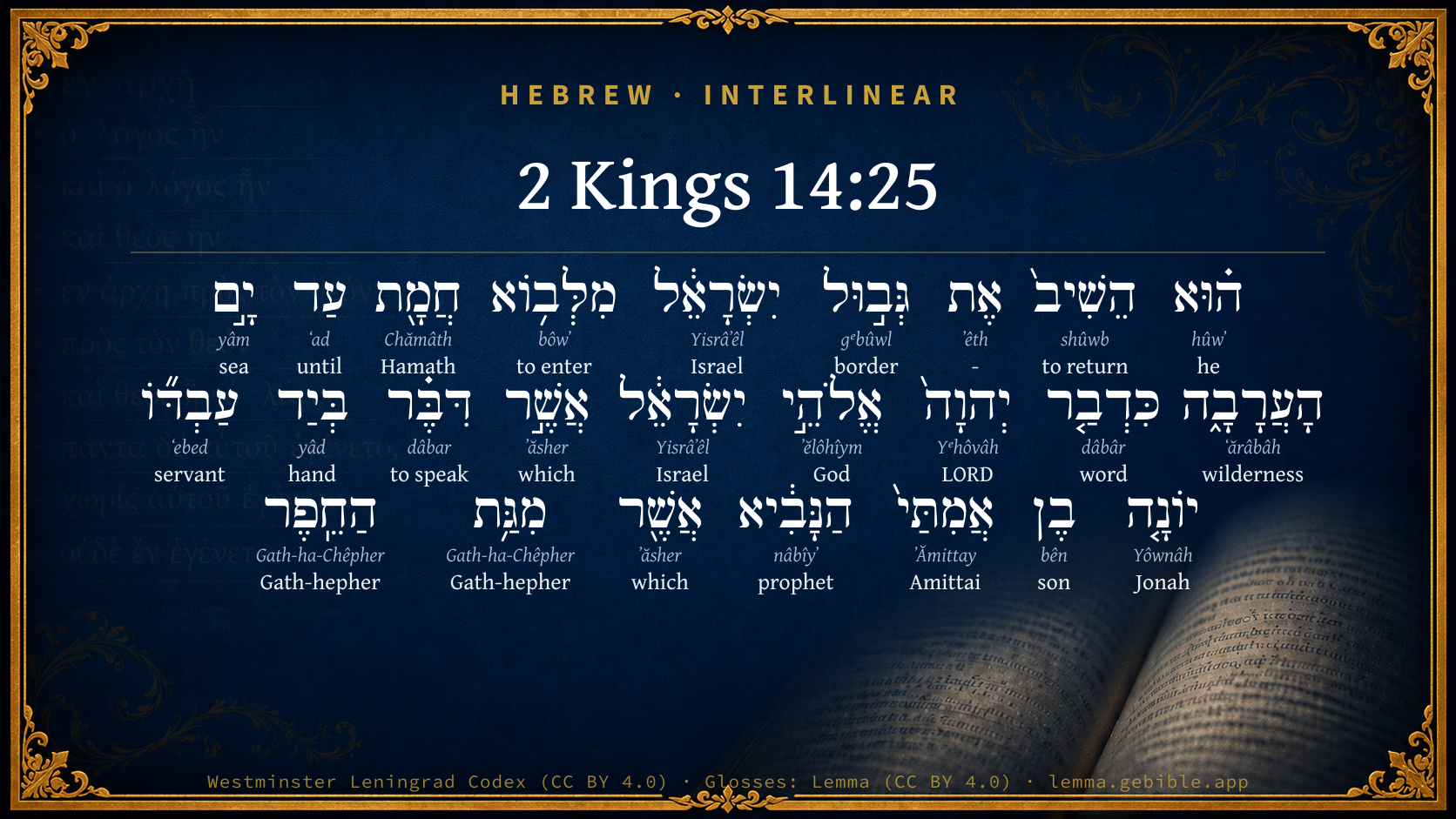
Hebrew (Westminster Leningrad Codex) 2 Kings 14:25 appears in the Hebrew Old Testament. The text above is from the Westminster Leningrad Codex. Each word links to its Strong’s number, a concise gloss, and parsing drawn from the Open Scriptures Hebrew Bible morphology. Click any word for its full Brown-Driver-Briggs (BDB) entry.
Download image
Cite this verse

2 Kings 14:25 (World English Bible). Public Domain. Lemma interlinear Bible study tool, https://lemma.gebible.app/v/2-kings/14/25.

Show BibTeX & RIS
BibTeX
RIS
English Translation
He restored the border of Israel from the entrance of Hamath to the sea of the Arabah, according to the word of Yahweh, the God of Israel, which he spoke by his servant Jonah the son of Amittai, the prophet, who was of Gath Hepher.
World English Bible · Public Domain
Highlights
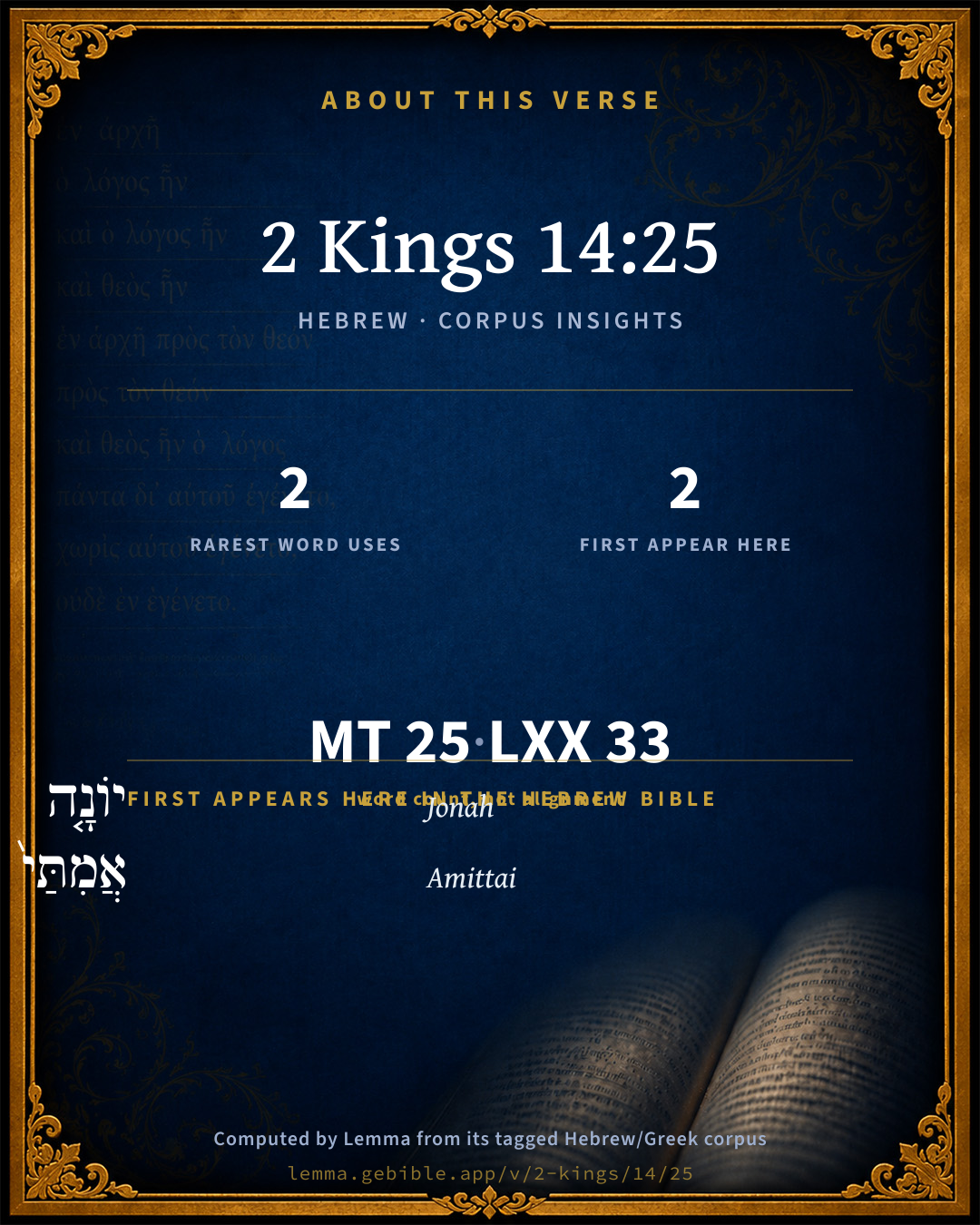
  • 2 first appearances in the Hebrew Bible
Full analysis ↓
Download a study sheet

One document with this verse’s original text, its word-by-word gloss line, the meaning frame, cross-references with their text, attributed commentary, and full source and license credits — printable, and it pastes into notes with its structure intact.

This verse Autodidact and up

Study sheet (.html) Plain text (.txt)

A passage Seminary Student

Up to 50 verses in one chapter. A passage sheet keeps up to 6 commentary sources and 12 cross-references per verse, in the order this page ranks them, and says so on the sheet whenever that leaves anything out. Ask for a single verse and you get the Autodidact verse sheet above.

Everything on this page stays free to read, with no account — the sheet is a download of what is already on screen, not access to it.

Want to remove ads? Support Godless Engineer
Compare translations 3

The same verse in 3 English versions, stacked beneath the original-language interlinear above. Click any original word for its lexicon entry.

Each is an independent rendering of the whole verse — the interlinear is not word-aligned to these translations.

Highlighted words mark where these versions differ — a whole-verse word diff, not a word-by-word alignment.

  • World English Bible Public Domain
    He restored the border of Israel from the entrance of Hamath to the sea of the Arabah, according to the word of Yahweh, the God of Israel, which he spoke by his servant Jonah the son of Amittai, the prophet, who was of Gath Hepher.
  • King James Version Public Domain
    He restored the coast of Israel from the entering of Hamath unto the sea of the plain, according to the word of the LORD God of Israel, which he spake by the hand of his servant Jonah, the son of Amittai, the prophet, which was of Gathhepher.
  • unfoldingWord Literal Text CC BY-SA 4.0
    He, he restored the border of Israel from Lebo Hamath to the Sea of the Arabah, according to the word of Yahweh, the God of Israel, that he spoke by the hand of his servant Jonah, the son of Amittai, the prophet, who from Gath Hepher.

unfoldingWord Literal Text — © unfoldingWord, licensed CC BY-SA 4.0. Word-aligned USFM3 via Door43 (git.door43.org/unfoldingWord/en_ult).

Versions to compare (up to 4)

3 of 4 selected

Show all 18 translations

Every available English version of this verse, each an independent rendering of the whole verse.

  • World English Bible Public Domain
    He restored the border of Israel from the entrance of Hamath to the sea of the Arabah, according to the word of Yahweh, the God of Israel, which he spoke by his servant Jonah the son of Amittai, the prophet, who was of Gath Hepher.
  • Berean Standard Bible Public Domain
    This Jeroboam restored the boundary of Israel from Lebo-hamath to the Sea of the Arabah, according to the word that the LORD, the God of Israel, had spoken through His servant Jonah son of Amittai, the prophet from Gath-hepher.
  • Majority Standard Bible Public Domain
    This Jeroboam restored the boundary of Israel from Lebo-hamath to the Sea of the Arabah, according to the word that the LORD, the God of Israel, had spoken through His servant Jonah son of Amittai, the prophet from Gath-hepher.
  • King James Version Public Domain
    He restored the coast of Israel from the entering of Hamath unto the sea of the plain, according to the word of the LORD God of Israel, which he spake by the hand of his servant Jonah, the son of Amittai, the prophet, which was of Gathhepher.
  • American Standard Version (1901) Public Domain
    He restored the border of Israel from the entrance of Hamath unto the sea of the Arabah, according to the word of Jehovah, the God of Israel, which he spake by his servant Jonah the son of Amittai, the prophet, who was of Gath-hepher.
  • Revised Version (1885) Public Domain
    He restored the border of Israel from the entering in of Hamath unto the sea of the Arabah, according to the word of the LORD, the God of Israel, which he spake by the hand of his servant Jonah the son of Amittai, the prophet, which was of Gath-hepher.
  • Geneva Bible (1599) Public Domain
    He restored the coast of Israel, from the entring of Hamath, vnto the Sea of the wildernesse, according to the worde of the Lord God of Israel, which he spake by his seruant Ionah the sonne of Amittai the Prophet, which was of Gath Hepher.
  • Douay-Rheims (1899) Public Domain
    He restored the borders of Israel from the entrance of Emath, unto the sea of the wilderness, according to the word of the Lord the God of Israel, which he spoke by his servant Jonas the son of Amathi, the prophet, who was of Geth, which is in Opher.
  • Young's Literal Translation Public Domain
    He hath brought back the border of Israel, from the entering in of Hamath unto the sea of the desert, according to the word of Jehovah, God of Israel, that He spake by the hand of His servant Jonah son of Amittai the prophet, who `is' of Gath-Hepher,
  • Literal Standard Version CC BY-SA 4.0
    He has brought back the border of Israel, from the entering in of Hamath to the sea of the desert, according to the word of YHWH, God of Israel, that He spoke by the hand of His servant Jonah son of Amittai the prophet, who [is] of Gath-Hepher,
  • Unlocked Literal Bible CC BY-SA 4.0
    He restored the border of Israel from Lebo Hamath to the Sea of the Arabah, following the commands of the word of Yahweh, the God of Israel, which he had spoken through his servant Jonah son of Amittai, the prophet, who was from Gath Hepher.
  • unfoldingWord Literal Text CC BY-SA 4.0
    He, he restored the border of Israel from Lebo Hamath to the Sea of the Arabah, according to the word of Yahweh, the God of Israel, that he spoke by the hand of his servant Jonah, the son of Amittai, the prophet, who from Gath Hepher.
  • Darby Bible Public Domain
    He restored the border of Israel from the entrance of Hamath as far as the sea of the plain, according to the word of Jehovah the God of Israel, which he had spoken through his servant Jonah the prophet, the son of Amittai, who was of Gath-Hepher.
  • World Messianic Bible Public Domain
    He restored the border of Israel from the entrance of Hamath to the sea of the Arabah, according to the LORD, the God of Israel’s word, which he spoke by his servant Jonah the son of Amittai, the prophet, who was from Gath Hepher.
  • Webster's Bible Public Domain
    He restored the border of Israel from the entering of Hamath to the sea of the plain, according to the word of the LORD God of Israel, which he spoke by the hand of his servant Jonah, the son of Amittai, the prophet, who was of Gath-hepher.
  • Free Bible Version CC BY-SA 4.0
    He restored the border of Israel to where it had been, from Lebo-hamath as far as the Sea of the Arabah, as the Lord, the God of Israel, had said through his servant Jonah, son of Amittai, the prophet, who came from Gath-hepher.
  • Bible in Basic English Public Domain
    He got back the old limits of Israel from the way into Hamath to the sea of the Arabah, as the Lord had said by his servant Jonah, the son of Amittai, the prophet of Gath-hepher.
  • JPS Tanakh (1917) Public Domain
    He restored the border of Israel from the entrance of Hamath unto the sea of the Arabah, according to the word of the LORD, the God of Israel, which He spoke by the hand of His servant Jonah the son of Amittai, the prophet, who was of Gath-hepher.

Literal Standard Version (2020), Covenant Press — licensed CC BY-SA 4.0. Text via the HelloAO Bible API (eBible.org). Unlocked Literal Bible (unfoldingWord) — licensed CC BY-SA 4.0. Text via the HelloAO Bible API (eBible.org). unfoldingWord Literal Text — © unfoldingWord, licensed CC BY-SA 4.0. Word-aligned USFM3 via Door43 (git.door43.org/unfoldingWord/en_ult). Free Bible Version, Dr. Jonathan Gallagher — licensed CC BY-SA 4.0. Text via the HelloAO Bible API (eBible.org).

Word by word

More ways to search: Search by grammar → Find every occurrence → Compare this word →

Practice this passage: Drill this verse → Learn its vocabulary →

אֲמִתַּי֙
ʼĂmittay
H573
“Amittai”
Noun, Proper
Part of Speech
Noun
Type
Proper
Full BDB Definition

Origin: from H571

TWOT: None

Amittai = "my truth" - the father of Jonah the prophet
  1. ה֗וּא hûwʼ H1931 “he” Pronoun, Personal, 3rd Person, Masculine, Singular
  2. הֵשִׁיב֙ shûwb H7725 “to return” Verb, Hiphil, Perfect, 3rd Person, Masculine, Singular
  3. אֶת ʼêth H853 “-” Particle, Direct Object
  4. גְּב֣וּל gᵉbûwl H1366 “border of” Noun, Common, Masculine, Singular, Construct
  5. יִשְׂרָאֵ֔ל Yisrâʼêl H3478 “Israel” Noun, Proper
  6. מִלְּב֥וֹא bôwʼ H935 “from · entrance of” Preposition + Noun, Common, Masculine, Singular, Construct
  7. חֲמָ֖ת Chămâth H2574 “Hamath” Noun, Proper
  8. עַד ʻad H5704 “until” Preposition
  9. יָ֣ם yâm H3220 “sea of” Noun, Common, Masculine, Singular, Construct
  10. הָעֲרָבָ֑ה ʻărâbâh H6160 “the · wilderness” Particle, Definite Article + Noun, Common, Feminine, Singular, Absolute
  11. כִּדְבַ֤ר dâbâr H1697 “like/as · word of” Preposition + Noun, Common, Masculine, Singular, Construct
  12. יְהוָה֙ Yᵉhôvâh H3068 “LORD” Noun, Proper
  13. אֱלֹהֵ֣י ʼĕlôhîym H430 “God(s) of” Noun, Common, Masculine, Plural, Construct
  14. יִשְׂרָאֵ֔ל Yisrâʼêl H3478 “Israel” Noun, Proper
  15. אֲשֶׁ֣ר ʼăsher H834 “which” Particle, Relative
  16. דִּבֶּ֗ר dâbar H1696 “to speak” Verb, Piel, Perfect, 3rd Person, Masculine, Singular
  17. בְּיַד yâd H3027 “in/at · hand of” Preposition + Noun, Common, Both, Singular, Construct
  18. עַבְדּ֞וֹ ʻebed H5650 “servant · his” Noun, Common, Masculine, Singular, Construct + Suffix, Personal, 3rd Person, Masculine, Singular
  19. יוֹנָ֤ה Yôwnâh H3124 “Jonah” Noun, Proper
  20. בֶן bên H1121 “son of” Noun, Common, Masculine, Singular, Construct
  21. הַנָּבִ֔יא nâbîyʼ H5030 “the · prophet” Particle, Definite Article + Noun, Common, Masculine, Singular, Absolute
  22. אֲשֶׁ֖ר ʼăsher H834 “which” Particle, Relative
  23. מִגַּ֥ת Gath-ha-Chêpher H1662 “from · Gath-hepher” Preposition + Noun, Proper
  24. הַחֵֽפֶר Gath-ha-Chêpher H1662 “Gath-hepher” Noun, Proper

About this verse

These counts appear in no published source. They are computed here, from the morphology-tagged text and Lemma’s own curated glosses. What Lemma adds →

25
words
22
distinct lemmas
Historical
section

Notable vocabulary

The rarest word here is אֲמִתַּי֙ Amittai H573 — appearing just 2 times in the whole Hebrew Bible.

First appearance in Scripture

These words make their first canonical appearance in the Hebrew Bible here:

  • יוֹנָ֤ה Jonah H3124
  • אֲמִתַּי֙ Amittai H573

Shared distinctive vocabulary

אֲמִתַּי֙ Amittai H573 occurs in 2 verses of the Hebrew Bible. Also found in:

Grammatical profile

  • 2 verbs
  • 18 nouns
  • 1 pronoun
  • 1 preposition
  • 3 particles

Verb forms

  • הֵשִׁיב֙ Hiphil · Perfect
  • דִּבֶּ֗ר Piel · Perfect

Repetition

Words recur within this verse — often emphatic in Hebrew:

  • יִשְׂרָאֵ֔ל Israel H3478 ×2
  • מִגַּ֥ת Gath-hepher H1662 ×2
  • אֲשֶׁ֣ר which H834 ×2

Hebrew & Septuagint length

In English translation the verse runs 45 words from the Hebrew and 42 from the Septuagint (LXX English) — closely comparable.

A rough comparison of the two English renderings, which tokenize alike — not a word-level alignment.

Word counts can differ between the Hebrew and the Greek without any difference in meaning — e.g. the Hebrew direct-object marker אֵת has no separate Greek word, and Greek often adds the article ὁ.

In the original languages it is 25 Hebrew tokens and 33 Greek tokens — but the two are counted differently (Hebrew bundles its prefixes and suffixes into one token; the Greek is in lemma form), so that isn’t a like-for-like length.

Cross-references

13

Topical passages linked to 2 Kings 14:25 in the Treasury of Scripture Knowledge — connected by theme and wording, ordered by reader-vote popularity; previews shown in the World English Bible.

  • Deuteronomy 3:17 the Arabah also, and the Jordan and the border [of it], from Chinnereth even to the sea of the Arabah, the Salt Sea, under the slopes of Pisgah eastward.
  • Numbers 13:21 So they went up, and spied out the land from the wilderness of Zin to Rehob, to the entrance of Hamath.
  • Joshua 19:13 and from there it passed along eastward to Gath Hepher, to Eth-kazin; and it went out at Rimmon which stretches to Neah;
  • 1 Kings 8:65 So Solomon held the feast at that time, and all Israel with him, a great assembly, from the entrance of Hamath to the brook of Egypt, before Yahweh our God, seven days and seven days, even fourteen days.
  • Jonah 1:1 Now the word of Yahweh came to Jonah the son of Amittai, saying,
  • Matthew 12:39–40 But he answered them, "An evil and adulterous generation seeks after a sign, but no sign will be given it but the sign of Jonah the prophet.
  • Genesis 14:3 All these joined together in the valley of Siddim (the same is the Salt Sea).
  • Numbers 34:7–8 This shall be your north border: from the great sea you shall mark out for you Mount Hor;
  • 2 Kings 13:25 Jehoash the son of Jehoahaz took again out of the hand of Benhadad the son of Hazael the cities which he had taken out of the hand of Jehoahaz his father by war. Three times did Joash strike him, and recovered the cities of Israel.
  • Ezekiel 47:16–18 Hamath, Berothah, Sibraim, which is between the border of Damascus and the border of Hamath; Hazer Hatticon, which is by the border of Hauran.
  • Matthew 16:4 An evil and adulterous generation seeks after a sign, and there will be no sign given to it, except the sign of the prophet Jonah." He left them, and departed.
  • 2 Kings 10:32 In those days Yahweh began to cut off from Israel: and Hazael struck them in all the borders of Israel;
  • Amos 6:14 For, behold, I will raise up against you a nation, house of Israel," Says Yahweh, the God of hosts; "And they will afflict you from the entrance of Hamath to the brook of the Arabah."

Cross-references courtesy of OpenBible.info (CC BY 4.0).

Hebrew and Greek witnesses Masoretic Hebrew ↔ Greek Septuagint

The same verse in the two great witnesses to the Old Testament, shown verse-for-verse.

These are two independent witnesses, not word-aligned to each other, and the Septuagint is shown in lemma (dictionary) form.

Hebrew 2 Kings 14:25 Masoretic · Westminster Leningrad Codex

ה֗וּא הֵשִׁיב֙ אֶת גְּב֣וּל יִשְׂרָאֵ֔ל מִלְּב֥וֹא חֲמָ֖ת עַד יָ֣ם הָעֲרָבָ֑ה כִּדְבַ֤ר יְהוָה֙ אֱלֹהֵ֣י יִשְׂרָאֵ֔ל אֲשֶׁ֣ר דִּבֶּ֗ר בְּיַד עַבְדּ֞וֹ יוֹנָ֤ה בֶן אֲמִתַּי֙ הַנָּבִ֔יא אֲשֶׁ֖ר מִגַּ֥ת הַחֵֽפֶר

He restored the border of Israel from the entrance of Hamath to the sea of the Arabah, according to the word of Yahweh, the God of Israel, which he spoke by his servant Jonah the son of Amittai, the prophet, who was of Gath Hepher.

World English Bible · Public Domain

Greek LXX 2 Kings 14:25 Septuagint · lemma form

αὐτός ἀποἵστημι ὁ ὅριον ἰσραήλ ἀπό εἴσοδος αιμαθ ἕως ὁ θάλασσα ὁ ἀραβά κατά ὁ ῥῆμα κύριος θεός ἰσραήλ ὅς λαλέω ἐν χείρ δοῦλος αὐτός ιωνα υἱός αμαθι ὁ προφήτης ὁ ἐκ γεθχοβερ

He recovered the coast of Israel from the entering in of Aemath to the sea of Araba, according to the word of the Lord God of Israel, which he spoke by his servant Jonas the son of Amathi, the prophet of Gethchopher.

LXX2012 (modern English Septuagint) · Public Domain

Hebrew: Westminster Leningrad Codex (CC BY 4.0). Greek: Septuagint (public domain); English from LXX2012 (modern English Septuagint) (Public Domain). How the Septuagint differs from the Hebrew →

Targum (Aramaic paraphrase)

1

The Targum is the ancient Jewish Aramaic paraphrase of the Hebrew Scriptures — an interpretive translation, not the Hebrew text itself. Onkelos (literal) and Pseudo-Jonathan (expansive) render the Torah, and Jonathan the Prophets. Coverage is partial: where no permissively-licensed English translation exists for a verse, only the Aramaic is shown. This is verse-level text, not a word-by-word alignment to the Hebrew.

  1. Targum Jonathan Prophets (Joshua–Malachi)
    הוּא אָתִיב יַת תְּחוּם יִשְׂרָאֵל מִמַעֲלָנָא דַחֲמָת עַד יַמָא דְמֵישְׁרָא כְּמָא דְמַלֵיל יְיָ אֱלָהָא דְיִשְׂרָאֵל דִי מַלֵיל בְּיַד עַבְדֵיהּ יוֹנָה בַּר אֲמִתַּי נְבִיָא דִי מִגַת חֵפֶר:

    (no public-domain English translation for this verse)

    Targum Jonathan — Aramaic: “Mikraot Gedolot” (public domain). English: “Sefaria Community Translation” (CC0 1.0 (public-domain dedication)); “London "Chaldee Paraphrase," 1871” (public domain). Text via Sefaria.

Commentary

Notes on 2 Kings 14:25 from classic Christian and Jewish commentators (each source and its license shown beneath its notes). The classic Christian expositions comment on the surrounding passage and are grouped to its opening verse, so a note may address several verses; the Jewish commentaries on the Tanakh (Rashi and others) are per-verse, so they appear only where the commentator wrote on this verse.

Lemma curates 59 commentaries, every one of them public domain or Creative Commons licensed, each selected and text-cleaned for this edition rather than reprinted as found. About our sources →

Trapp's Complete Commentary

John Trapp

2Ki 14:25 He restored the coast of Israel from the entering of Hamath unto the sea of the plain, according to the word of the LORD God of Israel, which he spake by the hand of his servant Jonah, the son of Amittai, the prophet, which [was] of Gathhepher.

Ver. 25. To the sea of the plain.] Called the salt sea. {Deu 3:17}

Jonah, the son of Amittai.] See on Jon 1:1.

John Trapp, A Commentary or Exposition upon All the Books of the Old and New Testament (1647–1656) — public domain. Text from a community e-Sword module.

Joseph Benson's Commentary

2Ki 14:25. He restored the coast, &c., from Hamath — Which was the northern border of the kingdom of Israel; unto the sea of the plain — The Dead sea, which was once a goodly plain, and was their southern border. Which he spake by his servant Jonah — Or Jonas; one of the lesser prophets. The only mention that we have of this prophet is in this passage, and in the account of his famous mission to Nineveh, in considering which we shall say more concerning him. What the prophecies were by which he encouraged Jeroboam to proclaim war against the king of Syria, is nowhere recorded. But as we have not every thing which the prophets did write, so several prophets did not commit any of their predictions to writing. From this place, however, we learn, that God was so gracious to the Israelites, wicked as they were, as to continue a race of prophets among them, even after Elijah and Elisha were dead. See Patrick and Dodd. Happy that land which is thus favoured! which has a succession of prophets running parallel with a succession of princes; that the word of the Lord may endure for ever!

Joseph Benson's Commentary on the Old and New Testaments (1811–1818) — public domain. Text from a community e-Sword module.

Tyndale Open Study Notes

Tyndale Open Resources

14:25 Israel and Judah apparently lived in harmony at this time so that both kingdoms prospered and recovered nearly all the territory that Solomon had held (see 2 Chr 26:6-15). • Lebo-hamath, known from Egyptian and Assyrian inscriptions, lay some forty-five miles north of Damascus in the Beqa‘ Valley. The extent of Jeroboam’s conquests testifies to the northern kingdom’s military power. Israel’s victories against the Arameans were possible because Aram had been weakened by earlier conquests of Adad-nirari III of Assyria. • Jonah is the famous prophet who pronounced the doom of Nineveh but was disappointed when God spared its repentant people (Jon 3:3–4:3).

Tyndale Open Study Notes — © Tyndale Open Resources, licensed CC BY-SA 4.0. Text via the HelloAO Bible API.

Geneva Bible (1599)

Geneva Bible translators

Hebrew, by the hand of.

Geneva Bible (1599) marginal notes — public domain. Text via Bolls.life.

Adam Clarke's Commentary

Verse 25. He restored the coast of Israel] From the description that is here given, it appears that Jeroboam reconquered all the territory that had been taken from the kings of Israel; so that Jeroboam the second left the kingdom as ample as it was when the ten tribes separated under Jeroboam the first.

Adam Clarke's Commentary on the Bible (1810–1826) — public domain. Text from a community e-Sword/MySword module.

Ellicott's Commentary for English Readers

(25) He restored.—Rather, He it was who restored the border, i.e., he wrested out of the hands of the Syrians the territory they had taken from Israel.

From the entering of Hamath—i.e., from the point where the territory of Hamath began. This was the originally determined boundary of Israel on the north (comp. Num_13:21; Num_34:8; Jos_13:5), and the prophet Ezekiel specifies it as the future limit (Eze_47:16; Eze_48:1). Israel’s territory first reached this limit under Solomon, who conquered a portion of the Hamathite domains (2Ch_8:3-4).

The sea of the plain—i.e., the Dead Sea (Num_3:17; Num_4:49; Jos_3:16). The whole length of the Dead Sea is included (comp. Amo_6:14, where virtually the same limits are specified), and the country beyond Jordan. (Comp. Note on 1Ch_5:17.)

Jonah, the son of Amittai, the prophet.—Comp. Jon_1:1. Ewald remarks that the activity of this prophet must have occupied a very large field, as tradition connects him with Nineveh. Hitzig and Knobel recognise the prophecy referred to here in Isaiah 15, 16. There is no difficulty in the supposition that Isaiah has “adopted and ratified the work of an earlier prophet,” as Jeremiah has so often done. (See Cheyne’s Isaiah, vol. i., p. 93.) But it is easier to prove that these chapters are not Isaiah’s, than that they belong to Jonah.

Gath-hepher.—Jos_19:13. The present Meshed, Not far north of Nazareth.

A Bible Commentary for English Readers, edited by Charles John Ellicott (1878–1897) — public domain. Text from a community e-Sword module.

The Cambridge Bible for Schools and Colleges

gen. ed. J. J. S. Perowne

25. He restored the coast of Israel] Here, as before, ‘coast’ has no reference to ‘seaboard’. The territory which Jeroboam recovered was on the east of the Jordan, and so what is meant is that he acquired again the portions of Gilead and Bashan that had been lost under previous kings.

from the entering of Hamath] R.V. entering in of H. This rendering is as in A.V. of 1Ki_8:65 and elsewhere. The ‘entering in of Hamath’ or ‘as men come to Hamath’ is frequently mentioned as a northern limit of the Israelite territory, Hamath being a chief city of Syria and under the rulers of Damascus. Cf. Num_13:21; Num_34:8; Jos_13:5; Jdg_3:3.

unto the sea of the plain] R.V. of the Arabah. The sea of the Arabah is the Dead Sea. Cf. Deu_3:17; Deu_4:49; Jos_3:16; Jos_12:3. The Arabah is the name given to the valley from the Sea of Galilee southward to the desert. The name is found in A.V. in Jos_18:18, and has been introduced as a proper name in the R.V. constantly. The sea of the Arabah is defined in Jos_3:16 as ‘the salt sea’. The district restored by Jeroboam was on the east of the Jordan, and extended from the valley of the Orontes where Hamath was situated, southward to the frontiers of the Moabites.

the Lord God of Israel] R.V. the God of I. As usual.

his servant Jonah, the son of Amittai] This must be the same person to whom the prophecy of Jonah is ascribed, for it is impossible to believe that there were two persons of this name, both prophets and both sons of Amittai. Jonah must therefore have prophesied before (or early in) the reign of Jeroboam II., the commencement of whose reign is placed about b.c. 823. Thus Jonah must be the earliest of those prophets, whose writings have been preserved. That there is nothing in the book of Jonah about the prophecy mentioned in this verse need not surprise us. That book is very brief and deals with but one episode in the prophet’s life. Yet a prophet, whose ministry God employed about distant Nineveh, may certainly be expected to have had messages also for his own countrymen. Hosea (2Ki_1:1) and Amos (2Ki_1:1) also prophesied in the days of Jeroboam II.

which was of Gath-hepher] The same place is called Gittah-hepher in Jos_19:13. It was not far from Nazareth in the tribe of Zebulon. Jonah therefore was a prophet of the northern Kingdom. Jewish tradition makes him to have been the son of the widow of Zarephath, whom Elijah restored to life, and says also that it was he who attended Elijah when he set forth into the wilderness, and who was sent to anoint Jehu. All which things have no foundation but conjecture.

The Cambridge Bible for Schools and Colleges (gen. ed. J. J. S. Perowne; Cambridge University Press, 1878–1918) — public domain. Text from a community e-Sword module.

John Gill's Exposition

And Jeroboam slept with his fathers, even with the kings of Israel,.... Died, and was buried with them:

and Zachariah his son reigned in his stead: who was of the fourth generation from Jehu, as was promised to him, Kg2 10:30.

Next: 2 Kings Chapter 15

John Gill's Exposition of the Whole Bible (1746–1763) — public domain (CC PDM 1.0). Text via the HelloAO Bible API.

Albert Barnes' Notes on the Bible

He restored the coast of Israel - Jeroboam, in the course of his long reign, recovered the old boundaries of the holy land to the north, the east, and the southeast. The “entering in of Hamath” is spoken of as the northern boundary; the “sea of the plain,” or the Dead Sea, is the southern boundary (see the marginal references): here Israel adjoined on Moab. The entire tract east of Jordan had been lost to Israel in the reign of Jehu and that of Jehoahaz 2Ki 10:33; 2Ki 13:3, 2Ki 13:25. All this was now recovered: and not only so, but Moab was reduced Amo 6:14, and the Syrians were in their turn forced to submit to the Jews 2Ki 14:28. The northern conquests were perhaps little less important than the eastern 2Ki 14:28.

The word of the Lord ... which he spake - Some have found the prophecy of Jonah here alluded to, or a portion of it, in Isa 15:1-9; Isa 16:1-14 (see 2Ki 16:13); but without sufficient grounds.

This passage tends to fix Jonah’s date to some period not very late in the reign of Jeroboam II, i. e. (according to the ordinary chronology) from 823 B.C. to 782 B.C. On Gath-hepher, see the marginal reference and note.

Albert Barnes' Notes on the Bible (1834–1885) — public domain. Text from a community e-Sword/MySword module.

Haydock's Catholic Bible Commentary

CHAPTER XIV.

Wilderness, or the Dead Sea, to which place the dominion of Israel originally extended, under Jeroboam I. (Calmet) --- Opher, in the tribe of Zabulon. (Challoner) --- Protestants, "which was of Gath-hepher." (Haydock) --- We have not all the works of the prophets, nor did they write all their predictions. (Calmet) --- Here we learn at what time Jonas lived. (Menochius)

George Leo Haydock (1774–1849), Haydock's Catholic Family Bible and Commentary, 1859 edition — public domain. Excludes Psalms (Douay-Rheims chapter numbering differs from Protestant) and Deuterocanonical books (Catholic canon only).

Matthew Poole's English Annotations

The entering of Hamath was the northern border of the kingdom of Israel, Num 13:21; 34:8.

Unto the sea of the plain, i.e. unto the Dead Sea, which once was a goodly plain, Gen 13:10, which was their southern border.

Jonah, or Jonas, one of the small prophets; though this prophecy of his be not recorded there; and therefore it is remembered here.

Matthew Poole's English Annotations on the Holy Bible (1683–1685) — public domain. Text from a community e-Sword/MySword module.

Whedon's Commentary on the Bible

Daniel D. Whedon

25. Restored the coast — Reconquered the territory that had been taken at different times from his predecessors, and made the kingdom as extensive as it was in the days of Jeroboam the son of Nebat.

Entering of Hamath — The northern border of the kingdom of Solomon, (1Ki_8:65,) commonly identified with the southern opening into the great valley of Coele-Syria. See on Jos_13:5.

Sea of the plain — The Salt or Dead Sea. Compare Deu_3:17.

Word of the Lord God — A communication or oracle granted, notwithstanding the king’s wickedness, for the comfort of Israel.

By the hand of… Jonah — That is, through his agency or instrumentality. There can be no reasonable doubt that this Jonah, the son of Amittai, is the same prophet whose ministry to the Ninevites is recorded in the prophetical book that bears his name. Josephus says: “Jonah, a prophet, foretold to Jeroboam that he should make war with the Syrians, and conquer their army, and enlarge the bounds of his kingdom on the northern parts to the city of Hamath, and on the southern to the lake Asphaltitis; for the bounds of the Canaanites were originally these, according as Joshua, the general, determined. So Jeroboam organized an expedition against the Syrians, and overran all their country, as Jonah had foretold.”

Gath-hepher — The same as Gittah-hepher, in the tribe of Zebulon. See on Jos_19:13.

Daniel D. Whedon (gen. ed.), Commentary on the Old and New Testaments (1874–1909) — public domain. Text from a community e-Sword module.

The Pulpit Commentary

He restored the coast of Israel from the entering in of Hamath. By "the entering in of Hamath" is to be understood the opening into the Coele-Syrian valley a little north of Baalbec, where the ground begins to slope northwards, and the streams to flow in the same direction to form the Orontes. Hamath itself was between eighty and ninety miles further to the north, on the middle Orontes, about N. lat. 35 22". The "entering in of Hamath" was always reckoned the northern boundary of the Holy Land (see Num_34:8; Jos_13:5; Jud_1:3:3; 1Ki_8:65) It corresponded with the watershed between the Orontes and the Litany. Unto the sea of the plain. The "sea of the plain" is undoubtedly the Dead Sea, the plain (ha-Arabah) being used as a sort of proper name for the lower Jordan valley, like El-Ghor at the present day (Deu_3:17; Jos_3:16 Jos_12:3, etc.) The territory recovered no doubt included all the trans-Jordanic region as far south as the river Aruon; but the recovery of dominion over Moab, and even over Ammon, which some have seen in this passage (Ewald, "History of Israel," vol. 4. p. 124), is scarcely con-rained in it. According to the word of the Lord God of Israel, which he spake by the hand of his servant Jonah, the son of Amittai. (comp. Jon_1:1) Jonah"s date is determined by this passage. He was contemporary with Hosea and Amos, and earlier than Micah. His prophecy concerning Jeroboam is probably assigned to the early part of that king"s reign. The prophet, which was of Gath-hepher. Gath-hepher is mentioned in Joshua, under the name of Gittah-hepher, as a city of Zebulon, (2Ki_19:13) not far from Mount Tabor. It is conjecturally identified with El-Meshhed north of Nazareth, where the tomb of Jonah is shown.

The Pulpit Commentary (1880–1919), ed. H.D.M. Spence-Jones & Joseph S. Exell — public domain. Text from a community e-Sword module.

John Wesley's Explanatory Notes

The sea - Unto the dead sea, once a goodly plain, Gen. xiii, 10, which was their southern border.

John Wesley, Explanatory Notes Upon the Whole Bible (1754–1765) — public domain. Text via the GEBible commentary corpus.

Keil & Delitzsch

C. F. Keil & F. Delitzsch

He brought back (השׁיב), i.e., restored, the boundary of Israel from towards Hamath in the north, to the point to which the kingdom extended in the time of Solomon (Kg1 8:65), to the sea of the Arabah (the present Ghor), i.e., to the Dead Sea (compare Deu 3:17, and Deu 4:49, from which this designation of the southern border of the kingdom of the ten tribes arose), "according to the word of the Lord, which He had spoken through the prophet Jonah," who had probably used this designation of the southern boundary, which was borrowed from the Pentateuch, in the announcement which he made. The extent of the kingdom of Israel in the reign of Jeroboam is defined in the same manner in Amo 6:14, but instead of הערבה ים the הערבה נחל is mentioned, i.e., in all probability the Wady el Ashy, which formed the boundary between Moab and Edom; from which we may see that Jeroboam had also subjugated the Moabites to his kingdom, which is not only rendered probable by Kg2 3:6., but is also implied in the words that he restored the former boundary of the kingdom of Israel-On the prophet Jonah, the son of Amittai, see the Comm. on Jon 1:1. Gath-hepher, in the tribe of Zebulun, is the present village of Meshed, to the north of Nazareth (see at Jos 19:13).

Keil & Delitzsch — Biblical Commentary on the Old Testament (1861–1891) — public domain (CC PDM 1.0). Text via the HelloAO Bible API. (Old Testament only.)

Rashi

Rabbi Shlomo Yitzchaki (Rashi)

He restored. From the hand of Arom.

Yonah son of Amitai. He was the one who anointed Yeihu, who said to him, “[Your] descendants of the fourth generation will occupy [the throne of Yisroel].” Our Rabbis, however, deduced, “And the word of Adonoy came to Yonah a second time,” but not a third time, because he demanded the honor of the son, but he did not demand the honor of the Father. This verse was therefore difficult to them, and they reconciled it [as follows]: Just like the word of Adonoy, Who had spoken through Yonah concerning Nineveh, and the evil decree was overturned for good, so was it changed for Yisroel in the days of Yerovom son of Yoash, from the distress in which they were found, that “the Arom’s king had destroyed them and trampled them like dirt,” and now it was changed for the good.

Rashi on the Tanakh — English translations: “The Judaica Press complete Tanach with Rashi, translated by A. J. Rosenberg” (CC BY 4.0); “Pentateuch with Rashi's commentary by M. Rosenbaum and A.M. Silbermann, 1929-1934” (public domain); “The Metsudah Tanach series, Lakewood, N.J” (CC BY 4.0); and “The Book of Joshua, Metsudah Publications, 1997” (CC BY 4.0). Text via Sefaria.

Lesson kit

Teaching starters — assembled from the data on this page, not authored interpretation. Every prompt links to the verse data it draws on. Edit before teaching.

2 Kings, in the Historical, opens this verse with 25 words (22 distinct Hebrew lemmas). Its most distinctive word is ʼĂmittay (“Amittai”). A historical commentator’s framing appears above. Read the whole chapter for the surrounding context.

Discussion questions

  1. The word ʼĂmittay carries the sense “Amittai.” How does it shape the verse?
  2. 2 words here appear for the first time in Scripture. What is being introduced at this debut?
  3. Jonah 1:1 shares the word «Amittai» with this verse. How do the two illuminate each other?
  4. “Israel” occurs 2× in this one verse. What is the effect of the repetition?
  5. The translations on this page render this verse differently — a whole-verse word diff, not a word-by-word alignment. What might account for the different wordings?
  6. The verb «הֵשִׁיב֙» is Hiphil Perfect. How does its form color the action?
  7. Reading how Trapp's Complete Commentary and Joseph Benson's Commentary read this verse, where do the two commentators agree and where do they part?

Things to notice

Reading settings

Reading text

Shown beneath each verse's original-language words.

Old Testament
Old Testament edition

Read the OT as the Masoretic Hebrew (MT) or the Greek Septuagint (LXX).

English shown for the Greek Septuagint (in the Hebrew ↔ Greek comparison).

Comparing translations? Open the Compare panel on any verse page to stack up to four side by side.