
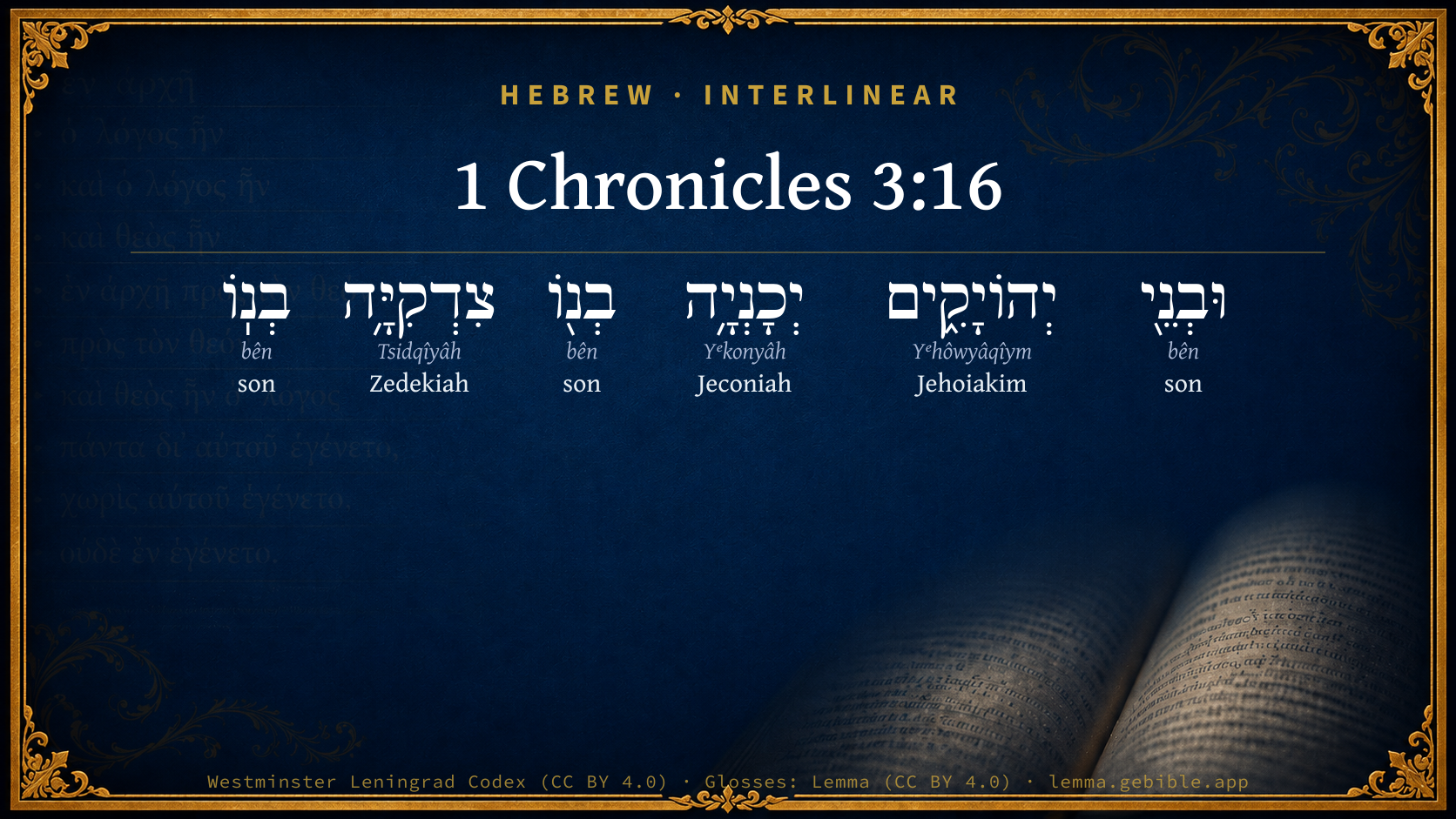
1 Chronicles 3:16

Hebrew (Westminster Leningrad Codex) 1 Chronicles 3:16 appears in the Hebrew Old Testament. The text above is from the Westminster Leningrad Codex. Each word links to its Strong’s number, a concise gloss, and parsing drawn from the Open Scriptures Hebrew Bible morphology. Click any word for its full Brown-Driver-Briggs (BDB) entry.
Download image
Cite this verse

1 Chronicles 3:16 (World English Bible). Public Domain. Lemma interlinear Bible study tool, https://lemma.gebible.app/v/1-chronicles/3/16.

Show BibTeX & RIS
BibTeX
RIS
English Translation
The sons of Jehoiakim: Jeconiah his son, Zedekiah his son.
World English Bible · Public Domain
Highlights
  • 1 first appearance in the Hebrew Bible
Full analysis ↓
Download a study sheet

One document with this verse’s original text, its word-by-word gloss line, the meaning frame, cross-references with their text, attributed commentary, and full source and license credits — printable, and it pastes into notes with its structure intact.

This verse Autodidact and up

Study sheet (.html) Plain text (.txt)

A passage Seminary Student

Up to 50 verses in one chapter. A passage sheet keeps up to 6 commentary sources and 12 cross-references per verse, in the order this page ranks them, and says so on the sheet whenever that leaves anything out. Ask for a single verse and you get the Autodidact verse sheet above.

Everything on this page stays free to read, with no account — the sheet is a download of what is already on screen, not access to it.

Want to remove ads? Support Godless Engineer
Compare translations 3

The same verse in 3 English versions, stacked beneath the original-language interlinear above. Click any original word for its lexicon entry.

Each is an independent rendering of the whole verse — the interlinear is not word-aligned to these translations.

Highlighted words mark where these versions differ — a whole-verse word diff, not a word-by-word alignment.

  • World English Bible Public Domain
    The sons of Jehoiakim: Jeconiah his son, Zedekiah his son.
  • King James Version Public Domain
    And the sons of Jehoiakim: Jeconiah his son, Zedekiah his son.
  • unfoldingWord Literal Text CC BY-SA 4.0
    And the sons of Jehoiakim: Jeconiah, his son; Zedekiah, his son.

unfoldingWord Literal Text — © unfoldingWord, licensed CC BY-SA 4.0. Word-aligned USFM3 via Door43 (git.door43.org/unfoldingWord/en_ult).

Versions to compare (up to 4)

3 of 4 selected

Show all 18 translations

Every available English version of this verse, each an independent rendering of the whole verse.

  • World English Bible Public Domain
    The sons of Jehoiakim: Jeconiah his son, Zedekiah his son.
  • Berean Standard Bible Public Domain
    The successors of Jehoiakim: Jeconiah his son, and Zedekiah.
  • Majority Standard Bible Public Domain
    The successors of Jehoiakim: Jeconiah his son, and Zedekiah.
  • King James Version Public Domain
    And the sons of Jehoiakim: Jeconiah his son, Zedekiah his son.
  • American Standard Version (1901) Public Domain
    And the sons of Jehoiakim: Jeconiah his son, Zedekiah his son.
  • Revised Version (1885) Public Domain
    And the sons of Jehoiakim: Jeconiah his son, Zedekiah his son.
  • Geneva Bible (1599) Public Domain
    And the sonnes of Iehoiakim were Ieconiah his sonne, and Zedekiah his sonne.
  • Douay-Rheims (1899) Public Domain
    Of Joakim was born Jechonias, and Sedecias.
  • Young's Literal Translation Public Domain
    And sons of Jehoiakim: Jeconiah his son, Zedekiah his son.
  • Literal Standard Version CC BY-SA 4.0
    And sons of Jehoiakim: Jeconiah his son, Zedekiah his son.
  • Unlocked Literal Bible CC BY-SA 4.0
    Jehoiakim's sons were Jehoiachin and Zedekiah.
  • unfoldingWord Literal Text CC BY-SA 4.0
    And the sons of Jehoiakim: Jeconiah, his son; Zedekiah, his son.
  • Darby Bible Public Domain
    And the sons of Jehoiakim: Jeconiah his son, Zedekiah his son.
  • World Messianic Bible Public Domain
    The sons of Jehoiakim: Jeconiah his son, and Zedekiah his son.
  • Webster's Bible Public Domain
    And the sons of Jehoiakim; Jeconiah his son, Zedekiah his son.
  • Free Bible Version CC BY-SA 4.0
    The sons of Jehoiakim: Jehoiachin and Zedekiah.
  • Bible in Basic English Public Domain
    And the sons of Jehoiakim: Jeconiah his son, Zedekiah his son.
  • JPS Tanakh (1917) Public Domain
    And the sons of Jehoiakim: Jeconiah his son, Zedekiah his son.

Literal Standard Version (2020), Covenant Press — licensed CC BY-SA 4.0. Text via the HelloAO Bible API (eBible.org). Unlocked Literal Bible (unfoldingWord) — licensed CC BY-SA 4.0. Text via the HelloAO Bible API (eBible.org). unfoldingWord Literal Text — © unfoldingWord, licensed CC BY-SA 4.0. Word-aligned USFM3 via Door43 (git.door43.org/unfoldingWord/en_ult). Free Bible Version, Dr. Jonathan Gallagher — licensed CC BY-SA 4.0. Text via the HelloAO Bible API (eBible.org).

Word by word

More ways to search: Search by grammar → Find every occurrence → Compare this word →

Practice this passage: Drill this verse → Learn its vocabulary →

About this verse

These counts appear in no published source. They are computed here, from the morphology-tagged text and Lemma’s own curated glosses. What Lemma adds →

6
words
4
distinct lemmas
Historical
section

Notable vocabulary

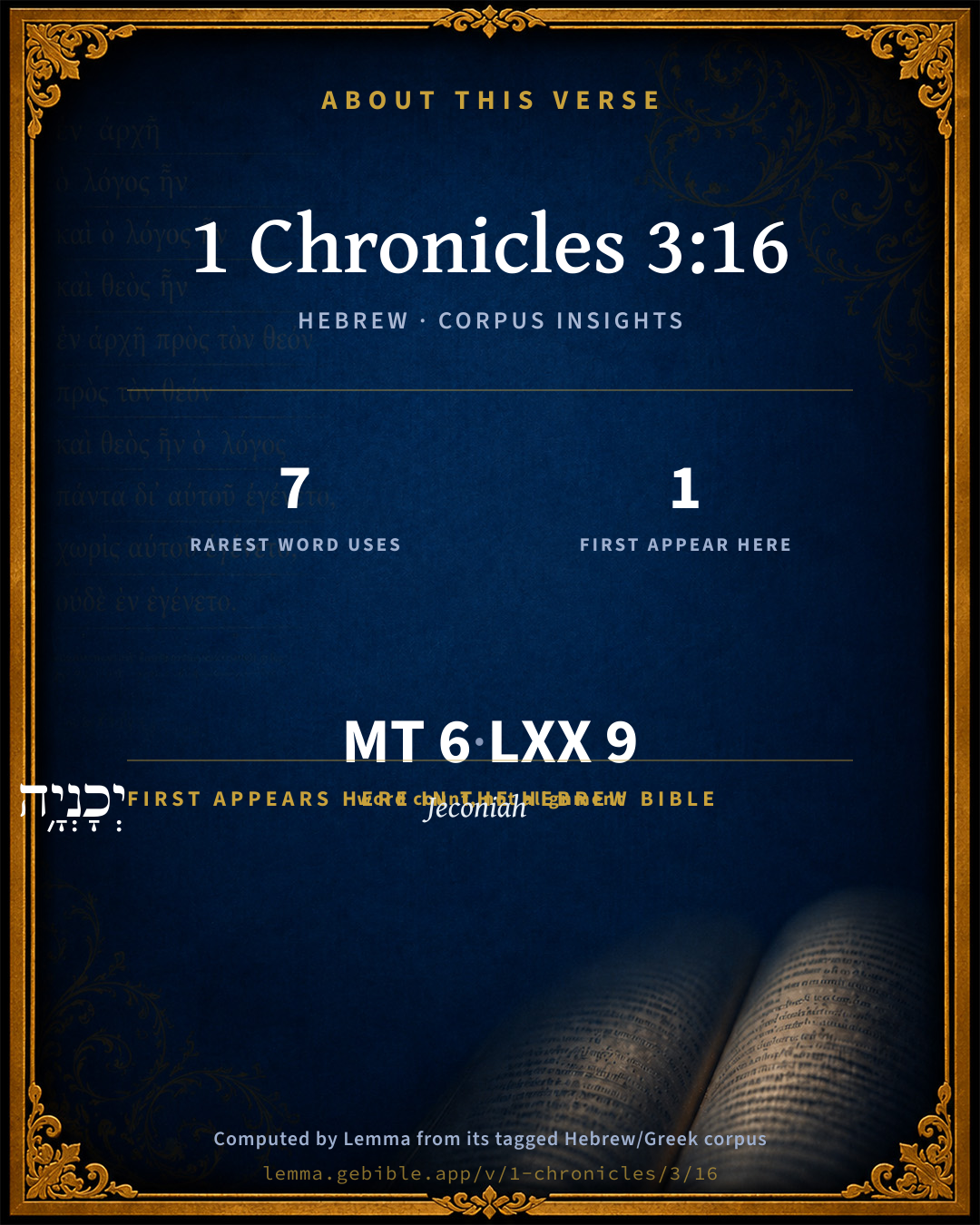
The rarest word here is יְכָנְיָ֥ה Jeconiah H3204 — appearing just 7 times in the whole Hebrew Bible.

First appearance in Scripture

This word makes its first canonical appearance in the Hebrew Bible here:

  • יְכָנְיָ֥ה Jeconiah H3204

Shared distinctive vocabulary

יְכָנְיָ֥ה Jeconiah H3204 occurs in 7 verses of the Hebrew Bible. Also found in:

Grammatical profile

  • 6 nouns

Repetition

A word recurs within this verse — often emphatic in Hebrew:

  • וּבְנֵ֖י son H1121 ×3

Hebrew & Septuagint length

In English translation the verse runs 10 words from the Hebrew and 11 from the Septuagint (LXX English) — closely comparable.

A rough comparison of the two English renderings, which tokenize alike — not a word-level alignment.

Word counts can differ between the Hebrew and the Greek without any difference in meaning — e.g. the Hebrew direct-object marker אֵת has no separate Greek word, and Greek often adds the article ὁ.

In the original languages it is 6 Hebrew tokens and 9 Greek tokens — but the two are counted differently (Hebrew bundles its prefixes and suffixes into one token; the Greek is in lemma form), so that isn’t a like-for-like length.

Cross-references

9

Topical passages linked to 1 Chronicles 3:16 in the Treasury of Scripture Knowledge — connected by theme and wording, ordered by reader-vote popularity; previews shown in the World English Bible.

  • 2 Kings 24:6 So Jehoiakim slept with his fathers; and Jehoiachin his son reigned in his place.
  • Matthew 1:11 Josiah became the father of Jechoniah and his brothers, at the time of the exile to Babylon.
  • 2 Kings 24:8 Jehoiachin was eighteen years old when he began to reign; and he reigned in Jerusalem three months: and his mother's name was Nehushta the daughter of Elnathan of Jerusalem.
  • 2 Kings 24:17 The king of Babylon made Mattaniah, [Jehoiachin's] father's brother, king is his place, and changed his name to Zedekiah.
  • Jeremiah 22:24 As I live, says Yahweh, though Coniah the son of Jehoiakim king of Judah were the signet on my right hand, yet would I pluck you there;
  • 2 Kings 25:27 It happened in the seven and thirtieth year of the captivity of Jehoiachin king of Judah, in the twelfth month, on the seven and twentieth day of the month, that Evilmerodach king of Babylon, in the year that he began to reign, did lift up the head of Jehoiachin king of Judah out of prison;
  • 1 Chronicles 3:15 The sons of Josiah: the firstborn Johanan, the second Jehoiakim, the third Zedekiah, the fourth Shallum.
  • 2 Chronicles 36:9 Jehoiachin was eight years old when he began to reign; and he reigned three months and ten days in Jerusalem: and he did that which was evil in the sight of Yahweh.
  • Jeremiah 22:28 Is this man Coniah a despised broken vessel? is he a vessel in which none delights? why are they cast out, he and his seed, and are cast into the land which they don't know?

Cross-references courtesy of OpenBible.info (CC BY 4.0).

Hebrew and Greek witnesses Masoretic Hebrew ↔ Greek Septuagint

The same verse in the two great witnesses to the Old Testament, shown verse-for-verse.

These are two independent witnesses, not word-aligned to each other, and the Septuagint is shown in lemma (dictionary) form.

Hebrew 1 Chronicles 3:16 Masoretic · Westminster Leningrad Codex

וּבְנֵ֖י יְהוֹיָקִ֑ים יְכָנְיָ֥ה בְנ֖וֹ צִדְקִיָּ֥ה בְנֽוֹ

The sons of Jehoiakim: Jeconiah his son, Zedekiah his son.

World English Bible · Public Domain

Greek LXX 1 Chronicles 3:16 Septuagint · lemma form

καί υἱός ιωακιμ ιεχονιας υἱός αὐτός σεδεκιας υἱός αὐτός

And the sons of Joakim; Jechonias his son, Sedekias his son.

LXX2012 (modern English Septuagint) · Public Domain

Hebrew: Westminster Leningrad Codex (CC BY 4.0). Greek: Septuagint (public domain); English from LXX2012 (modern English Septuagint) (Public Domain). How the Septuagint differs from the Hebrew →

Commentary

Notes on 1 Chronicles 3:16 from classic Christian and Jewish commentators (each source and its license shown beneath its notes). The classic Christian expositions comment on the surrounding passage and are grouped to its opening verse, so a note may address several verses; the Jewish commentaries on the Tanakh (Rashi and others) are per-verse, so they appear only where the commentator wrote on this verse.

Lemma curates 59 commentaries, every one of them public domain or Creative Commons licensed, each selected and text-cleaned for this edition rather than reprinted as found. About our sources →

Trapp's Complete Commentary

John Trapp

1Ch 3:16 And the sons of Jehoiakim: Jeconiah his son, Zedekiah his son.

Ver. 16. Zedekiah his son.] Not his natural son, as being his uncle, but his legal son, that is, his successor.

John Trapp, A Commentary or Exposition upon All the Books of the Old and New Testament (1647–1656) — public domain. Text from a community e-Sword module.

Joseph Benson's Commentary

1Ch 3:16. Zedekiah his son — This was another Zedekiah. How seldom has a crown gone in a direct line, from father to son, as it did here, for seventeen generations! This was the recompense of David’s piety. About the captivity, the lineal descent was interrupted, and the crown went from a nephew to an uncle, a presage of the glory’s departing from that house.

Joseph Benson's Commentary on the Old and New Testaments (1811–1818) — public domain. Text from a community e-Sword module.

Tyndale Open Study Notes

Tyndale Open Resources

3:16 The successors of Jehoiakim were his son Jehoiachin and his brother Zedekiah: At the very end of the monarchy of Judah, the sequence of kings did not follow the typical pattern of the eldest son succeeding his father.

Tyndale Open Study Notes — © Tyndale Open Resources, licensed CC BY-SA 4.0. Text via the HelloAO Bible API.

Adam Clarke's Commentary

Verse 16. Zedekiah his son.] If this be the same who was the last king of Judah, before the captivity, the word son must be taken here to signify successor; for it is certain that Zedekiah was the successor of Jeconiah, and that Zedekiah was the son of Josiah, and not of Jehoiakim.

Adam Clarke's Commentary on the Bible (1810–1826) — public domain. Text from a community e-Sword/MySword module.

Ellicott's Commentary for English Readers

(16) Jeconiah (Iah establish !)= Jehoiachin (Iahweh establisheth) = Coniah (Jer_22:24; Jer_22:28—an abbreviation of Jeconiah), was carried captive to Babylon by Nebuchadnezzar (2Ki_24:15), and Zedekiah his father’s brother, became king in his stead. Hence the supposition that “Zedekiah his son” means “Zedekiah his successor” on the throne. (Comp. margin.) But (1) the phrase “his son” has its natural sense throughout the preceding list; and (2) there really is nothing against the apparent statement of the text that Jeconiah the king had a son named Zedekiah, after his great-uncle. As, like Johanan (1Ch_3:15), he did not come to the throne, this younger Zedekiah is not mentioned elsewhere. (See 1Ch_3:17, Note.)

A Bible Commentary for English Readers, edited by Charles John Ellicott (1878–1897) — public domain. Text from a community e-Sword module.

The Cambridge Bible for Schools and Colleges

gen. ed. J. J. S. Perowne

16. Jeconiah] This name is sometimes shortened to Coniah (Jer_22:14) and written (with a slight change of meaning) Jehoiachin (2Ch_36:8-9; 2Ki_24:6 ff.).

Zedekiah his son] Zedekiah was heir, not son, to Jeconiah, whom he succeeded in the kingdom. His relationship to Jeconiah was that of uncle.

The Cambridge Bible for Schools and Colleges (gen. ed. J. J. S. Perowne; Cambridge University Press, 1878–1918) — public domain. Text from a community e-Sword module.

John Gill's Exposition

Malchiram also,.... That is, was a son of Jeconiah as well as Salathiel, and so the rest that follow:

and Pedaiah, and Shenazar, Jecamiah, Hoshama, and Nedabiah; Kimchi says these were the sons of Salathiel; but I rather think they were the sons of Jeconiah, and brethren of Salathiel, because of what follows.

John Gill's Exposition of the Whole Bible (1746–1763) — public domain (CC PDM 1.0). Text via the HelloAO Bible API.

Haydock's Catholic Bible Commentary

Jechonias, who is called also Joakim, (Worthington) and Cenias in Hebrew, Jeremias xxii. 28. (Calmet) --- Both the son and the grandson of Josias go under the name of Jechonias, Matthew i. 11. (Barradius i. 5. 16.) (Menochius) --- Sedecias. If this be the same with the king, was born must signify succeeded, as we know that Joakim was not the father of Sedecias. (Grotius, &c.)

George Leo Haydock (1774–1849), Haydock's Catholic Family Bible and Commentary, 1859 edition — public domain. Excludes Psalms (Douay-Rheims chapter numbering differs from Protestant) and Deuterocanonical books (Catholic canon only).

Matthew Poole's English Annotations

Not his natural son, for he was his uncle, 2Ki 24:17; but his legal son, or his successor, upon whom the son’s right was devolved by virtue of that law, Num 27:8-10, and therefore it is not strange if he have the name of

son with it. See Poole "Luk 3:1". Or this was another Zedekiah; because it is improbable, and without example, that one and the same man should be twice mentioned in the same genealogy as the son of two several parents.

Matthew Poole's English Annotations on the Holy Bible (1683–1685) — public domain. Text from a community e-Sword/MySword module.

The Pulpit Commentary

Of the above four brothers, sons of Josiah, the second, Jehoiakim, or Eliakim, had a son called Jeconiah, or Jehoiachin essentially the same word. He was eighteen years of age when he succeeded his father. (2Ki_24:8) A touching glimpse is given of him Jer_52:31. His name is shortened to Coniah in Jer_22:24 Jer_37:1, though elsewhere in the same prophet, Jeconiah, and in one place, (Jer_52:31) Jehoiachin. The name of Zedekiah occasions difficulty in this verse. In the first instance, following the examples of vers. 10-14, we should presume that this Zedekiah is set forth as a son of Jeconiah, and as it is not said that he reigned after Jeconiah (for it was undoubtedly Jeconiah"s uncle Zedekiah who reigned after him), we need only have read it as a statement of one of his sons. Against this, however, there are two tolerably decisive considerations; for, first, the verse opens confessedly by offering us sons of Jehoiakim, and these two, Jeconiah and Zedekiah, will fulfil the promise of that plural; and again, the seventeenth verse enters upon the formal enumeration of sons to Jeconiah. The question, therefore, returns Who was this Zedekiah, son of Jehoiakim? Some consider him identical with the Zedekiah of the previous verse, and that "his son" means here "his successor." This undoes fewer difficulties than it makes. If the text be not corrupt, the likeliest solution is to suppose that this Zedekiah of ver. 16 is an otherwise unknown brother of Jeconiah, and son of Jehoiakim.

The Pulpit Commentary (1880–1919), ed. H.D.M. Spence-Jones & Joseph S. Exell — public domain. Text from a community e-Sword module.

John Wesley's Explanatory Notes

Zedekiak - This was another Zedekiah. How seldom has a crown gone in a direct line, from father to son, as it did here, for seventeen generations! This was the recompense of David's piety. About the captivity the lineal descent was interrupted, and the crown went from a nephew to an uncle, a presage of the glory's departing from that house.

John Wesley, Explanatory Notes Upon the Whole Bible (1754–1765) — public domain. Text via the GEBible commentary corpus.

Keil & Delitzsch

C. F. Keil & F. Delitzsch

Malchiram also,.... That is, was a son of Jeconiah as well as Salathiel, and so the rest that follow:

and Pedaiah, and Shenazar, Jecamiah, Hoshama, and Nedabiah; Kimchi says these were the sons of Salathiel; but I rather think they were the sons of Jeconiah, and brethren of Salathiel, because of what follows.

Keil & Delitzsch — Biblical Commentary on the Old Testament (1861–1891) — public domain (CC PDM 1.0). Text via the HelloAO Bible API. (Old Testament only.)

Lesson kit

Teaching starters — assembled from the data on this page, not authored interpretation. Every prompt links to the verse data it draws on. Edit before teaching.

1 Chronicles, in the Historical, opens this verse with 6 words (4 distinct Hebrew lemmas). Its most distinctive word is Yᵉkonyâh (“Jeconiah”). A historical commentator’s framing appears above. Read the whole chapter for the surrounding context.

Discussion questions

  1. What does “Jeconiah” (Yᵉkonyâh) contribute to the verse as a whole?
  2. This is the first place “Jeconiah” appears in Scripture (first appears here). What does its debut here establish?
  3. How does 1 Chronicles 3:17, which shares the word «Jeconiah», read alongside this verse?
  4. What does the repetition of “son” (3× in this one verse) do in this verse?
  5. Compare how Trapp's Complete Commentary and Joseph Benson's Commentary read this verse. Where do they agree or differ?

Things to notice

Reading settings

Reading text

Shown beneath each verse's original-language words.

Old Testament
Old Testament edition

Read the OT as the Masoretic Hebrew (MT) or the Greek Septuagint (LXX).

English shown for the Greek Septuagint (in the Hebrew ↔ Greek comparison).

Comparing translations? Open the Compare panel on any verse page to stack up to four side by side.