
1 Chronicles 2:23

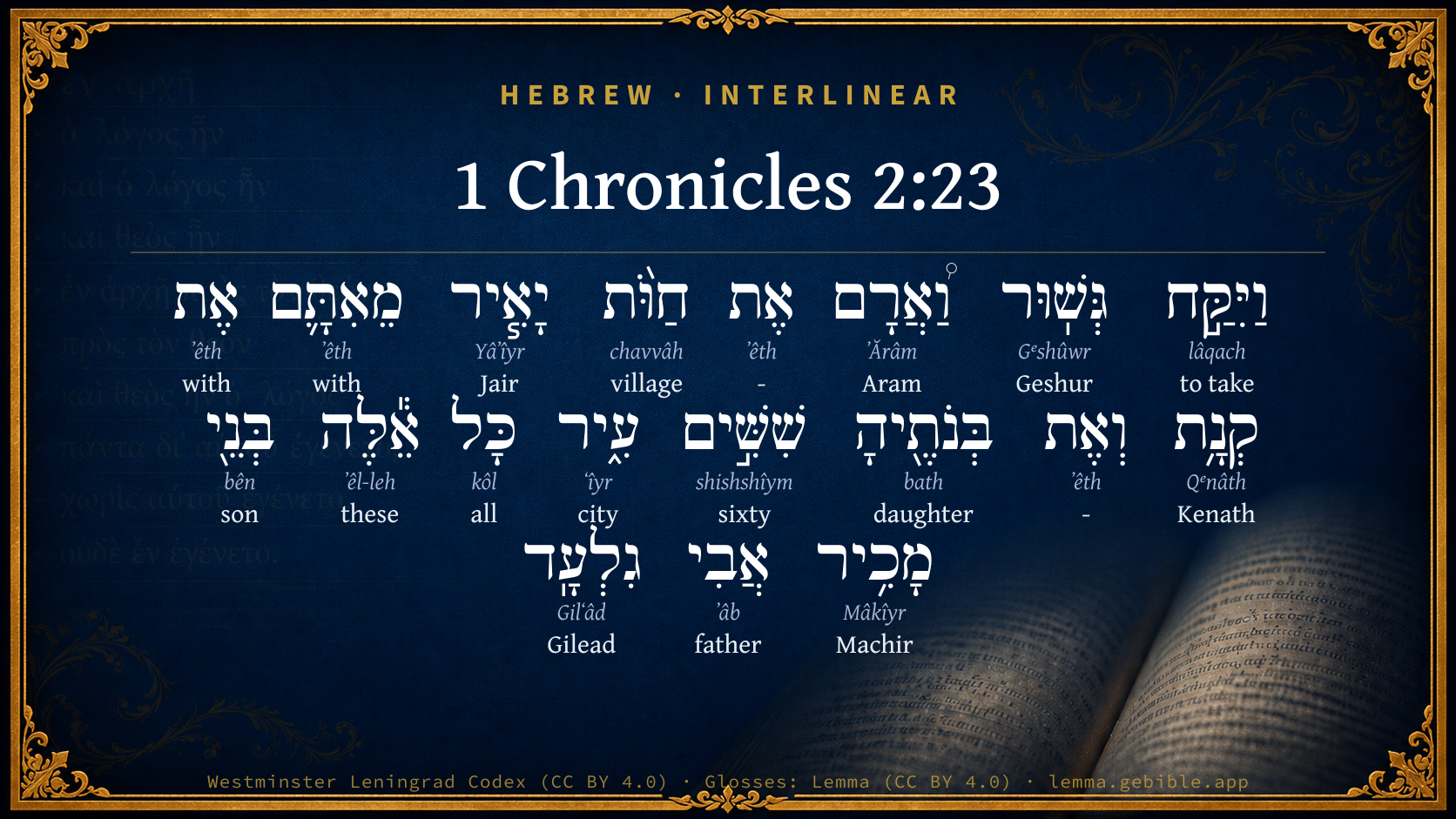
Hebrew (Westminster Leningrad Codex) 1 Chronicles 2:23 appears in the Hebrew Old Testament. The text above is from the Westminster Leningrad Codex. Each word links to its Strong’s number, a concise gloss, and parsing drawn from the Open Scriptures Hebrew Bible morphology. Click any word for its full Brown-Driver-Briggs (BDB) entry.
Download image
Cite this verse

1 Chronicles 2:23 (World English Bible). Public Domain. Lemma interlinear Bible study tool, https://lemma.gebible.app/v/1-chronicles/2/23.

Show BibTeX & RIS
BibTeX
RIS
English Translation
Geshur and Aram took the towns of Jair from them, with Kenath, and the villages of it, even sixty cities. All these were the sons of Machir the father of Gilead.
World English Bible · Public Domain
Download a study sheet

One document with this verse’s original text, its word-by-word gloss line, the meaning frame, cross-references with their text, attributed commentary, and full source and license credits — printable, and it pastes into notes with its structure intact.

This verse Autodidact and up

Study sheet (.html) Plain text (.txt)

A passage Seminary Student

Up to 50 verses in one chapter. A passage sheet keeps up to 6 commentary sources and 12 cross-references per verse, in the order this page ranks them, and says so on the sheet whenever that leaves anything out. Ask for a single verse and you get the Autodidact verse sheet above.

Everything on this page stays free to read, with no account — the sheet is a download of what is already on screen, not access to it.

Want to remove ads? Support Godless Engineer
Compare translations 3

The same verse in 3 English versions, stacked beneath the original-language interlinear above. Click any original word for its lexicon entry.

Each is an independent rendering of the whole verse — the interlinear is not word-aligned to these translations.

Highlighted words mark where these versions differ — a whole-verse word diff, not a word-by-word alignment.

  • World English Bible Public Domain
    Geshur and Aram took the towns of Jair from them, with Kenath, and the villages of it, even sixty cities. All these were the sons of Machir the father of Gilead.
  • King James Version Public Domain
    And he took Geshur, and Aram, with the towns of Jair, from them, with Kenath, and the towns thereof, even threescore cities. All these belonged to the sons of Machir the father of Gilead.
  • unfoldingWord Literal Text CC BY-SA 4.0
    And Geshur and Aram took from them Havvoth Jair, Kenath, and its daughters, 60 cities. All of these the sons of Machir, the father of Gilead. q1

unfoldingWord Literal Text — © unfoldingWord, licensed CC BY-SA 4.0. Word-aligned USFM3 via Door43 (git.door43.org/unfoldingWord/en_ult).

Versions to compare (up to 4)

3 of 4 selected

Show all 18 translations

Every available English version of this verse, each an independent rendering of the whole verse.

  • World English Bible Public Domain
    Geshur and Aram took the towns of Jair from them, with Kenath, and the villages of it, even sixty cities. All these were the sons of Machir the father of Gilead.
  • Berean Standard Bible Public Domain
    But Geshur and Aram captured Havvoth-jair, along with Kenath and its sixty surrounding villages. All these were descendants of Machir the father of Gilead.
  • Majority Standard Bible Public Domain
    But Geshur and Aram captured Havvoth-jair, along with Kenath and its sixty surrounding villages. All these were descendants of Machir the father of Gilead.
  • King James Version Public Domain
    And he took Geshur, and Aram, with the towns of Jair, from them, with Kenath, and the towns thereof, even threescore cities. All these belonged to the sons of Machir the father of Gilead.
  • American Standard Version (1901) Public Domain
    And Geshur and Aram took the towns of Jair from them, with Kenath, and the villages thereof, even threescore cities. All these were the sons of Machir the father of Gilead.
  • Revised Version (1885) Public Domain
    And Geshur and Aram took the towns of Jair from them, with Kenath, and the villages thereof, even threescore cities. All these were the sons of Machir the father of Gilead:
  • Geneva Bible (1599) Public Domain
    And Gesthur with Aram tooke the townes of Iair from them, and Kenath and the townes thereof, euen threescore cities. All these were the sonnes of Machir the father of Gilead.
  • Douay-Rheims (1899) Public Domain
    And he took Gessur, and Aram the towns of Jair, and Canath, and the villages thereof, threescore cities. All these, the sons of Machir father of Galaad.
  • Young's Literal Translation Public Domain
    and he taketh Geshur and Aram, the small villages of Jair, from them, with Kenath and its small towns, sixty cities -- all these `belonged to' the sons of Machir father of Gilead.
  • Literal Standard Version CC BY-SA 4.0
    and he takes Geshur and Aram, the small villages of Jair, from them, with Kenath and its small towns, sixty cities—all these [belonged to] the sons of Machir father of Gilead.
  • Unlocked Literal Bible CC BY-SA 4.0
    Geshur and Aram took Havvoth Jair and Kenath, as well as sixty surrounding towns. All these inhabitants were descendants of Makir, the father of Gilead.
  • unfoldingWord Literal Text CC BY-SA 4.0
    And Geshur and Aram took from them Havvoth Jair, Kenath, and its daughters, 60 cities. All of these the sons of Machir, the father of Gilead. q1
  • Darby Bible Public Domain
    and Geshur and Aram took the villages of Jair from them, with Kenath and its dependent towns, sixty cities. All these were sons of Machir the father of Gilead.
  • World Messianic Bible Public Domain
    Geshur and Aram took the towns of Jair from them, with Kenath, and its villages, even sixty cities. All these were the sons of Machir the father of Gilead.
  • Webster's Bible Public Domain
    And he took Geshur, and Aram, with the towns of Jair, from them, with Kenath and its towns, even sixty cities. All these belonged to the sons of Machir, the father of Gilead.
  • Free Bible Version CC BY-SA 4.0
    But Geshur and Aram took from them Havvoth Jair, along with Kenath and its towns, a total of sixty towns. These were all descendants of Makir the father of Gilead.
  • Bible in Basic English Public Domain
    And Geshur and Aram took the tent-towns of Jair from them, with Kenath and the small places round it, even sixty towns. All these were the sons of Machir, the father of Gilead.
  • JPS Tanakh (1917) Public Domain
    And Geshur and Aram took Havvoth-jair from them, with Kenath, and the villages thereof, even threescore cities. All these were the sons of Machir the father of Gilead.

Literal Standard Version (2020), Covenant Press — licensed CC BY-SA 4.0. Text via the HelloAO Bible API (eBible.org). Unlocked Literal Bible (unfoldingWord) — licensed CC BY-SA 4.0. Text via the HelloAO Bible API (eBible.org). unfoldingWord Literal Text — © unfoldingWord, licensed CC BY-SA 4.0. Word-aligned USFM3 via Door43 (git.door43.org/unfoldingWord/en_ult). Free Bible Version, Dr. Jonathan Gallagher — licensed CC BY-SA 4.0. Text via the HelloAO Bible API (eBible.org).

Word by word

More ways to search: Search by grammar → Find every occurrence → Compare this word →

Practice this passage: Drill this verse → Learn its vocabulary →

קְנָ֥ת
Qᵉnâth
H7079
“Kenath”
Noun, Proper
Part of Speech
Noun
Type
Proper
Full BDB Definition

Origin: from H7069

TWOT: None

Kenath = "possession" - a city in Gilead east of the Jordan taken possession of by a certain Nobah and renamed in his own honour
  1. וַיִּקַּ֣ח lâqach H3947 “and · to take” Conjunction + Verb, Qal, Sequential Imperfect, 3rd Person, Masculine, Singular
  2. גְּשֽׁוּר Gᵉshûwr H1650 “Geshur” Noun, Proper
  3. וַ֠אֲרָם ʼĂrâm H758 “and · Aram” Conjunction + Noun, Proper
  4. אֶת ʼêth H853 “-” Particle, Direct Object
  5. חַוֺּ֨ת chavvâh H2333 “villages of” Noun, Common, Feminine, Plural, Construct
  6. יָאִ֧יר Yâʼîyr H2971 “Jair” Noun, Proper
  7. מֵאִתָּ֛ם ʼêth H854 “from · with · them” Preposition + Preposition + Suffix, Personal, 3rd Person, Masculine, Plural
  8. אֶת ʼêth H854 “with” Preposition
  9. וְאֶת ʼêth H853 “and · -” Conjunction + Particle, Direct Object
  10. בְּנֹתֶ֖יהָ bath H1323 “daughters · her” Noun, Common, Feminine, Plural, Construct + Suffix, Personal, 3rd Person, Feminine, Singular
  11. שִׁשִּׁ֣ים shishshîym H8346 “sixty” Adjective, Cardinal number, Both, Plural, Absolute
  12. עִ֑יר ʻîyr H5892 “city” Noun, Common, Feminine, Singular, Absolute
  13. כָּל kôl H3605 “all of” Noun, Common, Masculine, Singular, Construct
  14. אֵ֕לֶּה ʼêl-leh H428 “these” Pronoun, Demonstrative, Common, Plural
  15. בְּנֵ֖י bên H1121 “sons of” Noun, Common, Masculine, Plural, Construct
  16. מָכִ֥יר Mâkîyr H4353 “Machir” Noun, Proper
  17. אֲבִי ʼâb H1 “father of” Noun, Common, Masculine, Singular, Construct
  18. גִלְעָֽד Gilʻâd H1568 “Gilead” Noun, Proper

About this verse

These counts appear in no published source. They are computed here, from the morphology-tagged text and Lemma’s own curated glosses. What Lemma adds →

19
words
17
distinct lemmas
Historical
section

Notable vocabulary

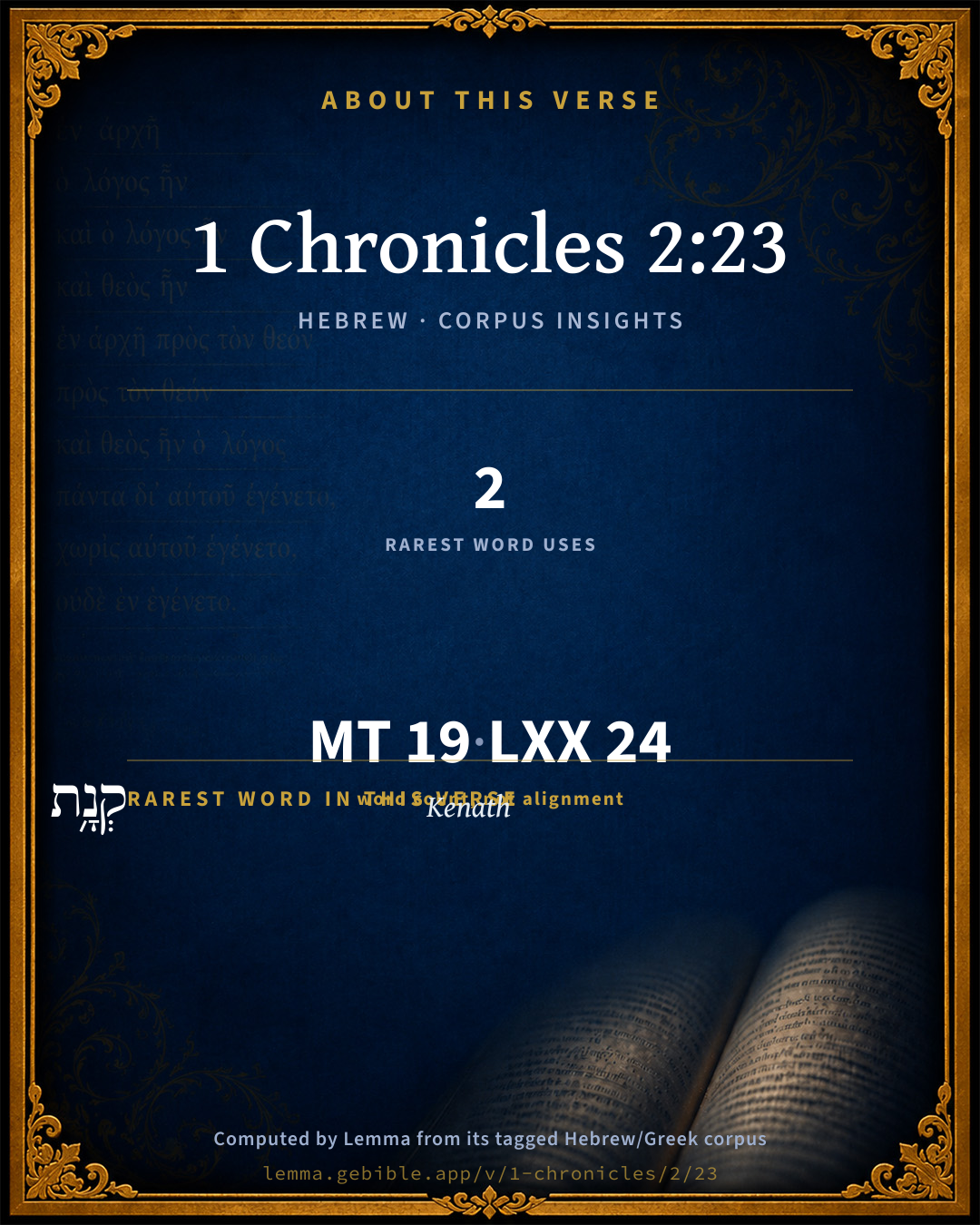
The rarest word here is קְנָ֥ת Kenath H7079 — appearing just 2 times in the whole Hebrew Bible.

Shared distinctive vocabulary

קְנָ֥ת Kenath H7079 occurs in 2 verses of the Hebrew Bible. Also found in:

Grammatical profile

  • 1 verb
  • 12 nouns
  • 1 adjective
  • 1 pronoun
  • 2 prepositions
  • 2 particles

Verb forms

  • וַיִּקַּ֣ח Qal · Sequential Imperfect

Repetition

A word recurs within this verse — often emphatic in Hebrew:

  • מֵאִתָּ֛ם with H854 ×2

Hebrew & Septuagint length

In English translation the verse runs 31 words from the Hebrew and 31 from the Septuagint (LXX English) — the same length.

A rough comparison of the two English renderings, which tokenize alike — not a word-level alignment.

Word counts can differ between the Hebrew and the Greek without any difference in meaning — e.g. the Hebrew direct-object marker אֵת has no separate Greek word, and Greek often adds the article ὁ.

In the original languages it is 19 Hebrew tokens and 24 Greek tokens — but the two are counted differently (Hebrew bundles its prefixes and suffixes into one token; the Greek is in lemma form), so that isn’t a like-for-like length.

Cross-references

5

Topical passages linked to 1 Chronicles 2:23 in the Treasury of Scripture Knowledge — connected by theme and wording, ordered by reader-vote popularity; previews shown in the World English Bible.

  • Numbers 32:41–42 Jair the son of Manasseh went and took the towns of it, and called them Havvoth Jair.
  • Deuteronomy 3:14 Jair the son of Manasseh took all the region of Argob, to the border of the Geshurites and the Maacathites, and called them, even Bashan, after his own name, Havvoth Jair, to this day.)
  • Joshua 13:13 Nevertheless the children of Israel didn't drive out the Geshurites, nor the Maacathites: but Geshur and Maacath dwell in the midst of Israel to this day.
  • Joshua 13:30 Their border was from Mahanaim, all Bashan, all the kingdom of Og king of Bashan, and all the towns of Jair, which are in Bashan, sixty cities:
  • 2 Samuel 13:38 So Absalom fled, and went to Geshur, and was there three years.

Cross-references courtesy of OpenBible.info (CC BY 4.0).

Hebrew and Greek witnesses Masoretic Hebrew ↔ Greek Septuagint

The same verse in the two great witnesses to the Old Testament, shown verse-for-verse.

These are two independent witnesses, not word-aligned to each other, and the Septuagint is shown in lemma (dictionary) form.

Hebrew 1 Chronicles 2:23 Masoretic · Westminster Leningrad Codex

וַיִּקַּ֣ח גְּשֽׁוּר וַ֠אֲרָם אֶת חַוֺּ֨ת יָאִ֧יר מֵאִתָּ֛ם אֶת קְנָ֥ת וְאֶת בְּנֹתֶ֖יהָ שִׁשִּׁ֣ים עִ֑יר כָּל אֵ֕לֶּה בְּנֵ֖י מָכִ֥יר אֲבִי גִלְעָֽד

Geshur and Aram took the towns of Jair from them, with Kenath, and the villages of it, even sixty cities. All these were the sons of Machir the father of Gilead.

World English Bible · Public Domain

Greek LXX 1 Chronicles 2:23 Septuagint · lemma form

καί λαμβάνω γεδσουρ καί αραμ ὁ κώμη ιαϊρ ἐκ αὐτός ὁ καναθ καί ὁ κώμη αὐτός ἑξήκοντα πόλις πᾶς οὗτος υἱός μαχιρ πατήρ γαλαάδ

And he took Gedsur and Aram, the towns of Jair from them; with Canath and its towns, sixty cities. All these belonged to the sons of Machir the father of Galaad.

LXX2012 (modern English Septuagint) · Public Domain

On this verse, Haydock's Catholic Bible Commentary discusses the Septuagint’s reading. Read the note in Commentary ↓

Hebrew: Westminster Leningrad Codex (CC BY 4.0). Greek: Septuagint (public domain); English from LXX2012 (modern English Septuagint) (Public Domain). How the Septuagint differs from the Hebrew →

Commentary

Notes on 1 Chronicles 2:23 from classic Christian and Jewish commentators (each source and its license shown beneath its notes). The classic Christian expositions comment on the surrounding passage and are grouped to its opening verse, so a note may address several verses; the Jewish commentaries on the Tanakh (Rashi and others) are per-verse, so they appear only where the commentator wrote on this verse.

Lemma curates 59 commentaries, every one of them public domain or Creative Commons licensed, each selected and text-cleaned for this edition rather than reprinted as found. About our sources →

Joseph Benson's Commentary

1Ch 2:23. All these belonged to the sons of Machir — Partly to his own sons, and partly to his son-in-law Jair, who by reason of that dear affection which was between them, and his forsaking his own tribe and kindred to fight for them, and to dwell with them, is here reckoned as his own son.

Joseph Benson's Commentary on the Old and New Testaments (1811–1818) — public domain. Text from a community e-Sword module.

Geneva Bible (1599)

Geneva Bible translators

That is, the Geshurites and Syrians took the towns from Jair’s children.

Geneva Bible (1599) marginal notes — public domain. Text via Bolls.life.

Jamieson, Fausset & Brown

Robert Jamieson, A. R. Fausset & David Brown

he took--rather "he had taken." This statement is accounting for his acquisition of so large a territory; he got it by right of conquest from the former possessors.

Kenath--This place, along with its group of surrounding villages, was gained by Nobah, one of Jair's officers sent by him to capture it (Num 32:1-2).

All these belonged to the sons of Machir--In their number Jair is included as having completely identified himself by his marriage and residence in Gilead with the tribe of Manasseh.

Jamieson, Fausset & Brown — Commentary Critical and Explanatory on the Whole Bible (1871) — public domain (CC PDM 1.0). Text via the HelloAO Bible API.

Ellicott's Commentary for English Readers

(23) And he took . . . of Gilead.—Rather, And Geshur and Aram took the Havoth-jair from them—Kenath and her daughters, sixty cities: all these (were) sons of Machir, chief of Gilead.

Geshur, and Aram.—That is, the Aramean state of Geshur, north-west of Bashan, near Hermon and the Jordan, which was an independent kingdom in the age of David (2Sa_3:3). The Geshurites “took the tent-villages of Jair from them”—i.e., from the sons of Jair, or the Jairites, at what date is unknown. Comp. Deu_3:14-15, above cited.

With Kenath.—The Hebrew particle before “Kenath” may be either the sign of the object of the verb, or the preposition “with.” In the latter case, the statement of the verse will be that the twenty-three villages of Jair, together with the (thirty-seven) places called Kenath and her daughters, amounting in all to sixty towns, were taken by the Geshurites. See Num_32:41-42, where it is said that Jair occupied the Havoth-jair, and “Nobah went and took Kenath and her daughters, and called it Nobah after his own name.” Kenath is the modern Kanwat, on the western slope of Jebel Hauran.

It is difficult to reconcile all the different statements about the Havoth-jair. Jdg_10:3-4, for example, speaks of Jair the Gileadite, who judged Israel twenty -two years, and “had thirty sons that rode on thirty ass colts,” and, moreover, possessed “thirty cities, which are called Havoth-jair unto this day.” Jos_13:30 seems to make the Havoth-jair sixty towns. Comp. 1Ki_4:13; also 1Ch_2:21, where Hezron is sixty when he marries the Gileadite daughter of Machir.

Of course the number of places included in the “camps of Jair” may have varied at different epochs.

All these belonged to the sons of Machir.—Or, all these were sons of Machir—i.e., the clans and families that came of the union of Hezron with the daughter of ‘Machir. (See Note on 1Ch_2:21; and Jos_19:34.)

A Bible Commentary for English Readers, edited by Charles John Ellicott (1878–1897) — public domain. Text from a community e-Sword module.

The Cambridge Bible for Schools and Colleges

gen. ed. J. J. S. Perowne

23. And he took Geshur, and Aram, with the towns] R.V. And Geshur and Aram took the towns. Geshur was a (probably Aramaean) kingdom E. of Jordan on the N.E. border of Manasseh. Aram, commonly translated “Syria” or “the Syrians” probably here signifies the kingdom of which Damascus was the capital. The conquest of Manassite territory by the Aramaeans (“Syrians”) here described probably took place before the days of Ahab, for in his reign they were already established as far south as Ramoth-gilead (1Ki_22:3).

the towns of Jair] R.V. marg., Havvoth Jair. Cp. Deu_3:14; Jdg_10:4. The name perhaps means “the tent-villages of Jair,” (Arab. ḥǐvâ = “a collection of tents near together”).

The Cambridge Bible for Schools and Colleges (gen. ed. J. J. S. Perowne; Cambridge University Press, 1878–1918) — public domain. Text from a community e-Sword module.

John Gill's Exposition

And the name of the wife of Abishur was Abihail,.... Of the same name was a wife of Rehoboam, a daughter of his grandfather David's eldest brother, Eliab, Ch2 11:18.

and she bare him Ahban, and Molid; which are no more mentioned, they perhaps leaving no posterity.

John Gill's Exposition of the Whole Bible (1746–1763) — public domain (CC PDM 1.0). Text via the HelloAO Bible API.

Albert Barnes' Notes on the Bible

Rather, “And Geshur and Aram (i. e. the Geshurites Deu 3:14 and Syrians) took the villages of Jair from them:” recovered, that is, from the new settlers the places which Jair had conquered.

All these belonged to the sons of Machir - Rather, “All these were sons of Machir,” i. e. Segub and Jair, with their descendants, were reckoned sons of Machir, rather than sons of Hezron, although only descended from Machir on the mother’s side. The reason of this seems to have been that they cast in their lot with the Manassites, and remained in their portion of the trans-Jordanic region.

Albert Barnes' Notes on the Bible (1834–1885) — public domain. Text from a community e-Sword/MySword module.

Haydock's Catholic Bible Commentary

Aram. Protestants add "with the towns of Jair from them," the former possessors; (Haydock) or Gessur assisted Aram (Syria) in attacking Israel, 4 Kings x. 32. (Calmet) --- All these villages. Protestants supply, "belonged to the sons." Septuagint, "were of the sons." All these were dependencies of Machir, "prince" of Galaad; in which sense father is taken, ver. 24. (Menochius) --- Sons often denote nephews, &c. (Worthington)

George Leo Haydock (1774–1849), Haydock's Catholic Family Bible and Commentary, 1859 edition — public domain. Excludes Psalms (Douay-Rheims chapter numbering differs from Protestant) and Deuterocanonical books (Catholic canon only).

Matthew Poole's English Annotations

And he took, or, for he had taken. So this is the reason why he had so great a territory and jurisdiction given to him.

Geshur and Aram; two cities or great towns so called.

With the towns of Jair, i.e. with those twenty-three cities which he is said to have, 1Ch 2:22.

From them, i.e. from the former inhabitants, which is easily understood.

With Kenath; which was taken by Nobah, one of Jair’s commanders, sent by him to take it, as may be gathered from Num 32:41,42.

To the sons of Machir; partly to his own sons, and partly to his son-in-law Jair, who by reason of that dear affection which was betwixt them and his forsaking his own tribe and kindred to fight for them, and to dwell with them, is here reckoned as his own son.

Matthew Poole's English Annotations on the Holy Bible (1683–1685) — public domain. Text from a community e-Sword/MySword module.

The Pulpit Commentary

Geshur was a small district between Argob and Bashan; and Aram, commonly translated Syria, i.e. the ancient Syria, viz. the territory of Damascus. Kenath, rechristened by its subduer Nobah, (Num_32:42) and retaining this name at the time of Gideon, and Zeba and Sahnunnah subsequently vindicated the life of its old name, and regained it, replaced in the present day by Kenawat. And the towns thereof; Hebrew literally, her daughters; i.e. the small, subordinate groups of people. Num_21:25, "All the villages thereof," literally, daughters All these belonged to the sons of Machir, the father of Gilead, might perhaps be open to the translation, "All these were the possessions of Machir, the possessor of Gilead."

The Pulpit Commentary (1880–1919), ed. H.D.M. Spence-Jones & Joseph S. Exell — public domain. Text from a community e-Sword module.

John Wesley's Explanatory Notes

Sons of Machir - Partly to his own sons, and partly to his son- in-law Jair, who by reason of that dear affection which was betwixt them, and his forsaking his own tribe and kindred to fight for them and to dwell with them, is here reckoned as his own son.

John Wesley, Explanatory Notes Upon the Whole Bible (1754–1765) — public domain. Text via the GEBible commentary corpus.

Keil & Delitzsch

C. F. Keil & F. Delitzsch

And the name of the wife of Abishur was Abihail,.... Of the same name was a wife of Rehoboam, a daughter of his grandfather David's eldest brother, Eliab, Ch2 11:18.

and she bare him Ahban, and Molid; which are no more mentioned, they perhaps leaving no posterity.

Keil & Delitzsch — Biblical Commentary on the Old Testament (1861–1891) — public domain (CC PDM 1.0). Text via the HelloAO Bible API. (Old Testament only.)

unfoldingWord translationNotes

Door43 World Missions Community

Geshur ... Aram

These are names of people groups named after ancestors. Translate "Aram" as in 1 Chronicles 1:17.

Havvoth Jair and Kenath

These are the names of places. (See: How to Translate Names)

Makir ... Gilead ... Hezron ... Caleb ... Ashhur ... Tekoa

These are the names of men. (See: How to Translate Names)

Ephrathah

This is the name of a woman. (See: How to Translate Names)

bore him

"gave birth to his son"

translationWords

Aram

descend

had relations with

unfoldingWord translationNotes — © Distant Shores Media and the Door43 World Missions Community, licensed CC BY-SA 4.0. Source: git.door43.org/Door43/en_tn.

Rashi

Rabbi Shlomo Yitzchaki (Rashi)

And Geshur and Aram took Geshur represents the Geshurites and the Maacathites because they were near the Arameans, who dwelt in the east of the land of Israel, and Aram dwelt in the east, as it is written (Isa. 9:11): “Aram from the east and the Philistines from the west.” During the period of the Judges (Jud. 3:8), when Israel sinned, He (God) delivered them into the hands of the enemy, into the hands of Aram, and then (these) went and took them from them, and when David came, he restored them, and because he restored them, Scripture mentioned them here.

Rashi on the Tanakh — English translations: “The Judaica Press complete Tanach with Rashi, translated by A. J. Rosenberg” (CC BY 4.0); “Pentateuch with Rashi's commentary by M. Rosenbaum and A.M. Silbermann, 1929-1934” (public domain); “The Metsudah Tanach series, Lakewood, N.J” (CC BY 4.0); and “The Book of Joshua, Metsudah Publications, 1997” (CC BY 4.0). Text via Sefaria.

Lesson kit

Teaching starters — assembled from the data on this page, not authored interpretation. Every prompt links to the verse data it draws on. Edit before teaching.

1 Chronicles, in the Historical, opens this verse with 19 words (17 distinct Hebrew lemmas). Its most distinctive word is Qᵉnâth (“Kenath”). A historical commentator’s framing appears above. Read the whole chapter for the surrounding context.

Discussion questions

  1. The word Qᵉnâth carries the sense “Kenath.” How does it shape the verse?
  2. Numbers 32:42 shares the word «Kenath» with this verse. How do the two illuminate each other?
  3. “with” occurs 2× in this one verse. What is the effect of the repetition?
  4. These translations render this verse differently. What is at stake in choosing one wording over another?
  5. The verb «וַיִּקַּ֣ח» is Qal Sequential Imperfect. How does its form color the action?
  6. Reading how Joseph Benson's Commentary and Geneva Bible (1599) read this verse, where do the two commentators agree and where do they part?

Things to notice

Reading settings

Reading text

Shown beneath each verse's original-language words.

Old Testament
Old Testament edition

Read the OT as the Masoretic Hebrew (MT) or the Greek Septuagint (LXX).

English shown for the Greek Septuagint (in the Hebrew ↔ Greek comparison).

Comparing translations? Open the Compare panel on any verse page to stack up to four side by side.