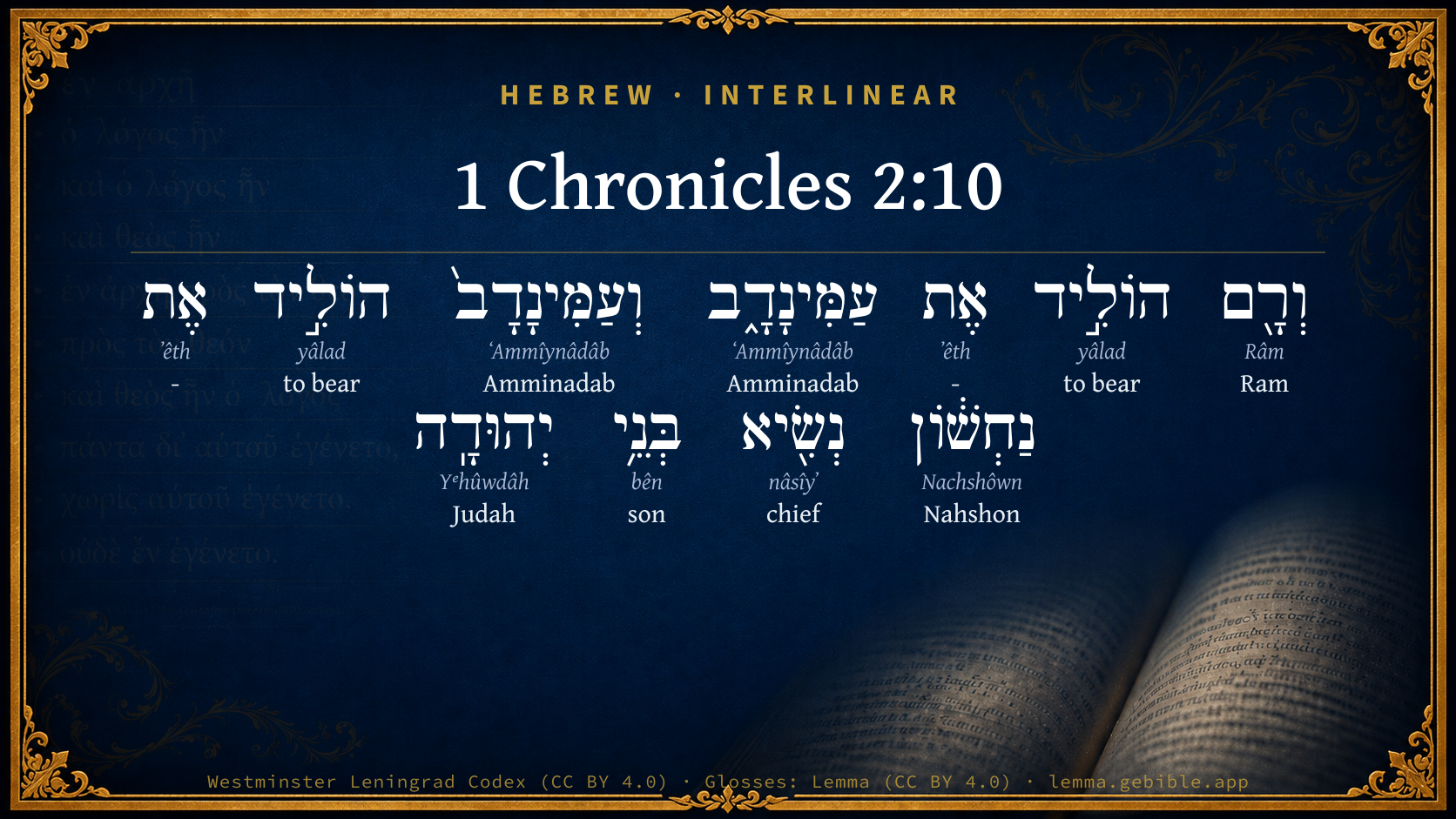
1 Chronicles 2:10

Hebrew (Westminster Leningrad Codex) 1 Chronicles 2:10 appears in the Hebrew Old Testament. The text above is from the Westminster Leningrad Codex. Each word links to its Strong’s number, a concise gloss, and parsing drawn from the Open Scriptures Hebrew Bible morphology. Click any word for its full Brown-Driver-Briggs (BDB) entry.
Download image
Cite this verse

1 Chronicles 2:10 (World English Bible). Public Domain. Lemma interlinear Bible study tool, https://lemma.gebible.app/v/1-chronicles/2/10.

Show BibTeX & RIS
BibTeX
RIS
English Translation
Ram became the father of Amminadab, and Amminadab became the father of Nahshon, prince of the children of Judah;
World English Bible · Public Domain
Download a study sheet

One document with this verse’s original text, its word-by-word gloss line, the meaning frame, cross-references with their text, attributed commentary, and full source and license credits — printable, and it pastes into notes with its structure intact.

This verse Autodidact and up

Study sheet (.html) Plain text (.txt)

A passage Seminary Student

Up to 50 verses in one chapter. A passage sheet keeps up to 6 commentary sources and 12 cross-references per verse, in the order this page ranks them, and says so on the sheet whenever that leaves anything out. Ask for a single verse and you get the Autodidact verse sheet above.

Everything on this page stays free to read, with no account — the sheet is a download of what is already on screen, not access to it.

Want to remove ads? Support Godless Engineer
Compare translations 3

The same verse in 3 English versions, stacked beneath the original-language interlinear above. Click any original word for its lexicon entry.

Each is an independent rendering of the whole verse — the interlinear is not word-aligned to these translations.

Highlighted words mark where these versions differ — a whole-verse word diff, not a word-by-word alignment.

  • World English Bible Public Domain
    Ram became the father of Amminadab, and Amminadab became the father of Nahshon, prince of the children of Judah;
  • King James Version Public Domain
    And Ram begat Amminadab; and Amminadab begat Nahshon, prince of the children of Judah;
  • unfoldingWord Literal Text CC BY-SA 4.0
    And Ram fathered Amminadab, and Amminadab fathered Nahshon, the leader of the sons of Judah.

unfoldingWord Literal Text — © unfoldingWord, licensed CC BY-SA 4.0. Word-aligned USFM3 via Door43 (git.door43.org/unfoldingWord/en_ult).

Versions to compare (up to 4)

3 of 4 selected

Show all 18 translations

Every available English version of this verse, each an independent rendering of the whole verse.

  • World English Bible Public Domain
    Ram became the father of Amminadab, and Amminadab became the father of Nahshon, prince of the children of Judah;
  • Berean Standard Bible Public Domain
    Ram was the father of Amminadab, and Amminadab was the father of Nahshon, a leader of the descendants of Judah.
  • Majority Standard Bible Public Domain
    Ram was the father of Amminadab, and Amminadab was the father of Nahshon, a leader of the descendants of Judah.
  • King James Version Public Domain
    And Ram begat Amminadab; and Amminadab begat Nahshon, prince of the children of Judah;
  • American Standard Version (1901) Public Domain
    And Ram begat Amminadab, and Amminadab begat Nahshon, prince of the children of Judah;
  • Revised Version (1885) Public Domain
    And Ram begat Amminadab; and Amminadab begat Nahshon, prince of the children of Judah;
  • Geneva Bible (1599) Public Domain
    And Ram begate Aminadab, and Aminadab begate Nahshon prince of the children of Iudah,
  • Douay-Rheims (1899) Public Domain
    And Ram beget Aminadab, and Aminadab beget Nahasson, prince of the children of Juda.
  • Young's Literal Translation Public Domain
    And Ram begat Amminadab, and Amminadab begat Nahshon, prince of the sons of Judah;
  • Literal Standard Version CC BY-SA 4.0
    And Ram begot Amminadab, and Amminadab begot Nahshon, prince of the sons of Judah;
  • Unlocked Literal Bible CC BY-SA 4.0
    Ram became the father of Amminadab, and Amminadab became the father of Nahshon, a leader among Judah's descendants.
  • unfoldingWord Literal Text CC BY-SA 4.0
    And Ram fathered Amminadab, and Amminadab fathered Nahshon, the leader of the sons of Judah.
  • Darby Bible Public Domain
    And Ram begot Amminadab; and Amminadab begot Nahshon, prince of the children of Judah;
  • World Messianic Bible Public Domain
    Ram became the father of Amminadab, and Amminadab became the father of Nahshon, prince of the children of Judah;
  • Webster's Bible Public Domain
    And Ram begat Amminadab; and Amminadab begat Nahshon, prince of the children of Judah;
  • Free Bible Version CC BY-SA 4.0
    Ram was the father of Amminadab, and Amminadab was the father of Nahshon, a leader of Judah's descendants.
  • Bible in Basic English Public Domain
    And Ram was the father of Amminadab; and Amminadab was the father of Nahshon, chief of the children of Judah;
  • JPS Tanakh (1917) Public Domain
    And Ram begot Amminadab; and Amminadab begot Nahshon, prince of the children of Judah;

Literal Standard Version (2020), Covenant Press — licensed CC BY-SA 4.0. Text via the HelloAO Bible API (eBible.org). Unlocked Literal Bible (unfoldingWord) — licensed CC BY-SA 4.0. Text via the HelloAO Bible API (eBible.org). unfoldingWord Literal Text — © unfoldingWord, licensed CC BY-SA 4.0. Word-aligned USFM3 via Door43 (git.door43.org/unfoldingWord/en_ult). Free Bible Version, Dr. Jonathan Gallagher — licensed CC BY-SA 4.0. Text via the HelloAO Bible API (eBible.org).

Word by word

More ways to search: Search by grammar → Find every occurrence → Compare this word →

Practice this passage: Drill this verse → Learn its vocabulary →

About this verse

These counts appear in no published source. They are computed here, from the morphology-tagged text and Lemma’s own curated glosses. What Lemma adds →

11
words
8
distinct lemmas
Historical
section

Notable vocabulary

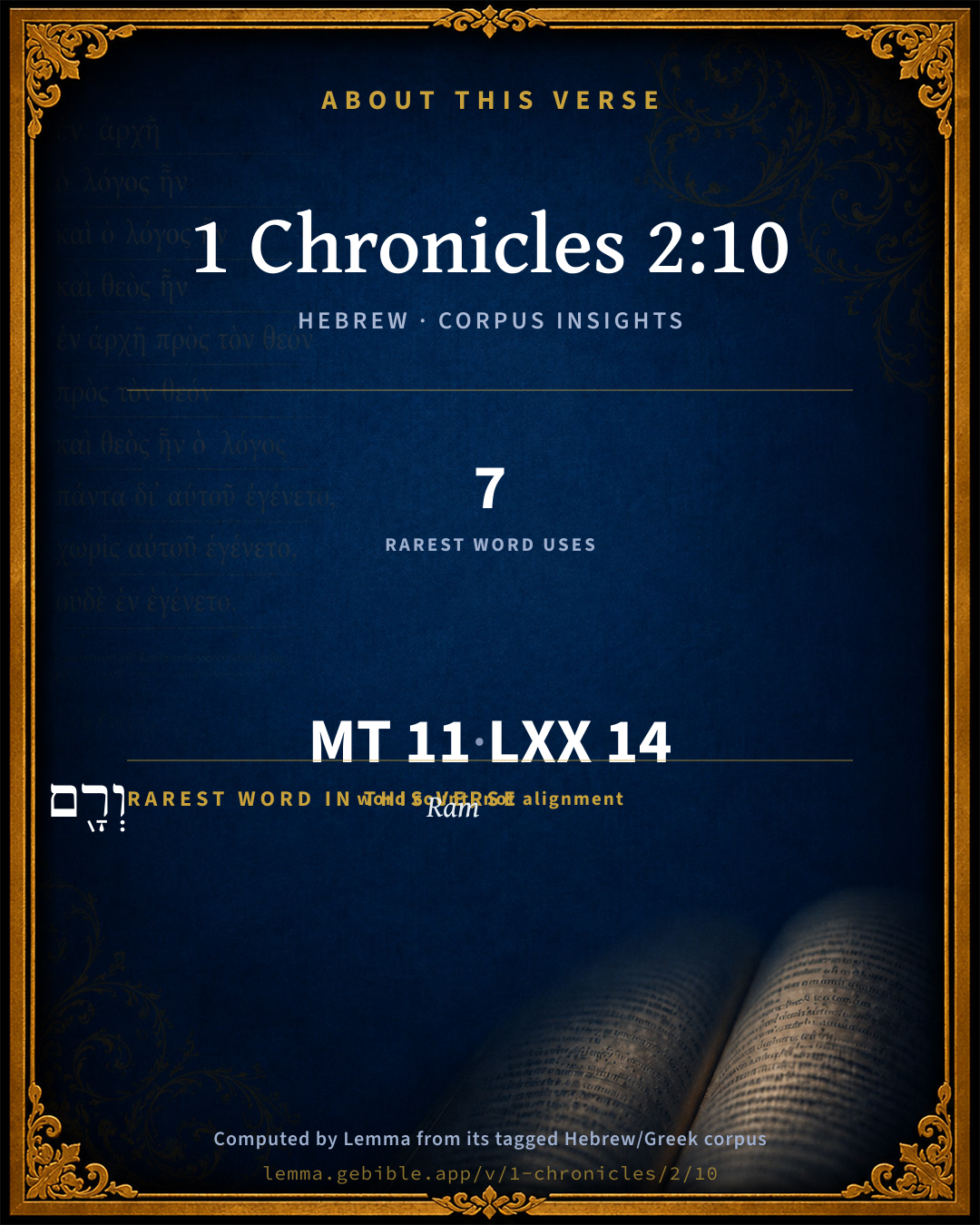
The rarest word here is וְרָ֖ם Ram H7410 — appearing just 7 times in the whole Hebrew Bible.

Shared distinctive vocabulary

וְרָ֖ם Ram H7410 occurs in 6 verses of the Hebrew Bible. Also found in:

Grammatical profile

  • 2 verbs
  • 7 nouns
  • 2 particles

Verb forms

  • הוֹלִ֣יד Hiphil · Perfect
  • הוֹלִ֣יד Hiphil · Perfect

Repetition

Words recur within this verse — often emphatic in Hebrew:

  • הוֹלִ֣יד to bear H3205 ×2
  • עַמִּינָדָ֑ב Amminadab H5992 ×2

Hebrew & Septuagint length

In English translation the verse runs 19 words from the Hebrew and 14 from the Septuagint (LXX English) — closely comparable.

A rough comparison of the two English renderings, which tokenize alike — not a word-level alignment.

Word counts can differ between the Hebrew and the Greek without any difference in meaning — e.g. the Hebrew direct-object marker אֵת has no separate Greek word, and Greek often adds the article ὁ.

In the original languages it is 11 Hebrew tokens and 14 Greek tokens — but the two are counted differently (Hebrew bundles its prefixes and suffixes into one token; the Greek is in lemma form), so that isn’t a like-for-like length.

Cross-references

8

Topical passages linked to 1 Chronicles 2:10 in the Treasury of Scripture Knowledge — connected by theme and wording, ordered by reader-vote popularity; previews shown in the World English Bible.

  • Matthew 1:4 Ram became the father of Amminadab. Amminadab became the father of Nahshon. Nahshon became the father of Salmon.
  • Numbers 1:7 Of Judah: Nahshon the son of Amminadab.
  • Numbers 2:3 Those who encamp on the east side toward the sunrise shall be of the standard of the camp of Judah, according to their divisions: and the prince of the children of Judah shall be Nahshon the son of Amminadab.
  • Ruth 4:19–20 and Hezron became the father of Ram, and Ram became the father of Amminadab,
  • Luke 3:32–33 the son of Jesse, the son of Obed, the son of Boaz, the son of Salmon, the son of Nahshon,
  • Numbers 7:12 He who offered his offering the first day was Nahshon the son of Amminadab, of the tribe of Judah,
  • Numbers 7:17 and for the sacrifice of peace offerings, two oxen, five rams, five male goats, and five male lambs a year old. This was the offering of Nahshon the son of Amminadab.
  • Numbers 10:14 In the first [place] the standard of the camp of the children of Judah set forward according to their hosts: and over his host was Nahshon the son of Amminadab.

Cross-references courtesy of OpenBible.info (CC BY 4.0).

Hebrew and Greek witnesses Masoretic Hebrew ↔ Greek Septuagint

The same verse in the two great witnesses to the Old Testament, shown verse-for-verse.

These are two independent witnesses, not word-aligned to each other, and the Septuagint is shown in lemma (dictionary) form.

Hebrew 1 Chronicles 2:10 Masoretic · Westminster Leningrad Codex

וְרָ֖ם הוֹלִ֣יד אֶת עַמִּינָדָ֑ב וְעַמִּינָדָב֙ הוֹלִ֣יד אֶת נַחְשׁ֔וֹן נְשִׂ֖יא בְּנֵ֥י יְהוּדָֽה

Ram became the father of Amminadab, and Amminadab became the father of Nahshon, prince of the children of Judah;

World English Bible · Public Domain

Greek LXX 1 Chronicles 2:10 Septuagint · lemma form

καί αραμ γεννάω ὁ αμιναδαβ καί αμιναδαβ γεννάω ὁ ναασσων ἄρχων ὁ οἶκος ἰουδά

And Aram begot Aminadab, and Aminadab begot Naasson, chief of the house of Juda.

LXX2012 (modern English Septuagint) · Public Domain

On this verse, The Pulpit Commentary discusses the Septuagint’s reading. Read the note in Commentary ↓

Hebrew: Westminster Leningrad Codex (CC BY 4.0). Greek: Septuagint (public domain); English from LXX2012 (modern English Septuagint) (Public Domain). How the Septuagint differs from the Hebrew →

Commentary

Notes on 1 Chronicles 2:10 from classic Christian and Jewish commentators (each source and its license shown beneath its notes). The classic Christian expositions comment on the surrounding passage and are grouped to its opening verse, so a note may address several verses; the Jewish commentaries on the Tanakh (Rashi and others) are per-verse, so they appear only where the commentator wrote on this verse.

Lemma curates 59 commentaries, every one of them public domain or Creative Commons licensed, each selected and text-cleaned for this edition rather than reprinted as found. About our sources →

Trapp's Complete Commentary

John Trapp

1Ch 2:10 And Ram begat Amminadab; and Amminadab begat Nahshon, prince of the children of Judah;

1Ch 2:11 And Nahshon begat Salma, and Salma begat Boaz,

1Ch 2:12 And Boaz begat Obed, and Obed begat Jesse,

Ver. 10-12. {See Trapp on "Mat 1:3"} {See Trapp on "Mat 1:4"} {See Trapp on "Mat 1:5"}

John Trapp, A Commentary or Exposition upon All the Books of the Old and New Testament (1647–1656) — public domain. Text from a community e-Sword module.

Tyndale Open Study Notes

Tyndale Open Resources

2:10-17 The passage dedicated to the descendants of Ram provides a direct line of descent from Ram to Jesse, then records Jesse’s children.

Tyndale Open Study Notes — © Tyndale Open Resources, licensed CC BY-SA 4.0. Text via the HelloAO Bible API.

Geneva Bible (1599)

Geneva Bible translators

That is, chief of the family.

Geneva Bible (1599) marginal notes — public domain. Text via Bolls.life.

Ellicott's Commentary for English Readers

I.—(10-17) The descent of David from Amminadab, of the house of Ram. The royal line naturally takes precedence of the other two. Rth_4:18-22 gives this line from Pharez to David. (Compare the genealogies of Christ, Matthew 1 and Luke 3) Nahshon is called chief of Judah in Num. ii 3 (comp. 1Ch_1:7; 1Ch_7:12), at the time of the Exodus.

(11) Salma.—So in Rth_4:20; but in 1Ch_2:21, Mat_1:4, and Luk_3:32, Salmon.

(13-17) The family of Jesse (Heb., Yishai in 1Ch_2:12, but ‘Ishai in 1Ch_2:13).

Seven sons are here named. 1Sa_17:12-13 states that Jesse had eight sons; and from 1Sa_16:6-10 (Heb.) it appears that he had that number. In both passages, Eliab, Abinadab, and Shimma (Heb., Shim‘â, here and at 1Ch_20:7) occur, the last under the form Shammah. He is called Shimei (2Sa_21:21); but Shimeah == Shim’ah (2Sa_13:3; 2Sa_13:32); and this appears to have been his real name.

(14, 15) Nethaneel . . . Raddai . . . Ozem.—Not named elsewhere in the Scriptures. The son of Jesse, omitted in our present Heb. text, is called Elihu in the Syriac version, which makes him seventh and David the eighth. The name Elihu occurs in 1Ch_27:18 for Eliab.

(16) Whose sisters were Zeruiah, and Abigail.—Literally, And their sisters, &c. If the reading in 2Sa_17:25 be correct, these two women were daughters of Nahash, who must therefore have been a wife of Jesse. Abigail (there called Abigal) was mother of the warrior Amasa, who became Absalom’s general (2Sa_19:13), and was afterwards assassinated by Joab (2Sa_20:10).

Abishai.—Abshai, here and elsewhere in the chronicle.

Joab, the famous commander-in-chief of David’s forces (see 1Ch_11:6-8); and for Joab and Abishai, who, like Asahel, was one of David’s heroes (1Ch_11:20; 1Ch_11:26), comp. 1Ch_18:12; 1Ch_18:15; 1Ch_19:10 seq., 1Ch_21:2 et seq., 1Ch_27:24. David’s champions were thus his immediate kin, just as Abner was to Saul.

(17) Jether the Ishmeelite.—Incorrectly called “Ithra an Israelite” in 2Sa_17:25. The later abhorrence of alien marriages seems to have been unknown in the age of David. The name of Zeruiah’s husband is unknown.

II.—The Calebite stock (1Ch_2:18-24).

A Bible Commentary for English Readers, edited by Charles John Ellicott (1878–1897) — public domain. Text from a community e-Sword module.

The Cambridge Bible for Schools and Colleges

gen. ed. J. J. S. Perowne

10. Ram] The descent of David from Judah is given also Rth_4:18-22 and Mat_1:3-6.

Nahshon, prince, etc.] See Num_1:4; Num_1:7; Num_2:3.

The Cambridge Bible for Schools and Colleges (gen. ed. J. J. S. Perowne; Cambridge University Press, 1878–1918) — public domain. Text from a community e-Sword module.

John Gill's Exposition

And Caleb the son of Hezron,.... The same that is called Chelubai, Ch1 2:9 but not the same with Caleb the son of Jephunneh, made mention of in the books of Numbers, Joshua, and Judges:

he begat children of Azubah his wife, and of Jerioth; who were both his wives; or it may be rather, since Azubah is so particularly called his wife, Jerioth might be a concubine: or of Azubah he begat Jerioth; so the Vulgate Latin, Syriac, and Arabic versions; though it seems best with Hillerus (p) to interpret these names of the same person, and render the last clause, "that is, of Jerioth", of her whose name also was Jerioth, Azubah having two names; and the rather, since only the children of one are mentioned, as follows:

her sons are these; Jesher, and Shobab, and Ardon of whom we read nowhere else; the Targum says, Azubah was so called, because she was barren and despised, which this clause contradicts.

(p) Onomastic. Sacr. p. 568.

John Gill's Exposition of the Whole Bible (1746–1763) — public domain (CC PDM 1.0). Text via the HelloAO Bible API.

Haydock's Catholic Bible Commentary

Ram. He is commonly called Aram. But it is to be observed here, once for all, that it was a common thing among the Hebrews for the same person to have different names: and that it is not impossible among so many proper names, as here occur in the first nine chapters of this book, that the transcribers of the ancient Hebrew copies may have made some slips in the orthography. (Challoner) --- Juda. Probably the first, appointed by Moses in the desert, Numbers i. 7., and vii. 12.

George Leo Haydock (1774–1849), Haydock's Catholic Family Bible and Commentary, 1859 edition — public domain. Excludes Psalms (Douay-Rheims chapter numbering differs from Protestant) and Deuterocanonical books (Catholic canon only).

The Pulpit Commentary

Vers. 10-15. (B) Ram (the Aram of the Septuagint and of Matthew Luk_3:33) is taken first in order, at once to push on the lineage of Judah to the great landmark DAVID, who is reached at the seventh generation from Ram (Rth_4:19-22; Mat_1:3-5; Luk_3:31-33) his name being ranked last of seven brothers only, sons of Jesse.

The Pulpit Commentary (1880–1919), ed. H.D.M. Spence-Jones & Joseph S. Exell — public domain. Text from a community e-Sword module.

Keil & Delitzsch

C. F. Keil & F. Delitzsch

And Caleb the son of Hezron,.... The same that is called Chelubai, Ch1 2:9 but not the same with Caleb the son of Jephunneh, made mention of in the books of Numbers, Joshua, and Judges:

he begat children of Azubah his wife, and of Jerioth; who were both his wives; or it may be rather, since Azubah is so particularly called his wife, Jerioth might be a concubine: or of Azubah he begat Jerioth; so the Vulgate Latin, Syriac, and Arabic versions; though it seems best with Hillerus (p) to interpret these names of the same person, and render the last clause, "that is, of Jerioth", of her whose name also was Jerioth, Azubah having two names; and the rather, since only the children of one are mentioned, as follows:

her sons are these; Jesher, and Shobab, and Ardon of whom we read nowhere else; the Targum says, Azubah was so called, because she was barren and despised, which this clause contradicts.

(p) Onomastic. Sacr. p. 568.

Keil & Delitzsch — Biblical Commentary on the Old Testament (1861–1891) — public domain (CC PDM 1.0). Text via the HelloAO Bible API. (Old Testament only.)

Rashi

Rabbi Shlomo Yitzchaki (Rashi)

Nahshon, the prince of the children of Judah He explains this only because of David’s honor.

Rashi on the Tanakh — English translations: “The Judaica Press complete Tanach with Rashi, translated by A. J. Rosenberg” (CC BY 4.0); “Pentateuch with Rashi's commentary by M. Rosenbaum and A.M. Silbermann, 1929-1934” (public domain); “The Metsudah Tanach series, Lakewood, N.J” (CC BY 4.0); and “The Book of Joshua, Metsudah Publications, 1997” (CC BY 4.0). Text via Sefaria.

Lesson kit

Teaching starters — assembled from the data on this page, not authored interpretation. Every prompt links to the verse data it draws on. Edit before teaching.

1 Chronicles, in the Historical, opens this verse with 11 words (8 distinct Hebrew lemmas). Its most distinctive word is Râm (“Ram”). A historical commentator’s framing appears above. Read the whole chapter for the surrounding context.

Discussion questions

  1. How does “Ram” (Râm) shape what this verse is saying?
  2. Ruth 4:19 shares the word «Ram» with this verse. How do the two illuminate each other?
  3. “to bear” occurs 2× in this one verse. What is the effect of the repetition?
  4. These translations render this verse differently. What is at stake in choosing one wording over another?
  5. The verb «הוֹלִ֣יד» is Hiphil Perfect. How does its form color the action?
  6. Reading how Trapp's Complete Commentary and Tyndale Open Study Notes read this verse, where do the two commentators agree and where do they part?

Things to notice

Reading settings

Reading text

Shown beneath each verse's original-language words.

Old Testament
Old Testament edition

Read the OT as the Masoretic Hebrew (MT) or the Greek Septuagint (LXX).

English shown for the Greek Septuagint (in the Hebrew ↔ Greek comparison).

Comparing translations? Open the Compare panel on any verse page to stack up to four side by side.