
1 Chronicles 1:28

Hebrew (Westminster Leningrad Codex) 1 Chronicles 1:28 appears in the Hebrew Old Testament. The text above is from the Westminster Leningrad Codex. Each word links to its Strong’s number, a concise gloss, and parsing drawn from the Open Scriptures Hebrew Bible morphology. Click any word for its full Brown-Driver-Briggs (BDB) entry.
Download image
Cite this verse

1 Chronicles 1:28 (World English Bible). Public Domain. Lemma interlinear Bible study tool, https://lemma.gebible.app/v/1-chronicles/1/28.

Show BibTeX & RIS
BibTeX
RIS
English Translation
The sons of Abraham: Isaac, and Ishmael.
World English Bible · Public Domain
Download a study sheet

One document with this verse’s original text, its word-by-word gloss line, the meaning frame, cross-references with their text, attributed commentary, and full source and license credits — printable, and it pastes into notes with its structure intact.

This verse Autodidact and up

Study sheet (.html) Plain text (.txt)

A passage Seminary Student

Up to 50 verses in one chapter. A passage sheet keeps up to 6 commentary sources and 12 cross-references per verse, in the order this page ranks them, and says so on the sheet whenever that leaves anything out. Ask for a single verse and you get the Autodidact verse sheet above.

Everything on this page stays free to read, with no account — the sheet is a download of what is already on screen, not access to it.

Want to remove ads? Support Godless Engineer
Compare translations 3

The same verse in 3 English versions, stacked beneath the original-language interlinear above. Click any original word for its lexicon entry.

Each is an independent rendering of the whole verse — the interlinear is not word-aligned to these translations.

Highlighted words mark where these versions differ — a whole-verse word diff, not a word-by-word alignment.

  • World English Bible Public Domain
    The sons of Abraham: Isaac, and Ishmael.
  • King James Version Public Domain
    The sons of Abraham; Isaac, and Ishmael.
  • unfoldingWord Literal Text CC BY-SA 4.0
    The sons of Abraham: Isaac and Ishmael.

unfoldingWord Literal Text — © unfoldingWord, licensed CC BY-SA 4.0. Word-aligned USFM3 via Door43 (git.door43.org/unfoldingWord/en_ult).

Versions to compare (up to 4)

3 of 4 selected

Show all 18 translations

Every available English version of this verse, each an independent rendering of the whole verse.

  • World English Bible Public Domain
    The sons of Abraham: Isaac, and Ishmael.
  • Berean Standard Bible Public Domain
    The sons of Abraham were Isaac and Ishmael.
  • Majority Standard Bible Public Domain
    The sons of Abraham were Isaac and Ishmael.
  • King James Version Public Domain
    The sons of Abraham; Isaac, and Ishmael.
  • American Standard Version (1901) Public Domain
    The sons of Abraham: Isaac, and Ishmael.
  • Revised Version (1885) Public Domain
    The sons of Abraham; Isaac, and Ishmael.
  • Geneva Bible (1599) Public Domain
    The sonnes of Abraham were Izhak, and Ishmael.
  • Douay-Rheims (1899) Public Domain
    And the sons of Abraham, Isaac and Ismahel.
  • Young's Literal Translation Public Domain
    Sons of Abraham: Isaac and Ishmael.
  • Literal Standard Version CC BY-SA 4.0
    Sons of Abraham: Isaac and Ishmael.
  • Unlocked Literal Bible CC BY-SA 4.0
    The sons of Abraham were Isaac and Ishmael.
  • unfoldingWord Literal Text CC BY-SA 4.0
    The sons of Abraham: Isaac and Ishmael.
  • Darby Bible Public Domain
    The sons of Abraham: Isaac and Ishmael.
  • World Messianic Bible Public Domain
    The sons of Abraham: Isaac and Ishmael.
  • Webster's Bible Public Domain
    The sons of Abraham; Isaac, and Ishmael.
  • Free Bible Version CC BY-SA 4.0
    The sons of Abraham: Isaac and Ishmael.
  • Bible in Basic English Public Domain
    The sons of Abraham: Isaac and Ishmael.
  • JPS Tanakh (1917) Public Domain
    The sons of Abraham: Isaac, and Ishmael.

Literal Standard Version (2020), Covenant Press — licensed CC BY-SA 4.0. Text via the HelloAO Bible API (eBible.org). Unlocked Literal Bible (unfoldingWord) — licensed CC BY-SA 4.0. Text via the HelloAO Bible API (eBible.org). unfoldingWord Literal Text — © unfoldingWord, licensed CC BY-SA 4.0. Word-aligned USFM3 via Door43 (git.door43.org/unfoldingWord/en_ult). Free Bible Version, Dr. Jonathan Gallagher — licensed CC BY-SA 4.0. Text via the HelloAO Bible API (eBible.org).

Word by word

More ways to search: Search by grammar → Find every occurrence → Compare this word →

Practice this passage: Drill this verse → Learn its vocabulary →

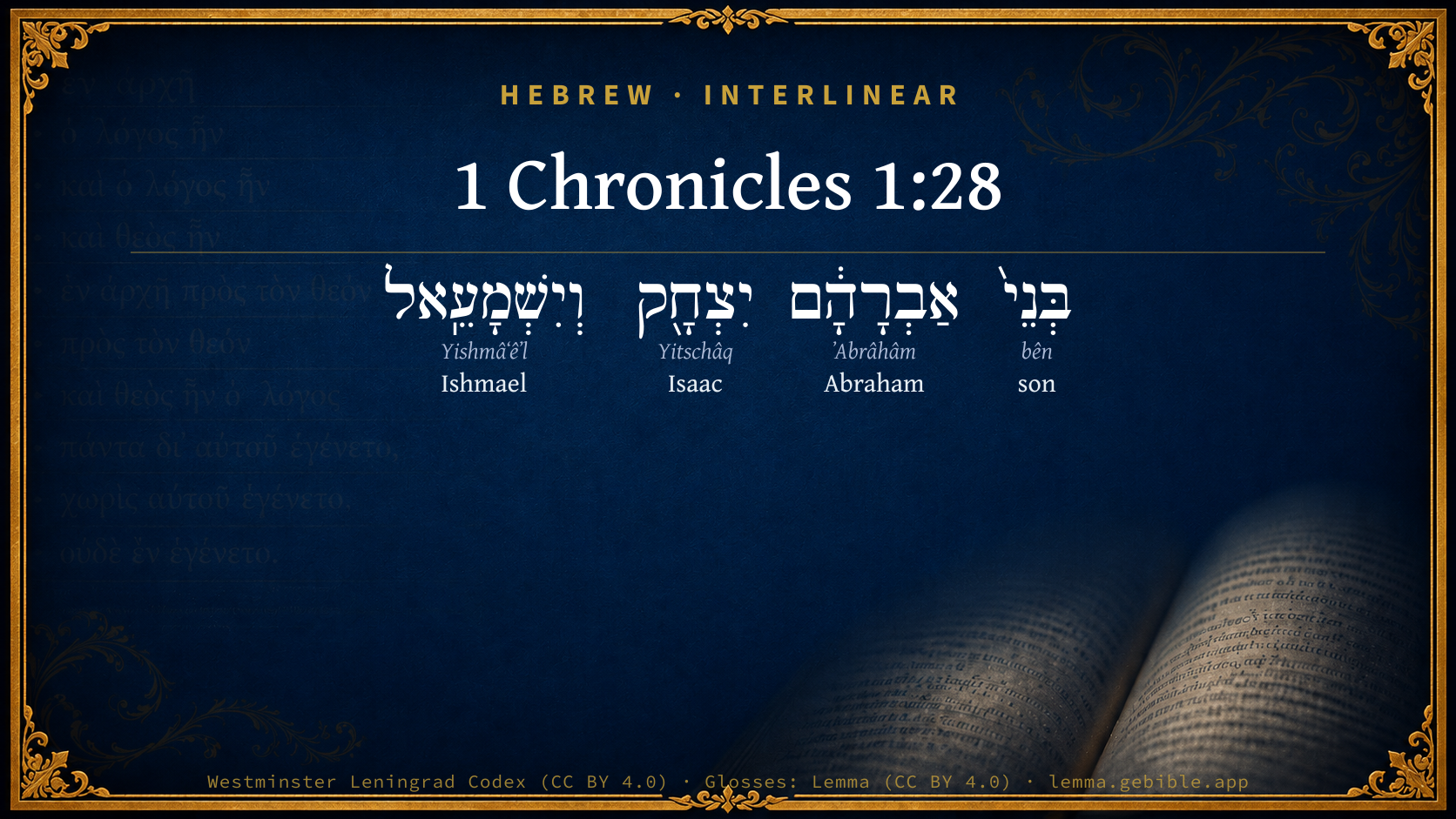
וְיִשְׁמָעֵֽאל
Yishmâʻêʼl
H3458
“and · Ishmael”
Conjunction + Noun, Proper
Part of Speech
Conjunction + Noun
Type
Proper
Full BDB Definition

Origin: from H8085 and H410

TWOT: None

Ishmael = "God will hear" - son of Abraham and Sarah's handmaid Hagar and the progenitor of the Arabian peoples - son of Nethaniah and the murderer of Gedaliah - a Benjamite, one of the sons of Azel a descendant of Saul through Meribbaal or Mephibosheth - a Judaite, father of Zebadiah - a Judaite, son of Johanan and one of the captains who aided Jehoiada in restoring Joash to the throne - a priest of the family of Pashur with a foreign wife whom he was forced to put away by Ezra
  1. בְּנֵי֙ bên H1121 “sons of” Noun, Common, Masculine, Plural, Construct
  2. אַבְרָהָ֔ם ʼAbrâhâm H85 “Abraham” Noun, Proper
  3. יִצְחָ֖ק Yitschâq H3327 “Isaac” Noun, Proper

About this verse

These counts appear in no published source. They are computed here, from the morphology-tagged text and Lemma’s own curated glosses. What Lemma adds →

4
words
4
distinct lemmas
Historical
section

Shared distinctive vocabulary

וְיִשְׁמָעֵֽאל Ishmael H3458 occurs in 44 verses of the Hebrew Bible. Also found in:

Grammatical profile

  • 4 nouns

Hebrew & Septuagint length

In English translation the verse runs 7 words from the Hebrew and 8 from the Septuagint (LXX English) — closely comparable.

A rough comparison of the two English renderings, which tokenize alike — not a word-level alignment.

Word counts can differ between the Hebrew and the Greek without any difference in meaning — e.g. the Hebrew direct-object marker אֵת has no separate Greek word, and Greek often adds the article ὁ.

Cross-references

5

Topical passages linked to 1 Chronicles 1:28 in the Treasury of Scripture Knowledge — connected by theme and wording, ordered by reader-vote popularity; previews shown in the World English Bible.

  • Genesis 16:11–16 The angel of Yahweh said to her, "Behold, you are with child, and will bear a son. You shall call his name Ishmael, because Yahweh has heard your affliction.
  • Genesis 17:19–21 God said, "No, but Sarah, your wife, will bear you a son. You shall call his name Isaac. I will establish my covenant with him for an everlasting covenant for his seed after him.
  • Genesis 21:2–5 Sarah conceived, and bore Abraham a son in his old age, at the set time of which God had spoken to him.
  • Genesis 21:9–10 Sarah saw the son of Hagar the Egyptian, whom she had borne to Abraham, mocking.
  • Genesis 21:12 God said to Abraham, "Don't let it be grievous in your sight because of the boy, and because of your handmaid. In all that Sarah says to you, listen to her voice. For from Isaac will your seed be called.

Cross-references courtesy of OpenBible.info (CC BY 4.0).

Hebrew and Greek witnesses Masoretic Hebrew ↔ Greek Septuagint

The same verse in the two great witnesses to the Old Testament, shown verse-for-verse.

These are two independent witnesses, not word-aligned to each other, and the Septuagint is shown in lemma (dictionary) form.

Hebrew 1 Chronicles 1:28 Masoretic · Westminster Leningrad Codex

בְּנֵי֙ אַבְרָהָ֔ם יִצְחָ֖ק וְיִשְׁמָעֵֽאל

The sons of Abraham: Isaac, and Ishmael.

World English Bible · Public Domain

Greek LXX 1 Chronicles 1:28 Septuagint · lemma form

υἱός σωβαλ γωλαμ μαναχαθ γαιβηλ σωβ καί ωναμ υἱός δέ σεβεγων αια καί ανα

And the sons of Abraam, Isaac, and Ismael.

LXX2012 (modern English Septuagint) · Public Domain

On this verse, John Gill's Exposition discusses the Septuagint’s reading. Read the note in Commentary ↓

Hebrew: Westminster Leningrad Codex (CC BY 4.0). Greek: Septuagint (public domain); English from LXX2012 (modern English Septuagint) (Public Domain). How the Septuagint differs from the Hebrew →

Commentary

Notes on 1 Chronicles 1:28 from classic Christian and Jewish commentators (each source and its license shown beneath its notes). The classic Christian expositions comment on the surrounding passage and are grouped to its opening verse, so a note may address several verses; the Jewish commentaries on the Tanakh (Rashi and others) are per-verse, so they appear only where the commentator wrote on this verse.

Lemma curates 59 commentaries, every one of them public domain or Creative Commons licensed, each selected and text-cleaned for this edition rather than reprinted as found. About our sources →

Joseph Benson's Commentary

1Ch 1:28. The sons of Abraham — All nations but the seed of Abraham are already shaken off from this genealogy. Not that we conclude, no particular persons of any other nation but this found favour with God; multitudes will be brought to heaven out of every nation, and we may hope there were many, very many people in the world, whose names were in the book of life, though they did not spring from the loins of Abraham.

Joseph Benson's Commentary on the Old and New Testaments (1811–1818) — public domain. Text from a community e-Sword module.

Tyndale Open Study Notes

Tyndale Open Resources

1:28-33 Using the same pattern as the author of Genesis, the Chronicler traces separately the descendants of Abraham apart from Isaac, listing the sons of Ishmael (1:29-31; cp. Gen 25:12-15) and the sons of Keturah (1 Chr 1:32-33; cp. Gen 25:1-3) before detailing the descendants in the chosen family line.

Tyndale Open Study Notes — © Tyndale Open Resources, licensed CC BY-SA 4.0. Text via the HelloAO Bible API.

Matthew Henry's Commentary

All nations but the seed of Abraham are already shaken off from this genealogy: they have no part nor lot in this matter. The Lord's portion is his people. Of them he keeps an account, knows them by name; but those who are strangers to him he beholds afar off. Not that we are to conclude that therefore no particular persons of any other nation but the seed of Abraham found favour with God. It was a truth, before Peter perceived it, that in every nation he that feared God and wrought righteousness was accepted of him. Multitudes will be brought to heaven out of all nations (Rev 7:9), and we are willing to hope there were many, very many, good people in the world, that lay out of the pale of God's covenant of peculiarity with Abraham, whose names were in the book of life, though not descended from any of the following families written in this book. The Lord knows those that are his. But Israel was a chosen nation, elect in type; and no other nation, in its national capacity, was so dignified and privileged as the Jewish nation was. That is the holy nation which is the subject of the sacred story; and therefore we are next to shake off all the seed of Abraham but the posterity of Jacob only, which were all incorporated into one nation and joined to the Lord, while the other descendants from Abraham, for aught that appears, were estranged both from God and from one another.

I. We shall have little to say of the Ishmaelites. They were the sons of the bondwoman, that were to be cast out and not to be heirs with the child of the promise; and their case was to represent that of the unbelieving Jews, who were rejected (Gal 4:22, etc.), and therefore there is little notice taken of that nation. Ishmael's twelve sons are just named here (Ch1 1:29-31), to show the performance of the promise God made to Abraham, in answer to his prayer for him, that, for Abraham's sake, he should become a great nation, and particularly that he should beget twelve princes, Gen 17:20.

II. We shall have little to say of the Midianites, who descended from Abraham's children by Keturah. They were children of the east (probably Job was one of them), and were separated from Isaac, the heir of the promise (Gen 25:6), and therefore they are only named here, Ch1 1:32. The sons of Jokshan, the son of Keturah, are named also, and the sons of Midian (Ch1 1:32, Ch1 1:33), who became most eminent, and perhaps gave denomination to all these families, as Judah to the Jews.

III. We shall not have much to say of the Edomites. They had an inveterate enmity to God's Israel; yet because they descended from Esau, the son of Isaac, we have here an account of their families, and the names of some of their famous men, Ch1 1:35 to the end. Some slight differences there are between some of the names here, and as we had them in Gen. 36, whence this whole account is taken. Three of four names that were written with a Vau there are written with a Jod here, probably the pronunciation being altered, as is usual in other languages. we now write many words very differently from what they were written but 200 years ago. Let us take occasion, from the reading of these genealogies, to think, 1. Of the multitudes that have gone through this world, have acted their part in it, and then quitted it. Job, even in his early day, saw not only every man drawing after him, but innumerable before him, Job 21:33. All these, and all theirs, had their day; many of them made a mighty noise and figure in the world; but their day came to fall, and their place knew them no more. The paths of death are trodden paths, but vestigia nulla retrorsum - none can retrace their steps. 2. Of the providence of God, which keeps up the generations of men, and so preserves that degenerate race, though guilty and obnoxious, in being upon earth. How easily could he cut it off without either a deluge or a conflagration! Write but all the children of men childless, as some are, and in a few years the earth will be eased of the burden under which it groans; but the divine patience lets the trees that cumber the ground not only grow, but propagate. As one generation, even of sinful men, passes away, another comes (Ecc 1:4; Num 32:14), and will do so while the earth remains. Destroy it not, for a blessing is in it.

Matthew Henry's Commentary on the Whole Bible (1708–1710) — public domain (CC PDM 1.0). Text via the HelloAO Bible API.

John Gill's Exposition

The sons of Abraham,.... The famous and well known ancestor of the Jews; of Ishmael his firstborn, and his posterity; of his sons by Keturah; and of Isaac and his sons, an account is given from hence to the end of Ch1 1:34 entirely agreeing with that in Gen 25:1.

.

1 Chronicles 1:35

ch1 1:35

ch1 1:35

ch1 1:35The sons of Esau,.... The firstborn of Isaac; his posterity are named in this and the two following verses, as in Gen 36:1 only it should be observed, that Timna, Ch1 1:36 is not the name of a man, but was the concubine of Eliphaz, the eldest son of Esau, and the mother of Amalek, Gen 36:12, and so in the Arabic version it is read,"and Timna, which was the concubine of Eliphaz, the son of Esau, bare him Amalek;''and so the Alexandrian copy of the Septuagint.

John Gill's Exposition of the Whole Bible (1746–1763) — public domain (CC PDM 1.0). Text via the HelloAO Bible API.

Albert Barnes' Notes on the Bible

Isaac and Ishmael - Isaac, though younger than Ishmael, is placed first, as the legitimate heir, since Sarah alone was Abraham’s true wife (compare the 1Ch 1:36 note).

Albert Barnes' Notes on the Bible (1834–1885) — public domain. Text from a community e-Sword/MySword module.

The Pulpit Commentary

Vers. 28-37. E. LIST OF THE SONS, GRANDSONS, AND OTHER DESCENDANTS OF ABRAHAM. In the first of these verses the new form of the name of Abraham is at once used in place of the old form. And the names of two of his sons are given, Isaac the son by Sarah, and Ishmael the son by Hagar, his Egyptian bondwoman. That these stand in the inverse order of their birth and age requires no explanation. The distinct and separate mention of these two sons, apart from all the others, is of course in harmony with Gen_21:12, 13 "In Isaac shall thy seed be called. And also of the son of the bondwoman will I make a nation, because he is thy seed." Although stated in the first place in the order of importance, and Isaac takes precedence of Ishmael, the name of this latter and of his posterity are treated of first. To note each clear instance of this kind will guard us against inferring, in cases not clear, anything positive, one way or the other, respecting seniority merely from order. The order either of age or of historic importance may be given in the first instance, to be immediately reversed in favour of the order which shall enable the writer to clear out of his way the less important.

The Pulpit Commentary (1880–1919), ed. H.D.M. Spence-Jones & Joseph S. Exell — public domain. Text from a community e-Sword module.

John Wesley's Explanatory Notes

The sons of Abraham - All nations but the seed of Abraham are already shaken off from this genealogy. Not that we conclude, no particular persons of any other nation but this found favour with God. Multitudes will be brought to heaven out of every nation, and we may hope there were many, very many people in the world, whose names were in the book of life, tho' they did not spring from the loins of Abraham.

John Wesley, Explanatory Notes Upon the Whole Bible (1754–1765) — public domain. Text via the GEBible commentary corpus.

Keil & Delitzsch

C. F. Keil & F. Delitzsch

The sons of Abraham,.... The famous and well known ancestor of the Jews; of Ishmael his firstborn, and his posterity; of his sons by Keturah; and of Isaac and his sons, an account is given from hence to the end of Ch1 1:34 entirely agreeing with that in Gen 25:1.

.

1 Chronicles 1:35

ch1 1:35

ch1 1:35

ch1 1:35The sons of Esau,.... The firstborn of Isaac; his posterity are named in this and the two following verses, as in Gen 36:1 only it should be observed, that Timna, Ch1 1:36 is not the name of a man, but was the concubine of Eliphaz, the eldest son of Esau, and the mother of Amalek, Gen 36:12, and so in the Arabic version it is read,"and Timna, which was the concubine of Eliphaz, the son of Esau, bare him Amalek;''and so the Alexandrian copy of the Septuagint.

Keil & Delitzsch — Biblical Commentary on the Old Testament (1861–1891) — public domain (CC PDM 1.0). Text via the HelloAO Bible API. (Old Testament only.)

unfoldingWord translationNotes

Door43 World Missions Community

General Information:

All of the names here are names of men. (See: How to Translate Names)

translationWords

Isaac

Ishmael

firstborn

unfoldingWord translationNotes — © Distant Shores Media and the Door43 World Missions Community, licensed CC BY-SA 4.0. Source: git.door43.org/Door43/en_tn.

Lesson kit

Teaching starters — assembled from the data on this page, not authored interpretation. Every prompt links to the verse data it draws on. Edit before teaching.

1 Chronicles, in the Historical, opens this verse with 4 words (4 distinct Hebrew lemmas). Its most distinctive word is Yishmâʻêʼl (“Ishmael”). A historical commentator’s framing appears above. Read the whole chapter for the surrounding context.

Discussion questions

  1. What does “Ishmael” (Yishmâʻêʼl) contribute to the verse as a whole?
  2. Genesis 16:11 shares the word «Ishmael» with this verse. How do the two illuminate each other?
  3. Reading how Joseph Benson's Commentary and Tyndale Open Study Notes read this verse, where do the two commentators agree and where do they part?

Reading settings

Reading text

Shown beneath each verse's original-language words.

Old Testament
Old Testament edition

Read the OT as the Masoretic Hebrew (MT) or the Greek Septuagint (LXX).

English shown for the Greek Septuagint (in the Hebrew ↔ Greek comparison).

Comparing translations? Open the Compare panel on any verse page to stack up to four side by side.