
Amos 1:13

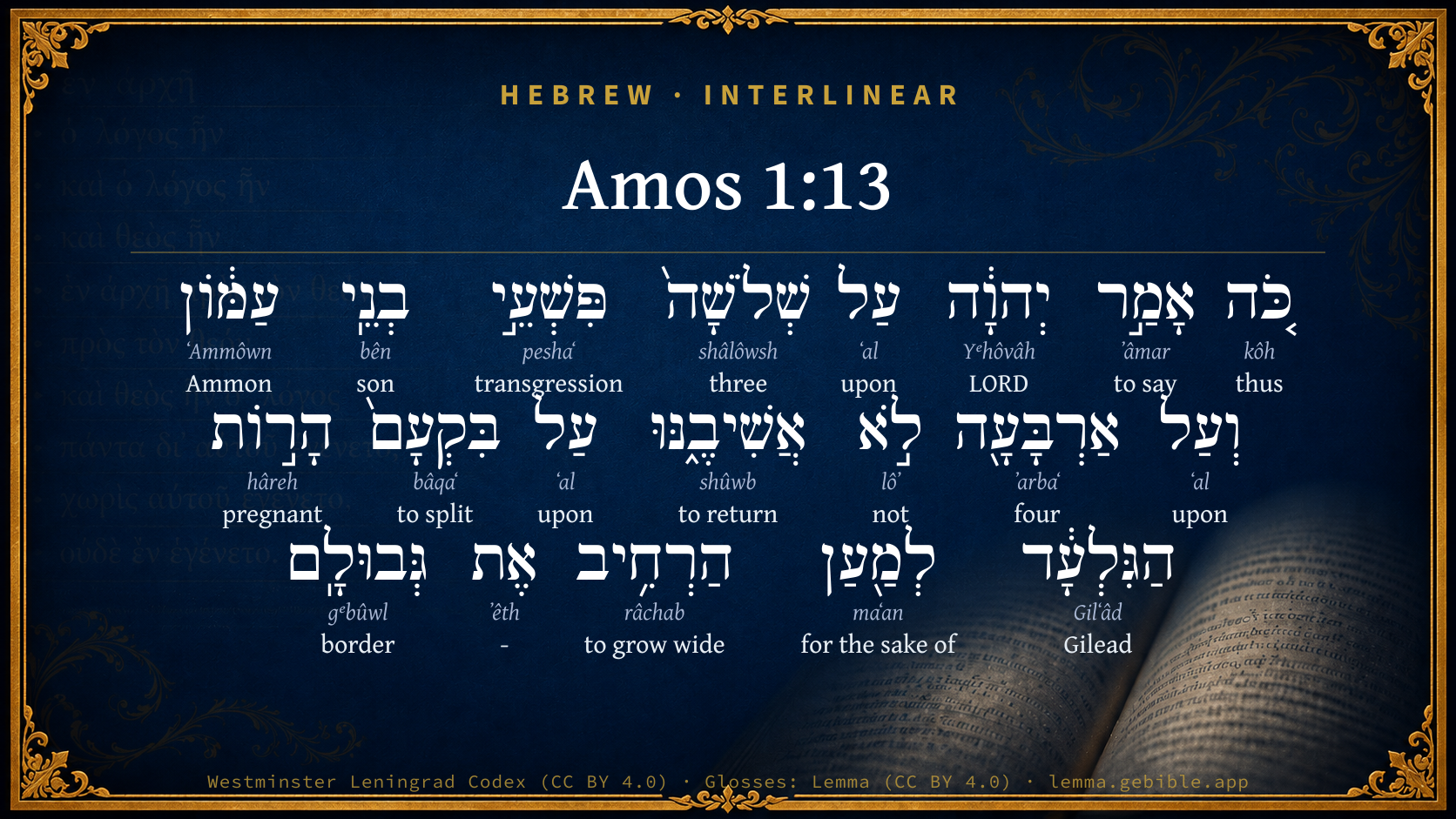
Hebrew (Westminster Leningrad Codex) Amos 1:13 appears in the Hebrew Old Testament. The text above is from the Westminster Leningrad Codex. Each word links to its Strong’s number, a concise gloss, and parsing drawn from the Open Scriptures Hebrew Bible morphology. Click any word for its full Brown-Driver-Briggs (BDB) entry.
Download image
Cite this verse

Amos 1:13 (World English Bible). Public Domain. Lemma interlinear Bible study tool, https://lemma.gebible.app/v/amos/1/13.

Show BibTeX & RIS
BibTeX
RIS
English Translation
Thus says Yahweh: "For three transgressions of the children of Ammon, yes, for four, I will not turn away its punishment; Because they have ripped open the pregnant women of Gilead, That they may enlarge their border.
World English Bible · Public Domain
Download a study sheet

One document with this verse’s original text, its word-by-word gloss line, the meaning frame, cross-references with their text, attributed commentary, and full source and license credits — printable, and it pastes into notes with its structure intact.

This verse Autodidact and up

Study sheet (.html) Plain text (.txt)

A passage Seminary Student

Up to 50 verses in one chapter. A passage sheet keeps up to 6 commentary sources and 12 cross-references per verse, in the order this page ranks them, and says so on the sheet whenever that leaves anything out. Ask for a single verse and you get the Autodidact verse sheet above.

Everything on this page stays free to read, with no account — the sheet is a download of what is already on screen, not access to it.

Want to remove ads? Support Godless Engineer
Compare translations 3

The same verse in 3 English versions, stacked beneath the original-language interlinear above. Click any original word for its lexicon entry.

Each is an independent rendering of the whole verse — the interlinear is not word-aligned to these translations.

Highlighted words mark where these versions differ — a whole-verse word diff, not a word-by-word alignment.

  • World English Bible Public Domain
    Thus says Yahweh: "For three transgressions of the children of Ammon, yes, for four, I will not turn away its punishment; Because they have ripped open the pregnant women of Gilead, That they may enlarge their border.
  • King James Version Public Domain
    Thus saith the LORD; For three transgressions of the children of Ammon, and for four, I will not turn away the punishment thereof; because they have ripped up the women with child of Gilead, that they might enlarge their border:
  • unfoldingWord Literal Text CC BY-SA 4.0
    This is what Yahweh says, “For three sins of the sons of Ammon, even for four, I will not turn away punishment, because they ripped open the pregnant women of Gilead, that they may enlarge their borders.

unfoldingWord Literal Text — © unfoldingWord, licensed CC BY-SA 4.0. Word-aligned USFM3 via Door43 (git.door43.org/unfoldingWord/en_ult).

Versions to compare (up to 4)

3 of 4 selected

Show all 18 translations

Every available English version of this verse, each an independent rendering of the whole verse.

  • World English Bible Public Domain
    Thus says Yahweh: "For three transgressions of the children of Ammon, yes, for four, I will not turn away its punishment; Because they have ripped open the pregnant women of Gilead, That they may enlarge their border.
  • Berean Standard Bible Public Domain
    This is what the LORD says: “For three transgressions of the Ammonites, even four, I will not revoke My judgment, because they ripped open the pregnant women of Gilead in order to enlarge their territory.
  • Majority Standard Bible Public Domain
    This is what the LORD says: “For three transgressions of the Ammonites, even four, I will not revoke My judgment, because they ripped open the pregnant women of Gilead in order to enlarge their territory.
  • King James Version Public Domain
    Thus saith the LORD; For three transgressions of the children of Ammon, and for four, I will not turn away the punishment thereof; because they have ripped up the women with child of Gilead, that they might enlarge their border:
  • American Standard Version (1901) Public Domain
    Thus saith Jehovah: For three transgressions of the children of Ammon, yea, for four, I will not turn away the punishment thereof; because they have ripped up the women with child of Gilead, that they may enlarge their border.
  • Revised Version (1885) Public Domain
    Thus saith the LORD: For three transgressions of the children of Ammon, yea, for four, I will not turn away the punishment thereof; because they have ripped up the women with child of Gilead, that they might enlarge their border:
  • Geneva Bible (1599) Public Domain
    Thus sayth ye Lord, For three transgressions of the children of Ammon, and for foure, I will not turne to it, because they haue ript vp the women with child of Gilead, that they might enlarge their border.
  • Douay-Rheims (1899) Public Domain
    Thus saith the Lord: For three crimes of the children of Ammon, and for four I will not convert him: because he hath ripped up the women with child of Galaad to enlarge his border.
  • Young's Literal Translation Public Domain
    Thus said Jehovah: For three transgressions of the sons of Ammon, And for four, I do not reverse it, Because of their ripping up the pregnant ones of Gilead, To enlarge their border,
  • Literal Standard Version CC BY-SA 4.0
    Thus said YHWH: “For three transgressions of the sons of Ammon, || And for four, I do not reverse it, || Because of their ripping up the pregnant ones of Gilead, || To enlarge their border,
  • Unlocked Literal Bible CC BY-SA 4.0
    This is what Yahweh says, “For three sins of the people of Ammon, even for four, I will not turn away punishment, because they ripped open the pregnant women of Gilead, that they may enlarge their borders.
  • unfoldingWord Literal Text CC BY-SA 4.0
    This is what Yahweh says, “For three sins of the sons of Ammon, even for four, I will not turn away punishment, because they ripped open the pregnant women of Gilead, that they may enlarge their borders.
  • Darby Bible Public Domain
    Thus saith Jehovah: For three transgressions of the children of Ammon, and for four, I will not revoke its sentence; because they ripped up the women with child of Gilead, that they might enlarge their border.
  • World Messianic Bible Public Domain
    The LORD says: “For three transgressions of the children of Ammon, yes, for four, I will not turn away its punishment, because they have ripped open the pregnant women of Gilead, that they may enlarge their border.
  • Webster's Bible Public Domain
    Thus saith the LORD; For three transgressions of the children of Ammon, and for four, I will not turn away their punishment: because they have ripped up the women with child of Gilead, that they might enlarge their border:
  • Free Bible Version CC BY-SA 4.0
    This is what the Lord says: The people of Ammon have repeatedly sinned and so I will not hesitate to punish them, because they ripped open pregnant women in Gilead as part of their war to enlarge their territory.
  • Bible in Basic English Public Domain
    These are the words of the Lord: For three crimes of the children of Ammon, and for four, I will not let its fate be changed; because in Gilead they had women with child cut open, so that they might make wider the limits of their land.
  • JPS Tanakh (1917) Public Domain
    Thus saith the LORD: For three transgressions of the children of Ammon, yea, for four, I will not reverse it: because they have ripped up the women with child of Gilead, that they might enlarge their border.

Literal Standard Version (2020), Covenant Press — licensed CC BY-SA 4.0. Text via the HelloAO Bible API (eBible.org). Unlocked Literal Bible (unfoldingWord) — licensed CC BY-SA 4.0. Text via the HelloAO Bible API (eBible.org). unfoldingWord Literal Text — © unfoldingWord, licensed CC BY-SA 4.0. Word-aligned USFM3 via Door43 (git.door43.org/unfoldingWord/en_ult). Free Bible Version, Dr. Jonathan Gallagher — licensed CC BY-SA 4.0. Text via the HelloAO Bible API (eBible.org).

Word by word

More ways to search: Search by grammar → Find every occurrence → Compare this word →

Practice this passage: Drill this verse → Learn its vocabulary →

הָר֣וֹת
hâreh
H2030
“pregnant of”
Adjective, Adjective, Feminine, Plural, Construct
Part of Speech
Adjective
Type
Adjective
Gender
Feminine
Number
Plural
State
Construct
Full BDB Definition

Origin: from H2029

TWOT: 515a

pregnant
  1. כֹּ֚ה kôh H3541 “thus” Adverb
  2. אָמַ֣ר ʼâmar H559 “to say” Verb, Qal, Perfect, 3rd Person, Masculine, Singular
  3. יְהוָ֔ה Yᵉhôvâh H3068 “LORD” Noun, Proper
  4. עַל ʻal H5921 “upon” Preposition
  5. שְׁלֹשָׁה֙ shâlôwsh H7969 “three” Adjective, Cardinal number, Masculine, Singular, Absolute
  6. פִּשְׁעֵ֣י peshaʻ H6588 “transgressions of” Noun, Common, Masculine, Plural, Construct
  7. בְנֵֽי bên H1121 “sons of” Noun, Common, Masculine, Plural, Construct
  8. עַמּ֔וֹן ʻAmmôwn H5983 “Ammon” Noun, Proper
  9. וְעַל ʻal H5921 “and · upon” Conjunction + Preposition
  10. אַרְבָּעָ֖ה ʼarbaʻ H702 “four” Adjective, Cardinal number, Masculine, Singular, Absolute
  11. לֹ֣א lôʼ H3808 “not” Particle, Negative
  12. אֲשִׁיבֶ֑נּוּ shûwb H7725 “to return · him” Verb, Hiphil, Imperfect, 1st Person, Common, Singular + Suffix, Personal, 3rd Person, Masculine, Singular
  13. עַל ʻal H5921 “upon” Preposition
  14. בִּקְעָם֙ bâqaʻ H1234 “to split · them” Verb, Qal, Infinitive Construct + Suffix, Personal, 3rd Person, Masculine, Plural
  15. הַגִּלְעָ֔ד Gilʻâd H1568 “the · Gilead” Particle, Definite Article + Noun, Proper
  16. לְמַ֖עַן maʻan H4616 “for the sake of” Preposition
  17. הַרְחִ֥יב râchab H7337 “to grow wide” Verb, Hiphil, Infinitive Construct
  18. אֶת ʼêth H853 “-” Particle, Direct Object
  19. גְּבוּלָֽם gᵉbûwl H1366 “border · their” Noun, Common, Masculine, Singular, Construct + Suffix, Personal, 3rd Person, Masculine, Plural

About this verse

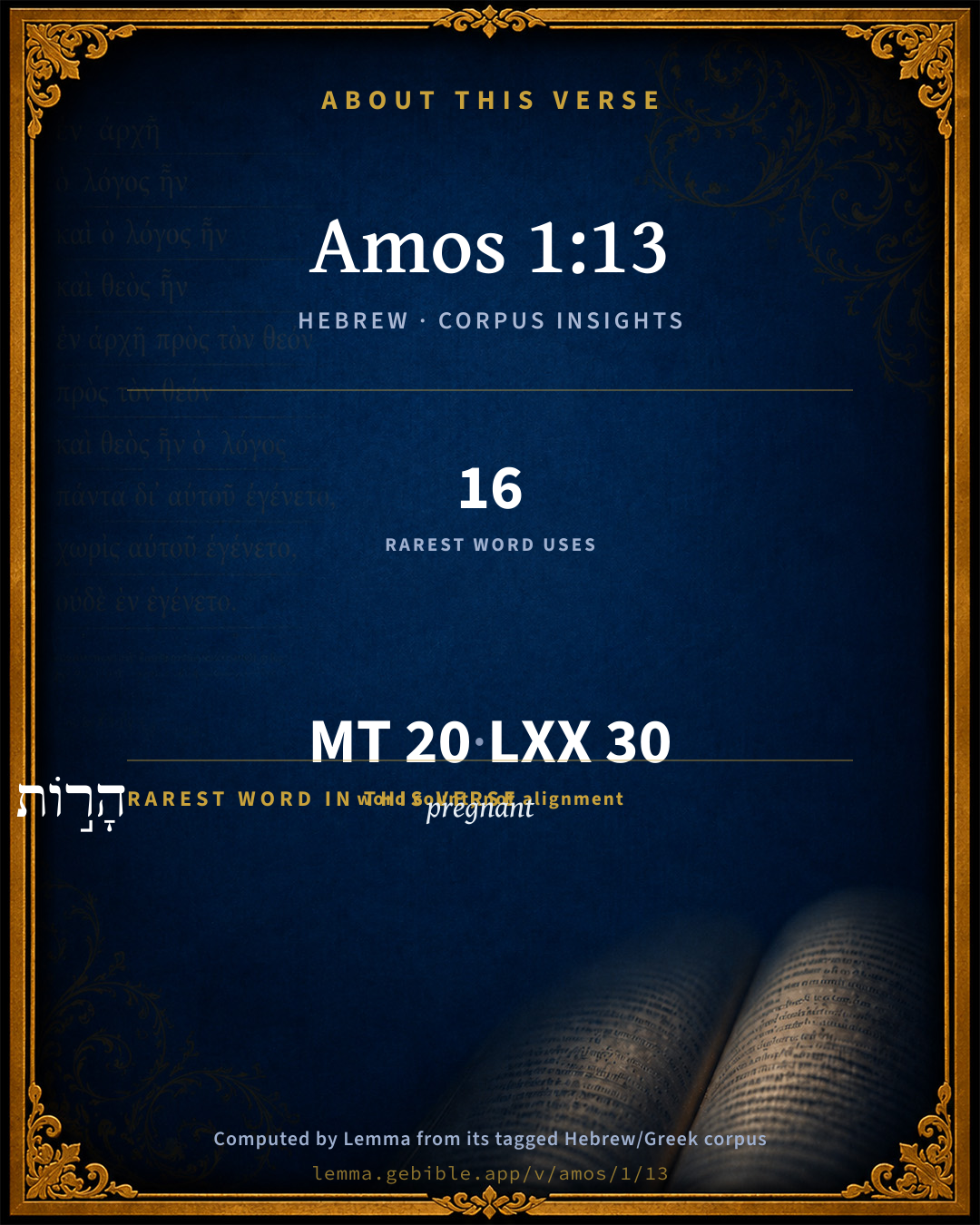
These counts appear in no published source. They are computed here, from the morphology-tagged text and Lemma’s own curated glosses. What Lemma adds →

20
words
18
distinct lemmas
Prophets
section

Notable vocabulary

The rarest word here is הָר֣וֹת pregnant H2030 — appearing just 16 times in the whole Hebrew Bible.

Shared distinctive vocabulary

הָר֣וֹת pregnant H2030 occurs in 16 verses of the Hebrew Bible. Also found in:

Grammatical profile

  • 4 verbs
  • 6 nouns
  • 3 adjectives
  • 4 prepositions
  • 1 adverb
  • 2 particles

Verb forms

  • אָמַ֣ר Qal · Perfect
  • אֲשִׁיבֶ֑נּוּ Hiphil · Imperfect
  • בִּקְעָם֙ Qal · Infinitive Construct
  • הַרְחִ֥יב Hiphil · Infinitive Construct

Repetition

A word recurs within this verse — often emphatic in Hebrew:

Hebrew & Septuagint length

In English translation the verse runs 37 words from the Hebrew and 39 from the Septuagint (LXX English) — closely comparable.

A rough comparison of the two English renderings, which tokenize alike — not a word-level alignment.

Word counts can differ between the Hebrew and the Greek without any difference in meaning — e.g. the Hebrew direct-object marker אֵת has no separate Greek word, and Greek often adds the article ὁ.

In the original languages it is 20 Hebrew tokens and 30 Greek tokens — but the two are counted differently (Hebrew bundles its prefixes and suffixes into one token; the Greek is in lemma form), so that isn’t a like-for-like length.

Cross-references

21

Topical passages linked to Amos 1:13 in the Treasury of Scripture Knowledge — connected by theme and wording, ordered by reader-vote popularity; previews shown in the World English Bible.

  • Ezekiel 25:2–7 Son of man, set your face toward the children of Ammon, and prophesy against them:
  • Hosea 13:16 Samaria will bear her guilt; For she has rebelled against her God. They will fall by the sword. Their infants will be dashed in pieces, And their pregnant women will be ripped open."
  • Jeremiah 49:1–6 Of the children of Ammon. Thus says Yahweh: Has Israel no sons? has he no heir? why then does Malcam possess Gad, and his people well in the cities of it?
  • Isaiah 5:8 Woe to those who join house to house, Who lay field to field, until there is no room, And you are made to dwell alone in the midst of the land!
  • Ezekiel 35:10 Because you have said, These two nations and these two countries shall be mine, and we will possess it; whereas Yahweh was there:
  • Zephaniah 2:8–9 I have heard the reproach of Moab, and the insults of the children of Ammon, with which they have reproached my people, and magnified themselves against their border.
  • Deuteronomy 2:19 and when you come near over against the children of Ammon, don't bother them, nor contend with them; for I will not give you of the land of the children of Ammon for a possession; because I have given it to the children of Lot for a possession.
  • Deuteronomy 23:3–4 An Ammonite or a Moabite shall not enter into the assembly of Yahweh; even to the tenth generation shall none belonging to them enter into the assembly of Yahweh forever:
  • Judges 10:7–9 The anger of Yahweh was kindled against Israel, and he sold them into the hand of the Philistines, and into the hand of the children of Ammon.
  • Judges 11:15–28 and he said to him, Thus says Jephthah: Israel didn't take away the land of Moab, nor the land of the children of Ammon,
  • 1 Samuel 11:1–2 Then Nahash the Ammonite came up, and encamped against Jabesh Gilead: and all the men of Jabesh said to Nahash, Make a covenant with us, and we will serve you.
  • 2 Samuel 10:1–8 It happened after this, that the king of the children of Ammon died, and Hanun his son reigned in his place.
  • 2 Kings 24:2 Yahweh sent against him bands of the Chaldeans, and bands of the Syrians, and bands of the Moabites, and bands of the children of Ammon, and sent them against Judah to destroy it, according to the word of Yahweh, which he spoke by his servants the prophets.
  • 2 Chronicles 20:1 It happened after this, that the children of Moab, and the children of Ammon, and with them some of the Ammonites, came against Jehoshaphat to battle.
  • 2 Chronicles 20:10 Now, behold, the children of Ammon and Moab and Mount Seir, whom you would not let Israel invade, when they came out of the land of Egypt, but they turned aside from them, and didn't destroy them;
  • Nehemiah 2:19 But when Sanballat the Horonite, and Tobiah the servant, the Ammonite, and Geshem the Arabian, heard it, they ridiculed us, and despised us, and said, What is this thing that you do? will you rebel against the king?
  • Nehemiah 4:7–23 But it happened that when Sanballat, Tobiah, the Arabians, the Ammonites, and the Ashdodites heard that the repairing of the walls of Jerusalem went forward, [and] that the breaches began to be stopped, then they were very angry;
  • Ezekiel 21:28 You, son of man, prophesy, and say, Thus says the Lord Yahweh concerning the children of Ammon, and concerning their reproach; and say you, A sword, a sword is drawn, for the slaughter it is furbished, to cause it to devour, that it may be as lightning;
  • Amos 1:3 Thus says Yahweh: "For three transgressions of Damascus, yes, for four, I will not turn away its punishment; Because they have threshed Gilead with threshing instruments of iron;
  • Habakkuk 2:5–6 Yes, moreover, wine is treacherous. A haughty man who doesn't stay at home, who enlarges his desire as Sheol, and he is like death, and can't be satisfied, but gathers to himself all nations, and heaps to himself all peoples.
  • Psalms 83:7 Gebal, Ammon, and Amalek; Philistia with the inhabitants of Tyre;

Cross-references courtesy of OpenBible.info (CC BY 4.0).

Hebrew and Greek witnesses Masoretic Hebrew ↔ Greek Septuagint

The same verse in the two great witnesses to the Old Testament, shown verse-for-verse.

These are two independent witnesses, not word-aligned to each other, and the Septuagint is shown in lemma (dictionary) form.

Hebrew Amos 1:13 Masoretic · Westminster Leningrad Codex

כֹּ֚ה אָמַ֣ר יְהוָ֔ה עַל שְׁלֹשָׁה֙ פִּשְׁעֵ֣י בְנֵֽי עַמּ֔וֹן וְעַל אַרְבָּעָ֖ה לֹ֣א אֲשִׁיבֶ֑נּוּ עַל בִּקְעָם֙ הָר֣וֹת הַגִּלְעָ֔ד לְמַ֖עַן הַרְחִ֥יב אֶת גְּבוּלָֽם

Thus says Yahweh: "For three transgressions of the children of Ammon, yes, for four, I will not turn away its punishment; Because they have ripped open the pregnant women of Gilead, That they may enlarge their border.

World English Bible · Public Domain

Greek LXX Amos 1:13 Septuagint · lemma form

ὅδε λέγω κύριος ἐπί ὁ τρεῖς ἀσέβεια υἱός αμμων καί ἐπί ὁ τέσσαρες οὐ ἀποστρέφω αὐτός ἀντί ὅς ἀνασχίζω ὁ ἐν γαστήρ ἔχω ὁ γαλααδῖτις ὅπως ἐνπλατύνω ὁ ὅριον αὐτός

Thus says the Lord; For three sins of the children of Ammon, and for four, I will not turn away from him; because they ripped up the women with child of the Galaadites, that they might widen their coasts.

LXX2012 (modern English Septuagint) · Public Domain

On this verse, The Preacher's Complete Homiletical Commentary discusses the Septuagint’s reading. Read the note in Commentary ↓

Hebrew: Westminster Leningrad Codex (CC BY 4.0). Greek: Septuagint (public domain); English from LXX2012 (modern English Septuagint) (Public Domain). How the Septuagint differs from the Hebrew →

Targum (Aramaic paraphrase)

1

The Targum is the ancient Jewish Aramaic paraphrase of the Hebrew Scriptures — an interpretive translation, not the Hebrew text itself. Onkelos (literal) and Pseudo-Jonathan (expansive) render the Torah, and Jonathan the Prophets. Coverage is partial: where no permissively-licensed English translation exists for a verse, only the Aramaic is shown. This is verse-level text, not a word-by-word alignment to the Hebrew.

  1. Targum Jonathan Prophets (Joshua–Malachi)
    כִּדְנַן אֲמַר יְיָ עַל תְּלָתָא חוֹבֵי בְנֵי עַמוֹן וְעַל אַרְבְּעָא לָא אֶשְׁבּוֹק לְהוֹן עַל דְבַזָעוּ מַעְדְיַת אֲרַע גִלְעָד בְּדִיל לְאַפְתָּאָה יַת תְּחוּמֵיהוֹן:

    (no public-domain English translation for this verse)

    Targum Jonathan — Aramaic: “Mikraot Gedolot” (public domain). English: “Sefaria Community Translation” (CC0 1.0 (public-domain dedication)); “London "Chaldee Paraphrase," 1871” (public domain). Text via Sefaria.

Commentary

Notes on Amos 1:13 from classic Christian and Jewish commentators (each source and its license shown beneath its notes). The classic Christian expositions comment on the surrounding passage and are grouped to its opening verse, so a note may address several verses; the Jewish commentaries on the Tanakh (Rashi and others) are per-verse, so they appear only where the commentator wrote on this verse.

Lemma curates 59 commentaries, every one of them public domain or Creative Commons licensed, each selected and text-cleaned for this edition rather than reprinted as found. About our sources →

The Cambridge Bible for Schools and Colleges

gen. ed. J. J. S. Perowne

13. because they have ript up the women with child of Gilead] A barbarity probably not uncommon in ancient warfare, at least among more cruel or uncivilized combatants: see 2Ki_8:12 (Hazael), 2Ki_15:16 (Menahem); Hos_13:16; cf. Hos_10:14 : comp. the similar cruelty of dashing children in pieces (2Ki_8:12; Hos_13:16; Nah_3:10; Isa_13:16; Psa_137:9). “In the embittered border-feuds between Arabian tribes the same ghastly barbarity is often mentioned; Ibn Athir iv. 256. 1, 258. 6, 260. 60, 262. 11 sqq.; Kitâb al-’Aghani, xix. 129. 12 sq., xx. 128. 13; Tabari ii. 755. 19” (Wellh.).

that they might enlarge their border] Such cruelty was not perpetrated in self-defence, but in cold blood, simply from a desire to augment their territory, at the expense of their Israelitish neighbours on the N. and W. (cf. at a later date Jer_49:1).

13–15. The Ammonites. The Ammonites occupied the district E. of Jordan bounded by the Arnon on the S., and by the territory of Reuben and the upper course of the Jabbok, on the W. Their capital was Rabbah, mentioned in Amo_1:14. They were closely related to their neighbours on the S., the Moabites, being reckoned as a brother-nation (Gen_19:37 f.); but (cf. D.B[137] s.v.), to judge from allusions in the O. T., they seem to have been less settled and civilised: their inhumanity in warfare appears from Amo_1:13, and the proposal in 1Sa_11:2; and a suspicious discourtesy towards allies is evinced in 2Sa_10:1-5. David reduced the Ammonites to the condition of tributaries (2Sa_8:12; cf. 2Sa_12:31); but it does not seem that they continued in this condition for long. Various examples of their hostility towards Israel are recorded in Jdg_10:7 ff. (their oppression of the trans-Jordanic Israelites, which was put an end to by Jephthah, ib. Jdg_11:33); 1 Samuel 11; 2Ki_24:2; Jer_40:14; Neh_2:10; Neh_4:3; Neh_4:7; comp. also Zep_2:8, Jer_49:1, Eze_21:28; Eze_25:2; Eze_25:6, which shew now they evinced a malicious satisfaction in Israel’s troubles, and sought to turn them to their own profit.

[137] .B. … Smith’s Dictionary of the Bible, ed. 1, or (from A to J) ed. 2.

The Cambridge Bible for Schools and Colleges (gen. ed. J. J. S. Perowne; Cambridge University Press, 1878–1918) — public domain. Text from a community e-Sword module.

Trapp's Complete Commentary

John Trapp

Amo 1:13 Thus saith the LORD; For three transgressions of the children of Ammon, and for four, I will not turn away [the punishment] thereof; because they have ripped up the women with child of Gilead, that they might enlarge their border:

Ver. 13. I will not turn away the punishment thereof] Or I will not turn and reduce him to myself by repentance, that I may show him mercy, as Lam 5:22 Jer 31:18, but harden his heart, and hasten his destruction.

Because they have ripped up the women with child] Immane facinus, et vicinis indignum, saith Mercer, a cruel fact, and the worse because done by so near neighbours and allies; thus to kill two at one blow, and those also innocent and impotent, and such as they ought to have spared by the law of nature and of nations: and all this, merely out of covetousness and ambition.

That they might enlarge their border] But first root out the little ones, that else might hereafter claim and recover their fathers’ possessions. So at the Sicilian Vespers they ripped up their own women that were with child by the French; that no French blood might remain among them. {See Trapp on "Hos 13:16"} Learn to detest covetousness, that "root of all evil," 1Ti 6:10. Better converse with a cannibal than with a truly covetous caitiff; and more courtesy you may expect.

John Trapp, A Commentary or Exposition upon All the Books of the Old and New Testament (1647–1656) — public domain. Text from a community e-Sword module.

The Biblical Illustrator

Joseph S. Exell

Amo_1:13-15; Amo_2:1-8

I will not turn away the punishment thereof.

Gods dealing with nations

I. The opportunity for repentance which all possess. The punishment of the six heathen nations, as of Judah and Israel, opens with a picture of the forbearance of God which had preceded this hour of wrath. For three transgressions of--, and for four, I will not turn away the punishment thereof. The cup of iniquity was not full till the fourth transgression. Gods dealing with individuals is such--Who hath hardened himself against Him, and hath prospered? (Pro_29:1.)

II. Persistence in course of sin has only one end. I will not turn away the punishment thereof. Men may put far away the evil day, but all history, all prophecy, all strivings of conscience point to the certainty of ruin.

III. The causes of the divine indignation vary according to human light. In the fate of Tyrus, for instance (Amo_1:9), we see that a brotherly covenant (the league of Hiram with David and Solomon) formed no barrier to the grasping spirit of the mercantile nation. Edom (Amo_1:11) did pursue his brother with the sword, and cast off all pity. The heathen nations were to suffer because they had offended against those eternal principles of compassion and of truth which are written on the hearts of all men alike. Judah (Amo_2:4) and Israel (Amo_1:6-8) were judged by a higher standard, for the light had been greater. In Judah is God known; His name is great in Israel.

IV. The vindication of Gods ways to men which these pictures of national sin furnish is complete. The preservation of truth and purity is of far higher moment than the fate of one nation, for human society can only be founded on the eternal principles of right and wrong. The detail of Israels sin makes us shrink back with horror. Their law gave no power to sell an insolvent debtor, but they were ready to sell the righteous man (one in trouble through no fault of his own) for silver; and the poor (whom there was none to succour), to provide for themselves a pair of luxurious sandals. They panted after the very dust which the poor spread on their head in token of mourning, and by the vilest sin they profaned the name of God which was called on them as His people. Even their altars witnessed their extortions (Amo_1:8; Deu_24:12-13) and banquetings. Application--The prophet would have the people clearly understand the equity of the judgments which he foretold. Men can be impartial in estimating the sin of others (David and Nathans parable). To study Gods dealings with others will often open our eyes to our own future. (J. Telford, B. A.)

Great sufferings following great sins

This passage illustrates three truths.

1. That the sins of all the people on the earth, whatever the peculiarities of their character or conduct, are under the cognisance of God.

2. That of all the sins of the people, that of persecution is peculiarly abhorrent to the Divine nature.

I. Great sins entail great sufferings. The calamities threatened to these different tribes of different lands are of the most terrible description. But they are all such as to match their crimes.

1. The connection between great sins and great sufferings is inevitable. The Moral Governor of the world has so arranged matters that every sin brings with its own punishment, and it is only when the sin is destroyed the suffering ceases. Thank God this sin can be destroyed through faith in the mediation of Him who came to put away sin by faith in the sacrifice of Himself.

2. Tim connection between great sins and great sufferings is universal. All these sinful peoples had to realise it from their own bitter experience. It does not matter where, when, or how a man lives, his sins will find him out.

II. Great sins often entail great sufferings upon people who are not the actual offenders. The fire, which is here the instrument of Gods retribution to us sinners, would not only scathe the persons and consume the property of the actual offenders, but others. The fact is patent in all history and in all experience, that men here suffer for the sins of others. Two facts may reconcile our consciences to this.

1. That few, if any, suffer more than their consciences tell them they deserve.

2. That there is to come a period when the whole will appear to be in accord with the justice and goodness of God. (Homilist.)

The atrocities of barbarism and the sins of civilisation

The sins Amos condemns in the heathen are at first sight very different from those which he exposes within Israel. Not only are they sins of foreign relations, of treaty and war, while Israels are all civic and domestic; but they are what we call the atrocities of barbarism--wanton war, massacre and sacrilege; while Israels are rather the sins of civilisation--the pressure of the rich upon the poor, the bribery of justice, the seduction of the innocent, personal impurity, and other evils of luxury. So great is this difference that a critic more gifted with ingenuity than insight, might plausibly distinguish, in the section before us, two prophets with two very different views of national sin--a ruder prophet, and of course an earlier, who judged nations only by the flagrant drunkenness of their war; and a more subtle prophet, and of course a later, who exposed the masked corruptions of their religion and their peace. Such a theory would be as false as it would be plausible. For not only is the diversity of the objects of the prophets judgment explained by this, that Amos had no familiarity with the interior life of other nations, and could only arraign their conduct at those points where it broke into light in their foreign relations, while Israels civic life he knew to the very core. But Amos had besides a strong and a deliberate aim in placing the sins of civilisation as the climax of a list of the atrocities of barbarism. He would recall what men are always forgetting, that the former are really more cruel and criminal than the latter; that luxury, bribery, and intolerance, the oppression of the poor, the corruption of the innocent and the silencing of the prophet--what Christ calls offences against His little ones--are even more awful atrocities than the wanton horrors of barbarian warfare. (Geo. Adam Smith, D. D.)

That they might enlarge their borders.--

Enlarging our borders

The message that comes from the old Hebrew prophet is the injunction to make our lives broader, larger, richer than they already are. Men are enlarged by travel, but the best part of that enlargement comes from intercourse with other human beings. The world of physical nature can do much to enlarge a man, but the world of human minds and hearts can do more. A man is like a planet; he is in the field of two forces, the centrifugal and the centripetal. As he grows, two methods are open to him. His idea of perfect manhood may be reached by pruning away excrescences. This is the conventional way: it produces a Chesterfield. The other is the educating of all his faculties to their full limit: this produces a Gladstone or a Browning. It exhibits many faults in a man; but it enlarges his borders, and gives magnitude and grandeur. Every one of us desires, or thinks he desires, breadth of thought, range of sympathy. Yet at our best we are never full, rounded circles. We may openly resent any imputation of narrowness, but in our hearts we must plead guilty. Let us learn to measure ourselves. How intolerant is youth of the methods of age! Let youth learn to enlarge its borders, and include the thoughts and feelings and methods of age. Every man, if he devotes himself earnestly to his lifes calling, must be, in some degree, narrowed by it. At least, he must give so much time to it that but little remains, and but little strength, for other things. This in itself is not an evil; but it frequently happens that such a man becomes wilfully narrow, and underrates or despises pursuits and faculties which are quite as high as his own. Enlarge your borders, is the command of our text. Broaden your sympathies! Extend your range of observation and understanding! Pierce through to the realities of things, and do not be deceived by externals! We all sadly need this injunction. Herein lies much of the inefficiency of our modern charitable work. The visitor and visited are not in touch, and never can be until both shall have their borders enlarged. In another field our text finds ready application. It is the field of theology, Men of broad religions views are so rare in our time, that the Sodom of our modern denominational life hardly seems worthy to be saved. There is a want of intellectual capacity to see the other side of things. There is such a radical difference in the very texture of mens minds, that the same facts, especially in art, in poetry, and in religion, will lead equally good and able men to widely different conclusions. Many are the forces which serve to enlarge our borders, as often without our consciousness as with it. Whatever opens up the minds and hearts of men to each other, whether it be joy or sorrow, is a blessing to them. The lessons which God teaches us through the varied experiences of life are, many of them, hard and bitter, but the wayward human heart needs deep probing. But the grandest enlargement of life is that which comes through the thought of God. It can enlarge your life by putting into your hand the key of love and compassion, which can open the doors of human hearts as can nothing else on this broad earth. A consciousness of God is the greatest broadening and deepening power which can come into any life. (Bradley Gilman.)

The Biblical Illustrator, edited by Joseph S. Exell (c. 1880s–1900s) — public domain. Text from a community e-Sword module.

Joseph Benson's Commentary

Amo 1:13-15. For three transgressions of the children of Ammon — The Ammonites descended from Lot: see Gen 19:38. Their country lay to the east of Jordan, in the neighbourhood of Gilead. Because they have ripped up the women with child — Hazael, king of Syria, grievously afflicted the Israelites that lay eastward of Jordan, particularly the Gileadites: see 2Ki 10:33. The low condition to which these countries were hereby reduced, might probably encourage the Ammonites to possess themselves of Gilead, and to destroy the inhabitants in the cruel manner here stated. But I will kindle a fire in the wall of Rabbah — The chief city of the Ammonites. With shouting in the day of battle — This was intended to express the great violence with which this city should be attacked; and with a tempest in the day of the whirlwind — The destructions of war are often compared to the devastations caused by whirlwinds and tempests; and the metaphor is here introduced very naturally and sublimely. And their king shall go into captivity, he and his princes together, saith the Lord — Foretold also Jer 49:3.

Joseph Benson's Commentary on the Old and New Testaments (1811–1818) — public domain. Text from a community e-Sword module.

The Preacher's Complete Homiletical Commentary

Joseph S. Exell (gen. ed.)

CRITICAL NOTES.]

Amo_1:13-15. Ammon] Ammonites joined the Chaldeans to invade and plunder Judea. Hazael perpetrated the cruelty predicted (2Ki_8:12). Ripped up] A cruel act, done to leave Israel without heir, so as to secure the inheritance. The punishment is by foreign invasion, swift, sudden, and resistless as a tempest; violent and terrific as a whirlwind. King] “Their Moloch (the idol of Ammon) and his priests” [Grotius and LXX.]. Or, as the English, their king and his princes would go together into captivity. The reigning head and those who shared his counsels were removed. Their idols and their earthly kings were unable either to save themselves, or those who submitted to them. “Hand in hand the wicked shall not be unpunished” (Pro_11:21).

THE JUDGMENT ON AMMON.—Amo_1:13-15

In the fifth place the Ammonites are accused of guilt, and their punishment is described.

I. Their crimes, consisted in most atrocious deeds towards the Gileadites.

1. Barbarous cruelty. “They have ripped up the women with child.” Hazael and Ammon were guilty of this barbarity. Probably Syria and Ammon were leagued together for the extermination of Israel. The offspring of the incest of Lot ever retained the stamp of their origin, and were noted for sensuality and ferocity. One would think that human beings could not become so inhuman, but history opens its pages of darkness and blood.

2. Unbounded selfishness. “That they might enlarge their border.” These deeds were not only performed in rage, but in deliberate design to extirpate the people and take possession of the land. Covetousness leads to great cruelty, and those that seek to extend their borders often use unscrupulous means to accomplish their design. Pharaoh killed the Israelites, and Ammon displayed unwonted ferocity towards the women of Gilead. But neither their kings nor their idols could protect them from the coming storm.

II. Their punishment. Their attempts to exterminate others recoiled upon themselves.

1. Their chief city was burned. “I will kindle a fire in the wall of Rabbah.” It was a strong city with a stronger citadel, but it was utterly destroyed. Its ruins still exist, some of which perhaps date back to this prophecy. “I will make Rabbah a stable for camels, and the Ammonites a couching place for flocks.”

2. War desolated the country. “Shouting in the day of battle.” Foreign invasion would sweep the land like a storm. (a) Swift as a tempest. (b) Violent as a whirlwind. The onset would be irresistible. Like the hurricane carrying the caravans of the desert, so the enemy would carry the walls and fortress of the city.

3. Kings and princes were taken into captivity. There would be no one left to resist and renew the revolt. On every side waste land and ruined cities. All defences, human and religious, were impotent. Inhabitants and gods were carried into a foreign country. Kings and counsellors, priests and people, linked together and driven to one common destruction. “Cry, ye daughters of Rabbah, gird you with sackcloth; lament and run to and fro by the hedges, for their king shall go into captivity, and his priests and his princes together” (Jer_49:3).

ILLUSTRATIONS TO CHAPTER 1

Amo_1:13. Heathenism is cruel, and multitudes of victims have been destroyed under the sanction of the gods. But what can we say when kings and enlightened nations commit such deeds as these?

“What will not ambition and revenge descend to?” [Milton.]

The Preacher's Complete Homiletical Commentary (gen. ed. Joseph S. Exell; Funk & Wagnalls, c. 1892) — public domain (pre-1929). A full-Bible homiletical/sermon-outline anthology covering 65 of 66 books (2 John is absent from the source module). Text from a community e-Sword module.

Keil & Delitzsch

C. F. Keil & F. Delitzsch

Ammon. - Amo 1:13. "Thus saith Jehovah: For three transgressions of the sons of Ammon, and for four, I shall not reverse it, because they have ripped up the pregnant women of Gilead, to widen their border, Amo 1:14. I kindle fire in the wall of Rabbah, and it will devour its palaces, with the war-cry on the day of slaughter, in the storm on the day of the tempest. Amo 1:15. And their king shall go into captivity, he and his princes all at once, saith Jehovah." The occasion on which the Ammonites were guilty of such cruelty towards the Israelites as is here condemned, is not recorded in the historical books of the Old Testament; possibly during the wars of Hazael with Israel, when they availed themselves of the opportunity to widen their territory by conquering back the land which had been wrested from them by Sihon king of the Amorites, and was then taken possession of by the Israelites, when he was overcome by them, - a thing which they had attempted once before in the time of Jephthah the judge (Jdg 11:12.). We may see from Jer 49:1. that they had taken possession of the territory of the tribe of Gad, which lay nearest to them, though probably not till after the carrying away of the tribes beyond Jordan by the Assyrians (Kg2 15:29). The ripping up of the women with child (see at Kg2 8:12) is singled out as the climax of the cruelties which the Ammonites inflicted upon the Israelites during the war. As a punishment for this, their capital was to be burned, and the king, with the princes, to wander into exile, and consequently their kingdom was to be destroyed. Rabbâh, i.e., the great one, is the abbreviated name of the capital; Rabbah of the children of Ammon, which has been preserved in the ruins of Aurân (see at Deu 3:11). The threat is sharpened by the clause בּתרוּעה וגו, at the war-cry on the field of battle, i.e., an actual fact, when the enemy shall take the city by storm. בּסער וגו is a figurative expression applied to the storming of a city carried by assault, like בּסוּפה in Num 21:14. The reading מלכּם, "their (the Ammonites') king," is confirmed by the lxx and the Chaldee, and required by ושׂריו (cf. Amo 2:3), whereas Μαλχόμ, Melchom, which is found in Aq., Symm., Jerome, and the Syriac, rests upon a false interpretation.

Keil & Delitzsch — Biblical Commentary on the Old Testament (1861–1891) — public domain (CC PDM 1.0). Text via the HelloAO Bible API. (Old Testament only.)

Tyndale Open Study Notes

Tyndale Open Resources

1:13 Israel regarded the people of Ammon as kin who also betrayed them. The Ammonites (like the Moabites, 2:1) were descendants of Lot, Abraham’s nephew (Gen 19:37-38). Ammon had been a constant threat to Gilead (see Judg 10:7-9). • In ancient times, conquering armies commonly ripped open pregnant women (2 Kgs 8:12; 15:16; Hos 13:16); they also raped the women and slaughtered the children of the towns they seized (Isa 13:16, 18; Lam 5:11; Hos 10:14; 13:16; Nah 3:10; Zech 14:2).

Tyndale Open Study Notes — © Tyndale Open Resources, licensed CC BY-SA 4.0. Text via the HelloAO Bible API.

Geneva Bible (1599)

Geneva Bible translators

He noteth the great cruelty of the Ammonites, that spared not the women, but most tyrannously tormented them, and yet the Ammonites came of Lot, who was of the household of Abraham.

Geneva Bible (1599) marginal notes — public domain. Text via Bolls.life.

Jamieson, Fausset & Brown

Robert Jamieson, A. R. Fausset & David Brown

Ammon--The Ammonites under Nahash attacked Jabesh-gilead and refused to accept the offer of the latter to save them, unless the Jabesh-gileadites would put out all their right eyes (Sa1 11:1, &c.). Saul rescued Jabesh-gilead. The Ammonites joined the Chaldeans in their invasion of Judea for the sake of plunder.

ripped up . . . women with-child--as Hazael of Syria also did (Kg2 8:12; compare Hos 13:16). Ammon's object in this cruel act was to leave Israel without "heir," so as to seize on Israel's inheritance (Jer 49:1).

Jamieson, Fausset & Brown — Commentary Critical and Explanatory on the Whole Bible (1871) — public domain (CC PDM 1.0). Text via the HelloAO Bible API.

Adam Clarke's Commentary

Verse 13. The children of Ammon] The country of the Ammonites lay to the east of Jordan, in the neighbourhood of Gilead. Rabbah was its capital.

Because they have ripped up] This refers to some barbarous transaction well known in the time of this prophet, but of which we have no distinct mention in the sacred historians.

Adam Clarke's Commentary on the Bible (1810–1826) — public domain. Text from a community e-Sword/MySword module.

John Calvin's Commentaries

He now prophesies against the Ammonites, who also derived their origin from the same common stock; for they were the posterity of Lot, as it is well known; and Lot was counted as the son of Abraham, as Abraham, having taken him with him from his country brought him up, no doubt, as his own son. Then Abraham was the common father of the Jews and of the Ammonites. Now, when the children of Ammon, without any regard to relationship, joined their forces to those of enemies, and conspired together, their cruelty admitted of no excuse. And there is no doubt but that they were guilty of many other crimes; but God, by his Prophet, enumerates not all the sins for which he had purposed to punish them, and only points out distinctly, as in passing, but one sin, and generally declares, that such people were utterly past hope, for they had hardened themselves in their wickedness.

He therefore says of the children of Ammon, that they rent the pregnant women Some take הרות, erut, for הרים, erim, mountains; but I see not what can induce them, unless they think it strange that pregnant women were rent, that the Ammonites might extend further their borders; and for this ends it would be more suitable to regard the word as meaning mountains; as though he said, “They have cut through mountains, even the earth itself; there has been no obstacle through which the Ammonites have not made their way: an insatiable cupidity has so inflamed them, that they have rent the very mountains, and destroyed the whole order of nature.” Others take mountains metaphorically for fortified cities; for when one seeks to take possession of a kingdoms cities stand in his way like mountains. But this exposition is too strained.

Now, since הרות, erut, mean women with child, the word, I doubt not, is to be taken in its genuine and usual sense, as we see it to be done in Hosea. [Hoseah 13:16.] But why does the Prophet say, that the Ammonites had rent pregnant women? It is to show, that their cupidity was so frantic, that they abstained not from any kind of cruelty. It is possible that one be so avaricious as to seek to devour up the whole earth, and yet be inclined to clemency. Alexander, the Macedonian, though a bloody man, did yet show some measure of kindness: but there have been others much more cruel; as the Persian, of whom Isaiah speaks, who desired not money, but shed blood, (Isaiah 13:17) So the Prophet says here of the Ammonites, that they not only, by unlawful means, extended their borders, used violence and became robbers who spoiled others of their property, but also that they did not spare even women with child. Now this is the worst thing in the storming of towns. When a town has wearied out an enemy, both pregnant women, and children, and infants may, through fury, be destroyed: but this is a rare thing, and never allowed, except under peculiar circumstances. He then reproaches the Ammonites, not only for their cupidity, but also for having committed every kind of cruelty to satisfy their greediness: they have then torn asunder women with child, that they might extend their borders.

John Calvin's Commentaries (1540-1563) — public domain. Text from the Calvin Translation Society English edition (1840s-50s) via the Christian Classics Ethereal Library (ccel.org). Calvin's coverage is partial (roughly two-thirds of the Bible); uncommented books and verses are honest gaps, never fabricated. The 19th-century editor's footnotes and remarks are omitted so the notes are faithfully Calvin's own voice.

Ellicott's Commentary for English Readers

CURSE ON AMMON.

(13) Ammon.—See art. in Smith’s Dict. of the Bible. The precise event of atrocious cruelty is not mentioned in the historical books; but the barbarous modes of warfare which prevailed in those days are darkly conveyed in 1Sa_11:2; 2Ki_15:16; Hos_13:16, &c., and in Assyrian inscriptions passim.

A Bible Commentary for English Readers, edited by Charles John Ellicott (1878–1897) — public domain. Text from a community e-Sword module.

John Gill's Exposition

Thus saith the Lord, for three transgressions of the children of Ammon,.... These are the descendants of Benammi, a son of Lots, by one of his daughters, Gen 19:38; are distinguished from the Ammonites, Ch2 20:1; were near neighbours of the Jews, but great enemies to them, though akin:

and for four, I will not turn away the punishment thereof; See Gill on Amo 1:3. Among these transgressions, for which God would punish these people, are to be reckoned, not only their ill treatment of the Gileadites after mentioned, but other sins, which are all included in this number, and particularly their idolatry; for idolaters they were, though the children of Lot; and originally might have had better instruction, from which they departed. Mo or Milcom, which signifies a king, was the abomination or idol of the Ammonites, Kg1 11:5. The image of this idol, according to the Jews, had seven chapels, and he was within them; and his face was the face of a calf or ox; and his hands were stretched out as a man stretches out his hands to receive anything of his friend; and they set it on fire within, for it was hollow; and everyone according to his offering went into these chapels; he that offered a fowl went into the first chapel; he that offered a sheep, into the second chapel; if a lamb, into the third; a calf, into the fourth; a bullock, into the fifth; an ox, into the sixth; but he that offered his son, they brought him into the seventh; and they put, the child before Mo, and kindled a fire in the inside of him, until his hands were like fire; and then they took the child, and put him within its arms; and beat upon tabrets or drums, that the cry of the child might not be heard by the father (f). Benjamin of Tudela (g) reports, that in his time, at Gibal, the border of the children of Ammon, a day's journey from Tripoli, was found the remains of a temple of the children of Ammon; and an idol of theirs sitting upon a throne; and it was made of stone, and covered with gold; and there were two women sitting, one on its right hand, and the other on its left; and before it an altar, on which they used to sacrifice and burn incense to it, as in the times of the children of Ammon. Chemosh also was worshipped by the Ammonites, Jdg 11:24; which was also the god of the Moabites; of which See Gill on Jer 48:7;

because they have ripped up the women with child of Gilead, that they might enlarge their border; this Hazael king of Syria did, according to Elisha's prophecy; and very likely the children of Ammon might join with him, inasmuch as they bordered on the countries which he smote, Kg2 8:12. This was an instance of shocking cruelty and inhumanity, to destroy at once the innocent and the impotent, though frequently done by enemies, Kg2 15:16. The reason of it was not only that they might possess their land, but keep it when they had got it; there being no heir to claim it, or molest them in the possession of it; see Jer 49:1; though some read the words, "because they divided, or cleaved the mountain of Gilead" (h); so Aben Ezra and Kimchi, though they mention the other sense: this they did to get into the land of Gilead, as Hannibal cut through the Alps; or rather to remove the borders of it, and lay it even with their own, and so enlarge theirs; which, as Kimchi says, was a very great iniquity, being one of the curses written in the law, Deu 27:17; thus one sin leads on to another. Some by "mountains" understand towers or fortified cities as Kimchi and Ben Melech observe; such as were built on mountains, which sense is approved by Gussetius (i).

(f) Yelammedenu apud Yalkut Simeoni in Jer. vii. 31. fol. 61. 4. (g) Itinerarium, p. 33. (h) "eo quod sciderint montes", Pagninus; so some in Drusius. (i) Ebr. Comment. p. 216.

John Gill's Exposition of the Whole Bible (1746–1763) — public domain (CC PDM 1.0). Text via the HelloAO Bible API.

Albert Barnes' Notes on the Bible

Ammon - These who receive their existence under circumstances, in any way like those of the first forefathers of Moab and Ammon, are known to be under physical as well as intellectual and moral disadvantages. Apart from the worst horrors, on the one side reason was stupefied, on the other it was active in sin. He who imprinted His laws on nature, has annexed the penalty to the infraction of those laws. It is known also how, even under the Gospel, the main character of a nation remains unchanged. The basis of natural character, upon which grace has to act, remains, under certain limits, the same. Still more in the unchanging east. Slave-dealers know of certain hereditary good or evil qualities in non-Christian nations in whom they traffic. What marvel then that Ammon and Moab retained the stamp of their origin, in a sensual or passionate nature? Their choice of their idols grew out of this original character and aggravated it.

They chose them gods like themselves, and worsened themselves by copying these idols of their sinful nature. The chief god of the fierce Ammon was Milehem or Molech, the principle of destruction, who was appeased with sacrifices of living children, given to the fire to devour. Moab, beside its idol Chemosh, had the degrading worship of Baal Peor Num 25:1-3, reproductiveness the counterpart of destruction. And, so. in fierce or degrading rites, they worshiped the power which belongs to God, to create, or to destroy. Moab was the seducer of Israel at Shittim Num 25:1-3. Ammon, it has been noticed, showed at different times a special wanton ferocity . Such was the proposal of Nahash to the men of Jabesh-Gilead, when offering to surrender, “that I may thrust out all your right eyes and lay it for a reproach unto all Israel” 1Sa 11:1-3.

Such was the insult to David’s messengers of peace, and the hiring of the Syrians in an aggressive war against David 2Sa 10:1-6. Such, again, was this war of extermination against the Gileadites. On Israel’s side, the relation to Moab and Ammon had been altogether friendly. God recalled to Israel the memory of their common descent, and forbade them to war against either. He speaks of them by the name of kindness, “the children of Lot,” the companion and friend of Abraham. “I will not give thee of their land for a possession, because I have given it unto the children of Lot for a possession” Deu 2:9, Deu 2:19. Akin by descent, their history had been alike. Each had driven out a giant tribe; Moab, the Emim; Ammon, the Zamzummim Deu 2:10-11, Deu 2:20-21. They had thus possessed themselves of the tract from the Arnon, not quite half way down the Dead Sea on its east side, to the Jabbok, about half-way between the Dead Sea and the Sea of Galilee . Both had been expelled by the Amorites, and had been driven, Moab, behind the Arnon, Ammon, behind the “strong border” Num 21:24 of the upper part of the Jabbok, what is now the Nahr Amman, “the river of Ammon,” eastward.

The whole of what became the inheritance of the 2 12 tribes, was in the hands of the Amorites, and threatened very nearly their remaining possessions; since, at “Aroer that is before Rabbah” Jos 13:25, the Amorites were already over against the capital of Ammon; at the Arnon they were but 2 12 hours from Ar-Moab, the remaining capital of Moab. Israel then, in destroying the Amorites, had been at once avenging and rescuing Moab and Ammon; and it is so far a token of friendliness at this time, that, after the victory at Edrei, the great “iron bedstead” of Og was placed in “Rabbah of the children of Ammon” Deu 3:11. Envy, jealousy, and fear, united them to “hire Balaam to curse Israel” Deu 23:4, although the king of Moab was the chief actor in this Num. 22–24, as he was in the seduction of Israel to idoltary Num 25:1-3. Probably Moab was then, and continued to be, the more influential or the more powerful, since in their first invasion of Israel, the Ammonites came as the allies of Eglon king of Moab. “He gathered unto him the children of Ammon and Amalek Jdg 3:13. And” they “served Eglon.” Yet Ammon’s subsequent oppression must have been yet more grievous, since God reminds Israel of His delivering them from the Ammonites Jdg 10:11, not from Moab. There we find Ammon under a king, and in league with the Philistines Jdg 10:7, “crashing and crushing for 18 years all the children of Israel in Gilead.” The Ammonites carried a wide invasion across the Jordan against Judah, Benjamin and Ephraim Jdg 10:9, until they were subdued by Jephthah. Moab is not named; but the king of Ammon claims as my land Jdg 11:13, the whole which Moab and Ammon had lost to the Amorites and they to Israel, “from Arnon unto Jabbok and unto Jordan” Jdg 11:13.

The range also of Jephthah’s victories included probably all that same country from the Arnon to the neighborhood of Rabbah of Ammon . The Ammonites, subdued then, were again on the offensive in the fierce siege of Jabesh-Gilead and against Saul (see above the note at Amo 1:11). Yet it seems that they had already taken from Israel what they had lost to the Amorites, for Jabesh-Gilead was beyond the Jabbok ; and “Mizpeh of Moab,” where David went to seek the king of Moab 1Sa 22:3, was probably no other than the Ramoth-Mizpeh Jos 13:26 of Gad, the Mizpeh Jdg 11:29 from where Jephthah went over to fight the Ammonites. With Hanan, king of Ammon, David sought to remain at peace, on account of some kindness, interested as it probably was, which his father Nahash had shown him, when persecuted by Saul 2Sa 10:2.

It was only after repeated attempts to bring an overwhelming force of the Syriains against David, that Rabbah was besieged and taken, and that awful punishment inflicted. The severity of the punishment inflicted on Moab and Ammon, in that two-thirds of the fighting men of Moab were put to death 2Sa 8:2, and fighting men of “the cities of Ammon” 2Sa 12:31 were destroyed by a ghastly death, so different from David’s treatment of the Philistines or the various Syrians, implies some extreme hostility on their part, from which there was no safety except in their destruction. Moab and Ammon were still united against Jehoshaphat 2 Chr. 20, and with Nebuchadnezzar against Jehoiakim 2Ki 24:2, whom they had before sought to stir up against the king of Babylon Jer 27:3. Both profited for a time by the distresses of Israel, “magnifying” themselves “against her border” Zep 2:8, and taking possession of her cities after the 2 12 tribes has been carried away by Tiglath-pileser. Both united in insulting Judah, and (as it appears from Ezekiel Eze 25:2-8), out of jealousy against its religious distinction.

When some of the scattered Jews were reunited under Gedaliah, after the destruction of Jerusalem by Nebuchadnezzar, it was a king of Ammon, Baalis, who instigated Johanan to murder him Jer 40:11-14; Jer 41:10. When Jerusalem was to be rebuilt after the return from the captivity, Ammonites and Moabites Neh 2:10, Neh 2:19; Neh 4:1-3, “Sanballat the Horonite” (that is, out of Horonaim, which Moab had taken to itself Isa 15:5; Jer 48:3, Jer 48:5, Jer 48:34.) “and Tobiah the servant, the Ammonite,” were chief in the opposition to it. They helped on the persecution by Antiochus (1 Macc. 5:6). Their anti-religious character, which showed itself in the hatred of Israel and the hire of Balaam, was the ground of the exclusion of both from admission “into the congregation of the Lord forever” Deu 23:3. The seduction of Solomon by his Ammonite and Moabite wives illustrates the infectiousness of their idolatry. While he made private chapels “for all his strange wives, to burn incense and sacrifice to their gods” 1Ki 11:8, the most stately idolatry was that of Chemosh and Molech, the abomination of Moab and Ammon . For Ashtoreth alone, besides these, did Solomon build high places in sight of the temple of God, on a lower part of the Mount of Olives 2Ki 23:13.

They have ripped up the women with child in Gilead - Since Elisha prophesied that Hazael would be guilty of this same atrocity, and since Gilead was the scene of his chief atrocities , probably Syria and Ammon were, as of old, united against Israel in a war of extermination. It was a conspiracy to displace God’s people from the land which He had given them, and themselves to replace them. The plan was effective; it was, Amos says, executed. They expelled and “inherited Gad” Jer 49:1. Gilead was desolated for the sins for which Hosea rebuked it; “blood had blood.” It had been “tracked with blood” (see the note at Hos 6:8); now life was sought out for destruction, even in the mother’s womb. But, in the end, Israel, whose extermination Ammon devised and in part effected, survived. Ammon perished and left no memorial.

That they might enlarge their border - It was a horror, then, exercised, not incidentally here and there, or upon a few, or in sudden stress of passion, but upon system and in cold blood. We have seen lately, in the massacres near Lebanon, where male children were murdered on system, how methodically such savageness goes to work. A massacre, here and there, would not have “enlarged their border.” They must haw carried on these horrors then, throughout all the lands which they wished to possess, making place for themselves by annihilating Israel, that there might be none to rise up and thrust them from their conquests, and claim their old inheritance. Such was the fruit of habitually indulged covetousness. Yet who beforehand would have thought it possible?

Albert Barnes' Notes on the Bible (1834–1885) — public domain. Text from a community e-Sword/MySword module.

Haydock's Catholic Bible Commentary

Border. They pretended that Galaad belonged to them, Judges xi. 12. David subdued Ammon; but after the division of the kingdom, they recovered their independence, and took occasion to commit these cruelties, while Israel had to contend with Syria. Jeremias (xlix. 1.) speaks of a later period.

George Leo Haydock (1774–1849), Haydock's Catholic Family Bible and Commentary, 1859 edition — public domain. Excludes Psalms (Douay-Rheims chapter numbering differs from Protestant) and Deuterocanonical books (Catholic canon only).

Matthew Poole's English Annotations

The children of Ammon: this is the fourth kingdom threatened; a people descended from Lot, by his younger daughter, of near kin to Israel, and much-like neighbours as the Edomites, bitter enemies to the Jews: see Eze 25:2.

I will not turn away the punishment thereof: see Amo 1:4.

Ripped up the women with child; a most inhuman practice, yet usual in those times and places, of which mention is made 2Ki 8:12; 15:16; Hos 13:16; which see. When, or in what particular place, this was done, is not reported in the history of the Bible. Probably it was when Hazael harassed Israel, 2Ki 8:12, with whom the Ammonites perhaps joined; but the thing was done, though we read not in any particular story when and where; all could not be written which was done in those ages.

Gilead: see Hos 6:8; Zec 10:10; name both of city and country about it, and very rich in excellent spices and balms.

Enlarge their border, by destroying all that dwelt in it, and that hereafter might claim or pretend a title to it.

Matthew Poole's English Annotations on the Holy Bible (1683–1685) — public domain. Text from a community e-Sword/MySword module.

Whedon's Commentary on the Bible

Daniel D. Whedon

13-15. The sin and punishment of Ammon.

Children of Ammon — Ammonites (compare “Children of Israel” — Israelites). The Ammonites, like the Moabites and Edomites, were closely related to the Hebrews. Their territory was east of the Jordan, north-northeast of Moab. The more desirable districts along the river were occupied in the earlier days by the Amorites and later by the Hebrews; as a result the Ammonites had to be content with the less desirable districts bordering on the desert. Consequently they were dependent upon their flocks, and never passed over entirely to an agricultural life. They possessed few large cities, and as a people they stood midway between the wandering Arab tribes of the desert and the settled agricultural peoples of Palestine.

Gilead — Immediately west of Ammon (see on Amo_1:3).

Ripped up the women with child — The Ammonites came frequently into hostile contact with the Hebrews (Jdg_11:32; 1Sa_11:11; 2Sa_12:31). After the division Ammon became tributary to Israel, but remained so only a little while. To the very end it manifested a spirit of hostility (2Ki_24:2; Jer_40:14; Neh_2:10). From the definiteness of the accusation it may be inferred that the prophet has in mind a particular event, though it is impossible to identify it with certainty; some connect it with the invasion of Israel by Hazael (2Ki_13:3; compare Amo_8:12). That the Ammonites were capable of the most inhuman practices is seen from 1Sa_11:2. The special form of cruelty condemned was not unknown in ancient times, even in Israel (2Ki_15:16; Hos_13:6; compare Nah_3:10; Isa_13:16). It is frequently spoken of in Arabic literature in connection with inter-tribal border warfare.

Enlarge their border — The cruelties could not be excused on the ground of self-defense; they were practiced in the pursuit of a policy of conquest.

Kindle — In all the other passages “send.”

Rabbah — The capital of Ammon (Eze_25:5; Deu_3:11), and the only city of the Ammonites mentioned in the Old Testament. It is situated at the head of the Jabbok, about twenty-five miles northeast of the Dead Sea. By Ptolemy Philadelphus (about 250 B.C.) its name was changed to Philadelphia; its ruins now bear the name Amman.

Shouting — Not the cry of despair of the defeated Ammonites, but the joyful shouts of the victorious conquerors (Jos_6:5; Jer_4:19, etc.).

Tempest… whirlwind — A figurative description of the onward sweep of the hostile armies; nothing can withstand. King and princes will be carried into exile.

Their king… his princes — On the latter see Hos_3:4. The reading “his princes,” analogy with the other oracles (Amo_2:3), the absence of all reference to idolatry in the preceding denunciations, and the LXX. and Targum favor the present Hebrew reading, “their king”; on the other hand, in Jer_49:3, which seems to be dependent upon this passage, Vulgate and Peshitto read in the place of “their king,” “Milcom,” which is the name of the national deity of Ammon (1Ki_11:5; 1Ki_11:33). If the same reading is adopted here, as is done by some, his princes becomes equivalent to his (Milcom’s) priests. In Jeremiah, where “his priests” is added, Milcom (R.V., “Malcam”) is probably correct; here the present Hebrew text is preferable.

The later history of Ammon is shrouded in obscurity; hence it is not easy to trace the fulfillment of this oracle. From the time of Tiglath-pileser III the Ammonites are mentioned in inscriptions as paying tribute to the Assyrian kings. Jeremiah prophesied against them (Jer_49:1-6; compare also Eze_25:1-7). In the time of Nehemiah they were still hostile to the Jews (Neh_2:19); and even at a later period they are spoken of as enemies of the Jews (1Ma_5:30-43). Justin Martyr speaks of them as still numerous, but Origen states that they had become merged into the Arab tribes.

Daniel D. Whedon (gen. ed.), Commentary on the Old and New Testaments (1874–1909) — public domain. Text from a community e-Sword module.

The Pulpit Commentary

Vers. 13-15. The judgment on Ammon.

Ammon was connected with Israel as being sprung from Lot, and together with Moab, which had the same origin, retained the stamp of its incestuous birth in habits, character, and worship. (Gen_19:30, etc.) The Ammonites seem to have been a predatory and roving nation, though the abundance of rains in the district shows that they possessed fixed abodes; but Rabbah was the only city of importance in their territory. (2Sa_11:1) Their hostility to Israel was first shown in their participation with Moab in the affair of Balsam. (Deu_23:4) Other instances are seen in their treatment of Jabesh-Gilead (1Sa_11:1-3) and of David"s messengers, and in hiring the Syrians to make war on David. (2Sa_10:1-6) We have no historical account of the atrocious outrage on the Gileadites mentioned in the text, but it is quite in character with the ferocity of their disposition, and was doubtless intended to depopulate the territory which they wished to acquire. This barbarity is spoken of in connection with Hazael, (2Ki_8:12) in concert with whom probably the Ammonites acted (comp. 2Ki_15:16; Hos_13:16) Another rendering would refer the clause to the removing of landmarks, and yet a third to the storming of lofty fortresses. But the Authorized Version is undoubtedly correct. That they might enlarge their border. The Ammonites laid claim to the territory which the Israelites had wrested from Sihon, lying between the Araon and Jabbok, and made an attempt upon it in the time of Jephthah, (Jud_1:11) and in later years seized on the possessions of Gad a proceeding which brought upon them the denunciation of Jeremiah. (Jer_49:2-6)

Vers. 13-15.

The woe against Ammon: brutality in its element.

There is a climax in these woes as we advance. Each seems to outdo in horror the one before. This one in which Ammon figures has circumstances of wanton atrocity and senseless savagery in it unparalleled in any other.

I UNNATURAL CONNECTIONS MAY BE EXPECTED TO BREED UNNATURAL MONSTERS. Ammon and Moab were the children of unnatural and shameful lust. (Gen_19:30-38) Begotten in drunkenness, and conceived in a paroxysm of lewdness, their chance of inheriting a healthy physical, mental, or moral organization was very small The almost inevitable moral twist with which they entered the world, their education by dissolute mothers would only strengthen and confirm. And the passionate and sensual nature he inherited, Ammon transmitted to the nation of which he became the father. An illustration of this inherited coarse corruption in the Ammonites was their gross and indecent treatment of David"s servants, sent on a friendly errand. (2Sa_10:4, 2Sa_10:5) The other occasion, recorded in our text, is an example of savage and senseless atrocity unparalleled in the annals of human violence. As to the women, it was from their number that Solomon"s harem was largely recruited, (1Ki_11:1, 1Ki_11:7) and they took to harlotry as easily as their ancestress herself. (Num_25:1 Num_31:16) Our besetting sins are likely to be those of our forefathers, and therefore against these we should be specially on our guard. They are likely also to beset our children after us, and should be all the more vigorously rooted out, lest we transmit to posterity the heritage of our sin and shame. That the thing can be done, let the virtuous simplicity of Ruth the Moabitess prove. Trained and moulded in a godly Hebrew family, she responds to religious influence, and exhibits a character that has been the admiration of all the ages.

II OTHER THINGS BEING EQUAL, THAT IS THE GREATEST SIN FOE WHICH THERE IS THE LEAST OCCASION. "He who has committed injustice lot a less advantage has done it under the impulse of a less temptation The more paltry it is in respect of profit, the more profane it may be in respect of principle" (Chalmers). In the case of Ammon there was the extreme of disproportion between the crime and the incentive to it. The object was to enlarge their border, an object

(1) unnecessary,

(2) under the circumstances unjust,

(3) in itself supplying no occasion for the horrid outrage, and

(4) to the attainment of which the atrocity was in no wise essential.

The act was simply one of stolid barbarism, unsoftened by any extenuating circumstance, and unaccounted for by any consideration of need or fitness.

III MURDER AS AN ACT OF REPRISAL IS STILL MURDER. David had put the inhabitants of Rabbah of the sons of Ammon to a death as dreadful as that inflicted on the women in Gilead. (2Sa_12:31) The present act of Ammon might look like a just retaliation. But, whatever may be thought of David"s conduct, it is clear that sin does not justify more sin. Then David"s siege and destruction of Rabbah was a natural and suitable act of defensive warfare against persistent attacks by Ammon in league with Syria. The aggressor in such a case is responsible for the bloodshed on both sides. Man has a natural right to kill in self-defence, and he whose action necessitates such bloodshed is the party on whose head the guilt of it must lie.

IV GOD"S JUDGMENTS STRIKE THE DEVISERS OF WICKEDNESS AS WELL AS THE DOERS OF IT. "The king and his princes," These ancient kings were absolute monarchs. Every national act was an expression of their will. With them, therefore, the responsibility for it ultimately rested. It was done by their direction and under their superintendence, done often in part by their own hand, and so was in every case their own act. And the princes, as the king"s advisers, were parties to it. Therefore kings and princes alike must suffer. To strike them was to strike the criminal on the head. Thus far and wide do the consequences of sin reach, devouring from every side. The committer of sin, the suggester of sin, the deviser of sin, the tempter to sin, the procurer of sin, the knowing occasion of sin, the person privy to sin, all are sinners, and as such are written down for the sword. Some are nearer the centre than others, but all are in the vortex, and all must be swallowed up together.

Vers. 13-15.

Greed of territory.

The history of the Ammonites is full of indications of their natural qualities and of their conduct towards Israel. They were an unprincipled arid cruel people, and were continually at war with their neighbours. Their settlement on the east of the Jordan brought them into constant conflict with the Jews, and from the Book of Deuteronomy down to that of Nehemiah references to Ammon occur from which we gather that they were an idolatrous, restless, pitiless, lustful, and treacherous tribe. The incident upon which Amos founds this prediction was an incursion which the Ammonites made into Gilead during the reign of King Uzziah.

I GREED OF TERRITORY IS A NATIONAL SIN. How many a nation has been possessed with a selfish desire to "enlarge its border"! When population increases, emigration and colonization may become necessary, and may be for good. What is blamed is the desire for a neighbour"s land, the extirpation or subjugation of friendly neighbours, in order to obtain room for expansion or increase of luxury or of power.

II GREED OF TERRITORY LEADS TO NEFARIOUS CRUELTY. The instance here mentioned is no doubt an extreme one; it shows convincingly that Ammon had no sense of humanity, compassion, or decency. Alas! the annals of our race afford too many an instance of the cruelty to which ambition leads. The history of the Spaniards in America is a sufficient proof of the awful lengths to which conquerors will go when urged by greed of power or of gold. And settlers even from our own land have not seldom been guilty of most indefensible cruelty and oppression towards the natives of the territories they have acquired. For the protection of aborigines it has been necessary to awaken public opinion, to institute special laws; Men plead necessity or expediency in defence or in extenuation of conduct which is a reproach to any people.

III GREED OF TERRITORY AND ITS FRUITS ARE NOT UNNOTICED BY HIM WHO RULES OVER ALL. "The earth is the Lord"s." He has "given it to the children of men." But when he beholds sordid greed animate men to robbery, and not to robbery only but to inhumanity and vile cruelty, his indignation is aroused. Amos makes use of the fire, the tempest, the whirlwind, to set forth the retribution which must overtake the capital of Ammon, its king and princes. But the Lord reigneth over all lands. The violent shall not always prosper. The day shall come when their schemes shall be defeated, and they themselves be laid low in the dust. T.

The Pulpit Commentary (1880–1919), ed. H.D.M. Spence-Jones & Joseph S. Exell — public domain. Text from a community e-Sword module.

John Wesley's Explanatory Notes

Enlarge their border - By destroying all that dwelt in it, and hereafter might claim a title to it.

John Wesley, Explanatory Notes Upon the Whole Bible (1754–1765) — public domain. Text via the GEBible commentary corpus.

unfoldingWord translationNotes

Door43 World Missions Community

For three sins of ... even for four

This is a poetic device. It does not mean that a specific number of sins had been committed, but indicates that many sins had led to God's judgment. See how you translated these words in Amos 1:3.

I will not turn away punishment

Yahweh uses two negatives here to emphasize that he would punish them. See how you translated these words in Amos 1:3. (See: Litotes)

enlarge their borders

"extend their boundaries" or "expand their territory"

translationWords

Ammon

Gilead

unfoldingWord translationNotes — © Distant Shores Media and the Door43 World Missions Community, licensed CC BY-SA 4.0. Source: git.door43.org/Door43/en_tn.

Rashi

Rabbi Shlomo Yitzchaki (Rashi)

they ripped up the pregnant woman of Gilead—They destroyed it and also ripped up their pregnant women so that no heir would remain who would contest the inheritance. And so does Scripture state: (Jer. 49:1) “Concerning the children of Ammon. So said the Lord: Has Israel no sons? Has he no heir? Why has Malcam taken possession of Gad?”

Rashi on the Tanakh — English translations: “The Judaica Press complete Tanach with Rashi, translated by A. J. Rosenberg” (CC BY 4.0); “Pentateuch with Rashi's commentary by M. Rosenbaum and A.M. Silbermann, 1929-1934” (public domain); “The Metsudah Tanach series, Lakewood, N.J” (CC BY 4.0); and “The Book of Joshua, Metsudah Publications, 1997” (CC BY 4.0). Text via Sefaria.

Lesson kit

Teaching starters — assembled from the data on this page, not authored interpretation. Every prompt links to the verse data it draws on. Edit before teaching.

Amos, in the Prophets, opens this verse with 20 words (18 distinct Hebrew lemmas). Its most distinctive word is hâreh (“pregnant”). A historical commentator’s framing appears above. Read the whole chapter for the surrounding context.

Discussion questions

  1. What does “pregnant” (hâreh) contribute to the verse as a whole?
  2. How does Genesis 16:11, which shares the word «pregnant», read alongside this verse?
  3. What does the repetition of “upon” (3× in this one verse) do in this verse?
  4. These translations render this verse differently. What is at stake in choosing one wording over another?
  5. «אָמַ֣ר» is a Qal Perfect verb. How does that grammatical form shape the action described?
  6. Compare how The Cambridge Bible for Schools and Colleges and Trapp's Complete Commentary read this verse. Where do they agree or differ?

Things to notice

Reading settings

Reading text

Shown beneath each verse's original-language words.

Old Testament
Old Testament edition

Read the OT as the Masoretic Hebrew (MT) or the Greek Septuagint (LXX).

English shown for the Greek Septuagint (in the Hebrew ↔ Greek comparison).

Comparing translations? Open the Compare panel on any verse page to stack up to four side by side.