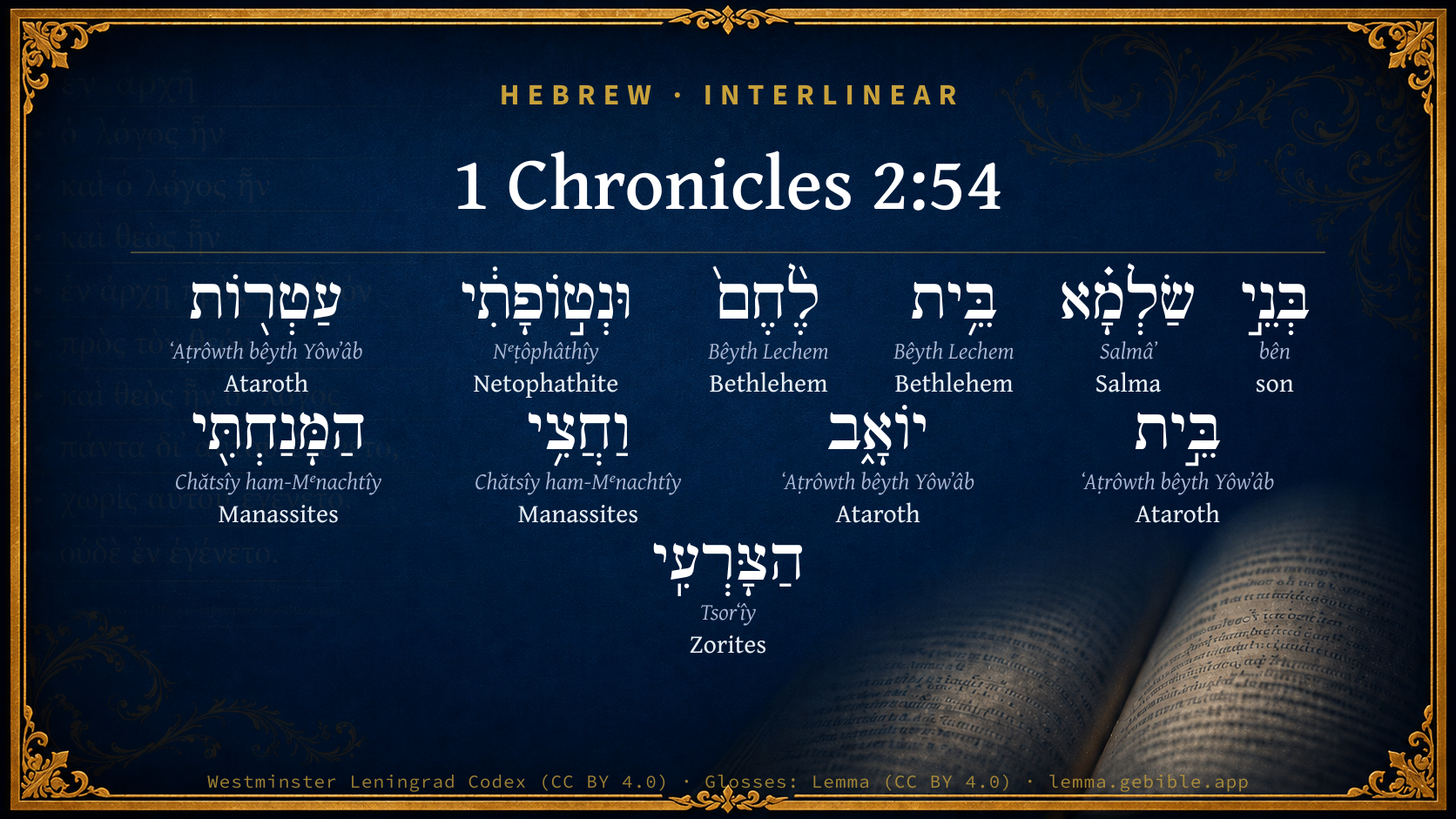
1 Chronicles 2:54

Hebrew (Westminster Leningrad Codex) 1 Chronicles 2:54 appears in the Hebrew Old Testament. The text above is from the Westminster Leningrad Codex. Each word links to its Strong’s number, a concise gloss, and parsing drawn from the Open Scriptures Hebrew Bible morphology. Click any word for its full Brown-Driver-Briggs (BDB) entry.
Download image
Cite this verse

1 Chronicles 2:54 (World English Bible). Public Domain. Lemma interlinear Bible study tool, https://lemma.gebible.app/v/1-chronicles/2/54.

Show BibTeX & RIS
BibTeX
RIS
English Translation
The sons of Salma: Bethlehem, and the Netophathites, Atroth Beth Joab, and half of the Manahathites, the Zorites.
World English Bible · Public Domain
Highlights
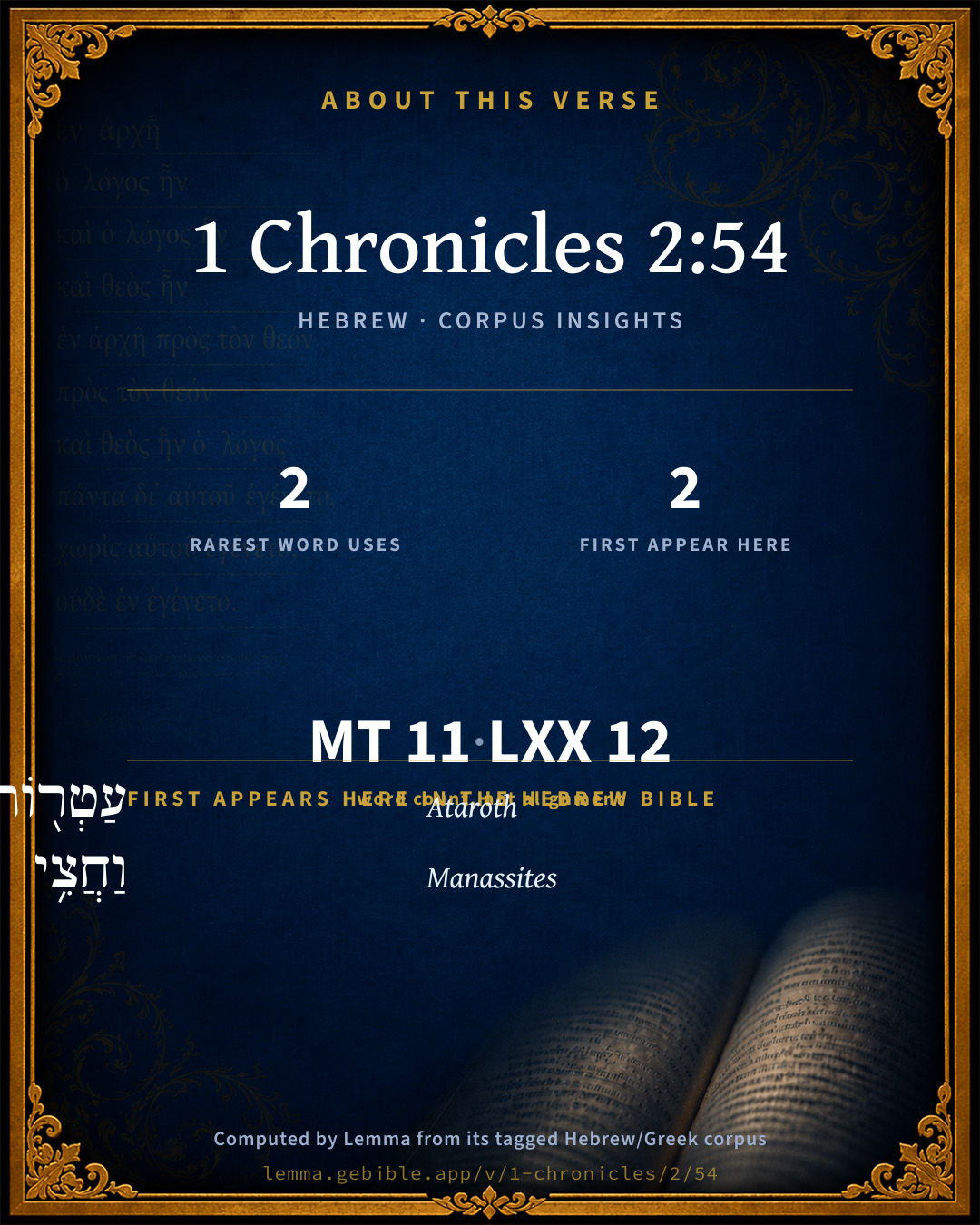
  • 2 first appearances in the Hebrew Bible
Full analysis ↓
Download a study sheet

One document with this verse’s original text, its word-by-word gloss line, the meaning frame, cross-references with their text, attributed commentary, and full source and license credits — printable, and it pastes into notes with its structure intact.

This verse Autodidact and up

Study sheet (.html) Plain text (.txt)

A passage Seminary Student

Up to 50 verses in one chapter. A passage sheet keeps up to 6 commentary sources and 12 cross-references per verse, in the order this page ranks them, and says so on the sheet whenever that leaves anything out. Ask for a single verse and you get the Autodidact verse sheet above.

Everything on this page stays free to read, with no account — the sheet is a download of what is already on screen, not access to it.

Want to remove ads? Support Godless Engineer
Compare translations 3

The same verse in 3 English versions, stacked beneath the original-language interlinear above. Click any original word for its lexicon entry.

Each is an independent rendering of the whole verse — the interlinear is not word-aligned to these translations.

Highlighted words mark where these versions differ — a whole-verse word diff, not a word-by-word alignment.

  • World English Bible Public Domain
    The sons of Salma: Bethlehem, and the Netophathites, Atroth Beth Joab, and half of the Manahathites, the Zorites.
  • King James Version Public Domain
    The sons of Salma; Bethlehem, and the Netophathites, Ataroth, the house of Joab, and half of the Manahethites, the Zorites.
  • unfoldingWord Literal Text CC BY-SA 4.0
    The sons of Salma: Bethlehem and the Netophathites, Atroth Beth Joab and half of the Manahathites, the Zorites,

unfoldingWord Literal Text — © unfoldingWord, licensed CC BY-SA 4.0. Word-aligned USFM3 via Door43 (git.door43.org/unfoldingWord/en_ult).

Versions to compare (up to 4)

3 of 4 selected

Show all 18 translations

Every available English version of this verse, each an independent rendering of the whole verse.

  • World English Bible Public Domain
    The sons of Salma: Bethlehem, and the Netophathites, Atroth Beth Joab, and half of the Manahathites, the Zorites.
  • Berean Standard Bible Public Domain
    The descendants of Salma: Bethlehem, the Netophathites, Atroth-beth-joab, half the Manahathites, the Zorites,
  • Majority Standard Bible Public Domain
    The descendants of Salma: Bethlehem, the Netophathites, Atroth-beth-joab, half the Manahathites, the Zorites,
  • King James Version Public Domain
    The sons of Salma; Bethlehem, and the Netophathites, Ataroth, the house of Joab, and half of the Manahethites, the Zorites.
  • American Standard Version (1901) Public Domain
    The sons of Salma: Beth-lehem, and the Netophathites, Atroth-beth-joab, and half of the Manahathites, the Zorites.
  • Revised Version (1885) Public Domain
    The sons of Salma; Beth-lehem, the Netophathites, Atroth-beth-Joab, and half of the Manahathites, the Zorites.
  • Geneva Bible (1599) Public Domain
    The sonnes of Salma of Beth-lehem, and the Netophathite, the crownes of the house of Ioab, and halfe the Manahthites and the Zorites.
  • Douay-Rheims (1899) Public Domain
    The sons of Salma, Bethlehem, and Netophathi, the crowns of the house of Joab, and half of the place of rest of Sarai.
  • Young's Literal Translation Public Domain
    Sons of Salma: Beth-Lehem, and the Netophathite, Atroth, Beth-Joab, and half of the Menuhothite, the Zorite;
  • Literal Standard Version CC BY-SA 4.0
    Sons of Salma: Beth-Lehem, and the Netophathite, Atroth, Beth-Joab, and half of the Menuhothite, the Zorite;
  • Unlocked Literal Bible CC BY-SA 4.0
    The clans of Salma were the following: Bethlehem, the Netophathites, Atroth Beth Joab, and half of the Manahathites—the Zorites,
  • unfoldingWord Literal Text CC BY-SA 4.0
    The sons of Salma: Bethlehem and the Netophathites, Atroth Beth Joab and half of the Manahathites, the Zorites,
  • Darby Bible Public Domain
    The sons of Salma: Bethlehem, and the Netophathites. Atroth-Beth-Joab, and the Hazi-Hammana-hethites, the Zorites;
  • World Messianic Bible Public Domain
    The sons of Salma: Bethlehem, the Netophathites, Atroth Beth Joab, and half of the Manahathites, the Zorites.
  • Webster's Bible Public Domain
    The sons of Salma; Beth-lehem, and the Netophathites, Ataroth, the house of Joab, and half of the Menahethites, the Zorites.
  • Free Bible Version CC BY-SA 4.0
    The descendants of Salma: Bethlehem, the Netophathites, Atroth Beth Joab, half the Manahathites, the Zorites,
  • Bible in Basic English Public Domain
    The sons of Salma: Beth-lehem and the Netophathites, Atroth-beth-Joab and half of the Manahathites, the Zorites.
  • JPS Tanakh (1917) Public Domain
    The sons of Salma: Beth-lehem, and the Netophathites, Atroth-beth-joab, and half of the Manahathites, the Zorites.

Literal Standard Version (2020), Covenant Press — licensed CC BY-SA 4.0. Text via the HelloAO Bible API (eBible.org). Unlocked Literal Bible (unfoldingWord) — licensed CC BY-SA 4.0. Text via the HelloAO Bible API (eBible.org). unfoldingWord Literal Text — © unfoldingWord, licensed CC BY-SA 4.0. Word-aligned USFM3 via Door43 (git.door43.org/unfoldingWord/en_ult). Free Bible Version, Dr. Jonathan Gallagher — licensed CC BY-SA 4.0. Text via the HelloAO Bible API (eBible.org).

Word by word

More ways to search: Search by grammar → Find every occurrence → Compare this word →

Practice this passage: Drill this verse → Learn its vocabulary →

וַחֲצִ֥י
Chătsîy ham-Mᵉnachtîy
H2680
“and · Manassites of”
Conjunction + Noun, Common, Masculine, Singular, Construct
Part of Speech
Conjunction + Noun
Type
Common
Gender
Masculine
Number
Singular
State
Construct
Full BDB Definition

Origin: patronymically from H2679

TWOT: None

(half of the) Manassites = see Manasseh " causing to forget" - half of the Manassites; also spelled like 2679
  1. בְּנֵ֣י bên H1121 “sons of” Noun, Common, Masculine, Plural, Construct
  2. שַׂלְמָ֗א Salmâʼ H8007 “Salma” Noun, Proper
  3. בֵּ֥ית Bêyth Lechem H1035 “Bethlehem” Noun, Proper
  4. לֶ֨חֶם֙ Bêyth Lechem H1035 “Bethlehem” Noun, Proper
  5. וּנְט֣וֹפָתִ֔י Nᵉṭôphâthîy H5200 “and · Netophathite” Conjunction + Noun, Gentilic, Masculine, Singular, Absolute
  6. עַטְר֖וֹת ʻAṭrôwth bêyth Yôwʼâb H5854 “Ataroth” Noun, Proper
  7. בֵּ֣ית ʻAṭrôwth bêyth Yôwʼâb H5854 “Ataroth” Noun, Proper
  8. יוֹאָ֑ב ʻAṭrôwth bêyth Yôwʼâb H5854 “Ataroth” Noun, Proper
  9. הַמָּנַחְתִּ֖י Chătsîy ham-Mᵉnachtîy H2680 “the · Manassites” Particle, Definite Article + Noun, Gentilic, Masculine, Singular, Absolute
  10. הַצָּרְעִֽי Tsorʻîy H6882 “the · Zorites” Particle, Definite Article + Noun, Gentilic, Masculine, Singular, Absolute

About this verse

These counts appear in no published source. They are computed here, from the morphology-tagged text and Lemma’s own curated glosses. What Lemma adds →

11
words
7
distinct lemmas
Historical
section

Notable vocabulary

The rarest word here is וַחֲצִ֥י Manassites H2680 — appearing just 2 times in the whole Hebrew Bible.

First appearance in Scripture

These words make their first canonical appearance in the Hebrew Bible here:

  • עַטְר֖וֹת Ataroth H5854
  • וַחֲצִ֥י Manassites H2680

Grammatical profile

  • 11 nouns

Repetition

Words recur within this verse — often emphatic in Hebrew:

  • עַטְר֖וֹת Ataroth H5854 ×3
  • בֵּ֥ית Bethlehem H1035 ×2
  • וַחֲצִ֥י Manassites H2680 ×2

Hebrew & Septuagint length

In English translation the verse runs 18 words from the Hebrew and 21 from the Septuagint (LXX English) — closely comparable.

A rough comparison of the two English renderings, which tokenize alike — not a word-level alignment.

Word counts can differ between the Hebrew and the Greek without any difference in meaning — e.g. the Hebrew direct-object marker אֵת has no separate Greek word, and Greek often adds the article ὁ.

In the original languages it is 11 Hebrew tokens and 12 Greek tokens — but the two are counted differently (Hebrew bundles its prefixes and suffixes into one token; the Greek is in lemma form), so that isn’t a like-for-like length.

Cross-references

6

Topical passages linked to 1 Chronicles 2:54 in the Treasury of Scripture Knowledge — connected by theme and wording, ordered by reader-vote popularity; previews shown in the World English Bible.

  • Ezra 2:22 The men of Netophah, fifty-six.
  • Nehemiah 7:26 The men of Bethlehem and Netophah, one hundred eighty-eight.
  • Nehemiah 12:28 The sons of the singers gathered themselves together, both out of the plain round about Jerusalem, and from the villages of the Netophathites;
  • Joshua 16:2 and it went out from Bethel to Luz, and passed along to the border of the Archites to Ataroth;
  • 2 Samuel 23:29 Heleb the son of Baanah the Netophathite, Ittai the son of Ribai of Gibeah of the children of Benjamin,
  • 1 Chronicles 11:30 Maharai the Netophathite, Heled the son of Baanah the Netophathite,

Cross-references courtesy of OpenBible.info (CC BY 4.0).

Hebrew and Greek witnesses Masoretic Hebrew ↔ Greek Septuagint

The same verse in the two great witnesses to the Old Testament, shown verse-for-verse.

These are two independent witnesses, not word-aligned to each other, and the Septuagint is shown in lemma (dictionary) form.

Hebrew 1 Chronicles 2:54 Masoretic · Westminster Leningrad Codex

בְּנֵ֣י שַׂלְמָ֗א בֵּ֥ית לֶ֨חֶם֙ וּנְט֣וֹפָתִ֔י עַטְר֖וֹת בֵּ֣ית יוֹאָ֑ב וַחֲצִ֥י הַמָּנַחְתִּ֖י הַצָּרְעִֽי

The sons of Salma: Bethlehem, and the Netophathites, Atroth Beth Joab, and half of the Manahathites, the Zorites.

World English Bible · Public Domain

Greek LXX 1 Chronicles 2:54 Septuagint · lemma form

υἱός σαλωμών βαιθλαεμ νετωφαθι αταρωθ οἶκος ιωαβ καί ἥμισυς ὁ μαναθι ησαρεϊ

The sons of Salomon; Baethalaem, the Netophathite, Ataroth of the house of Joab, and half of the family of Malathi, Esari.

LXX2012 (modern English Septuagint) · Public Domain

On this verse, Haydock's Catholic Bible Commentary discusses the Septuagint’s reading. Read the note in Commentary ↓

Hebrew: Westminster Leningrad Codex (CC BY 4.0). Greek: Septuagint (public domain); English from LXX2012 (modern English Septuagint) (Public Domain). How the Septuagint differs from the Hebrew →

Commentary

Notes on 1 Chronicles 2:54 from classic Christian and Jewish commentators (each source and its license shown beneath its notes). The classic Christian expositions comment on the surrounding passage and are grouped to its opening verse, so a note may address several verses; the Jewish commentaries on the Tanakh (Rashi and others) are per-verse, so they appear only where the commentator wrote on this verse.

Lemma curates 59 commentaries, every one of them public domain or Creative Commons licensed, each selected and text-cleaned for this edition rather than reprinted as found. About our sources →

Trapp's Complete Commentary

John Trapp

1Ch 2:54 The sons of Salma; Bethlehem, and the Netophathites, Ataroth, the house of Joab, and half of the Manahethites, the Zorites.

Ver. 54. The sons of Salma; Bethlehem,] i.e., The Bethlehemites.

Ataroth, the house of Joab.] Or, Crowns of the house of Joab. Those Netophathites, for their prowess and achievements, were Joab’s glory, his crown of rejoicing.

John Trapp, A Commentary or Exposition upon All the Books of the Old and New Testament (1647–1656) — public domain. Text from a community e-Sword module.

Joseph Benson's Commentary

1Ch 2:54. The sons of Salma; Beth-lehem — That is, the inhabitants of Beth-lehem: and so of Ataroth, and the house of Joab, or, as it should rather be rendered, Beth-joab, for the writer is not speaking of a family, but of a place. The people of those towns, and the Manahethites, and the Zorites, were all the descendants of this Salma, the son of Caleb. So that, it appears, he had a very numerous posterity.

Joseph Benson's Commentary on the Old and New Testaments (1811–1818) — public domain. Text from a community e-Sword module.

Geneva Bible (1599)

Geneva Bible translators

Or, the Zorites, the half of the Manahethites.

Meaning, the chief and principle.

Geneva Bible (1599) marginal notes — public domain. Text via Bolls.life.

Adam Clarke's Commentary

Verse 54. The sons of Salma] "The righteous Bethlehemites, who had a good name, as the Netophathites, who removed the guards which Jeroboam had placed in the way lest the people should carry the first-fruits to Jerusalem: for the sons of Salma carried baskets full of first-fruits privately to Jerusalem; and having cloven wood, they made ladders, and brought them to Jerusalem to be laid up in Beth-mokad for oblations. These came from the lineage of Joab the son of Zeruiah; and some of them were priests; and they divided the residue of the sacrifices with the sons of the prophets who were in Zorah." - T.

Adam Clarke's Commentary on the Bible (1810–1826) — public domain. Text from a community e-Sword/MySword module.

The Cambridge Bible for Schools and Colleges

gen. ed. J. J. S. Perowne

54. Ataroth, the house of Joab] R.V. Atroth-beth-Joab.

The Cambridge Bible for Schools and Colleges (gen. ed. J. J. S. Perowne; Cambridge University Press, 1878–1918) — public domain. Text from a community e-Sword module.

Albert Barnes' Notes on the Bible

Ataroth, the house of Joab - Rather, “Ataroth-beth-Joab,” probably so called, to distinguish it from Ataroth-Adar, a city of Benjamin Jos 18:13. It is uncertain from what Joab it derived its distinctive appellation.

Albert Barnes' Notes on the Bible (1834–1885) — public domain. Text from a community e-Sword/MySword module.

Haydock's Catholic Bible Commentary

Salma, or Salmon’s descendants, people Bethlehem, &c. --- Crowns. Valiant heroes who assisted Joab to gain crowns. (Worthington) --- Hebrew, "Hateroth," the house (Alexandrian Septuagint, of the house of Jobab) of Joab; (Haydock) perhaps the famous general who had land near Absalom’s, on the frontiers of Ephraim, where Ataroth was situated. --- And half. Hebrew, "half of the Manahethites." Protestants (Haydock) or "of Menuchat, towards Zarai." The author seems purposely to mention to whom the cities at first belonged, that the right owners might be reinstated in their possessions, at their return from Babylon. (Calmet) --- This verse may specify six towns, Bethlehem and Netophat, (Haydock) Beth-Joab, Chatsi, Manachti, and Atsothi.

George Leo Haydock (1774–1849), Haydock's Catholic Family Bible and Commentary, 1859 edition — public domain. Excludes Psalms (Douay-Rheims chapter numbering differs from Protestant) and Deuterocanonical books (Catholic canon only).

Matthew Poole's English Annotations

The sons of Salma; of that Salma mentioned 1Ch 2:51.

Beth-lehem, i.e. the inhabitants of Beth-lehem.

Ataroth; the name of a person or people.

The house of Joab; the progenitors of Joab’s family.

Half of the Manahethites; the other half being mentioned 1Ch 2:52.

Zorites, for, to wit, the Zorites.

Matthew Poole's English Annotations on the Holy Bible (1683–1685) — public domain. Text from a community e-Sword/MySword module.

Scofield Reference Notes

C. I. Scofield

Ataroth

Or, Atarites, or, crowns of the house of Joab.

The Scofield Reference Bible (1917 edition), notes by C. I. Scofield — public domain. Text from a community e-Sword module.

unfoldingWord translationNotes

Door43 World Missions Community

Salma ... Hammath

names of man (See: How to Translate Names)

Bethlehem ... Atroth Beth Joab ... Jabez

names of towns (See: How to Translate Names)

Netophathites, Atroth Beth Joab ... Manahathites ... Zorites ... Tirathites, Shimeathites, and Sucathites ... Kenites ... Rekabites

These are the names of clans. (See: How to Translate Names)

translationWords

scribe

unfoldingWord translationNotes — © Distant Shores Media and the Door43 World Missions Community, licensed CC BY-SA 4.0. Source: git.door43.org/Door43/en_tn.

Rashi

Rabbi Shlomo Yitzchaki (Rashi)

The sons of Salma: Bethlehem The sons of Salma were inhabitants of Bethlehem.

and the Netophathites, Atroth Beth Joab and also of the inhabitants of Netophoth and Atroth Beth Joab, half the province of the Manahtite the people of Zorah seized for themselves and dwelled in them. They are names of places, (II Sam. 28:29f.): “Maharai the Netophathite... Baanah the Netophathite,” David’s mighty men. And Manahath [is also a name of a place, as below (8:6)]: “... and they exiled them to Manahath.”

Rashi on the Tanakh — English translations: “The Judaica Press complete Tanach with Rashi, translated by A. J. Rosenberg” (CC BY 4.0); “Pentateuch with Rashi's commentary by M. Rosenbaum and A.M. Silbermann, 1929-1934” (public domain); “The Metsudah Tanach series, Lakewood, N.J” (CC BY 4.0); and “The Book of Joshua, Metsudah Publications, 1997” (CC BY 4.0). Text via Sefaria.

Lesson kit

Teaching starters — assembled from the data on this page, not authored interpretation. Every prompt links to the verse data it draws on. Edit before teaching.

1 Chronicles, in the Historical, opens this verse with 11 words (7 distinct Hebrew lemmas). Its most distinctive word is Chătsîy ham-Mᵉnachtîy (“Manassites”). A historical commentator’s framing appears above. Read the whole chapter for the surrounding context.

Discussion questions

  1. The word Chătsîy ham-Mᵉnachtîy carries the sense “Manassites.” How does it shape the verse?
  2. 2 words here appear for the first time in Scripture. What is being introduced at this debut?
  3. Ezra 2:22 shares this passage’s theme. How do the two illuminate each other?
  4. “Ataroth” occurs 3× in this one verse. What is the effect of the repetition?
  5. These translations render this verse differently; the difference is in the English rendering, not the original. What questions does that raise?
  6. Reading how Trapp's Complete Commentary and Joseph Benson's Commentary read this verse, where do the two commentators agree and where do they part?

Things to notice

Reading settings

Reading text

Shown beneath each verse's original-language words.

Old Testament
Old Testament edition

Read the OT as the Masoretic Hebrew (MT) or the Greek Septuagint (LXX).

English shown for the Greek Septuagint (in the Hebrew ↔ Greek comparison).

Comparing translations? Open the Compare panel on any verse page to stack up to four side by side.