
2 Kings 13:3

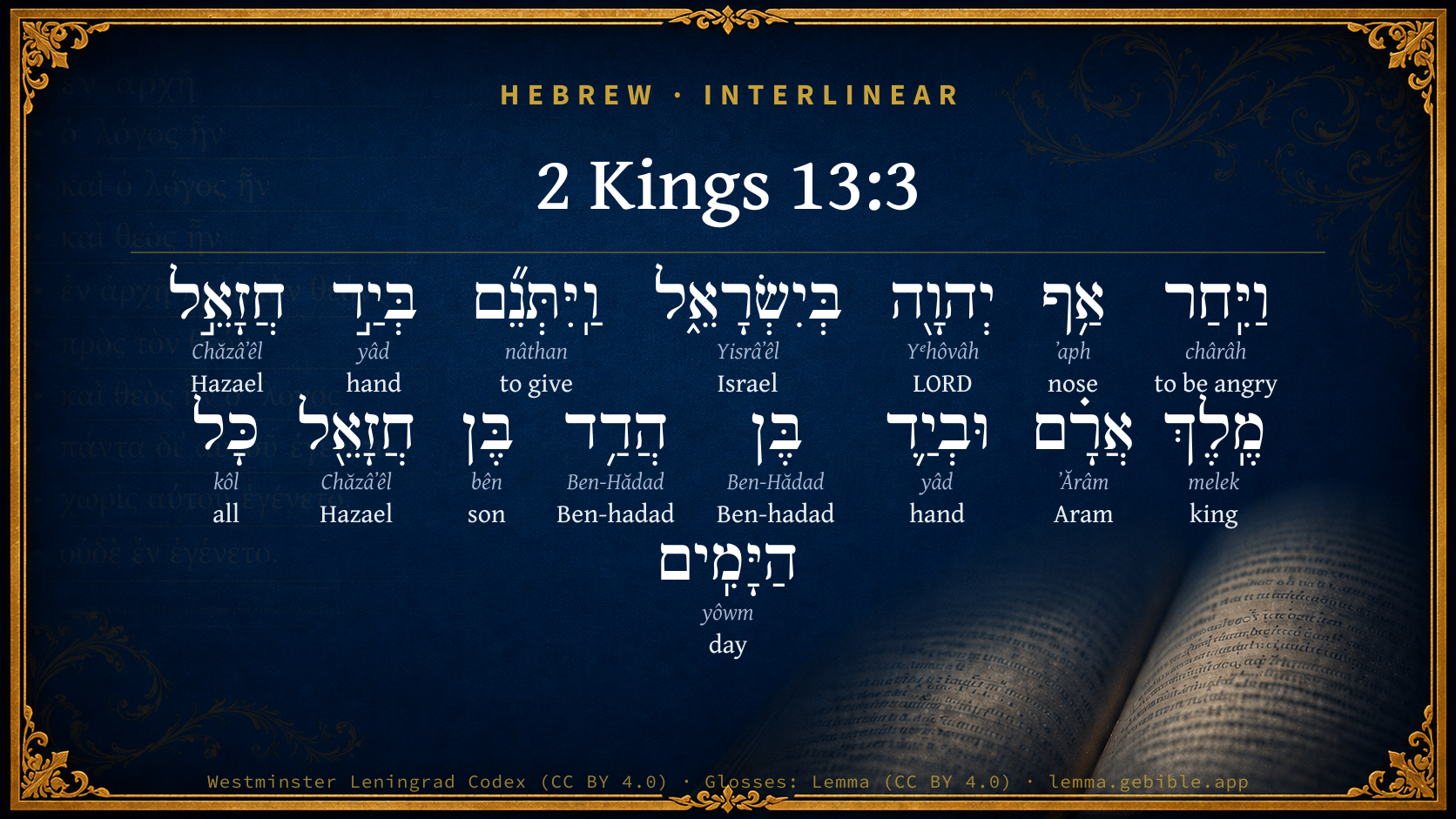
Hebrew (Westminster Leningrad Codex) 2 Kings 13:3 appears in the Hebrew Old Testament. The text above is from the Westminster Leningrad Codex. Each word links to its Strong’s number, a concise gloss, and parsing drawn from the Open Scriptures Hebrew Bible morphology. Click any word for its full Brown-Driver-Briggs (BDB) entry.
Download image
Cite this verse

2 Kings 13:3 (World English Bible). Public Domain. Lemma interlinear Bible study tool, https://lemma.gebible.app/v/2-kings/13/3.

Show BibTeX & RIS
BibTeX
RIS
English Translation
The anger of Yahweh was kindled against Israel, and he delivered them into the hand of Hazael king of Syria, and into the hand of Benhadad the son of Hazael, continually.
World English Bible · Public Domain
Download a study sheet

One document with this verse’s original text, its word-by-word gloss line, the meaning frame, cross-references with their text, attributed commentary, and full source and license credits — printable, and it pastes into notes with its structure intact.

This verse Autodidact and up

Study sheet (.html) Plain text (.txt)

A passage Seminary Student

Up to 50 verses in one chapter. A passage sheet keeps up to 6 commentary sources and 12 cross-references per verse, in the order this page ranks them, and says so on the sheet whenever that leaves anything out. Ask for a single verse and you get the Autodidact verse sheet above.

Everything on this page stays free to read, with no account — the sheet is a download of what is already on screen, not access to it.

Want to remove ads? Support Godless Engineer
Compare translations 3

The same verse in 3 English versions, stacked beneath the original-language interlinear above. Click any original word for its lexicon entry.

Each is an independent rendering of the whole verse — the interlinear is not word-aligned to these translations.

Highlighted words mark where these versions differ — a whole-verse word diff, not a word-by-word alignment.

  • World English Bible Public Domain
    The anger of Yahweh was kindled against Israel, and he delivered them into the hand of Hazael king of Syria, and into the hand of Benhadad the son of Hazael, continually.
  • King James Version Public Domain
    And the anger of the LORD was kindled against Israel, and he delivered them into the hand of Hazael king of Syria, and into the hand of Benhadad the son of Hazael, all their days.
  • unfoldingWord Literal Text CC BY-SA 4.0
    And the nose of Yahweh burned against Israel, and he gave them into the hand of Hazael, the king of Aram, and into the hand of Ben Hadad, the son of Hazael, all of the days.

unfoldingWord Literal Text — © unfoldingWord, licensed CC BY-SA 4.0. Word-aligned USFM3 via Door43 (git.door43.org/unfoldingWord/en_ult).

Versions to compare (up to 4)

3 of 4 selected

Show all 18 translations

Every available English version of this verse, each an independent rendering of the whole verse.

  • World English Bible Public Domain
    The anger of Yahweh was kindled against Israel, and he delivered them into the hand of Hazael king of Syria, and into the hand of Benhadad the son of Hazael, continually.
  • Berean Standard Bible Public Domain
    So the anger of the LORD burned against Israel, and He delivered them continually into the hands of Hazael king of Aram and his son Ben-hadad.
  • Majority Standard Bible Public Domain
    So the anger of the LORD burned against Israel, and He delivered them continually into the hands of Hazael king of Aram and his son Ben-hadad.
  • King James Version Public Domain
    And the anger of the LORD was kindled against Israel, and he delivered them into the hand of Hazael king of Syria, and into the hand of Benhadad the son of Hazael, all their days.
  • American Standard Version (1901) Public Domain
    And the anger of Jehovah was kindled against Israel, and he delivered them into the hand of Hazael king of Syria, and into the hand of Benhadad the son of Hazael, continually.
  • Revised Version (1885) Public Domain
    And the anger of the LORD was kindled against Israel, and he delivered them into the hand of Hazael king of Syria, and into the hand of Ben-hadad the son of Hazael, continually.
  • Geneva Bible (1599) Public Domain
    And the Lord was angry with Israel, and deliuered them into the hand of Hazael King of Aram, and into the hand of Ben-hadad the sonne of Hazael, all his dayes.
  • Douay-Rheims (1899) Public Domain
    And the wrath of the Lord was kindled against Israel, and he delivered them into the hand of Hazael the king of Syria, and into the hand of Benadad the son of Hazael all days.
  • Young's Literal Translation Public Domain
    and the anger of Jehovah burneth against Israel, and He giveth them into the hand of Hazael king of Aram, and into the hand of Ben-Hadad son of Hazael, all the days.
  • Literal Standard Version CC BY-SA 4.0
    and the anger of YHWH burns against Israel, and He gives them into the hand of Hazael king of Aram, and into the hand of Ben-Hadad son of Hazael, all the days.
  • Unlocked Literal Bible CC BY-SA 4.0
    The anger of Yahweh burned against Israel, and he gave them continually into the hand of Hazael king of Aram and into the hand of Ben Hadad son of Hazael.
  • unfoldingWord Literal Text CC BY-SA 4.0
    And the nose of Yahweh burned against Israel, and he gave them into the hand of Hazael, the king of Aram, and into the hand of Ben Hadad, the son of Hazael, all of the days.
  • Darby Bible Public Domain
    And the anger of Jehovah was kindled against Israel, and he delivered them into the hand of Hazael king of Syria, and into the hand of Ben-Hadad the son of Hazael, all those days.
  • World Messianic Bible Public Domain
    The LORD’s anger burned against Israel, and he delivered them into the hand of Hazael king of Syria, and into the hand of Benhadad the son of Hazael, continually.
  • Webster's Bible Public Domain
    And the anger of the LORD was kindled against Israel, and he delivered them into the hand of Hazael king of Syria, and into the hand of Ben-hadad the son of Hazael, all their days.
  • Free Bible Version CC BY-SA 4.0
    So the Lord was angry with Israel, and he repeatedly allowed them to be defeated by Hazael, king of Aram, and his son Ben-hadad.
  • Bible in Basic English Public Domain
    So the wrath of the Lord was burning against Israel, and he gave them up into the power of Hazael, king of Aram, and into the power of Ben-hadad, the son of Hazael, again and again.
  • JPS Tanakh (1917) Public Domain
    And the anger of the LORD was kindled against Israel, and He delivered them into the hand of Hazael king of Aram, and into the hand of Ben-hadad the son of Hazael, continually.

Literal Standard Version (2020), Covenant Press — licensed CC BY-SA 4.0. Text via the HelloAO Bible API (eBible.org). Unlocked Literal Bible (unfoldingWord) — licensed CC BY-SA 4.0. Text via the HelloAO Bible API (eBible.org). unfoldingWord Literal Text — © unfoldingWord, licensed CC BY-SA 4.0. Word-aligned USFM3 via Door43 (git.door43.org/unfoldingWord/en_ult). Free Bible Version, Dr. Jonathan Gallagher — licensed CC BY-SA 4.0. Text via the HelloAO Bible API (eBible.org).

Word by word

More ways to search: Search by grammar → Find every occurrence → Compare this word →

Practice this passage: Drill this verse → Learn its vocabulary →

חֲזָאֵ֣ל
Chăzâʼêl
H2371
“Hazael”
Noun, Proper
Part of Speech
Noun
Type
Proper
Full BDB Definition

Origin: from H2372 and H410

TWOT: None

Hazael = "one who sees God" - a king of Syria; sent by his master, Ben-hadad, to the prophet Elisha, to seek a remedy for Ben-hadad's leprosy; apparently later killed Ben-hadad, assumed the throne, and soon became engaged in a war with the kings of Judah and Israel for the possession of the city of Ramoth-gilead
  1. וַיִּֽחַר chârâh H2734 “and · to be angry” Conjunction + Verb, Qal, Sequential Imperfect, 3rd Person, Masculine, Singular
  2. אַ֥ף ʼaph H639 “nose” Particle, Accusative
  3. יְהוָ֖ה Yᵉhôvâh H3068 “LORD” Noun, Proper
  4. בְּיִשְׂרָאֵ֑ל Yisrâʼêl H3478 “in/at · Israel” Preposition + Noun, Proper
  5. וַֽיִּתְּנֵ֞ם nâthan H5414 “and · to give · them” Conjunction + Verb, Qal, Sequential Imperfect, 3rd Person, Masculine, Singular + Suffix, Personal, 3rd Person, Masculine, Plural
  6. בְּיַ֣ד yâd H3027 “in/at · hand of” Preposition + Noun, Common, Both, Singular, Construct
  7. מֶֽלֶךְ melek H4428 “king of” Noun, Common, Masculine, Singular, Construct
  8. אֲרָ֗ם ʼĂrâm H758 “Aram” Noun, Proper
  9. וּבְיַ֛ד yâd H3027 “and · in/at · hand of” Conjunction + Preposition + Noun, Common, Both, Singular, Construct
  10. בֶּן Ben-Hădad H1130 “Ben-hadad” Noun, Proper
  11. הֲדַ֥ד Ben-Hădad H1130 “Ben-hadad” Noun, Proper
  12. בֶּן bên H1121 “son of” Noun, Common, Masculine, Singular, Construct
  13. חֲזָאֵ֖ל Chăzâʼêl H2371 “Hazael” Noun, Proper
  14. כָּל kôl H3605 “all of” Noun, Common, Masculine, Singular, Construct
  15. הַיָּמִֽים yôwm H3117 “the · days” Particle, Definite Article + Noun, Common, Masculine, Plural, Absolute

About this verse

These counts appear in no published source. They are computed here, from the morphology-tagged text and Lemma’s own curated glosses. What Lemma adds →

16
words
13
distinct lemmas
Historical
section

Notable vocabulary

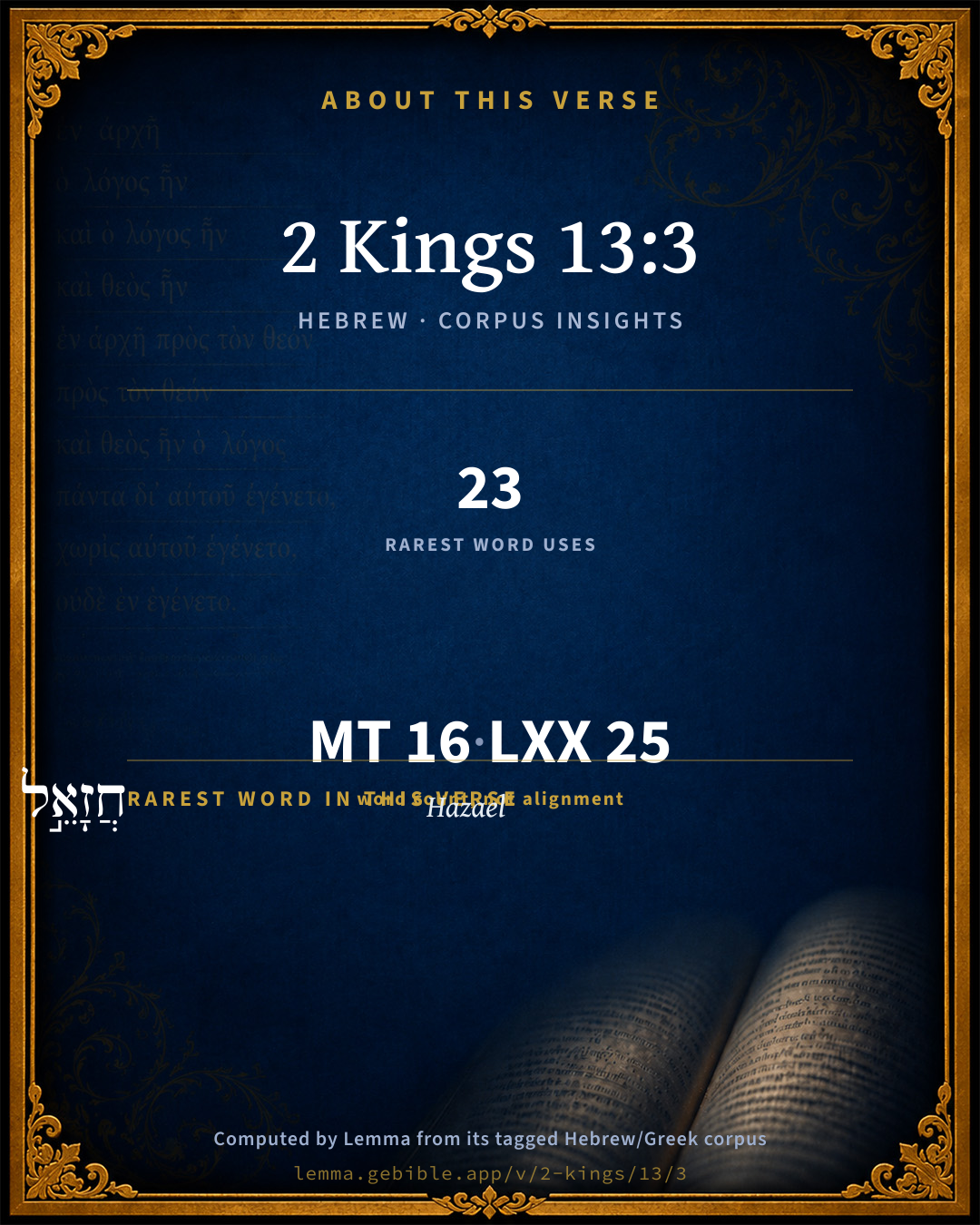
The rarest word here is חֲזָאֵ֣ל Hazael H2371 — appearing just 23 times in the whole Hebrew Bible.

Shared distinctive vocabulary

חֲזָאֵ֣ל Hazael H2371 occurs in 21 verses of the Hebrew Bible. Also found in:

Grammatical profile

  • 2 verbs
  • 13 nouns
  • 1 particle

Verb forms

  • וַיִּֽחַר Qal · Sequential Imperfect
  • וַֽיִּתְּנֵ֞ם Qal · Sequential Imperfect

Repetition

Words recur within this verse — often emphatic in Hebrew:

  • בְּיַ֣ד hand H3027 ×2
  • חֲזָאֵ֣ל Hazael H2371 ×2
  • בֶּן Ben-hadad H1130 ×2

Hebrew & Septuagint length

In English translation the verse runs 31 words from the Hebrew and 34 from the Septuagint (LXX English) — closely comparable.

A rough comparison of the two English renderings, which tokenize alike — not a word-level alignment.

Word counts can differ between the Hebrew and the Greek without any difference in meaning — e.g. the Hebrew direct-object marker אֵת has no separate Greek word, and Greek often adds the article ὁ.

In the original languages it is 16 Hebrew tokens and 25 Greek tokens — but the two are counted differently (Hebrew bundles its prefixes and suffixes into one token; the Greek is in lemma form), so that isn’t a like-for-like length.

Cross-references

13

Topical passages linked to 2 Kings 13:3 in the Treasury of Scripture Knowledge — connected by theme and wording, ordered by reader-vote popularity; previews shown in the World English Bible.

  • 1 Kings 19:17 It shall happen, that he who escapes from the sword of Hazael shall Jehu kill; and he who escapes from the sword of Jehu shall Elisha kill.
  • 2 Kings 13:24–25 Hazael king of Syria died; and Benhadad his son reigned in his place.
  • Judges 2:14 The anger of Yahweh was kindled against Israel, and he delivered them into the hands of spoilers who despoiled them; and he sold them into the hands of their enemies round about, so that they could not any longer stand before their enemies.
  • 2 Kings 12:17 Then Hazael king of Syria went up, and fought against Gath, and took it; and Hazael set his face to go up to Jerusalem.
  • Leviticus 26:17 I will set my face against you, and you will be struck before your enemies. Those who hate you will rule over you; and you will flee when no one pursues you.
  • Deuteronomy 4:24–27 For Yahweh your God is a devouring fire, a jealous God.
  • Deuteronomy 28:25 Yahweh will cause you to be struck before your enemies; you shall go out one way against them, and shall flee seven ways before them: and you shall be tossed back and forth among all the kingdoms of the earth.
  • Judges 3:8 Therefore the anger of Yahweh was kindled against Israel, and he sold them into the hand of Cushan Rishathaim king of Mesopotamia: and the children of Israel served Cushan Rishathaim eight years.
  • Judges 10:7–14 The anger of Yahweh was kindled against Israel, and he sold them into the hand of the Philistines, and into the hand of the children of Ammon.
  • 2 Kings 8:12–13 Hazael said, Why weeps my lord? He answered, Because I know the evil that you will do to the children of Israel: their strongholds will you set on fire, and their young men will you kill with the sword, and will dash in pieces their little ones, and rip up their women with child.
  • 2 Kings 13:22 Hazael king of Syria oppressed Israel all the days of Jehoahaz.
  • Isaiah 10:5–6 Ho Assyrian, the rod of my anger, the staff in whose hand is my indignation!
  • Hebrews 12:29 for our God is a consuming fire.

Cross-references courtesy of OpenBible.info (CC BY 4.0).

Hebrew and Greek witnesses Masoretic Hebrew ↔ Greek Septuagint

The same verse in the two great witnesses to the Old Testament, shown verse-for-verse.

These are two independent witnesses, not word-aligned to each other, and the Septuagint is shown in lemma (dictionary) form.

Hebrew 2 Kings 13:3 Masoretic · Westminster Leningrad Codex

וַיִּֽחַר אַ֥ף יְהוָ֖ה בְּיִשְׂרָאֵ֑ל וַֽיִּתְּנֵ֞ם בְּיַ֣ד חֲזָאֵ֣ל מֶֽלֶךְ אֲרָ֗ם וּבְיַ֛ד בֶּן הֲדַ֥ד בֶּן חֲזָאֵ֖ל כָּל הַיָּמִֽים

The anger of Yahweh was kindled against Israel, and he delivered them into the hand of Hazael king of Syria, and into the hand of Benhadad the son of Hazael, continually.

World English Bible · Public Domain

Greek LXX 2 Kings 13:3 Septuagint · lemma form

καί ὀργίζω θυμός κύριος ἐν ὁ ἰσραήλ καί δίδωμι αὐτός ἐν χείρ αζαηλ βασιλεύς συρία καί ἐν χείρ υἱός αδερ υἱός αζαηλ πᾶς ὁ ἡμέρα

And the Lord was very angry with Israel, and delivered them into the hand of Azael king of Syria, and into the hand of the son of Ader son of Azael, all their days.

LXX2012 (modern English Septuagint) · Public Domain

Hebrew: Westminster Leningrad Codex (CC BY 4.0). Greek: Septuagint (public domain); English from LXX2012 (modern English Septuagint) (Public Domain). How the Septuagint differs from the Hebrew →

Targum (Aramaic paraphrase)

1

The Targum is the ancient Jewish Aramaic paraphrase of the Hebrew Scriptures — an interpretive translation, not the Hebrew text itself. Onkelos (literal) and Pseudo-Jonathan (expansive) render the Torah, and Jonathan the Prophets. Coverage is partial: where no permissively-licensed English translation exists for a verse, only the Aramaic is shown. This is verse-level text, not a word-by-word alignment to the Hebrew.

  1. Targum Jonathan Prophets (Joshua–Malachi)
    וּתְקֵיף רוּגְזָא דַייָ בְּיִשְׂרָאֵל וּמַסְרִינוּן בְיַד חֲזָאֵל מַלְכָּא דַאֲרָם וּבְיַד בַּר הֲדַר בַּר חֲזָאֵל כָּל יוֹמַיָא:

    (no public-domain English translation for this verse)

    Targum Jonathan — Aramaic: “Mikraot Gedolot” (public domain). English: “Sefaria Community Translation” (CC0 1.0 (public-domain dedication)); “London "Chaldee Paraphrase," 1871” (public domain). Text via Sefaria.

Commentary

Notes on 2 Kings 13:3 from classic Christian and Jewish commentators (each source and its license shown beneath its notes). The classic Christian expositions comment on the surrounding passage and are grouped to its opening verse, so a note may address several verses; the Jewish commentaries on the Tanakh (Rashi and others) are per-verse, so they appear only where the commentator wrote on this verse.

Lemma curates 59 commentaries, every one of them public domain or Creative Commons licensed, each selected and text-cleaned for this edition rather than reprinted as found. About our sources →

Trapp's Complete Commentary

John Trapp

2Ki 13:3 And the anger of the LORD was kindled against Israel, and he delivered them into the hand of Hazael king of Syria, and into the hand of Benhadad the son of Hazael, all [their] days.

Ver. 3. And the anger of the Lord.] God is said to be angry at evildoers, because, as angry men use to do, he threateneth and smiteth them.

John Trapp, A Commentary or Exposition upon All the Books of the Old and New Testament (1647–1656) — public domain. Text from a community e-Sword module.

Joseph Benson's Commentary

2Ki 13:3. The anger of the Lord was kindled against Israel — Who, knowing the only living and true God to be a spirit, an eternal mind, an infinitely wise and mighty, just and holy, and absolutely perfect Being, besides all their other sins and abominations, still continued to change the glory of this their incorruptible God into the similitude of an ox, the truth of God into a lie, and, like the nations around them, to worship the work of their own hands. There could not be a greater reproach than the two idolized calves were, to a people acquainted with the nature and attributes of God, and intrusted with his lively oracles, in which he had given them rules, of his own appointment, to direct them how to worship him. Strange it is, indeed, that in all the history of the ten tribes, we never find the least shock given to that idolatry, but, in every reign, still the calf was their god! and that notwithstanding the many and repeated judgments executed upon them to reclaim them from that senseless and stupid practice. Well might the anger of God be kindled against them! And he delivered them into the hand of Hazael — It had been the honour of Israel that they were taken under the special protection of Heaven: God himself was their defence, the shield of their help, and the sword of their excellency. But here again, as often before, we find them stripped of this glory, and exposed to the insults of all their neighbours. Surely never was any nation so often plucked and pillaged as Israel was: but this they brought upon themselves by their sins: and when they had provoked God to break down their hedge, the goodness of their land did but tempt their neighbours. So low was Israel brought in this reign, by the many depredations which the Syrians made upon them, that the militia of the kingdom, and all the force they could bring into the field, was but fifty horsemen, ten chariots, and ten thousand footmen, a despicable muster, 2Ki 13:7. Are the thousands of Israel come to this? How is the gold become dim!

Joseph Benson's Commentary on the Old and New Testaments (1811–1818) — public domain. Text from a community e-Sword module.

Tyndale Open Study Notes

Tyndale Open Resources

13:3 Hazael, who had seized the throne of Aram in Damascus by assassinating his predecessor Ben-hadad II (8:15), continued the oppression of the northern kingdom. • Ben-hadad apparently served as a commander in Hazael’s forces until he succeeded his father as king in 802 BC.

Tyndale Open Study Notes — © Tyndale Open Resources, licensed CC BY-SA 4.0. Text via the HelloAO Bible API.

Geneva Bible (1599)

Geneva Bible translators

While Jehoahaz lived.

Geneva Bible (1599) marginal notes — public domain. Text via Bolls.life.

The Cambridge Bible for Schools and Colleges

gen. ed. J. J. S. Perowne

3. all their days] R.V. continually. The sense cannot be what is represented by A.V. For in the days of Benhadad (2Ki_13:25) the son of Jehoahaz made conquests from Benhadad. Hence ‘all the days’ must mean the days of Jehoahaz, which accords with the statement of verse 22 below. So ‘continually’ must refer to the whole of this reign.

The Cambridge Bible for Schools and Colleges (gen. ed. J. J. S. Perowne; Cambridge University Press, 1878–1918) — public domain. Text from a community e-Sword module.

John Gill's Exposition

And the anger of the Lord was kindled against Israel,.... They doing as their kings did:

and he delivered them into the hand of Hazael king of Syria, and into the hand of Benhadad the son of Hazael, all their days; the word "their" should not be supplied, since it was not true that Israel was delivered into the hands of both those kings of Syria as long as they lived; for they were delivered out of the hands of Benhadad, Kg2 13:25, but the word "his" should be inserted for it as to be understood of the days of Jehoahaz, see Kg2 13:22.

John Gill's Exposition of the Whole Bible (1746–1763) — public domain (CC PDM 1.0). Text via the HelloAO Bible API.

Albert Barnes' Notes on the Bible

All their days - literally, “all the days.” Not “all the days” of the two Syrian kings, for Ben-hadad lost to Joash all the cities which he had gained from Jehoahaz 2Ki 13:25; but either “all the days of Jehoahaz” 2Ki 13:22, or “all the days of Hazael” - both while he led his own armies, and while they were led by his son.

Albert Barnes' Notes on the Bible (1834–1885) — public domain. Text from a community e-Sword/MySword module.

Haydock's Catholic Bible Commentary

Days, while Joachaz lived, ver. 22. (Menochius) --- Yet Benadad only molested his son. (Calmet) --- Hazael proved a dreadful scourge in the hand of God, to punish his people, chap. viii. 12. (Haydock)

George Leo Haydock (1774–1849), Haydock's Catholic Family Bible and Commentary, 1859 edition — public domain. Excludes Psalms (Douay-Rheims chapter numbering differs from Protestant) and Deuterocanonical books (Catholic canon only).

Matthew Poole's English Annotations

Or rather, all his days, as it is explained, 2Ki 13:22.

Matthew Poole's English Annotations on the Holy Bible (1683–1685) — public domain. Text from a community e-Sword/MySword module.

Whedon's Commentary on the Bible

Daniel D. Whedon

3. All their days — Rather, all his days; literally, all the days; that is, all the days of Jehoahaz. Compare 2Ki_13:22.

Daniel D. Whedon (gen. ed.), Commentary on the Old and New Testaments (1874–1909) — public domain. Text from a community e-Sword module.

The Pulpit Commentary

And the anger of the Lord was kindled against Israel. We know so much less of the nature of the calf-worship and of the rites which accompanied it, that we cannot to the same extent justify the Divine severity in connection with it as in connection with the Baal and Astarte cult. Still, we must remember the coarse, lewd dancing which accompanied the first calf-worship, (Exo_32:19) for which death was not thought too heavy a penalty, (Exo_32:27) and the almost universal combination of unchastity with idolatrous ceremonies, which raises a suspicion that those who frequented the shrines at Dan and Bethel were not wholly innocent of impurity. And he delivered them into the hand of Hazel King of Syria. The national sins of Israel were mostly punished in this way, by the sword of some foreign foe. Hazael had been already made an instrument for the chastisement of Jehu. (2Ki_10:32, 2Ki_10:33) Now he was to chastise Jehoahaz still more severely. And into the hand of Benhadad the son of Hazael, all their days; literally, all the days. Not certainly all the days of the two kings Hazael and Benhadad, for Benhadad was entirely worsted in his war with Joash (vers. 24, 25), but either all the days of Jehoahaz, or all the days that God had appointed for the duration of the calamity. It is perhaps against the former interpretation that Hazael appears to have outlived Jehoahaz (vers. 22-24); but Ben-hadad may have warred against him as his father"s general (ver. 25) during his father"s lifetime.

The Pulpit Commentary (1880–1919), ed. H.D.M. Spence-Jones & Joseph S. Exell — public domain. Text from a community e-Sword module.

unfoldingWord translationNotes

Door43 World Missions Community

The anger of Yahweh burned against Israel

Yahweh becoming angry with Israel is spoken of as if his anger was a fire that burned. AT: "Then Yahweh became very angry with Israel" (See: Metaphor)

gave them continually into the hand of Hazael king of Aram and into the hand of Ben Hadad son of Hazael

Here "them" refers to Israel and "hand" refers to the power to control them. AT: "allowed Hazael the king of Aram, and Ben Hadad, his son, to repeatedly defeat the Israelites in battle" (See: Metonymy)

implored Yahweh

"prayed to Yahweh"

he saw the oppression of Israel, how the king of Aram was oppressing them

These two phrases mean the same thing and are repeated for emphasis. The abstract noun "oppression" means the same as "the king of Aram was oppressing them." AT: "he saw how severely the king of Aram was oppressing Israel" (See: Abstract Nouns)

a rescuer

"someone to rescue them"

they escaped from the hand of the Arameans

Here "hand" refers to the power to control them. AT: "he enabled them to be free from Aram's power" (See: Metonymy)

translationWords

anger

Yahweh

Aram

oppress

power

unfoldingWord translationNotes — © Distant Shores Media and the Door43 World Missions Community, licensed CC BY-SA 4.0. Source: git.door43.org/Door43/en_tn.

Lesson kit

Teaching starters — assembled from the data on this page, not authored interpretation. Every prompt links to the verse data it draws on. Edit before teaching.

2 Kings, in the Historical, opens this verse with 16 words (13 distinct Hebrew lemmas). Its most distinctive word is Chăzâʼêl (“Hazael”). A historical commentator’s framing appears above. Read the whole chapter for the surrounding context.

Discussion questions

  1. How does “Hazael” (Chăzâʼêl) shape what this verse is saying?
  2. How does 1 Kings 19:15, which shares the word «Hazael», read alongside this verse?
  3. What does the repetition of “hand” (2× in this one verse) do in this verse?
  4. These translations render this verse differently; the difference is in the English rendering, not the original. What questions does that raise?
  5. «וַיִּֽחַר» is a Qal Sequential Imperfect verb. How does that grammatical form shape the action described?
  6. Compare how Trapp's Complete Commentary and Joseph Benson's Commentary read this verse. Where do they agree or differ?

Things to notice

Reading settings

Reading text

Shown beneath each verse's original-language words.

Old Testament
Old Testament edition

Read the OT as the Masoretic Hebrew (MT) or the Greek Septuagint (LXX).

English shown for the Greek Septuagint (in the Hebrew ↔ Greek comparison).

Comparing translations? Open the Compare panel on any verse page to stack up to four side by side.