
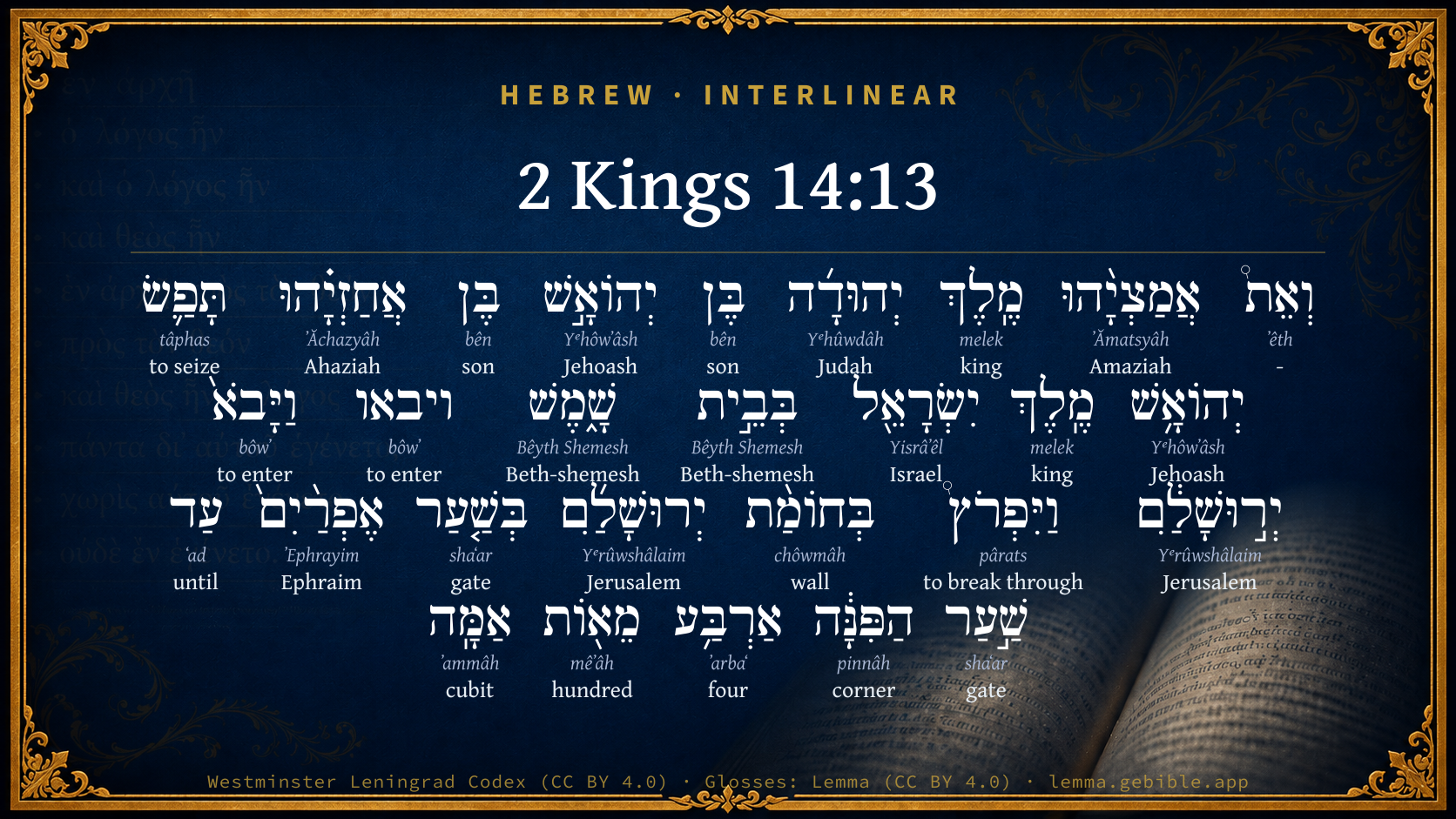
2 Kings 14:13

Hebrew (Westminster Leningrad Codex) 2 Kings 14:13 appears in the Hebrew Old Testament. The text above is from the Westminster Leningrad Codex. Each word links to its Strong’s number, a concise gloss, and parsing drawn from the Open Scriptures Hebrew Bible morphology. Click any word for its full Brown-Driver-Briggs (BDB) entry.
Download image
Cite this verse

2 Kings 14:13 (World English Bible). Public Domain. Lemma interlinear Bible study tool, https://lemma.gebible.app/v/2-kings/14/13.

Show BibTeX & RIS
BibTeX
RIS
English Translation
Jehoash king of Israel took Amaziah king of Judah, the son of Jehoash the son of Ahaziah, at Beth-shemesh, and came to Jerusalem, and broke down the wall of Jerusalem from the gate of Ephraim to the corner gate, four hundred cubits.
World English Bible · Public Domain
Download a study sheet

One document with this verse’s original text, its word-by-word gloss line, the meaning frame, cross-references with their text, attributed commentary, and full source and license credits — printable, and it pastes into notes with its structure intact.

This verse Autodidact and up

Study sheet (.html) Plain text (.txt)

A passage Seminary Student

Up to 50 verses in one chapter. A passage sheet keeps up to 6 commentary sources and 12 cross-references per verse, in the order this page ranks them, and says so on the sheet whenever that leaves anything out. Ask for a single verse and you get the Autodidact verse sheet above.

Everything on this page stays free to read, with no account — the sheet is a download of what is already on screen, not access to it.

Want to remove ads? Support Godless Engineer
Compare translations 3

The same verse in 3 English versions, stacked beneath the original-language interlinear above. Click any original word for its lexicon entry.

Each is an independent rendering of the whole verse — the interlinear is not word-aligned to these translations.

Highlighted words mark where these versions differ — a whole-verse word diff, not a word-by-word alignment.

  • World English Bible Public Domain
    Jehoash king of Israel took Amaziah king of Judah, the son of Jehoash the son of Ahaziah, at Beth-shemesh, and came to Jerusalem, and broke down the wall of Jerusalem from the gate of Ephraim to the corner gate, four hundred cubits.
  • King James Version Public Domain
    And Jehoash king of Israel took Amaziah king of Judah, the son of Jehoash the son of Ahaziah, at Bethshemesh, and came to Jerusalem, and brake down the wall of Jerusalem from the gate of Ephraim unto the corner gate, four hundred cubits.
  • unfoldingWord Literal Text CC BY-SA 4.0
    And Jehoash, the king of Israel, captured Amaziah, the king of Judah, the son of Jehoash, the son of Ahaziah, in Beth Shemesh. And he came to Jerusalem, and he broke down the wall of Jerusalem from the Gate of Ephraim to the Gate of the Corner, 400 cubits.

unfoldingWord Literal Text — © unfoldingWord, licensed CC BY-SA 4.0. Word-aligned USFM3 via Door43 (git.door43.org/unfoldingWord/en_ult).

Versions to compare (up to 4)

3 of 4 selected

Show all 18 translations

Every available English version of this verse, each an independent rendering of the whole verse.

  • World English Bible Public Domain
    Jehoash king of Israel took Amaziah king of Judah, the son of Jehoash the son of Ahaziah, at Beth-shemesh, and came to Jerusalem, and broke down the wall of Jerusalem from the gate of Ephraim to the corner gate, four hundred cubits.
  • Berean Standard Bible Public Domain
    There at Beth-shemesh, Jehoash king of Israel captured Amaziah king of Judah, the son of Joash, the son of Ahaziah. Then Jehoash went to Jerusalem and broke down the wall of Jerusalem from the Ephraim Gate to the Corner Gate—a section of four hundred cubits.
  • Majority Standard Bible Public Domain
    There at Beth-shemesh, Jehoash king of Israel captured Amaziah king of Judah, the son of Joash, the son of Ahaziah. Then Jehoash went to Jerusalem and broke down the wall of Jerusalem from the Ephraim Gate to the Corner Gate—a section of four hundred cubits.
  • King James Version Public Domain
    And Jehoash king of Israel took Amaziah king of Judah, the son of Jehoash the son of Ahaziah, at Bethshemesh, and came to Jerusalem, and brake down the wall of Jerusalem from the gate of Ephraim unto the corner gate, four hundred cubits.
  • American Standard Version (1901) Public Domain
    And Jehoash king of Israel took Amaziah king of Judah, the son of Jehoash the son of Ahaziah, at Beth-shemesh, and came to Jerusalem, and brake down the wall of Jerusalem from the gate of Ephraim unto the corner gate, four hundred cubits.
  • Revised Version (1885) Public Domain
    And Jehoash king of Israel took Amaziah king of Judah, the son of Jehoash the son of Ahaziah, at Beth-shemesh, and came to Jerusalem, and brake down the wall of Jerusalem from the gate of Ephraim unto the corner gate, four hundred cubists.
  • Geneva Bible (1599) Public Domain
    But Iehoash King of Israel tooke Amaziah King of Iudah, the sonne of Iehoash the sonne of Ahaziah, at Beth-shemesh, and came to Ierusalem, and brake downe the wall of Ierusalem from the gate of Ephraim to the corner gate, foure hundreth cubites.
  • Douay-Rheims (1899) Public Domain
    But Joas king of Israel took Amasias, king of Juda the son of Joas, the son of Ochozias, in Bethsames, and brought him into Jerusalem: and he broke down the wall of Jerusalem, from the gate of Ephraim to the gate of the corner, four hundred cubits.
  • Young's Literal Translation Public Domain
    And Amaziah king of Judah, son of Jehoash son of Ahaziah, caught hath Jehoash king of Israel in Beth-Shemesh, and they come in to Jerusalem, and he bursteth through the wall of Jerusalem, at the gate of Ephraim unto the gate of the corner, four hundred cubits,
  • Literal Standard Version CC BY-SA 4.0
    And Jehoash king of Israel caught Amaziah king of Judah, son of Jehoash, son of Ahaziah, in Beth-Shemesh, and they come to Jerusalem, and he bursts through the wall of Jerusalem, at the Gate of Ephraim to the Corner Gate, four hundred cubits,
  • Unlocked Literal Bible CC BY-SA 4.0
    Jehoash king of Israel, captured Amaziah, king of Judah son of Jehoash son of Ahaziah, at Beth Shemesh. He came to Jerusalem and tore down the wall of Jerusalem from the Ephraim Gate to the Corner Gate, four hundred cubits in distance.
  • unfoldingWord Literal Text CC BY-SA 4.0
    And Jehoash, the king of Israel, captured Amaziah, the king of Judah, the son of Jehoash, the son of Ahaziah, in Beth Shemesh. And he came to Jerusalem, and he broke down the wall of Jerusalem from the Gate of Ephraim to the Gate of the Corner, 400 cubits.
  • Darby Bible Public Domain
    And Jehoash king of Israel took Amaziah king of Judah, the son of Jehoash son of Ahaziah, at Beth-shemesh, and came to Jerusalem, and broke down the wall of Jerusalem from the gate of Ephraim to the corner-gate, four hundred cubits.
  • World Messianic Bible Public Domain
    Jehoash king of Israel took Amaziah king of Judah, the son of Jehoash the son of Ahaziah, at Beth Shemesh and came to Jerusalem, then broke down the wall of Jerusalem from the gate of Ephraim to the corner gate, four hundred cubits.
  • Webster's Bible Public Domain
    And Jehoash king of Israel took Amaziah king of Judah, the son of Jehoash the son of Ahaziah, at Beth-shemesh, and came to Jerusalem, and broke down the wall of Jerusalem from the gate of Ephraim to the corner gate, four hundred cubits.
  • Free Bible Version CC BY-SA 4.0
    Jehoash, king of Israel, captured Amaziah, king of Judah, the son of Joash, son of Ahaziah, at Beth Shemesh. Then Jehoash attacked Jerusalem and knocked down the city wall from the Ephraim Gate to the Corner Gate, about four hundred cubits in length.
  • Bible in Basic English Public Domain
    And Jehoash, king of Israel, made Amaziah, king of Judah, the son of Jehoash, son of Ahaziah, prisoner at Beth-shemesh, and came to Jerusalem, and had the wall of Jerusalem pulled down from the doorway of Ephraim to the door in the angle, four hundred cubits.
  • JPS Tanakh (1917) Public Domain
    And Jehoash king of Israel took Amaziah king of Judah, the son of Jehoash the son of Ahaziah, at Beth-shemesh, and came to Jerusalem, and broke down the wall of Jerusalem from the gate of Ephraim unto the corner gate, four hundred cubits.

Literal Standard Version (2020), Covenant Press — licensed CC BY-SA 4.0. Text via the HelloAO Bible API (eBible.org). Unlocked Literal Bible (unfoldingWord) — licensed CC BY-SA 4.0. Text via the HelloAO Bible API (eBible.org). unfoldingWord Literal Text — © unfoldingWord, licensed CC BY-SA 4.0. Word-aligned USFM3 via Door43 (git.door43.org/unfoldingWord/en_ult). Free Bible Version, Dr. Jonathan Gallagher — licensed CC BY-SA 4.0. Text via the HelloAO Bible API (eBible.org).

Word by word

More ways to search: Search by grammar → Find every occurrence → Compare this word →

Practice this passage: Drill this verse → Learn its vocabulary →

יְהוֹאָ֣שׁ
Yᵉhôwʼâsh
H3060
“Jehoash”
Noun, Proper
Part of Speech
Noun
Type
Proper
Full BDB Definition

Origin: from H3068 and (perhaps) H784

TWOT: None

Jehoash = "given by the Lord" - son of king Ahaziah and the 8th king of Judah - son of king Jehoahaz and the 12th king of the northern kingdom of Israel
  1. וְאֵת֩ ʼêth H853 “and · -” Conjunction + Particle, Direct Object
  2. אֲמַצְיָ֨הוּ ʼĂmatsyâh H558 “Amaziah” Noun, Proper
  3. מֶֽלֶךְ melek H4428 “king of” Noun, Common, Masculine, Singular, Construct
  4. יְהוּדָ֜ה Yᵉhûwdâh H3063 “Judah” Noun, Proper
  5. בֶּן bên H1121 “son of” Noun, Common, Masculine, Singular, Construct
  6. בֶּן bên H1121 “son of” Noun, Common, Masculine, Singular, Construct
  7. אֲחַזְיָ֗הוּ ʼĂchazyâh H274 “Ahaziah” Noun, Proper
  8. תָּפַ֛שׂ tâphas H8610 “to seize” Verb, Qal, Perfect, 3rd Person, Masculine, Singular
  9. יְהוֹאָ֥שׁ Yᵉhôwʼâsh H3060 “Jehoash” Noun, Proper
  10. מֶֽלֶךְ melek H4428 “king of” Noun, Common, Masculine, Singular, Construct
  11. יִשְׂרָאֵ֖ל Yisrâʼêl H3478 “Israel” Noun, Proper
  12. בְּבֵ֣ית Bêyth Shemesh H1053 “in/at · Beth-shemesh” Preposition + Noun, Proper
  13. שָׁ֑מֶשׁ Bêyth Shemesh H1053 “Beth-shemesh” Noun, Proper
  14. ויבאו bôwʼ H935 “and · to enter” Conjunction + Verb, Qal, Sequential Imperfect, 3rd Person, Masculine, Plural
  15. וַיָּבֹא֙ bôwʼ H935 “and · to enter” Conjunction + Verb, Qal, Sequential Imperfect, 3rd Person, Masculine, Singular
  16. יְר֣וּשָׁלִַ֔ם Yᵉrûwshâlaim H3389 “Jerusalem” Noun, Proper
  17. וַיִּפְרֹץ֩ pârats H6555 “and · to break through” Conjunction + Verb, Qal, Sequential Imperfect, 3rd Person, Masculine, Singular
  18. בְּחוֹמַ֨ת chôwmâh H2346 “in/at · wall of” Preposition + Noun, Common, Feminine, Singular, Construct
  19. יְרוּשָׁלִַ֜ם Yᵉrûwshâlaim H3389 “Jerusalem” Noun, Proper
  20. בְּשַׁ֤עַר shaʻar H8179 “in/at · gate of” Preposition + Noun, Common, Masculine, Singular, Construct
  21. אֶפְרַ֨יִם֙ ʼEphrayim H669 “Ephraim” Noun, Proper
  22. עַד ʻad H5704 “until” Preposition
  23. שַׁ֣עַר shaʻar H8179 “gate of” Noun, Common, Masculine, Singular, Construct
  24. הַפִּנָּ֔ה pinnâh H6438 “the · corner” Particle, Definite Article + Noun, Common, Feminine, Singular, Absolute
  25. אַרְבַּ֥ע ʼarbaʻ H702 “four” Adjective, Cardinal number, Feminine, Singular, Absolute
  26. מֵא֖וֹת mêʼâh H3967 “hundred” Adjective, Cardinal number, Both, Plural, Absolute
  27. אַמָּֽה ʼammâh H520 “cubit” Noun, Common, Feminine, Singular, Absolute

About this verse

These counts appear in no published source. They are computed here, from the morphology-tagged text and Lemma’s own curated glosses. What Lemma adds →

28
words
21
distinct lemmas
Historical
section

Notable vocabulary

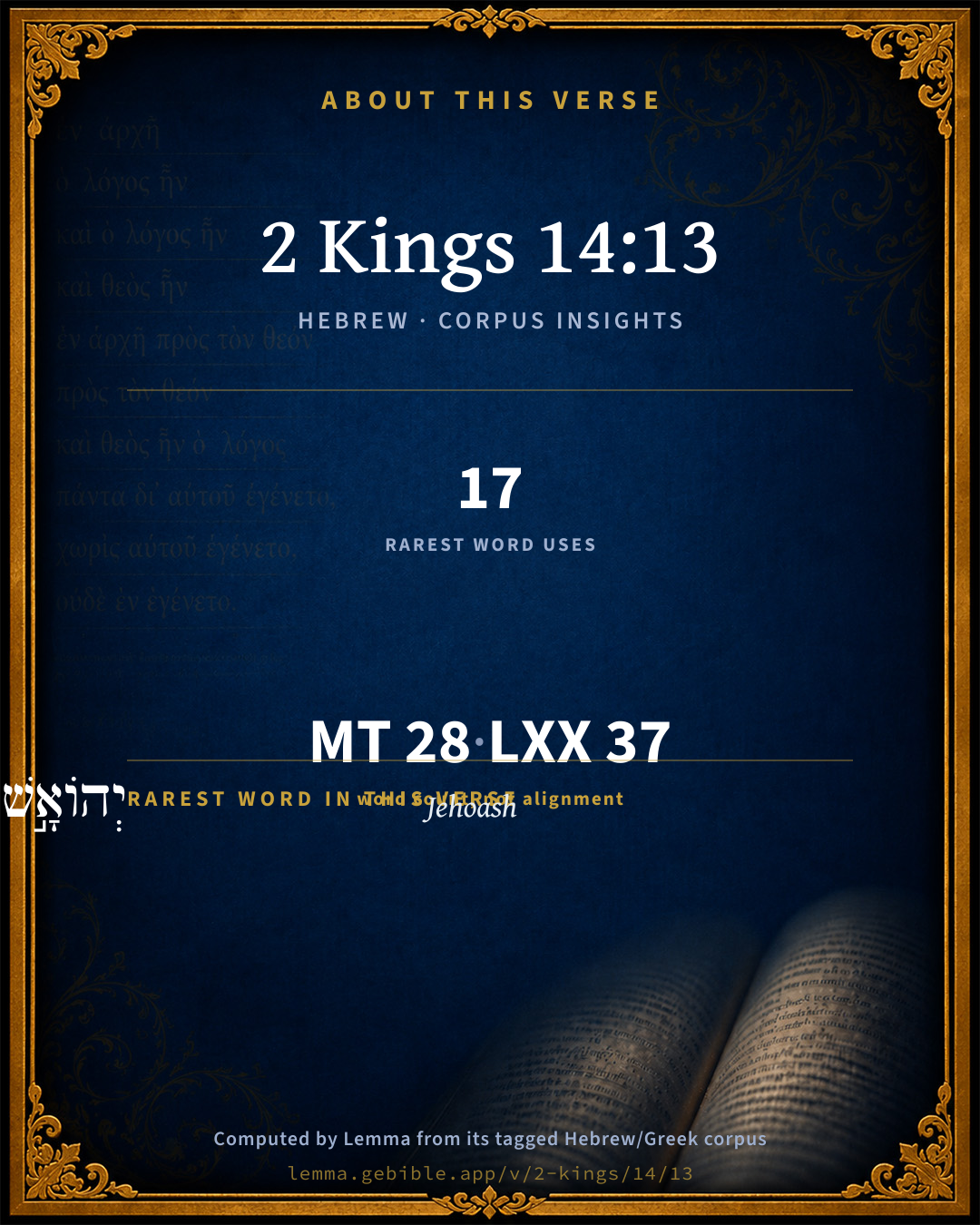
The rarest word here is יְהוֹאָ֣שׁ Jehoash H3060 — appearing just 17 times in the whole Hebrew Bible.

Shared distinctive vocabulary

יְהוֹאָ֣שׁ Jehoash H3060 occurs in 16 verses of the Hebrew Bible. Also found in:

Grammatical profile

  • 4 verbs
  • 20 nouns
  • 2 adjectives
  • 1 preposition
  • 1 particle

Verb forms

  • תָּפַ֛שׂ Qal · Perfect
  • ויבאו Qal · Sequential Imperfect
  • וַיָּבֹא֙ Qal · Sequential Imperfect
  • וַיִּפְרֹץ֩ Qal · Sequential Imperfect

Repetition

Words recur within this verse — often emphatic in Hebrew:

  • מֶֽלֶךְ king H4428 ×2
  • בֶּן son H1121 ×2
  • יְהוֹאָ֣שׁ Jehoash H3060 ×2
  • בְּבֵ֣ית Beth-shemesh H1053 ×2
  • ויבאו to enter H935 ×2
  • יְר֣וּשָׁלִַ֔ם Jerusalem H3389 ×2
  • בְּשַׁ֤עַר gate H8179 ×2

Hebrew & Septuagint length

In English translation the verse runs 42 words from the Hebrew and 46 from the Septuagint (LXX English) — closely comparable.

A rough comparison of the two English renderings, which tokenize alike — not a word-level alignment.

Word counts can differ between the Hebrew and the Greek without any difference in meaning — e.g. the Hebrew direct-object marker אֵת has no separate Greek word, and Greek often adds the article ὁ.

In the original languages it is 28 Hebrew tokens and 37 Greek tokens — but the two are counted differently (Hebrew bundles its prefixes and suffixes into one token; the Greek is in lemma form), so that isn’t a like-for-like length.

Cross-references

15

Topical passages linked to 2 Kings 14:13 in the Treasury of Scripture Knowledge — connected by theme and wording, ordered by reader-vote popularity; previews shown in the World English Bible.

  • Nehemiah 8:16 So the people went forth, and brought them, and made themselves booths, everyone on the roof of his house, and in their courts, and in the courts of the house of God, and in the broad place of the water gate, and in the broad place of the gate of Ephraim.
  • Nehemiah 12:39 and above the gate of Ephraim, and by the old gate, and by the fish gate, and the tower of Hananel, and the tower of Hammeah, even to the sheep gate: and they stood still in the gate of the guard.
  • Jeremiah 31:38 Behold, the days come, says Yahweh, that the city shall be built to Yahweh from the tower of Hananel to the gate of the corner.
  • Zechariah 14:10 All the land will be made like the Arabah, from Geba to Rimmon south of Jerusalem; and she will be lifted up, and will dwell in her place, from Benjamin's gate to the place of the first gate, to the corner gate, and from the tower of Hananel to the king's wine-presses.
  • 2 Kings 25:6 Then they took the king, and carried him up to the king of Babylon to Riblah; and they gave judgment on him.
  • 2 Chronicles 25:23–24 Joash king of Israel took Amaziah king of Judah, the son of Joash the son of Jehoahaz, at Beth-shemesh, and brought him to Jerusalem, and broke down the wall of Jerusalem from the gate of Ephraim to the corner gate, four hundred cubits.
  • 2 Chronicles 33:11 Therefore Yahweh brought on them the captains of the host of the king of Assyria, who took Manasseh in chains, and bound him with fetters, and carried him to Babylon.
  • 2 Chronicles 36:6 Against him came up Nebuchadnezzar king of Babylon, and bound him in fetters, to carry him to Babylon.
  • Job 40:11–12 Pour forth the fury of your anger. Look on everyone who is proud, and bring him low.
  • Proverbs 16:18 Pride goes before destruction, And a haughty spirit before a fall.
  • Proverbs 29:23 A man's pride brings him low, But one of lowly spirit gains honor.
  • Isaiah 2:11–12 The lofty looks of man will be brought low, The haughtiness of men will be bowed down, And Yahweh alone will be exalted in that day.
  • Daniel 4:37 Now I, Nebuchadnezzar, praise and extol and honor the King of heaven; for all his works are truth, and his ways justice; and those who walk in pride he is able to abase.
  • Luke 14:11 For everyone who exalts himself will be humbled, and whoever humbles himself will be exalted."
  • 2 Chronicles 36:10 At the return of the year king Nebuchadnezzar sent, and brought him to Babylon, with the goodly vessels of the house of Yahweh, and made Zedekiah his brother king over Judah and Jerusalem.

Cross-references courtesy of OpenBible.info (CC BY 4.0).

Hebrew and Greek witnesses Masoretic Hebrew ↔ Greek Septuagint

The same verse in the two great witnesses to the Old Testament, shown verse-for-verse.

These are two independent witnesses, not word-aligned to each other, and the Septuagint is shown in lemma (dictionary) form.

Hebrew 2 Kings 14:13 Masoretic · Westminster Leningrad Codex

וְאֵת֩ אֲמַצְיָ֨הוּ מֶֽלֶךְ יְהוּדָ֜ה בֶּן יְהוֹאָ֣שׁ בֶּן אֲחַזְיָ֗הוּ תָּפַ֛שׂ יְהוֹאָ֥שׁ מֶֽלֶךְ יִשְׂרָאֵ֖ל בְּבֵ֣ית שָׁ֑מֶשׁ ויבאו וַיָּבֹא֙ יְר֣וּשָׁלִַ֔ם וַיִּפְרֹץ֩ בְּחוֹמַ֨ת יְרוּשָׁלִַ֜ם בְּשַׁ֤עַר אֶפְרַ֨יִם֙ עַד שַׁ֣עַר הַפִּנָּ֔ה אַרְבַּ֥ע מֵא֖וֹת אַמָּֽה

Jehoash king of Israel took Amaziah king of Judah, the son of Jehoash the son of Ahaziah, at Beth-shemesh, and came to Jerusalem, and broke down the wall of Jerusalem from the gate of Ephraim to the corner gate, four hundred cubits.

World English Bible · Public Domain

Greek LXX 2 Kings 14:13 Septuagint · lemma form

καί ὁ αμεσσιας υἱός ιωας υἱός οχοζιας βασιλεύς ιουδα συνλαμβάνω ιωας υἱός ιωαχας βασιλεύς ἰσραήλ ἐν βαιθσαμυς καί ἔρχομαι εἰς ἰερουσαλήμ καί κατααἱρέω ἐν ὁ τεῖχος ἰερουσαλήμ ἐν ὁ πύλη ἐφράιμ ἕως πύλη ὁ γωνία τετρακόσιοι πῆχυς

And Joas king of Israel took Amessias the son of Joas the son of Ochozias, in Baethsamys; and he came to Jerusalem, and broke down the wall of Jerusalem, beginning at the gate of Ephraim as far as the gate of the corner, four hundred cubits.

LXX2012 (modern English Septuagint) · Public Domain

Hebrew: Westminster Leningrad Codex (CC BY 4.0). Greek: Septuagint (public domain); English from LXX2012 (modern English Septuagint) (Public Domain). How the Septuagint differs from the Hebrew →

Targum (Aramaic paraphrase)

1

The Targum is the ancient Jewish Aramaic paraphrase of the Hebrew Scriptures — an interpretive translation, not the Hebrew text itself. Onkelos (literal) and Pseudo-Jonathan (expansive) render the Torah, and Jonathan the Prophets. Coverage is partial: where no permissively-licensed English translation exists for a verse, only the Aramaic is shown. This is verse-level text, not a word-by-word alignment to the Hebrew.

  1. Targum Jonathan Prophets (Joshua–Malachi)
    וְיַת אֲמַצְיָהוּ מֶלֶךְ שִׁבְטָא דְבֵית יְהוּדָה בַר יְהוֹאָשׁ בַּר אֲחַזְיָה אֲחַד יְהוֹאָשׁ מַלְכָּא דְיִשְׂרָאֵל בְּבֵית שֶׁמֶשׁ וַאֲתוֹ לִירוּשְׁלֵם וּפָרַץ בְּשׁוּרָא דִירוּשְׁלֵם בִּתְרַע שִׁבְטָא דְאֶפְרַיִם עַד תְּרַע זִוְיָתָא אַרְבַּע מְאָה אַמִין:

    (no public-domain English translation for this verse)

    Targum Jonathan — Aramaic: “Mikraot Gedolot” (public domain). English: “Sefaria Community Translation” (CC0 1.0 (public-domain dedication)); “London "Chaldee Paraphrase," 1871” (public domain). Text via Sefaria.

Commentary

Notes on 2 Kings 14:13 from classic Christian and Jewish commentators (each source and its license shown beneath its notes). The classic Christian expositions comment on the surrounding passage and are grouped to its opening verse, so a note may address several verses; the Jewish commentaries on the Tanakh (Rashi and others) are per-verse, so they appear only where the commentator wrote on this verse.

Lemma curates 59 commentaries, every one of them public domain or Creative Commons licensed, each selected and text-cleaned for this edition rather than reprinted as found. About our sources →

Trapp's Complete Commentary

John Trapp

2Ki 14:13 And Jehoash king of Israel took Amaziah king of Judah, the son of Jehoash the son of Ahaziah, at Bethshemesh, and came to Jerusalem, and brake down the wall of Jerusalem from the gate of Ephraim unto the corner gate, four hundred cubits.

Ver. 13. And Jehoash king of Israel took Amaziah.] Whom he used nothing so courteously as Alexander, Prince of the Bulgarians, did Andronicus II, Emperor of Constantinople, who had sent him a challenge, as here Amaziah did Jehoash. But when Alexander had beaten him out of the field, he nevertheless offered him a peace, and suffered him to return home with his shattered army, advising him to be better advised for the future, and to consider that in each year there are four different seasons; and that in a short moment there may be great changes in human affairs. {a}

{a} Val. Max., Christ, 59.

John Trapp, A Commentary or Exposition upon All the Books of the Old and New Testament (1647–1656) — public domain. Text from a community e-Sword module.

Joseph Benson's Commentary

2Ki 14:13-14. Jehoash took Amaziah king of Judah, &c. — Amaziah’s pedigree comes in here somewhat abruptly. The son of Jehoash, the son of Ahaziah — Because perhaps he had gloried in the dignity of his ancestors, or now smarted for their iniquity. And came to Jerusalem — Which tamely opened to him; probably because he demanded entrance in Amaziah’s name, and with his consent. And brake down the wall of Jerusalem — In reproach to them; and that he might, when he pleased, take possession of the royal city. Josephus says, that he drove his chariot in triumph through the breach. And he took all the gold and silver, &c. — He plundered Jerusalem, and took away all that was valuable, spoiling both the house of the Lord, and the king’s house, of all their treasures. And hostages — To ensure their peaceable conduct. And returned to Samaria — He did not keep Jerusalem, nor seek to gain the possession and dominion of that kingdom; partly, because he thought he could not keep it, considering the difficulty he found in defending his own from such potent and near enemies as the Syrians were, and the great affection which all Judah bore to David’s house; and partly, because God so inclined his heart, that he might make good his promise to David and his family.

Joseph Benson's Commentary on the Old and New Testaments (1811–1818) — public domain. Text from a community e-Sword module.

Tyndale Open Study Notes

Tyndale Open Resources

14:13-14 The extensive demolition of Jerusalem’s wall and the thorough looting of the city testify to Jehoash’s overwhelming victory. Carrying off Temple and palace treasures and taking hostages are often noted in the annals of victorious Assyrian kings. See also 12:17-18; 18:13-15; 24:13-14; 25:8-21; 1 Kgs 14:25-26.

Tyndale Open Study Notes — © Tyndale Open Resources, licensed CC BY-SA 4.0. Text via the HelloAO Bible API.

Geneva Bible (1599)

Geneva Bible translators

Or, brought him.

Geneva Bible (1599) marginal notes — public domain. Text via Bolls.life.

Adam Clarke's Commentary

Verse 13. Took Amaziah king of Judah] It is plain that Amaziah afterwards had his liberty; but how or on what terms he got it, is not known. See on the following verse.

Adam Clarke's Commentary on the Bible (1810–1826) — public domain. Text from a community e-Sword/MySword module.

Ellicott's Commentary for English Readers

(13) Amaziah king of Judah, the son of Jehoash the son of Ahaziah.—Comp, 2Ki_14:8. Thenius thinks the formal specification of Amaziah’s descent indicates that this narrative was derived from “the Book of the Chronicles of the Kings of Israel.” At all events, it emphasises the importance of the incident, which is further indicated in the original by the order of the words: “And Amaziah king of Judah . . . did Jehoash king of Israel take . . .”

Came.—So the Hebrew margin. The Hebrew text has, brought him (way’bî’ô; a rare form). So Chronicles and the Vulg., but not the other versions. Jehoash brought Amaziah a prisoner to his own capital.

Brake down the wall.—Or, made a breach in the wall. No resistance appears to have been offered. Josephus relates that Amaziah was induced by menaces of death to order the gates to be thrown open to the enemy; a needless assumption, considering that the army had been routed and the king was a captive. He adds, that Jehoash rode in his chariot through the breach in the walls, leading Amaziah as a prisoner.

From the gate.—So Chronicles and the Syriac, Vulg., and Arabic here. The Hebrew text has, at the gate, which is due to the common confusion of the letters b and m (be, “in;” min, “from”). The following “unto” shows that “from” is right.

Of Ephraim.—This gate lay on the north side of the city, and was also called the “Gate of Benjamin.” It answers to the modern Damascus gate.

The corner gate.—This gate was at the north-west corner of the wall at the point where it trended southwards.

Four hundred cubits.—That is, about 222 yards. The insolence of a victorious enemy is sufficient to account for this conduct of Jehoash. It was also a forcible way of convincing Amaziah that even his strongest city was not proof against the prowess of Ephraim. Thenius thinks that Jehoash wanted to make room for the triumphal entry of his troops.

A Bible Commentary for English Readers, edited by Charles John Ellicott (1878–1897) — public domain. Text from a community e-Sword module.

The Cambridge Bible for Schools and Colleges

gen. ed. J. J. S. Perowne

13. took Amaziah] i.e. Took him prisoner. And there is some difficulty in deciding what became of Amaziah at this time and afterwards. In 2Ch_25:23 it is added that Jehoash brought him to Jerusalem, and the Kethib (= they came) in this verse is intended to give that idea. Both A.V. and R.V. have translated the Keri (= he came). Josephus (Ant. IX. 9. 3) has given an account which makes Amaziah be brought as a captive into his own capital. ‘When the troops (of Judah) were scattered in alarm, Amaziah was left alone and was taken prisoner by the enemy. Then Jehoash threatened to put him to death unless he persuaded the people of Jerusalem to open their gates and admit him with his army into the city. And Amaziah through necessity and in fear for his life caused the enemy to be received. And Jehoash having broken down about four hundred cubits of the walls, drove in his chariot through the opening into Jerusalem, bringing Amaziah as his prisoner.’ This is a picture in which the imagination has added to the details of the sacred narrative. Yet the very formal way in which Amaziah is mentioned in this verse, both here and by the Chronicler, as ‘Amaziah king of Judah, the son of Jehoash the son of Ahaziah’, seems to indicate that some crisis in the reign of this king is marked by the defeat at Beth-shemesh. Perhaps he was kept a prisoner till the death of Jehoash. The way in which it is said in verse 17 that Amaziah lived (not reigned) after the death of Jehoash, seems also, from its unusual nature, to mark an exceptional state of things.

from the gate of Ephraim] This portion of the wall was on the north of the city, opening towards the kingdom of Israel, and the demolition of a large part of the wall on that side was meant to leave the city exposed to the entry of the Israelites if they were desirous to come in. The gate was where now is ‘the Damascus gate’.

The Cambridge Bible for Schools and Colleges (gen. ed. J. J. S. Perowne; Cambridge University Press, 1878–1918) — public domain. Text from a community e-Sword module.

John Gill's Exposition

Now the rest of the acts of Jehoash which he did, and his might,.... His valiant and mighty acts which he did in his wars with the Syrians, Kg2 13:25,

and how he fought with Amaziah king of Judah; a short account of which is given in the preceding verses:

are they not written in the book of the chronicles of the kings of Israel? a book very often mentioned and referred to, as containing the history of the events and transactions of every reign.

John Gill's Exposition of the Whole Bible (1746–1763) — public domain (CC PDM 1.0). Text via the HelloAO Bible API.

Albert Barnes' Notes on the Bible

The object of breaking down the wall was to leave Jerusalem at the mercy of her rival; and it must have been among the conditions of the peace that the breach thus made should not be repaired.

Gates in Oriental cities are named from the places to which they lead. The gate of Ephraim must therefore have been a north gate: perhaps also known, later on, by the name of the “gate of Benjamin” Jer 37:13; Zec 14:10. The corner gate was probably a gate at the northwest angle of the city, where the north wall approached the Valley of Hinnom. The entire breach was thus in the north wall, on the side where Jerusalem was naturally the weakest. Josephus says that Joash drove his chariot through the breach into the town, a practice not unusual with conquerors.

Albert Barnes' Notes on the Bible (1834–1885) — public domain. Text from a community e-Sword/MySword module.

Haydock's Catholic Bible Commentary

Cubits. Josephus says 300, and that he led Amasias in triumph through the ruins, (Antiquities ix. 10.) on the west side, (Calmet) or on the north. (Villalpand) (Menochius)

George Leo Haydock (1774–1849), Haydock's Catholic Family Bible and Commentary, 1859 edition — public domain. Excludes Psalms (Douay-Rheims chapter numbering differs from Protestant) and Deuterocanonical books (Catholic canon only).

Matthew Poole's English Annotations

Came to Jerusalem; commanding entrance in Amaziah’s name, and with his consent, which he durst not deny.

The gate of Ephraim; which led to Ephraim.

Four hundred cubits; which was done, partly in scorn and contempt, and partly that he might re-enter and retake it, if they should attempt to renew the war.

Matthew Poole's English Annotations on the Holy Bible (1683–1685) — public domain. Text from a community e-Sword/MySword module.

Whedon's Commentary on the Bible

Daniel D. Whedon

13. Brake down the wall of Jerusalem — The northern wall.

Gate of Ephraim — The same, doubtless, as the gate of Benjamin, (Jer_37:13; Zec_14:10,) and so called from being the principal entrance to the city in the direction of these tribes. Its location was probably not far from the modern Damascus gate. Compare Neh_8:16; Neh_12:39.

Corner gate — Situated probably at the northwestern corner of the same wall. Compare Jer_31:38; Zec_14:10.

Four hundred cubits — About seven hundred feet.

Daniel D. Whedon (gen. ed.), Commentary on the Old and New Testaments (1874–1909) — public domain. Text from a community e-Sword module.

The Pulpit Commentary

And Jehoash King of Israel took Amaziah King of Judah, the son of Jehoash the son of Ahaziah at Beth-shemesh Josephus says (l.s.c. ) that Amaziah was deserted by his troops, who were seized with a sudden panic and fled from the fieldand came to Jerusalem, and brake down the wall of Jerusalem. According to Josephus, Joash threatened his prisoner with death unless the gates of Jerusalem were opened to him, and his army admitted into the town; and it was upon Amaziah"s representations that the surrender was made as soon as the Israelite army appeared before the place. The breach in the wall was therefore not the result of siege operations, but the act of a conqueror, who desired to leave his enemy as defenseless as possible. From the gate of Ephraim; i.e. the main gate in the northern wall of the city that by which travelers ordinarily proceeded into the territory of the tribe of Ephraim. In later times it seems to have been called indifferently "the gate of Ephraim" (Neh_8:16 Neh_12:39) and "the gate of Benjamin" (Jer_37:13; Zec_14:10) The great north road, which passed through it, led across the Benjamite into the Ephraim-its territory. Unto the corner gate. The, "corner gate" is generally thought to have been that at the north-western angle of the City wall, where it turned southward, but this is perhaps doubtful. The exact line of the city wall in the time of Amaziah is exceedingly uncertain. Four hundred cubits; six hundred feet, or two hundred yards. This seems to have been the entire distance between the two gates. As there were at least thirteen gates in the circuit of the walls (Neh_3:1-31 Neh_12:31-39; Zec_14:10) which were probably not mere extensive than those of the present town (3960 yards), the distance of two hundred yards between one gate and another would not be improbable, the average distance being about three hundred yards.

The Pulpit Commentary (1880–1919), ed. H.D.M. Spence-Jones & Joseph S. Exell — public domain. Text from a community e-Sword module.

John Wesley's Explanatory Notes

Ahaziah - Amaziah's pedigree comes in somewhat abruptly, the son of Joash, the son of Ahaziah: Probably because he now smarted, for the iniquity of his ancestors.

John Wesley, Explanatory Notes Upon the Whole Bible (1754–1765) — public domain. Text via the GEBible commentary corpus.

unfoldingWord translationNotes

Door43 World Missions Community

General Information:

This is what happened after the army of Israel defeated the army of Judah at Beth Shemesh.

He came ... He took

Here "He" refers to Jehoash and his army. AT: "Jehoash and his army came ... Jehoash's soldiers took" (See: Synecdoche)

Ephraim Gate ... Corner Gate

There are the names of gates in the wall of Jerusalem. (See: How to Translate Names)

four hundred cubits

"about 180 meters" (See: Numbers)

cubits

A cubit was about 46 centimeters. (See: Biblical Distance)

with hostages also, and returned to Samaria

This implies that Jehoash needed to take these hostages to prevent Amaziah from attacking again. This can be made explicit. AT: "and they also took to Samaria some prisoners to make sure that Amaziah would cause them no more trouble" (See: Assumed Knowledge and Implicit Information)

translationWords

Jerusalem

Ephraim

gate

gold

silver

house of God

Samaria

unfoldingWord translationNotes — © Distant Shores Media and the Door43 World Missions Community, licensed CC BY-SA 4.0. Source: git.door43.org/Door43/en_tn.

Lesson kit

Teaching starters — assembled from the data on this page, not authored interpretation. Every prompt links to the verse data it draws on. Edit before teaching.

2 Kings, in the Historical, opens this verse with 28 words (21 distinct Hebrew lemmas). Its most distinctive word is Yᵉhôwʼâsh (“Jehoash”). A historical commentator’s framing appears above. Read the whole chapter for the surrounding context.

Discussion questions

  1. The word Yᵉhôwʼâsh carries the sense “Jehoash.” How does it shape the verse?
  2. How does 2 Kings 11:21, which shares the word «Jehoash», read alongside this verse?
  3. What does the repetition of “king” (2× in this one verse) do in this verse?
  4. These translations render this verse differently. What is at stake in choosing one wording over another?
  5. «תָּפַ֛שׂ» is a Qal Perfect verb. How does that grammatical form shape the action described?
  6. Compare how Trapp's Complete Commentary and Joseph Benson's Commentary read this verse. Where do they agree or differ?

Things to notice

Reading settings

Reading text

Shown beneath each verse's original-language words.

Old Testament
Old Testament edition

Read the OT as the Masoretic Hebrew (MT) or the Greek Septuagint (LXX).

English shown for the Greek Septuagint (in the Hebrew ↔ Greek comparison).

Comparing translations? Open the Compare panel on any verse page to stack up to four side by side.