Genesis 6:2

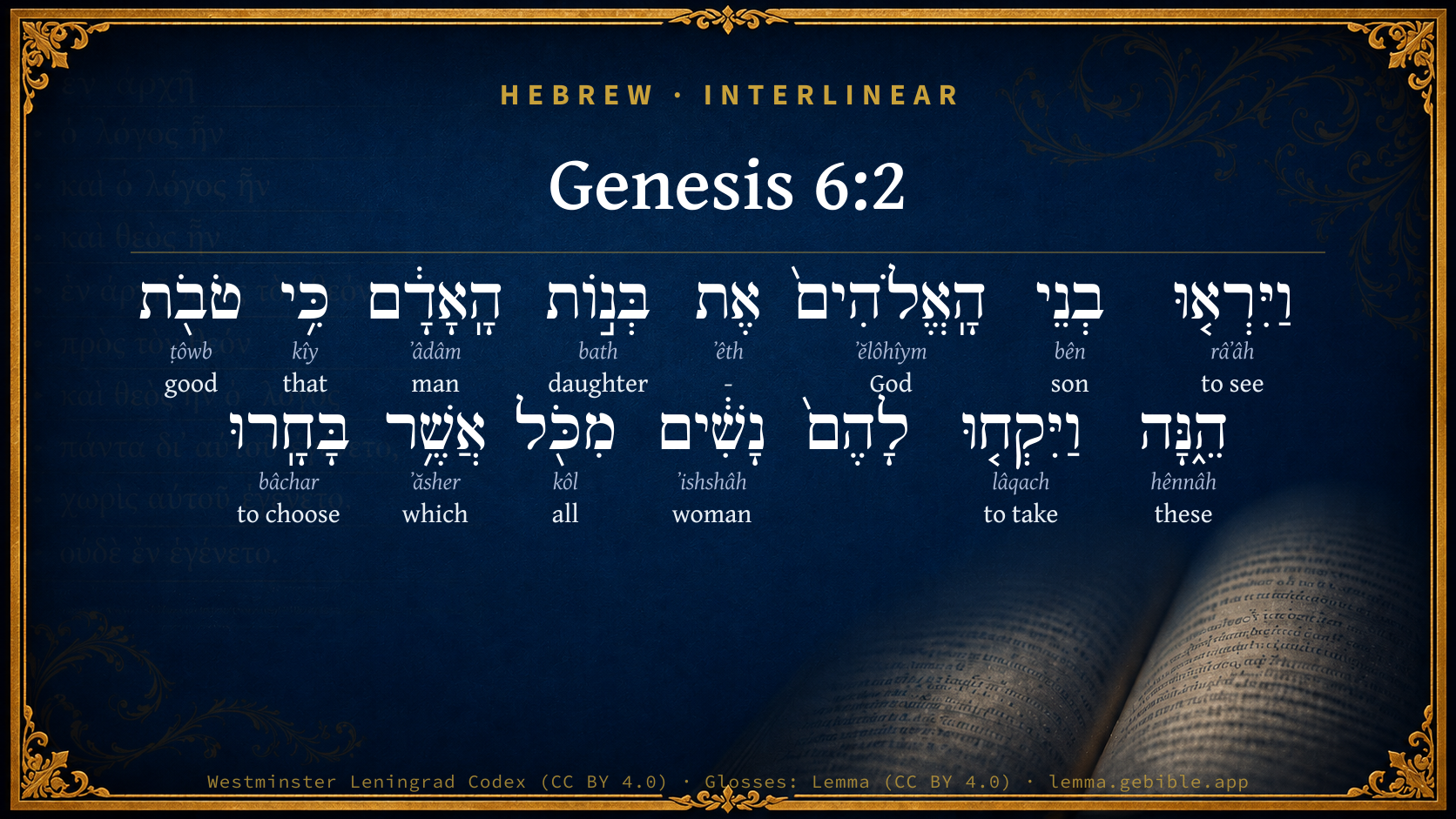
Hebrew (Westminster Leningrad Codex) Genesis 6:2 appears in the Hebrew Old Testament. The text above is from the Westminster Leningrad Codex. Each word links to its Strong’s number, a concise gloss, and parsing drawn from the Open Scriptures Hebrew Bible morphology. Click any word for its full Brown-Driver-Briggs (BDB) entry.
Download image
Cite this verse

Genesis 6:2 (World English Bible). Public Domain. Lemma interlinear Bible study tool, https://lemma.gebible.app/v/genesis/6/2.

Show BibTeX & RIS
BibTeX
RIS
English Translation
that God's sons saw that men's daughters were beautiful, and they took for themselves wives of all that they chose.
World English Bible · Public Domain
Highlights
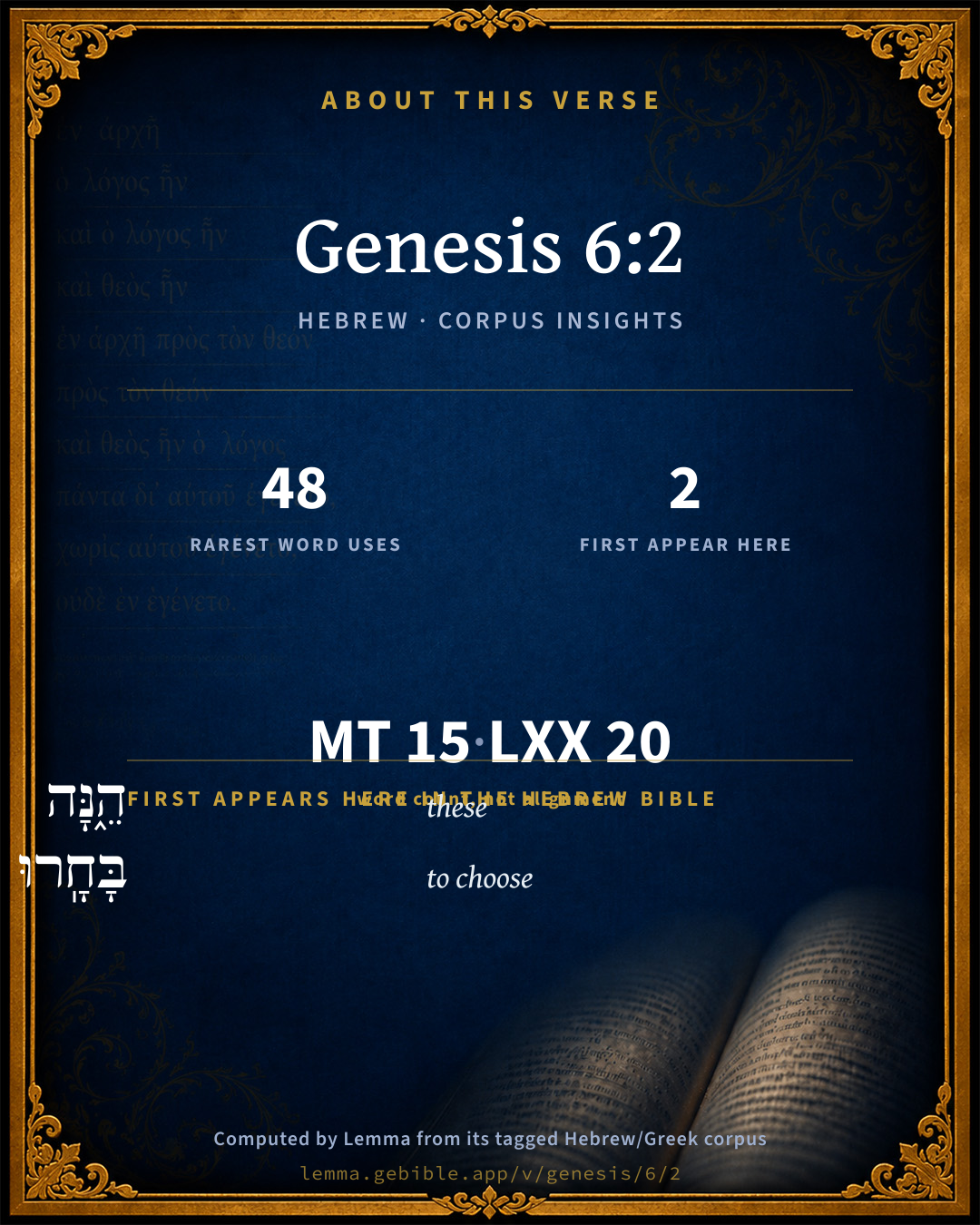
  • 2 first appearances in the Hebrew Bible
Full analysis ↓
Download a study sheet

One document with this verse’s original text, its word-by-word gloss line, the meaning frame, cross-references with their text, attributed commentary, and full source and license credits — printable, and it pastes into notes with its structure intact.

This verse Autodidact and up

Study sheet (.html) Plain text (.txt)

A passage Seminary Student

Up to 50 verses in one chapter. A passage sheet keeps up to 6 commentary sources and 12 cross-references per verse, in the order this page ranks them, and says so on the sheet whenever that leaves anything out. Ask for a single verse and you get the Autodidact verse sheet above.

Everything on this page stays free to read, with no account — the sheet is a download of what is already on screen, not access to it.

Want to remove ads? Support Godless Engineer
Compare translations 3

The same verse in 3 English versions, stacked beneath the original-language interlinear above. Click any original word for its lexicon entry.

Each is an independent rendering of the whole verse — the interlinear is not word-aligned to these translations.

Highlighted words mark where these versions differ — a whole-verse word diff, not a word-by-word alignment.

  • World English Bible Public Domain
    that God's sons saw that men's daughters were beautiful, and they took for themselves wives of all that they chose.
  • King James Version Public Domain
    That the sons of God saw the daughters of men that they were fair; and they took them wives of all which they chose.
  • unfoldingWord Literal Text CC BY-SA 4.0
    then the sons of God saw the daughters of mankind, that they beautiful, so they took wives for themselves from any that they chose.

unfoldingWord Literal Text — © unfoldingWord, licensed CC BY-SA 4.0. Word-aligned USFM3 via Door43 (git.door43.org/unfoldingWord/en_ult).

Versions to compare (up to 4)

3 of 4 selected

Show all 18 translations

Every available English version of this verse, each an independent rendering of the whole verse.

  • World English Bible Public Domain
    that God's sons saw that men's daughters were beautiful, and they took for themselves wives of all that they chose.
  • Berean Standard Bible Public Domain
    the sons of God saw that the daughters of men were beautiful, and they took as wives whomever they chose.
  • Majority Standard Bible Public Domain
    the sons of God saw that the daughters of men were beautiful, and they took as wives whomever they chose.
  • King James Version Public Domain
    That the sons of God saw the daughters of men that they were fair; and they took them wives of all which they chose.
  • American Standard Version (1901) Public Domain
    that the sons of God saw the daughters of men that they were fair; and they took them wives of all that they chose.
  • Revised Version (1885) Public Domain
    that the sons of God saw the daughters of men that they were fair; and they took them wives of all that they chose.
  • Geneva Bible (1599) Public Domain
    Then the sonnes of God sawe the daughters of men that they were faire, and they tooke them wiues of all that they liked.
  • Douay-Rheims (1899) Public Domain
    The sons of God seeing the daughters of men, that they were fair, took themselves wives of all which they chose.
  • Young's Literal Translation Public Domain
    and sons of God see the daughters of men that they `are' fair, and they take to themselves women of all whom they have chosen.
  • Literal Standard Version CC BY-SA 4.0
    and the sons of God see that they, the daughters of men, [are] beautiful, and they take women for themselves of all whom they have chosen.
  • Unlocked Literal Bible CC BY-SA 4.0
    that the sons of God saw that the daughters of mankind were attractive. They took for themselves wives, any of them that they chose.
  • unfoldingWord Literal Text CC BY-SA 4.0
    then the sons of God saw the daughters of mankind, that they beautiful, so they took wives for themselves from any that they chose.
  • Darby Bible Public Domain
    that the sons of God saw the daughters of men that they were fair, and took themselves wives of all that they chose.
  • World Messianic Bible Public Domain
    God’s sons saw that men’s daughters were beautiful, and they took any that they wanted for themselves as wives.
  • Webster's Bible Public Domain
    That the sons of God saw the daughters of men that they were fair; and they took them wives of all whom they chose.
  • Free Bible Version CC BY-SA 4.0
    and the sons of God saw that these women were beautiful, and they took whichever ones they wanted.
  • Bible in Basic English Public Domain
    The sons of God saw that the daughters of men were fair; and they took wives for themselves from those who were pleasing to them.
  • JPS Tanakh (1917) Public Domain
    that the sons of God saw the daughters of men that they were fair; and they took them wives, whomsoever they chose.

Literal Standard Version (2020), Covenant Press — licensed CC BY-SA 4.0. Text via the HelloAO Bible API (eBible.org). Unlocked Literal Bible (unfoldingWord) — licensed CC BY-SA 4.0. Text via the HelloAO Bible API (eBible.org). unfoldingWord Literal Text — © unfoldingWord, licensed CC BY-SA 4.0. Word-aligned USFM3 via Door43 (git.door43.org/unfoldingWord/en_ult). Free Bible Version, Dr. Jonathan Gallagher — licensed CC BY-SA 4.0. Text via the HelloAO Bible API (eBible.org).

Word by word

More ways to search: Search by grammar → Find every occurrence → Compare this word →

Practice this passage: Drill this verse → Learn its vocabulary →

הֵ֑נָּה
hênnâh
H2007
“these”
Pronoun, Personal, 3rd Person, Feminine, Plural
Part of Speech
Pronoun
Type
Personal
Person
3rd Person
Gender
Feminine
Number
Plural
Full BDB Definition

Origin: prolongation for H2004

TWOT: 504

they, these, the same, who
  1. וַיִּרְא֤וּ râʼâh H7200 “and · to see” Conjunction + Verb, Qal, Sequential Imperfect, 3rd Person, Masculine, Plural
  2. בְנֵי bên H1121 “sons of” Noun, Common, Masculine, Plural, Construct
  3. הָֽאֱלֹהִים֙ ʼĕlôhîym H430 “the · God(s)” Particle, Definite Article + Noun, Common, Masculine, Plural, Absolute
  4. אֶת ʼêth H853 “-” Particle, Direct Object
  5. בְּנ֣וֹת bath H1323 “daughters of” Noun, Common, Feminine, Plural, Construct
  6. הָֽאָדָ֔ם ʼâdâm H120 “the · man” Particle, Definite Article + Noun, Common, Masculine, Singular, Absolute
  7. כִּ֥י kîy H3588 “that” Conjunction
  8. טֹבֹ֖ת ṭôwb H2896 “good” Adjective, Adjective, Feminine, Plural, Absolute
  9. וַיִּקְח֤וּ lâqach H3947 “and · to take” Conjunction + Verb, Qal, Sequential Imperfect, 3rd Person, Masculine, Plural
  10. נָשִׁ֔ים ʼishshâh H802 “women” Noun, Common, Feminine, Plural, Absolute
  11. מִכֹּ֖ל kôl H3605 “from · all” Preposition + Noun, Common, Masculine, Singular, Absolute
  12. אֲשֶׁ֥ר ʼăsher H834 “which” Particle, Relative
  13. בָּחָֽרוּ bâchar H977 “to choose” Verb, Qal, Perfect, 3rd Person, Common, Plural

About this verse

These counts appear in no published source. They are computed here, from the morphology-tagged text and Lemma’s own curated glosses. What Lemma adds →

15
words
14
distinct lemmas
Pentateuch
section

First appearance in Scripture

These words make their first canonical appearance in the Hebrew Bible here:

  • הֵ֑נָּה these H2007
  • בָּחָֽרוּ to choose H977

Shared distinctive vocabulary

הֵ֑נָּה these H2007 occurs in 44 verses of the Hebrew Bible. Also found in:

Grammatical profile

  • 3 verbs
  • 6 nouns
  • 1 adjective
  • 1 pronoun
  • 1 preposition
  • 1 conjunction
  • 2 particles

Verb forms

  • וַיִּרְא֤וּ Qal · Sequential Imperfect
  • וַיִּקְח֤וּ Qal · Sequential Imperfect
  • בָּחָֽרוּ Qal · Perfect

Hebrew & Septuagint length

In English translation the verse runs 20 words from the Hebrew and 24 from the Septuagint (LXX English) — closely comparable.

A rough comparison of the two English renderings, which tokenize alike — not a word-level alignment.

Word counts can differ between the Hebrew and the Greek without any difference in meaning — e.g. the Hebrew direct-object marker אֵת has no separate Greek word, and Greek often adds the article ὁ.

In the original languages it is 15 Hebrew tokens and 20 Greek tokens — but the two are counted differently (Hebrew bundles its prefixes and suffixes into one token; the Greek is in lemma form), so that isn’t a like-for-like length.

Cross-references

26

Topical passages linked to Genesis 6:2 in the Treasury of Scripture Knowledge — connected by theme and wording, ordered by reader-vote popularity; previews shown in the World English Bible.

  • Psalms 82:6–7 I said, "You are gods, All of you are sons of the Most High.
  • 1 John 2:16 For all that is in the world, the lust of the flesh, the lust of the eyes, and the pride of life, isn't the Father's, but is the world's.
  • Romans 9:7–8 Neither, because they are Abraham's seed, are they all children. But, "In Isaac will your seed be called."
  • 2 Peter 2:14 having eyes full of adultery, and who can't cease from sin; enticing unsettled souls; having a heart trained in greed; children of cursing;
  • Deuteronomy 7:3–4 neither shall you make marriages with them; your daughter you shall not give to his son, nor his daughter shall you take to your son.
  • 2 Samuel 11:2 It happened at evening, that David arose from off his bed, and walked on the roof of the king's house: and from the roof he saw a woman bathing; and the woman was very beautiful to look on.
  • Nehemiah 13:24–27 and their children spoke half in the speech of Ashdod, and could not speak in the Jews' language, but according to the language of each people.
  • Genesis 3:6 When the woman saw that the tree was good for food, and that it was a delight to the eyes, and that the tree was to be desired to make one wise, she took of the fruit of it, and ate; and she gave some to her husband with her, and he ate.
  • Ezra 9:1–2 Now when these things were done, the princes drew near to me, saying, The people of Israel, and the priests and the Levites, have not separated themselves from the peoples of the lands, [doing] according to their abominations, even of the Canaanites, the Hittites, the Perizzites, the Jebusites, the Ammonites, the Moabites, the Egyptians, and the Amorites.
  • Ezra 9:12 now therefore don't give your daughters to their sons, neither take their daughters to your sons, nor seek their peace or their prosperity forever; that you may be strong, and eat the good of the land, and leave it for an inheritance to your children forever.
  • John 8:41–42 You do the works of your father." They said to him, "We were not born of sexual immorality. We have one Father, God."
  • Genesis 24:3 I will make you swear by Yahweh, the God of heaven and the God of the earth, that you shall not take a wife for my son of the daughters of the Canaanites, among whom I live.
  • Exodus 4:22–23 You shall tell Pharaoh, 'Thus says Yahweh, Israel is my son, my firstborn,
  • Deuteronomy 14:1 You are the children of Yahweh your God: you shall not cut yourselves, nor make any baldness between your eyes for the dead.
  • Joshua 23:12–13 Else if you do at all go back, and cleave to the remnant of these nations, even these who remain among you, and make marriages with them, and go in to them, and they to you;
  • Genesis 4:26 There was also born a son to Seth, and he named him Enosh. Then men began to call on Yahweh's name.
  • Genesis 27:46 Rebekah said to Isaac, "I am weary of my life because of the daughters of Heth. If Jacob takes a wife of the daughters of Heth, such as these, of the daughters of the land, what good will my life do me?"
  • Genesis 39:6–7 He left all that he had in Joseph's hand. He didn't concern himself with anything, except for the food which he ate. Joseph was well-built and handsome.
  • Exodus 34:16 and you take of their daughters to your sons, and their daughters play the prostitute after their gods, and make your sons play the prostitute after their gods.
  • Job 31:1 "I made a covenant with my eyes, How then should I look lustfully at a young woman?
  • Isaiah 63:16 For you are our Father, though Abraham doesn't know us, and Israel does not acknowledge us: you, Yahweh, are our Father; our Redeemer from everlasting is your name.
  • Malachi 2:15 Did he not make one, although he had the residue of the Spirit? Why one? He sought a godly seed. Therefore take heed to your spirit, and let none deal treacherously against the wife of his youth.
  • 1 Corinthians 7:39 A wife is bound by law for as long as her husband lives; but if the husband is dead, she is free to be married to whoever she desires, only in the Lord.
  • 2 Corinthians 6:14–16 Don't be unequally yoked with unbelievers, for what fellowship have righteousness and iniquity? Or what communion has light with darkness?
  • Malachi 2:11 Judah has dealt treacherously, and an abomination is committed in Israel and in Jerusalem; for Judah has profaned the holiness of Yahweh which he loves, and has married the daughter of a foreign god.
  • 2 Corinthians 6:18 I will be to you a Father. You will be to me sons and daughters,' says the Lord Almighty."

Cross-references courtesy of OpenBible.info (CC BY 4.0).

Hebrew and Greek witnesses Masoretic Hebrew ↔ Greek Septuagint

The same verse in the two great witnesses to the Old Testament, shown verse-for-verse.

These are two independent witnesses, not word-aligned to each other, and the Septuagint is shown in lemma (dictionary) form.

Hebrew Genesis 6:2 Masoretic · Westminster Leningrad Codex

וַיִּרְא֤וּ בְנֵי הָֽאֱלֹהִים֙ אֶת בְּנ֣וֹת הָֽאָדָ֔ם כִּ֥י טֹבֹ֖ת הֵ֑נָּה וַיִּקְח֤וּ לָהֶם֙ נָשִׁ֔ים מִכֹּ֖ל אֲשֶׁ֥ר בָּחָֽרוּ

that God's sons saw that men's daughters were beautiful, and they took for themselves wives of all that they chose.

World English Bible · Public Domain

Greek LXX Genesis 6:2 Septuagint · lemma form

ὁράω δέ ὁ υἱός ὁ θεός ὁ θυγάτηρ ὁ ἄνθρωπος ὅτι καλός εἰμί λαμβάνω ἑαυτοῦ γυνή ἀπό πᾶς ὅς ἐκλέγω

that the sons of God having seen the daughters of men that they were beautiful, took to themselves wives of all whom they chose.

LXX2012 (modern English Septuagint) · Public Domain

On this verse, Ellicott's Commentary for English Readers discusses the Septuagint’s reading. Read the note in Commentary ↓

Hebrew: Westminster Leningrad Codex (CC BY 4.0). Greek: Septuagint (public domain); English from LXX2012 (modern English Septuagint) (Public Domain). How the Septuagint differs from the Hebrew →

Targum (Aramaic paraphrase)

2

The Targum is the ancient Jewish Aramaic paraphrase of the Hebrew Scriptures — an interpretive translation, not the Hebrew text itself. Onkelos (literal) and Pseudo-Jonathan (expansive) render the Torah, and Jonathan the Prophets. Coverage is partial: where no permissively-licensed English translation exists for a verse, only the Aramaic is shown. This is verse-level text, not a word-by-word alignment to the Hebrew.

  1. Targum Onkelos Torah (Genesis–Deuteronomy)
    וַחֲזוֹ בְנֵי רַבְרְבַיָּא יָת בְּנַת אֱנָשָׁא אֲרֵי שַׁפִּירָן אִנוּן וּנְסִיבוּ לְהוֹן נְשִׁין מִכֹּל דִּי אִתְרְעִיאוּ

    that the sons of the mighty saw the daughters of men that they were beautiful, and took to them wives of all whom they pleased.

    Targum Onkelos — Aramaic: “Onkelos Genesis” (public domain); “Onkelos Exodus” (public domain); “Onkelos Leviticus” (public domain); “Onkelos Numbers” (public domain); “Onkelos Deuteronomy” (public domain). English: “Sefaria Community Translation” (CC0 1.0 (public-domain dedication)); “J.W. Etheridge. The Targums of Onkelos and Jonathan Ben Uzziel on the Pentateuch. London: Longmans, Green, 1862” (public domain). Text via Sefaria.

  2. Targum Pseudo-Jonathan Torah (Genesis–Deuteronomy)
    וְחָמוֹן בְּנֵי רַבְרְבַיָא יַת בְּנַת אֱנָשָׁא אֲרוּם שַׁפִּירָן הִינוּן וְכַחֲלָן וּפַקְסָן וּמְהַלְכִין בְּגִילוּי בִּשְׁרָא וְהִרְהִירוּ לִזְנוּ וּנְסִיבוּ לְהוֹן נְשִׁין מִכָּל דְאִתְרְעִיוּ

    and the sons of the great saw that the daughters of men were beautiful, and painted, and curled, walking with revelation of the flesh, and with imaginations of wickedness; that they took them wives of all who pleased them.

    Targum Pseudo-Jonathan — Aramaic: “Targum Jonathan on Genesis” (public domain); “Targum Jonathan on Exodus” (public domain); “Targum Jonathan on Leviticus” (public domain); “Targum Jonathan on Numbers” (public domain); “Targum Jonathan on Deuteronomy” (public domain). English: “The Targum of Jonathan ben Uzziel, trans. J. W. Etheridge, London, 1862” (public domain). Text via Sefaria.

Commentary

Notes on Genesis 6:2 from classic Christian and Jewish commentators (each source and its license shown beneath its notes). The classic Christian expositions comment on the surrounding passage and are grouped to its opening verse, so a note may address several verses; the Jewish commentaries on the Tanakh (Rashi and others) are per-verse, so they appear only where the commentator wrote on this verse.

Lemma curates 59 commentaries, every one of them public domain or Creative Commons licensed, each selected and text-cleaned for this edition rather than reprinted as found. About our sources →

Ellicott's Commentary for English Readers

(2) The sons of God. . . . —The literal translation of this verse is, And the sons of the Elohim saw the daughters of the adam that they were good (beautiful); and they took to them wives whomsoever they chose. Of the sons of the Elohim there are three principal interpretations: the first, that of the Targums and the chief Jewish expositors, that they were the nobles, and men of high rank; the second, that they were angels. St. Jude, Jud_1:6, and St. Peter, 2 Ep., 2Pe_2:4, seem to favour this interpretation, possibly as being the translation of the LXX. according to several MSS. But even if this be their meaning, which is very uncertain, they use it only as an illustration; and a higher authority says that the angels neither marry nor are given in marriage. The third, and most generally accepted interpretation in modern times, is that the sons of the Elohim were the Sethites, and that when they married for mere lust of beauty, universal corruption soon ensued. But no modern commentator has shown how such marriages could produce “mighty men . . . men of renown;” or how strong warriors could be the result of the intermarriage of pious men with women of an inferior race, such as the Cainites are assumed to have been.

The Jewish interpreters, who well understood the uses of their own language, are right in the main point that the phrase “sons of the Elohim” conveys no idea of moral goodness or piety. Elohim constantly means mighty ones (Exo_15:11, marg.). (Comp. Exo_12:12, marg., Exo_21:6; Exo_22:8-9, where it is translated judges; Exo_22:28, 1Sa_2:25, where also it is translated judge.) In Job_1:6 the “sons of Elohim” are the nobles, the idea being that of a king who at his durbar gathers his princes round him; and, not unnecessarily to multiply examples, the “sons of the Elim,” the other form of the plural, is rightly translated mighty ones in Psa_29:1.

Who, then, are these “mighty ones?” Before answering this question, let me call attention to the plain teaching of the narrative as to what is meant by the “daughters of men.” It says: “When the adam began to multiply, and daughters were born unto them, the sons of the Elohim saw the daughters of the adam . . . and took them wives,” &c. But according to every right rule of interpretation, the “daughters of the adam” in Gen_6:1 must be the same as the “daughters of the adam” in Gen_6:2, whom the sons of the Elohim married. Now, it seems undeniable that the adam here spoken of were the Sethites. The phrase occurs in the history of Noah, just after giving his descent from Adam; Cain is absolutely passed over, even in the account of the birth of Seth, who is described as Adam’s firstborn, such as legally he was. The corruption described is that of the Sethites; for the Cainites have already been depicted as violent and lustful, and their history has been brought to an end. Moreover, in Gen_6:3, “the adam with whom God will not always strive” is certainly the family of Seth, who, though the chosen people and possessors of the birthright, are nevertheless described as falling into evil ways; and their utter corruption finally is the result of the depravation of their women by a race superior to themselves in muscular vigour and warlike prowess.

Where, then, shall we find these men? Certainly among the descendants of Cain. In Gen_4:17-24, we find Cain described as the founder of civil institutions and social life: the name he gives to his son testifies to his determination that his race shall be trained men. They advance rapidly in the arts, become rich, refined, luxurious, but also martial and arrogant. The picture terminates in a boastful hero parading himself before his admiring wives, displaying to them his weapons, and vaunting himself in a poem of no mean merit as ten times superior to their forefather Cain. His namesake in the race of Seth also indites a poem; but it is a groan over their hard toil, and the difficulty with which, by incessant labour, they earned their daily bread. To the simple “daughters of the adam,” these men, enriched by the possession of implements of metal, playing sweet music on harp and pipe, and rendered invincible by the deadly weapons they had forged, must have seemed indeed as very “sons of the Elohim.” The Sethites could not have taken the Cainite women according to their fancy in the way described, protected as they were by armed men; but the whole phrase, “whomsoever they would,” reeks of that arrogancy and wantonness of which the polygamist Lamech had set so notable an example. And so, not by the women corrupting nobler natures, but by these strong men acting according to their lust, the race with the birthright sank to the Cainite level, and God had no longer a people on earth worthy of His choice.

A Bible Commentary for English Readers, edited by Charles John Ellicott (1878–1897) — public domain. Text from a community e-Sword module.

Trapp's Complete Commentary

John Trapp

Gen 6:2 That the sons of God saw the daughters of men that they [were] fair; and they took them wives of all which they chose.

Ver. 2. That the sons of God saw the daughters.] Sons of God; such as had called themselves by his name, {Gen 4:26} his peculiar professant people, called sons of Jehovah, {Deu 14:1} yea, his firstborn, and so higher than the kings of the earth. {Psa 89:27} Hence, after mention made of the four monarchies, a greater than them all succeeds; and that is the "kingdom of the saints of the Most High"; {Dan 7:17-18} saints at large he means; all "that have made a covenant with him by sacrifice". {Psa 50:5} Now we read of sacrificing Sodomites; {Isa 1:10} "sinners in Sion"; {Isa 33:14} profligate professors; {Mat 7:23} who, though called "Israel," yet are to God "as Ethiopians". {Amo 9:7} Such were these sons of God.

Saw the daughters of men that they were fair.] Beauty is a dangerous bait, and lust is sharpsighted. It is not safe gazing on a fair woman. How many have died of the wound in the eye! No one means has so enriched hell as beautiful faces. Take heed our eyes are not windows of wickedness and loopholes of lust. Make "a covenant with them" as Job; {Job 31:1} pray against the abuse of them with David; {Psa 119:37} and curb them from forbidden objects, as Nazianzen, who had learned τους σφθαλμους σωφρονιζειν, to nurture his eyes, as himself tells us. {See note on "Gen 3:6"}

They took them wives.] Of their own heads, without God’s licence, or parents’ consent; as Esau did; and of all which they chose, that is, that they liked and loved. Thus, as some marry by their ears, upon mere hearsay; others, by their fingers’ ends, for money; so these gallants married by their eyes. They were led by the "lust of their hearts, and sight of their eyes," {Pro 31:30} as Solomon’s young nobleman; not considering that "favour is deceitful, beauty vanity"; and that many a woman is like Helen without, but Hecuba within, or an earthen "potsherd covered with silver dross". {Pro 26:23} {a}

{a} Amor formae rationis est oblivio, insaniae proximus, turbat consilia, altos et generosos spiritus frangit. - Jerom.

John Trapp, A Commentary or Exposition upon All the Books of the Old and New Testament (1647–1656) — public domain. Text from a community e-Sword module.

Joseph Benson's Commentary

Gen 6:2. The sons of God — Those who were called by the name of the Lord, and called upon that name; married the daughters of men — Those that were profane, and strangers to God. The posterity of Seth did not keep to themselves as they ought, but intermingled with the race of Cain: they took them wives of all which they chosen — They chose only by the eye. They saw that they were fair — Which was all they looked at.

Joseph Benson's Commentary on the Old and New Testaments (1811–1818) — public domain. Text from a community e-Sword module.

Geneva Bible (1599)

Geneva Bible translators

Those that came of wicked parents, as of Cain.

The children of the godly, which began to degenerate.

Having more respect to their beauty and to worldly considerations, than to their manners and godliness.

Or, had chosen.

Geneva Bible (1599) marginal notes — public domain. Text via Bolls.life.

John Calvin's Commentaries

2. That they were fair. Moses does not deem it worthy of condemnation that regard was had to beauty, in the choice of wives; but that mere lust reigned. For marriage is a thing too sacred to allow that men should be induced to it by the lust of the eyes. For this union is inseparable comprising all the parts of life; as we have before seen, that the woman was created to be a helper of the man. Therefore our appetite becomes brutal, when we are so ravished with the charms of beauty, that those things which are chief are not taken into the account. Moses more clearly describes the violent impetuosity of their lust, when he says, that they took wives of all that they chose; by which he signifies, that the sons of God did not make their choice from those possessed of necessary endowments, but wandered without discrimination, rushing onward according to their lust. We are taught, however, in these words, that temperance is to be used in holy wedlock, and that its profanation is no light crime before God. For it is not fornication which is here condemned in the sons of the saints, but the too great indulgence of license in choosing themselves wives. And truly, it is impossible but that, in the succession of time, the sons of God should degenerate when they thus bound themselves in the same yoke with unbelievers. And this was the extreme policy of Balaam; that, when the power of cursing was taken from him, he commanded women to be privily sent by the Midianites, who might seduce the people of God to impious defection. Thus, as in the sons of the patriarchs, of whom Moses now treats, the forgetfulness of that grace which had been divinely imparted to them was, in itself, a grievous evil, inasmuch as they formed illicit marriages after their own host; a still worse addition was made, when, by mingling themselves with the wicked, they profaned the worship of God, and fell away from the faith; a corruption which is almost always wont to follow the former.

John Calvin's Commentaries (1540-1563) — public domain. Text from the Calvin Translation Society English edition (1840s-50s) via the Christian Classics Ethereal Library (ccel.org). Calvin's coverage is partial (roughly two-thirds of the Bible); uncommented books and verses are honest gaps, never fabricated. The 19th-century editor's footnotes and remarks are omitted so the notes are faithfully Calvin's own voice.

The Cambridge Bible for Schools and Colleges

gen. ed. J. J. S. Perowne

2. that the sons of God, &c.] This is one of the most disputed passages in the book. But the difficulty, in a great measure, disappears, if it is frankly recognized, that the verse must be allowed to have its literal meaning. According to the legend which it preserves, intermarriages took place between Heavenly Beings and mortal women.

Commentators have often shrunk from the admission that this piece of mythology could have a place in the Hebrew Scriptures. Accordingly, very fanciful explanations have sometimes found favour; e.g. (a) “the sons of God” are the men of the upper classes, “the daughters of men” are “the women of the lower classes”; (b) “the sons of God” are “the sons of the god-fearing,” “the daughters of men” are “the daughters of the impious”; (c) “the sons of God” are “the descendants of Seth,” “the daughters of men” are “the women of the Cainite race.”

Such interpretations may be dismissed as arbitrary and non-natural: and they furnish no explanation of the inference in Gen_6:4, that a race of giants or heroes was the progeny of these marriages.

the sons of God] Heb. B’nê Elohim, “sons of Elohim,” i.e. beings partaking of the Divine nature. It has been pointed out above (see note on Gen_1:26), that the Israelites believed the Almighty to be surrounded by a court of beings who were subordinate to Him in authority, office, and rank: their dwelling-place was in Heaven; their duty was to perform the tasks appointed them by the Almighty. They were “angels” or “messengers,” Heb. mal’âkhîm, Gr. ἄγγελοι. The sons of God are mentioned in Job_1:6; Job_2:1; Job_38:7, Psa_29:1; Psa_89:1, Dan_3:25; Dan_3:28.

The expression must be judged in accordance with Hebrew, not English, idiom. “The sons of the prophets” (1Ki_20:35 : cf. Amo_7:14) are persons who belong to the guild of the prophets, members, as we should say, of the prophet’s calling. No family relationship is implied. Similarly “the sons of God” are not “sons of gods,” in the sense of being their children, but “sons of Elohim” in the sense of belonging to the class of super-natural, or heavenly, beings.

There is no reference, on the one hand, to Oriental speculations respecting emanations from the Deity; nor to actual sonship, or generation. The description is quite general. Nowhere do we find in the O.T. mention of the “sons of Jehovah” instead of the “sons of Elohim.”

of all that they chose] i.e. whomsoever they chose. The sons of God are represented as being irresistible. The sons of men could offer no effective opposition. The marriages, contracted in this way, are evidently implied to be wrong, and the result of mere unbridled passion. The men were powerless to defend their women folk.

In the later days of Judaism, this passage became the source of the strange legends respecting “fallen angels,” of which we find traces in the N.T.: 2Pe_2:4, “for if God spared not angels when they sinned, but cast them down to Hell”; Jdg_1:6, “angels which kept not their own principality, but left their proper habitation”; and in the Book of Enoch.

There is no trace, however, in the Book of Genesis of any tradition respecting either the fall, or the rebellion, of members of the angel-host. Unquestionably English ideas are profoundly affected by the influence of Milton’s Paradise Lost, and by the vague impression that a great and noble religious poem must have been founded upon literal facts.

The Cambridge Bible for Schools and Colleges (gen. ed. J. J. S. Perowne; Cambridge University Press, 1878–1918) — public domain. Text from a community e-Sword module.

John Gill's Exposition

That the sons of God saw the daughters of men, that they were fair,.... Or "good" (k), not in a moral but natural sense; goodly to look upon, of a beautiful aspect; and they looked upon, and only regarded their external beauty, and lusted after them: those "sons of God" were not angels either good or bad, as many have thought, since they are incorporeal beings, and cannot be affected with fleshly lusts, or marry and be given in marriage, or generate and be generated; nor the sons of judges, magistrates, and great personages, nor they themselves, as the Targums of Onkelos and Jonathan, and so Jarchi and Aben Ezra; but this could be no crime in them, to look upon and take in marriage such persons, though they were the daughters of the meaner sort; and supposing they acted a criminal part in looking at them, and lusting after them, and committing fornication with them, and even in marrying irreligious persons; yet this could only be a partial, not an universal corruption, as is after affirmed, though such examples must indeed have great influence upon the populace; but rather this is to be understood of the posterity of Seth, who from the times of Enos, when then began to be called by the name of the Lord, Gen 4:25 had the title of the sons of God, in distinction from the children of men; these claimed the privilege of divine adoption, and professed to be born of God, and partakers of his grace, and pretended to worship him according to his will, so far as revealed to them, and to fear and serve and glorify him. According to the Arabic writers (l), immediately after the death of Adam the family of Seth was separated from the family of Cain; Seth took his sons and their wives to a high mountain (Hermon), on the top of which Adam was buried, and Cain and all his sons lived in the valley beneath, where Abel was slain; and they on the mountain obtained a name for holiness and purity, and were so near the angels that they could hear their voices and join their hymns with them; and they, their wives and their children, went by the common name of the sons of God: and now these were adjured, by Seth and by succeeding patriarchs, by no means to go down from the mountain and join the Cainites; but notwithstanding in the times of Jared some did go down, it seems; See Gill on Gen 5:20 and after that others, and at this time it became general; and being taken with the beauty of the daughters of Cain and his posterity, they did as follows:

and they took them wives of all that they chose; not by force, as Aben Ezra and Ben Gersom interpret, for the Cainites being more numerous and powerful than they, it can hardly be thought that the one would attempt it, or the other suffer it; but they intermarried with them, which the Cainites might not be averse unto; they took to them wives as they fancied, which were pleasing to the flesh, without regard to their moral and civil character, and without the advice and consent of their parents, and without consulting God and his will in the matter; or they took women as they pleased, and were to their liking, and committed fornication, to which the Cainites were addicted; for they spent their time in singing and dancing, and in uncleanness, whereby the posterity of Seth or sons of God were allured to come down and join them, and commit fornication with them, as the Arabic writers (m) relate.

(k) Sept, "bonae" Cocceius. (l) Elmacinus, Patricides apud Hottinger. Smegma, l. 1. c. viii. p. 226, 227, 228. (m) Elmacinus, Patricides apud Hottinger. Smegma, l. 1. c. viii. p. 232, 235, 236, 242, 247.

John Gill's Exposition of the Whole Bible (1746–1763) — public domain (CC PDM 1.0). Text via the HelloAO Bible API.

Haydock's Catholic Bible Commentary

The sons of God. The descendants of Seth and Enos are here called Sons of God, from their religion and piety: whereas the ungodly race of Cain, who by their carnal affections lay grovelling upon the earth, are called the children of men. The unhappy consequence of the former marrying with the latter, ought to be a warning to Christians to be very circumspect in their marriages; and not to suffer themselves to be determined in choice by their carnal passion, to the prejudice of virtue or religion. (Challoner) --- See St. Chrysostom, hom. 22, &c. Some copies of the Septuagint having the angels of God, induced some of the ancients to suppose, that these spiritual beings (to whom, by another mistake, they attributed a sort of aerial bodies) had commerce with women, as the pagans derived their heroes from a mortal and a god. But this notion, which is borrowed from the book of Henoch, is quite exploded. (Calmet) --- The distinction of the true Church from the synagogue of satan, here established, has been ever since retained, as heretics are still distinguished from Catholics. (Worthington) (St. Augustine)

George Leo Haydock (1774–1849), Haydock's Catholic Family Bible and Commentary, 1859 edition — public domain. Excludes Psalms (Douay-Rheims chapter numbering differs from Protestant) and Deuterocanonical books (Catholic canon only).

Matthew Poole's English Annotations

The sons of God; either,

1. Persons of greatest eminency for place and power, for such are called gods, and children of the Most High, Psa 82:6; where also they are opposed to men, Gen 6:7, i.e. to meaner men. And the most eminent things in their kinds are attributed to God, as cedars of God, all of God, & c. But it is not probable that the princes and nobles should generally take wives or women of the meaner rank, nor would the marriages of such persons be simply condemned, or at least it would not be mentioned as a crying sin, and a great cause of the deluge. Or rather,

2. The children of Seth and Enos, the professors of the true religion. For,

1. Such, and only such, in the common use of Scripture, are called the

sons and

children of God, as Deu 14:1; 32:19; Isa 1:2; 45:11; Hos 11:1; Luk 17:27; &c.

2. This title manifestly relates to Gen 4:26, where the same persons are said to be called by the name of the Lord, i.e. to be the sons and servants of God.

3. They are opposed to the daughters of men, the word men being here taken in an ill sense, for such as had nothing in them but the nature of men, which is corrupt and abominable, and were not sons of God, but foreigners and strangers to him, and apostates from him.

4. These unequal matches with persons of a false religion are every where condemned in Scripture as sinful and pernicious, as Gen 26:35; Exo 34:16; 1Ki 11:2-3; Ezra 9:12; Neh 13:23, &c.; Mal 2:11; 1Co 7:39; 2Co 6:14, and therefore are fitly spoken of here as one of the sins which brought the flood upon the ungodly world.

Saw, i.e. gazed upon and observed curiously and lustfully, as the sequel showeth,

the daughters of men, of that ungodly and accursed race of Cain.

They were fair, i.e. beautiful, and set off their beauty with all the allurements of ornaments and carriage; herein using greater liberty than the sons and daughters of God did or durst take, 1Pe 3:3; and therefore were more enticing and prevalent with fleshly-minded men. Either,

1. By force and violence, as the word sometimes signifies. Or rather,

2. By consent; for the sons of God were so few, in comparison of the wicked world, that they durst not take away their daughters by force; which also proves that they did not take them for harlots, but for wives.

They took them wives, possibly more than one for each of them, after the example of those wicked families into which they were matched; of all which they chose, i.e. loved and liked, as the word choosing is taken, Psa 25:12; 119:173; Isa 1:29; 42:1, compared with Mat 12:28. This is noted as the first error, that they did promiscuously choose wives, without any regard to their sobriety and religion, minding only the pleasing of their own fancies and lusts, not the pleasing and serving of their Lord and Maker, nor the obtaining of a godly seed, which was God’s end in the institution of marriage, Mal 2:15, and therefore should have been theirs too.

Matthew Poole's English Annotations on the Holy Bible (1683–1685) — public domain. Text from a community e-Sword/MySword module.

Whedon's Commentary on the Bible

Daniel D. Whedon

2. Sons of God — There has been much dispute as to the nature and character of the “sons of God” mentioned in this section. Three different theories have been maintained in the Jewish and Christian Churches. The first, arising apparently from the Samaritan, which translates the phrase sons of mighty men, is found in the Targums of Jonathan and Onkelos, and was maintained by eminent Jewish commentators, like Aben Ezra and Rashi, but is now abandoned. A second view, which seems to have some countenance from the LXX, some copies of which read αγγελοι του θεου, instead of υιοι του θεου, makes the sons of God angels, as in Job_1:6; Job_2:1. The Alexandrian commentators, and Jews who fell under strong Greek influences, as Philo and Josephus, in their anxiety to bridge over the chasm between Judaism and heathenism, and many of the Rabbins and oldest Church Fathers, (Justin., Clem., Alex., Tertul., Cyp., etc.,) adopted this view; while others of the Rabbins, and Chrysostom and Augustine, vehemently opposed it. Modern commentators who regard the early history of Genesis as mythical, as well as some orthodox commentators, from Luther to Stier and Delitzsch, embrace this view. The third view, that of Chrysostom, Cyril, etc., and now generally held, is, that the “sons of God” were the children of the godly Sethite line. Against the second view it may be conclusively urged 1) that we have had thus far no account of the creation of the angels, and the author would not for the first time mention them thus incidentally. 2) Our Lord expressly says (Mat_22:30) that angels “neither marry nor are given in marriage.” 3) Although in poetical pieces (as in Job_1:6; Job_2:1; Job_38:7; Psa_29:1; Psa_89:6) angels are styled sons of God, in pure historical composition this never occurs. On the other hand, godly men and the chosen race are expressly said to stand in this filial relation to God. Exo_4:22-23, “Israel is my son;” Deu_14:1, “Ye are the children of the Lord your God;” also, Hos_11:1; Hos_11:4) It is not the corruption of angels but of men that forms the subject of the narrative. No judgment is pronounced upon angels, but a flood destroys the race of men. If the sin of angels is here recorded, it is inappropriate to follow it with an account of the punishment of men. 5) “Sons of God,” is a Hebrew idiom for “men in the likeness of God.” Noah (Gen_5:32) is called the “son of five hundred years;” Abraham calls Eliezer (Gen_15:3) “son of my house;” Rachel named her son Benoni, “son of my sorrow,” but Jacob called him Benjamin, “son of the right hand;” “sons of the prophets” (1Ki_20:35, etc.) are the disciples or followers of the prophets. “Son” thus has a latitude of meaning in the Hebrew idiom that specially fits it to convey the idea of the text, as is also seen in the New Testament phraseology, wherein “sons of God” and “born of God” are applied to true Christians. Joh_1:12-13.

Took them wives of all which they chose — Sensuality, polygamy, and the intermarriage of the Sethite and Cainite families were the great causes of the “corruption” and “violence” that now filled the earth. These causes may have been centuries in operation, even from the time of Seth and of Cain. The author has separately described the fleshly and the godly race; and now, after his manner, he returns to take up events which were transpiring contemporaneously. From the time that “men began to multiply” the godly race did not keep itself wholly distinct, but the “sons of God” looked on the beauty of the “daughters of men,” rather than on their moral character, and took them wives of all which they chose, that is, took such and as many as carnal choice might prompt. The personal charms of the daughters of the Cainites are commemorated in the names of Lamech’s wives, (Gen_4:19,) yet we are not to suppose that it was these women only that are intended by the daughters of men. The phrase is general, and means simply womankind. The word מֶכל from all, is noteworthy and emphatic. The choice was indiscriminate among those that were fair, selecting one or many, according to a carnal desire. Not the amours of angels, but family degradation, does the historian assign as the great cause of the antediluvian corruption. This is written for our instruction. It is a solemn warning against poisoning with sin the family fountain. See the Mosaic law, Deu_7:3-4, repeated by Joshua. Jos_23:12. Thus Israel was led into apostasy in the desert, (Numbers 25,) and in the time of the judges. Jdg_3:6. Thus Solomon fell, and Ezra and Nehemiah could not deliver the restored nation from idolatry till the people had put away their “strange wives.” The anxiety of Abraham concerning the marriage of Isaac, and of Isaac and Rebekah for their sons Jacob and Esau, (Gen_24:3; Gen_26:34-35; Gen_27:46,) will illustrate the text.

Daniel D. Whedon (gen. ed.), Commentary on the Old and New Testaments (1874–1909) — public domain. Text from a community e-Sword module.

John Wesley's Explanatory Notes

The sons of God - Those who were called by the name of the Lord, and called upon that name, married the daughters of men - Those that were profane, and strangers to God. The posterity of Seth did not keep to themselves as they ought, but intermingled with the race of Cain: they took them wives of all that they chose - They chose only by the eye: They saw that they were fair - Which was all they looked at.

John Wesley, Explanatory Notes Upon the Whole Bible (1754–1765) — public domain. Text via the GEBible commentary corpus.

Rashi

Rabbi Shlomo Yitzchaki (Rashi)

בני האלהים THE SONS OF ELOHIM — The sons of princes and rulers (Genesis Rabbah 26:15). Another explanation of בני האלהים is that these were princely angels who came as messengers from God: they, too, intermingled with them (the daughters of men). Wherever the word אלהים occurs in the Scriptures it signifies authority, and the following passages prove this: (Exodus 4:16) “and thou shalt be his (אלהים) master”, and (Exodus 7:1) “See, I have made the (אלהים) a master.”

כי טבת הנה THAT THEY WERE FAIR — Rabbi Judan said, “It is written here טבת, for when they were being made to appear “good” by being decked out to be taken beneath the marriage canopy one of the lords would come and carry her off first (Genesis Rabbah 26:5).

מכל אשר בחרו OF ALL WHOM THEY CHOOSE — even if it were a married woman or a man or an animal (Genesis Rabbah 26:5).

Rashi on the Tanakh — English translations: “The Judaica Press complete Tanach with Rashi, translated by A. J. Rosenberg” (CC BY 4.0); “Pentateuch with Rashi's commentary by M. Rosenbaum and A.M. Silbermann, 1929-1934” (public domain); “The Metsudah Tanach series, Lakewood, N.J” (CC BY 4.0); and “The Book of Joshua, Metsudah Publications, 1997” (CC BY 4.0). Text via Sefaria.

Ramban (Nachmanides)

Rabbi Moshe ben Nachman (Ramban / Nachmanides)

BNEI HA’ELOHIM. The sons of princes and rulers. This is the language of Rashi, and so it is in Bereshith Rabbah. If so, Scripture relates that the judges whose duty it was to administer justice among them committed open violence without anyone interfering.

‘KI’ (WHEN) THEY WERE FAIR. [The meaning of the word ki here] is the same as in the verses: ‘Ki’ (when) thou seest the ass of him that hateth thee; ‘ki’ (when) a bird’s nest chance to be before thee. When the daughters of men were fair, they would take them forcibly as wives for themselves. Thus Scripture tells of the violence and mentions further, whomsoever they chose, in order to include those who were married to others. Scripture, however, did not mention the prohibition concerning them clearly, and the punishment decreed upon them was only because of the violence, because this is a reasoned concept and does not require the Torah to prohibit it.

Ramban (Nachmanides) on the Tanakh — English translation: “Commentary on the Torah by Ramban (Nachmanides). Translated and annotated by Charles B. Chavel. New York, Shilo Pub. House, 1971-1976” (CC BY 4.0). Text via Sefaria.

Radak

Rabbi David Kimhi (Radak)

ויראו בני האלוהים, the sons of the judges, the elite of the species who are here referred to as אלוהים, just as in Exodus 22,27 אלוהים לא תקלל, “you must not curse a judge.” There are numerous similar examples in the Torah of the attribute אלוהים being applied to morally high ranking human beings. Onkelos also translates it in this vein when he speaks of בני רברביא. The explanations offered that the Torah refers to Uzza and Uzael are very far fetched. (compare Torah shleymah on this verse). [The two aforementioned are supposed to have been angels who had voted against the creation of man and who belittled man’s effort to conquer the evil urge. They were supposedly punished by being consigned to earth to experience life on earth by themselves. Instead of proving their superiority, they were the first to succumb to the allurement of physically attractive females. Their request to return to the celestial regions was denied by G’d. Ed.] According to Bereshit Rabbah 26,5 Rabbi Shimon ben Yochai cursed anyone who translated the words בני האלוהים as “the sons of G’d.” He added that when the elite of the people are themselves guilty of the sins they want the common man to refrain from, their efforts are doomed to start with. Another reason offered why these people were referred to as בני האלוהים, (according to both Rabbi Chaninah and Rabbi Shimon ben Lakish, is that these were the people enjoying carefree long lives, free from sickness and other impediments. [This may have given them the illusion of being able to get away with whatever they felt like doing. Ed.] Rav Hunna, quoting Rabbi Yossi, says that these people were granted such long lives in order to enable them to study the sky, observe the orbits of the stars and make calculations resulting in our calendar.

את בנות האדם, the daughters of the weaker specimen of the human race. The women were unable to resist the physically superior specimen referred to as בני האלוהים, and as a result if fancied by the latter, they would be taken by them as wives or concubines against their will, and the will of even their husbands. [The Torah describes the first time the law of the “survival of the fittest” was practiced by the human race. The result was the deluge. Ed.] The term אדם next to the term אלוהים simply compares the weak to the strong In the Sifri¸ (Behaalotcha 86) the point is made that when ordinary individuals observed that the judges took the law into their own hands, they reasoned that they themselves would most certainly be able to get away with the same thing, seeing that the judges are supposed to set a good example. Rabbi Avraham Ibn Ezra understands the expression בני אלוהים, as referring to spiritually superior people, people who knew what G’d expected of them. They chose wives according to what they perceived was suitable for them basing themselves on their reading of astrology. As a result of such careful mating, their offspring were in many instances giants, etc., as we read about at the end of our verse. It is possible that they took women of their choice even against the will of these women.

כי טובות הנה, Rabbi Yudan, noting the defective spelling of the word טובות as טבת claims that this is a transitive form of the verb, and that the judges when handing over the virgin bride to her prospective husband would first sleep with her. The missing letters ו in the word טבת refer to these girls having been deprived of their hymen.

ויקחו להם נשים, a reference to married women.

מכל אשר בחרו, the word מכל, “from all,” includes homosexual unions, and mating between man and beast.

Radak on the Tanakh — English translations: “Sefaria Community Translation” (CC0 1.0 (public-domain dedication)); “Eliyahu Munk, HaChut Hameshulash” (CC BY 4.0); “Rabbi Mike Feuer, Jerusalem Anthology” (CC BY 4.0); and “R. David Kimhi on the first book of Psalms, Translated by R.G. Finch, London, 1919” (public domain). Text via Sefaria.

Lesson kit

Teaching starters — assembled from the data on this page, not authored interpretation. Every prompt links to the verse data it draws on. Edit before teaching.

Genesis, in the Pentateuch, opens this verse with 15 words (14 distinct Hebrew lemmas). Its most distinctive word is hênnâh (“these”). A historical commentator’s framing appears above. Read the whole chapter for the surrounding context.

Discussion questions

  1. How does “these” (hênnâh) shape what this verse is saying?
  2. 2 words here appear for the first time in Scripture. What is being introduced at this debut?
  3. Genesis 21:29 shares the word «these» with this verse. How do the two illuminate each other?
  4. The translations on this page render this verse differently — a whole-verse word diff, not a word-by-word alignment. What might account for the different wordings?
  5. The verb «וַיִּרְא֤וּ» is Qal Sequential Imperfect. How does its form color the action?
  6. Reading how Ellicott's Commentary for English Readers and Trapp's Complete Commentary read this verse, where do the two commentators agree and where do they part?

Things to notice

Reading settings

Reading text

Shown beneath each verse's original-language words.

Old Testament
Old Testament edition

Read the OT as the Masoretic Hebrew (MT) or the Greek Septuagint (LXX).

English shown for the Greek Septuagint (in the Hebrew ↔ Greek comparison).

Comparing translations? Open the Compare panel on any verse page to stack up to four side by side.