
Deuteronomy 4:25

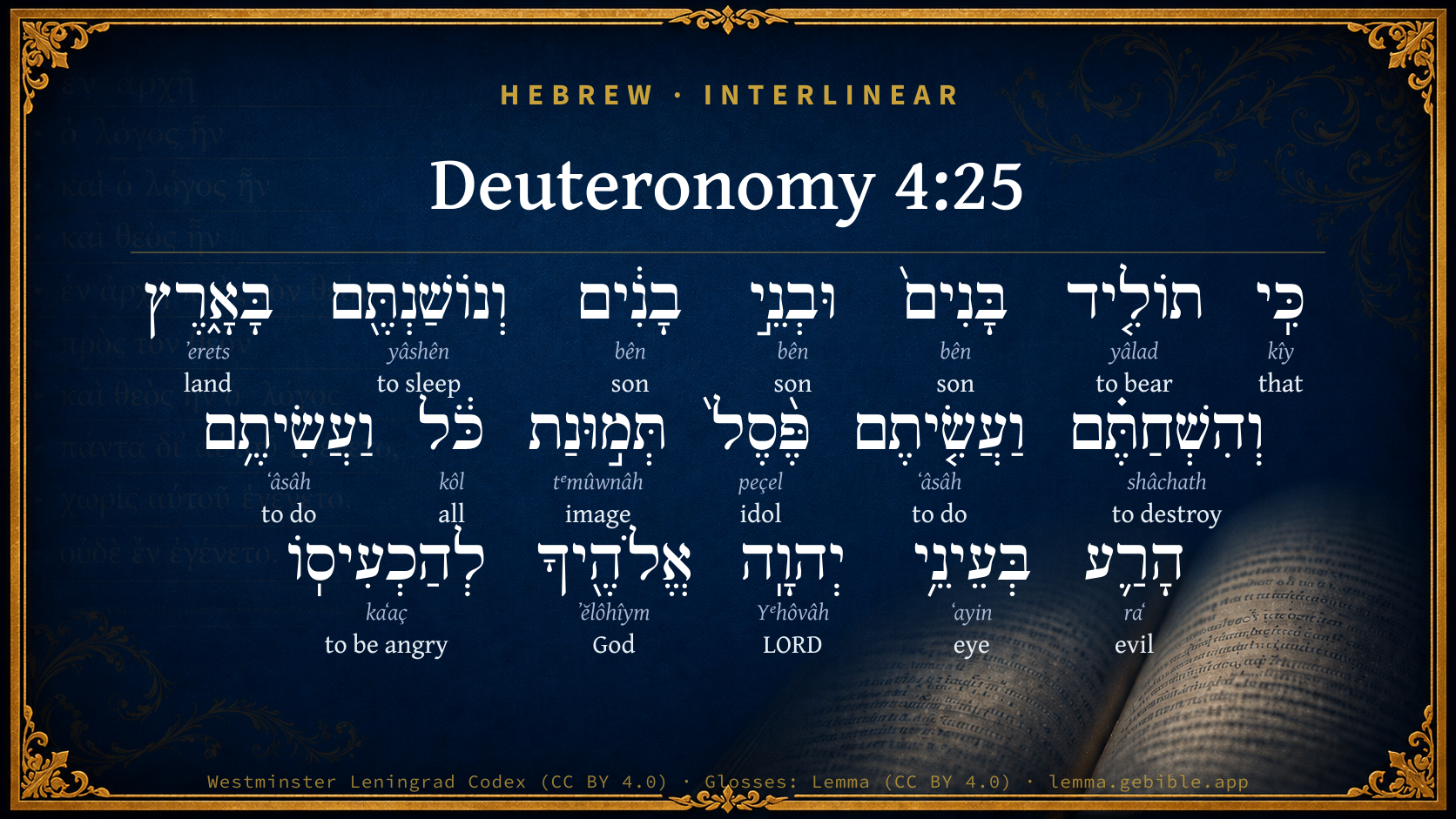
Hebrew (Westminster Leningrad Codex) Deuteronomy 4:25 appears in the Hebrew Old Testament. The text above is from the Westminster Leningrad Codex. Each word links to its Strong’s number, a concise gloss, and parsing drawn from the Open Scriptures Hebrew Bible morphology. Click any word for its full Brown-Driver-Briggs (BDB) entry.
Download image
Cite this verse

Deuteronomy 4:25 (World English Bible). Public Domain. Lemma interlinear Bible study tool, https://lemma.gebible.app/v/deuteronomy/4/25.

Show BibTeX & RIS
BibTeX
RIS
English Translation
When you shall father children, and children's children, and you shall have been long in the land, and shall corrupt yourselves, and make an engraved image in the form of anything, and shall do that which is evil in the sight of Yahweh your God, to provoke him to anger;
World English Bible · Public Domain
Highlights
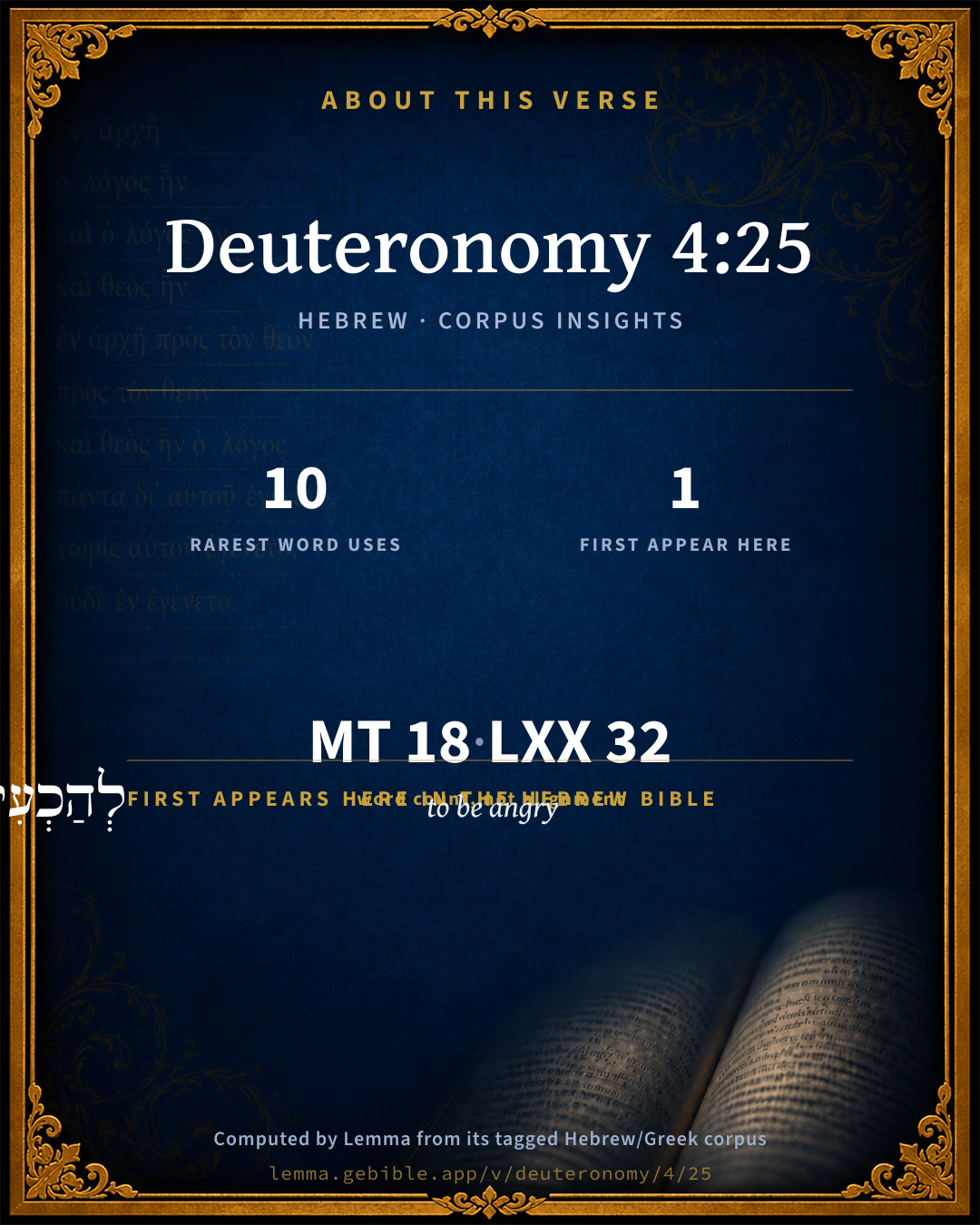
  • 1 first appearance in the Hebrew Bible
Full analysis ↓
Download a study sheet

One document with this verse’s original text, its word-by-word gloss line, the meaning frame, cross-references with their text, attributed commentary, and full source and license credits — printable, and it pastes into notes with its structure intact.

This verse Autodidact and up

Study sheet (.html) Plain text (.txt)

A passage Seminary Student

Up to 50 verses in one chapter. A passage sheet keeps up to 6 commentary sources and 12 cross-references per verse, in the order this page ranks them, and says so on the sheet whenever that leaves anything out. Ask for a single verse and you get the Autodidact verse sheet above.

Everything on this page stays free to read, with no account — the sheet is a download of what is already on screen, not access to it.

Want to remove ads? Support Godless Engineer
Compare translations 3

The same verse in 3 English versions, stacked beneath the original-language interlinear above. Click any original word for its lexicon entry.

Each is an independent rendering of the whole verse — the interlinear is not word-aligned to these translations.

Highlighted words mark where these versions differ — a whole-verse word diff, not a word-by-word alignment.

  • World English Bible Public Domain
    When you shall father children, and children's children, and you shall have been long in the land, and shall corrupt yourselves, and make an engraved image in the form of anything, and shall do that which is evil in the sight of Yahweh your God, to provoke him to anger;
  • King James Version Public Domain
    When thou shalt beget children, and children's children, and ye shall have remained long in the land, and shall corrupt yourselves, and make a graven image, or the likeness of any thing, and shall do evil in the sight of the LORD thy God, to provoke him to anger:
  • unfoldingWord Literal Text CC BY-SA 4.0
    If you beget sons, and sons of sons, and you grow old in the land, and you act corruptly and make an idol a form of anything, and do evil in the eyes of Yahweh your God, to cause him to be angry,

unfoldingWord Literal Text — © unfoldingWord, licensed CC BY-SA 4.0. Word-aligned USFM3 via Door43 (git.door43.org/unfoldingWord/en_ult).

Versions to compare (up to 4)

3 of 4 selected

Show all 18 translations

Every available English version of this verse, each an independent rendering of the whole verse.

  • World English Bible Public Domain
    When you shall father children, and children's children, and you shall have been long in the land, and shall corrupt yourselves, and make an engraved image in the form of anything, and shall do that which is evil in the sight of Yahweh your God, to provoke him to anger;
  • Berean Standard Bible Public Domain
    After you have children and grandchildren and you have been in the land a long time, if you then act corruptly and make an idol of any form—doing evil in the sight of the LORD your God and provoking Him to anger—
  • Majority Standard Bible Public Domain
    After you have children and grandchildren and you have been in the land a long time, if you then act corruptly and make an idol of any form—doing evil in the sight of the LORD your God and provoking Him to anger—
  • King James Version Public Domain
    When thou shalt beget children, and children's children, and ye shall have remained long in the land, and shall corrupt yourselves, and make a graven image, or the likeness of any thing, and shall do evil in the sight of the LORD thy God, to provoke him to anger:
  • American Standard Version (1901) Public Domain
    When thou shalt beget children, and children's children, and ye shall have been long in the land, and shall corrupt yourselves, and make a graven image in the form of anything, and shall do that which is evil in the sight of Jehovah thy God, to provoke him to anger;
  • Revised Version (1885) Public Domain
    When thou shalt beget children, and children’s children, and ye shall have been long in the land, and shall corrupt yourselves, and make a graven image in the form of any thing, and shall do that which is evil in the sight of the LORD thy God, to provoke him to anger:
  • Geneva Bible (1599) Public Domain
    When thou shalt beget children and childrens children, and shalt haue remained long in the land, if ye corrupt your selues, and make any grauen image, or likenes of any thing, and worke euill in the sight of the Lord thy God, to prouoke him to anger,
  • Douay-Rheims (1899) Public Domain
    If you shall beget sons and grandsons, and abide in the land, and being deceived, make to yourselves any similitude, committing evil before the Lord your God, to provoke him to wrath:
  • Young's Literal Translation Public Domain
    `When thou begettest sons and sons' sons, and ye have become old in the land, and have done corruptly, and have made a graven image, a similitude of anything, and have done the evil thing in the eyes of Jehovah, to provoke Him to anger: --
  • Literal Standard Version CC BY-SA 4.0
    When you beget sons and sons’ sons, and you have become old in the land, and have done corruptly, and have made a carved image, a likeness of anything, and have done evil in the eyes of YHWH to provoke Him to anger,
  • Unlocked Literal Bible CC BY-SA 4.0
    When you beget children and children's children, and when you will have been in the land for a long time, and if you corrupt yourselves and make a carved figure in the form of anything, and do what is evil in the sight of Yahweh your God, to provoke him to anger—
  • unfoldingWord Literal Text CC BY-SA 4.0
    If you beget sons, and sons of sons, and you grow old in the land, and you act corruptly and make an idol a form of anything, and do evil in the eyes of Yahweh your God, to cause him to be angry,
  • Darby Bible Public Domain
    When thou begettest sons, and sons' sons, and ye have remained long in the land, and shall corrupt yourselves, and make a graven image, the form of anything, and do evil in the sight of Jehovah thy God, to provoke him to anger,
  • World Messianic Bible Public Domain
    When you father children and children’s children, and you have been long in the land, and then corrupt yourselves, and make a carved image in the form of anything, and do that which is evil in the LORD your God’s sight to provoke him to anger,
  • Webster's Bible Public Domain
    When thou shalt beget children, and children's children, and ye shall have remained long in the land, and shall corrupt yourselves, and make a graven image, or the likeness of any thing, and shall do evil in the sight of the LORD thy God, to provoke him to anger:
  • Free Bible Version CC BY-SA 4.0
    After you have been living in the country for a long time and have had children and grandchildren, you may then spoil the relationship you have with the Lord and make an idol in some form. The Lord your God sees this as evil and it makes him angry.
  • Bible in Basic English Public Domain
    If, when you have had children and children's children, and have been living a long time in the land, you are turned to evil ways, and make an image of any sort, and do evil in the eyes of the Lord your God, moving him to wrath:
  • JPS Tanakh (1917) Public Domain
    When thou shalt beget children, and children's children, and ye shall have been long in the land, and shall deal corruptly, and make a graven image, even the form of any thing, and shall do that which is evil in the sight of the LORD thy God, to provoke Him;

Literal Standard Version (2020), Covenant Press — licensed CC BY-SA 4.0. Text via the HelloAO Bible API (eBible.org). Unlocked Literal Bible (unfoldingWord) — licensed CC BY-SA 4.0. Text via the HelloAO Bible API (eBible.org). unfoldingWord Literal Text — © unfoldingWord, licensed CC BY-SA 4.0. Word-aligned USFM3 via Door43 (git.door43.org/unfoldingWord/en_ult). Free Bible Version, Dr. Jonathan Gallagher — licensed CC BY-SA 4.0. Text via the HelloAO Bible API (eBible.org).

Word by word

More ways to search: Search by grammar → Find every occurrence → Compare this word →

Practice this passage: Drill this verse → Learn its vocabulary →

תְּמ֣וּנַת
tᵉmûwnâh
H8544
“image of”
Noun, Common, Feminine, Singular, Construct
Part of Speech
Noun
Type
Common
Gender
Feminine
Number
Singular
State
Construct
Full BDB Definition

Origin: from H4327

TWOT: 1191b

form, image, likeness, representation, semblance
  1. כִּֽי kîy H3588 “that” Conjunction
  2. תוֹלִ֤יד yâlad H3205 “to bear” Verb, Hiphil, Imperfect, 2nd Person, Masculine, Singular
  3. בָּנִים֙ bên H1121 “sons” Noun, Common, Masculine, Plural, Absolute
  4. וּבְנֵ֣י bên H1121 “and · sons of” Conjunction + Noun, Common, Masculine, Plural, Construct
  5. בָנִ֔ים bên H1121 “sons” Noun, Common, Masculine, Plural, Absolute
  6. וְנוֹשַׁנְתֶּ֖ם yâshên H3462 “and · to sleep” Conjunction + Verb, Niphal, Sequential Perfect, 2nd Person, Masculine, Plural
  7. בָּאָ֑רֶץ ʼerets H776 “in/at the · land” Preposition, Determined + Noun, Common, Both, Singular, Absolute
  8. וְהִשְׁחַתֶּ֗ם shâchath H7843 “and · to destroy” Conjunction + Verb, Hiphil, Sequential Perfect, 2nd Person, Masculine, Plural
  9. וַעֲשִׂ֤יתֶם ʻâsâh H6213 “and · to do” Conjunction + Verb, Qal, Sequential Perfect, 2nd Person, Masculine, Plural
  10. פֶּ֨סֶל֙ peçel H6459 “idol” Noun, Common, Masculine, Singular, Absolute
  11. כֹּ֔ל kôl H3605 “all” Noun, Common, Masculine, Singular, Absolute
  12. וַעֲשִׂיתֶ֥ם ʻâsâh H6213 “and · to do” Conjunction + Verb, Qal, Sequential Perfect, 2nd Person, Masculine, Plural
  13. הָרַ֛ע raʻ H7451 “the · evil” Particle, Definite Article + Adjective, Adjective, Masculine, Singular, Absolute
  14. בְּעֵינֵ֥י ʻayin H5869 “in/at · eyes of” Preposition + Noun, Common, Both, Dual, Construct
  15. יְהוָֽה Yᵉhôvâh H3068 “LORD” Noun, Proper
  16. אֱלֹהֶ֖יךָ ʼĕlôhîym H430 “God(s) · your” Noun, Common, Masculine, Plural, Construct + Suffix, Personal, 2nd Person, Masculine, Singular
  17. לְהַכְעִיסֽוֹ kaʻaç H3707 “to be angry · him” Preposition + Verb, Hiphil, Infinitive Construct + Suffix, Personal, 3rd Person, Masculine, Singular

About this verse

These counts appear in no published source. They are computed here, from the morphology-tagged text and Lemma’s own curated glosses. What Lemma adds →

18
words
15
distinct lemmas
Pentateuch
section

Notable vocabulary

The rarest word here is תְּמ֣וּנַת image H8544 — appearing just 10 times in the whole Hebrew Bible.

First appearance in Scripture

This word makes its first canonical appearance in the Hebrew Bible here:

  • לְהַכְעִיסֽוֹ to be angry H3707

Shared distinctive vocabulary

תְּמ֣וּנַת image H8544 occurs in 10 verses of the Hebrew Bible. Also found in:

Grammatical profile

  • 6 verbs
  • 10 nouns
  • 1 adjective
  • 1 conjunction

Verb forms

  • תוֹלִ֤יד Hiphil · Imperfect
  • וְנוֹשַׁנְתֶּ֖ם Niphal · Sequential Perfect
  • וְהִשְׁחַתֶּ֗ם Hiphil · Sequential Perfect
  • וַעֲשִׂ֤יתֶם Qal · Sequential Perfect
  • וַעֲשִׂיתֶ֥ם Qal · Sequential Perfect
  • לְהַכְעִיסֽוֹ Hiphil · Infinitive Construct

Repetition

Words recur within this verse — often emphatic in Hebrew:

  • בָּנִים֙ son H1121 ×3
  • וַעֲשִׂ֤יתֶם to do H6213 ×2

Hebrew & Septuagint length

In English translation the verse runs 50 words from the Hebrew and 48 from the Septuagint (LXX English) — closely comparable.

A rough comparison of the two English renderings, which tokenize alike — not a word-level alignment.

Word counts can differ between the Hebrew and the Greek without any difference in meaning — e.g. the Hebrew direct-object marker אֵת has no separate Greek word, and Greek often adds the article ὁ.

In the original languages it is 18 Hebrew tokens and 32 Greek tokens — but the two are counted differently (Hebrew bundles its prefixes and suffixes into one token; the Greek is in lemma form), so that isn’t a like-for-like length.

Cross-references

11

Topical passages linked to Deuteronomy 4:25 in the Treasury of Scripture Knowledge — connected by theme and wording, ordered by reader-vote popularity; previews shown in the World English Bible.

  • Deuteronomy 4:16 Lest you corrupt yourselves, and make yourself an engraved image in the form of any figure, the likeness of male or female,
  • Hosea 9:9 They have deeply corrupted themselves, As in the days of Gibeah. He will remember their iniquity. He will punish them for their sins.
  • 1 Corinthians 10:22 Or do we provoke the Lord to jealousy? Are we stronger than he?
  • Exodus 32:7 Yahweh spoke to Moses, "Go, get down; for your people, who you brought up out of the land of Egypt, have corrupted themselves!
  • Deuteronomy 31:16–18 Yahweh said to Moses, Behold, you shall sleep with your fathers; and this people will rise up, and play the prostitute after the strange gods of the land, where they go to be among them, and will forsake me, and break my covenant which I have made with them.
  • Deuteronomy 31:29 For I know that after my death you will utterly corrupt yourselves, and turn aside from the way which I have commanded you; and evil will happen to you in the latter days; because you will do that which is evil in the sight of Yahweh, to provoke him to anger through the work of your hands.
  • Judges 2:8–15 Joshua the son of Nun, the servant of Yahweh, died, being one hundred ten years old.
  • 2 Kings 17:17–19 They caused their sons and their daughters to pass through the fire, and used divination and enchantments, and sold themselves to do that which was evil in the sight of Yahweh, to provoke him to anger.
  • 2 Kings 21:2 He did that which was evil in the sight of Yahweh, after the abominations of the nations whom Yahweh cast out before the children of Israel.
  • 2 Kings 21:14–16 I will cast off the remnant of my inheritance, and deliver them into the hand of their enemies; and they shall become a prey and a spoil to all their enemies;
  • 2 Chronicles 36:12–16 and he did that which was evil in the sight of Yahweh his God; he didn't humble himself before Jeremiah the prophet [speaking] from the mouth of Yahweh.

Cross-references courtesy of OpenBible.info (CC BY 4.0).

Hebrew and Greek witnesses Masoretic Hebrew ↔ Greek Septuagint

The same verse in the two great witnesses to the Old Testament, shown verse-for-verse.

These are two independent witnesses, not word-aligned to each other, and the Septuagint is shown in lemma (dictionary) form.

Hebrew Deuteronomy 4:25 Masoretic · Westminster Leningrad Codex

כִּֽי תוֹלִ֤יד בָּנִים֙ וּבְנֵ֣י בָנִ֔ים וְנוֹשַׁנְתֶּ֖ם בָּאָ֑רֶץ וְהִשְׁחַתֶּ֗ם וַעֲשִׂ֤יתֶם פֶּ֨סֶל֙ תְּמ֣וּנַת כֹּ֔ל וַעֲשִׂיתֶ֥ם הָרַ֛ע בְּעֵינֵ֥י יְהוָֽה אֱלֹהֶ֖יךָ לְהַכְעִיסֽוֹ

When you shall father children, and children's children, and you shall have been long in the land, and shall corrupt yourselves, and make an engraved image in the form of anything, and shall do that which is evil in the sight of Yahweh your God, to provoke him to anger;

World English Bible · Public Domain

Greek LXX Deuteronomy 4:25 Septuagint · lemma form

ἐάν δέ γεννάω υἱός καί υἱός ὁ υἱός σύ καί χρονίζω ἐπί ὁ γῆ καί ἀνομέω καί ποιέω γλυπτός ὁμοίωμα πᾶς καί ποιέω ὁ πονηρός ἐναντίον κύριος ὁ θεός σύ παραὀργίζω αὐτός

And when you shall have begotten sons, and shall have sons' sons, and you⌃ shall have lived a long time on the land, and shall have transgressed, and made a graven image of any thing, and shall have done wickedly before the Lord your God to provoke him;

LXX2012 (modern English Septuagint) · Public Domain

On this verse, The Cambridge Bible for Schools and Colleges discusses the Septuagint’s reading. Read the note in Commentary ↓

Hebrew: Westminster Leningrad Codex (CC BY 4.0). Greek: Septuagint (public domain); English from LXX2012 (modern English Septuagint) (Public Domain). How the Septuagint differs from the Hebrew →

Targum (Aramaic paraphrase)

2

The Targum is the ancient Jewish Aramaic paraphrase of the Hebrew Scriptures — an interpretive translation, not the Hebrew text itself. Onkelos (literal) and Pseudo-Jonathan (expansive) render the Torah, and Jonathan the Prophets. Coverage is partial: where no permissively-licensed English translation exists for a verse, only the Aramaic is shown. This is verse-level text, not a word-by-word alignment to the Hebrew.

  1. Targum Onkelos Torah (Genesis–Deuteronomy)
    אֲרֵי תוֹלְדוּן בְּנִין וּבְנֵי בְנִין וְתִתְעַתְּקוּן בְּאַרְעָא וּתְחַבְּלוּן וְתַעְבְּדוּן צֶלֶם דְמוּת כֹּלָא וְתַעְבְּדוּן דְבִישׁ קֳדָם יְיָ אֱלָהָךְ לְאַרְגָזָא קֳדָמוֹהִי

    (no public-domain English translation for this verse)

    Targum Onkelos — Aramaic: “Onkelos Genesis” (public domain); “Onkelos Exodus” (public domain); “Onkelos Leviticus” (public domain); “Onkelos Numbers” (public domain); “Onkelos Deuteronomy” (public domain). English: “Sefaria Community Translation” (CC0 1.0 (public-domain dedication)); “J.W. Etheridge. The Targums of Onkelos and Jonathan Ben Uzziel on the Pentateuch. London: Longmans, Green, 1862” (public domain). Text via Sefaria.

  2. Targum Pseudo-Jonathan Torah (Genesis–Deuteronomy)
    אֲרוּם תֵּלְדוּן בְּנִין וּבְנֵי בְנִין וְתִתְעַתְּקוּן בְּאַרְעָא וּתְחַבְּלוּן עוֹבָדֵיכוֹן וְתַעַבְדוּן לְכוֹן צְלַם דְּמוּת כּוֹלָא וְתַעַבְדוּן דְּבִישׁ קֳדָם יְיָ אֱלָהָכוֹן לְאַרְגָזָא קֳדָמוֹי

    If, when thou wilt have begotten children and children’s children, and wilt have grown old in the land, you corrupt your works, and make to you an image or any likeness, and do that which is evil before the Lord to provoke Him;

    Targum Pseudo-Jonathan — Aramaic: “Targum Jonathan on Genesis” (public domain); “Targum Jonathan on Exodus” (public domain); “Targum Jonathan on Leviticus” (public domain); “Targum Jonathan on Numbers” (public domain); “Targum Jonathan on Deuteronomy” (public domain). English: “The Targum of Jonathan ben Uzziel, trans. J. W. Etheridge, London, 1862” (public domain). Text via Sefaria.

Commentary

Notes on Deuteronomy 4:25 from classic Christian and Jewish commentators (each source and its license shown beneath its notes). The classic Christian expositions comment on the surrounding passage and are grouped to its opening verse, so a note may address several verses; the Jewish commentaries on the Tanakh (Rashi and others) are per-verse, so they appear only where the commentator wrote on this verse.

Lemma curates 59 commentaries, every one of them public domain or Creative Commons licensed, each selected and text-cleaned for this edition rather than reprinted as found. About our sources →

The Cambridge Bible for Schools and Colleges

gen. ed. J. J. S. Perowne

25. When thou shalt beget … and ye shall have been] Read, ye shall beget. The sentence illustrates the difficulties raised by the variant forms of address. So quick a change from Sg. to Pl., confirmed by LXX (though Sam. has Pl. for both verbs), is logically possible (thou = the mother nation; ye = the nation and its children). Yet the Sg. is more probably due to the attraction of the previous Sg., a copyist naturally continuing the latter till the changed form arrested him. For thy God both Sam. and LXX read your God. Thus the Pl. is complete throughout 25–28. The word for beget only here, Deu_27:1 and in P.

ye shall have been long] Or grown old or stale, used of old corn, Lev_26:10, and inveterate leprosy, Deu_13:11, Here not merely living long in the land, but growing aged in spirit, losing spiritual freshness. Similarly the prophets judged the wilderness days to have been the ideal period of Israel’s history, the subsequent ages decadent.

corrupt yourselves] See on Deu_4:16; graven image, etc., ibid.

do evil in the eyes of the Lord] Deu_9:18, Deu_17:2, Deu_31:29, and P, Num_32:13; or good, Deu_6:18, Deu_12:28.

to provoke him] Deu_9:18, Deu_31:29, Deu_32:16; Deu_32:21, also in deuteronomic passages in Kings and in Jeremiah.

25–31. Threat of Exile with Promise of Grace on Repentance

If, with the slackness of increasing years, Israel give way to idolatry (Deu_4:25) Moses testifies that they shall perish from the land (Deu_4:26), and be scattered among the peoples (Deu_4:27) where indeed they must worship senseless idols (Deu_4:28). So far the Pl. address. But if—change to the Sg.—in these latter days of tribulation the nation seeks and returns to Jehovah it shall find Him (Deu_4:29 f.). He will not fail nor forget His covenant (Deu_4:31).—As we shall see from the notes the threat of exile is no sufficient ground for judging Deu_4:25-28 to be an exilic addition, but there are several phrases which only D and P have. Others are found only in xxviii. The exilic origin of 29–31 is more probable. Dillm. denies a connection between Deu_4:25 and the preceding; it seems to the present writer that Deu_4:25-28 is a natural continuation of Deu_4:23. This, however, by itself does not prove identity of authorship.

Further Note on 25–31. The two parts of this Deu_4:25-28 and Deu_4:29-31 are probably separate; note the change of address. Berth. says that the whole ‘bears clearly the stamp of exilic authorship.’ This is not true of Deu_4:25-28, the threat of exile. After the exile of N. Israel in 721 and the precedents in prophecy for a threat of exile (cp. Amos, Isaiah and Jeremiah), and the notorious policy of Assyria towards subject races, it would on the contrary have been strange not to have found in the pre-exilic deuteronomists, with their prophetic temper, some foreboding of exile. Dillm. rightly says, ‘the threat of exile has nothing surprising in it,’ if we compare ch. 28. But the case is different with the promise contingent on the conversion of the people in exile. In itself it is as conceivable in D as in the prophets (whom it is impossible to regard, as a powerful school of criticism does, as predicters only of judgement), but as Dillm. points out it lies here too far away from the purpose of the exhortation1[115]. Add to this reasons of form, (1) that the for introducing Deu_4:32 ff. has no relevancy to Deu_4:29-31, but continues Deu_4:25-28 (see Driver), and (2) the change from the Pl. to the Sg. address—and there is a strong case for taking Deu_4:29-31 as a later exilic insertion like Deu_30:1-10. Berth.’s argument that Deu_4:32 naturally follows Deu_4:24 is met by the fact that it more naturally follows Deu_4:28, and we have already seen that Deu_4:25-28 are the natural continuation of Deu_4:23. We may, therefore, take Deu_4:25-28 as integral, and only Deu_4:29-31 as a later exilic intrusion.

[115] There is an analogy, however, in 29 f.

The Cambridge Bible for Schools and Colleges (gen. ed. J. J. S. Perowne; Cambridge University Press, 1878–1918) — public domain. Text from a community e-Sword module.

Trapp's Complete Commentary

John Trapp

Deu 4:25 When thou shalt beget children, and children’s children, and ye shall have remained long in the land, and shall corrupt [yourselves], and make a graven image, [or] the likeness of any [thing], and shall do evil in the sight of the LORD thy God, to provoke him to anger:

Ver. 25. And shalt have remained long.] So that thou thinkest there is no removing thee, thou art so rooted and riveted. Nicephorus Phocas having built a mighty wall, heard from heaven, Though thou built as high as heaven, ενδον το κακον, ευαλωτος η πολις, Sin is within, all will be lost.

John Trapp, A Commentary or Exposition upon All the Books of the Old and New Testament (1647–1656) — public domain. Text from a community e-Sword module.

Joseph Benson's Commentary

Deu 4:25. And shall corrupt yourselves — This seems to be evidently a prediction of what Moses foresaw would take place; which that he did is still more manifest in Deu 4:30.

Joseph Benson's Commentary on the Old and New Testaments (1811–1818) — public domain. Text from a community e-Sword module.

Whedon's Commentary on the Bible

Daniel D. Whedon

DISPERSION AMONG THE HEATHEN THREATENED, Deu_4:25-28.

Daniel D. Whedon (gen. ed.), Commentary on the Old and New Testaments (1874–1909) — public domain. Text from a community e-Sword module.

Keil & Delitzsch

C. F. Keil & F. Delitzsch

To give emphasis to this warning, Moses holds up the future dispersion of the nation among the heathen as the punishment of apostasy from the Lord.

Deu 4:25-26

If the Israelites should beget children and children's children, and grow old in the land, and then should make images of God, and do that which was displeasing to God to provoke Him; in that case Moses called upon heaven and earth as witnesses against them, that they should be quickly destroyed out of the land. "Growing old in the land" involved forgetfulness of the former manifestations of grace on the part of the Lord, but not necessarily becoming voluptuous through the enjoyment of the riches of the land, although this might also lead to forgetfulness of God and the manifestations of His grace (cf. Deu 6:10., Deu 32:15). The apodosis commences with Deu 4:26. העיד, with בּ and the accusative, to take or summon as a witness against a person. Heaven and earth do not stand here for the rational beings dwelling in them, but are personified, represented as living, and capable of sensation and speech, and mentioned as witnesses who would raise up against Israel, not to proclaim its guilt, but to bear witness that God, the Lord of heaven and earth, had warned the people, and, as it is described in the parallel passage in Deu 30:19, had set before them the choice of life and death, and therefore was just in punishing them for their unfaithfulness (cf. Psa 50:6; Psa 51:6). "Prolong days," as in Exo 20:12.

Deu 4:27

Jehovah would scatter them among the nations, where they would perish through want and suffering, and only a few (מספּר מתי, Gen 34:30) would be left. "Whither" refers to the nations whose land is thought of (cf. Deu 12:29; Deu 30:3). For the thing intended, see Lev 26:33, Lev 26:36, Lev 26:38-39, and Deu 28:64., from which it is evident that the author had not "the fate of the nation in the time of the Assyrians in his mind" (Knobel), but rather all the dispersions which would come upon the rebellious nation in future times, even down to the dispersion under the Romans, which continues still; so that Moses contemplated the punishment in its fullest extent.

Deu 4:28

There among the heathen they would be obliged to serve gods that were the work of men's hands, gods of wood and stone, that could neither hear, nor eat, nor smell, i.e., possessed no senses, showed no sign of life. What Moses threatens here, follows from the eternal laws of the divine government. The more refined idolatry of image-worship leads to coarser and coarser forms, in which the whole nature of idol-worship is manifested in all its pitiableness. "When once the God of revelation is forsaken, the God of reason and imagination must also soon be given up and make way for still lower powers, that perfectly accord with the I exalted upon the throne, and in the time of pretended 'illumination' to atheism and materialism also" (Schultz).

Deu 4:29

From thence Israel would come to itself again in the time of deepest misery, like the prodigal son in the gospel (Luk 15:17), would seek the Lord its God, and would also find Him if it sought with all its heart and soul (cf. Deu 6:5; Deu 10:12).

Deu 4:30-31

"In tribulation to thee (in thy trouble), all these things (the threatened punishments and sufferings) will befall thee; at the end of the days (see at Gen 49:1) thou wilt turn to Jehovah thy God, and hearken to His voice." With this comprehensive thought Moses brings his picture of the future to a close. (On the subject-matter, vid., Lev 26:39-40.) Returning to the Lord and hearkening to His voice presuppose that the Lord will be found by those who earnestly seek Him; "for (Deu 4:31) He is a merciful God, who does not let His people go, nor destroy them, and who does not forget the covenant with the fathers" (cf. Lev 26:42 and Lev 26:45). הרפּה, to let loose, to withdraw the hand from a person (Jos 10:6).

Keil & Delitzsch — Biblical Commentary on the Old Testament (1861–1891) — public domain (CC PDM 1.0). Text via the HelloAO Bible API. (Old Testament only.)

Geneva Bible (1599)

Geneva Bible translators

Meaning hereby all superstition and corruption of the true service of God.

Geneva Bible (1599) marginal notes — public domain. Text via Bolls.life.

Ellicott's Commentary for English Readers

(25) Shall have remained long.—Literally, shall slumber—a very suggestive expression. Prosperity often sends true religion to sleep, and brings conventional, or fashionable, religion in its stead.

A Bible Commentary for English Readers, edited by Charles John Ellicott (1878–1897) — public domain. Text from a community e-Sword module.

John Gill's Exposition

When thou shall beget children, and children's children,.... Children and grandchildren, and several ages and generations have passed:

and shalt have remained long in the land; many years and even ages, or have grown old (h) in it: now they were in their infancy, and as such they were about to enter into it; during the times of the judges, they were in their childhood, or youth; in the times of David and Solomon, they were in their manhood; after that, in their decline; and in the times of Jeconiah and his brethren in their old age, when for their sins they were carried captive:

and shall corrupt yourselves, and make a graven image, or the likeness of anything; See Gill on Deu 25:16.

and shall do evil in the sight of the Lord thy God, to provoke him to anger; that sin of idolatry, that God provoking sin, is chiefly intended.

(h) "inveteraveritis", Montanus: "veteres facti fueritis", Junius & Tremellius, Piscator; "senueritis", Vatablus.

John Gill's Exposition of the Whole Bible (1746–1763) — public domain (CC PDM 1.0). Text via the HelloAO Bible API.

Albert Barnes' Notes on the Bible

Compare with these verses Lev 26:33-40, and Deu 28:64 ff.

Albert Barnes' Notes on the Bible (1834–1885) — public domain. Text from a community e-Sword/MySword module.

Matthew Poole's English Annotations

In the sight of the Lord: these words are here added, either,

1. As a caution. Your idolatry, though possibly secretly and cunningly managed, will not be hid from him; he sees it, and he will punish it. Or,

2. To aggravate their spiritual whoredom, as being committed in the sight and presence of their Lord and Husband, whose eye is alone peculiarly upon them in all their ways, than it is upon other people. Or,

3. By way of opposition unto men’s judgment. Idolatry ofttimes seems good, and reasonable, and religious in the eyes of men, but, saith he, it is evil in the eyes of the Lord, whose judgment is most considerable.

Matthew Poole's English Annotations on the Holy Bible (1683–1685) — public domain. Text from a community e-Sword/MySword module.

The Pulpit Commentary

CHAPTER Deu_6:10, etc.; Deu_8:7, etc.; Deu_31:20, Deu_31:21; Deu_32:15, etc.; Hos_13:6) then should they utterly perish from off the land of which they were now about to take possession.

Have remained long in the land; literally, have become old, an ancient nation, etc. To provoke him to anger; i.e. so as that he should be displeased and grieved, and roused to punish.

Vers. 25-28. Penalties of disobedience and apostasy.

(See Homiletics, De 28)

HOMILIES BY R.M. EDGAR Vers. 25-31. Judgment leading to mercy.

After stating the fact of God"s jealousy in the matter of graven images, Moses goes on as a prophet to declare that, if they corrupt themselves in this way in Canaan, the result will be their destruction and dispersion. But in dispersion, if they turn with all their hearts to God (ver. 29), they shall find him and be restored. God is merciful as well as jealous (ver. 31). The following thoughts are hereby suggested:

I JUDGMENT IS WITH A VIEW TO AMENDMENT. Of course, the incorrigible stage may eventually be reached. But until this spirit is manifested, judgment is remedial. The dealings of God with Israel, as we know from the history, were in hope of national amendment. Defeat at the hand of their enemies, exile in Babylon, and all the severe dispensations were to bring them to their senses and lead them to return to God. Judgment, in fact, is first the servant of mercy.

II TRIBULATION SHOULD AT ONCE LEAD US TO HEARTSEARCHING. It is not an infallible sign of special sin, as the case of Job proves. But the probabilities are in favor of supposing that some special sin has called for special sorrow. Let self-examination, then, be the rule in the midst of all our tribulations. God is calling us in trumpet-tones to return to his embrace.

III MERCY FINDS IN TROUBLE A SPLENDID SPHERE. The riches of God"s grace and mercy can be displayed only in the permitted extremities of human experience. Tribulation, exile, the bitterness which no earthly intermeddling can relieve, are so many worlds into which mercy enters to assert its power and to reign. The permission of evil has here the only explanation which the present life allows. We shall learn more afterwards, but meanwhile this is all we can learn here.

IV THE MERCIFUL ONE COUNSELS SOULS TO RETURN AT ONCE TO COVENANT RELATIONS. A loving God is jealous of the defections of his people hence the judgment and the tribulation. But in mercy he counsels return, and promises to receive them into covenant relationship again. Here alone can we have peace and satisfaction of a permanent character. Outside the covenant there can be no real comfort or joy. In covenant relations with God, there is a charmed circle, and peace passing all understanding. As Israel returned after the exile, may we return from our backslidings to the consolations of the covenant again! R.M.E.

The Pulpit Commentary (1880–1919), ed. H.D.M. Spence-Jones & Joseph S. Exell — public domain. Text from a community e-Sword module.

Kretzmann's Popular Commentary

Paul E. Kretzmann

The Appeal Supported by a Reference to God’s Kindness

v. 25. When thou shalt beget children and children’s children, and ye shall have remained long in the land, literally, become old in the land, which would include the forgetting of the former acts of God’s mercy, and shall corrupt yourselves, the first zealous love for Jehovah having grown cold, and make a graven image, or the likeness of anything, and shall do evil in the sight of the Lord, thy God, to provoke Him to anger,

v. 26. I call heaven and earth, as living, sensible creatures, to witness against you this day that ye shall soon utterly perish from off the land whereunto ye go over Jordan to possess it; ye shall not prolong your days upon it, but shall utterly be destroyed. The witness summoned by Moses would be able to testify to the fact that the Lord had given His people the choice of life and death, Deu 30:19, and therefore was fully justified in punishing unfaithfulness.

v. 27. And the Lord shall scatter you among the nations, and ye shall be left few in number among the heathen, whither the Lord shall lead you, Lev 26:33. All the judgments of the Lord upon His disobedient people are here included, down to the time of the Romans and the destruction of Jerusalem in 70 A. D.

v. 28. And there, in the captivity and in the final dispersal among the nations, ye shall serve gods, the work of men’s hands, wood and stone, which neither see, nor hear, nor eat, nor smell, Psa 115:4-5; Psa 135:15-16; Isa 44:9; Isa 46:7. Having rejected Jehovah, they would find themselves condemned by Him in being given up to the foolishness of their idolatrous hearts.

v. 29. But if from thence thou shalt seek the Lord, thy God, turning back to Him in true repentance, thou shalt find Him, if thou seek Him with all thy heart and with all thy soul. Cf Luk 15:17. The promise that the children of Israel should find Jehovah is a wonderful and comforting Gospel-message: for it assures them that His kindness, grace, and mercy will be poured out upon the truly repentant sinners once more.

v. 30. When thou art in tribulation, misery, oppression, and all these things are come upon thee, find thee, strike thee, even in the latter days, in the far-distant future, if thou turn to the Lord, thy God, and shalt be obedient unto His voice,

v. 31. (for the Lord, thy God, is a merciful God,) he will not forsake thee, neither destroy thee, nor forget the covenant of thy fathers which he sware unto them. The covenant of God’s faithfulness and mercy would not be broken on His side.

v. 32. For ask now of the days that are past, search the records of the world’s history from the beginning, which were before thee, since the day that God created man upon the earth, and ask from the one side of heaven unto the other, as far as the world extends, whether there hath been any such thing as this great thing is, or hath been heard like it.

v. 33. Did ever people hear the voice of God speaking out of the midst of the fire, as thou hast heard, and live? All of which goes to show that the Lord had singled out Israel for unusual manifestations of His kindness.

v. 34. Or hath God assayed (essayed) to go and take Him a nation from the midst of another nation, as He did in leading Israel out of the midst of the Egyptians, by temptations, by which the position of Pharaoh over against the Lord was tried out, by signs and by wonders, the great plagues of Egypt, and by war, when the Egyptians were about to attack the children of Israel at the Red Sea, and by a mighty hand, and by a stretched-out arm, Exo 13:3; Exo 6:6, and by great terrors, according to all that the Lord, your God, did for you in Egypt before your eyes?

v. 35. Unto thee, before every other nation on the earth, it was showed that thou mightest know that the Lord, He is God; there is none else beside Him. He is the one exclusive, the one true God.

v. 36. Out of heaven he made thee to hear His voice, Exo 19:9-19, that He might instruct thee; and upon earth He showed thee His great fire, in the burning of Mount Sinai; and thou heardest His words out of the midst of the fire. The purpose of this instruction was to impart a wholesome fear of the sanctity of Jehovah to the hearts of the people.

v. 37. And because He loved thy fathers, from Abraham down, therefore he chose their seed after them, and brought thee out in His sight with His mighty power out of Egypt, Exo 13:3-14;

v. 38. to drive out nations from before thee greater and mightier than thou art, to bring thee in, to give thee their land for an in heritance, as it is this day, for the conquest of the country east of the Jordan was a guarantee of the conquest of the entire country.

v. 39. Know, therefore, this day, and consider it in thine heart, contemplate the lessons of all these happenings most carefully, that the Lord, he is God in heaven above and upon the earth beneath; there is none else, there is only one true God; He is unity.

v. 40. Thou shalt keep, therefore, His statutes and His commandments which I command thee this day, both those pertaining to them, concerning them, as men, and those having reference to them as the covenant people, that it may go well with thee, since they would have Jehovah on their side, and with thy children after thee, and that thou mayest prolong thy days upon the earth which the Lord, thy God, giveth thee, forever; for a long and happy life, accompanied by the goodness of the Lord, is a blessing. We Christians also know the precepts of the Lord’s holy will and should live in accordance with them. If we are always mindful of the fact that God has redeemed us from the kingdom of darkness and translated us into the kingdom of His dear Son, we shall also be ready to serve Him in true obedience, to do according to His commandments.

Paul E. Kretzmann, Popular Commentary of the Bible (1921–1924) — public domain. Text from a community e-Sword module.

unfoldingWord translationNotes

Door43 World Missions Community

General Information:

Moses continues to speak to the people of Israel.

you beget ... Yahweh your God

The words "you" and "your" are singular here.

beget

become the father of, or become the ancestor of

if you corrupt yourselves

"if you do what is wrong." See how you translated these words in Deuteronomy 4:16.

do what is evil in the sight of Yahweh your God, to provoke him to anger

This is an idiom. AT: "you make Yahweh your God angry by doing what he says is evil" (See: Idiom)

I call heaven and earth to witness

Possible meanings are 1) Moses is calling on all those who live in heaven and earth to be witnesses to what he says or 2) Moses is speaking to heaven and earth as if they are people, and he is calling them to be witnesses to what he says. (See: Metonymy and Personification)

you will not prolong your days

Long days are a metaphor for a long life. AT: "you will not be able to live a long time" (See: Metaphor)

but you will be completely destroyed

As indicated in Deu 4:27, not every Israelite will be killed. Here "completely destroy" is a generalization and emphasizes that many of the Israelites will die. This can be stated in active form. AT: "but Yahweh will destroy many of you" (See: Hyperbole and Generalization and Active or Passive)

translationWords

corrupt

image

evil

anger

heaven

earth

testimony

perish

Jordan River

possess

unfoldingWord translationNotes — © Distant Shores Media and the Door43 World Missions Community, licensed CC BY-SA 4.0. Source: git.door43.org/Door43/en_tn.

Rashi

Rabbi Shlomo Yitzchaki (Rashi)

ונושנתם AND YE SHALL HAVE BEEN LONG [IN THE LAND] — He gave them a vague intimation that they would be exiled from it at the end of 852 years, according to the numerical value of the word ונושנתם, but He sent them into exile earlier, at the end of 850 years. He did this two years earlier than the numerical value of ונושנתם, in order that the prophecy should not be fulfilled in them “that ye shall utterly perish” (v. 26). This is the meaning of what is said, (Daniel 9:14) “And the Lord hastened in regard to the evil, and He brought it upon us, for the Lord our God is צדיק” — i.e., He acted charitably (צדקה) with us, in that He brought it (the evil) two years before its assigned time (Sanhedrin 38a; Gittin 88a).

Rashi on the Tanakh — English translations: “The Judaica Press complete Tanach with Rashi, translated by A. J. Rosenberg” (CC BY 4.0); “Pentateuch with Rashi's commentary by M. Rosenbaum and A.M. Silbermann, 1929-1934” (public domain); “The Metsudah Tanach series, Lakewood, N.J” (CC BY 4.0); and “The Book of Joshua, Metsudah Publications, 1997” (CC BY 4.0). Text via Sefaria.

Ramban (Nachmanides)

Rabbi Moshe ben Nachman (Ramban / Nachmanides)

KI’ (WHEN) THOU SHALT BEGET CHILDREN, AND CHILDREN’S CHILDREN, AND YE SHALL HAVE BEEN LONG ESTABLISHED IN THE LAND. The purport of this verse is that it mentions and affirms that “when ye shall beget children and children’s children, and because you will have been long established in the Land and dwelled in security, you may perhaps forget G-d — I call heaven and earth to witness against you this day ], but instead they constitute one statement, as follows: “Should a longer period of security in the Land create a tendency among the people to idolatry, heaven and earth will witness Israel’s loss of the Land.” that ye shall speedily perish, for He will not be long-suffering with you seeing that you worshipped idols.”Now this section, although constituting a warning, opened [with the word ki — “when” and] not with the expression im — “if” [which would be here more appropriate, since it speaks of a hypothetical condition of future time]. The reason is that he [Moses] was virtually prophesying about their affairs, and therefore he spoke in an equivocal manner — using an expression which in addition to being a warning [to avoid the sin of idolatry] also contains a prediction of things to come [when the warning will not be heeded]. He was thus saying that if they do so the following will happen to them, but he does not decree that they will do it. Therefore our Rabbis have said that in the numerical-value of [the letters in the Hebrew word] v’noshantem (and ye shall have been long established) is equivalent to 852 [vav = 6; nun = 50; vav = 6; shin = 300; nun = 50; tav = 400; mem = 40; — totalling 852]. Thus at the end of 852 years from the time that Israel came into the Land the exile was to occur. G-d, however, brought this about two years earlier in order that the prophecy — they shall “utterly perish” — at the end of that period should not come to pass. By bringing about the exile two years before the terminus of 852 years, G-d voided the prediction of total retribution. — It is of interest to note that in his Sefer Hage’ulah (Book of Redemption) Ramban similarly writes of the future redemption that, after it will have occurred, the allusion to that date will be found in this section of the Torah (Kithvei Haramban, Vol. I, p. 263). he alluded to the time of the exile following the destruction of the First Sanctuary. It was thus a tradition [among the prophets and Sages of the generations] that this section of the Torah contains an allusion to the time of the exile, and, when it actually came to pass, they understood the allusion by contemplating this section [and interpreting the hidden message of the prophecy in light of the historical event].

He states and ye make a graven image, ‘t’munath kol’ (even the form of any thing), but does not say “and you will worship it or bow down to it.” Instead he says, and ye shall corrupt yourselves, for “the graven image” spoken of here is the form of Kol (All) and on account of “corruption” He prohibited it, as I have explained above.

Ramban (Nachmanides) on the Tanakh — English translation: “Commentary on the Torah by Ramban (Nachmanides). Translated and annotated by Charles B. Chavel. New York, Shilo Pub. House, 1971-1976” (CC BY 4.0). Text via Sefaria.

Lesson kit

Teaching starters — assembled from the data on this page, not authored interpretation. Every prompt links to the verse data it draws on. Edit before teaching.

Deuteronomy, in the Pentateuch, opens this verse with 18 words (15 distinct Hebrew lemmas). Its most distinctive word is tᵉmûwnâh (“image”). A historical commentator’s framing appears above. Read the whole chapter for the surrounding context.

Discussion questions

  1. What does “image” (tᵉmûwnâh) contribute to the verse as a whole?
  2. The word “to be angry” first appears here in Scripture. What is being introduced at this debut?
  3. Exodus 20:4 shares the word «image» with this verse. How do the two illuminate each other?
  4. “son” occurs 3× in this one verse. What is the effect of the repetition?
  5. These translations render this verse differently. What is at stake in choosing one wording over another?
  6. The verb «תוֹלִ֤יד» is Hiphil Imperfect. How does its form color the action?
  7. Reading how The Cambridge Bible for Schools and Colleges and Trapp's Complete Commentary read this verse, where do the two commentators agree and where do they part?

Things to notice

Reading settings

Reading text

Shown beneath each verse's original-language words.

Old Testament
Old Testament edition

Read the OT as the Masoretic Hebrew (MT) or the Greek Septuagint (LXX).

English shown for the Greek Septuagint (in the Hebrew ↔ Greek comparison).

Comparing translations? Open the Compare panel on any verse page to stack up to four side by side.