
2 Kings 12:21

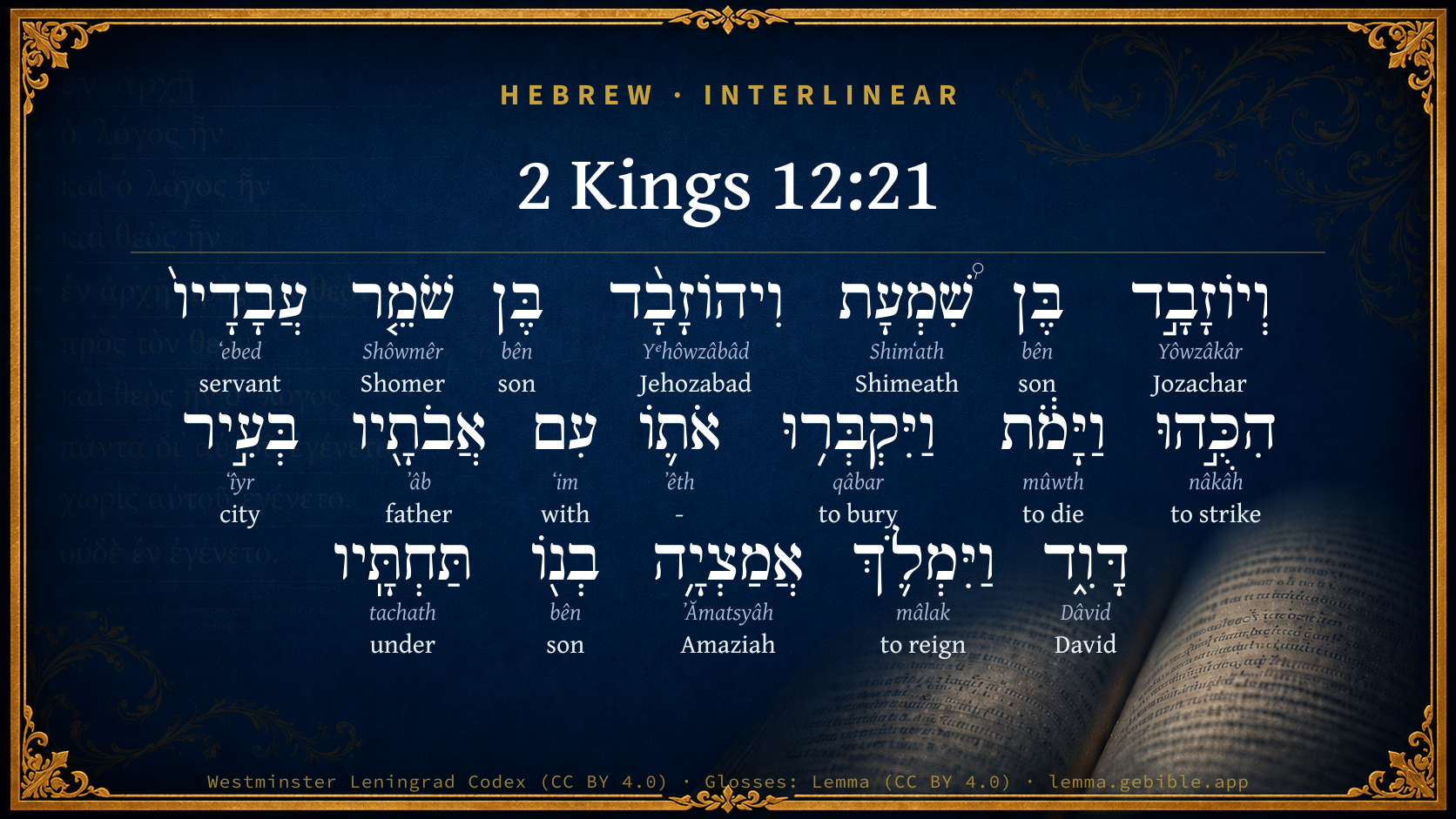
Hebrew (Westminster Leningrad Codex) 2 Kings 12:21 appears in the Hebrew Old Testament. The text above is from the Westminster Leningrad Codex. Each word links to its Strong’s number, a concise gloss, and parsing drawn from the Open Scriptures Hebrew Bible morphology. Click any word for its full Brown-Driver-Briggs (BDB) entry.
Download image
Cite this verse

2 Kings 12:21 (World English Bible). Public Domain. Lemma interlinear Bible study tool, https://lemma.gebible.app/v/2-kings/12/21.

Show BibTeX & RIS
BibTeX
RIS
English Translation
For Jozacar the son of Shimeath, and Jehozabad the son of Shomer, his servants, struck him, and he died; and they buried him with his fathers in the city of David: and Amaziah his son reigned in his place.
World English Bible · Public Domain
Highlights
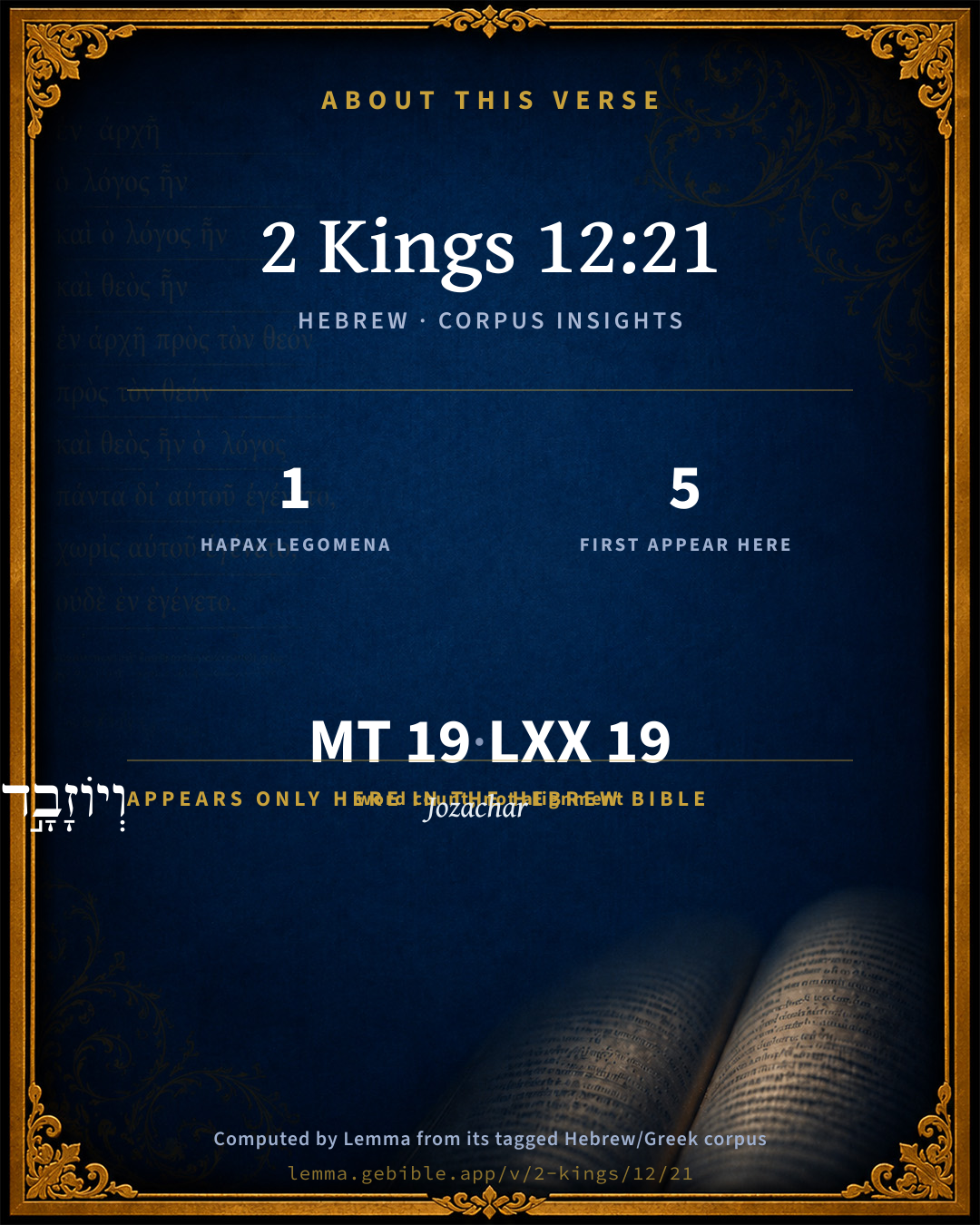
  • 1 hapax legomenon — only here in the Hebrew Bible
  • 5 first appearances in the Hebrew Bible
Full analysis ↓
Download a study sheet

One document with this verse’s original text, its word-by-word gloss line, the meaning frame, cross-references with their text, attributed commentary, and full source and license credits — printable, and it pastes into notes with its structure intact.

This verse Autodidact and up

Study sheet (.html) Plain text (.txt)

A passage Seminary Student

Up to 50 verses in one chapter. A passage sheet keeps up to 6 commentary sources and 12 cross-references per verse, in the order this page ranks them, and says so on the sheet whenever that leaves anything out. Ask for a single verse and you get the Autodidact verse sheet above.

Everything on this page stays free to read, with no account — the sheet is a download of what is already on screen, not access to it.

Want to remove ads? Support Godless Engineer
Compare translations 3

The same verse in 3 English versions, stacked beneath the original-language interlinear above. Click any original word for its lexicon entry.

Each is an independent rendering of the whole verse — the interlinear is not word-aligned to these translations.

Highlighted words mark where these versions differ — a whole-verse word diff, not a word-by-word alignment.

  • World English Bible Public Domain
    For Jozacar the son of Shimeath, and Jehozabad the son of Shomer, his servants, struck him, and he died; and they buried him with his fathers in the city of David: and Amaziah his son reigned in his place.
  • King James Version Public Domain
    For Jozachar the son of Shimeath, and Jehozabad the son of Shomer, his servants, smote him, and he died; and they buried him with his fathers in the city of David: and Amaziah his son reigned in his stead.
  • unfoldingWord Literal Text CC BY-SA 4.0
    And Jozabad, the son of Shimeath, and Jehozabad, the son of Shomer, his servants, struck him, and he died. And they buried him with his fathers in the City of David. And Amaziah his son reigned in his place.

unfoldingWord Literal Text — © unfoldingWord, licensed CC BY-SA 4.0. Word-aligned USFM3 via Door43 (git.door43.org/unfoldingWord/en_ult).

Versions to compare (up to 4)

3 of 4 selected

Show all 18 translations

Every available English version of this verse, each an independent rendering of the whole verse.

  • World English Bible Public Domain
    For Jozacar the son of Shimeath, and Jehozabad the son of Shomer, his servants, struck him, and he died; and they buried him with his fathers in the city of David: and Amaziah his son reigned in his place.
  • Berean Standard Bible Public Domain
    His servants Jozabad son of Shimeath and Jehozabad son of Shomer struck him down, and he died. And they buried him with his fathers in the City of David, and his son Amaziah reigned in his place.
  • Majority Standard Bible Public Domain
    His servants Jozabad son of Shimeath and Jehozabad son of Shomer struck him down, and he died. And they buried him with his fathers in the City of David, and his son Amaziah reigned in his place.
  • King James Version Public Domain
    For Jozachar the son of Shimeath, and Jehozabad the son of Shomer, his servants, smote him, and he died; and they buried him with his fathers in the city of David: and Amaziah his son reigned in his stead.
  • American Standard Version (1901) Public Domain
    For Jozacar the son of Shimeath, and Jehozabad the son of Shomer, his servants, smote him, and he died; and they buried him with his fathers in the city of David: and Amaziah his son reigned in his stead.
  • Revised Version (1885) Public Domain
    For Jozacar the son of Shimeath, and Jehozabad the son of Shomer, his servants, smote him, and he died; and they buried him with his fathers in the city of David: and Amaziah his son reigned in hin stead.
  • Geneva Bible (1599) Public Domain
    Euen Iozachar the sonne of Shimeath, and Iehozabad the sonne of Shomer his seruants smote him, and he dyed: and they buried him with his fathers in the citie of Dauid. And Amaziah his sonne reigned in his stead.
  • Douay-Rheims (1899) Public Domain
    For Josachar the son of Semaath, and Jozabad the son of Somer his servant struck him, and he died: and they buried him with his fathers in the city of David, and Amasias his son reigned in his stead.
  • Young's Literal Translation Public Domain
    yea, Jozachar son of Shimeath, and Jehozabad son of Shemer, his servants, have smitten him, and he dieth, and they bury him with his fathers in the city of David, and reign doth Amaziah his son, in his stead.
  • Literal Standard Version CC BY-SA 4.0
    Indeed, Jozachar son of Shimeath, and Jehozabad son of Shemer, his servants, have struck him, and he dies, and they bury him with his fathers in the City of David, and his son Amaziah reigns in his stead.
  • Unlocked Literal Bible CC BY-SA 4.0
    Jozabad son of Shimeath, and Jehozabad son of Shomer, his servants, attacked him, and he died. They buried Joash with his ancestors in the city of David, and Amaziah, his son, became king in his place.
  • unfoldingWord Literal Text CC BY-SA 4.0
    And Jozabad, the son of Shimeath, and Jehozabad, the son of Shomer, his servants, struck him, and he died. And they buried him with his fathers in the City of David. And Amaziah his son reigned in his place.
  • Darby Bible Public Domain
    And Jozachar the son of Shimeath and Jehozabad the son of Shomer, his servants, smote him and he died; and they buried him with his fathers in the city of David. And Amaziah his son reigned in his stead.
  • World Messianic Bible Public Domain
    For Jozacar the son of Shimeath, and Jehozabad the son of Shomer, his servants, struck him, and he died; and they buried him with his fathers in David’s city; and Amaziah his son reigned in his place.
  • Webster's Bible Public Domain
    For Jozachar the son of Shimeath, and Jehozabad the son of Shomer, his servants, smote him, and he died; and they buried him with his fathers in the city of David: And Amaziah his son reigned in his stead.
  • Free Bible Version CC BY-SA 4.0
    The officials who attacked and killed him were Jozacar, son of Shimeath, and Jehozabad, son of Shomer. They buried him with his forefathers in the City of David. His son Amaziah succeeded him as king.
  • Bible in Basic English Public Domain
    And Jozacar, the son of Shimeath, and Jehozabad, the son of Shomer, his servants, came to him and put him to death; and they put him into the earth with his fathers in the town of David; and Amaziah his son became king in his place.
  • JPS Tanakh (1917) Public Domain
    (12-22) For Jozacar the son of Shimeath, and Jehozabad the son of Shomer, his servants, smote him, and he died; and they buried him with his fathers in the city of David; and Amaziah his son reigned in his stead.

Literal Standard Version (2020), Covenant Press — licensed CC BY-SA 4.0. Text via the HelloAO Bible API (eBible.org). Unlocked Literal Bible (unfoldingWord) — licensed CC BY-SA 4.0. Text via the HelloAO Bible API (eBible.org). unfoldingWord Literal Text — © unfoldingWord, licensed CC BY-SA 4.0. Word-aligned USFM3 via Door43 (git.door43.org/unfoldingWord/en_ult). Free Bible Version, Dr. Jonathan Gallagher — licensed CC BY-SA 4.0. Text via the HelloAO Bible API (eBible.org).

Word by word

More ways to search: Search by grammar → Find every occurrence → Compare this word →

Practice this passage: Drill this verse → Learn its vocabulary →

וְיוֹזָבָ֣ד
Yôwzâkâr
H3108
“and · Jozachar”
Conjunction + Noun, Proper
Part of Speech
Conjunction + Noun
Type
Proper
Full BDB Definition

Origin: from H3068 and H2142

TWOT: None

Jozachar = "Jehovah remembers" - a servant of king Joash of Judah and one of his murderers - also called 'Zabad'
  1. בֶּן bên H1121 “son of” Noun, Common, Masculine, Singular, Construct
  2. שִׁ֠מְעָת Shimʻath H8100 “Shimeath” Noun, Proper
  3. וִיהוֹזָבָ֨ד Yᵉhôwzâbâd H3075 “and · Jehozabad” Conjunction + Noun, Proper
  4. בֶּן bên H1121 “son of” Noun, Common, Masculine, Singular, Construct
  5. שֹׁמֵ֤ר Shôwmêr H7763 “Shomer” Noun, Proper
  6. עֲבָדָיו֙ ʻebed H5650 “servants · his” Noun, Common, Masculine, Plural, Construct + Suffix, Personal, 3rd Person, Masculine, Singular
  7. הִכֻּ֣הוּ nâkâh H5221 “to strike · him” Verb, Hiphil, Perfect, 3rd Person, Common, Plural + Suffix, Personal, 3rd Person, Masculine, Singular
  8. וַיָּמֹ֔ת mûwth H4191 “and · to die” Conjunction + Verb, Qal, Sequential Imperfect, 3rd Person, Masculine, Singular
  9. וַיִּקְבְּר֥וּ qâbar H6912 “and · to bury” Conjunction + Verb, Qal, Sequential Imperfect, 3rd Person, Masculine, Plural
  10. אֹת֛וֹ ʼêth H853 “- · him” Particle, Direct Object + Suffix, Personal, 3rd Person, Masculine, Singular
  11. עִם ʻim H5973 “with” Preposition
  12. אֲבֹתָ֖יו ʼâb H1 “fathers · his” Noun, Common, Masculine, Plural, Construct + Suffix, Personal, 3rd Person, Masculine, Singular
  13. בְּעִ֣יר ʻîyr H5892 “in/at · city of” Preposition + Noun, Common, Feminine, Singular, Construct
  14. דָּוִ֑ד Dâvid H1732 “David” Noun, Proper
  15. וַיִּמְלֹ֛ךְ mâlak H4427 “and · to reign” Conjunction + Verb, Qal, Sequential Imperfect, 3rd Person, Masculine, Singular
  16. אֲמַצְיָ֥ה ʼĂmatsyâh H558 “Amaziah” Noun, Proper
  17. בְנ֖וֹ bên H1121 “son · his” Noun, Common, Masculine, Singular, Construct + Suffix, Personal, 3rd Person, Masculine, Singular
  18. תַּחְתָּֽיו tachath H8478 “under · him” Preposition + Suffix, Personal, 3rd Person, Masculine, Singular

About this verse

These counts appear in no published source. They are computed here, from the morphology-tagged text and Lemma’s own curated glosses. What Lemma adds →

19
words
17
distinct lemmas
Historical
section

Notable vocabulary

1 hapax legomenon — a word that appears only here in the entire Hebrew Bible:

  • וְיוֹזָבָ֣ד Jozachar H3108

First appearance in Scripture

These words make their first canonical appearance in the Hebrew Bible here:

  • וְיוֹזָבָ֣ד Jozachar H3108
  • שִׁ֠מְעָת Shimeath H8100
  • וִיהוֹזָבָ֨ד Jehozabad H3075
  • שֹׁמֵ֤ר Shomer H7763
  • אֲמַצְיָ֥ה Amaziah H558

Shared distinctive vocabulary

שִׁ֠מְעָת Shimeath H8100 occurs in 2 verses of the Hebrew Bible. Also found in:

Grammatical profile

  • 4 verbs
  • 12 nouns
  • 2 prepositions
  • 1 particle

Verb forms

  • הִכֻּ֣הוּ Hiphil · Perfect
  • וַיָּמֹ֔ת Qal · Sequential Imperfect
  • וַיִּקְבְּר֥וּ Qal · Sequential Imperfect
  • וַיִּמְלֹ֛ךְ Qal · Sequential Imperfect

Repetition

A word recurs within this verse — often emphatic in Hebrew:

Hebrew & Septuagint length

In English translation the verse runs 39 words from the Hebrew and 37 from the Septuagint (LXX English) — closely comparable.

A rough comparison of the two English renderings, which tokenize alike — not a word-level alignment.

Word counts can differ between the Hebrew and the Greek without any difference in meaning — e.g. the Hebrew direct-object marker אֵת has no separate Greek word, and Greek often adds the article ὁ.

In the original languages it is 19 Hebrew tokens and 19 Greek tokens — but the two are counted differently (Hebrew bundles its prefixes and suffixes into one token; the Greek is in lemma form), so that isn’t a like-for-like length.

Cross-references

2

Topical passages linked to 2 Kings 12:21 in the Treasury of Scripture Knowledge — connected by theme and wording, ordered by reader-vote popularity; previews shown in the World English Bible.

  • 2 Kings 14:1 In the second year of Joash son of Joahaz king of Israel began Amaziah the son of Joash king of Judah to reign.
  • 2 Chronicles 24:26–27 These are those who conspired against him: Zabad the son of Shimeath the Ammonitess, and Jehozabad the son of Shimrith the Moabitess.

Cross-references courtesy of OpenBible.info (CC BY 4.0).

Hebrew and Greek witnesses Masoretic Hebrew ↔ Greek Septuagint

The same verse in the two great witnesses to the Old Testament, shown verse-for-verse.

These are two independent witnesses, not word-aligned to each other, and the Septuagint is shown in lemma (dictionary) form.

Hebrew 2 Kings 12:21 Masoretic · Westminster Leningrad Codex

וְיוֹזָבָ֣ד בֶּן שִׁ֠מְעָת וִיהוֹזָבָ֨ד בֶּן שֹׁמֵ֤ר עֲבָדָיו֙ הִכֻּ֣הוּ וַיָּמֹ֔ת וַיִּקְבְּר֥וּ אֹת֛וֹ עִם אֲבֹתָ֖יו בְּעִ֣יר דָּוִ֑ד וַיִּמְלֹ֛ךְ אֲמַצְיָ֥ה בְנ֖וֹ תַּחְתָּֽיו

For Jozacar the son of Shimeath, and Jehozabad the son of Shomer, his servants, struck him, and he died; and they buried him with his fathers in the city of David: and Amaziah his son reigned in his place.

World English Bible · Public Domain

Greek LXX 2 Kings 12:21 Septuagint · lemma form

καί ἀναἵστημι ὁ δοῦλος αὐτός καί δέω πᾶς σύνδεσμος καί πατάσσω ὁ ιωας ἐν οἶκος μαλλω ὁ ἐν γααλλα

And Jezirchar the son of Jemuath, and Jezabuth Somer's son, his servants, struck him, and he died; and they buried him with his fathers in the city of David: and Amessias his son reigned in his stead.

LXX2012 (modern English Septuagint) · Public Domain

Hebrew: Westminster Leningrad Codex (CC BY 4.0). Greek: Septuagint (public domain); English from LXX2012 (modern English Septuagint) (Public Domain). How the Septuagint differs from the Hebrew →

Targum (Aramaic paraphrase)

1

The Targum is the ancient Jewish Aramaic paraphrase of the Hebrew Scriptures — an interpretive translation, not the Hebrew text itself. Onkelos (literal) and Pseudo-Jonathan (expansive) render the Torah, and Jonathan the Prophets. Coverage is partial: where no permissively-licensed English translation exists for a verse, only the Aramaic is shown. This is verse-level text, not a word-by-word alignment to the Hebrew.

  1. Targum Jonathan Prophets (Joshua–Malachi)
    וְקָמוּ עַבְדוֹהִי וּמְרַדוּ מֵירְדָא וּמְחוֹ יַת יוֹאָשׁ בֵּית מִלוֹ דְנָחִת לְסִלָא:

    (no public-domain English translation for this verse)

    Targum Jonathan — Aramaic: “Mikraot Gedolot” (public domain). English: “Sefaria Community Translation” (CC0 1.0 (public-domain dedication)); “London "Chaldee Paraphrase," 1871” (public domain). Text via Sefaria.

Commentary

Notes on 2 Kings 12:21 from classic Christian and Jewish commentators (each source and its license shown beneath its notes). The classic Christian expositions comment on the surrounding passage and are grouped to its opening verse, so a note may address several verses; the Jewish commentaries on the Tanakh (Rashi and others) are per-verse, so they appear only where the commentator wrote on this verse.

Lemma curates 59 commentaries, every one of them public domain or Creative Commons licensed, each selected and text-cleaned for this edition rather than reprinted as found. About our sources →

Trapp's Complete Commentary

John Trapp

2Ki 12:21 For Jozachar the son of Shimeath, and Jehozabad the son of Shomer, his servants, smote him, and he died; and they buried him with his fathers in the city of David: and Amaziah his son reigned in his stead.

Ver. 21. For Jozachar the son of Shimeath.] An Ammonitess.

And Jehozabad the son of Shomer.] A Moabitess. {2Ch 24:26} These were his bondwomen likely, and their sons his slaves.

And they buried him with his fathers.] But not among the kings, {2Ch 24:25} probably because his body was so putrefied with his wounds and other maladies.

John Trapp, A Commentary or Exposition upon All the Books of the Old and New Testament (1647–1656) — public domain. Text from a community e-Sword module.

Geneva Bible (1599)

Geneva Bible translators

Or, Jozahar.

Geneva Bible (1599) marginal notes — public domain. Text via Bolls.life.

Adam Clarke's Commentary

Verse 21. For Jozachar] This person is called Zabad in 2Ch 24:26; and Shimeath his mother is said to be an Ammonitess, as Jehozabad is said to be the son, not of Shomer, but of Shimrith, a Moabitess.

They buried him with his fathers in the city of David] But they did not bury him in the sepulchres of the kings; this is supposed to express the popular disapprobation of his conduct. Thus ended a reign full of promise and hope in the beginning, but profligate, cruel, and ruinous in the end. Never was the hand of God's justice more signally stretched out against an apostate king and faithless people, than at this time. Now Hazael had a plenary commission; the king, the nobles, and the people, were food for his sword, and by a handful of Syrians the mighty armies of Israel were overthrown: For the army of the Syrians came with a small company of men, and the Lord delivered a very great host into their hand, because they had forsaken the Lord God, 2Ch 24:24. Thus, as righteousness exalteth a nation, so sin is the disgrace and confusion of any people. Sin destroys both counsel and strength; and the wicked flee when none pursue.

Adam Clarke's Commentary on the Bible (1810–1826) — public domain. Text from a community e-Sword/MySword module.

Ellicott's Commentary for English Readers

(21) For Jozachar . . . smote him.—Rather, And Jozachar . . . it was that smote him. The names are different in Chronicles. (See the Note on 2Ch_24:26.) Thenius notices the curious coincidence of the names as given here with the last words of the murdered Zechariah, “Jehovah see, and avenge!” The prophet was avenged by Jozachar (“Jehovah remembers”), the son of shimeath (“hearing”), and Jehozabad (“Jehovah bestows”), the son of Shomer (“watcher”).

With his fathers—i.e., in the city of David; but “not in the sepulchres of the kings 2)” Chron. 24:25).

A Bible Commentary for English Readers, edited by Charles John Ellicott (1878–1897) — public domain. Text from a community e-Sword module.

The Cambridge Bible for Schools and Colleges

gen. ed. J. J. S. Perowne

21. For Jozachar [R.V. Jozacar] the son of Shimeath, and Jehozabad the son of Shomer] In 2 Chron. the names of the conspirators are given as ‘Zabad the son of Shimeath an Ammonitess, and Jehozabad the son of Shemrith a Moabitess’. Between זבד Zabad and זכר Zacar, the abbreviated form of Jozacar, it is easy to see how a mistake might arise from the similarity of the Hebrew letters. The Chronicler who mentions the nationality of the mothers gives their names both in the feminine form. In Kings the last two letters from שׁמרית (Shemrith) have fallen out and so the name has become שׁמר (Shomer). Although these names are without doubt historical it is very remarkable (as Thenius points out) how when they are translated they recall Zechariah’s last words ‘The Lord look upon it and require it’. For they signify ‘Jehovah-remembers’, the son of ‘Hearer;’ and ‘Jehovah-gives’, the son of ‘Watcher’.

and they buried him with his fathers] i.e. In the city of David, but as the Chronicler records, not in the sepulchres of the kings. The words of the Chronicler about the ‘greatness of the burdens’ laid upon Jehoash refers to the many prophetic oracles which were uttered against him in consequence of his evil deeds. Cf. for that sense of the word ‘burden’ Isa_13:1, and many other passages of that prophet. On the margin R.V. in such cases, gives ‘oracle concerning’.

and Amaziah his son] The Chronicler (2Ch_24:27) speaks of the ‘sons of Jehoash’; we know nothing however of any son but Amaziah, though it is said (2Ch_24:3) ‘Jehoiada took for Jehoash two wives, and he begat sons and daughters’.

The Cambridge Bible for Schools and Colleges (gen. ed. J. J. S. Perowne; Cambridge University Press, 1878–1918) — public domain. Text from a community e-Sword module.

Haydock's Catholic Bible Commentary

Josachar, or Zabad, the son of Semmaath, an Ammonitess, and Jozabad, the son of Semarith, a Moabitess. (Paralipomenon) Both their mothers were of foreign extraction. (Calmet) --- People have frequently two names. --- Somer is the father of Jozabad. (Menochius) --- David. Achaz was treated in like manner. The fear of this infamy might tend to keep the kings in awe. After death, the kings of Egypt might be accused, and deprived of sepulture, if their crimes deserved it: as many of them were. (Diodorus i. p. 46.) (Calmet) --- Thus Joas was covered with eternal infamy, after he had begun so well. Finis coronat opus. (Haydock)

George Leo Haydock (1774–1849), Haydock's Catholic Family Bible and Commentary, 1859 edition — public domain. Excludes Psalms (Douay-Rheims chapter numbering differs from Protestant) and Deuterocanonical books (Catholic canon only).

Matthew Poole's English Annotations

Jozachar, called also Zabad, 2Ch 24:26. Silomer, called Shimrith, 2Ch 24:26; except Shomer be the father’s name, and Shimrith the mother’s.

With his fathers, i.e. in the same city, but not in the same royal sepulchre, 2Ch 24:25.

Matthew Poole's English Annotations on the Holy Bible (1683–1685) — public domain. Text from a community e-Sword/MySword module.

Whedon's Commentary on the Bible

Daniel D. Whedon

21. Buried him with his fathers — But not, says 2Ch_24:25, “in the sepulchres of the kings.” For a fuller account of Joash’s history, see the parallel history in Chronicles.

Daniel D. Whedon (gen. ed.), Commentary on the Old and New Testaments (1874–1909) — public domain. Text from a community e-Sword module.

The Pulpit Commentary

For Jozachar the son of Shimeath; called in Chronicles "Zabad," probably through a corruption of the text. His mother, Shimeath, was, according to Chronicles, (2Ch_24:26) an Ammonitess. And Jehozabad the son of Shomer. For "Shomer" we have in Chronicles "Shim-rith," which is the feminine form of "Shomer," and we are told that she was a Moabitess. The Jews were at all times fond of taking wives from Moab and Ammon (Rth_1:4; 1Ki_11:1; Ezr_9:1, Ezr_9:2; Neh_13:23) despite the prohibition of mixed marriages in the Law. (see Deu_7:3) His servants, smote him, and he died (for their motives, see the introductory paragraph), and they buried him with his fathers in the city of David. Some critics (as Thenius and Dean Stanley) see a contradiction between this statement and that of 2Ch_24:25, that he was "not buried in the sepulchers of the kings;" but, as Bertheau, Keil, and Bahr observe. "the two statements are not irreconcilable," since he may have been regarded as "buried with his fathers," if his grave was anywhere in Jerusalem, even though he was excluded from the royal burying-place. And Amaziah his son reigned in his stead. (For the reign of Amaziah, see 2Ki_14:1-20)

The Pulpit Commentary (1880–1919), ed. H.D.M. Spence-Jones & Joseph S. Exell — public domain. Text from a community e-Sword module.

Rashi

Rabbi Shlomo Yitzchaki (Rashi)

At Beis Millo. In that place.

Millo. The name of a place.

Selo. The name of a place.

Rashi on the Tanakh — English translations: “The Judaica Press complete Tanach with Rashi, translated by A. J. Rosenberg” (CC BY 4.0); “Pentateuch with Rashi's commentary by M. Rosenbaum and A.M. Silbermann, 1929-1934” (public domain); “The Metsudah Tanach series, Lakewood, N.J” (CC BY 4.0); and “The Book of Joshua, Metsudah Publications, 1997” (CC BY 4.0). Text via Sefaria.

Lesson kit

Teaching starters — assembled from the data on this page, not authored interpretation. Every prompt links to the verse data it draws on. Edit before teaching.

2 Kings, in the Historical, opens this verse with 19 words (17 distinct Hebrew lemmas). Its most distinctive word is Yôwzâkâr (“Jozachar”). A historical commentator’s framing appears above. Read the whole chapter for the surrounding context.

Discussion questions

  1. What does “Jozachar” (Yôwzâkâr) contribute to the verse as a whole?
  2. This verse holds 1 word here found nowhere else in the Hebrew Bible. What might the rare word draw attention to?
  3. 5 words here appear for the first time in Scripture. What is being introduced at this debut?
  4. 2 Chronicles 24:26 shares the word «Shimeath» with this verse. How do the two illuminate each other?
  5. “son” occurs 3× in this one verse. What is the effect of the repetition?
  6. The translations on this page render this verse differently — a whole-verse word diff, not a word-by-word alignment. What might account for the different wordings?
  7. The verb «הִכֻּ֣הוּ» is Hiphil Perfect. How does its form color the action?
  8. Reading how Trapp's Complete Commentary and Geneva Bible (1599) read this verse, where do the two commentators agree and where do they part?

Things to notice

  • 1 word in this verse appears nowhere else in the Hebrew Bible.
  • 5 words make their first canonical appearance in Scripture here.
  • This verse counts 19 Hebrew ↔ 19 Greek words.
  • These translations choose different wording for 7 words in this verse.
  • “son” occurs 3× in this single verse.

Reading settings

Reading text

Shown beneath each verse's original-language words.

Old Testament
Old Testament edition

Read the OT as the Masoretic Hebrew (MT) or the Greek Septuagint (LXX).

English shown for the Greek Septuagint (in the Hebrew ↔ Greek comparison).

Comparing translations? Open the Compare panel on any verse page to stack up to four side by side.