
Exodus 38:26

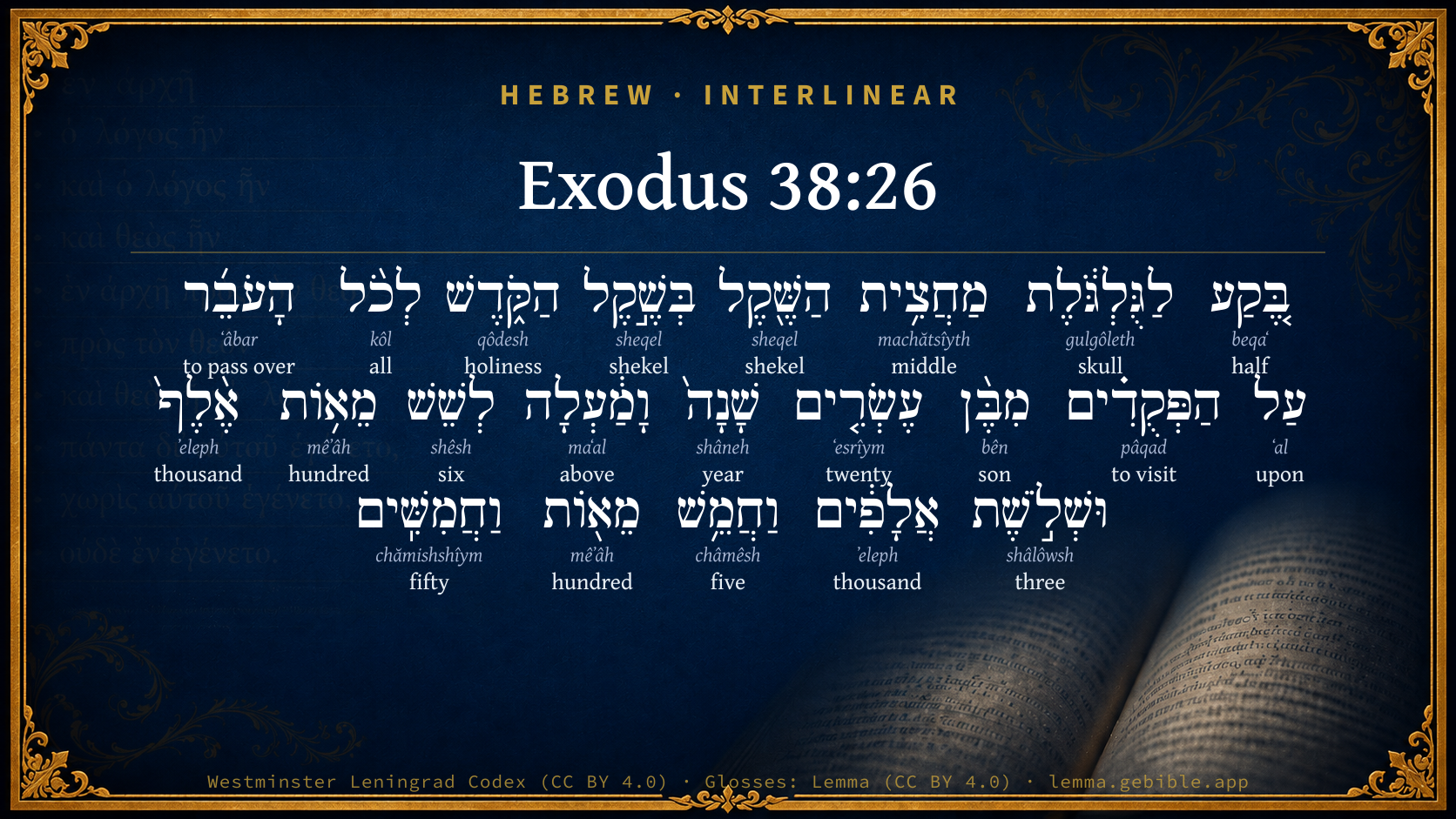
Hebrew (Westminster Leningrad Codex) Exodus 38:26 appears in the Hebrew Old Testament. The text above is from the Westminster Leningrad Codex. Each word links to its Strong’s number, a concise gloss, and parsing drawn from the Open Scriptures Hebrew Bible morphology. Click any word for its full Brown-Driver-Briggs (BDB) entry.
Download image
Cite this verse

Exodus 38:26 (World English Bible). Public Domain. Lemma interlinear Bible study tool, https://lemma.gebible.app/v/exodus/38/26.

Show BibTeX & RIS
BibTeX
RIS
English Translation
a beka a head, that is, half a shekel, after the shekel of the sanctuary, for everyone who passed over to those who were numbered, from twenty years old and upward, for six hundred three thousand five hundred fifty men.
World English Bible · Public Domain
Download a study sheet

One document with this verse’s original text, its word-by-word gloss line, the meaning frame, cross-references with their text, attributed commentary, and full source and license credits — printable, and it pastes into notes with its structure intact.

This verse Autodidact and up

Study sheet (.html) Plain text (.txt)

A passage Seminary Student

Up to 50 verses in one chapter. A passage sheet keeps up to 6 commentary sources and 12 cross-references per verse, in the order this page ranks them, and says so on the sheet whenever that leaves anything out. Ask for a single verse and you get the Autodidact verse sheet above.

Everything on this page stays free to read, with no account — the sheet is a download of what is already on screen, not access to it.

Want to remove ads? Support Godless Engineer
Compare translations 3

The same verse in 3 English versions, stacked beneath the original-language interlinear above. Click any original word for its lexicon entry.

Each is an independent rendering of the whole verse — the interlinear is not word-aligned to these translations.

Highlighted words mark where these versions differ — a whole-verse word diff, not a word-by-word alignment.

  • World English Bible Public Domain
    a beka a head, that is, half a shekel, after the shekel of the sanctuary, for everyone who passed over to those who were numbered, from twenty years old and upward, for six hundred three thousand five hundred fifty men.
  • King James Version Public Domain
    A bekah for every man, that is, half a shekel, after the shekel of the sanctuary, for every one that went to be numbered, from twenty years old and upward, for six hundred thousand and three thousand and five hundred and fifty men.
  • unfoldingWord Literal Text CC BY-SA 4.0
    a beka for a head (half a shekel), by the shekel of the sanctuary, from every passer over to the counted ones from a son of 20 years and older—from 603, 550.

unfoldingWord Literal Text — © unfoldingWord, licensed CC BY-SA 4.0. Word-aligned USFM3 via Door43 (git.door43.org/unfoldingWord/en_ult).

Versions to compare (up to 4)

3 of 4 selected

Show all 18 translations

Every available English version of this verse, each an independent rendering of the whole verse.

  • World English Bible Public Domain
    a beka a head, that is, half a shekel, after the shekel of the sanctuary, for everyone who passed over to those who were numbered, from twenty years old and upward, for six hundred three thousand five hundred fifty men.
  • Berean Standard Bible Public Domain
    a beka per person, that is, half a shekel, according to the sanctuary shekel, from everyone twenty years of age or older who had crossed over to be numbered, a total of 603,550 men.
  • Majority Standard Bible Public Domain
    a beka per person, that is, half a shekel, according to the sanctuary shekel, from everyone twenty years of age or older who had crossed over to be numbered, a total of 603,550 men.
  • King James Version Public Domain
    A bekah for every man, that is, half a shekel, after the shekel of the sanctuary, for every one that went to be numbered, from twenty years old and upward, for six hundred thousand and three thousand and five hundred and fifty men.
  • American Standard Version (1901) Public Domain
    a beka a head, `that is', half a shekel, after the shekel of the sanctuary, for every one that passed over to them that were numbered, from twenty years old and upward, for six hundred thousand and three thousand and five hundred and fifty men.
  • Revised Version (1885) Public Domain
    a beka a head, that is, half a shekel, after the shekel of the sanctuary, for every one that passed over to them that were numbered, from twenty years old and upward, for six hundred thousand and three thousand and five hundred and fifty men.
  • Geneva Bible (1599) Public Domain
    A portion for a man, that is, halfe a shekel after ye shekel of the Sanctuarie, for all them that were numbred from twentie yeere olde and aboue, among sixe hundreth thousande, and three thousand, and fiue hundreth and fiftie men.
  • Douay-Rheims (1899) Public Domain
    There were moreover a hundred talents of silver, whereof were cast the sockets of the sanctuary, and of the entry where the veil hangeth.
  • Young's Literal Translation Public Domain
    a bekah for a poll (half a shekel, by the shekel of the sanctuary,) for every one who is passing over unto those numbered, from a son of twenty years and upwards, for six hundred thousand, and three thousand, and five hundred and fifty.
  • Literal Standard Version CC BY-SA 4.0
    a bekah for the counted head (half a shekel, by the shekel of the holy place), for everyone who is passing over to those numbered, from a son of twenty years and upwards, for six hundred thousand and three thousand and five hundred and fifty.
  • Unlocked Literal Bible CC BY-SA 4.0
    or one beka per man, which is half a shekel, measured by the sanctuary shekel. This figure was reached on the basis of every person who was counted in the census, those twenty years old and older—603,550 men in all.
  • unfoldingWord Literal Text CC BY-SA 4.0
    a beka for a head (half a shekel), by the shekel of the sanctuary, from every passer over to the counted ones from a son of 20 years and older—from 603, 550.
  • Darby Bible Public Domain
    a bekah the head -- half a shekel, according to the shekel of the sanctuary, for every one that passed the numbering from twenty years old and upward, [of] the six hundred and three thousand five hundred and fifty.
  • World Messianic Bible Public Domain
    a beka a head, that is, half a shekel, according to the shekel of the sanctuary, for everyone who passed over to those who were counted, from twenty years old and upward, for six hundred three thousand five hundred fifty men.
  • Webster's Bible Public Domain
    A bekah for every man, that is, half a shekel, after the shekel of the sanctuary, for every one that went to be numbered, from twenty years old and upward, for six hundred thousand and three thousand and five hundred and fifty men.
  • Free Bible Version CC BY-SA 4.0
    This represents a beka per person, or half a shekel (using the sanctuary shekel standard) from everyone twenty years of age or older who had been censused, a total of 603,550 men.
  • Bible in Basic English Public Domain
    A beka, that is, half a shekel by the holy scale, for everyone who was numbered; there were six hundred and three thousand, five hundred and fifty men of twenty years old and over.
  • JPS Tanakh (1917) Public Domain
    a beka a head, that is, half a shekel, after the shekel of the sanctuary, for every one that passed over to them that are numbered, from twenty years old and upward, for six hundred thousand and three thousand and five hundred and fifty men.

Literal Standard Version (2020), Covenant Press — licensed CC BY-SA 4.0. Text via the HelloAO Bible API (eBible.org). Unlocked Literal Bible (unfoldingWord) — licensed CC BY-SA 4.0. Text via the HelloAO Bible API (eBible.org). unfoldingWord Literal Text — © unfoldingWord, licensed CC BY-SA 4.0. Word-aligned USFM3 via Door43 (git.door43.org/unfoldingWord/en_ult). Free Bible Version, Dr. Jonathan Gallagher — licensed CC BY-SA 4.0. Text via the HelloAO Bible API (eBible.org).

Word by word

More ways to search: Search by grammar → Find every occurrence → Compare this word →

Practice this passage: Drill this verse → Learn its vocabulary →

בֶּ֚קַע
beqaʻ
H1235
“half”
Noun, Common, Masculine, Singular, Absolute
Part of Speech
Noun
Type
Common
Gender
Masculine
Number
Singular
State
Absolute
Full BDB Definition

Origin: from H1234

TWOT: 271a

half, part also called " shekel of the sanctuary" or " holy shekel" - half a shekel (metonymy) There appears to be at least three different shekels, one of silver, gold and copper. See a Bible Dictionary for a complete treatment of the subject.
  1. לַגֻּלְגֹּ֔לֶת gulgôleth H1538 “to/for the · skull” Preposition, Determined + Noun, Common, Feminine, Singular, Absolute
  2. מַחֲצִ֥ית machătsîyth H4276 “middle of” Noun, Common, Feminine, Singular, Construct
  3. הַשֶּׁ֖קֶל sheqel H8255 “the · shekel” Particle, Definite Article + Noun, Common, Masculine, Singular, Absolute
  4. בְּשֶׁ֣קֶל sheqel H8255 “in/at · shekel of” Preposition + Noun, Common, Masculine, Singular, Construct
  5. הַקֹּ֑דֶשׁ qôdesh H6944 “the · holiness” Particle, Definite Article + Noun, Common, Masculine, Singular, Absolute
  6. לְכֹ֨ל kôl H3605 “to/for · all of” Preposition + Noun, Common, Masculine, Singular, Construct
  7. הָעֹבֵ֜ר ʻâbar H5674 “the · passing over” Particle, Definite Article + Verb, Qal, Participle Active, Masculine, Singular, Absolute
  8. עַל ʻal H5921 “upon” Preposition
  9. הַפְּקֻדִ֗ים pâqad H6485 “the · visited” Particle, Definite Article + Verb, Qal, Participle Passive, Masculine, Plural, Absolute
  10. מִבֶּ֨ן bên H1121 “from · son of” Preposition + Noun, Common, Masculine, Singular, Construct
  11. עֶשְׂרִ֤ים ʻesrîym H6242 “twenty” Adjective, Cardinal number, Both, Plural, Absolute
  12. שָׁנָה֙ shâneh H8141 “year” Noun, Common, Feminine, Singular, Absolute
  13. וָמַ֔עְלָה maʻal H4605 “and · above · toward” Conjunction + Adverb + Suffix, Demonstrative
  14. לְשֵׁשׁ shêsh H8337 “to/for · six” Preposition + Adjective, Cardinal number, Feminine, Singular, Absolute
  15. מֵא֥וֹת mêʼâh H3967 “hundred” Adjective, Cardinal number, Both, Plural, Absolute
  16. אֶ֨לֶף֙ ʼeleph H505 “thousand” Adjective, Cardinal number, Both, Singular, Absolute
  17. וּשְׁלֹ֣שֶׁת shâlôwsh H7969 “and · three” Conjunction + Adjective, Cardinal number, Masculine, Singular, Construct
  18. אֲלָפִ֔ים ʼeleph H505 “thousand” Adjective, Cardinal number, Both, Plural, Absolute
  19. וַחֲמֵ֥שׁ châmêsh H2568 “and · five” Conjunction + Adjective, Cardinal number, Feminine, Singular, Absolute
  20. מֵא֖וֹת mêʼâh H3967 “hundred” Adjective, Cardinal number, Both, Plural, Absolute
  21. וַחֲמִשִּֽׁים chămishshîym H2572 “and · fifty” Conjunction + Adjective, Cardinal number, Both, Plural, Absolute

About this verse

These counts appear in no published source. They are computed here, from the morphology-tagged text and Lemma’s own curated glosses. What Lemma adds →

22
words
19
distinct lemmas
Pentateuch
section

Notable vocabulary

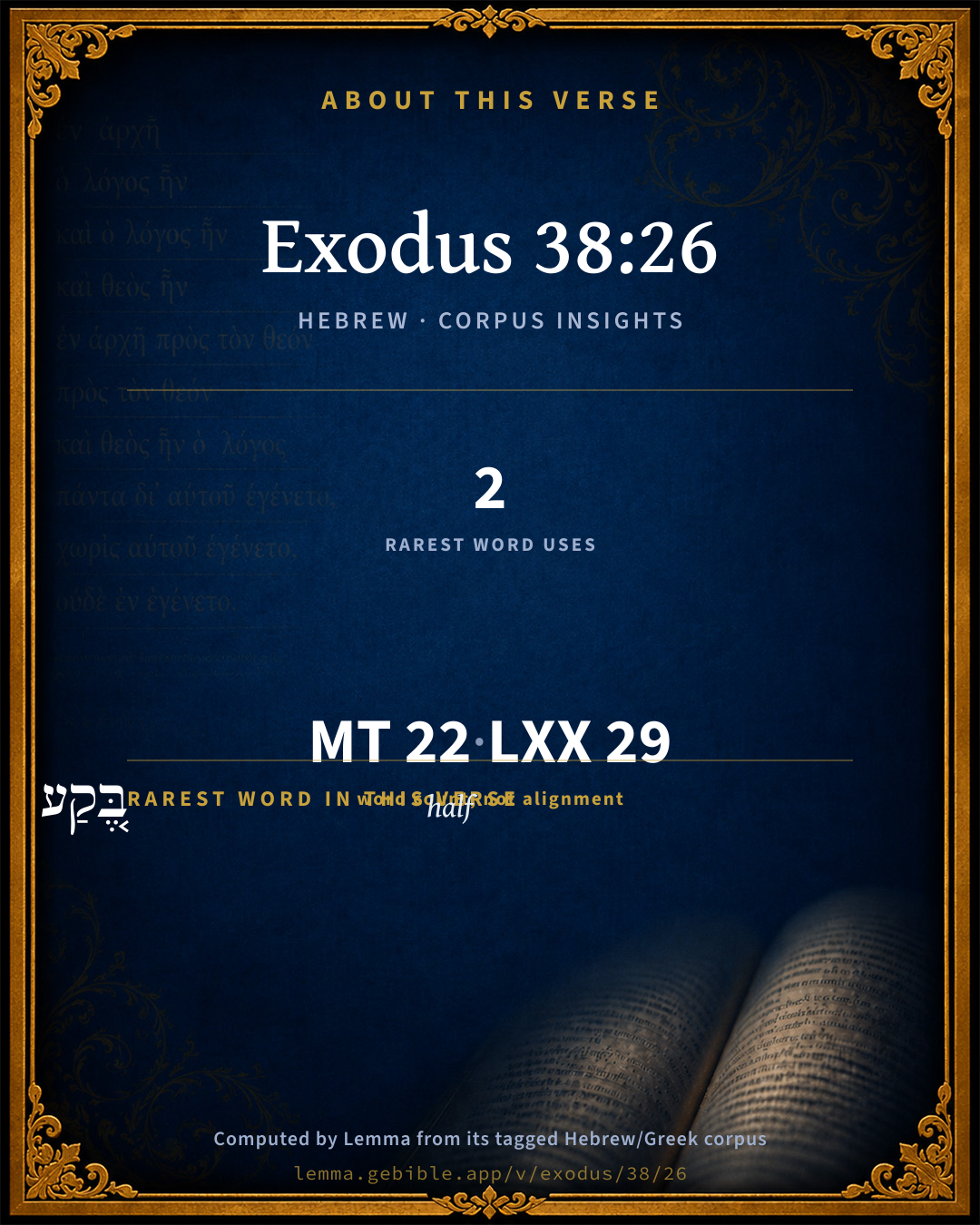
The rarest word here is בֶּ֚קַע half H1235 — appearing just 2 times in the whole Hebrew Bible.

Shared distinctive vocabulary

בֶּ֚קַע half H1235 occurs in 2 verses of the Hebrew Bible. Also found in:

Grammatical profile

  • 2 verbs
  • 9 nouns
  • 9 adjectives
  • 1 preposition
  • 1 adverb

Verb forms

  • הָעֹבֵ֜ר Qal · Participle Active
  • הַפְּקֻדִ֗ים Qal · Participle Passive

Repetition

Words recur within this verse — often emphatic in Hebrew:

  • הַשֶּׁ֖קֶל shekel H8255 ×2
  • מֵא֥וֹת hundred H3967 ×2
  • אֶ֨לֶף֙ thousand H505 ×2

Hebrew & Septuagint length

In English translation the verse runs 40 words from the Hebrew and 38 from the Septuagint (LXX English) — closely comparable.

A rough comparison of the two English renderings, which tokenize alike — not a word-level alignment.

Word counts can differ between the Hebrew and the Greek without any difference in meaning — e.g. the Hebrew direct-object marker אֵת has no separate Greek word, and Greek often adds the article ὁ.

In the original languages it is 22 Hebrew tokens and 29 Greek tokens — but the two are counted differently (Hebrew bundles its prefixes and suffixes into one token; the Greek is in lemma form), so that isn’t a like-for-like length.

Cross-references

4

Topical passages linked to Exodus 38:26 in the Treasury of Scripture Knowledge — connected by theme and wording, ordered by reader-vote popularity; previews shown in the World English Bible.

  • Numbers 1:46 even all those who were numbered were six hundred three thousand five hundred fifty.
  • Exodus 30:13 They shall give this, everyone who passes over to those who are numbered, half a shekel after the shekel of the sanctuary; (the shekel is twenty gerahs;) half a shekel for an offering to Yahweh.
  • Exodus 12:37 The children of Israel traveled from Rameses to Succoth, about six hundred thousand on foot who were men, besides children.
  • Exodus 30:15–16 The rich shall not give more, and the poor shall not give less, than the half shekel, when they give the offering of Yahweh, to make atonement for your souls.

Cross-references courtesy of OpenBible.info (CC BY 4.0).

Hebrew and Greek witnesses Masoretic Hebrew ↔ Greek Septuagint

The same verse in the two great witnesses to the Old Testament, shown verse-for-verse.

These are two independent witnesses, not word-aligned to each other, and the Septuagint is shown in lemma (dictionary) form.

Hebrew Exodus 38:26 Masoretic · Westminster Leningrad Codex

בֶּ֚קַע לַגֻּלְגֹּ֔לֶת מַחֲצִ֥ית הַשֶּׁ֖קֶל בְּשֶׁ֣קֶל הַקֹּ֑דֶשׁ לְכֹ֨ל הָעֹבֵ֜ר עַל הַפְּקֻדִ֗ים מִבֶּ֨ן עֶשְׂרִ֤ים שָׁנָה֙ וָמַ֔עְלָה לְשֵׁשׁ מֵא֥וֹת אֶ֨לֶף֙ וּשְׁלֹ֣שֶׁת אֲלָפִ֔ים וַחֲמֵ֥שׁ מֵא֖וֹת וַחֲמִשִּֽׁים

a beka a head, that is, half a shekel, after the shekel of the sanctuary, for everyone who passed over to those who were numbered, from twenty years old and upward, for six hundred three thousand five hundred fifty men.

World English Bible · Public Domain

Greek LXX Exodus 38:26 Septuagint · lemma form

οὗτος ποιέω ὁ λουτήρ χαλκοῦς καί ὁ βάσις αὐτός χαλκοῦς ἐκ ὁ κάτοπτρον ὁ νηστεύω ὅς νηστεύω παρά ὁ θύρα ὁ σκηνή ὁ μαρτύριον ἐν ὅς ἡμέρα πήγνυμι αὐτός

He made the brazen laver, and the brazen base of it of the mirrors of the women that fasted, who fasted by the doors of the tabernacle of witness, in the day in which he set it up.

LXX2012 (modern English Septuagint) · Public Domain

Hebrew: Westminster Leningrad Codex (CC BY 4.0). Greek: Septuagint (public domain); English from LXX2012 (modern English Septuagint) (Public Domain). How the Septuagint differs from the Hebrew →

Targum (Aramaic paraphrase)

2

The Targum is the ancient Jewish Aramaic paraphrase of the Hebrew Scriptures — an interpretive translation, not the Hebrew text itself. Onkelos (literal) and Pseudo-Jonathan (expansive) render the Torah, and Jonathan the Prophets. Coverage is partial: where no permissively-licensed English translation exists for a verse, only the Aramaic is shown. This is verse-level text, not a word-by-word alignment to the Hebrew.

  1. Targum Onkelos Torah (Genesis–Deuteronomy)
    תִּקְלָּא לְגֻלְגַלְתָּא פַלְגוּת סִלְעָא בְּסִלְעֵי קוּדְשָׁא לְכֹל דְעָבַר עַל מִנְיָנַיָא מִבַּר עֶסְרִין שְׁנִין וּלְעֵלָא לְשִׁית מְאָה וּתְלָתָא אַלְפִין וַחֲמֵשׁ מְאָה וְחַמְשִׁין:

    (no public-domain English translation for this verse)

    Targum Onkelos — Aramaic: “Onkelos Genesis” (public domain); “Onkelos Exodus” (public domain); “Onkelos Leviticus” (public domain); “Onkelos Numbers” (public domain); “Onkelos Deuteronomy” (public domain). English: “Sefaria Community Translation” (CC0 1.0 (public-domain dedication)); “J.W. Etheridge. The Targums of Onkelos and Jonathan Ben Uzziel on the Pentateuch. London: Longmans, Green, 1862” (public domain). Text via Sefaria.

  2. Targum Pseudo-Jonathan Torah (Genesis–Deuteronomy)
    דַּרְכְּמוֹנָא לְגֻלְגַלְתָּא פַּלְגוּת סִלְעָא בְּסִלְעָא דְקוּדְשָׁא לְכָל מַאן דְּעָבַר עַל מִנְיָינַיָא מִבַּר עֶשְרִין שְׁנִין וּלְעֵילָא לְשִׁית מְאָה וּתְלָתָא אַלְפִין וַחֲמֵשׁ מְאָה וְחַמְשִׁין

    A drachma for (each) head, a half shekel of the shekel of the sanctuary, for every one who passed to the numberments, from twenty years and upwards, for six hundred and three thousand and five hundred and fifty (men).

    Targum Pseudo-Jonathan — Aramaic: “Targum Jonathan on Genesis” (public domain); “Targum Jonathan on Exodus” (public domain); “Targum Jonathan on Leviticus” (public domain); “Targum Jonathan on Numbers” (public domain); “Targum Jonathan on Deuteronomy” (public domain). English: “The Targum of Jonathan ben Uzziel, trans. J. W. Etheridge, London, 1862” (public domain). Text via Sefaria.

Commentary

Notes on Exodus 38:26 from classic Christian and Jewish commentators (each source and its license shown beneath its notes). The classic Christian expositions comment on the surrounding passage and are grouped to its opening verse, so a note may address several verses; the Jewish commentaries on the Tanakh (Rashi and others) are per-verse, so they appear only where the commentator wrote on this verse.

Lemma curates 59 commentaries, every one of them public domain or Creative Commons licensed, each selected and text-cleaned for this edition rather than reprinted as found. About our sources →

Tyndale Open Study Notes

Tyndale Open Resources

38:26 For the earlier discussion of this tax, see 30:11-16. The sanctuary shekel was evidently the standard against which other weights were measured for accuracy. • 603,550: See study note on 12:37.

Tyndale Open Study Notes — © Tyndale Open Resources, licensed CC BY-SA 4.0. Text via the HelloAO Bible API.

Geneva Bible (1599)

Geneva Bible translators

Or, half a shekel.

Geneva Bible (1599) marginal notes — public domain. Text via Bolls.life.

Adam Clarke's Commentary

Verse 26. A bekah for every man] The Hebrew word בקי beka, from בקי baka, to divide, separate into two, seems to signify, not a particular coin, but a shekel broken or cut in two; so, anciently, our farthing was a penny divided in the midst and then subdivided, so that each division contained the fourth part of the penny; hence its name fourthing or fourthling, since corrupted into farthing.

THERE appear to be three particular reasons why much riches should be employed in the construction of the tabernacle, c.

1. To impress the people's minds with the glory and dignity of the Divine Majesty, and the importance of his service.

2. To take out of their hands the occasion of covetousness for as they brought much spoils out of Egypt, and could have little if any use for gold and silver in the wilderness, where it does not appear that they had much intercourse with any other people, and were miraculously supported, so that they did not need their riches, it was right to employ that in the worship of God which otherwise might have engendered that love which is the root of all evil.

3. To prevent pride and vainglory, by leading them to give up to the Divine service even the ornaments of their persons, which would have had too direct a tendency to divert their minds from better things. Thus God's worship was rendered august and respectable, incitements to sin and low desires removed, and the people instructed to consider nothing valuable, but as far as it might be employed to the glory and in the service of God.

Adam Clarke's Commentary on the Bible (1810–1826) — public domain. Text from a community e-Sword/MySword module.

Ellicott's Commentary for English Readers

(26) A bekah for every man.—The word “bekah” means simply a half, but appears to have been restricted in its use to the half-shekel. (Comp. Gen_24:22.) The exegetical clause, half a shekel,” is probably a later addition to the text, inserted to clear the sense.

For every one that went to be numbered.—It is remarkable that the principle of compulsory payment towards the fabric of the sanctuary should have received a sanction at the very time when the greatest stress was laid upon the greater acceptableness of voluntary offerings. (See Exo_25:2; Exo_35:5; Exo_35:21-29.) Whatever may be thought of the expediency of levying church-rates, they are clearly defensible in principle, both from the standpoint of the Old Testament and of the New (Mat_17:24-27).

From twenty years old and upward.—See Note on Exo_30:14.

Six hundred thousand and three thousand and five hundred and fifty.—The identity of this number with that which is given in Num_1:46, as arrived at “in the second year, on the first day of the second month” (Num_1:1), is best explained by regarding both passages as having reference to the same transaction. The taking of the census occupied several months, during which the money was gradually collected, the sockets, &c., made, and the Tabernaclo set up. The registration was deferred, and took place on a single day, when Moses and Aaron went round the tribes, received the results from their hands, and entered them in a book. It appears from Num_1:47 that the Levites were not counted in the sum total, no atonement money being taken from them. (See Birks’ Exodus of Israel, pp. 118-120.)

A Bible Commentary for English Readers, edited by Charles John Ellicott (1878–1897) — public domain. Text from a community e-Sword module.

The Cambridge Bible for Schools and Colleges

gen. ed. J. J. S. Perowne

26. a beḳa‘] Gen_24:22.† Lit. a thing cleft or halved. Three beḳa‘s have been found recently in Palestine (Qu. St. of PEF., 1904, pp. 179, 211, ZDPV. 1906, p. 94), weighing respectively 90.58, 94.28, and 102.5 grains Troy. They are apparently light, or worn, beḳa‘s of the ‘Phoenician’ standard (DB. iv. 905b; EB. iv. 4444, 5297 f.), in which the shekel weighed 224 grs.

that passed over to them that were numbered] as Exo_30:13.

The Cambridge Bible for Schools and Colleges (gen. ed. J. J. S. Perowne; Cambridge University Press, 1878–1918) — public domain. Text from a community e-Sword module.

John Gill's Exposition

And of the thousand seven hundred seventy five shekels,.... Which remained of the sum collected, Exo 38:25 after the silver sockets were cast:

he made hooks for the pillars: on each side of the court of the tabernacle on which the hangings were hung; these hooks, as Kimchi says (t), were in the form of the letter and were made to hang the sacrifices upon, when they took their skins off; and so it is said in the Misnah (u), that there were iron hooks fixed in the walls and pillars, on which they hung (the passover lambs) and skinned them; this was done in the second temple, when the hooks, it seems, were iron, but those of the tabernacle were silver:

and overlaid their chapiters, and filleted them; that is, overlaid the heads, tops, or knobs of the pillars with silver plates, and filleted, girded, or hooped other parts of them with silver.

(t) Sepher Shorash. Rad. (u) Pesachim, c. 5. sect. 9.

John Gill's Exposition of the Whole Bible (1746–1763) — public domain (CC PDM 1.0). Text via the HelloAO Bible API.

Albert Barnes' Notes on the Bible

A bekah - Literally, “a half”: the words “half a shekel,” etc. appear to be inserted only for emphasis, to enforce the accuracy to be observed in the payment. See Exo 30:13. Respecting the capitation and the numbering of the people, see Exo 30:12.

Albert Barnes' Notes on the Bible (1834–1885) — public domain. Text from a community e-Sword/MySword module.

The Pulpit Commentary

A bekah for every man. Literally, "for every head." From twenty years old and upward. Compare Num_1:3, Num_1:22, etc. Six hundred thousand, etc. It is remarkable that this number agrees exactly with the sum total of the numbering in Num_2:32, which took place about six months later, and was exclusive of 22, 000 Levites. Perhaps the number was lost in this place, and restored from Num_2:32, without its being recollected that the Levites were not included in that reckoning.

The Pulpit Commentary (1880–1919), ed. H.D.M. Spence-Jones & Joseph S. Exell — public domain. Text from a community e-Sword module.

Rashi

Rabbi Shlomo Yitzchaki (Rashi)

בקע (from בָּקַע to split) is the name given to a weight of half a shekel.

לשש מאות אלף וגו׳ FOR SIX HUNDRED THOUSAND [AND THREE THOUSAND etc.] — Thus were the Israelites in number, and thus did their number amount to after the Tabernacle was set up, as it is stated in the Book of Numbers (ch. II), and at this time, also, when they contributed toward the Tabernacle they were just as many (cf. Rashi on Exodus 30:16). The half-shekels of 600,000 amount to a hundred talents, each talents consisting of three thousand shekels (cf. v. 25). How is this? 600,000 half-shekels are 300,000 whole shekels, making one hundred talents and the remaining 3550 half-shekels make 1775 whole shekels, as stated in the text.

Rashi on the Tanakh — English translations: “The Judaica Press complete Tanach with Rashi, translated by A. J. Rosenberg” (CC BY 4.0); “Pentateuch with Rashi's commentary by M. Rosenbaum and A.M. Silbermann, 1929-1934” (public domain); “The Metsudah Tanach series, Lakewood, N.J” (CC BY 4.0); and “The Book of Joshua, Metsudah Publications, 1997” (CC BY 4.0). Text via Sefaria.

Lesson kit

Teaching starters — assembled from the data on this page, not authored interpretation. Every prompt links to the verse data it draws on. Edit before teaching.

Exodus, in the Pentateuch, opens this verse with 22 words (19 distinct Hebrew lemmas). Its most distinctive word is beqaʻ (“half”). A historical commentator’s framing appears above. Read the whole chapter for the surrounding context.

Discussion questions

  1. The word beqaʻ carries the sense “half.” How does it shape the verse?
  2. How does Genesis 24:22, which shares the word «half», read alongside this verse?
  3. What does the repetition of “shekel” (2× in this one verse) do in this verse?
  4. These translations render this verse differently; the difference is in the English rendering, not the original. What questions does that raise?
  5. «הָעֹבֵ֜ר» is a Qal Participle Active verb. How does that grammatical form shape the action described?
  6. Compare how Tyndale Open Study Notes and Geneva Bible (1599) read this verse. Where do they agree or differ?

Things to notice

Reading settings

Reading text

Shown beneath each verse's original-language words.

Old Testament
Old Testament edition

Read the OT as the Masoretic Hebrew (MT) or the Greek Septuagint (LXX).

English shown for the Greek Septuagint (in the Hebrew ↔ Greek comparison).

Comparing translations? Open the Compare panel on any verse page to stack up to four side by side.