
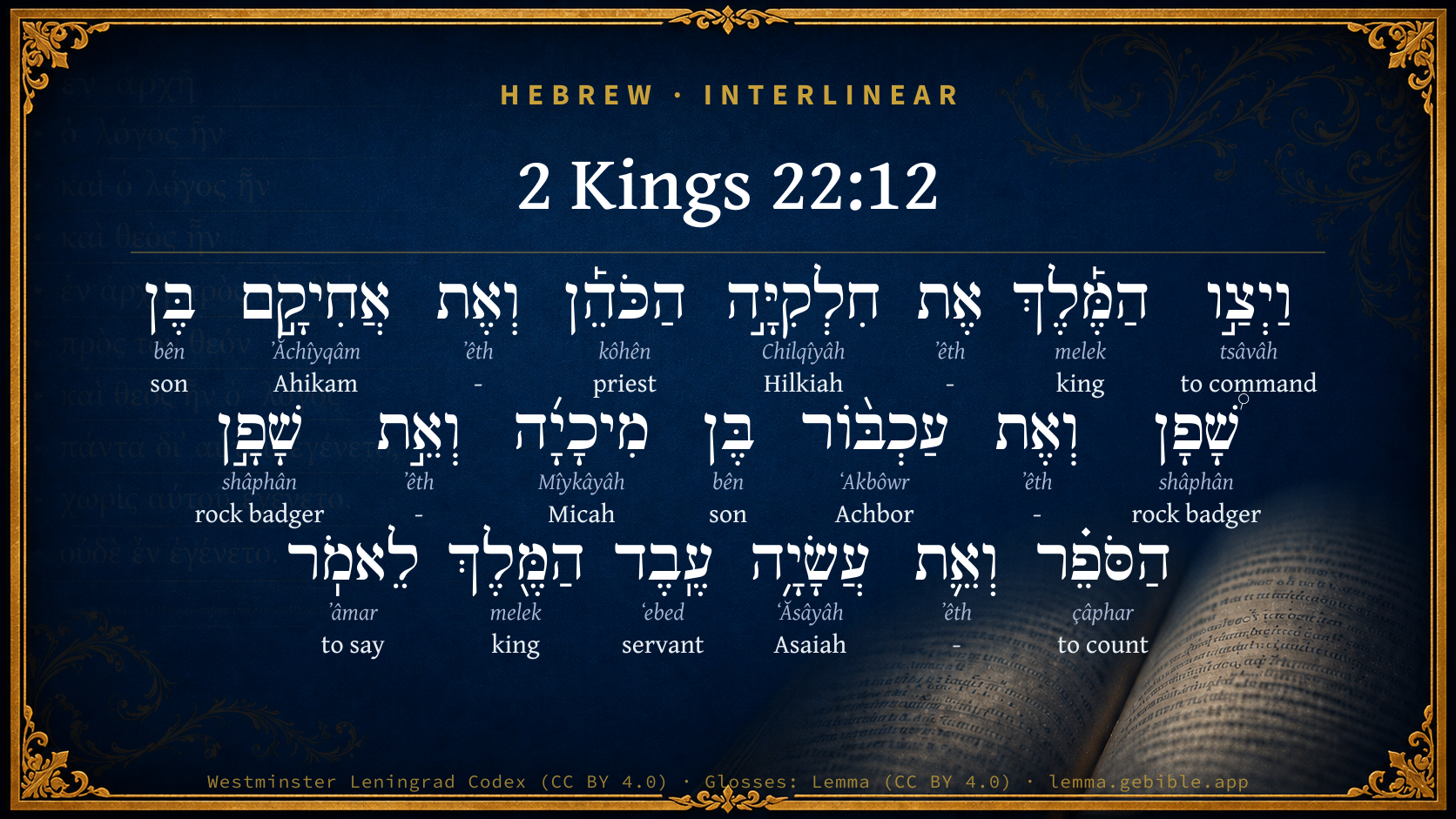
2 Kings 22:12

Hebrew (Westminster Leningrad Codex) 2 Kings 22:12 appears in the Hebrew Old Testament. The text above is from the Westminster Leningrad Codex. Each word links to its Strong’s number, a concise gloss, and parsing drawn from the Open Scriptures Hebrew Bible morphology. Click any word for its full Brown-Driver-Briggs (BDB) entry.
Download image
Cite this verse

2 Kings 22:12 (World English Bible). Public Domain. Lemma interlinear Bible study tool, https://lemma.gebible.app/v/2-kings/22/12.

Show BibTeX & RIS
BibTeX
RIS
English Translation
The king commanded Hilkiah the priest, and Ahikam the son of Shaphan, and Achbor the son of Micaiah, and Shaphan the scribe, and Asaiah the king's servant, saying,
World English Bible · Public Domain
Highlights
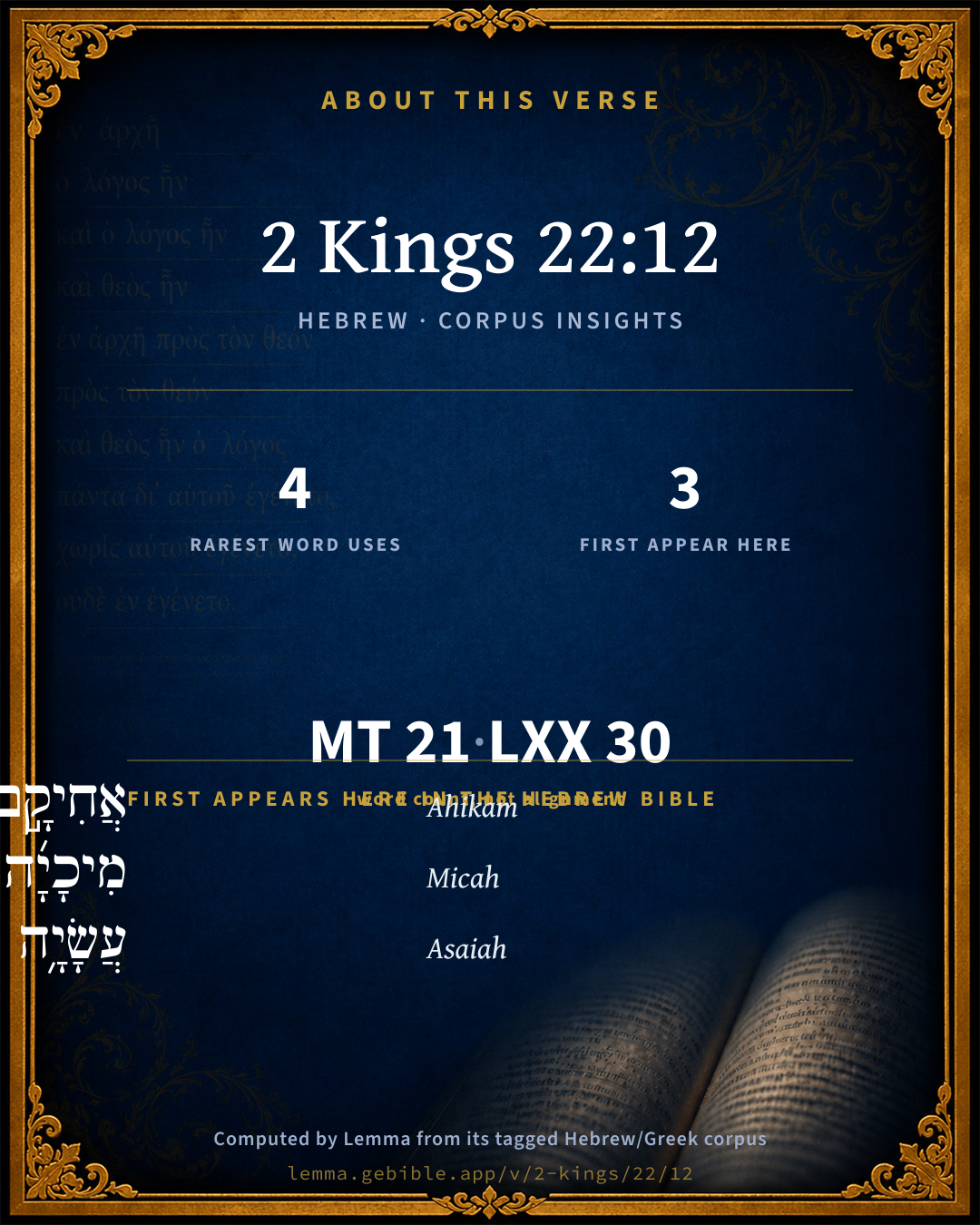
  • 3 first appearances in the Hebrew Bible
Full analysis ↓
Download a study sheet

One document with this verse’s original text, its word-by-word gloss line, the meaning frame, cross-references with their text, attributed commentary, and full source and license credits — printable, and it pastes into notes with its structure intact.

This verse Autodidact and up

Study sheet (.html) Plain text (.txt)

A passage Seminary Student

Up to 50 verses in one chapter. A passage sheet keeps up to 6 commentary sources and 12 cross-references per verse, in the order this page ranks them, and says so on the sheet whenever that leaves anything out. Ask for a single verse and you get the Autodidact verse sheet above.

Everything on this page stays free to read, with no account — the sheet is a download of what is already on screen, not access to it.

Want to remove ads? Support Godless Engineer
Compare translations 3

The same verse in 3 English versions, stacked beneath the original-language interlinear above. Click any original word for its lexicon entry.

Each is an independent rendering of the whole verse — the interlinear is not word-aligned to these translations.

Highlighted words mark where these versions differ — a whole-verse word diff, not a word-by-word alignment.

  • World English Bible Public Domain
    The king commanded Hilkiah the priest, and Ahikam the son of Shaphan, and Achbor the son of Micaiah, and Shaphan the scribe, and Asaiah the king's servant, saying,
  • King James Version Public Domain
    And the king commanded Hilkiah the priest, and Ahikam the son of Shaphan, and Achbor the son of Michaiah, and Shaphan the scribe, and Asahiah a servant of the king's, saying,
  • unfoldingWord Literal Text CC BY-SA 4.0
    And the king commanded Hilkiah the priest and Ahikam, the son of Shaphan, and Akbor, the son of Micaiah, and Shaphan the scribe and Asaiah, the servant of the king, saying,

unfoldingWord Literal Text — © unfoldingWord, licensed CC BY-SA 4.0. Word-aligned USFM3 via Door43 (git.door43.org/unfoldingWord/en_ult).

Versions to compare (up to 4)

3 of 4 selected

Show all 18 translations

Every available English version of this verse, each an independent rendering of the whole verse.

  • World English Bible Public Domain
    The king commanded Hilkiah the priest, and Ahikam the son of Shaphan, and Achbor the son of Micaiah, and Shaphan the scribe, and Asaiah the king's servant, saying,
  • Berean Standard Bible Public Domain
    and commanded Hilkiah the priest, Ahikam son of Shaphan, Achbor son of Micaiah, Shaphan the scribe, and Asaiah the servant of the king:
  • Majority Standard Bible Public Domain
    and commanded Hilkiah the priest, Ahikam son of Shaphan, Achbor son of Micaiah, Shaphan the scribe, and Asaiah the servant of the king:
  • King James Version Public Domain
    And the king commanded Hilkiah the priest, and Ahikam the son of Shaphan, and Achbor the son of Michaiah, and Shaphan the scribe, and Asahiah a servant of the king's, saying,
  • American Standard Version (1901) Public Domain
    And the king commanded Hilkiah the priest, and Ahikam the son of Shaphan, and Achbor the son of Micaiah, and Shaphan the scribe, and Asaiah the king's servant, saying,
  • Revised Version (1885) Public Domain
    And the king commanded Hilkiah the priest, and Ahikam the son of Shaphan, and Achbor the son of Micaiah, and Shaphan the scribe, and Asaiah the king’s servant, saying,
  • Geneva Bible (1599) Public Domain
    Therefore the King commanded Hilkiah the Priest, and Ahikam the sonne of Shaphan, and Achbor the sonne of Michaiah, and Shaphan the chanceller, and Asahiah the Kings seruant, saying,
  • Douay-Rheims (1899) Public Domain
    And he commanded Helcias the priest, and Ahicam the son of Saphan, and Achobor the son of Micha, and Saphan the scribe, and Asaia the king's servant, saying:
  • Young's Literal Translation Public Domain
    and the king commandeth Hilkiah the priest, and Ahikam son of Shaphan, and Achbor son of Michaiah, and Shaphan the scribe, and Asahiah servant of the king, saying,
  • Literal Standard Version CC BY-SA 4.0
    and the king commands Hilkiah the priest, and Ahikam son of Shaphan, and Achbor son of Michaiah, and Shaphan the scribe, and Asahiah servant of the king, saying,
  • Unlocked Literal Bible CC BY-SA 4.0
    The king commanded Hilkiah the priest, Ahikam son of Shaphan, Akbor son of Micaiah, Shaphan the scribe, and Asaiah, his own servant, saying,
  • unfoldingWord Literal Text CC BY-SA 4.0
    And the king commanded Hilkiah the priest and Ahikam, the son of Shaphan, and Akbor, the son of Micaiah, and Shaphan the scribe and Asaiah, the servant of the king, saying,
  • Darby Bible Public Domain
    And the king commanded Hilkijah the priest, and Ahikam the son of Shaphan, and Achbor the son of Micaiah, and Shaphan the scribe, and Asaiah a servant of the king, saying,
  • World Messianic Bible Public Domain
    The king commanded Hilkiah the priest, Ahikam the son of Shaphan, Achbor the son of Micaiah, Shaphan the scribe, and Asaiah the king’s servant, saying,
  • Webster's Bible Public Domain
    And the king commanded Hilkiah the priest, and Ahikam the son of Shaphan, and Achbor the son of Michaiah, and Shaphan the scribe, and Asahiah a servant of the king's, saying,
  • Free Bible Version CC BY-SA 4.0
    Then he gave orders to Hilkiah the priest, Ahikam, son of Shaphan, Acbor, son of Micaiah, Shaphan, the scribe, and Asaiah the king's assistant, saying,
  • Bible in Basic English Public Domain
    And he gave orders to Hilkiah the priest, and Ahikam, the son of Shaphan, and Achbor, the son of Micaiah, and Shaphan the scribe, and Asaiah the king's servant, saying,
  • JPS Tanakh (1917) Public Domain
    And the king commanded Hilkiah the priest, and Ahikam the son of Shaphan, and Achbor the son of Micaiah, and Shaphan the scribe, and Asaiah the king's servant, saying:

Literal Standard Version (2020), Covenant Press — licensed CC BY-SA 4.0. Text via the HelloAO Bible API (eBible.org). Unlocked Literal Bible (unfoldingWord) — licensed CC BY-SA 4.0. Text via the HelloAO Bible API (eBible.org). unfoldingWord Literal Text — © unfoldingWord, licensed CC BY-SA 4.0. Word-aligned USFM3 via Door43 (git.door43.org/unfoldingWord/en_ult). Free Bible Version, Dr. Jonathan Gallagher — licensed CC BY-SA 4.0. Text via the HelloAO Bible API (eBible.org).

Word by word

More ways to search: Search by grammar → Find every occurrence → Compare this word →

Practice this passage: Drill this verse → Learn its vocabulary →

מִיכָיָ֜ה
Mîykâyâh
H4320
“Micah”
Noun, Proper
Part of Speech
Noun
Type
Proper
Full BDB Definition

Origin: from H4310 and (the prefix derivative from) H3588 and H3050

TWOT: None

Micah or Michaiah = "who is like God" - the 6th in order of the minor prophets; a native of Moresheth, he prophesied during the reigns of Jotham, Ahaz, and Hezekiah of Judah, and was contemporary with the prophets Hosea, Amos, and Isaiah - father of Achbor, a man of high station in the reign of Josiah - one of the priests at the dedication of the wall of Jerusalem
  1. וַיְצַ֣ו tsâvâh H6680 “and · to command” Conjunction + Verb, Piel, Sequential Imperfect, 3rd Person, Masculine, Singular
  2. הַמֶּ֡לֶךְ melek H4428 “the · king” Particle, Definite Article + Noun, Common, Masculine, Singular, Absolute
  3. אֶת ʼêth H853 “-” Particle, Direct Object
  4. חִלְקִיָּ֣ה Chilqîyâh H2518 “Hilkiah” Noun, Proper
  5. הַכֹּהֵ֡ן kôhên H3548 “the · priest” Particle, Definite Article + Noun, Common, Masculine, Singular, Absolute
  6. וְאֶת ʼêth H853 “and · -” Conjunction + Particle, Direct Object
  7. אֲחִיקָ֣ם ʼĂchîyqâm H296 “Ahikam” Noun, Proper
  8. בֶּן bên H1121 “son of” Noun, Common, Masculine, Singular, Construct
  9. שָׁ֠פָן shâphân H8227 “rock badger” Noun, Proper
  10. וְאֶת ʼêth H853 “and · -” Conjunction + Particle, Direct Object
  11. עַכְבּ֨וֹר ʻAkbôwr H5907 “Achbor” Noun, Proper
  12. בֶּן bên H1121 “son of” Noun, Common, Masculine, Singular, Construct
  13. וְאֵ֣ת ʼêth H853 “and · -” Conjunction + Particle, Direct Object
  14. שָׁפָ֣ן shâphân H8227 “rock badger” Noun, Proper
  15. הַסֹּפֵ֗ר çâphar H5608 “the · scribe” Particle, Definite Article + Noun, Common, Masculine, Singular, Absolute
  16. וְאֵ֛ת ʼêth H853 “and · -” Conjunction + Particle, Direct Object
  17. עֲשָׂיָ֥ה ʻĂsâyâh H6222 “Asaiah” Noun, Proper
  18. עֶֽבֶד ʻebed H5650 “servant of” Noun, Common, Masculine, Singular, Construct
  19. הַמֶּ֖לֶךְ melek H4428 “the · king” Particle, Definite Article + Noun, Common, Masculine, Singular, Absolute
  20. לֵאמֹֽר ʼâmar H559 “to say” Preposition + Verb, Qal, Infinitive Construct

About this verse

These counts appear in no published source. They are computed here, from the morphology-tagged text and Lemma’s own curated glosses. What Lemma adds →

21
words
14
distinct lemmas
Historical
section

Notable vocabulary

The rarest word here is מִיכָיָ֜ה Micah H4320 — appearing just 4 times in the whole Hebrew Bible.

First appearance in Scripture

These words make their first canonical appearance in the Hebrew Bible here:

  • אֲחִיקָ֣ם Ahikam H296
  • מִיכָיָ֜ה Micah H4320
  • עֲשָׂיָ֥ה Asaiah H6222

Shared distinctive vocabulary

מִיכָיָ֜ה Micah H4320 occurs in 4 verses of the Hebrew Bible. Also found in:

Grammatical profile

  • 2 verbs
  • 14 nouns
  • 5 particles

Verb forms

  • וַיְצַ֣ו Piel · Sequential Imperfect
  • לֵאמֹֽר Qal · Infinitive Construct

Repetition

Words recur within this verse — often emphatic in Hebrew:

  • הַמֶּ֡לֶךְ king H4428 ×2
  • בֶּן son H1121 ×2
  • שָׁ֠פָן rock badger H8227 ×2

Hebrew & Septuagint length

In English translation the verse runs 28 words from the Hebrew and 29 from the Septuagint (LXX English) — closely comparable.

A rough comparison of the two English renderings, which tokenize alike — not a word-level alignment.

Word counts can differ between the Hebrew and the Greek without any difference in meaning — e.g. the Hebrew direct-object marker אֵת has no separate Greek word, and Greek often adds the article ὁ.

In the original languages it is 21 Hebrew tokens and 30 Greek tokens — but the two are counted differently (Hebrew bundles its prefixes and suffixes into one token; the Greek is in lemma form), so that isn’t a like-for-like length.

Cross-references

7

Topical passages linked to 2 Kings 22:12 in the Treasury of Scripture Knowledge — connected by theme and wording, ordered by reader-vote popularity; previews shown in the World English Bible.

  • Jeremiah 26:24 But the hand of Ahikam the son of Shaphan was with Jeremiah, that they should not give him into the hand of the people to put him to death.
  • 2 Kings 25:22 As for the people who were left in the land of Judah, whom Nebuchadnezzar king of Babylon had left, even over them he made Gedaliah the son of Ahikam, the son of Shaphan, governor.
  • 2 Kings 19:2–3 He sent Eliakim, who was over the household, and Shebna the scribe, and the elders of the priests, covered with sackcloth, to Isaiah the prophet the son of Amoz.
  • 2 Kings 22:9 Shaphan the scribe came to the king, and brought the king word again, and said, Your servants have emptied out the money that was found in the house, and have delivered it into the hand of the workmen who have the oversight of the house of Yahweh.
  • 2 Chronicles 34:19–21 It happened, when the king had heard the words of the law, that he tore his clothes.
  • Isaiah 37:1–4 It happened, when king Hezekiah heard it, that he tore his clothes, and covered himself with sackcloth, and went into the house of Yahweh.
  • Jeremiah 26:22 and Jehoiakim the king sent men into Egypt, [namely], Elnathan the son of Achbor, and certain men with him, into Egypt;

Cross-references courtesy of OpenBible.info (CC BY 4.0).

Hebrew and Greek witnesses Masoretic Hebrew ↔ Greek Septuagint

The same verse in the two great witnesses to the Old Testament, shown verse-for-verse.

These are two independent witnesses, not word-aligned to each other, and the Septuagint is shown in lemma (dictionary) form.

Hebrew 2 Kings 22:12 Masoretic · Westminster Leningrad Codex

וַיְצַ֣ו הַמֶּ֡לֶךְ אֶת חִלְקִיָּ֣ה הַכֹּהֵ֡ן וְאֶת אֲחִיקָ֣ם בֶּן שָׁ֠פָן וְאֶת עַכְבּ֨וֹר בֶּן מִיכָיָ֜ה וְאֵ֣ת שָׁפָ֣ן הַסֹּפֵ֗ר וְאֵ֛ת עֲשָׂיָ֥ה עֶֽבֶד הַמֶּ֖לֶךְ לֵאמֹֽר

The king commanded Hilkiah the priest, and Ahikam the son of Shaphan, and Achbor the son of Micaiah, and Shaphan the scribe, and Asaiah the king's servant, saying,

World English Bible · Public Domain

Greek LXX 2 Kings 22:12 Septuagint · lemma form

καί ἐντέλλομαι ὁ βασιλεύς ὁ χελκιας ὁ ἱερεύς καί ὁ αχικαμ υἱός σαφφαν καί ὁ αχοβωρ υἱός μιχαιας καί ὁ σαφφαν ὁ γραμματεύς καί ὁ ασαιας δοῦλος ὁ βασιλεύς λέγω

And the king commanded Chelcias the priest, and Achikam the son of Sapphan, and Achobor the son of Michaias, and Sapphan the scribe, and Asaias the king's servant, saying,

LXX2012 (modern English Septuagint) · Public Domain

Hebrew: Westminster Leningrad Codex (CC BY 4.0). Greek: Septuagint (public domain); English from LXX2012 (modern English Septuagint) (Public Domain). How the Septuagint differs from the Hebrew →

Targum (Aramaic paraphrase)

1

The Targum is the ancient Jewish Aramaic paraphrase of the Hebrew Scriptures — an interpretive translation, not the Hebrew text itself. Onkelos (literal) and Pseudo-Jonathan (expansive) render the Torah, and Jonathan the Prophets. Coverage is partial: where no permissively-licensed English translation exists for a verse, only the Aramaic is shown. This is verse-level text, not a word-by-word alignment to the Hebrew.

  1. Targum Jonathan Prophets (Joshua–Malachi)
    וּפַקֵיד מַלְכָּא יַת חִלְקִיָה כַהֲנָא וְיַת אֲחִיקָם בַּר שָׁפָן וְיַת עַכְבּוֹר בַּר מִיכָיָה וְיַת שָׁפָן סַפְרָא וְיַת עֲשָׂיָה עַבְדָא דְמַלְכָּא לְמֵימָר:

    (no public-domain English translation for this verse)

    Targum Jonathan — Aramaic: “Mikraot Gedolot” (public domain). English: “Sefaria Community Translation” (CC0 1.0 (public-domain dedication)); “London "Chaldee Paraphrase," 1871” (public domain). Text via Sefaria.

Commentary

Notes on 2 Kings 22:12 from classic Christian and Jewish commentators (each source and its license shown beneath its notes). The classic Christian expositions comment on the surrounding passage and are grouped to its opening verse, so a note may address several verses; the Jewish commentaries on the Tanakh (Rashi and others) are per-verse, so they appear only where the commentator wrote on this verse.

Lemma curates 59 commentaries, every one of them public domain or Creative Commons licensed, each selected and text-cleaned for this edition rather than reprinted as found. About our sources →

Trapp's Complete Commentary

John Trapp

2Ki 22:12 And the king commanded Hilkiah the priest, and Ahikam the son of Shaphan, and Achbor the son of Michaiah, and Shaphan the scribe, and Asahiah a servant of the king’s, saying,

Ver. 12. And Achbor the son of Michaiah.] Called Abdon the son of Micah, {2Ch 34:20} by a different pronunciation.

John Trapp, A Commentary or Exposition upon All the Books of the Old and New Testament (1647–1656) — public domain. Text from a community e-Sword module.

Joseph Benson's Commentary

2Ki 22:12-13. Asahiah, a servant of the king’s — Who most constantly waited upon the king’s person; otherwise all of those here mentioned were the king’s servants. Go ye, inquire of the Lord for me, and for the people, &c. — What we shall do to appease his wrath, and whether the curses here threatened must come upon us without remedy, or whether there be hope in Israel concerning the prevention of them. For great is the wrath of the Lord, because our fathers, &c. — In the glass of the divine law, he saw the sins of his people to be more numerous and more heinous than he had before seen them, and more exceeding sinful. And he saw that the wrath of God was kindled in a high degree against the whole nation, not only for the sins of the present generation, but because that from their first coming out of Egypt to this time, they had been almost in the constant habit of disregarding and violating the divine laws, and that in the most notorious and flagrant instances.

Joseph Benson's Commentary on the Old and New Testaments (1811–1818) — public domain. Text from a community e-Sword module.

Whedon's Commentary on the Bible

Daniel D. Whedon

THE ORACLE OF HULDAH THE PROPHETESS, 2Ki_22:12-20.

12. Hilkiah… Ahikam… Achbor… Shaphan… Asahiah — A truly honourable and imposing delegation, and indicative of the king’s profound earnestness and anxiety. Here was first the high priest: then Ahikam, who afterwards appears as the friend of Jeremiah, and father of the governor of the cities of Judah; (Jer_26:24; Jer_40:5;) then Achbor, whose eminence in the kingdom is shown further by the fact that his son Elnathan was one of Zedekiah’s chief ministers; (Jer_26:22; Jer_36:12;) then Shaphan, the scribe, who must now have been an old and venerable man to have a son so eminent in the kingdom as Ahikam; and, lastly, a servant of the king’s named Asahiah, who seems, from his association with the other deputies, to have been some honourable officer.

Daniel D. Whedon (gen. ed.), Commentary on the Old and New Testaments (1874–1909) — public domain. Text from a community e-Sword module.

Jamieson, Fausset & Brown

Robert Jamieson, A. R. Fausset & David Brown

the king commanded . . . Go, inquire of the Lord for me, &c.--The agitated feelings of the king prompted him to ask immediate counsel how to avert those curses under which his kingdom lay; and forthwith a deputation of his principal officers was sent to one endowed with the prophetic spirit.

Ahikam--a friend of Jeremiah (Jer 26:24).

Jamieson, Fausset & Brown — Commentary Critical and Explanatory on the Whole Bible (1871) — public domain (CC PDM 1.0). Text via the HelloAO Bible API.

Ellicott's Commentary for English Readers

(12) And the king commanded . . .—Comp. the similar embassy to Isaiah (2Ki_19:2).

As to Ahikam see Jer_26:24; Jer_40:5; and for Achbor, Jer_26:22; Jer_36:12.

Asahiah a servant of the king’s.—Probably the same officer as “the knight” or aide-de-camp who attended on the king (2Ki_7:2; 2Ki_9:25.)

A Bible Commentary for English Readers, edited by Charles John Ellicott (1878–1897) — public domain. Text from a community e-Sword module.

The Cambridge Bible for Schools and Colleges

gen. ed. J. J. S. Perowne

12. Ahikam the son of Shaphan] Ahikam was father of Gedaliah (Jer_39:14), and continued in an official position in the reign of Jehoiakim (Jer_26:24). Ahikam must have been a person of ripe years to be sent on such an errand as this to Huldah. Hence Shaphan his father must have been of an advanced age. (See above on verse 3.)

Achbor the son of Michaiah] R.V. Micaiah. He is not mentioned except in this history. In the parallel place of Chronicles (2Ch_34:20) he is called Abdon the son of Micah.

Asahiah a servant of the king’s] R.V. Asaiah the king’s servant. The name is so spelt in 2Ch_34:20. ‘Servant’ in such phrases signifies some person of influence in close attendance on the king. See on v. 13 above.

The Cambridge Bible for Schools and Colleges (gen. ed. J. J. S. Perowne; Cambridge University Press, 1878–1918) — public domain. Text from a community e-Sword module.

John Gill's Exposition

And the king commanded Hilkiah the priest,.... The high priest, as he is called, Kg2 22:4.

and Ahikam the son of Shaphan; whether the same with Shaphan the scribe, before mentioned, or another of the same name, is not certain:

and Achbor the son of Michaiah; who is called Abdon, the son of Micah, Ch2 34:20.

and Shaphan the scribe; who brought and read the book to the king:

and Asahiah, a servant of the king's; that waited on him constantly:

saying; as follows.

John Gill's Exposition of the Whole Bible (1746–1763) — public domain (CC PDM 1.0). Text via the HelloAO Bible API.

Matthew Poole's English Annotations

A servant of the king’s, who most constantly waited upon the king’s person; otherwise all of them were the king’s servants.

Matthew Poole's English Annotations on the Holy Bible (1683–1685) — public domain. Text from a community e-Sword/MySword module.

The Pulpit Commentary

And the king commanded Hilkiah the priest, and Ahikam the son of Shaphan. "Ahikam the son of Shaphan" is almost certainly Jeremiah"s protector at the court of Jehoiakim, (Jer_26:24) the father of the Godaliah who wan made governor of Judaea on Nebuchadnezzar"s final conquest. (Jer_39:14 Jer_40:7) "Shaphan;" his father, is no doubt "Shaphan the scribe." And Achbor the son of Michaiah. The parallel passage of Chronicles (2Ch_34:20) has "Abdon the son of Micah," which is probably a corrupt reading. Achbor was the father of El-nathan, one of the "princes of Judah" (Jer_36:12) in Jehoiakim"s reign. And Shaphan the scribe, and Asa-hiah a servant of the king"s or Asaiah, as the name is given in Chronicles, l.s.c. saying,

The Pulpit Commentary (1880–1919), ed. H.D.M. Spence-Jones & Joseph S. Exell — public domain. Text from a community e-Sword module.

Lesson kit

Teaching starters — assembled from the data on this page, not authored interpretation. Every prompt links to the verse data it draws on. Edit before teaching.

2 Kings, in the Historical, opens this verse with 21 words (14 distinct Hebrew lemmas). Its most distinctive word is Mîykâyâh (“Micah”). A historical commentator’s framing appears above. Read the whole chapter for the surrounding context.

Discussion questions

  1. How does “Micah” (Mîykâyâh) shape what this verse is saying?
  2. 3 words make their first appearance in Scripture here. What does this debut establish?
  3. How does Nehemiah 12:35, which shares the word «Micah», read alongside this verse?
  4. What does the repetition of “king” (2× in this one verse) do in this verse?
  5. These translations render this verse differently. What is at stake in choosing one wording over another?
  6. «וַיְצַ֣ו» is a Piel Sequential Imperfect verb. How does that grammatical form shape the action described?
  7. Compare how Trapp's Complete Commentary and Joseph Benson's Commentary read this verse. Where do they agree or differ?

Things to notice

Reading settings

Reading text

Shown beneath each verse's original-language words.

Old Testament
Old Testament edition

Read the OT as the Masoretic Hebrew (MT) or the Greek Septuagint (LXX).

English shown for the Greek Septuagint (in the Hebrew ↔ Greek comparison).

Comparing translations? Open the Compare panel on any verse page to stack up to four side by side.