
Deuteronomy 18:10

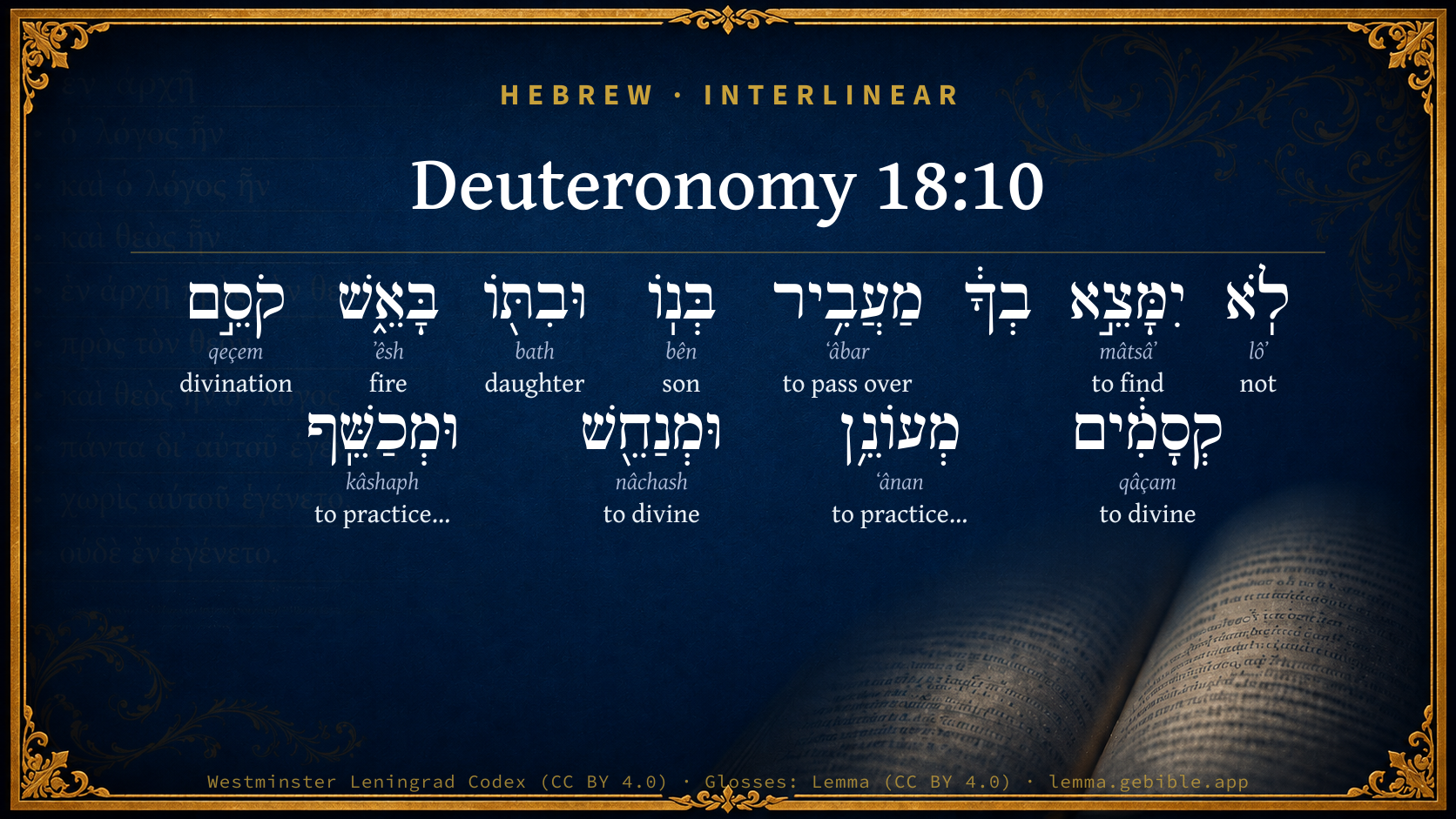
Hebrew (Westminster Leningrad Codex) Deuteronomy 18:10 appears in the Hebrew Old Testament. The text above is from the Westminster Leningrad Codex. Each word links to its Strong’s number, a concise gloss, and parsing drawn from the Open Scriptures Hebrew Bible morphology. Click any word for its full Brown-Driver-Briggs (BDB) entry.
Download image
Cite this verse

Deuteronomy 18:10 (World English Bible). Public Domain. Lemma interlinear Bible study tool, https://lemma.gebible.app/v/deuteronomy/18/10.

Show BibTeX & RIS
BibTeX
RIS
English Translation
There shall not be found with you anyone who makes his son or his daughter to pass through the fire, one who uses divination, one who practices sorcery, or an enchanter, or a sorcerer,
World English Bible · Public Domain
Highlights
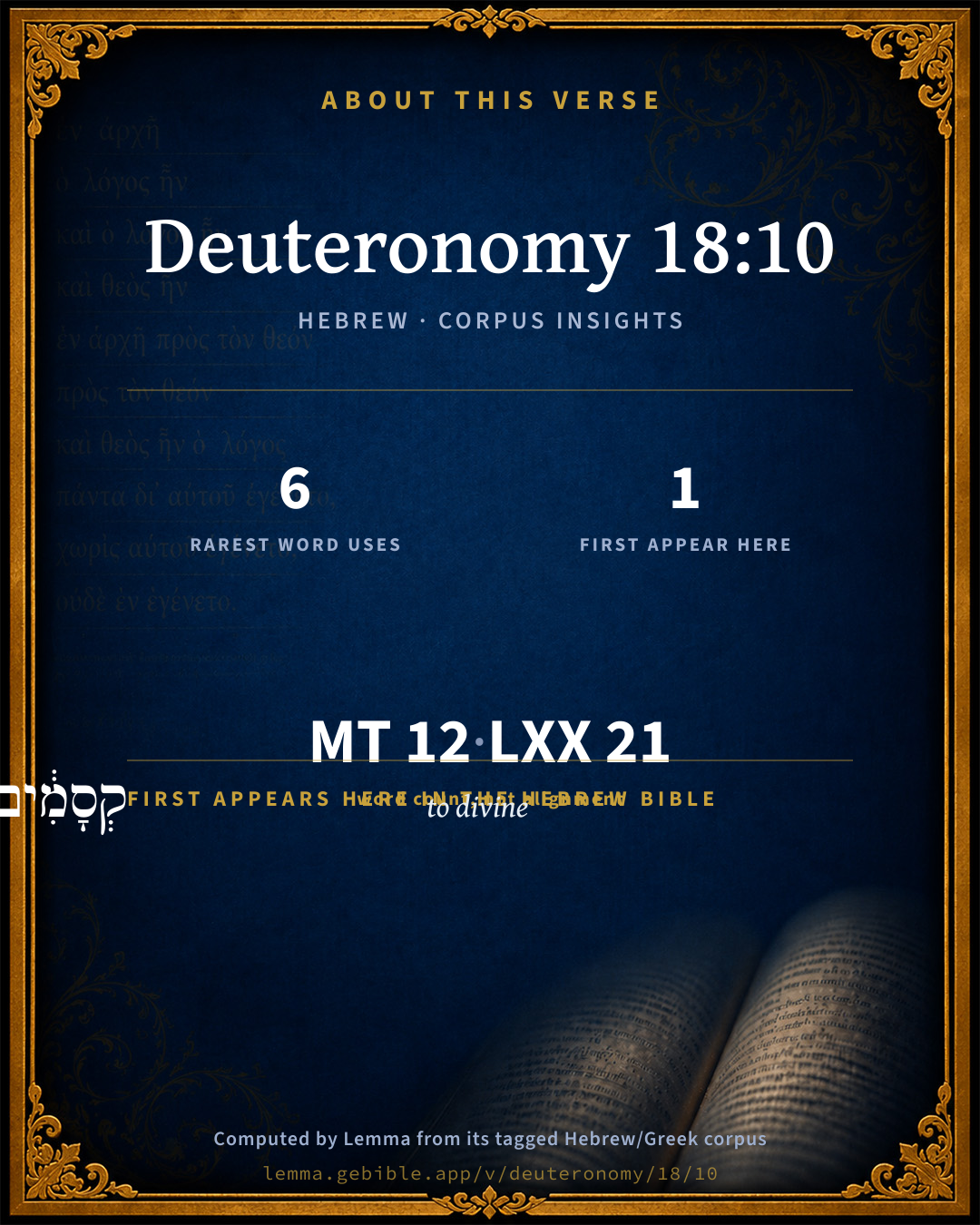
  • 1 first appearance in the Hebrew Bible
Full analysis ↓
Download a study sheet

One document with this verse’s original text, its word-by-word gloss line, the meaning frame, cross-references with their text, attributed commentary, and full source and license credits — printable, and it pastes into notes with its structure intact.

This verse Autodidact and up

Study sheet (.html) Plain text (.txt)

A passage Seminary Student

Up to 50 verses in one chapter. A passage sheet keeps up to 6 commentary sources and 12 cross-references per verse, in the order this page ranks them, and says so on the sheet whenever that leaves anything out. Ask for a single verse and you get the Autodidact verse sheet above.

Everything on this page stays free to read, with no account — the sheet is a download of what is already on screen, not access to it.

Want to remove ads? Support Godless Engineer
Compare translations 3

The same verse in 3 English versions, stacked beneath the original-language interlinear above. Click any original word for its lexicon entry.

Each is an independent rendering of the whole verse — the interlinear is not word-aligned to these translations.

Highlighted words mark where these versions differ — a whole-verse word diff, not a word-by-word alignment.

  • World English Bible Public Domain
    There shall not be found with you anyone who makes his son or his daughter to pass through the fire, one who uses divination, one who practices sorcery, or an enchanter, or a sorcerer,
  • King James Version Public Domain
    There shall not be found among you any one that maketh his son or his daughter to pass through the fire, or that useth divination, or an observer of times, or an enchanter, or a witch.
  • unfoldingWord Literal Text CC BY-SA 4.0
    There shall not be found among you one who causes his son or his daughter to pass through the fire, a user of divination, a soothsayer or a diviner or a sorcerer

unfoldingWord Literal Text — © unfoldingWord, licensed CC BY-SA 4.0. Word-aligned USFM3 via Door43 (git.door43.org/unfoldingWord/en_ult).

Versions to compare (up to 4)

3 of 4 selected

Show all 18 translations

Every available English version of this verse, each an independent rendering of the whole verse.

  • World English Bible Public Domain
    There shall not be found with you anyone who makes his son or his daughter to pass through the fire, one who uses divination, one who practices sorcery, or an enchanter, or a sorcerer,
  • Berean Standard Bible Public Domain
    Let no one be found among you who sacrifices his son or daughter in the fire, practices divination or conjury, interprets omens, practices sorcery,
  • Majority Standard Bible Public Domain
    Let no one be found among you who sacrifices his son or daughter in the fire, practices divination or conjury, interprets omens, practices sorcery,
  • King James Version Public Domain
    There shall not be found among you any one that maketh his son or his daughter to pass through the fire, or that useth divination, or an observer of times, or an enchanter, or a witch.
  • American Standard Version (1901) Public Domain
    There shall not be found with thee any one that maketh his son or his daughter to pass through the fire, one that useth divination, one that practiseth augury, or an enchanter, or a sorcerer,
  • Revised Version (1885) Public Domain
    There shall not be found with thee any one that maketh his son or his daughter to pass through the fire, one that useth divination, one that practiseth augury, or an enchanter, or a sorcerer,
  • Geneva Bible (1599) Public Domain
    Let none be founde among you that maketh his sonne or his daughter to goe thorough the fire, or that vseth witchcraft, or a regarder of times, or a marker of the flying of foules, or a sorcerer,
  • Douay-Rheims (1899) Public Domain
    Neither let there be found among you any one that shall expiate his son or daughter, making them to pass through the fire: or that consulteth soothsayers, or observeth dreams and omens, neither let there be any wizard,
  • Young's Literal Translation Public Domain
    there is not found in thee one causing his son and his daughter to pass over into fire, a user of divinations, an observer of clouds, and an enchanter, and a sorcerer,
  • Literal Standard Version CC BY-SA 4.0
    There is not found in you one causing his son and his daughter to pass over into fire, a user of divinations, an observer of clouds, and an enchanter, and a sorcerer,
  • Unlocked Literal Bible CC BY-SA 4.0
    There must not be found among you anyone who sacrifices his son or his daughter in the fire, anyone who uses divination or tells fortunes, or reads signs found in a cup, or engages in witchcraft,
  • unfoldingWord Literal Text CC BY-SA 4.0
    There shall not be found among you one who causes his son or his daughter to pass through the fire, a user of divination, a soothsayer or a diviner or a sorcerer
  • Darby Bible Public Domain
    There shall not be found among you he that maketh his son or his daughter to pass through the fire, that useth divination, that useth auguries, or an enchanter, or a sorcerer,
  • World Messianic Bible Public Domain
    There shall not be found with you anyone who makes his son or his daughter to pass through the fire, one who uses divination, one who tells fortunes, or an enchanter, or a sorcerer,
  • Webster's Bible Public Domain
    There shall not be found among you any one that maketh his son or his daughter to pass through the fire, or that useth divination, or an observer of times, or an enchanter, or a witch,
  • Free Bible Version CC BY-SA 4.0
    No one is to sacrifice their son or daughter in the fire, practice divination or fortune-telling, use magic or sorcery,
  • Bible in Basic English Public Domain
    Let there not be seen among you anyone who makes his son or his daughter go through the fire, or anyone using secret arts, or a maker of strange sounds, or a reader of signs, or any wonder-worker,
  • JPS Tanakh (1917) Public Domain
    There shall not be found among you any one that maketh his son or his daughter to pass through the fire, one that useth divination, a soothsayer, or an enchanter, or a sorcerer,

Literal Standard Version (2020), Covenant Press — licensed CC BY-SA 4.0. Text via the HelloAO Bible API (eBible.org). Unlocked Literal Bible (unfoldingWord) — licensed CC BY-SA 4.0. Text via the HelloAO Bible API (eBible.org). unfoldingWord Literal Text — © unfoldingWord, licensed CC BY-SA 4.0. Word-aligned USFM3 via Door43 (git.door43.org/unfoldingWord/en_ult). Free Bible Version, Dr. Jonathan Gallagher — licensed CC BY-SA 4.0. Text via the HelloAO Bible API (eBible.org).

Word by word

More ways to search: Search by grammar → Find every occurrence → Compare this word →

Practice this passage: Drill this verse → Learn its vocabulary →

וּמְכַשֵּֽׁף
kâshaph
H3784
“and · practicing witchcraft”
Conjunction + Verb, Piel, Participle Active, Masculine, Singular, Absolute
Part of Speech
Conjunction + Verb
Stem
Piel
Form
Participle Active
Gender
Masculine
Number
Singular
State
Absolute
Full BDB Definition

Origin: a primitive root

TWOT: 1051

(Piel) to practice witchcraft or sorcery, use witchcraft - sorcerer, sorceress (participle)
  1. לֹֽא lôʼ H3808 “not” Particle, Negative
  2. יִמָּצֵ֣א mâtsâʼ H4672 “to find” Verb, Niphal, Imperfect, 3rd Person, Masculine, Singular
  3. מַעֲבִ֥יר ʻâbar H5674 “passing over” Verb, Hiphil, Participle Active, Masculine, Singular, Absolute
  4. בְּנֽוֹ bên H1121 “son · his” Noun, Common, Masculine, Singular, Construct + Suffix, Personal, 3rd Person, Masculine, Singular
  5. וּבִתּ֖וֹ bath H1323 “and · daughter · his” Conjunction + Noun, Common, Feminine, Singular, Construct + Suffix, Personal, 3rd Person, Masculine, Singular
  6. בָּאֵ֑שׁ ʼêsh H784 “in/at the · fire” Preposition, Determined + Noun, Common, Both, Singular, Absolute
  7. קֹסֵ֣ם qeçem H7081 “divination” Verb, Qal, Participle Active, Masculine, Singular, Absolute
  8. קְסָמִ֔ים qâçam H7080 “diviners” Noun, Common, Masculine, Plural, Absolute
  9. מְעוֹנֵ֥ן ʻânan H6049 “practicing sorcery” Verb, Poel, Participle Active, Masculine, Singular, Absolute
  10. וּמְנַחֵ֖שׁ nâchash H5172 “and · divining” Conjunction + Verb, Piel, Participle Active, Masculine, Singular, Absolute

About this verse

These counts appear in no published source. They are computed here, from the morphology-tagged text and Lemma’s own curated glosses. What Lemma adds →

12
words
11
distinct lemmas
Pentateuch
section

Notable vocabulary

The rarest word here is וּמְכַשֵּֽׁף to practice witchcraft H3784 — appearing just 6 times in the whole Hebrew Bible.

First appearance in Scripture

This word makes its first canonical appearance in the Hebrew Bible here:

  • קְסָמִ֔ים to divine H7080

Shared distinctive vocabulary

וּמְכַשֵּֽׁף to practice witchcraft H3784 occurs in 6 verses of the Hebrew Bible. Also found in:

Grammatical profile

  • 6 verbs
  • 4 nouns
  • 1 preposition
  • 1 particle

Verb forms

  • יִמָּצֵ֣א Niphal · Imperfect
  • מַעֲבִ֥יר Hiphil · Participle Active
  • קֹסֵ֣ם Qal · Participle Active
  • מְעוֹנֵ֥ן Poel · Participle Active
  • וּמְנַחֵ֖שׁ Piel · Participle Active
  • וּמְכַשֵּֽׁף Piel · Participle Active

Hebrew & Septuagint length

In English translation the verse runs 34 words from the Hebrew and 27 from the Septuagint (LXX English) — closely comparable.

A rough comparison of the two English renderings, which tokenize alike — not a word-level alignment.

Word counts can differ between the Hebrew and the Greek without any difference in meaning — e.g. the Hebrew direct-object marker אֵת has no separate Greek word, and Greek often adds the article ὁ.

In the original languages it is 12 Hebrew tokens and 21 Greek tokens — but the two are counted differently (Hebrew bundles its prefixes and suffixes into one token; the Greek is in lemma form), so that isn’t a like-for-like length.

Cross-references

23

Topical passages linked to Deuteronomy 18:10 in the Treasury of Scripture Knowledge — connected by theme and wording, ordered by reader-vote popularity; previews shown in the World English Bible.

  • Leviticus 19:31 "'Don't turn to those who are mediums, nor to the wizards. Don't seek them out, to be defiled by them. I am Yahweh your God.
  • Exodus 22:18 "You shall not allow a sorceress to live.
  • Leviticus 19:26 "'You shall not eat any meat with the blood still in it; neither shall you use enchantments, nor practice sorcery.
  • Deuteronomy 12:31 You shall not do so to Yahweh your God: for every abomination to Yahweh, which he hates, have they done to their gods; for even their sons and their daughters do they burn in the fire to their gods.
  • 2 Chronicles 33:6 He also made his children to pass through the fire in the valley of the son of Hinnom; and he practiced sorcery, and used enchantments, and practiced sorcery, and dealt with those who had familiar spirits, and with wizards: he worked much evil in the sight of Yahweh, to provoke him to anger.
  • Acts 19:19 Many of those who practiced magical arts brought their books together and burned them in the sight of all. They counted the price of them, and found it to be fifty thousand pieces of silver.
  • Leviticus 20:2–5 "Moreover, you shall tell the children of Israel, 'Anyone of the children of Israel, or of the strangers who live as foreigners in Israel, who gives any of his seed to Molech; he shall surely be put to death. The people of the land shall stone him with stones.
  • 1 Samuel 28:9 The woman said to him, Behold, you know what Saul has done, how he has cut off those who have familiar spirits, and the wizards, out of the land: why then lay you a snare for my life, to cause me to die?
  • 2 Kings 16:3 But he walked in the way of the kings of Israel, yes, and made his son to pass through the fire, according to the abominations of the nations, whom Yahweh cast out from before the children of Israel.
  • 2 Kings 17:17 They caused their sons and their daughters to pass through the fire, and used divination and enchantments, and sold themselves to do that which was evil in the sight of Yahweh, to provoke him to anger.
  • 2 Kings 21:6 He made his son to pass through the fire, and practiced sorcery, and used enchantments, and dealt with those who had familiar spirits, and with wizards: he worked much evil in the sight of Yahweh, to provoke him to anger.
  • 1 Chronicles 10:13 So Saul died for his trespass which he committed against Yahweh, because of the word of Yahweh, which he didn't keep; and also because he asked counsel of one who had a familiar spirit, to inquire [thereby],
  • 2 Chronicles 28:3 Moreover he burnt incense in the valley of the son of Hinnom, and burnt his children in the fire, according to the abominations of the nations whom Yahweh cast out before the children of Israel.
  • Isaiah 47:13 You are wearied in the multitude of your counsels: let now the astrologers, the star-gazers, the monthly prognosticators, stand up, and save you from the things that shall come on you.
  • Leviticus 20:26–27 You shall be holy to me: for I, Yahweh, am holy, and have set you apart from the peoples, that you should be mine.
  • 1 Samuel 28:3 Now Samuel was dead, and all Israel had lamented him, and buried him in Ramah, even in his own city. Saul had put away those who had familiar spirits, and the wizards, out of the land.
  • 1 Samuel 28:7 Then said Saul to his servants, Seek me a woman who has a familiar spirit, that I may go to her, and inquire of her. His servants said to him, Behold, there is a woman who has a familiar spirit at En-dor.
  • Psalms 106:37–38 Yes, they sacrificed their sons and their daughters to demons.
  • Jeremiah 32:35 They built the high places of Baal, which are in the valley of the son of Hinnom, to cause their sons and their daughters to pass through [the fire] to Molech; which I didn't command them, neither did it come into my mind, that they should do this abomination, to cause Judah to sin.
  • Leviticus 18:21–30 "'You shall not give any of your children to sacrifice to Molech; neither shall you profane the name of your God: I am Yahweh.
  • Isaiah 8:19–20 When they shall tell you, "Consult with those who have familiar spirits and with the wizards, who chirp and who mutter:" shouldn't a people consult with their God? on behalf of the living [should they consult] with the dead?
  • Jeremiah 19:4–6 Because they have forsaken me, and have estranged this place, and have burned incense in it to other gods, that they didn't know, they and their fathers and the kings of Judah; and have filled this place with the blood of innocents,
  • Galatians 5:20 idolatry, sorcery, hatred, strife, jealousies, outbursts of anger, rivalries, divisions, heresies,

Cross-references courtesy of OpenBible.info (CC BY 4.0).

Hebrew and Greek witnesses Masoretic Hebrew ↔ Greek Septuagint

The same verse in the two great witnesses to the Old Testament, shown verse-for-verse.

These are two independent witnesses, not word-aligned to each other, and the Septuagint is shown in lemma (dictionary) form.

Hebrew Deuteronomy 18:10 Masoretic · Westminster Leningrad Codex

לֹֽא יִמָּצֵ֣א בְךָ֔ מַעֲבִ֥יר בְּנֽוֹ וּבִתּ֖וֹ בָּאֵ֑שׁ קֹסֵ֣ם קְסָמִ֔ים מְעוֹנֵ֥ן וּמְנַחֵ֖שׁ וּמְכַשֵּֽׁף

There shall not be found with you anyone who makes his son or his daughter to pass through the fire, one who uses divination, one who practices sorcery, or an enchanter, or a sorcerer,

World English Bible · Public Domain

Greek LXX Deuteronomy 18:10 Septuagint · lemma form

οὐ εὑρίσκω ἐν σύ περι κατααἴρω ὁ υἱός αὐτός ἤ ὁ θυγάτηρ αὐτός ἐν πῦρ μαντεύομαι μαντεία κληδονίζω καί οἰωνίζω φαρμακός

There shall not be found in you one who purges his son or his daughter with fire, one who uses divination, who deals with omens, and augury,

LXX2012 (modern English Septuagint) · Public Domain

On this verse, The Cambridge Bible for Schools and Colleges discusses the Septuagint’s reading. Read the note in Commentary ↓

Hebrew: Westminster Leningrad Codex (CC BY 4.0). Greek: Septuagint (public domain); English from LXX2012 (modern English Septuagint) (Public Domain). How the Septuagint differs from the Hebrew →

Targum (Aramaic paraphrase)

2

The Targum is the ancient Jewish Aramaic paraphrase of the Hebrew Scriptures — an interpretive translation, not the Hebrew text itself. Onkelos (literal) and Pseudo-Jonathan (expansive) render the Torah, and Jonathan the Prophets. Coverage is partial: where no permissively-licensed English translation exists for a verse, only the Aramaic is shown. This is verse-level text, not a word-by-word alignment to the Hebrew.

  1. Targum Onkelos Torah (Genesis–Deuteronomy)
    לָא יִשְׁתְּכַח בָּךְ מַעֲבַר בְּרֵהּ וּבְרַתֵּהּ בְּנוּרָא קָסֵם קֻסְמִין מְעָנֵן וּמְנַחֵשׁ וְחָרָשׁ

    (no public-domain English translation for this verse)

    Targum Onkelos — Aramaic: “Onkelos Genesis” (public domain); “Onkelos Exodus” (public domain); “Onkelos Leviticus” (public domain); “Onkelos Numbers” (public domain); “Onkelos Deuteronomy” (public domain). English: “Sefaria Community Translation” (CC0 1.0 (public-domain dedication)); “J.W. Etheridge. The Targums of Onkelos and Jonathan Ben Uzziel on the Pentateuch. London: Longmans, Green, 1862” (public domain). Text via Sefaria.

  2. Targum Pseudo-Jonathan Torah (Genesis–Deuteronomy)
    לָא יִשְׁתְּכַח בְּכוֹן מְעַבְּרִין בְּנֵיהוֹן וּבְנָתֵיהוֹן בְּנוּרָא לָא קְסוֹמֵי קוּסְמִין וְלָא חֲרוּרֵי עַיְינִין וְלָא נַטוֹרֵי נְחָשִׁין וְלָא חַרְשִׁין

    None shall be found among you to make his sons or daughters pass through the fire, nor who enchant with enchantments, or inspect serpents, nor observe divinations and auguries,

    Targum Pseudo-Jonathan — Aramaic: “Targum Jonathan on Genesis” (public domain); “Targum Jonathan on Exodus” (public domain); “Targum Jonathan on Leviticus” (public domain); “Targum Jonathan on Numbers” (public domain); “Targum Jonathan on Deuteronomy” (public domain). English: “The Targum of Jonathan ben Uzziel, trans. J. W. Etheridge, London, 1862” (public domain). Text via Sefaria.

Commentary

Notes on Deuteronomy 18:10 from classic Christian and Jewish commentators (each source and its license shown beneath its notes). The classic Christian expositions comment on the surrounding passage and are grouped to its opening verse, so a note may address several verses; the Jewish commentaries on the Tanakh (Rashi and others) are per-verse, so they appear only where the commentator wrote on this verse.

Lemma curates 59 commentaries, every one of them public domain or Creative Commons licensed, each selected and text-cleaned for this edition rather than reprinted as found. About our sources →

Trapp's Complete Commentary

John Trapp

Deu 18:10 There shall not be found among you [any one] that maketh his son or his daughter to pass through the fire, [or] that useth divination, [or] an observer of times, or an enchanter, or a witch,

Ver. 10. That maketh his son.] {See Trapp on "Lev 18:21"}

John Trapp, A Commentary or Exposition upon All the Books of the Old and New Testament (1647–1656) — public domain. Text from a community e-Sword module.

Joseph Benson's Commentary

Deu 18:10. That maketh his son or daughter pass through the fire — By a superstitious dedicating, or a cruel sacrificing of them, see on Lev 18:21. That useth divination — Of which there were many sorts, as is implied in the original expressions here: קסם קסמים, kosem kesamim, divining divinations, or with divinations. The meaning undoubtedly is, That seeketh to know or foretel things secret, or to come, by unlawful arts and practices. An observer of times — Superstitiously pronouncing some days lucky and others unlucky: or, an observer of the clouds, or heavens; for the word מעונן, megnonen, here used, may be derived from ענן, gnanan, a cloud; and then it means, That divineth by the motion or figure of the clouds, the appearance or passage of meteors, by thunder, lightning, by the stars, the flying or chattering of birds, and the like. Or, deriving the word from עין, gnain, an eye, qui præstigiis utitur, a juggler, one who causes things to assume a false appearance, practises illusions on people’s fancies, or deceives them by sleight of hand. An enchanter — Or a conjecturer, that endeavours, or pretends, to discover hidden things by a superstitious use of words or ceremonies, by observation of water or smoke, or tiny contingencies. Or, as the original word seems to be derived from נחשׁ, nachash, a serpent, it means one that divines by means of serpents, of which kind of diviners we have many instances in the heathen poets, particularly Homer and Virgil. A witch — Supposed to be in covenant with the devil, and by his help to delude people’s senses, or hurt their persons, their cattle, or other property, through the use of evil arts. The same Hebrew word is translated witch also, Exo 22:18, where it is evidently intended to be taken in the same sense as here. But, Exo 7:11; Dan 2:2, and Mal 3:5, where it occurs in the plural number, it is translated sorcerers, and interpreted by Aben Ezra of those who change and transform natural things so as to deceive the eyes of the beholders. Le Clerc translates the word, hariolus, soothsayer, because it is joined in the Scriptures with other species of divination.

Joseph Benson's Commentary on the Old and New Testaments (1811–1818) — public domain. Text from a community e-Sword module.

Tyndale Open Study Notes

Tyndale Open Resources

18:10 never sacrifice your son or daughter as a burnt offering: Some Canaanite religions included child sacrifice to appease their gods. Israel was strictly warned never to engage in this practice (Exod 34:15-16; Lev 18:21; 20:2-5). When they did, it aroused God’s judgment (2 Kgs 17:16-17; 21:6; Ezek 23:37). • fortune-telling: Throughout the ancient Near East, diviners were considered experts at reading and interpreting omens. Divination was commonly done through extispicy, the examination of livers, kidneys, and other internal organs of various animals. • sorcery: Sorcerers conjured up the spirits of the dead. • Divining cups were often used to interpret omens (see Gen 44:5). Drops of oil would be placed in containers of water, and the spread of the oil communicated some message to the expert. A parallel would be reading tea leaves. • The practice of witchcraft included performing unusual acts or signs (Exod 7:11) to mislead people (Mal 3:5).

Tyndale Open Study Notes — © Tyndale Open Resources, licensed CC BY-SA 4.0. Text via the HelloAO Bible API.

Geneva Bible (1599)

Geneva Bible translators

Signifying they were purged by this ceremony of passing between two fires.

Geneva Bible (1599) marginal notes — public domain. Text via Bolls.life.

Adam Clarke's Commentary

Verse 10. To pass through the fire] Probably in the way of consecration to Molech, or some other deity. It is not likely that their being burnt to death is here intended. See Clarke on Le 18:21.

Divination] קסם קסמים kosem kesamim, one who endeavours to find out futurity by auguries, using lots, c.

Observer of times] מעונן meonen, one who pretends to foretell future events by present occurrences, and who predicts great political or physical changes from the aspects of the planets, eclipses, motion of the clouds, &c., &c. See Clarke on Ge 41:8.

Enchanter] מנחש menachesh, from נחש nichesh, to view attentively one who inspected the entrails of beasts, observed the flight of birds, &c., &c., and drew auguries thence. Some think divination by serpents is meant, which was common among the heathen.

A witch] מחשף mechashsheph, probably those who by means of drugs, herbs, perfumes, &c., pretended to bring certain celestial influences to their aid. See the note on "Le 19:26".

Adam Clarke's Commentary on the Bible (1810–1826) — public domain. Text from a community e-Sword/MySword module.

Ellicott's Commentary for English Readers

(10) To pass through the fire.—See Lev_18:21.

Useth divination—(Num_22:7), possibly by sacrifices.

Observer of times.—This is the Rabbinical explanation of the word. In Hebrew the idea of “time” is not so clear. It seems to mean practising hidden arts. (See Lev_19:26.)

Enchanter.—Whisperer, or serpent charmer. (See Gen_44:5.)

Witch.—One who uses charms or spells (Exo_7:11).

A Bible Commentary for English Readers, edited by Charles John Ellicott (1878–1897) — public domain. Text from a community e-Sword module.

The Cambridge Bible for Schools and Colleges

gen. ed. J. J. S. Perowne

10. There shall not be found with thee] Deu_17:2.

that maketh his son … to pass through the fire] See on Deu_12:31 : the want of a conjunction following this clause (so also Sam. and LXX except in some codd.) is remarkable, and raises a doubt as to the originality of the clause.

On the following terms see W. R. Smith, Journal of Philology, xiii. 273 ff., xiv. 113 ff.: ‘The Forms of Divination and Magic in Dt. xviii. 10, 11’; Wellhausen, Reste des arab. Heidentums2, 135–153; Driver, Deut. 223–226; T. W. Davies ‘Divination’ and ‘Magic,’ in E.B.; F. B. Jevons ‘Divination,’ Hastings’ D.B., to all of which the references below are directed.

one that useth divination] Heb. kôsem kesamîm. From its root and certain Ar. forms which = ‘to divide’ or ‘allot,’ the vb appears to have meant originally to divine by the lot (disputed by Davies, E.B. 2900), e.g. by arrows as described in Eze_21:21 ff. (Eze_21:26 ff.); practised by the Babylonians (Lenormant, Chald. Magic, 238 n. 2), and Arabs (Korân, Deu_5:4, where it is forbidden; Sale, Prelimin. Discourse, Sec. v.). Elsewhere in O.T. it has a wider sense, e.g. 1Sa_28:8. LXX here μαντευόμενος μαντείαν.

one that practiseth augury] Better, soothsayer. LXX κληδονιζόμενος. Heb. me‘ônen, which used to be derived from ‘anan, ‘cloud,’ as if cloud-gazer, and is by Wellh. supposed to spring from the root-meaning of ‘anan, ‘to appear’ or ‘intervene’ (cp. Ar. ‘ann), as if dealing in phenomena. But the word is probably onomatopoetic, humming or crooning (W. R. Smith); cp. Ar. ghanna, and Jdg_9:37, the oak of the me‘ônenîm, a whispering, oracular tree. Condemned also in Isa_2:6, as Philistine, Mic_5:12, Jer_27:9.

or an enchanter] Better, augur or observer of omens. LXX οἰωνιζόμενος. That this is the meaning of the Heb. menaḥesh appears from the story of Balaam, Num_24:1 (where for enchantments read omens), from Gen_44:15, of Joseph’s divination With his cup (hydromancy; cp. for Babylonia Zimmern in KAT3[141], 533 f., and for the Arabs, Doughty ii. 188), the use of the vb in Gen_30:27, 1Ki_20:33, to observe, and its meaning in Syriac, ‘divination from natural signs.’ Others take it as onomatopoetic, ‘to hiss,’ or connect it with naḥash, serpent. On divination on the sand, see Doughty i. 162.

[141] Die Keilinschriften und das AIte Testament, 3rd edition (1903), by H. Zimmern and H. Winckler.

or a sorcerer] Heb. mekashsheph. For this and keshaphîm, see Exo_7:11; Exo_22:18 (17) (E’s law against the sorceress, see Dri.’s note), Mic_5:11, Nah_3:4, Jer_27:9, Mal_3:5, 2Ch_33:6 (of Manasseh) and Isa_47:9; Isa_47:12, Dan_2:2 (both of Babylon). W. R. Smith, comparing the Ar. form, suggests that keshaphîm were ‘herbs or other drugs shredded into a magic brew’ (in Mic_5:12, they are held in the hand); cp. the LXX φάρμακα, ‘magical potions.’ But the original meaning of the Ar. kispu is (Zimmern, Schrader’s KAT3[142], 605) spittle or foam from the mouth by which a man might be bewitched; cp. Ḫammurabi, § 2.

[142] Die Keilinschriften und das AIte Testament, 3rd edition (1903), by H. Zimmern and H. Winckler.

The Cambridge Bible for Schools and Colleges (gen. ed. J. J. S. Perowne; Cambridge University Press, 1878–1918) — public domain. Text from a community e-Sword module.

John Gill's Exposition

There shall not be found among you anyone that maketh his son or his daughter to pass through the fire,.... To Moloch, which was a sort of lustration by fire, two fires being made, and the child led by a priest between them, and which was an initiation of him into the religion of that deity, and devoting him to it; so Jarchi says, this is the service of Moloch, making piles of fire here and there (on this side and on that), and causing (the children) to pass between them both. Besides this they used to burn them with fire to this deity, perhaps after the performance of this ceremony; see Deu 12:31, or that useth divination: according to Aben Ezra this is a general name, and so Ben Melech, the particulars of which are what follow:

an observer of times, &c. Cicero says (z), there are two sorts of divination, one is of art, the other of nature. What nation or what city is not moved by prediction, either by the entrails of beasts, or of those that interpret strange things and lightnings, or of soothsayers, or astrologers, or of lots (for these are mostly of art); or of dreams or prophecies, for these two are thought to be natural? Again he says (a), the Phrygians, Pisidians, and Cilicians, pay a great respect to the signs of birds--from the beginning of the world it was that certain signs were forerunners of certain things; some in the entrails of beasts, some in birds, others in lightnings, others in marvellous things, others in the stars; some in visions and dreams, and others in the words of frantic persons. So the comedian remarks (b), that if a strange black dog comes into a house, or a snake falls from the tiles through rain, or a hen crows, these, are observed as ominous, by the diviner or soothsayer. Porphyry says (c), that soothsayers divine by the noise of crows and ravens; and it is said (d) the Arabians, from birds as from oracles, divine what shall come to pass; and that they attain to, as they say, by eating the heart and liver of dragons. Jarchi on this place asks, who is the diviner? one that lays hold on his staff, and says, shall I go? or shall I not go? that is, to such a place; and according as it fell, so judgment was made; see Hos 4:12. Now such sort of diviners and divinations are cautioned against, as not to be admitted among the people of Israel, and regarded by them:

or an observer of times: and such things the Egyptians were very inquisitive about, what month or day belonged to the gods, what day any one was born on, what shall befall him, how he will die, and what he shall be, as Herodotus (e) relates; and such are they who are here meant, according to R. Akiba (f) that count times and hours, and say such a time is beautiful (or seasonable) to go out in and trade; but the wise men say, as Jarchi observes, these are they that hold the eyes, cast a mist over people's eyes, that they cannot perceive their juggling tricks. Some think the word has the signification of clouds, and so designs such that observed them and their motions, and made their conclusions according to them; see Lev 19:26,

or an enchanter; according to Jarchi, one that remarks things as ominous; as when a morsel falls out of a man's mouth, a roe stops him in the way, or his staff falls out of his hands: the word has the signification of a serpent in it, and so may signify one that enchants them; see Psa 58:4 or makes observations by them, as portending this and that, and the other, as before observed of the snake falling from the tiles; and Horace (g) speaks of a serpent lying in the way, and frightening horses, as taken notice of by soothsayers:

or a witch; of whom see Exo 22:18.

(z) De Divinatione, l. 1. c. 8. (a) Ibid. (b) Terent Phormio, Act. 4. Sc. 4. "introit in aedes", &c. (c) De Abstinentia, l. 3. c. 4. (d) Philostrat. Vit. Apollon. l. 1. c. 14. (e) Enterpe, sive, l. 2. c. 82. (f) Apud R. Sol. Urbin. Ohel Moed, fol. 24. 1. (g) "Rumpat et serpens iter institutum", &c. Horat. Carmin. l. 3. Ode 27.

John Gill's Exposition of the Whole Bible (1746–1763) — public domain (CC PDM 1.0). Text via the HelloAO Bible API.

Albert Barnes' Notes on the Bible

To pass through the fire - i. e., to Moloch; compare the Lev 20:2 note.

That useth divination - Compare Num 23:23 note.

Observer of times ... enchanter - Compare Lev 19:26 note.

Witch - Rather “sorcerer,” compare the Exo 7:11 note.

Albert Barnes' Notes on the Bible (1834–1885) — public domain. Text from a community e-Sword/MySword module.

Haydock's Catholic Bible Commentary

Fire. This impiety is not punished with death, (Leviticus xviii. 21,) as the burning of children was, Leviticus xx. 2. (Grotius) --- It was done in imitation of the latter, and became more common, as it was less cruel; the person who was thus expiated, being to pass between or to jump over fire. The council of Trullo (canon 65,) was forced to condemn this remnant of an abominable superstition. But the other inhuman worship of Moloc, and of other pagan divinities, was certainly very common, and chiefly brought down destruction upon the people of Chanaan. See Jeremias xix. 5., Ezechiel xxiii. 37., Psalm cv. 37., and 4 Kings xvii. 31. Ennius says, Pæni sunt soliti suos sacrificare puellos. See St. Augustine, City of God vii. 17.; St. Jerome in Jeremias vii. 31. (Calmet) --- Soothsayers. The original term may also signify, "that useth divination." Both those who set up for diviners, and those who consult them, are condemned. (Haydock) --- Hiscuni explains it of a superstitious practice, by which a person measured a stick with his finger, saying first I will go; and then I will not; and if, when he came to the end of the stick, he had to say I will go, he determined to begin his journey. See Ezechial xxi. 21. --- Dreams. Hebrew mehonen, (Leviticus xix. 26,) may denote one who judges from the sight of the clouds, or feigns revelations. --- Wizard. Hebrew, "witch." Septuagint, "poisoner," or one who gives things to do harm. (Rabbins)

George Leo Haydock (1774–1849), Haydock's Catholic Family Bible and Commentary, 1859 edition — public domain. Excludes Psalms (Douay-Rheims chapter numbering differs from Protestant) and Deuterocanonical books (Catholic canon only).

Matthew Poole's English Annotations

To pass through the fire; either by a superstitious lustration or purgation, or by a cruel sacrificing of them. See Lev 18:21; 2Ki 17:31; 23:10; 2Ch 28:3; Psa 106:37; Jer 7:31; 19:5; Eze 16:20,21; Eze 23:37-39.

That useth divination, i.e. foretelleth things secret or to come, Mic 3:11, by unlawful arts and practices.

An observer of times; superstitiously pronouncing some days good and lucky, and others unlucky, for such or such actions. Or,

an observer of the clouds or heavens, i.e. one that divineth by the motions of the clouds, by the stars, or by the flying or chattering of birds, all which heathens used to observe.

An enchanter, or, a conjecturer, that discovers hidden things by a superstitious use of words or ceremonies, by observation of water or smoke, or any contingencies, as the meeting of a hare, &c. See Poole "Lev 19:26".

A witch; one that is in covenant with the devil, and by his help deludes their senses, or hurts their persons. See Exo 7:11; 22:18.

Matthew Poole's English Annotations on the Holy Bible (1683–1685) — public domain. Text from a community e-Sword/MySword module.

Whedon's Commentary on the Bible

Daniel D. Whedon

10. There shall not be found among you — That is, shall not exist among you, shall not be tolerated.

That maketh his son or his daughter to pass through the fire — The sacrificing of children to Molech, or Moloch, is here again forbidden. Moloch seems to have been the fire-god of the eastern nations, whose worship was probably similar to that of Baal and Chemosh. In 1Ki_11:7, Molech is called the abomination of the children of Ammon, Chemosh the abomination of Moab. It was Chemosh, we infer, to whom the king of Moab sacrificed his son. 2Ki_3:27. According to a Jewish tradition Molech was worshipped under the form of a brazen statue which was hollow and capable of being heated. It had the head of a bull and the arms of a man, extended to receive the child that was to be sacrificed. Molech is first mentioned in Lev_18:21. See also Lev_20:2-5. These rigid prohibitions did not prevent Ahaz from making “his son to pass through the fire according to the abominations of the heathen.” 2Ki_16:3. And it is said of Manasseh that “he made his son to pass through the fire.” 2Ki_21:6. Jeremiah (Jer_32:35) represents Jehovah as saying, “They built the high places of Baal, which are in the valley of the son of Hinnom, to cause their sons and their daughters to pass through the fire unto Molech.” Comp. Jer_7:31. We find traces of this worship among the Phoenicians, Carthaginians, and Cretans.

That useth divination — Diviner of divination is the literal rendering of the Hebrew. Baalam is called קסם, (kosem,) diviner, in Jos_13:22. It is doubtful if the term is ever applied to a true prophet.

In Eze_21:21, several kinds of divination are mentioned.

An observer of times — From the word here used (participle of ענן) some have thought reference is made to one who draws omens from the movements of the clouds. It was probably one who used some kind of divination connected with idolatrous worship.

An enchanter — This, from the connexion in which it occurs, can hardly be understood to refer to serpent charmers, as some have interpreted it: it rather means one who uses magical formulas.

A witch — Rather, a magician, a sorcerer. The Hebrew word here used occurs first in Exo_7:11, where it is translated sorcerers. The verb כשׁŠmeans to offer prayers in worship, limited to idol-worship, and then to use incantations.

Daniel D. Whedon (gen. ed.), Commentary on the Old and New Testaments (1874–1909) — public domain. Text from a community e-Sword module.

The Pulpit Commentary

Vers. 10, 11. Maketh his son or daughter to pass through the fire. (see note on Deu_12:31) That useth divination (cf. Eze_21:21, where the different methods of divination are enumerated) An observer of times. This is according to the Targum, observans horns; the LXX have klhdonizomenov, "one who augurs what is to happen;" Vulgate, qui observat somnia atque auguria. The word (newOm) is part of a verb which signifies to cover, to use covert arts, to practice sorcery; though some derive it from the noun n; a thick cloud, and explain it as "interpreter of clouds;" while others trace it to yi, the eye, and explain it as "one who cheats by optical fascinations" (so the Syriac, fascinans oculis), or one who divines by inspection an augur." An enchanter; one who practices magic, or divines by signs. (cf. Gen_44:5; Num_24:1) It is sometimes said that the verb of which this word is a part (vjeni) is a denominative from vj; n; a serpent; whence it is inferred that the species of divination indicated by this word is ophiomancy, or divination by serpents, but this is not generally accepted by scholars. A witch (pvekmi; LXX, farmakov: Vulgate, maleficus); probably one who pretended to cure diseases, or procure some desired result, by means of nostrums and philtres. In the enumeration of the wise men of Babylon, (Dan_2:2) the Mecashephim have a place beside the Hartummim, and in Gen_41:8 and Exo_7:11, they are joined with the Hachamim or Magi of Egypt; and this favors the conclusion that their sorcery had a quasi-scientific basis. The English word "witch" is now restricted to the female practicer of unlawful arts; formerly it was applied to males as well, if not chiefly (Trench, "Select Glossary," p. 806) A charmer (rbh rbejo); a dealer in spells, one who by means of spells or charms pretends to achieve some desired result. The verb here used primarily means to bind, and the species of magic indicated is probably that practiced by binding certain knots, whereby it was supposed that the curse or blessing, as the case might he, was bound on its object; this was accompanied apparently with incantation. (Psa_58:5) Comp. English spell-bound, and the phrase, "to rivet charms" (Jonson, "Sad Shepherd," 2:2). A species of incantation known to the Romans consisted in tying knots with threads of different colors, three in number, which were supposed to become a bond to secure an object (cf. Virg., "Eclog." 8:76, 77). A consulter with familiar spirits. This phrase conveys something different from what is expressed, in the Hebrew. bwOa laecO is one who asks or inquires of an Ob, that is, a Python, or divining spirit. This spirit was supposed to be in the person of the conjurer, and to be able to reveal to him what was secret or hidden in the future. (Lev_20:27; 1Sa_28:7, 1Sa_28:8; Act_16:16) The notion of "a familiar spirit," i.e. a spirit not dwelling in the person, but with which he is intimate generally the spirit of one who formerly lived on earth is a modern notion not known to Scripture. The persons here referred to were probably ventriloquists (LXX, ejggastrimuqoi), and used their faculty in this respect for purposes of magic, pretending that they had within them a spirit which they could consult, and by which they could predict what would happen or reveal what was hid. Wizard. The English word "wizard" did not originally convey the idea of anything evil in the person of whom it was used; Milton applies it to the Magi who came to worship at Bethlehem ("Ode on the Nativity," 4.); it meant merely "the wise one," or "the knowing one;" and thus is an exact equivalent for the Hebrew word here used (yniOdy, knowing, wise, from dy to know). A necromancer; one who professed to call up the dead, and from them to learn the secrets of futurity. (of 1Sa_28:7) (See on all these names the learned and copious dissertation of Dr. Holmes, art. "Divination," in Kitto"s "Bibl. Cyclop.," 3rd. edit., 1:682.)

The Pulpit Commentary (1880–1919), ed. H.D.M. Spence-Jones & Joseph S. Exell — public domain. Text from a community e-Sword module.

John Wesley's Explanatory Notes

Useth divination - Foretelleth things secret or to come, by unlawful arts and practices. An observer of times - Superstitiously pronouncing some days lucky, and others unlucky. Or, an observer of the clouds or heavens, one that divineth by the motions of the clouds, by the stars, or by the flying or chattering of birds, all which Heathens used to observe. An inchanter - Or, a conjecturer, that discovers hidden things by a superstitious use of words or ceremonies, by observation of water or smoke or any contingencies. A witch - One that is in covenant with the devil.

John Wesley, Explanatory Notes Upon the Whole Bible (1754–1765) — public domain. Text via the GEBible commentary corpus.

Rashi

Rabbi Shlomo Yitzchaki (Rashi)

מעביר בנו ובתו באש [THERE SHALL NOT BE FOUND AMONG YOU ANYONE] THAT MAKETH HIS SON OR HIS DAUGHTER TO PASS THROUGH THE FIRE — This was the way of worshipping Molech. They made two pyres, one on this side and one on the other (one opposite the other) and passed it (the child) between them (cf. Sanhedrin 64b).

קסם קסמים ONE THAT USETH DIVINATION — What is a diviner? One who takes his stick in hand and says, (as though he were consulting it), “Shall I go, or shall I not go?” So does it state, (Hoshea 4:12) “My people ask counsel of their stick, and their staff declareth unto them” (Sifrei Devarim 171:6).

מעונן — Rabbi Akiba said, Such are people who assign times (עונות plural of עונה “period”, “time”) — who say, “This time is auspicious to begin some work”; the Sages, however, say, It refers to those “who hold your eyes under control” (who delude by optical deception; they connect מעונן with עין “eye”) (Sifrei Devarim 171:9).

מנחש A SORCERER — [one who draws prognostications from the fact that] the bread fell from his mouth, or that a stag crossed his path, or that his stick fell from his hand (Sifrei Devarim 171:10; Sanhedrin 65b; cf. Rashi on Leviticus 19:26).

Rashi on the Tanakh — English translations: “The Judaica Press complete Tanach with Rashi, translated by A. J. Rosenberg” (CC BY 4.0); “Pentateuch with Rashi's commentary by M. Rosenbaum and A.M. Silbermann, 1929-1934” (public domain); “The Metsudah Tanach series, Lakewood, N.J” (CC BY 4.0); and “The Book of Joshua, Metsudah Publications, 1997” (CC BY 4.0). Text via Sefaria.

Lesson kit

Teaching starters — assembled from the data on this page, not authored interpretation. Every prompt links to the verse data it draws on. Edit before teaching.

Deuteronomy, in the Pentateuch, opens this verse with 12 words (11 distinct Hebrew lemmas). Its most distinctive word is kâshaph (“to practice witchcraft”). A historical commentator’s framing appears above. Read the whole chapter for the surrounding context.

Discussion questions

  1. What does “to practice witchcraft” (kâshaph) contribute to the verse as a whole?
  2. This is the first place “to divine” appears in Scripture (first appears here). What does its debut here establish?
  3. How does Exodus 7:11, which shares the word «to practice witchcraft», read alongside this verse?
  4. These translations render this verse differently; the difference is in the English rendering, not the original. What questions does that raise?
  5. «יִמָּצֵ֣א» is a Niphal Imperfect verb. How does that grammatical form shape the action described?
  6. Compare how Trapp's Complete Commentary and Joseph Benson's Commentary read this verse. Where do they agree or differ?

Things to notice

Reading settings

Reading text

Shown beneath each verse's original-language words.

Old Testament
Old Testament edition

Read the OT as the Masoretic Hebrew (MT) or the Greek Septuagint (LXX).

English shown for the Greek Septuagint (in the Hebrew ↔ Greek comparison).

Comparing translations? Open the Compare panel on any verse page to stack up to four side by side.