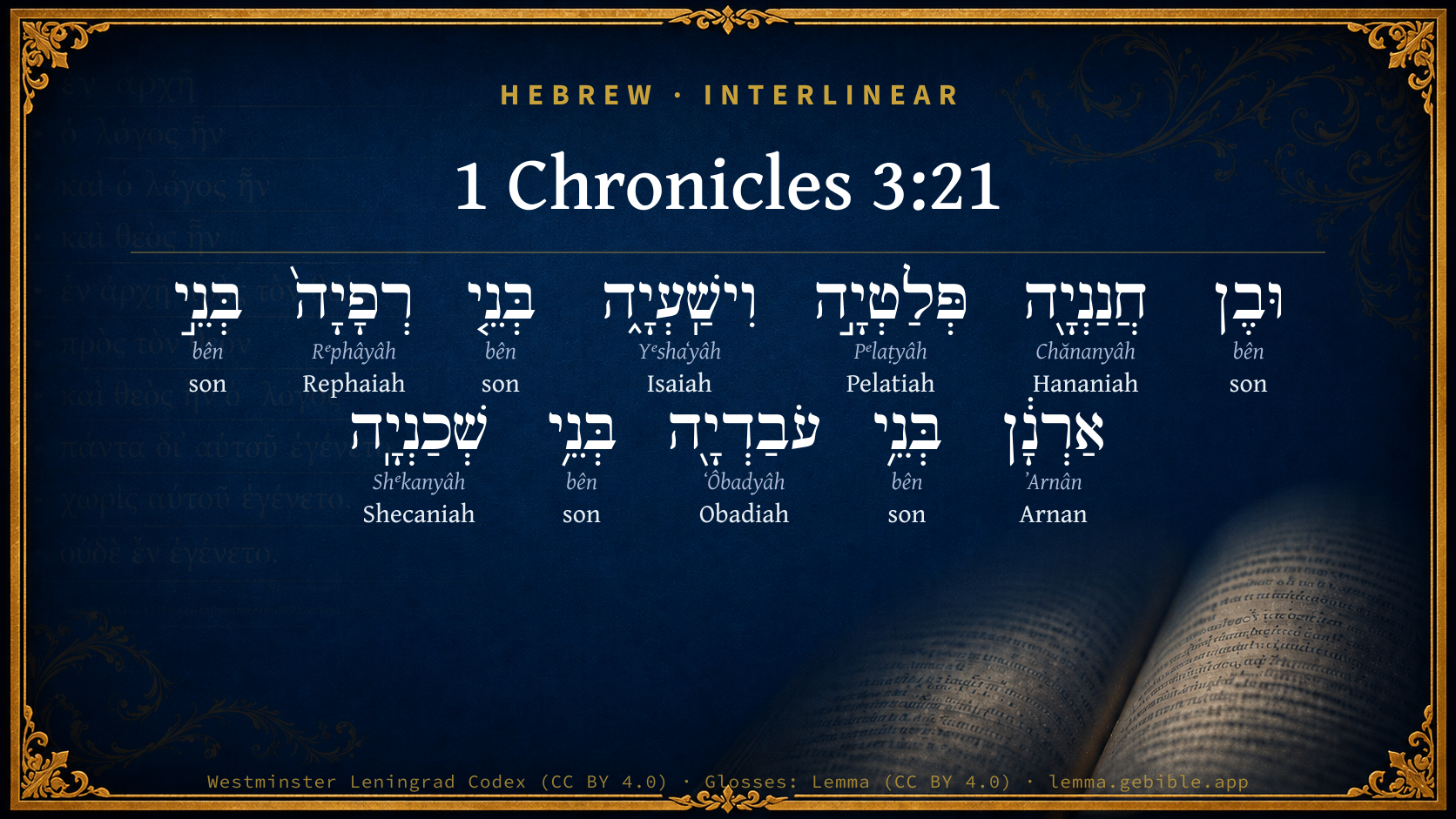
1 Chronicles 3:21

Hebrew (Westminster Leningrad Codex) 1 Chronicles 3:21 appears in the Hebrew Old Testament. The text above is from the Westminster Leningrad Codex. Each word links to its Strong’s number, a concise gloss, and parsing drawn from the Open Scriptures Hebrew Bible morphology. Click any word for its full Brown-Driver-Briggs (BDB) entry.
Download image
Cite this verse

1 Chronicles 3:21 (World English Bible). Public Domain. Lemma interlinear Bible study tool, https://lemma.gebible.app/v/1-chronicles/3/21.

Show BibTeX & RIS
BibTeX
RIS
English Translation
The sons of Hananiah: Pelatiah, and Jeshaiah; the sons of Rephaiah, the sons of Arnan, the sons of Obadiah, the sons of Shecaniah.
World English Bible · Public Domain
Highlights
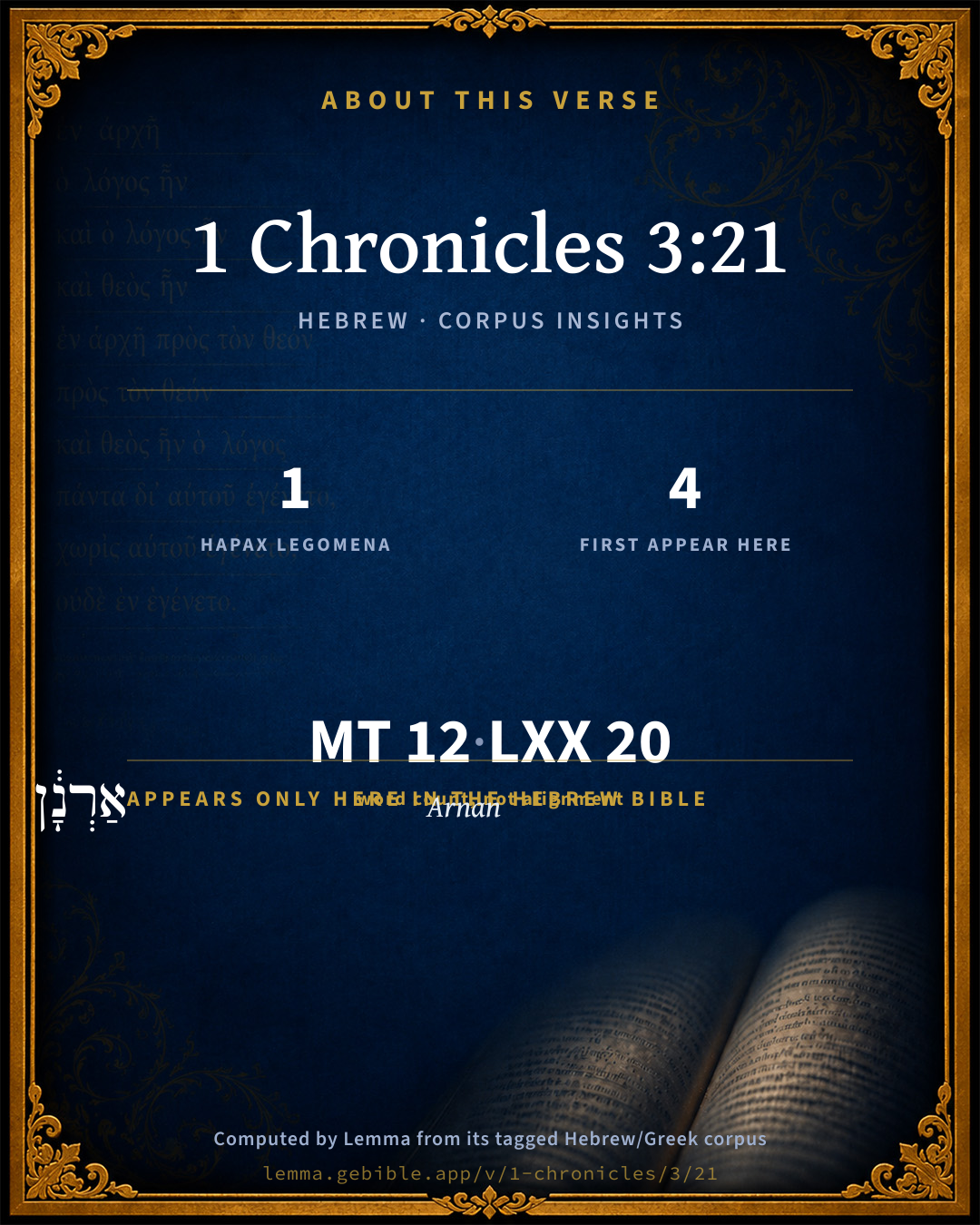
  • 1 hapax legomenon — only here in the Hebrew Bible
  • 4 first appearances in the Hebrew Bible
Full analysis ↓
Download a study sheet

One document with this verse’s original text, its word-by-word gloss line, the meaning frame, cross-references with their text, attributed commentary, and full source and license credits — printable, and it pastes into notes with its structure intact.

This verse Autodidact and up

Study sheet (.html) Plain text (.txt)

A passage Seminary Student

Up to 50 verses in one chapter. A passage sheet keeps up to 6 commentary sources and 12 cross-references per verse, in the order this page ranks them, and says so on the sheet whenever that leaves anything out. Ask for a single verse and you get the Autodidact verse sheet above.

Everything on this page stays free to read, with no account — the sheet is a download of what is already on screen, not access to it.

Want to remove ads? Support Godless Engineer
Compare translations 3

The same verse in 3 English versions, stacked beneath the original-language interlinear above. Click any original word for its lexicon entry.

Each is an independent rendering of the whole verse — the interlinear is not word-aligned to these translations.

Highlighted words mark where these versions differ — a whole-verse word diff, not a word-by-word alignment.

  • World English Bible Public Domain
    The sons of Hananiah: Pelatiah, and Jeshaiah; the sons of Rephaiah, the sons of Arnan, the sons of Obadiah, the sons of Shecaniah.
  • King James Version Public Domain
    And the sons of Hananiah; Pelatiah, and Jesaiah: the sons of Rephaiah, the sons of Arnan, the sons of Obadiah, the sons of Shechaniah.
  • unfoldingWord Literal Text CC BY-SA 4.0
    And the son of Hananiah: Pelatiah and Jeshaiah; the sons of Rephaiah, the sons of Arnan, the sons of Obadiah, the sons of Shekaniah.

unfoldingWord Literal Text — © unfoldingWord, licensed CC BY-SA 4.0. Word-aligned USFM3 via Door43 (git.door43.org/unfoldingWord/en_ult).

Versions to compare (up to 4)

3 of 4 selected

Show all 18 translations

Every available English version of this verse, each an independent rendering of the whole verse.

  • World English Bible Public Domain
    The sons of Hananiah: Pelatiah, and Jeshaiah; the sons of Rephaiah, the sons of Arnan, the sons of Obadiah, the sons of Shecaniah.
  • Berean Standard Bible Public Domain
    The descendants of Hananiah: Pelatiah, Jeshaiah, and the sons of Rephaiah, of Arnan, of Obadiah, and of Shecaniah.
  • Majority Standard Bible Public Domain
    The descendants of Hananiah: Pelatiah, Jeshaiah, and the sons of Rephaiah, of Arnan, of Obadiah, and of Shecaniah.
  • King James Version Public Domain
    And the sons of Hananiah; Pelatiah, and Jesaiah: the sons of Rephaiah, the sons of Arnan, the sons of Obadiah, the sons of Shechaniah.
  • American Standard Version (1901) Public Domain
    And the sons of Hananiah: Pelatiah, and Jeshaiah; the sons of Rephaiah, the sons of Arnan, the sons of Obadiah, the sons of Shecaniah.
  • Revised Version (1885) Public Domain
    And the sons of Hananiah; Pelatiah, and Jeshaiah: the sons of Rephaiah, the sons of Arnan, the sons of Obadiah, the sons of Shecaniah.
  • Geneva Bible (1599) Public Domain
    And the sonnes of Hananiah were Pelatiah, and Iesaiah: the sonnes of Rephaiah, the sonnes of Arnan, the sonnes of Obadiah, the sonnes of Shechaniah.
  • Douay-Rheims (1899) Public Domain
    And the son of Hananias was Phaltias the father of Jeseias, whose son was Raphaia. And his son was Arnan, of whom was born Obdia, whose son was Sechenias.
  • Young's Literal Translation Public Domain
    And sons of Hananiah: Pelatiah, and Jesaiah, sons of Rephaiah, sons of Arnan, sons of Obadiah, sons of Shechaniah.
  • Literal Standard Version CC BY-SA 4.0
    And sons of Hananiah: Pelatiah, and Jesaiah, sons of Rephaiah, sons of Arnan, sons of Obadiah, sons of Shechaniah.
  • Unlocked Literal Bible CC BY-SA 4.0
    Hananiah's sons were Pelatiah and Jeshaiah. His son was Rephaiah, and further descendants were Arnan, Obadiah, and Shekaniah.
  • unfoldingWord Literal Text CC BY-SA 4.0
    And the son of Hananiah: Pelatiah and Jeshaiah; the sons of Rephaiah, the sons of Arnan, the sons of Obadiah, the sons of Shekaniah.
  • Darby Bible Public Domain
    And the sons of Hananiah: Pelatiah and Isaiah; the sons of Rephaiah, the sons of Arnan, the sons of Obadiah, the sons of Shechaniah.
  • World Messianic Bible Public Domain
    The sons of Hananiah: Pelatiah and Jeshaiah; the sons of Rephaiah, the sons of Arnan, the sons of Obadiah, the sons of Shecaniah.
  • Webster's Bible Public Domain
    And the sons of Hananiah; Pelatiah, and Jesaiah: the sons of Rephaiah, the sons of Arnan, the sons of Obadiah, the sons of Shechaniah.
  • Free Bible Version CC BY-SA 4.0
    The sons of Hananiah: Pelatiah and Jeshaiah, and the sons of Rephaiah, the sons of Arnan, the sons of Obadiah, and the sons of Shecaniah.
  • Bible in Basic English Public Domain
    And the sons of Hananiah: Pelatiah and Jeshaiah; the sons of Rephaiah, the sons of Arnan, the sons of Obadiah, the sons of Shecaniah.
  • JPS Tanakh (1917) Public Domain
    And the sons of Hananiah: Pelatiah, and Jeshaiah; the sons of Jeshaiah: Rephaiah; the sons of Rephaiah: Arnan; the sons of Arnan: Obadiah; the sons of Obadiah: Shecaniah.

Literal Standard Version (2020), Covenant Press — licensed CC BY-SA 4.0. Text via the HelloAO Bible API (eBible.org). Unlocked Literal Bible (unfoldingWord) — licensed CC BY-SA 4.0. Text via the HelloAO Bible API (eBible.org). unfoldingWord Literal Text — © unfoldingWord, licensed CC BY-SA 4.0. Word-aligned USFM3 via Door43 (git.door43.org/unfoldingWord/en_ult). Free Bible Version, Dr. Jonathan Gallagher — licensed CC BY-SA 4.0. Text via the HelloAO Bible API (eBible.org).

Word by word

More ways to search: Search by grammar → Find every occurrence → Compare this word →

Practice this passage: Drill this verse → Learn its vocabulary →

About this verse

These counts appear in no published source. They are computed here, from the morphology-tagged text and Lemma’s own curated glosses. What Lemma adds →

12
words
8
distinct lemmas
Historical
section

Notable vocabulary

1 hapax legomenon — a word that appears only here in the entire Hebrew Bible:

  • אַרְנָ֔ן Arnan H770

First appearance in Scripture

These words make their first canonical appearance in the Hebrew Bible here:

  • פְּלַטְיָ֣ה Pelatiah H6410
  • רְפָיָה֙ Rephaiah H7509
  • אַרְנָ֔ן Arnan H770
  • שְׁכַנְיָֽה Shecaniah H7935

Shared distinctive vocabulary

פְּלַטְיָ֣ה Pelatiah H6410 occurs in 5 verses of the Hebrew Bible. Also found in:

Grammatical profile

  • 12 nouns

Repetition

A word recurs within this verse — often emphatic in Hebrew:

  • וּבֶן son H1121 ×5

Hebrew & Septuagint length

In English translation the verse runs 23 words from the Hebrew and 22 from the Septuagint (LXX English) — closely comparable.

A rough comparison of the two English renderings, which tokenize alike — not a word-level alignment.

Word counts can differ between the Hebrew and the Greek without any difference in meaning — e.g. the Hebrew direct-object marker אֵת has no separate Greek word, and Greek often adds the article ὁ.

In the original languages it is 12 Hebrew tokens and 20 Greek tokens — but the two are counted differently (Hebrew bundles its prefixes and suffixes into one token; the Greek is in lemma form), so that isn’t a like-for-like length.

Cross-references

1

Topical passages linked to 1 Chronicles 3:21 in the Treasury of Scripture Knowledge — connected by theme and wording, ordered by reader-vote popularity; previews shown in the World English Bible.

Cross-references courtesy of OpenBible.info (CC BY 4.0).

Hebrew and Greek witnesses Masoretic Hebrew ↔ Greek Septuagint

The same verse in the two great witnesses to the Old Testament, shown verse-for-verse.

These are two independent witnesses, not word-aligned to each other, and the Septuagint is shown in lemma (dictionary) form.

Hebrew 1 Chronicles 3:21 Masoretic · Westminster Leningrad Codex

וּבֶן חֲנַנְיָ֖ה פְּלַטְיָ֣ה וִישַֽׁעְיָ֑ה בְּנֵ֤י רְפָיָה֙ בְּנֵ֣י אַרְנָ֔ן בְּנֵ֥י עֹבַדְיָ֖ה בְּנֵ֥י שְׁכַנְיָֽה

The sons of Hananiah: Pelatiah, and Jeshaiah; the sons of Rephaiah, the sons of Arnan, the sons of Obadiah, the sons of Shecaniah.

World English Bible · Public Domain

Greek LXX 1 Chronicles 3:21 Septuagint · lemma form

καί υἱός ανανια φαλλετια καί ισαια υἱός αὐτός ραφαια υἱός αὐτός ορνα υἱός αὐτός αβδια υἱός αὐτός σεχενια υἱός αὐτός

And the sons of Anania, Phalettia, and Jesias his son, Raphal his son, Orna his son, Abdia his son, Sechenias his son.

LXX2012 (modern English Septuagint) · Public Domain

On this verse, Ellicott's Commentary for English Readers discusses the Septuagint’s reading. Read the note in Commentary ↓

Hebrew: Westminster Leningrad Codex (CC BY 4.0). Greek: Septuagint (public domain); English from LXX2012 (modern English Septuagint) (Public Domain). How the Septuagint differs from the Hebrew →

Commentary

Notes on 1 Chronicles 3:21 from classic Christian and Jewish commentators (each source and its license shown beneath its notes). The classic Christian expositions comment on the surrounding passage and are grouped to its opening verse, so a note may address several verses; the Jewish commentaries on the Tanakh (Rashi and others) are per-verse, so they appear only where the commentator wrote on this verse.

Lemma curates 59 commentaries, every one of them public domain or Creative Commons licensed, each selected and text-cleaned for this edition rather than reprinted as found. About our sources →

Trapp's Complete Commentary

John Trapp

1Ch 3:21 And the sons of Hananiah; Pelatiah, and Jesaiah: the sons of Rephaiah, the sons of Arnan, the sons of Obadiah, the sons of Shechaniah.

Ver. 21. And the sons of Hananiah.] It is thought that these were the families of the blood royal, after the captivity. And some do here hence gather, that these Books of Chronicles were last written of all the Old Testament: by the Hebrews they are placed last.

John Trapp, A Commentary or Exposition upon All the Books of the Old and New Testament (1647–1656) — public domain. Text from a community e-Sword module.

Joseph Benson's Commentary

1Ch 3:21-22. The sons of Shechaniah — All these, both parents and their sons blended together, are mentioned as the sons of Hananiah, and branches of the royal stock. Six — Including the father. But the Hebrew word, shisha, which is rendered six, may be the proper name of one of the sons of Shemaiah. As the family of David was the most considerable of any of the tribe of Judah, the genealogy of his descendants was preserved with great care and exactness; and is here recorded in part, to assist us in tracing the descent of our Lord Jesus Christ from him, that we might have that proof, among others, of his being the true Messiah.

Joseph Benson's Commentary on the Old and New Testaments (1811–1818) — public domain. Text from a community e-Sword module.

Tyndale Open Study Notes

Tyndale Open Resources

3:21 The sons of Hananiah . . . Shecaniah (literally The son of Hananiah [was] Pelatiah and Jeshaiah, the sons of Rephaiah, the sons of Arnan, the sons of Obadiah, the sons of Shecaniah): In Hebrew, all the names are listed as “the sons” of Hananiah, all in one generation. However, many ancient manuscripts and translations support viewing the list as covering several generations (as in the NLT) by translating “sons of” (Hebrew beney, four times) as “son of” (Hebrew beno). The resulting genealogy extends several generations from the time of Zerubbabel and his son Hananiah.

Tyndale Open Study Notes — © Tyndale Open Resources, licensed CC BY-SA 4.0. Text via the HelloAO Bible API.

Ellicott's Commentary for English Readers

(21) And the sons of Hananiah; Pelatiah, and Jesaiah.—Heb., son; but some MSS. and all the versions read sons. Pelatiah means Iah is deliverance. Jesaiah is the same name as Isaiah, meaning Iah is salvation.

The sons of Rephaiah.—The ancient versions represent here an important various reading. The LXX. have rendered the whole verse thus: “And sons of Anania; Phalettia, and Jesias his son, Raphal his son, Orna his son, Abdia his son (Sechenias his son.)” The Syriac reads: “Sons of Hananiah: Pelatiah and Ushaiah. Arphaia his son, Arnun his son, Ubia his son—viz., Ushaia’s; and his son, viz., Shechaniah’s Shemaiah,” &c. The difference between “sons” and “his son” in Hebrew writing is simply that between y and w. (See Note on 1 Chronicles 1)

This various reading presents a form of genealogy like that which prevails in 1Ch_3:10-16, and occurs also in 1Ch_3:17, at the beginning of the present section. But it is probable that this reading is really an ancient correction of the Hebrew text, which, as it stands, appears to leave undefined the relation between Hananiah and the four families mentioned in this verse. The truth, however, would seem to be that the expression “the sons of Hananiah” includes not only Pelatiah and Jesaiah, but also the four families named after Rephaiah, Arnan, Obadiah, and Shechaniah (comp. 1Ch_2:42, and Note). The four founders of these families were perhaps brothers of Pelatiah and Jesaiah, though not necessarily so; for these families may have been subdivisions of those of Pelatiah and Jesaiah.

Rephaiah.—Iah healeth (Isa_30:26; Exo_15:26). See Note on 1Ch_3:20.

A Bible Commentary for English Readers, edited by Charles John Ellicott (1878–1897) — public domain. Text from a community e-Sword module.

The Cambridge Bible for Schools and Colleges

gen. ed. J. J. S. Perowne

21. and Jesaiah … Shechaniah] The LXX. reads (with some blunders hi reproducing the names), “and Jesaiah his son, Rephaiah his son, Arnan his son, Obadiah his son, Shechaniah his son,” thus adding five steps to the genealogy. The difference of reading in the Heb. text thus suggested is very slight. Probably the LXX. is to be followed.

The Cambridge Bible for Schools and Colleges (gen. ed. J. J. S. Perowne; Cambridge University Press, 1878–1918) — public domain. Text from a community e-Sword module.

Haydock's Catholic Bible Commentary

Son. Hebrew, "sons of Hananias, Phaltias, and Jesacias, the sons of Raphias, the sons of Arnan,...(22) the sons of Sechenias, Semeia, &c." But the Septuagint and Syriac have read in a more intelligible manner, (Calmet) intimating that these people were lineally descended from each other, (Haydock) while the Hebrew leaves us ignorant of the names of the sons of Rephaias, &c. (Calmet)

George Leo Haydock (1774–1849), Haydock's Catholic Family Bible and Commentary, 1859 edition — public domain. Excludes Psalms (Douay-Rheims chapter numbering differs from Protestant) and Deuterocanonical books (Catholic canon only).

Matthew Poole's English Annotations

All these men, both parents and their sons here blended together, are mentioned as the sons of Hananiah, and branches of the royal stock.

Matthew Poole's English Annotations on the Holy Bible (1683–1685) — public domain. Text from a community e-Sword/MySword module.

The Pulpit Commentary

The Hebrew text, followed by the Vulgate, not followed by the Septuagint, reads here jynnh Yet some manuscripts have the plural "sons," from which comes our Authorized Version. The indication is important. It is doubly interesting, as the only indication in our Hebrew text that tends to give confirmation to the very noteworthy differences of the Septuagint Version. For although this last, apparently somewhat perversely, begins its version with "sons," which plural does not so well suit its sequel, instead of the "son" of our Hebrew text, which would suit it, yet it proceeds with a translation which must have been obtained from another text, such text again suiting properly the singular of our Hebrew. The form of its translation is analogous to that marked in the words of vers. 10-14. "The sons sic son of Ananiah, Pelatiah, and Jesaiah his son, Rephaiah his son, Arnan his son, Obadiah his son, Shechaniah his son," making six (presumably) consecutive generations. This, therefore, is the reading which (if correct) might carry down the genealogy to the times of Alexander the Great, and indeed to a time a quarter of a century later. And in doing so, it would certify this entry as of later date than probably any other of the canon! If we reject this position and reading, we have to get over the term, repeated several times, the sons of. To do this, Bertheau suggests that the intention of our passage was, from the name Rephaiah inclusive, not to mention the individual four brothers" names, but to mention them as four distinguished families among the posterity of David an attempt at explanation certainly not satisfactory. The conclusion of the matter is, that in this twenty-first verse we have difficulties in either alternative, not satisfactorily explained. Either we have the names in all of six brothers, being sons of Hananiah the last four of whom are styled, not by their individual names, but as heads of families; or we have six lineal descendants from Hananiah. If this last supposition were correct, calculate a royal succession at the lowest average (say something under twenty years), and the genealogy, including what follows in the remaining verses of the chapter, will bring us, as above, to a date that covers the whole life of Alexander the Great.

The Pulpit Commentary (1880–1919), ed. H.D.M. Spence-Jones & Joseph S. Exell — public domain. Text from a community e-Sword module.

John Wesley's Explanatory Notes

Shechaniah - All these both parents and their sons blended together, are mentioned as the sons of Hananiah, and branches of the royal stock.

John Wesley, Explanatory Notes Upon the Whole Bible (1754–1765) — public domain. Text via the GEBible commentary corpus.

Lesson kit

Teaching starters — assembled from the data on this page, not authored interpretation. Every prompt links to the verse data it draws on. Edit before teaching.

1 Chronicles, in the Historical, opens this verse with 12 words (8 distinct Hebrew lemmas). Its most distinctive word is ʼArnân (“Arnan”). A historical commentator’s framing appears above. Read the whole chapter for the surrounding context.

Discussion questions

  1. The word ʼArnân carries the sense “Arnan.” How does it shape the verse?
  2. 1 word here appears nowhere else in the Hebrew Bible. Why might the author reach for such rare wording?
  3. 4 words make their first appearance in Scripture here. What does this debut establish?
  4. How does 1 Chronicles 4:42, which shares the word «Pelatiah», read alongside this verse?
  5. What does the repetition of “son” (5× in this one verse) do in this verse?
  6. These translations render this verse differently. What is at stake in choosing one wording over another?
  7. Compare how Trapp's Complete Commentary and Joseph Benson's Commentary read this verse. Where do they agree or differ?

Things to notice

  • 1 word in this verse appears nowhere else in the Hebrew Bible.
  • 4 words make their first canonical appearance in Scripture here.
  • This verse counts 12 Hebrew ↔ 20 Greek words.
  • These translations choose different wording for 6 words in this verse.
  • “son” occurs 5× in this single verse.

Reading settings

Reading text

Shown beneath each verse's original-language words.

Old Testament
Old Testament edition

Read the OT as the Masoretic Hebrew (MT) or the Greek Septuagint (LXX).

English shown for the Greek Septuagint (in the Hebrew ↔ Greek comparison).

Comparing translations? Open the Compare panel on any verse page to stack up to four side by side.