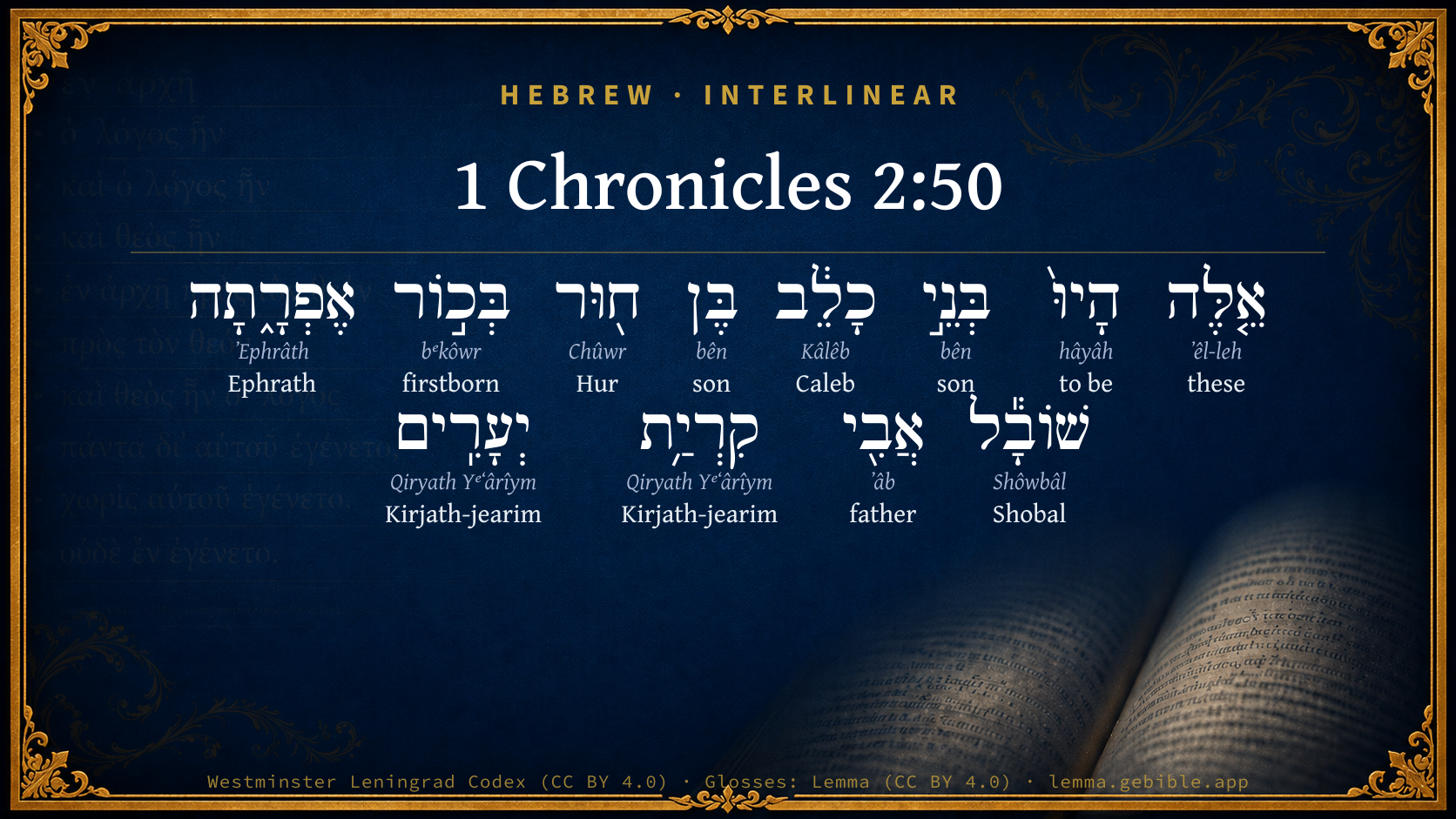
1 Chronicles 2:50

Hebrew (Westminster Leningrad Codex) 1 Chronicles 2:50 appears in the Hebrew Old Testament. The text above is from the Westminster Leningrad Codex. Each word links to its Strong’s number, a concise gloss, and parsing drawn from the Open Scriptures Hebrew Bible morphology. Click any word for its full Brown-Driver-Briggs (BDB) entry.
Download image
Cite this verse

1 Chronicles 2:50 (World English Bible). Public Domain. Lemma interlinear Bible study tool, https://lemma.gebible.app/v/1-chronicles/2/50.

Show BibTeX & RIS
BibTeX
RIS
English Translation
These were the sons of Caleb, the son of Hur, the firstborn of Ephrathah: Shobal the father of Kiriath Jearim,
World English Bible · Public Domain
Download a study sheet

One document with this verse’s original text, its word-by-word gloss line, the meaning frame, cross-references with their text, attributed commentary, and full source and license credits — printable, and it pastes into notes with its structure intact.

This verse Autodidact and up

Study sheet (.html) Plain text (.txt)

A passage Seminary Student

Up to 50 verses in one chapter. A passage sheet keeps up to 6 commentary sources and 12 cross-references per verse, in the order this page ranks them, and says so on the sheet whenever that leaves anything out. Ask for a single verse and you get the Autodidact verse sheet above.

Everything on this page stays free to read, with no account — the sheet is a download of what is already on screen, not access to it.

Want to remove ads? Support Godless Engineer
Compare translations 3

The same verse in 3 English versions, stacked beneath the original-language interlinear above. Click any original word for its lexicon entry.

Each is an independent rendering of the whole verse — the interlinear is not word-aligned to these translations.

Highlighted words mark where these versions differ — a whole-verse word diff, not a word-by-word alignment.

  • World English Bible Public Domain
    These were the sons of Caleb, the son of Hur, the firstborn of Ephrathah: Shobal the father of Kiriath Jearim,
  • King James Version Public Domain
    These were the sons of Caleb the son of Hur, the firstborn of Ephratah; Shobal the father of Kirjathjearim.
  • unfoldingWord Literal Text CC BY-SA 4.0
    These were the sons of Caleb. q1 The son of Hur, the firstborn of Ephrathah: Shobal, the father of Kiriath Jearim;

unfoldingWord Literal Text — © unfoldingWord, licensed CC BY-SA 4.0. Word-aligned USFM3 via Door43 (git.door43.org/unfoldingWord/en_ult).

Versions to compare (up to 4)

3 of 4 selected

Show all 18 translations

Every available English version of this verse, each an independent rendering of the whole verse.

  • World English Bible Public Domain
    These were the sons of Caleb, the son of Hur, the firstborn of Ephrathah: Shobal the father of Kiriath Jearim,
  • Berean Standard Bible Public Domain
    These were the descendants of Caleb. The sons of Hur the firstborn of Ephrathah: Shobal the father of Kiriath-jearim,
  • Majority Standard Bible Public Domain
    These were the descendants of Caleb. The sons of Hur the firstborn of Ephrathah: Shobal the father of Kiriath-jearim,
  • King James Version Public Domain
    These were the sons of Caleb the son of Hur, the firstborn of Ephratah; Shobal the father of Kirjathjearim.
  • American Standard Version (1901) Public Domain
    These were the sons of Caleb, the son of Hur, the first-born of Ephrathah: Shobal the father of Kiriath-jearim,
  • Revised Version (1885) Public Domain
    These were the sons of Caleb; the son of Hur, the firstborn of Ephrathah, Shobal the father of Kiriath-jearim;
  • Geneva Bible (1599) Public Domain
    These were the sonnes of Caleb the sone of Hur the eldest sonne of Ephrathah, Shobal the father of Kiriath-iearim.
  • Douay-Rheims (1899) Public Domain
    These were the sons of Caleb, the son of Hur the firstborn of Ephrata, Sobal the father of Cariathiarim.
  • Young's Literal Translation Public Domain
    These were sons of Caleb son of Hur, first-born of Ephrathah: Shobal father of Kirjath-Jearim,
  • Literal Standard Version CC BY-SA 4.0
    These were sons of Caleb son of Hur, firstborn of Ephrathah: Shobal father of Kirjath-Jearim,
  • Unlocked Literal Bible CC BY-SA 4.0
    These were the sons of Hur, his firstborn by Ephrathah: Shobal the father of Kiriath Jearim,
  • unfoldingWord Literal Text CC BY-SA 4.0
    These were the sons of Caleb. q1 The son of Hur, the firstborn of Ephrathah: Shobal, the father of Kiriath Jearim;
  • Darby Bible Public Domain
    These are the sons of Caleb. The sons of Hur, the firstborn of Ephratah: Shobal the father of Kirjath-jearim,
  • World Messianic Bible Public Domain
    These were the sons of Caleb, the son of Hur, the firstborn of Ephrathah: Shobal the father of Kiriath Jearim,
  • Webster's Bible Public Domain
    These were the sons of Caleb the son of Hur, the first-born of Ephratah; Shobal the father of Kirjath-jearim,
  • Free Bible Version CC BY-SA 4.0
    These are all the descendants of Caleb. The sons of Hur the firstborn of Ephrathah: Shobal, the father of Kiriath Jearim,
  • Bible in Basic English Public Domain
    The sons of Hur, the oldest son of Ephrathah; Shobal, the father of Kiriath-jearim,
  • JPS Tanakh (1917) Public Domain
    These were the sons of Caleb. The sons of Hur the first-born of Ephrath: Shobal the father of Kiriath-jearim;

Literal Standard Version (2020), Covenant Press — licensed CC BY-SA 4.0. Text via the HelloAO Bible API (eBible.org). Unlocked Literal Bible (unfoldingWord) — licensed CC BY-SA 4.0. Text via the HelloAO Bible API (eBible.org). unfoldingWord Literal Text — © unfoldingWord, licensed CC BY-SA 4.0. Word-aligned USFM3 via Door43 (git.door43.org/unfoldingWord/en_ult). Free Bible Version, Dr. Jonathan Gallagher — licensed CC BY-SA 4.0. Text via the HelloAO Bible API (eBible.org).

Word by word

More ways to search: Search by grammar → Find every occurrence → Compare this word →

Practice this passage: Drill this verse → Learn its vocabulary →

About this verse

These counts appear in no published source. They are computed here, from the morphology-tagged text and Lemma’s own curated glosses. What Lemma adds →

12
words
10
distinct lemmas
Historical
section

Notable vocabulary

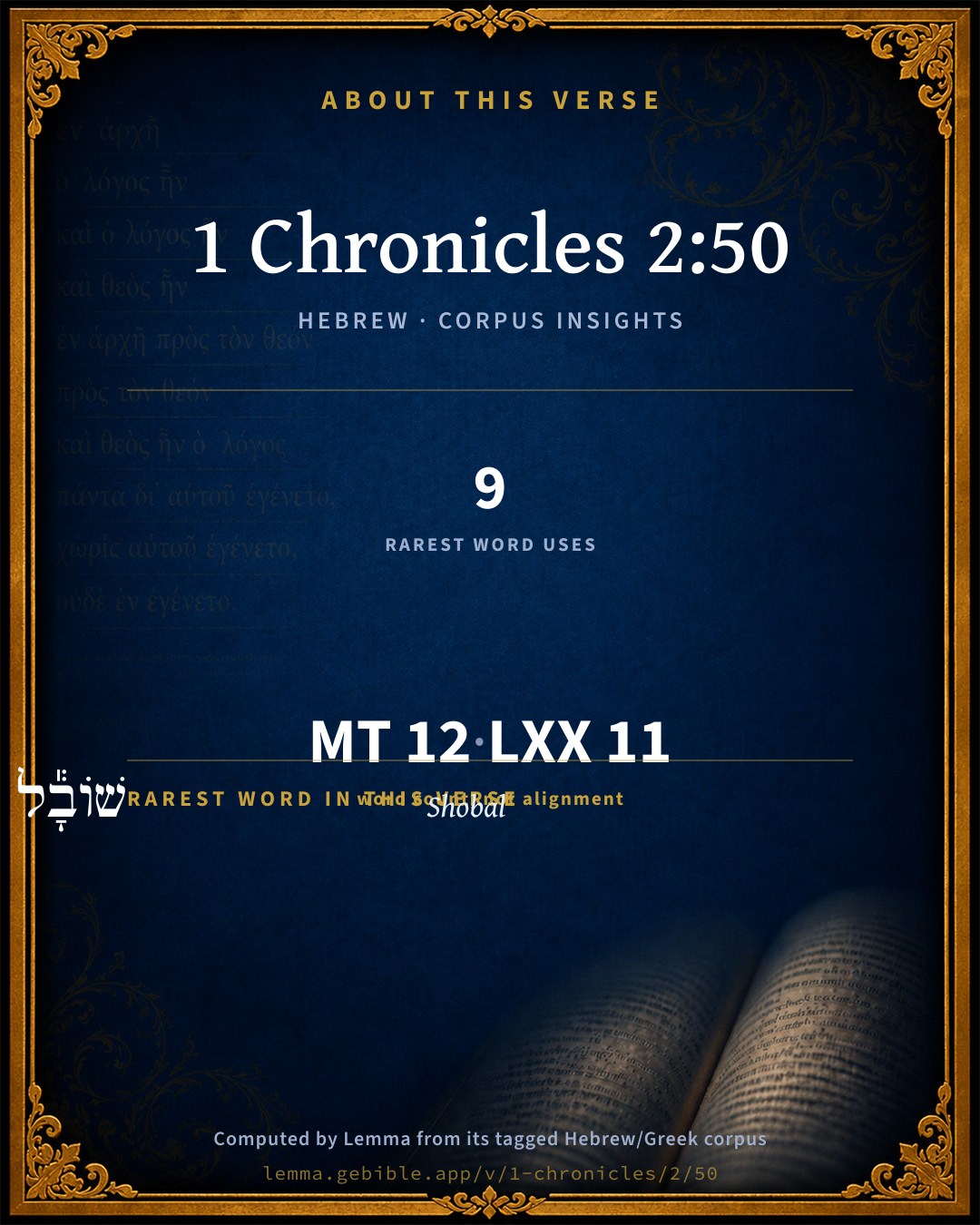
The rarest word here is שׁוֹבָ֕ל Shobal H7732 — appearing just 9 times in the whole Hebrew Bible.

Shared distinctive vocabulary

שׁוֹבָ֕ל Shobal H7732 occurs in 9 verses of the Hebrew Bible. Also found in:

Grammatical profile

  • 1 verb
  • 10 nouns
  • 1 pronoun

Verb forms

  • הָיוּ֙ Qal · Perfect

Repetition

Words recur within this verse — often emphatic in Hebrew:

  • בְּנֵ֣י son H1121 ×2
  • קִרְיַ֥ת Kirjath-jearim H7157 ×2

Hebrew & Septuagint length

In English translation the verse runs 20 words from the Hebrew and 19 from the Septuagint (LXX English) — closely comparable.

A rough comparison of the two English renderings, which tokenize alike — not a word-level alignment.

Word counts can differ between the Hebrew and the Greek without any difference in meaning — e.g. the Hebrew direct-object marker אֵת has no separate Greek word, and Greek often adds the article ὁ.

In the original languages it is 12 Hebrew tokens and 11 Greek tokens — but the two are counted differently (Hebrew bundles its prefixes and suffixes into one token; the Greek is in lemma form), so that isn’t a like-for-like length.

Cross-references

7

Topical passages linked to 1 Chronicles 2:50 in the Treasury of Scripture Knowledge — connected by theme and wording, ordered by reader-vote popularity; previews shown in the World English Bible.

  • Joshua 15:9 and the border extended from the top of the mountain to the spring of the waters of Nephtoah, and went out to the cities of Mount Ephron; and the border extended to Baalah (the same is Kiriath Jearim);
  • Joshua 15:60 Kiriath Baal (the same is Kiriath Jearim), and Rabbah; two cities with their villages.
  • 1 Samuel 7:1 The men of Kiriath Jearim came, and fetched up the ark of Yahweh, and brought it into the house of Abinadab in the hill, and sanctified Eleazar his son to keep the ark of Yahweh.
  • 1 Chronicles 2:19–20 Azubah died, and Caleb took to him Ephrath, who bore him Hur.
  • 1 Chronicles 2:53 The families of Kiriath Jearim: The Ithrites, and the Puthites, and the Shumathites, and the Mishraites; of them came the Zorathites and the Eshtaolites.
  • 1 Chronicles 4:4 and Penuel the father of Gedor, and Ezer the father of Hushah. These are the sons of Hur, the firstborn of Ephrathah, the father of Bethlehem.
  • 1 Chronicles 13:5–6 So David assembled all Israel together, from the Shihor [the brook] of Egypt even to the entrance of Hamath, to bring the ark of God from Kiriath Jearim.

Cross-references courtesy of OpenBible.info (CC BY 4.0).

Hebrew and Greek witnesses Masoretic Hebrew ↔ Greek Septuagint

The same verse in the two great witnesses to the Old Testament, shown verse-for-verse.

These are two independent witnesses, not word-aligned to each other, and the Septuagint is shown in lemma (dictionary) form.

Hebrew 1 Chronicles 2:50 Masoretic · Westminster Leningrad Codex

אֵ֤לֶּה הָיוּ֙ בְּנֵ֣י כָלֵ֔ב בֶּן ח֖וּר בְּכ֣וֹר אֶפְרָ֑תָה שׁוֹבָ֕ל אֲבִ֖י קִרְיַ֥ת יְעָרִֽים

These were the sons of Caleb, the son of Hur, the firstborn of Ephrathah: Shobal the father of Kiriath Jearim,

World English Bible · Public Domain

Greek LXX 1 Chronicles 2:50 Septuagint · lemma form

οὗτος εἰμί υἱός χαλεβ υἱός ωρ πρωτότοκος εφραθα σωβαλ πατήρ καριαθιαριμ

These were the sons of Chaleb: the sons of Or the firstborn of Ephratha; Sobal the father of Cariathiarim,

LXX2012 (modern English Septuagint) · Public Domain

On this verse, Ellicott's Commentary for English Readers discusses the Septuagint’s reading. Read the note in Commentary ↓

Hebrew: Westminster Leningrad Codex (CC BY 4.0). Greek: Septuagint (public domain); English from LXX2012 (modern English Septuagint) (Public Domain). How the Septuagint differs from the Hebrew →

Commentary

Notes on 1 Chronicles 2:50 from classic Christian and Jewish commentators (each source and its license shown beneath its notes). The classic Christian expositions comment on the surrounding passage and are grouped to its opening verse, so a note may address several verses; the Jewish commentaries on the Tanakh (Rashi and others) are per-verse, so they appear only where the commentator wrote on this verse.

Lemma curates 59 commentaries, every one of them public domain or Creative Commons licensed, each selected and text-cleaned for this edition rather than reprinted as found. About our sources →

Ellicott's Commentary for English Readers

III.—1Ch_2:50-55 : A third register of Calebite clans and settlements.

(50) The sons of Caleb the son of Hur, the firstborn of Ephratah.—See 1Ch_2:19-20 and Notes. The statement “These were the sons of Caleb” should be connected with 1Ch_2:49, as a subscription or concluding remark to the list, 1Ch_2:42-49. (Comp. 1Ch_2:33.) A fresh start is then made with “the sons (so the LXX.) of Hur, firstborn of Ephratah,” reverting to the Caleb of 1Ch_2:19 seq., just as 1Ch_2:34 returns to Jerahmeel in the Sheshanite branch.

Shobal the father of Kirjath-jearim.—Shobal is named at 1Ch_4:1 as a chief clan or sub-tribe of Judah, along with Hur.

Kirjath-jearim.—“City of woods,” one of the four cities of the Gibeonites (Jos_9:17), also called Kirjath-Baal and Baalah (Jos_15:9; Jos_15:60), in the hill-country of Judah.

(51) Salma the father of Beth-lehem.—See 1Ch_2:11, where Salma may be the feather-house (clan) of which Boaz was a member. The present Salma, however, is a Calebite, whereas the Salma of 1Ch_2:11 is a Ramite.

Beth-gader (géder).—Jos_12:13, Geder; Jos_15:36, Gederah; or perhaps Gedor (Jos_15:58).

(52) Haroeh, and half of the Manahethites.—Haroeh is probably a relic of Jehoraah (LXX., Ἀραά) =Reaiah (see 1chron iv 2) and perhaps hatsi-hammenuhoth should be altered to hatsi-hammanahti (see 1Ch_2:54), which would give the sense of the Authorised Version. As the Hebrew stands, the Vulg. is a literal rendering of it: qui videbat dimidium requietionum (!). The Manahathites were the people of Manahath (1Ch_8:6). a town near the frontier of Dan and Judah (1Ch_2:54).

(53) This verse is really a continuation of the last, and a comma would be better than a full stop after the word Manahathites. The “families” (clans or groups of families, mishpehôth) dwelling in the canton of Kirjath-jearim, viz., the Ithrites, Puhites (Heb., Puthites), &c, were also sons of Shobâl. Two of David’s heroes, Ira and Gareb (1Ch_11:40), were Ithrites. The three other clans are nowhere else mentioned.

Of them came the Zareathites, and the Eshtaulites.—Rather, from these went forth the Zorathites, &c. The men of Zorah and Eshtaôl were subdivisions of the clans of Kirjath-jearim. Zorah (Jdg_13:2), a Danite town, the home of Samson, now Sura. Eshtaôl, also a Danite town, near Zorah (Jdg_16:31; Jdg_18:11-12), the present Um-Eshteiyeh. Both were on the western border of Judah, a few miles west of Kirjath-jearim.

(54) The sons of Salma; Beth-lehem.—In 1Ch_2:51 Salma is called “father of Bethlehem,” and according to 1Ch_2:50, Salma is a son of Hur and a grandson of Ephratah, i.e., Beth-lehem (see 1Ch_2:19, Note). The recognition of the ethnographical and geographical significance of these expressions at once removes all difficulty. Salma was the principal clan established in Bethlehem-Ephratah; branches of which were settled at Netophah, a neighbouring township (1Ch_9:16; 2Sa_23:28-29), important after the return (Ezr_2:22; Neh_7:26).

Ataroth, the house of Joab.—Rather, Atroth-beth-Joab (comp. Abel-beth-Maachah); an unknown town, whose name means “ramparts of the house of Joab,” i.e., “Joab’s castle,” perhaps a strong city where Joab’s family was settled. (See 1Ch_2:26.)

Half of the Manahethites were sons of Salma, the other half sons of Shobal (1Ch_2:52).

The Zorites.—A by-form of Zorathites (1Ch_2:53). The word really belongs to the next verse, as the sons of Salma are arranged in pairs.

(55) The families (mishpehôth=clans) of the scribes which dwelt at Jabez.—Among the clans calling themselves sons of Salma were three groups of Sopherim (Authorised version, “scribes”) settled at Jabez (Heb., Ia‘bêç), a town of northern Judah, near to Zorah. (See 1Ch_4:9, Note.) The three clans were known as those of Tir‘ah, Shimeah, and Suchah. The Vulg. treats these names as appellatives, and renders canentes atque resonantes et in tabernaculis commorantes, that is, “singing and resounding, and dwelling in tents.” This translation is assumed to be due to Jerome’s Rabbinical teachers, and is justified by reference to the words terû‘âh, “trumpet-blare;” shim‘âh, “report;” or the Aramaic Shema‘tâ “legal tradition” and sûkâh (= sukkah), “a booth.” Hence the conclusion has been drawn that the Sopherim of Jabez were, in fact, ministers of religion, discharging functions precisely like those of the Levites. So Wellhausen, who refers to Jer_35:19, and the title of Psalms 70 in the LXX., and to one or two late fragmentary notices of the Rechabites. On the face of it the supposition is unlikely; nor does it derive any real support from the Kenite origin of these Sopherim, for it is a mere fancy that the house of Jethro, the Kenite priest of Midian, became temple-ministers in Israel. Besides, the etymologies of the names are hardly cogent; and if we try to extract history from etymology here, we might as well do so in the case of the clans of Kirjath-jearim (1Ch_2:53), and make the Ithrites a guild of ropers (yether, “cord, bowstring”), the Puthites hinge-makers (pôthôth—1Ki_1:50—“hinges”), and the Shumathithes garlic-eaters (shûm, “garlic,” Num_11:5). The Vulg. often makes the blunder of translating proper names. (See 1Ch_2:52; 1Ch_2:54).

These are the Kenites that came of Hemath (Heb., Hammath), the father of the house of (Beth-) Rechab.—The three clans of Sopherim were originally Kenites, and traced their descent from Hammath, the traditional founder of the Rechabite stock. When, or under what circumstances these Rechabite Kenites amalgamated with the Calebite clan of Salma is unknown; but comp. Jdg_1:11-16.

A Bible Commentary for English Readers, edited by Charles John Ellicott (1878–1897) — public domain. Text from a community e-Sword module.

The Cambridge Bible for Schools and Colleges

gen. ed. J. J. S. Perowne

50. These were the sons of Caleb the son of Hur] Read with LXX., These were the sons of Caleb. The sons of Hur (Cp. R.V.). Hur was the son of Caleb (1Ch_2:19).

The Cambridge Bible for Schools and Colleges (gen. ed. J. J. S. Perowne; Cambridge University Press, 1878–1918) — public domain. Text from a community e-Sword module.

Albert Barnes' Notes on the Bible

Caleb the son of Hur - Hur was the son, not the father, of Caleb 1Ch 2:19. The text should perhaps be read: “These (the list in 1Ch 2:42-49) were the sons of Caleb. The sons of Hur, the first-born of Ephratah, were Shobal, etc.”

Albert Barnes' Notes on the Bible (1834–1885) — public domain. Text from a community e-Sword/MySword module.

Haydock's Catholic Bible Commentary

Caleb, grandson of Calubi. (Vatable, &c.) --- Sobal, his descendant, was prince of those who established themselves at Cariathiarim. (Calmet) --- The Alexandrian Septuagint seems rather to assert that he was son of Hur, as well as those who follow. "The sons of Hur....Sobal....Salomon, father of Baithlammon, father of Bethleem." But the editions vary. (Haydock)

George Leo Haydock (1774–1849), Haydock's Catholic Family Bible and Commentary, 1859 edition — public domain. Excludes Psalms (Douay-Rheims chapter numbering differs from Protestant) and Deuterocanonical books (Catholic canon only).

The Pulpit Commentary

Vers. 50-55. The opening sentence of these verses has also been already discussed. It may be now added (see Keil, "Commentary," in loc.) that some would understand the words as though they meant, These were the sons of Caleb, in the descending line of Hur, Ephratah"s firstborn. This rendering is got at by altering "the son of Hut" into "the sons of Hur," which seems to have been the reading of the Septuagint manuscripts, and which, at all events, their rendering has. The remainder of ver. 50, with the following four, give three sons of Caleb:

1. Shobal, prince of Kirjath-jearim (city of woods; Jos_9:17 Jos_18:15 Jos_15:9, Jos_15:60; cf. Jos_18:14), on the border-hind of Judah and Benjamin, and about ten miles from Jerusalem on the road to Emmaus (Nicopolis ). It is to be identified, almost with certainty, with the modern Kuriet-el-Enab. Other references of exceeding interest are 1Sa_6:21 1Sa_7:2; Ezr_2:25; Neh_7:29; 1Ch_13:6; 2Ch_1:4; Jer_26:20; Psa_132:6. This Shobal (ver. 52) had two sons, Haroeh , i.e. Reaiah, (1Ch_4:5) and the progenitor, whatever his name, of half of the people called Manahethites (Authorized Version) a form probably suggested by the Masoretic pointing of ver. 54 or Chatsi-hammenon-choth (Hebrew text), which Gesenius treats as a proper name, and which means "the midst of quiet places", (Psa_23:2) from which comes the patronymic of the next verse but one (Barrington, "Genealogies," 1:213). From the Kirjath-jearim family were derived (ver. 53), the Ithrites, Puhites, Shumathites, and Mishraites, of none of whom, except probably the Ithrites (2Sa_11:4) do we find other mention; and from the Mishraites again were derived two offshoots, the Zareathites and Eshtaulites, the towns of both of whom are with great probability to be tracked (Jos_15:33 Jos_19:41; Jud_1:13:25 18:2) They were situated in that part of Judah called the "low" country, or the Shefelah, stretching from Joppa to Gaza on the Mediterranean.

2. Salma, prince of Bethlehem. The so-called "sons" here attributed to him, six in number, including Bethlehem, evidently betoken families rather than the names of individuals. The town Netophah (Ezr_2:21; Neh_7:26) gave the gentile noun Netophathites (Jer_40:8) Ataroth, the house of Joab (i.e. "crowns" of the house of Joab), is not mentioned elsewhere; but the reason of its being distinguished thus may be due to the fact that there was another Ataroth of, (Num_32:3, Num_32:34) and yet another of Ephraim. (Jos_14:5 Jos_18:13) The Zorites (yirxi) Gesenius thinks to be another gentile form from hrx; with ytirxi, but of them we do not read elsewhere.

The Pulpit Commentary (1880–1919), ed. H.D.M. Spence-Jones & Joseph S. Exell — public domain. Text from a community e-Sword module.

unfoldingWord translationNotes

Door43 World Missions Community

Hur ... Shobal ... Salma ... Hareph

These are all the names of men. (See: How to Translate Names)

Ephrathah

This is the name of a woman. (See: How to Translate Names)

father of Kiriath Jearim ... father of Bethlehem ... father of Beth Gader

These are all the names of towns. The towns are metonyms for the people who live in the towns. AT: "founder of Kiriath Jearim ... founder of Bethlehem ... founder of Beth Gader" (See: How to Translate Names)

translationWords

Bethlehem

unfoldingWord translationNotes — © Distant Shores Media and the Door43 World Missions Community, licensed CC BY-SA 4.0. Source: git.door43.org/Door43/en_tn.

Rashi

Rabbi Shlomo Yitzchaki (Rashi)

These were the sons of Caleb, the son of Hur, the firstborn of Ephrathah The interpretation is: These were the sons of Caleb. בֶּן חוּר is like בְּנוֹ חוּר, his son was Hur, and that Hur was the firstborn of Ephrath, his wife, not the firstborn of Caleb, and so it is explained above (verse 19): “And Caleb took to himself Ephrath, and she bore him Hur.” Another explanation [is that] “for these were the sons of, etc.” Hur was Caleb’s son, and he begot a son whom he named Caleb, and this is its explanation: And these were the sons of Caleb the son of Hur: Shobal, etc.

the firstborn of Ephrathah but not the firstborn of Caleb. This refers to Hur. So it appears to us.

Rashi on the Tanakh — English translations: “The Judaica Press complete Tanach with Rashi, translated by A. J. Rosenberg” (CC BY 4.0); “Pentateuch with Rashi's commentary by M. Rosenbaum and A.M. Silbermann, 1929-1934” (public domain); “The Metsudah Tanach series, Lakewood, N.J” (CC BY 4.0); and “The Book of Joshua, Metsudah Publications, 1997” (CC BY 4.0). Text via Sefaria.

Lesson kit

Teaching starters — assembled from the data on this page, not authored interpretation. Every prompt links to the verse data it draws on. Edit before teaching.

1 Chronicles, in the Historical, opens this verse with 12 words (10 distinct Hebrew lemmas). Its most distinctive word is Shôwbâl (“Shobal”). A historical commentator’s framing appears above. Read the whole chapter for the surrounding context.

Discussion questions

  1. What does “Shobal” (Shôwbâl) contribute to the verse as a whole?
  2. Genesis 36:20 shares the word «Shobal» with this verse. How do the two illuminate each other?
  3. “son” occurs 2× in this one verse. What is the effect of the repetition?
  4. These translations render this verse differently; the difference is in the English rendering, not the original. What questions does that raise?
  5. The verb «הָיוּ֙» is Qal Perfect. How does its form color the action?
  6. Reading how Ellicott's Commentary for English Readers and The Cambridge Bible for Schools and Colleges read this verse, where do the two commentators agree and where do they part?

Things to notice

Reading settings

Reading text

Shown beneath each verse's original-language words.

Old Testament
Old Testament edition

Read the OT as the Masoretic Hebrew (MT) or the Greek Septuagint (LXX).

English shown for the Greek Septuagint (in the Hebrew ↔ Greek comparison).

Comparing translations? Open the Compare panel on any verse page to stack up to four side by side.