
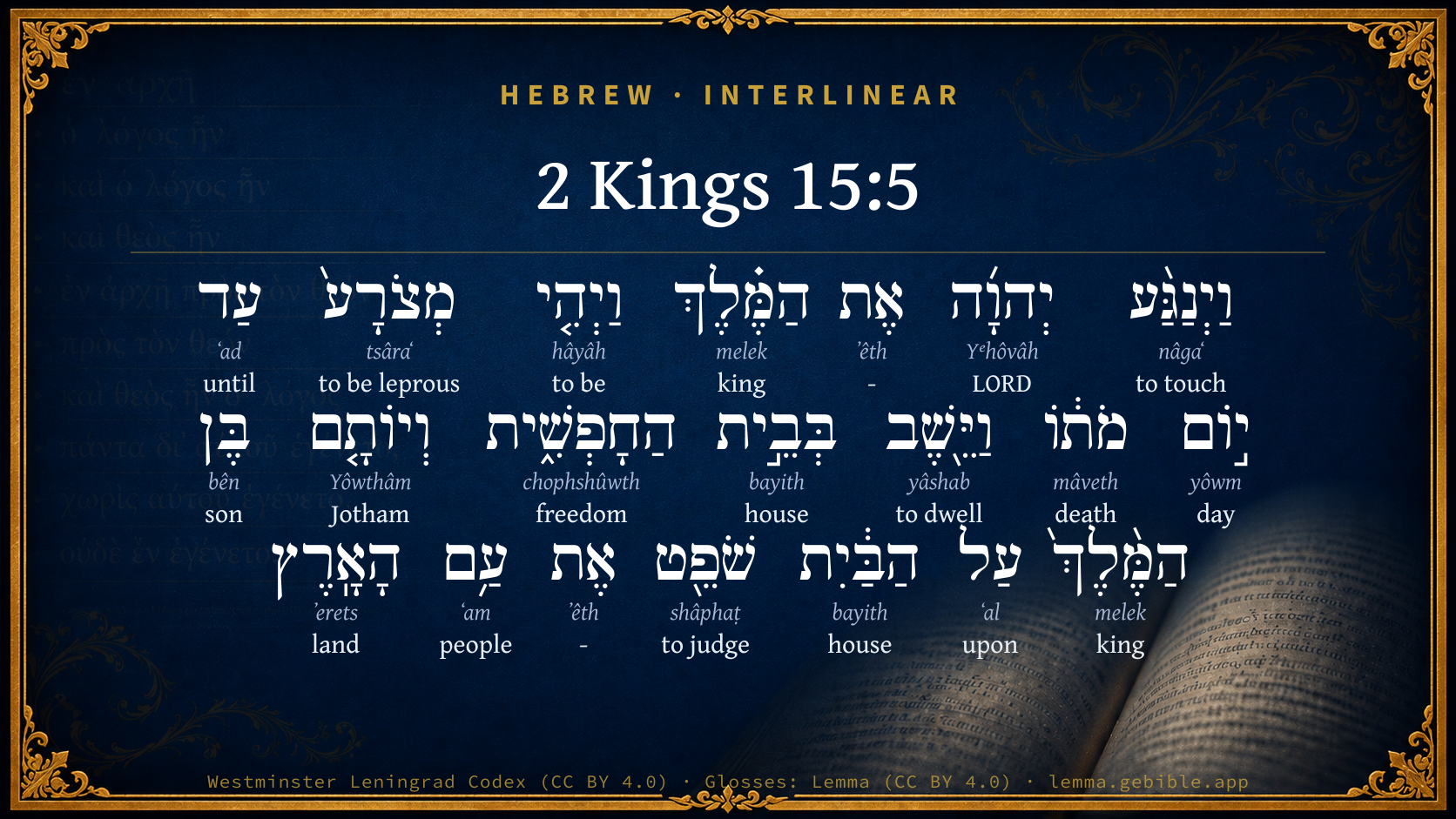
2 Kings 15:5

Hebrew (Westminster Leningrad Codex) 2 Kings 15:5 appears in the Hebrew Old Testament. The text above is from the Westminster Leningrad Codex. Each word links to its Strong’s number, a concise gloss, and parsing drawn from the Open Scriptures Hebrew Bible morphology. Click any word for its full Brown-Driver-Briggs (BDB) entry.
Download image
Cite this verse

2 Kings 15:5 (World English Bible). Public Domain. Lemma interlinear Bible study tool, https://lemma.gebible.app/v/2-kings/15/5.

Show BibTeX & RIS
BibTeX
RIS
English Translation
Yahweh struck the king, so that he was a leper to the day of his death, and lived in a separate house. Jotham the king's son was over the household, judging the people of the land.
World English Bible · Public Domain
Highlights
  • 1 first appearance in the Hebrew Bible
Full analysis ↓
Download a study sheet

One document with this verse’s original text, its word-by-word gloss line, the meaning frame, cross-references with their text, attributed commentary, and full source and license credits — printable, and it pastes into notes with its structure intact.

This verse Autodidact and up

Study sheet (.html) Plain text (.txt)

A passage Seminary Student

Up to 50 verses in one chapter. A passage sheet keeps up to 6 commentary sources and 12 cross-references per verse, in the order this page ranks them, and says so on the sheet whenever that leaves anything out. Ask for a single verse and you get the Autodidact verse sheet above.

Everything on this page stays free to read, with no account — the sheet is a download of what is already on screen, not access to it.

Want to remove ads? Support Godless Engineer
Compare translations 3

The same verse in 3 English versions, stacked beneath the original-language interlinear above. Click any original word for its lexicon entry.

Each is an independent rendering of the whole verse — the interlinear is not word-aligned to these translations.

Highlighted words mark where these versions differ — a whole-verse word diff, not a word-by-word alignment.

  • World English Bible Public Domain
    Yahweh struck the king, so that he was a leper to the day of his death, and lived in a separate house. Jotham the king's son was over the household, judging the people of the land.
  • King James Version Public Domain
    And the LORD smote the king, so that he was a leper unto the day of his death, and dwelt in a several house. And Jotham the king's son was over the house, judging the people of the land.
  • unfoldingWord Literal Text CC BY-SA 4.0
    And Yahweh touched the king, and he was a leper until the day of his death, and he lived in a house of separation. And Jotham, the son of the king, over the house, judging the people of the land.

unfoldingWord Literal Text — © unfoldingWord, licensed CC BY-SA 4.0. Word-aligned USFM3 via Door43 (git.door43.org/unfoldingWord/en_ult).

Versions to compare (up to 4)

3 of 4 selected

Show all 18 translations

Every available English version of this verse, each an independent rendering of the whole verse.

  • World English Bible Public Domain
    Yahweh struck the king, so that he was a leper to the day of his death, and lived in a separate house. Jotham the king's son was over the household, judging the people of the land.
  • Berean Standard Bible Public Domain
    And the LORD afflicted the king with leprosy until the day he died, so that he lived in a separate house while his son Jotham had charge of the palace and governed the people of the land.
  • Majority Standard Bible Public Domain
    And the LORD afflicted the king with leprosy until the day he died, so that he lived in a separate house while his son Jotham had charge of the palace and governed the people of the land.
  • King James Version Public Domain
    And the LORD smote the king, so that he was a leper unto the day of his death, and dwelt in a several house. And Jotham the king's son was over the house, judging the people of the land.
  • American Standard Version (1901) Public Domain
    And Jehovah smote the king, so that he was a leper unto the day of his death, and dwelt in a separate house. And Jotham the king's son was over the household, judging the people of the land.
  • Revised Version (1885) Public Domain
    And the LORD smote the king, so that he was a leper unto the day of his death, and dwelt in a several house. And Jotham the king’s son was over the household, judging the people of the land:
  • Geneva Bible (1599) Public Domain
    And the Lord smote the King: and he was a leper vnto the day of his death, and dwelt in an house apart, and Iotham the kings sonne gouerned the house, and iudged the people of the land.
  • Douay-Rheims (1899) Public Domain
    And the Lord struck the king, so that he was a leper unto the day of his death, and he dwelt in a free house apart: but Joatham the king's soil governed the palace, and judged the people of the land.
  • Young's Literal Translation Public Domain
    And Jehovah smiteth the king, and he is a leper unto the day of his death, and he dwelleth in a separate house, and Jotham son of the king `is' over the house, judging the people of the land.
  • Literal Standard Version CC BY-SA 4.0
    And YHWH strikes the king, and he is a leper to the day of his death, and he dwells in a separate house, and Jotham son of the king [is] over the house, judging the people of the land.
  • Unlocked Literal Bible CC BY-SA 4.0
    Yahweh afflicted the king so that he was a leper to the day of his death and lived in a separate house. Jotham, the king's son, was over the household and ruled the people of the land.
  • unfoldingWord Literal Text CC BY-SA 4.0
    And Yahweh touched the king, and he was a leper until the day of his death, and he lived in a house of separation. And Jotham, the son of the king, over the house, judging the people of the land.
  • Darby Bible Public Domain
    And Jehovah smote the king, so that he was a leper to the day of his death, and dwelt in a separate house. And Jotham the king's son was over the house, judging the people of the land.
  • World Messianic Bible Public Domain
    The LORD struck the king, so that he was a leper to the day of his death, and lived in a separate house. Jotham, the king’s son, was over the household, judging the people of the land.
  • Webster's Bible Public Domain
    And the LORD smote the king, so that he was a leper to the day of his death, and dwelt in a separate house. And Jotham the king's son was over the house, judging the people of the land.
  • Free Bible Version CC BY-SA 4.0
    The Lord touched the king and he had leprosy until the day he died. He lived in isolation in a separate house. His son Jotham was in charge of the palace and was the country's actual ruler.
  • Bible in Basic English Public Domain
    And the Lord sent disease on the king and he became a leper, and to the day of his death he was living separately in his private house. And Jotham his son was over his house, judging the people of the land.
  • JPS Tanakh (1917) Public Domain
    And the LORD smote the king, so that he was a leper unto the day of his death, and dwelt in a house set apart. And Jotham the king's son was over the household, judging the people of the land.

Literal Standard Version (2020), Covenant Press — licensed CC BY-SA 4.0. Text via the HelloAO Bible API (eBible.org). Unlocked Literal Bible (unfoldingWord) — licensed CC BY-SA 4.0. Text via the HelloAO Bible API (eBible.org). unfoldingWord Literal Text — © unfoldingWord, licensed CC BY-SA 4.0. Word-aligned USFM3 via Door43 (git.door43.org/unfoldingWord/en_ult). Free Bible Version, Dr. Jonathan Gallagher — licensed CC BY-SA 4.0. Text via the HelloAO Bible API (eBible.org).

Word by word

More ways to search: Search by grammar → Find every occurrence → Compare this word →

Practice this passage: Drill this verse → Learn its vocabulary →

הַחָפְשִׁ֑ית
chophshûwth
H2669
“the · freedom”
Particle, Definite Article + Noun, Common, Feminine, Singular, Absolute
Part of Speech
Particle + Noun
Type
Common
Gender
Feminine
Number
Singular
State
Absolute
Full BDB Definition

Origin: from H2666

TWOT: 717d

separateness, freedom
  1. וַיְנַגַּ֨ע nâgaʻ H5060 “and · to touch” Conjunction + Verb, Piel, Sequential Imperfect, 3rd Person, Masculine, Singular
  2. יְהוָ֜ה Yᵉhôvâh H3068 “LORD” Noun, Proper
  3. אֶת ʼêth H853 “-” Particle, Direct Object
  4. הַמֶּ֗לֶךְ melek H4428 “the · king” Particle, Definite Article + Noun, Common, Masculine, Singular, Absolute
  5. וַיְהִ֤י hâyâh H1961 “and · to be” Conjunction + Verb, Qal, Sequential Imperfect, 3rd Person, Masculine, Singular
  6. מְצֹרָע֙ tsâraʻ H6879 “leprous” Verb, Pual, Participle Passive, Masculine, Singular, Absolute
  7. עַד ʻad H5704 “until” Preposition
  8. י֣וֹם yôwm H3117 “day of” Noun, Common, Masculine, Singular, Construct
  9. מֹת֔וֹ mâveth H4194 “death · his” Noun, Common, Masculine, Singular, Construct + Suffix, Personal, 3rd Person, Masculine, Singular
  10. וַיֵּ֖שֶׁב yâshab H3427 “and · to dwell” Conjunction + Verb, Qal, Sequential Imperfect, 3rd Person, Masculine, Singular
  11. בְּבֵ֣ית bayith H1004 “in/at · house of” Preposition + Noun, Common, Masculine, Singular, Construct
  12. וְיוֹתָ֤ם Yôwthâm H3147 “and · Jotham” Conjunction + Noun, Proper
  13. בֶּן bên H1121 “son of” Noun, Common, Masculine, Singular, Construct
  14. הַמֶּ֨לֶךְ֙ melek H4428 “the · king” Particle, Definite Article + Noun, Common, Masculine, Singular, Absolute
  15. עַל ʻal H5921 “upon” Preposition
  16. הַבַּ֔יִת bayith H1004 “the · house” Particle, Definite Article + Noun, Common, Masculine, Singular, Absolute
  17. שֹׁפֵ֖ט shâphaṭ H8199 “judging” Verb, Qal, Participle Active, Masculine, Singular, Absolute
  18. אֶת ʼêth H853 “-” Particle, Direct Object
  19. עַ֥ם ʻam H5971 “people of” Noun, Common, Masculine, Singular, Construct
  20. הָאָֽרֶץ ʼerets H776 “the · land” Particle, Definite Article + Noun, Common, Both, Singular, Absolute

About this verse

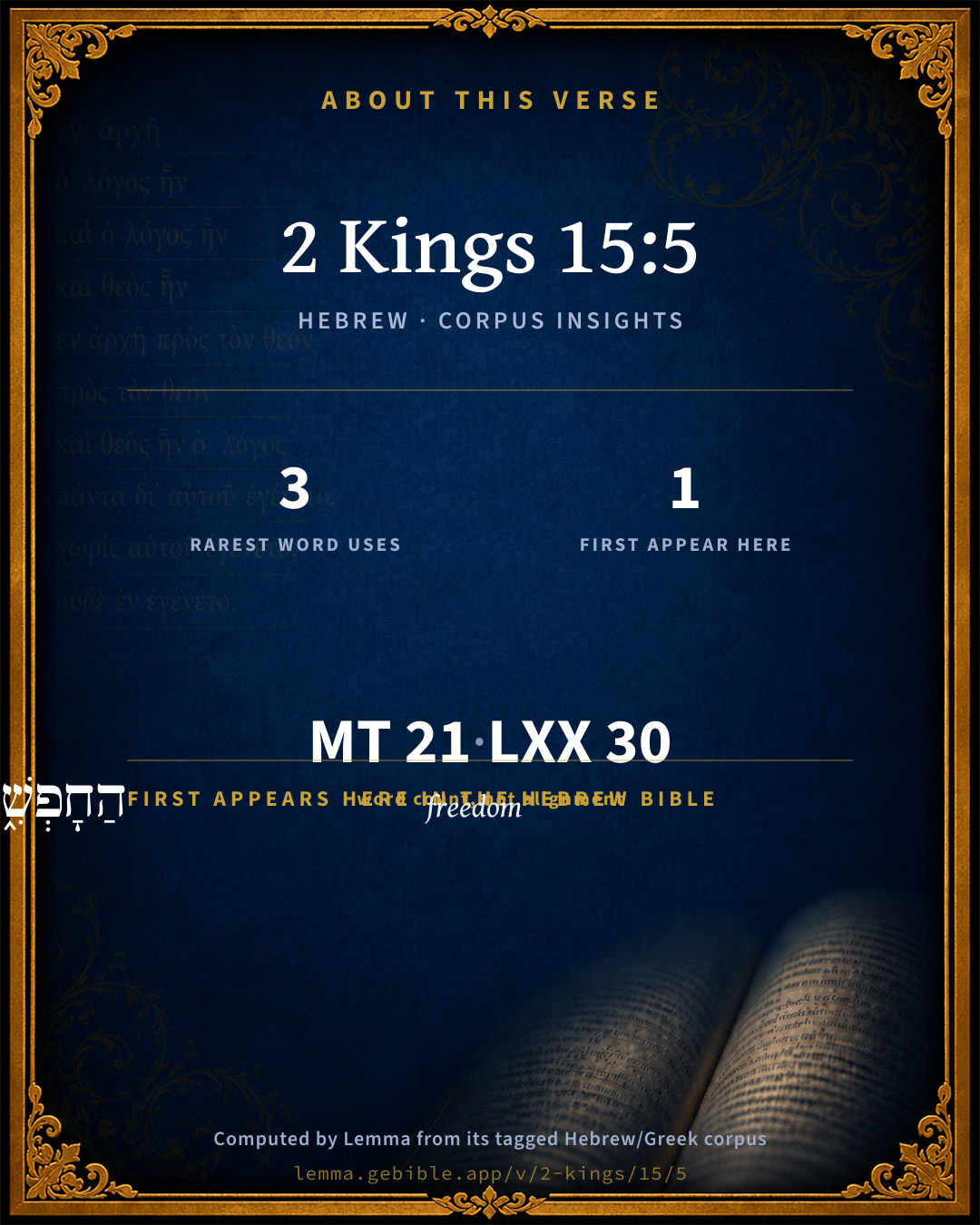
These counts appear in no published source. They are computed here, from the morphology-tagged text and Lemma’s own curated glosses. What Lemma adds →

21
words
18
distinct lemmas
Historical
section

Notable vocabulary

The rarest word here is הַחָפְשִׁ֑ית freedom H2669 — appearing just 3 times in the whole Hebrew Bible.

First appearance in Scripture

This word makes its first canonical appearance in the Hebrew Bible here:

  • הַחָפְשִׁ֑ית freedom H2669

Shared distinctive vocabulary

הַחָפְשִׁ֑ית freedom H2669 occurs in 2 verses of the Hebrew Bible. Also found in:

Grammatical profile

  • 5 verbs
  • 12 nouns
  • 2 prepositions
  • 2 particles

Verb forms

  • וַיְנַגַּ֨ע Piel · Sequential Imperfect
  • וַיְהִ֤י Qal · Sequential Imperfect
  • מְצֹרָע֙ Pual · Participle Passive
  • וַיֵּ֖שֶׁב Qal · Sequential Imperfect
  • שֹׁפֵ֖ט Qal · Participle Active

Repetition

Words recur within this verse — often emphatic in Hebrew:

  • הַמֶּ֗לֶךְ king H4428 ×2
  • בְּבֵ֣ית house H1004 ×2

Hebrew & Septuagint length

In English translation the verse runs 36 words from the Hebrew and 38 from the Septuagint (LXX English) — closely comparable.

A rough comparison of the two English renderings, which tokenize alike — not a word-level alignment.

Word counts can differ between the Hebrew and the Greek without any difference in meaning — e.g. the Hebrew direct-object marker אֵת has no separate Greek word, and Greek often adds the article ὁ.

In the original languages it is 21 Hebrew tokens and 30 Greek tokens — but the two are counted differently (Hebrew bundles its prefixes and suffixes into one token; the Greek is in lemma form), so that isn’t a like-for-like length.

Cross-references

14

Topical passages linked to 2 Kings 15:5 in the Treasury of Scripture Knowledge — connected by theme and wording, ordered by reader-vote popularity; previews shown in the World English Bible.

  • Leviticus 13:46 All the days in which the plague is in him he shall be unclean. He is unclean. He shall dwell alone. Outside of the camp shall be his dwelling.
  • Numbers 12:14 Yahweh said to Moses, If her father had but spit in her face, shouldn't she be ashamed seven days? let her be shut up outside of the camp seven days, and after that she shall be brought in again.
  • Numbers 12:10 The cloud removed from over the Tent; and, behold, Miriam was leprous, as [white as] snow: and Aaron looked at Miriam, and, behold, she was leprous.
  • Deuteronomy 24:8 Take heed in the plague of leprosy, that you observe diligently, and do according to all that the priests the Levites shall teach you: as I commanded them, so you shall observe to do.
  • 2 Samuel 3:29 let it fall on the head of Joab, and on all his father's house; and let there not fail from the house of Joab one who has an issue, or who is a leper, or who leans on a staff, or who falls by the sword, or who lacks bread.
  • 2 Samuel 8:15 David reigned over all Israel; and David executed justice and righteousness to all his people.
  • 2 Samuel 15:2–4 Absalom rose up early, and stood beside the way of the gate: and it was so, that when any man had a suit which should come to the king for judgment, then Absalom called to him, and said, Of what city are you? He said, Your servant is of one of the tribes of Israel.
  • 1 Kings 3:9 Give your servant therefore an understanding heart to judge your people, that I may discern between good and evil; for who is able to judge this your great people?
  • 1 Kings 3:28 All Israel heard of the judgment which the king had judged; and they feared the king: for they saw that the wisdom of God was in him, to do justice.
  • 2 Kings 5:27 The leprosy therefore of Naaman shall cleave to you, and to your seed forever. He went out from his presence a leper [as white] as snow.
  • 2 Kings 7:3 Now there were four leprous men at the entrance of the gate: and they said one to another, Why sit we here until we die?
  • 2 Chronicles 26:16–23 But when he was strong, his heart was lifted up, so that he did corruptly, and he trespassed against Yahweh his God; for he went into the temple of Yahweh to burn incense on the altar of incense.
  • Job 34:19 Who doesn't respect the persons of princes, Nor regards the rich more than the poor; For they all are the work of his hands.
  • Psalms 72:1 God, give the king your justice; Your righteousness to the royal son.

Cross-references courtesy of OpenBible.info (CC BY 4.0).

Hebrew and Greek witnesses Masoretic Hebrew ↔ Greek Septuagint

The same verse in the two great witnesses to the Old Testament, shown verse-for-verse.

These are two independent witnesses, not word-aligned to each other, and the Septuagint is shown in lemma (dictionary) form.

Hebrew 2 Kings 15:5 Masoretic · Westminster Leningrad Codex

וַיְנַגַּ֨ע יְהוָ֜ה אֶת הַמֶּ֗לֶךְ וַיְהִ֤י מְצֹרָע֙ עַד י֣וֹם מֹת֔וֹ וַיֵּ֖שֶׁב בְּבֵ֣ית הַחָפְשִׁ֑ית וְיוֹתָ֤ם בֶּן הַמֶּ֨לֶךְ֙ עַל הַבַּ֔יִת שֹׁפֵ֖ט אֶת עַ֥ם הָאָֽרֶץ

Yahweh struck the king, so that he was a leper to the day of his death, and lived in a separate house. Jotham the king's son was over the household, judging the people of the land.

World English Bible · Public Domain

Greek LXX 2 Kings 15:5 Septuagint · lemma form

καί ἅπτομαι κύριος ὁ βασιλεύς καί εἰμί λεπρόω ἕως ἡμέρα θάνατος αὐτός καί βασιλεύω ἐν οἶκος αφφουσωθ καί ιωαθαμ υἱός ὁ βασιλεύς ἐπί ὁ οἶκος κρίνον ὁ λαός ὁ γῆ

And the Lord plagued the king, and he was leprous till the day of his death; and he reigned in a separate house. And Joatham the king's son was over the household, judging the people of the land.

LXX2012 (modern English Septuagint) · Public Domain

On this verse, The Cambridge Bible for Schools and Colleges discusses the Septuagint’s reading. Read the note in Commentary ↓

Hebrew: Westminster Leningrad Codex (CC BY 4.0). Greek: Septuagint (public domain); English from LXX2012 (modern English Septuagint) (Public Domain). How the Septuagint differs from the Hebrew →

Targum (Aramaic paraphrase)

1

The Targum is the ancient Jewish Aramaic paraphrase of the Hebrew Scriptures — an interpretive translation, not the Hebrew text itself. Onkelos (literal) and Pseudo-Jonathan (expansive) render the Torah, and Jonathan the Prophets. Coverage is partial: where no permissively-licensed English translation exists for a verse, only the Aramaic is shown. This is verse-level text, not a word-by-word alignment to the Hebrew.

  1. Targum Jonathan Prophets (Joshua–Malachi)
    וְאַיְתֵי יְיָ מַכְתַּשׁ עַל מַלְכָּא וַהֲוָה סְגִיר עַל יוֹם מוֹתֵיהּ וִיתֵיב בַּר מִן יְרוּשְׁלֵם וְיוֹתָם בַּר מַלְכָּא מְמַנָא עַל בֵּיתָא דָאֵין יַת עַמָא דְאַרְעָא:

    (no public-domain English translation for this verse)

    Targum Jonathan — Aramaic: “Mikraot Gedolot” (public domain). English: “Sefaria Community Translation” (CC0 1.0 (public-domain dedication)); “London "Chaldee Paraphrase," 1871” (public domain). Text via Sefaria.

Commentary

Notes on 2 Kings 15:5 from classic Christian and Jewish commentators (each source and its license shown beneath its notes). The classic Christian expositions comment on the surrounding passage and are grouped to its opening verse, so a note may address several verses; the Jewish commentaries on the Tanakh (Rashi and others) are per-verse, so they appear only where the commentator wrote on this verse.

Lemma curates 59 commentaries, every one of them public domain or Creative Commons licensed, each selected and text-cleaned for this edition rather than reprinted as found. About our sources →

Trapp's Complete Commentary

John Trapp

2Ki 15:5 And the LORD smote the king, so that he was a leper unto the day of his death, and dwelt in a several house. And Jotham the king’s son [was] over the house, judging the people of the land.

Ver. 5. And the Lord smote the king.] For his arrogancy and impudency in invading the priest’s office; God spat in his face, that he might be ashamed and humbled, and that others might be warned.

And Jotham the king’s son was over the house, &c.] He did not thrust out his father: but ruled all as his substitute. This was some comfort to the diseased king.

John Trapp, A Commentary or Exposition upon All the Books of the Old and New Testament (1647–1656) — public domain. Text from a community e-Sword module.

The Biblical Illustrator

Joseph S. Exell

2Ki_15:5

And the Lord smote the King.

Familiarity with religious things

1. The character and conduct of King Uzziah are very full of instruction. His life was marked by one fault, and by one signal act of punishment from God. His fault was the offering sacrifice, that which only the priest might do; and his punishment a leprosy, inflicted on him by the word of a priest on his persevering in his fault. This is the more remarkable as he is on the whole described as a good character. One notable circumstance is, that in the Book of Kings he goes by the name of Azariah, and is there also described as a good king, and all that we are told is that he died a leper, having dwelt in a several house until the day of his death. He made constant reference to Zachariah the prophet, and we are told, as long as he sought the Lord, God made him to prosper. He made war on Philistia, and prospered. Again, we are told that God helped him against the Philistines and against the Arabians. Having come back, he built towers in the desert, and he had much cattle. It appears that in his campaigns he won a high name for courage. He transgressed against God by going into the temple and offering incense on the altar. The priest went in after him with fourscore other priests--all valiant men; and they withstood Uzziah, saying, It appertaineth not to thee, O Uzziah, to burn it. Uzziah, having a censer in his hand, was wroth; and while angry, holding the censer in his hand, the leprosy rose up into his forehead, and the priests thrust him forcibly out; and he himself hasted to go out, because the Lord had smitten him.

2. It seems clear that Uzziah was a man whose life throughout, until the finishing act of it, was in conformity to Gods will, and blessed with Gods mercy. That crowning act of his life--the offering the incense, we are told, was the result of a presumptuous spirit brought on by the success of his life. But while this cause is assigned for the fault, and the fault is mentioned to explain the punishment in the Book of Chronicles, in the Book of Kings the punishment only is mentioned; and we are simply told that the Lord smote the king till he was a leper; and that he dwelt in a several house; so that any one reading the account in this book, without referring to Chronicles, would be in the dark as to the motive of the Almighty in afflicting the king. We must refer to one portion of Gods counsels to understand the other. The light shed from one page of His will, will irradiate and explain that which hitherto may have appeared to be obscure; and how often is this the case in daily life!

3. And this leads us to consider that particular form of sin in King Uzziah which called out the vengeance of God, and which developed itself into so singular an act, and one, at first sight, so little in keeping with the former portions of his life. His early career was one of a good and religious man, blessed by God with prosperity on that account. Trusting to his success as a sign not only of Gods favour, but of his own moral security, he became inflated with pride and self-sufficiency, and his temptation was to fall into that very sin, so natural to those who, having once been earnest or sincere in their religion, have by degrees familiarised themselves with it; so that they think they may play with it as a bauble, or use its influence to serve their own ends, and, like Uzziah, thrust themselves into the very office of the priest, by a profane and irreverent handling of holy things. This familiarity with the things of religion is the natural result of that precocity of spiritual knowledge which belongs to many. It ends in more than one false condition of mind. Familiarity itself quickly shades off into irreverence, pride and self-sufficiency, and independence of those means of grace and elevated helps to the religious life which are so inseparably mixed up with the life of the earnest Christian. Into these faults Uzziah fell. A disposition of independence, which his seems to have been, would naturally lead him to think very much for himself in things religious; and thinking for himself would naturally lead him to too subjective a view of religion generally.

4. There are many forms which this particular error takes that come before our eye--familiarity with holy things and holy names, which look upon reserve with the same eye as they look on hypocrisy, and on reverence with the same feeling with which they regard superstition. Many sad conditions result from this so great a familiarity of treatment of the external objects of religion, that, by degrees, such men lose sight of objective religion altogether, and blend it into themselves. In the realms of faith, where the shadowy forms which pass before the minds eye are matters of apprehension more to the mind than to the sense, there is ever a danger of our ignoring the separate existence of those forms, making them after all but the idols of our own creation. The attitude necessary towards those objects is one of reverence and reserved delicacy. The forms of the unseen world are in themselves to our eye infinitely fine; the rude touch, the over-curious gaze, may dissipate them as far as our perception of them goes. So that some have dealt with the Second blessed Person of the Trinity, till they have denied His Divinity, and with the Holy Spirit until they have denied His Personality. With an unauthorised touch they have entered the holiest place, and dared to intrude upon scenes for which they have neither warrant nor commission. Another end in which this kind of spirit results is, very naturally, pride and self-sufficiency. In proportion as we melt off the outlines of the objects of our creed, we lower our estimation of them; and in proportion as they are made parts only of our own interior self, we by degrees find nothing on which we can place reliance, save on our own opinion or personal energy. It is to this condition of mind that our familiarity with religious subjects will judicially bring us, and those whose intentions were best, may in this life have to bewail Uzziahs end. (E. Monro.)

The Biblical Illustrator, edited by Joseph S. Exell (c. 1880s–1900s) — public domain. Text from a community e-Sword module.

Joseph Benson's Commentary

2Ki 15:5. The Lord smote the king, so that he was a leper — The cause of this stroke is related at large, 2Ch 26:16-21. And dwelt in a several house — Separated from conversation with others by virtue of the law, recorded Lev 13:46, which, being the law of the King of kings, bound kings no less than subjects. The Jews, by the term several house, understand a house in the country; where he might have liberty to take his pleasure, but not to meddle with public affairs. Jotham, the king’s son, was over the house, &c. — That is, he lived in the palace, and managed all the affairs of the court and of the kingdom, governing in his father’s name as his vicegerent. It was in the twenty-seventh year of Azariah’s reign that he was smitten with the leprosy, and he continued a leper twenty-five years, during which time Jotham administered the government, his father being incapable of it.

Joseph Benson's Commentary on the Old and New Testaments (1811–1818) — public domain. Text from a community e-Sword module.

Tyndale Open Study Notes

Tyndale Open Resources

15:5 Because Uzziah usurped the prerogatives of the priesthood (2 Chr 26:16-21), the Lord struck the king with leprosy. His son Jotham became co-regent (about 750 BC). While Uzziah’s isolation kept him from public duties, he may have continued to exercise political power. King Tiglath-pileser III of Assyria (744–727 BC), in connection with his first western campaign (744–743 BC), mentioned an opponent named Azariau whom many scholars understand as Uzziah.

Tyndale Open Study Notes — © Tyndale Open Resources, licensed CC BY-SA 4.0. Text via the HelloAO Bible API.

Geneva Bible (1599)

Geneva Bible translators

His father and grandfather were slain by their subjects and servants, and he because he would usurp the Priest’s office contrary to God’s ordinance was smitten immediately by the hand of God with the leprosy, 2 Chron. 26:21.

As viceroy, or deputy to his father.

Geneva Bible (1599) marginal notes — public domain. Text via Bolls.life.

Adam Clarke's Commentary

Verse 5. The Lord smote the king, so that he was a leper] The reason of this plague is well told in the above quoted chapter, 2Ch 26:16. That his heart being elated, he went into the temple to burn incense upon the altar, assuming to himself the functions of the high priest; that Azariah the priest, with fourscore others, went in after him, to prevent him; and that while they were remonstrating against his conduct, the Lord struck him with the leprosy, which immediately appeared on his forehead; that they thrust him out as an unclean person; and that he himself hurried to get out, feeling that the Lord had smitten him; that he was obliged to dwell in a house by himself, being leprous, to the day of his death; and that during this time the affairs of the kingdom were administered by his son Jotham. A poet, ridiculing the conduct of those who, without an episcopal ordination, think they have authority from God to dispense all the ordinances of the Church, expresses himself thus: -

But now the warm enthusiast cries,

The office to myself I take;

Offering the Christian sacrifice,

Myself a lawful priest I make:

To me this honour appertains,

No need of man when GOD ordains.

[Some go into the contrary extreme, and in affect say, no need of GOD when MAN ordains.]

Though kings may not so far presume,

"Tis no presumption in a clown,

And, lo, without a call from Rome,

My flail or hammer I lay down;

And if my order's name ye seek,

Come, see a new Melchisedek!

Ye upstart (men-made) priests, your sentence know,

The marks you can no longer hide;

Your daring deeds too plainly show

The loathsome leprosy of pride;

And if ye still your crime deny,

Who lepers live shall lepers die.

CHARLES WESLEY.

This is very severe, but applies to every man who, through pride, presumption, or the desire of gain, enters into the priest's office, though he have the utmost authority that the highest ecclesiastical officer can confer.

Adam Clarke's Commentary on the Bible (1810–1826) — public domain. Text from a community e-Sword/MySword module.

Ellicott's Commentary for English Readers

(5) And the Lord smote the king.—The chronicler relates the reason—viz., because of his usurpation of priestly functions in the sanctuary. This happened towards the end of the reign. Jotham, the regent, was only twenty-five when Azariah died (2Ki_15:33).

Smote.—Or, struck. So we speak of a paralytic stroke, and the word plague literally means stroke.

In a several house.—Rather, in the sickhouse (or, hospital)—i.e., a royal residence outside of Jerusalem (Lev_13:46; 2Ki_7:3) set apart for such cases. (Strictly, in the house of freedom; because lepers were emancipated from all social relations and duties. Gesenius explains the word from an Arabic root said to mean prostration, weakness; but Lane gives for that term the special meaning smallness (or, narrowness) of the eye; weakness of sight. See his Arabic Lexicon, Bk. I., Pt. II., p. 772.

Over the house.—Not apparently as prefect of the palace (comp. 1Ki_4:6; 1Ki_18:3), but as dwelling in the palace instead of his father.

Judging the people of the land.—As his father’s representative. (Comp. 1Sa_8:6; 1Sa_8:20; 1Ki_3:9.)

This passage is strong evidence against the assumption of joint sovereignties of princes with their fathers, so often made by way of escaping chronological difficulties in Hebrew history. Jotham is not co-regent but viceroy of Azariah until the latter dies.

A Bible Commentary for English Readers, edited by Charles John Ellicott (1878–1897) — public domain. Text from a community e-Sword module.

The Cambridge Bible for Schools and Colleges

gen. ed. J. J. S. Perowne

5. And the Lord smote the king, so that he was a leper] The more political history in Kings tells us nothing about the reason why Azariah was smitten. The Chronicler however says that the king’s successes caused his heart to be lifted up, and he presumed to go into the temple, and to take upon him the priest’s office of burning incense. He was withstood by the priest (also called Azariah) and by fourscore other priests, but in his anger he persisted, and then it was that the leprosy rose up in his forehead. Whereupon he hasted to go forth from the temple because the Lord had smitten him.

and dwelt in a several house] The noun here is connected with the adjective that signifies ‘free’ and which is used of manumitted slaves. It has been suggested that the meaning here is that the place was one where those lived who could no longer mix with their fellows, and take part in the ordinary business of life. But in that case the building would be a public one or it would not have been so called. It appears therefore better to consider that the house was ‘free’ in the sense of ‘standing apart’, not mixed up among other dwellings. It was perhaps some place in the country to which the king confined himself after the disease had broken out upon him. The R.V. gives ‘lazar-house’ on the margin, but we must not suppose that the king went into a home devoted to such sufferers. He would live alone. The LXX. makes a sort of transliteration of the word but does not translate. The Vulgate has in domo libera seorsum.

For the English word ‘several’ in the sense of ‘separate’, cf. Pilkington’s Works (Parker Society) p. 64 where the author speaks of people ‘buried not in hallowed churchyards by any bishops, but in a several place appointed for the same purpose without the city’, and further down on the same page he describes a burial-ground as ‘an honest place to be kept several from beasts and unreverent using the same’.

the king’s son was over the house] R.V. household. From 1Ki_4:6 where Ahishar is spoken of as being over Solomon’s household, and 2Ki_19:2 where the same office is assigned to Eliakim in the time of Hezekiah, it is clear that the post was one of great dignity, but it was in no way connected with a regency. Eliakim is mentioned as the most prominent person among those who were sent to confer with Rabshakeh, and to consult the prophet Isaiah, but the duties he performed were those of a subject. And though Jotham is here said to have judged the people of the land, we cannot from this conclude that he was joint ruler with his father.

The Cambridge Bible for Schools and Colleges (gen. ed. J. J. S. Perowne; Cambridge University Press, 1878–1918) — public domain. Text from a community e-Sword module.

John Gill's Exposition

And the rest of the acts of Azariah, and all that he did, are they not written in the book of the chronicles of the kings of Judah? In the history of the reigns of those kings; some of them are recorded in the canonical book of the Chronicles, Ch2 26:1 and some were written by the prophet Isaiah, Ch2 26:22.

.

2 Kings 15:7

kg2 15:7

kg2 15:7

kg2 15:7So Azariah slept with his fathers,.... Or died, when he had reigned fifty two years:

and they buried him with his fathers in the city of David; but not in the sepulchres of the kings, but in the field of the burial, or the burying ground which belonged to them, because he was a leper, Ch2 26:23. Benjamin of Tudela (p) places his grave near the pillar of Absalom, and the fountain of Siloah, near the brook Kidron:

and Jotham his son reigned in his stead; who reigned sixteen years; a further account of him, and his reign, we have in the latter part of this chapter, after the reigns of several of the kings of Israel.

(p) Itinerar. p. 43.

John Gill's Exposition of the Whole Bible (1746–1763) — public domain (CC PDM 1.0). Text via the HelloAO Bible API.

Albert Barnes' Notes on the Bible

The Lord smote the king, so that he was a leper - The circumstances under which this terrible affliction befel one of the greatest of the Jewish kings, are given at some length by the author of Chronicles (marginal reference), who supplies us with a tolerably full account of this important reign, which the writer of Kings dismisses in half-a-dozen verses.

A several house - “A house of liberation,” or, freedom. On the necessity, under which the Law placed lepers, of living apart from other men, see marginal reference Jotham became regent in his father’s room, and exercised the functions of judge (1Ki 3:9 note), from the time that his father became a leper.

Albert Barnes' Notes on the Bible (1834–1885) — public domain. Text from a community e-Sword/MySword module.

Haydock's Catholic Bible Commentary

A leper. In punishment of his usurping the priestly functions, 2 Paralipomenon xxvi. 19. (Challoner) (Worthington) --- The priests boldly remonstrated with him, but to no effect; till the king perceived himself stricken with the leprosy. Josephus ([Antiquities?] ix. 10.) says, a dreadful earthquake was felt at the same time, which is supposed to be that mentioned [in] Amos i. 1., and Zacharias xiv. 5; (St. Jerome, &c.) though Usher produces some chronological difficulties against this opinion: but they are founded on error. (Calmet) --- Free. Paralipomenon apart; at a distance from all. (Haydock) --- The like rules were observed in cities, as in the camp, Leviticus xiii. 46. (Menochius) --- Ozias was in a manner dead to all civil transactions; and Isaias (vi. 1.) probably refers to this event. Syriac and Arabic, "he remained hidden." Josephus (ibid.[ix. 10.]) says, "leading a private life." Thus aiming at too much, he lost all! (Haydock)

George Leo Haydock (1774–1849), Haydock's Catholic Family Bible and Commentary, 1859 edition — public domain. Excludes Psalms (Douay-Rheims chapter numbering differs from Protestant) and Deuterocanonical books (Catholic canon only).

Matthew Poole's English Annotations

He was a leper; the cause whereof see 2Ch 26:16.

Dwelt in a several house; separated from conversation with others by virtue of that law, Lev 13:46, which being the law of the King of kings, bound kings no less than subjects.

Over the house, judging the people of the land, i.e. he governed the king’s court and whole kingdom, in his name, and as his vicegerent.

Matthew Poole's English Annotations on the Holy Bible (1683–1685) — public domain. Text from a community e-Sword/MySword module.

Whedon's Commentary on the Bible

Daniel D. Whedon

5. The Lord smote the king — For burning incense, and thereby usurping priestly functions. See in Chronicles.

A several house — Some explain this a free house, or house of liberation; meaning a house for those who were dismissed from the Lord’s service, and so dishonourably free; or, according to others, free from the society of men. But Gesenius and Furst explain it as a house of sickness; that is, an infirmary or hospital.

Daniel D. Whedon (gen. ed.), Commentary on the Old and New Testaments (1874–1909) — public domain. Text from a community e-Sword module.

The Pulpit Commentary

And the Lord smote the king. This comes in somewhat strangely, following close upon a statement that the king "did that which was right in the sight of the Lord." We have to go to Chronicles for an explanation. By Chronicles it appears that, in the earlier portion of his reign, Azariah was a good and pious prince, and that God blessed him in all his undertakings. Not only did he recover Eloth, (2Ch_26:2) but he carried on a successful war with the Philistines took Garb, Jabneh (Jamnia), and Ashdod, and dismantled them, (2Ch_26:6) defeated the Arabians of Gur-Baal, and the Mehuuim or Maonites, (2Ch_26:7) forced the Ammonites to pay him a tribute, and caused his power to be known and feared far and wide. (2Ch_26:8) The standing army which he maintained numbered 307, 500 men, under 2600 officers, well armed and equipped with shields, spears, helmets, breast-plates, bows, and slings. (2Ch_26:12-14) "His name spread far abroad, for he was wonderfully helped". (2Ch_26:15) This marvelous prosperity developed in him a pride equal to that of his father, but one which vented itself differently, Azariab, deeming himself superior to all other men, and exempt from ordinary rules, boldly invaded the priestly office, took a censer, and entered into the temple, and proceeded to burn incense upon the golden altar that was before the veil. (2Ch_26:16-18) It was then that "the Lord smote the king." As, in defiance of the high priest and his attendant train, who sought to prevent the lawless act, Azariah persisted in his endeavors, God struck him with leprosy, his forehead grew white with the unmistakable scaly scab, and in a moment his indomitable pride was quelled. The priests closed in upon him and began to thrust him out, but no violence was necessary. Aware of what had happened, "he himself also hasted to go out, because the Lord had smitten him". (2Ch_26:20) It is not very clear why the writer of Kings passes over these facts; but certainly they are not discredited by his silence. At any rate, those who accept the entire series of conquests, whereof the writer of Kings says nothing, on the sole authority of Chronicles, are logically precluded from rejecting the circumstances accompanying the leprosy, which is acknowledged by the writer of Kings, and viewed as a judgment from God. So that he was a leper unto the day of his death, and dwelt in a several house. (comp. 2Ch_26:21) Lepers had to be separated from the congregation to "dwell alone the camp". (Lev_13:46) Ahaziah"s "several house" is regarded by some as an "infirmary," or "hospital for lepers" (Ewald, Gesenius, Winer); but there is no reason to believe that hospitals of any kind existed among the Israelites. The lepers mentioned intycipjh 2Ki_7:3 are houseless. tyB is best translated "house of separation" and understood of a house standing by itself in the open country, separate from others. "Probably the house in which the leprous king lived was," as Bahr says, "especially built for him." And Jotham the Mug"s son was over the house not over the "several house," but over the royal palacejudging the people of the land; i.e. executing the royal functions, whereof "judging" was one of the highest. Azariah"s infirmity made a regency necessary, and naturally his eldest son held the office.

The Pulpit Commentary (1880–1919), ed. H.D.M. Spence-Jones & Joseph S. Exell — public domain. Text from a community e-Sword module.

John Wesley's Explanatory Notes

A leper - The cause whereof see 2 Chron. xxvi, 16.

John Wesley, Explanatory Notes Upon the Whole Bible (1754–1765) — public domain. Text via the GEBible commentary corpus.

Rashi

Rabbi Shlomo Yitzchaki (Rashi)

Adonoy brought a plague upon the king. It is explained in Divrei Hayomim that he entered the Temple to burn incense on the Incense Altar. for attempting to assume the role of the kohein gadol and burn incense on the altar. See II Divrei Hayomim 26-16:21 and Rashi in Bamidbar 17:5.

In a retirement house. He made himself a house in the cemetery, is forced to live in isolation. He was therefore unable to attend to his royal duties and was thus “freed” from his responsibilities. is accounted as dead. And like the dead who is free from the many toils of life, as it states in Tehilim 88:6, “I am [considered] among the dead who are free,” so is a metzora. as it is stated, ”I am [considered] among the dead who are free.” In [Talmud] Yerushalmi.

Rashi on the Tanakh — English translations: “The Judaica Press complete Tanach with Rashi, translated by A. J. Rosenberg” (CC BY 4.0); “Pentateuch with Rashi's commentary by M. Rosenbaum and A.M. Silbermann, 1929-1934” (public domain); “The Metsudah Tanach series, Lakewood, N.J” (CC BY 4.0); and “The Book of Joshua, Metsudah Publications, 1997” (CC BY 4.0). Text via Sefaria.

Radak

Rabbi David Kimhi (Radak)

Our sages of blessed memory said in Horayot:10, that being a King is work; You need to carry the burdens of the nation, listen to them, and judge their cases in court whether you want to or not. If being a King is work, and the leprosy caused him to lived alone, then he was free from the work of being a king. Therefore, it was called a House of Freedom. Alternatively, the sages said this 'house of freedom' was a cemetery as it says in the verse (Psalms 88:6) "...among the dead who are free".

Radak on the Tanakh — English translations: “Sefaria Community Translation” (CC0 1.0 (public-domain dedication)); “Eliyahu Munk, HaChut Hameshulash” (CC BY 4.0); “Rabbi Mike Feuer, Jerusalem Anthology” (CC BY 4.0); and “R. David Kimhi on the first book of Psalms, Translated by R.G. Finch, London, 1919” (public domain). Text via Sefaria.

Lesson kit

Teaching starters — assembled from the data on this page, not authored interpretation. Every prompt links to the verse data it draws on. Edit before teaching.

2 Kings, in the Historical, opens this verse with 21 words (18 distinct Hebrew lemmas). Its most distinctive word is chophshûwth (“freedom”). A historical commentator’s framing appears above. Read the whole chapter for the surrounding context.

Discussion questions

  1. What does “freedom” (chophshûwth) contribute to the verse as a whole?
  2. This is the first place “freedom” appears in Scripture (first appears here). What does its debut here establish?
  3. How does 2 Chronicles 26:21, which shares the word «freedom», read alongside this verse?
  4. What does the repetition of “king” (2× in this one verse) do in this verse?
  5. These translations render this verse differently. What is at stake in choosing one wording over another?
  6. «וַיְנַגַּ֨ע» is a Piel Sequential Imperfect verb. How does that grammatical form shape the action described?
  7. Compare how Trapp's Complete Commentary and The Biblical Illustrator read this verse. Where do they agree or differ?

Things to notice

Reading settings

Reading text

Shown beneath each verse's original-language words.

Old Testament
Old Testament edition

Read the OT as the Masoretic Hebrew (MT) or the Greek Septuagint (LXX).

English shown for the Greek Septuagint (in the Hebrew ↔ Greek comparison).

Comparing translations? Open the Compare panel on any verse page to stack up to four side by side.