
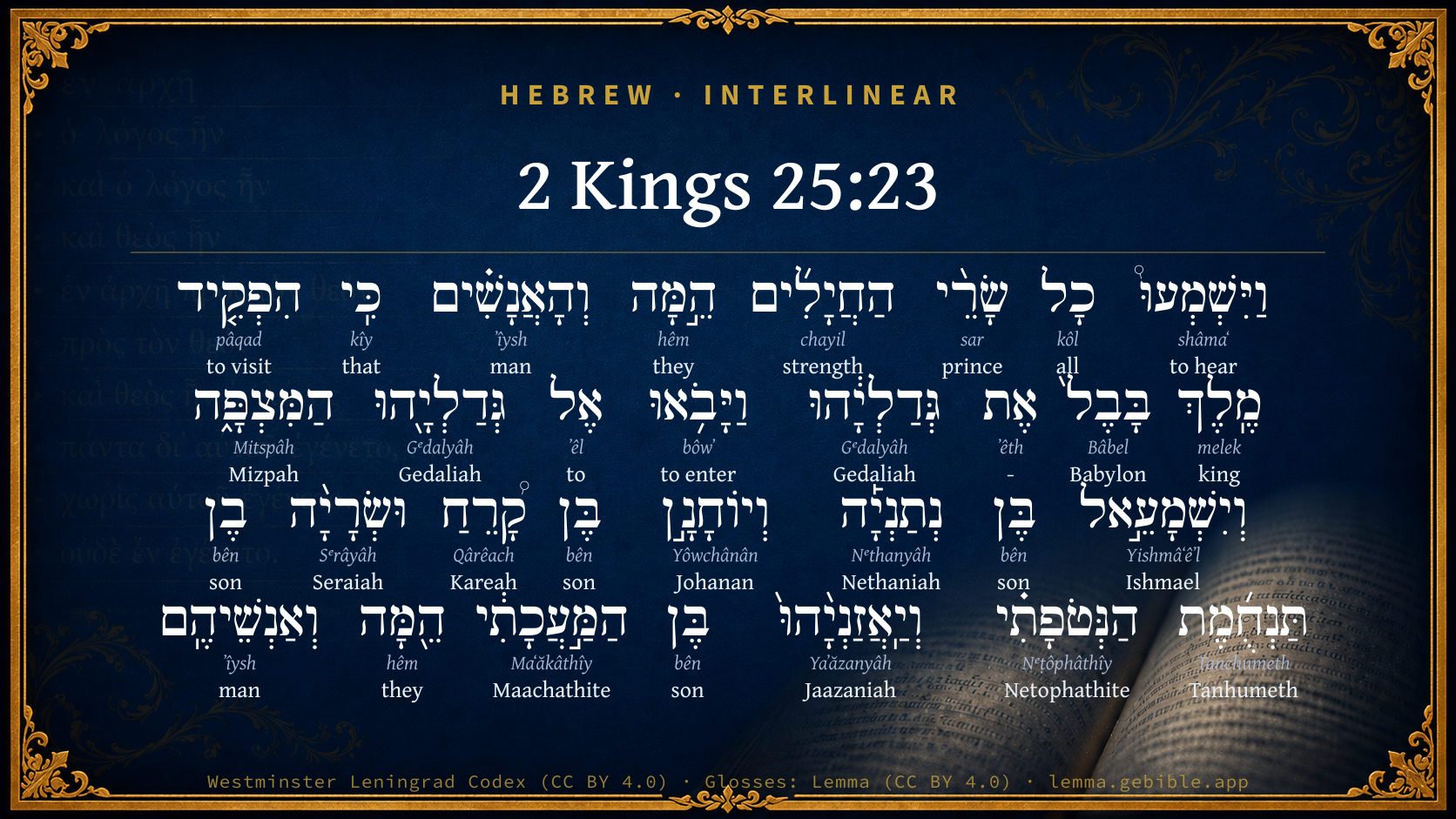
2 Kings 25:23

Hebrew (Westminster Leningrad Codex) 2 Kings 25:23 appears in the Hebrew Old Testament. The text above is from the Westminster Leningrad Codex. Each word links to its Strong’s number, a concise gloss, and parsing drawn from the Open Scriptures Hebrew Bible morphology. Click any word for its full Brown-Driver-Briggs (BDB) entry.
Download image
Cite this verse

2 Kings 25:23 (World English Bible). Public Domain. Lemma interlinear Bible study tool, https://lemma.gebible.app/v/2-kings/25/23.

Show BibTeX & RIS
BibTeX
RIS
English Translation
Now when all the captains of the forces, they and their men, heard that the king of Babylon had made Gedaliah governor, they came to Gedaliah to Mizpah, even Ishmael the son of Nethaniah, and Johanan the son of Kareah, and Seraiah the son of Tanhumeth the Netophathite, and Jaazaniah the son of the Maacathite, they and their men.
World English Bible · Public Domain
Highlights
  • 5 first appearances in the Hebrew Bible
Full analysis ↓
Download a study sheet

One document with this verse’s original text, its word-by-word gloss line, the meaning frame, cross-references with their text, attributed commentary, and full source and license credits — printable, and it pastes into notes with its structure intact.

This verse Autodidact and up

Study sheet (.html) Plain text (.txt)

A passage Seminary Student

Up to 50 verses in one chapter. A passage sheet keeps up to 6 commentary sources and 12 cross-references per verse, in the order this page ranks them, and says so on the sheet whenever that leaves anything out. Ask for a single verse and you get the Autodidact verse sheet above.

Everything on this page stays free to read, with no account — the sheet is a download of what is already on screen, not access to it.

Want to remove ads? Support Godless Engineer
Compare translations 3

The same verse in 3 English versions, stacked beneath the original-language interlinear above. Click any original word for its lexicon entry.

Each is an independent rendering of the whole verse — the interlinear is not word-aligned to these translations.

Highlighted words mark where these versions differ — a whole-verse word diff, not a word-by-word alignment.

  • World English Bible Public Domain
    Now when all the captains of the forces, they and their men, heard that the king of Babylon had made Gedaliah governor, they came to Gedaliah to Mizpah, even Ishmael the son of Nethaniah, and Johanan the son of Kareah, and Seraiah the son of Tanhumeth the Netophathite, and Jaazaniah the son of the Maacathite, they and their men.
  • King James Version Public Domain
    And when all the captains of the armies, they and their men, heard that the king of Babylon had made Gedaliah governor, there came to Gedaliah to Mizpah, even Ishmael the son of Nethaniah, and Johanan the son of Careah, and Seraiah the son of Tanhumeth the Netophathite, and Jaazaniah the son of a Maachathite, they and their men.
  • unfoldingWord Literal Text CC BY-SA 4.0
    And all of the captains of the armies, they and the men, heard that the king of Babylon had appointed Gedaliah, and they came to Gedaliah Mizpah, and Ishmael, the son of Nethaniah, and Johanan, the son of Kareah, and Seraiah, the son of Tanhumeth the Netophathite, and Jaazaniah, the son of the Maacathite, they and their men.

unfoldingWord Literal Text — © unfoldingWord, licensed CC BY-SA 4.0. Word-aligned USFM3 via Door43 (git.door43.org/unfoldingWord/en_ult).

Versions to compare (up to 4)

3 of 4 selected

Show all 18 translations

Every available English version of this verse, each an independent rendering of the whole verse.

  • World English Bible Public Domain
    Now when all the captains of the forces, they and their men, heard that the king of Babylon had made Gedaliah governor, they came to Gedaliah to Mizpah, even Ishmael the son of Nethaniah, and Johanan the son of Kareah, and Seraiah the son of Tanhumeth the Netophathite, and Jaazaniah the son of the Maacathite, they and their men.
  • Berean Standard Bible Public Domain
    When all the commanders of the armies and their men heard that the king of Babylon had appointed Gedaliah as governor, they came to Gedaliah at Mizpah—Ishmael son of Nethaniah, Johanan son of Kareah, Seraiah son of Tanhumeth the Netophathite, and Jaazaniah son of the Maacathite, as well as their men.
  • Majority Standard Bible Public Domain
    When all the commanders of the armies and their men heard that the king of Babylon had appointed Gedaliah as governor, they came to Gedaliah at Mizpah—Ishmael son of Nethaniah, Johanan son of Kareah, Seraiah son of Tanhumeth the Netophathite, and Jaazaniah son of the Maacathite, as well as their men.
  • King James Version Public Domain
    And when all the captains of the armies, they and their men, heard that the king of Babylon had made Gedaliah governor, there came to Gedaliah to Mizpah, even Ishmael the son of Nethaniah, and Johanan the son of Careah, and Seraiah the son of Tanhumeth the Netophathite, and Jaazaniah the son of a Maachathite, they and their men.
  • American Standard Version (1901) Public Domain
    Now when all the captains of the forces, they and their men, heard that the king of Babylon had made Gedaliah governor, they came to Gedaliah to Mizpah, even Ishmael the son of Nethaniah, and Johanan the son of Kareah, and Seraiah the son of Tanhumeth the Netophathite, and Jaazaniah the son of the Maacathite, they and their men.
  • Revised Version (1885) Public Domain
    Now when all the captains of the forces, they and their men, heard that the king of Babylon had made Gedaliah governor, they came to Gedaliah to Mizpah, even Ishmael the son of Nethaniah, and Johanan the son of Kareah, and Seraiah the son of Tanhumeth the Netophathite, and Jaazaniah the son of the Maacathite, they and their men.
  • Geneva Bible (1599) Public Domain
    Then when all the captaines of the host and their men heard, that the king of Babel had made Gedaliah gouernour, they came to Gedaliah to Mizpah, to wit, Ishmael the sonne of Nethaniah, and Iohanan the sonne of Kareah, and Seraiah the sonne of Tanhumeth the Netophathite, and Iaazaniah the sonne of Maachathi, they and their men.
  • Douay-Rheims (1899) Public Domain
    And when all the captains of the soldiers had heard this, they and the men that were with them, to wit, that the king of Babylon had made Godolias governor, they came to Godolias to Maspha, Ismael the son of Nathanias, and Johanan the son of Caree, and Saraia the son of Thanehumeth the Netophathite, and Jezonias the son of Maachathi, they and their men.
  • Young's Literal Translation Public Domain
    And all the heads of the forces hear -- they and the men -- that the king of Babylon hath appointed Gedaliah, and they come in unto Gedaliah, to Mizpah, even Ishmael son of Nethaniah, and Johanan son of Kareah, and Seraiah son of Tanhumeth the Netophathite, and Jaazaniah son of the Maachathite -- they and their men;
  • Literal Standard Version CC BY-SA 4.0
    And all the heads of the forces hear—they and the men—that the king of Babylon has appointed Gedaliah, and they come to Gedaliah, to Mizpah, even Ishmael son of Nethaniah, and Johanan son of Kareah, and Seraiah son of Tanhumeth the Netophathite, and Jaazaniah son of the Maachathite—they and their men;
  • Unlocked Literal Bible CC BY-SA 4.0
    Now when all the commanders of the soldiers, they and their men, heard that the king of Babylon had made Gedaliah governor, they went to Gedaliah at Mizpah. These men were Ishmael son of Nethaniah, Johanan son of Kareah, Seraiah son of Tanhumeth the Netophathite, and Jaazaniah son of the Maakathite—they and their men.
  • unfoldingWord Literal Text CC BY-SA 4.0
    And all of the captains of the armies, they and the men, heard that the king of Babylon had appointed Gedaliah, and they came to Gedaliah Mizpah, and Ishmael, the son of Nethaniah, and Johanan, the son of Kareah, and Seraiah, the son of Tanhumeth the Netophathite, and Jaazaniah, the son of the Maacathite, they and their men.
  • Darby Bible Public Domain
    And all the captains of the forces, they and their men, heard that the king of Babylon had appointed Gedaliah, and they came to Gedaliah to Mizpah, namely, Ishmael the son of Nethaniah, and Johanan the son of Kareah, and Seraiah the son of Tanhumeth the Netophathite, and Jaazaniah the son of a Maachathite, they and their men.
  • World Messianic Bible Public Domain
    Now when all the captains of the forces, they and their men, heard that the king of Babylon had made Gedaliah governor, they came to Gedaliah to Mizpah, even Ishmael the son of Nethaniah, Yochanan the son of Kareah, Seraiah the son of Tanhumeth the Netophathite, and Jaazaniah the son of the Maacathite, they and their men.
  • Webster's Bible Public Domain
    And when all the captains of the armies, they and their men, heard that the king of Babylon had made Gedaliah governor, there came to Gedaliah to Mizpah, even Ishmael the son of Nethaniah, and Johanan the son of Careah, and Seraiah the son of Tanhumeth the Netophathite, and Jaazaniah the son of Maachathite, they and their men.
  • Free Bible Version CC BY-SA 4.0
    When all the army officers of Judah and their men learned that the king of Babylon had appointed Gedaliah as governor, they and their men met with Gedaliah at Mizpah. They included: Ishmael son of Nethaniah, Johanan, son of Kareah, Seraiah, son of Tanhumeth the Netophathite, Jaazaniah, son of the Maakathite.
  • Bible in Basic English Public Domain
    Now the captains of the armed forces, hearing that the king of Babylon had made Gedaliah ruler, came with their men to Gedaliah at Mizpah; Ishmael, the son of Nethaniah, and Johanan, the son of Kareah, and Seraiah, the son of Tanhumeth the Netophathite, and Jaazaniah, the son of the Maacathite, came with all their men.
  • JPS Tanakh (1917) Public Domain
    Now when all the captains of the forces, they and their men, heard that the king of Babylon had made Gedaliah governor, they came to Gedaliah to Mizpah, even Ishmael the son of Nethaniah, and Johanan the son of Kareah, and Seraiah the son of Tanhumeth the Netophathite and Jaazaniah the son of the Maacathite, they and their men.

Literal Standard Version (2020), Covenant Press — licensed CC BY-SA 4.0. Text via the HelloAO Bible API (eBible.org). Unlocked Literal Bible (unfoldingWord) — licensed CC BY-SA 4.0. Text via the HelloAO Bible API (eBible.org). unfoldingWord Literal Text — © unfoldingWord, licensed CC BY-SA 4.0. Word-aligned USFM3 via Door43 (git.door43.org/unfoldingWord/en_ult). Free Bible Version, Dr. Jonathan Gallagher — licensed CC BY-SA 4.0. Text via the HelloAO Bible API (eBible.org).

Word by word

More ways to search: Search by grammar → Find every occurrence → Compare this word →

Practice this passage: Drill this verse → Learn its vocabulary →

תַּנְחֻ֜מֶת
Tanchumeth
H8576
“Tanhumeth”
Noun, Proper
Part of Speech
Noun
Type
Proper
Full BDB Definition

Origin: for H8575 (fem.)

TWOT: None

Tanhumeth = "consolation" - father of Seraiah, a leader who joined Gedaliah after Jerusalem's fall
  1. וַיִּשְׁמְעוּ֩ shâmaʻ H8085 “and · to hear” Conjunction + Verb, Qal, Sequential Imperfect, 3rd Person, Masculine, Plural
  2. כָל kôl H3605 “all of” Noun, Common, Masculine, Singular, Construct
  3. שָׂרֵ֨י sar H8269 “princes of” Noun, Common, Masculine, Plural, Construct
  4. הַחֲיָלִ֜ים chayil H2428 “the · forces” Particle, Definite Article + Noun, Common, Masculine, Plural, Absolute
  5. הֵ֣מָּה hêm H1992 “they” Pronoun, Personal, 3rd Person, Masculine, Plural
  6. וְהָאֲנָשִׁ֗ים ʼîysh H376 “and · the · men” Conjunction + Particle, Definite Article + Noun, Common, Masculine, Plural, Absolute
  7. כִּֽי kîy H3588 “that” Conjunction
  8. הִפְקִ֤יד pâqad H6485 “to visit” Verb, Hiphil, Perfect, 3rd Person, Masculine, Singular
  9. מֶֽלֶךְ melek H4428 “king of” Noun, Common, Masculine, Singular, Construct
  10. בָּבֶל֙ Bâbel H894 “Babylon” Noun, Proper
  11. אֶת ʼêth H853 “-” Particle, Direct Object
  12. גְּדַלְיָ֔הוּ Gᵉdalyâh H1436 “Gedaliah” Noun, Proper
  13. וַיָּבֹ֥אוּ bôwʼ H935 “and · to enter” Conjunction + Verb, Qal, Sequential Imperfect, 3rd Person, Masculine, Plural
  14. אֶל ʼêl H413 “to” Preposition
  15. גְּדַלְיָ֖הוּ Gᵉdalyâh H1436 “Gedaliah” Noun, Proper
  16. הַמִּצְפָּ֑ה Mitspâh H4709 “the · Mizpah” Particle, Definite Article + Noun, Proper
  17. וְיִשְׁמָעֵ֣אל Yishmâʻêʼl H3458 “and · Ishmael” Conjunction + Noun, Proper
  18. בֶּן bên H1121 “son of” Noun, Common, Masculine, Singular, Construct
  19. נְתַנְיָ֡ה Nᵉthanyâh H5418 “Nethaniah” Noun, Proper
  20. וְיוֹחָנָ֣ן Yôwchânân H3110 “and · Johanan” Conjunction + Noun, Proper
  21. בֶּן bên H1121 “son of” Noun, Common, Masculine, Singular, Construct
  22. קָ֠רֵחַ Qârêach H7143 “Kareah” Noun, Proper
  23. וּשְׂרָיָ֨ה Sᵉrâyâh H8304 “and · Seraiah” Conjunction + Noun, Proper
  24. בֶן bên H1121 “son of” Noun, Common, Masculine, Singular, Construct
  25. הַנְּטֹפָתִ֗י Nᵉṭôphâthîy H5200 “the · Netophathite” Particle, Definite Article + Noun, Gentilic, Masculine, Singular, Absolute
  26. וְיַֽאֲזַנְיָ֨הוּ֙ Yaʼăzanyâh H2970 “and · Jaazaniah” Conjunction + Noun, Proper
  27. בֶּן bên H1121 “son of” Noun, Common, Masculine, Singular, Construct
  28. הַמַּ֣עֲכָתִ֔י Maʻăkâthîy H4602 “the · Maachathite” Particle, Definite Article + Noun, Gentilic, Masculine, Singular, Absolute
  29. הֵ֖מָּה hêm H1992 “they” Pronoun, Personal, 3rd Person, Masculine, Plural
  30. וְאַנְשֵׁיהֶֽם ʼîysh H376 “and · men · their” Conjunction + Noun, Common, Masculine, Plural, Construct + Suffix, Personal, 3rd Person, Masculine, Plural

About this verse

These counts appear in no published source. They are computed here, from the morphology-tagged text and Lemma’s own curated glosses. What Lemma adds →

31
words
25
distinct lemmas
Historical
section

Notable vocabulary

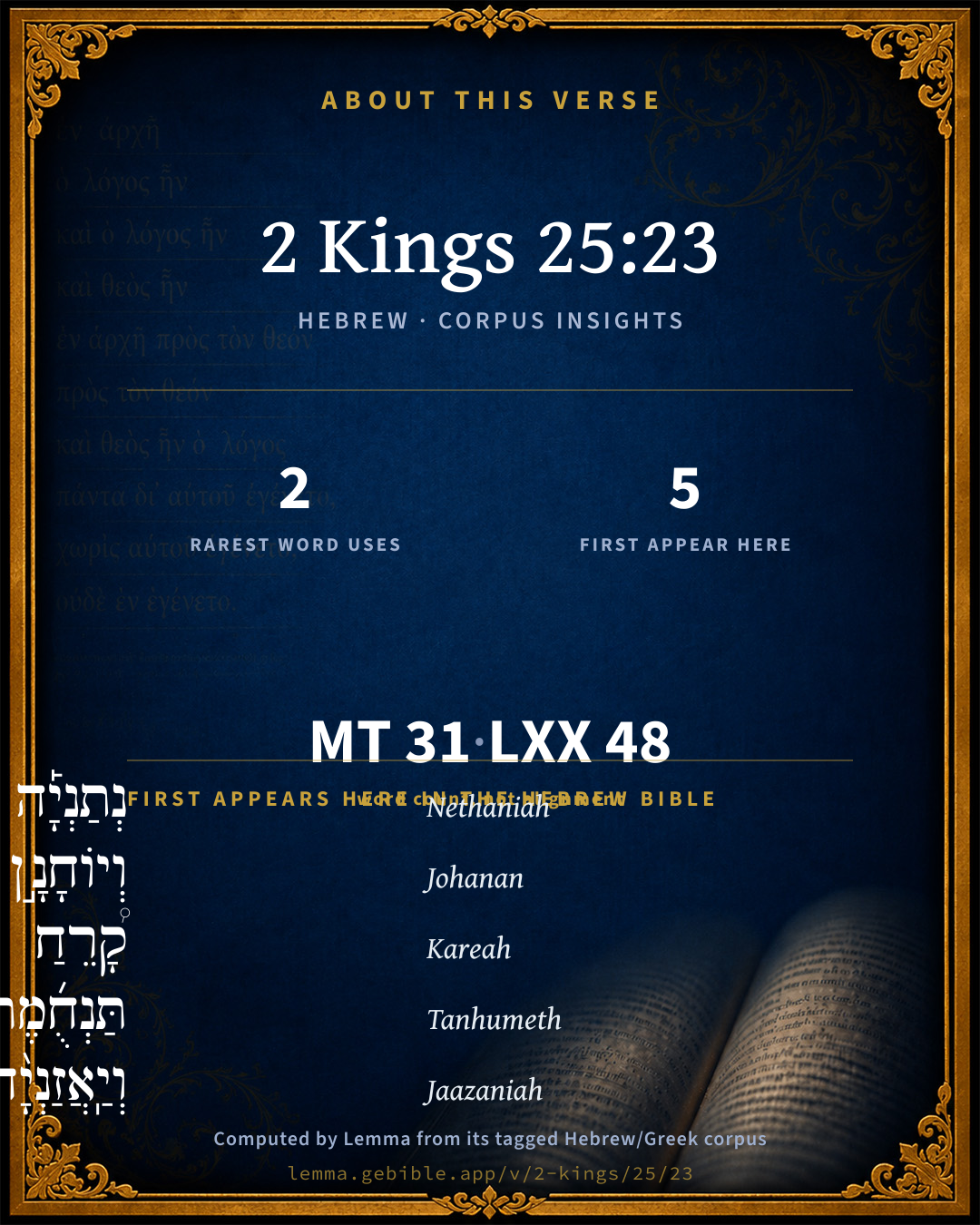
The rarest word here is תַּנְחֻ֜מֶת Tanhumeth H8576 — appearing just 2 times in the whole Hebrew Bible.

First appearance in Scripture

These words make their first canonical appearance in the Hebrew Bible here:

  • נְתַנְיָ֡ה Nethaniah H5418
  • וְיוֹחָנָ֣ן Johanan H3110
  • קָ֠רֵחַ Kareah H7143
  • תַּנְחֻ֜מֶת Tanhumeth H8576
  • וְיַֽאֲזַנְיָ֨הוּ֙ Jaazaniah H2970

Shared distinctive vocabulary

תַּנְחֻ֜מֶת Tanhumeth H8576 occurs in 2 verses of the Hebrew Bible. Also found in:

Grammatical profile

  • 3 verbs
  • 23 nouns
  • 2 pronouns
  • 1 preposition
  • 1 conjunction
  • 1 particle

Verb forms

  • וַיִּשְׁמְעוּ֩ Qal · Sequential Imperfect
  • הִפְקִ֤יד Hiphil · Perfect
  • וַיָּבֹ֥אוּ Qal · Sequential Imperfect

Repetition

Words recur within this verse — often emphatic in Hebrew:

  • בֶּן son H1121 ×4
  • וְהָאֲנָשִׁ֗ים man H376 ×2
  • גְּדַלְיָ֔הוּ Gedaliah H1436 ×2
  • הֵ֣מָּה they H1992 ×2

Hebrew & Septuagint length

In English translation the verse runs 59 words from the Hebrew and 56 from the Septuagint (LXX English) — closely comparable.

A rough comparison of the two English renderings, which tokenize alike — not a word-level alignment.

Word counts can differ between the Hebrew and the Greek without any difference in meaning — e.g. the Hebrew direct-object marker אֵת has no separate Greek word, and Greek often adds the article ὁ.

In the original languages it is 31 Hebrew tokens and 48 Greek tokens — but the two are counted differently (Hebrew bundles its prefixes and suffixes into one token; the Greek is in lemma form), so that isn’t a like-for-like length.

Cross-references

3

Topical passages linked to 2 Kings 25:23 in the Treasury of Scripture Knowledge — connected by theme and wording, ordered by reader-vote popularity; previews shown in the World English Bible.

  • Jeremiah 40:7–9 Now when all the captains of the forces who were in the fields, even they and their men, heard that the king of Babylon had made Gedaliah the son of Ahikam governor in the land, and had committed to him men, and women, and children, and of the poorest of the land, of those who were not carried away captive to Babylon;
  • Joshua 18:26 and Mizpeh, and Chephirah, and Mozah,
  • Jeremiah 40:11–12 Likewise when all the Jews who were in Moab, and among the children of Ammon, and in Edom, and who were in all the countries, heard that the king of Babylon had left a remnant of Judah, and that he had set over them Gedaliah the son of Ahikam, the son of Shaphan;

Cross-references courtesy of OpenBible.info (CC BY 4.0).

Hebrew and Greek witnesses Masoretic Hebrew ↔ Greek Septuagint

The same verse in the two great witnesses to the Old Testament, shown verse-for-verse.

These are two independent witnesses, not word-aligned to each other, and the Septuagint is shown in lemma (dictionary) form.

Hebrew 2 Kings 25:23 Masoretic · Westminster Leningrad Codex

וַיִּשְׁמְעוּ֩ כָל שָׂרֵ֨י הַחֲיָלִ֜ים הֵ֣מָּה וְהָאֲנָשִׁ֗ים כִּֽי הִפְקִ֤יד מֶֽלֶךְ בָּבֶל֙ אֶת גְּדַלְיָ֔הוּ וַיָּבֹ֥אוּ אֶל גְּדַלְיָ֖הוּ הַמִּצְפָּ֑ה וְיִשְׁמָעֵ֣אל בֶּן נְתַנְיָ֡ה וְיוֹחָנָ֣ן בֶּן קָ֠רֵחַ וּשְׂרָיָ֨ה בֶן תַּנְחֻ֜מֶת הַנְּטֹפָתִ֗י וְיַֽאֲזַנְיָ֨הוּ֙ בֶּן הַמַּ֣עֲכָתִ֔י הֵ֖מָּה וְאַנְשֵׁיהֶֽם

Now when all the captains of the forces, they and their men, heard that the king of Babylon had made Gedaliah governor, they came to Gedaliah to Mizpah, even Ishmael the son of Nethaniah, and Johanan the son of Kareah, and Seraiah the son of Tanhumeth the Netophathite, and Jaazaniah the son of the Maacathite, they and their men.

World English Bible · Public Domain

Greek LXX 2 Kings 25:23 Septuagint · lemma form

καί ἀκούω πᾶς ὁ ἄρχων ὁ δύναμις αὐτός καί ὁ ἀνήρ αὐτός ὅτι καταἵστημι βασιλεύς βαβυλών ὁ γοδολιας καί ἔρχομαι πρός γοδολιας εἰς μασσηφαθ καί ισμαηλ υἱός ναθανιας καί ιωαναν υἱός καρηε καί σαραιας υἱός θανεμαθ ὁ νετωφαθίτης καί ιεζονίας υἱός ὁ μαχαθι αὐτός καί ὁ ἀνήρ αὐτός

And all the captains of the host, they and their men, heard that the king of Babylon had thus appointed Godolias, and they came to Godolias to Massephath, both Ismael the son of Nathanias, and Jona son of Careth, and Saraias, son of Thanamath the Netophathite, and Jezonias son of a Machathite, they and their men.

LXX2012 (modern English Septuagint) · Public Domain

Hebrew: Westminster Leningrad Codex (CC BY 4.0). Greek: Septuagint (public domain); English from LXX2012 (modern English Septuagint) (Public Domain). How the Septuagint differs from the Hebrew →

Targum (Aramaic paraphrase)

1

The Targum is the ancient Jewish Aramaic paraphrase of the Hebrew Scriptures — an interpretive translation, not the Hebrew text itself. Onkelos (literal) and Pseudo-Jonathan (expansive) render the Torah, and Jonathan the Prophets. Coverage is partial: where no permissively-licensed English translation exists for a verse, only the Aramaic is shown. This is verse-level text, not a word-by-word alignment to the Hebrew.

  1. Targum Jonathan Prophets (Joshua–Malachi)
    וּשְׁמָעוּ כָל רַבָּנֵי חֵילְוָתָא אִינוּן וְגַבְרֵיהוֹן אֲרֵי מַנֵי עֲלֵיהוֹן מַלְכָּא דְבָבֶל יַת גְדַלְיָה וַאֲתוֹ לְוַת גְדַלְיָה לְמִצְפְּיָא וְיִשְׁמָעֵאל בַּר נְתַנְיָה וְיוֹחָנָן בַּר קָרֵחַ וּשְׂרָיָה בַר תַּנְחֻמֶת דְמִנְטוֹפָה וְיַאֲזַנְיָה בַר מַעֲכָת אִינוּן וְגַבְרֵיהוֹן:

    (no public-domain English translation for this verse)

    Targum Jonathan — Aramaic: “Mikraot Gedolot” (public domain). English: “Sefaria Community Translation” (CC0 1.0 (public-domain dedication)); “London "Chaldee Paraphrase," 1871” (public domain). Text via Sefaria.

Commentary

Notes on 2 Kings 25:23 from classic Christian and Jewish commentators (each source and its license shown beneath its notes). The classic Christian expositions comment on the surrounding passage and are grouped to its opening verse, so a note may address several verses; the Jewish commentaries on the Tanakh (Rashi and others) are per-verse, so they appear only where the commentator wrote on this verse.

Lemma curates 59 commentaries, every one of them public domain or Creative Commons licensed, each selected and text-cleaned for this edition rather than reprinted as found. About our sources →

Trapp's Complete Commentary

John Trapp

2Ki 25:23 And when all the captains of the armies, they and their men, heard that the king of Babylon had made Gedaliah governor, there came to Gedaliah to Mizpah, even Ishmael the son of Nethaniah, and Johanan the son of Careah, and Seraiah the son of Tanhumeth the Netophathite, and Jaazaniah the son of a Maachathite, they and their men.

Ver. 23. And when all the captains of the army.] Palantes per agros, qui dispersi fuerant; those, likely, that were scattered from Zedekiah. {2Ki 25:5}

John Trapp, A Commentary or Exposition upon All the Books of the Old and New Testament (1647–1656) — public domain. Text from a community e-Sword module.

Joseph Benson's Commentary

2Ki 25:23. When all the captains of the armies — Who escaped when Zedekiah was taken; heard that the king of Babylon had made Gedaliah governor — One of themselves, and that things were put into a good posture: there came to Gedaliah to Mizpah — A place in the land of Benjamin, famous in Samuel’s time; Ishmael, Johanan, &c., they and their men — To put themselves under his protection. Gedaliah, though he had not the pomp and power of a sovereign prince, yet might have been a greater blessing to them than many of their kings had been, especially having such a privy counsellor as Jeremiah, who was now with them, and interested himself in their affairs, Jer 40:5-6.

Joseph Benson's Commentary on the Old and New Testaments (1811–1818) — public domain. Text from a community e-Sword module.

Tyndale Open Study Notes

Tyndale Open Resources

25:23-24 Because Gedaliah came from a family experienced in civic affairs, his governorship was initially well accepted (see also Jer 40:1-12). A seal impression recovered from Lachish confirms Gedaliah’s importance as the officer “over the house” (see study note on 1 Kgs 4:6). • In addition to the army commanders, the prophet Jeremiah also went to Mizpah to support Gedaliah (Jer 40:6). This Mizpah was a border town in Benjamin; it had been prominent in Israelite history as a place of religious assembly (1 Sam 7:5-6). • The men listed here held important posts. Ishmael was from a prominent family of royal lineage (2 Kgs 25:25; Jer 36:12). Johanan served Gedaliah faithfully (Jer 40:13-16). The name Jezaniah occurs on materials recovered from excavations at Tell-en-Nasbeh.

Tyndale Open Study Notes — © Tyndale Open Resources, licensed CC BY-SA 4.0. Text via the HelloAO Bible API.

Adam Clarke's Commentary

Verse 23. To Mizpah] This is said to have been situated on the east side of the river Jordan, and most contiguous to Babylon, and therefore the most proper for the residence of Gedaliah, because nearest to the place from which he was to receive his instructions. But there were several places of this name, and we do not exactly know where this was situated.

Adam Clarke's Commentary on the Bible (1810–1826) — public domain. Text from a community e-Sword/MySword module.

Ellicott's Commentary for English Readers

(23) The captains of the armies.—Rather, the army captains; or, the captains of the forces. They and their men had fled with the king, and dispersed themselves over the country (Jer_40:7). Now they came out of hiding.

Their men.—The Hebrew text has the men, but all the versions, and Jer_40:7, read rightly, their men.

Mizpah.—See 1Ki_15:22. It was well suited to be the governor’s residence, as it lay high, and was a naturally strong position. Moreover, it was the seat of an ancient sanctuary (Jdg_20:1), which might serve in some sort as a substitute for the destroyed Temple of Jerusalem (Jer_41:5).

Ishmael.—Grandson of Elishama the royal secretary (2Ki_25:25; Jer_36:12; Jer_36:20), and of royal blood (Jer_41:1).

Johanan the son of Careah.—Jer_40:8, “and Johanan and Jonathan the sons of Careah.”

The Netophathite.—The words, “and the sons of Ophai,” have fallen out before this epithet (Jer_40:8), and probably the names of these sons of Ophai in both passages. Netophah is mentioned in Ezr_2:22; Neh_7:26. It may be Beit Nettif south-west of Jerusalem.

The son of a (the) Maachathite.—His father was an alien, and belonged to the Syrian state of Maachah (2Sa_10:6; 2Sa_10:8).

A Bible Commentary for English Readers, edited by Charles John Ellicott (1878–1897) — public domain. Text from a community e-Sword module.

The Cambridge Bible for Schools and Colleges

gen. ed. J. J. S. Perowne

23. And [R.V. Now] when all the captains … heard] The governorship of Gedaliah appears to have found much favour. We are told (Jeremiah 41) that when Jeremiah was set at liberty by Nebuzar-adan at Ramah he at once made his way to Gedaliah; beside that the captains of the forces gathered to him, and so did the Jews that had escaped into the countries round about, Moab, Ammon and Edom; and it is said ‘they gathered wine and summer fruits very much’. Meantime Gedaliah was warned that Baalis the king of the Ammonites had sent Ishmael to slay him, but he refused to credit the report, and when one of his friends voluntered to slay Ishmael, Gedaliah would not permit it.

captains of the armies] R.V. forces. Thus translated in Jer_40:7.

to Mizpah] See on 1Ki_15:22. Jerusalem was now in ruins. Mizpah was a strong place about six miles north of the Holy City.

Ishmael the son of Nethaniah] Jer_41:1 (see also below verse 25) adds that Nethaniah was the son of Elishama of the seed royal. How he was connected with the royal blood we cannot discover. He had been in the country of the Ammonites during the destruction of Jerusalem, and when Gedaliah was set up as governor in Mizpah he came into Judah, apparently at the instigation of Baalis, king of Ammon, with the purpose of slaying Gedaliah and occupying his place. At first he acted as if friendly to Gedaliah, but after a short time, at a banquet where he and ten friends were entertained by Gedaliah, the murder of the governor was perpetrated, and at the same time all the Jews in the house with Gedaliah were likewise slain. All this was done with such precaution and secrecy that for two days nobody outside the governor’s palace knew what had been done. After that time Ishmael, observing a party of fourscore pilgrims coming towards Mizpah, went to meet them, and bringing them into the courtyard of the house as if to see Gedaliah, had all but ten of them killed and cast into the well in the court. He now resolved on flight and taking away with him the daughters of Zedekiah, who had been put under Gedaliah’s charge, he turned his steps to the land of Ammon. But Johanan and the other captains, who had by this time discovered the atrocious murders, pursued Ishmael, yet though they came up with him and his party ‘by the great waters that were in Gibeon’, and though Ishmael’s followers were at once ready to desert him, the villain, and eight more with him, escaped into the country of the Ammonites.

Johanan the son of Careah] R.V. Kareah. This is the spelling of A.V. in Jer_40:8; Jer_41:11, &c. It was Johanan who warned Gedaliah of the plot against him. He is mentioned (Jer_43:2-4) as one of those who were prominent in the proceedings when Jeremiah was carried off into Egypt. He is there classed among ‘all the proud men’. A brother of his, Jonathan, is mentioned in Jer_40:8.

Seraiah the son of Tanhumeth] He is called here the Netophathite, but in the enumeration of Jeremiah that description is omitted, and some other persons are described as ‘the sons of Ephai, the Netophathite’.

Jaazaniah the son of a [R.V. the] Maachathite] The name is spelt Jezaniah in Jeremiah’s narrative.

The Cambridge Bible for Schools and Colleges (gen. ed. J. J. S. Perowne; Cambridge University Press, 1878–1918) — public domain. Text from a community e-Sword module.

Albert Barnes' Notes on the Bible

The captains of the armies - i. e., the officers of the troops who had fled from Jerusalem with Zedekiah 2Ki 25:4, and had then dispersed and gone into hiding 2Ki 25:5.

For Mizpah, see Jos 18:26 note.

The Netophathite - Netophah, the city of Ephai (compare Jer 40:8), appears to have been in the neighborhood of Bethlehem Neh 7:26; Ezr 2:21-22. The name is perhaps continued in the modern Antubeh, about 2 12 miles S. S. E. of Jerusalem.

A Maachathite - Maachah lay in the stony country east of the upper Jordan, bordering upon Bashan Deu 3:14.

Albert Barnes' Notes on the Bible (1834–1885) — public domain. Text from a community e-Sword/MySword module.

Matthew Poole's English Annotations

The captains of the armies, which escaped away when Zedekiah was taken. See Poole "2Ki 25:4", See Poole "2Ki 25:5".

Matthew Poole's English Annotations on the Holy Bible (1683–1685) — public domain. Text from a community e-Sword/MySword module.

Whedon's Commentary on the Bible

Daniel D. Whedon

23. The captains of the armies — The men of war who fled by night with Zedekiah from Jerusalem, (2Ki_25:4,) but soon after deserted him, and had become scattered “in the fields.” Jer_40:7.

To Mizpah — In the land of Benjamin. See on Jos_18:25, and 1Sa_7:5. The city had been strongly fortified by Asa, (1Ki_15:22,) and Gedaliah occupied it instead of Jerusalem, because the latter city was in too ruinous a condition to be any proper residence for a governor.

Daniel D. Whedon (gen. ed.), Commentary on the Old and New Testaments (1874–1909) — public domain. Text from a community e-Sword module.

The Pulpit Commentary

And when all the captains of the armies; rather, the captains of the forces (Revised Version); i.e. the officers in command of the troops which had defended Jerusalem, and, having escaped from the city, were dispersed and scattered in various directions, partly in Judaea, partly in foreign countries. They and their men apparently, each of them had kept with him a certain number of the men under his commandheard that the King of Babylon had made Gedaliah governor. The news was gratifying to them. It was something to have a Jewish ruler set over them, and not a Babylonian; it was, perhaps, even more to have a man noted for his justice and moderation (Josephus, "Ant. Jud:," 10:9. who had no selfish aims, but desired simply the prosperity and good government of the country. There same to Gedaliah to Mispah, even Ishmael the son of Nethaniah, and Jo-hanan the son of Careah Jer_40:8 has "Johanan and Jonathan, the sons of Kareahand Seraiah the son of Tanhumeth the Netophathite. in Jer_40:8 we read, "And Seraiah the son of Tanhumeth, and the sons of Ephai the Netephathite," by which it would seem that some words have fallen out here. By "Netophathite" is to be understood "native of Netophah," now Antubah, near Bethlehem (see Ezr_2:22; Neh_7:26) And Jaazaniah the son of a Maschathite. Called Jezaniak by Jeremiah, and said by him (Jer_42:1) to have been the son of a certain Heshaiah. Hoshaiah was a native of the Syrian kingdom, or district, known as Maschah, or Maachathi (Deu_3:14; 1Ch_19:6, 1Ch_19:7) which adjoined Bashan towards the north. They and their men. The persons mentioned, that is, with the soldiers under them, came to Gedaliah at Mizpah, and placed themselves under him as his subjects.

The Pulpit Commentary (1880–1919), ed. H.D.M. Spence-Jones & Joseph S. Exell — public domain. Text from a community e-Sword module.

Rashi

Rabbi Shlomo Yitzchaki (Rashi)

All the officers of the armies. Who had left the city to hide in the strongholds, boulders, rocks and forests.

Rashi on the Tanakh — English translations: “The Judaica Press complete Tanach with Rashi, translated by A. J. Rosenberg” (CC BY 4.0); “Pentateuch with Rashi's commentary by M. Rosenbaum and A.M. Silbermann, 1929-1934” (public domain); “The Metsudah Tanach series, Lakewood, N.J” (CC BY 4.0); and “The Book of Joshua, Metsudah Publications, 1997” (CC BY 4.0). Text via Sefaria.

Lesson kit

Teaching starters — assembled from the data on this page, not authored interpretation. Every prompt links to the verse data it draws on. Edit before teaching.

2 Kings, in the Historical, opens this verse with 31 words (25 distinct Hebrew lemmas). Its most distinctive word is Tanchumeth (“Tanhumeth”). A historical commentator’s framing appears above. Read the whole chapter for the surrounding context.

Discussion questions

  1. How does “Tanhumeth” (Tanchumeth) shape what this verse is saying?
  2. 5 words here appear for the first time in Scripture. What is being introduced at this debut?
  3. Jeremiah 40:8 shares the word «Tanhumeth» with this verse. How do the two illuminate each other?
  4. “son” occurs 4× in this one verse. What is the effect of the repetition?
  5. The translations on this page render this verse differently — a whole-verse word diff, not a word-by-word alignment. What might account for the different wordings?
  6. The verb «וַיִּשְׁמְעוּ֩» is Qal Sequential Imperfect. How does its form color the action?
  7. Reading how Trapp's Complete Commentary and Joseph Benson's Commentary read this verse, where do the two commentators agree and where do they part?

Things to notice

Reading settings

Reading text

Shown beneath each verse's original-language words.

Old Testament
Old Testament edition

Read the OT as the Masoretic Hebrew (MT) or the Greek Septuagint (LXX).

English shown for the Greek Septuagint (in the Hebrew ↔ Greek comparison).

Comparing translations? Open the Compare panel on any verse page to stack up to four side by side.