
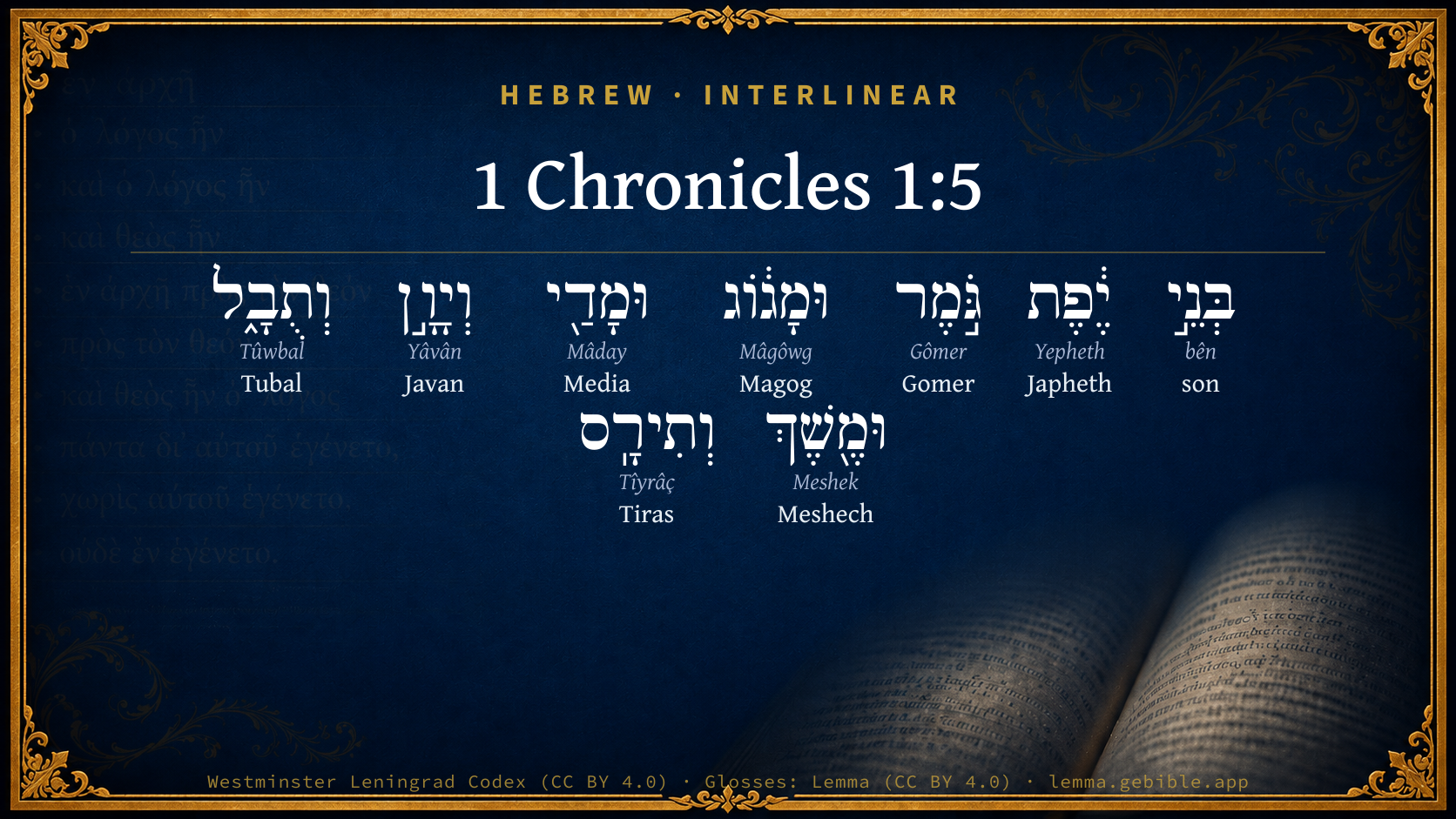
1 Chronicles 1:5

Hebrew (Westminster Leningrad Codex) 1 Chronicles 1:5 appears in the Hebrew Old Testament. The text above is from the Westminster Leningrad Codex. Each word links to its Strong’s number, a concise gloss, and parsing drawn from the Open Scriptures Hebrew Bible morphology. Click any word for its full Brown-Driver-Briggs (BDB) entry.
Download image
Cite this verse

1 Chronicles 1:5 (World English Bible). Public Domain. Lemma interlinear Bible study tool, https://lemma.gebible.app/v/1-chronicles/1/5.

Show BibTeX & RIS
BibTeX
RIS
English Translation
The sons of Japheth: Gomer, and Magog, and Madai, and Javan, and Tubal, and Meshech, and Tiras.
World English Bible · Public Domain
Download a study sheet

One document with this verse’s original text, its word-by-word gloss line, the meaning frame, cross-references with their text, attributed commentary, and full source and license credits — printable, and it pastes into notes with its structure intact.

This verse Autodidact and up

Study sheet (.html) Plain text (.txt)

A passage Seminary Student

Up to 50 verses in one chapter. A passage sheet keeps up to 6 commentary sources and 12 cross-references per verse, in the order this page ranks them, and says so on the sheet whenever that leaves anything out. Ask for a single verse and you get the Autodidact verse sheet above.

Everything on this page stays free to read, with no account — the sheet is a download of what is already on screen, not access to it.

Want to remove ads? Support Godless Engineer
Compare translations 3

The same verse in 3 English versions, stacked beneath the original-language interlinear above. Click any original word for its lexicon entry.

Each is an independent rendering of the whole verse — the interlinear is not word-aligned to these translations.

Highlighted words mark where these versions differ — a whole-verse word diff, not a word-by-word alignment.

  • World English Bible Public Domain
    The sons of Japheth: Gomer, and Magog, and Madai, and Javan, and Tubal, and Meshech, and Tiras.
  • King James Version Public Domain
    The sons of Japheth; Gomer, and Magog, and Madai, and Javan, and Tubal, and Meshech, and Tiras.
  • unfoldingWord Literal Text CC BY-SA 4.0
    The sons of Japheth: Gomer and Magog and Madai and Javan and Tubal and Meshech and Tiras.

unfoldingWord Literal Text — © unfoldingWord, licensed CC BY-SA 4.0. Word-aligned USFM3 via Door43 (git.door43.org/unfoldingWord/en_ult).

Versions to compare (up to 4)

3 of 4 selected

Show all 18 translations

Every available English version of this verse, each an independent rendering of the whole verse.

  • World English Bible Public Domain
    The sons of Japheth: Gomer, and Magog, and Madai, and Javan, and Tubal, and Meshech, and Tiras.
  • Berean Standard Bible Public Domain
    The sons of Japheth: Gomer, Magog, Madai, Javan, Tubal, Meshech, and Tiras.
  • Majority Standard Bible Public Domain
    The sons of Japheth: Gomer, Magog, Madai, Javan, Tubal, Meshech, and Tiras.
  • King James Version Public Domain
    The sons of Japheth; Gomer, and Magog, and Madai, and Javan, and Tubal, and Meshech, and Tiras.
  • American Standard Version (1901) Public Domain
    The sons of Japheth: Gomer, and Magog, and Madai, and Javan, and Tubal, and Meshech, and Tiras.
  • Revised Version (1885) Public Domain
    The sons of Japheth; Gomer, and Magog, and Madai, and Javan, and Tubal, and Meshech, and Tiras.
  • Geneva Bible (1599) Public Domain
    The sonnes of Iapheth were Gomer, and Magog, and Madai, and Iauan, and Tubal, and Meshech, and Tiras.
  • Douay-Rheims (1899) Public Domain
    The sons of Japheth: Gomer, and Magog, and Madai, and Javan, Thubal, Mosoch, Thiras.
  • Young's Literal Translation Public Domain
    Sons of Japheth: Gomer and Magog, and Madai, and Javan, and Tubal, and Meshech, and Tiras.
  • Literal Standard Version CC BY-SA 4.0
    Sons of Japheth: Gomer and Magog, and Madai, and Javan, and Tubal, and Meshech, and Tiras.
  • Unlocked Literal Bible CC BY-SA 4.0
    The sons of Japheth were Gomer, Magog, Madai, Javan, Tubal, Meshek, and Tiras.
  • unfoldingWord Literal Text CC BY-SA 4.0
    The sons of Japheth: Gomer and Magog and Madai and Javan and Tubal and Meshech and Tiras.
  • Darby Bible Public Domain
    The sons of Japheth: Gomer, and Magog, and Madai, and Javan, and Tubal, and Meshech, and Tiras.
  • World Messianic Bible Public Domain
    The sons of Japheth: Gomer, Magog, Madai, Javan, Tubal, Meshech, and Tiras.
  • Webster's Bible Public Domain
    The sons of Japheth; Gomer, and Magog, and Madai, and Javan, and Tubal, and Meshech, and Tiras.
  • Free Bible Version CC BY-SA 4.0
    The sons of Japheth: Gomer, Magog, Madai, Javan, Tubal, Meshech, and Tiras.
  • Bible in Basic English Public Domain
    The sons of Japheth: Gomer and Magog and Madai and Javan and Tubal and Meshech and Tiras.
  • JPS Tanakh (1917) Public Domain
    The sons of Japheth: Gomer, and Magog, and Madai, and Javan, and Tubal, and Meshech, and Tiras.

Literal Standard Version (2020), Covenant Press — licensed CC BY-SA 4.0. Text via the HelloAO Bible API (eBible.org). Unlocked Literal Bible (unfoldingWord) — licensed CC BY-SA 4.0. Text via the HelloAO Bible API (eBible.org). unfoldingWord Literal Text — © unfoldingWord, licensed CC BY-SA 4.0. Word-aligned USFM3 via Door43 (git.door43.org/unfoldingWord/en_ult). Free Bible Version, Dr. Jonathan Gallagher — licensed CC BY-SA 4.0. Text via the HelloAO Bible API (eBible.org).

Word by word

More ways to search: Search by grammar → Find every occurrence → Compare this word →

Practice this passage: Drill this verse → Learn its vocabulary →

About this verse

These counts appear in no published source. They are computed here, from the morphology-tagged text and Lemma’s own curated glosses. What Lemma adds →

9
words
9
distinct lemmas
Historical
section

Notable vocabulary

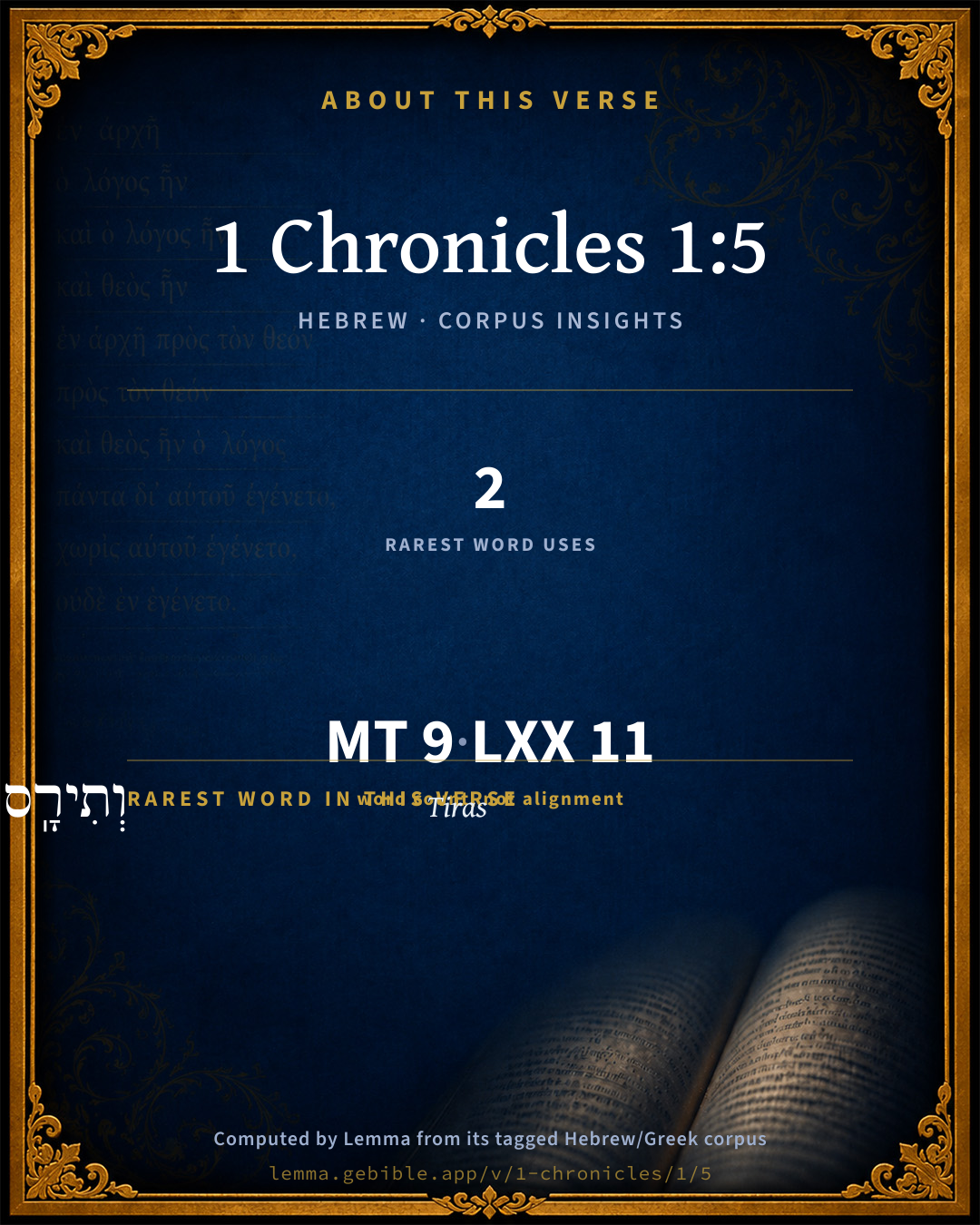
The rarest word here is וְתִירָֽס Tiras H8494 — appearing just 2 times in the whole Hebrew Bible.

Shared distinctive vocabulary

וְתִירָֽס Tiras H8494 occurs in 2 verses of the Hebrew Bible. Also found in:

Grammatical profile

  • 9 nouns

Hebrew & Septuagint length

In English translation the verse runs 17 words from the Hebrew and 13 from the Septuagint (LXX English) — closely comparable.

A rough comparison of the two English renderings, which tokenize alike — not a word-level alignment.

Word counts can differ between the Hebrew and the Greek without any difference in meaning — e.g. the Hebrew direct-object marker אֵת has no separate Greek word, and Greek often adds the article ὁ.

In the original languages it is 9 Hebrew tokens and 11 Greek tokens — but the two are counted differently (Hebrew bundles its prefixes and suffixes into one token; the Greek is in lemma form), so that isn’t a like-for-like length.

Cross-references

5

Topical passages linked to 1 Chronicles 1:5 in the Treasury of Scripture Knowledge — connected by theme and wording, ordered by reader-vote popularity; previews shown in the World English Bible.

  • Genesis 10:1–5 Now this is the history of the generations of the sons of Noah and of Shem, Ham, and Japheth. Sons were born to them after the flood.
  • Ezekiel 27:13 Javan, Tubal, and Meshech, they were your traffickers; they traded the persons of men and vessels of brass for your merchandise.
  • Ezekiel 38:2–3 Son of man, set your face toward Gog, of the land of Magog, the prince of Rosh, Meshech, and Tubal, and prophesy against him,
  • Ezekiel 38:6 Gomer, and all his hordes; the house of Togarmah in the uttermost parts of the north, and all his hordes; even many peoples with you.
  • Ezekiel 39:1 You, son of man, prophesy against Gog, and say, Thus says the Lord Yahweh: Behold, I am against you, Gog, prince of Rosh, Meshech, and Tubal:

Cross-references courtesy of OpenBible.info (CC BY 4.0).

Hebrew and Greek witnesses Masoretic Hebrew ↔ Greek Septuagint

The same verse in the two great witnesses to the Old Testament, shown verse-for-verse.

These are two independent witnesses, not word-aligned to each other, and the Septuagint is shown in lemma (dictionary) form.

Hebrew 1 Chronicles 1:5 Masoretic · Westminster Leningrad Codex

בְּנֵ֣י יֶ֔פֶת גֹּ֣מֶר וּמָג֔וֹג וּמָדַ֖י וְיָוָ֣ן וְתֻבָ֑ל וּמֶ֖שֶׁךְ וְתִירָֽס

The sons of Japheth: Gomer, and Magog, and Madai, and Javan, and Tubal, and Meshech, and Tiras.

World English Bible · Public Domain

Greek LXX 1 Chronicles 1:5 Septuagint · lemma form

υἱός ιαφεθ γαμερ μαγωγ μαδαι ιωυαν ελισα θοβελ μοσοχ καί θιρας

The sons of Japheth, Gamer, Magog, Madaim, Jovan, Helisa, Thobel, Mosoch, and Thiras.

LXX2012 (modern English Septuagint) · Public Domain

On this verse, Ellicott's Commentary for English Readers discusses the Septuagint’s reading. Read the note in Commentary ↓

Hebrew: Westminster Leningrad Codex (CC BY 4.0). Greek: Septuagint (public domain); English from LXX2012 (modern English Septuagint) (Public Domain). How the Septuagint differs from the Hebrew →

Commentary

Notes on 1 Chronicles 1:5 from classic Christian and Jewish commentators (each source and its license shown beneath its notes). The classic Christian expositions comment on the surrounding passage and are grouped to its opening verse, so a note may address several verses; the Jewish commentaries on the Tanakh (Rashi and others) are per-verse, so they appear only where the commentator wrote on this verse.

Lemma curates 59 commentaries, every one of them public domain or Creative Commons licensed, each selected and text-cleaned for this edition rather than reprinted as found. About our sources →

Ellicott's Commentary for English Readers

THE SONS OF JAPHETH THE FAIR—(1Ch_1:5-7).

The Oriental theory of political and even social communities refers each to a common ancestor. The Israelites are known as “sons of Israel,” the Ammonites as “sons of Ammon” (Authorised version, “children”). In the same way, an Arab tribe is called. the “Bêni Hassan” (sons of Hassan), and Assurbanipal styles his subjects “sons of Asshur.” Sometimes a people is called “sons” of the land or city they inhabit; e.g., the Babylonians are styled “sons of Babel.” The “sons of Japheth” are probably the fair Caucasian race.

(5) Gomer.—The Cimmerians of the Greek writers; called Gi-mir-ra-a-a in Assyrian inscriptions. Their country was Cappadocia, called Gamir by the ancient Armenians. The Arabic version has “Turkey.”

Magog.—Eze_38:2-3; Eze_38:6 speaks of Gog, king of Magog, and suzerain of Tubal, Meshech, Gomer and the house of Togarmah. With the name Gog compare Gâgu, king of Salii, mentioned in connection with Assurbanipal’s campaign against the Mannâ-a. Magog appears to be a general name for the peoples north of Assyria, i.e., in Armenia.

Madai.—The Medes. 2Ki_17:6; Isa_13:17. Assyr., Ma-da-a-a.

Javan.—The Assyrian Yavnan, i.e., Cyprus, mentioned in the Behistun Inscription, as here, along with Media, Armenia, and Cappadocia. (Comp. Joe_3:6; Isa_66:19.)

Tubal and Meshech, the Tibareni and Moschi of classical writers; and the Muski and Tabali of Assyrian records.

Tiras has been compared with the Tyras or Dniester. Perhaps we may compare Tros and the Trojans.

(6) Ashchenaz.—Jer_51:27, near or in Armenia. Apparently the Asguzâa mentioned by Esarhaddon in the account of his campaign against the Cimmerians and Cilicians. The Arabic has Slavonia.

Riphath.—The reading of Gen_10:3, some Heb. MSS., the LXX., and Vulg. The common Hebrew text (Van der Hooght’s) wrongly reads Diphath (Syriac, Diphar). Togarmah seems to be the Tulgarimmç on the border of Tabali, which Sennacherib reduced in his expedition against Cilicia (Smith, Sennach., p. 86).

(7) Elishah.—Usually identified with Hellas, or the Hellenes. Perhaps, however, Carthage is meant: comp. the name Elissa, as a by-name of Dido, Virg. Æn. iv. 335.

Tarshish.—Usually identified with the Phœnician colony of Tartessus, in Spain. (Comp. Psa_72:10.)

Dodanim.—So many Heb. MSS., the Syriac, Vulg., and Gen_10:3. The LXX. has “Rhodians,” which implies a reading, Rodanim, which we find in the common Hebrew text. Dodanim might be the Dardauians of the Troad, or the Dodoneans (Dodona, the seat of an ancient oracle, the fame of which might have reached Phœnician ears).

Thus far the list appears to deal with Asia Minor and adjacent lands; and Japheth, whose name is curiously like the Greek Iäpetus, seems to include the western races so far as known to the Hebrews.

A Bible Commentary for English Readers, edited by Charles John Ellicott (1878–1897) — public domain. Text from a community e-Sword module.

The Cambridge Bible for Schools and Colleges

gen. ed. J. J. S. Perowne

5–7 (= Gen_10:2-4). The Sons of Japheth

5. The sons of Japheth] The writer begins with the Northern “zone.”

Gomer] to he identified with the Gimirrai of the Assyrian monuments who in the seventh century b.c. inhabited the district afterwards called Cappadocia. Probably they are also to be identified with the Κιμμέριοι of the Greeks, who migrated from South Russia into Asia Minor under the pressure of the Scythians (Hdt. I. 103; IV. 11, 12; cp. Eze_38:6, R.V.; Sayce, Higher Criticism and the Monuments, p. 124).

Magog] In Ezekiel 38 judgement is denounced on “Gog, of the land of Magog, the prince of Rosh, Meshech and Tubal” (1Ch_1:2, R.V.) who is represented as accompanied in his migration by the “hordes” of Gomer and Togarmah (1Ch_1:6, R.V.), “all of them riding upon horses” (1Ch_1:15). Magog represents therefore one of several tribes of Northern nomads (Scythians) known to Israel; see note below on Tubal and Meshech.

Madai] first mentioned in an inscription of the Assyrian king Rammannirar (Rimmon-nirari III.), who reigned b.c. 812–783. They are probably the Medes who lived in small communities (κατὰ κώμας, Hdt. I. 96) without a central government in Azerbaijan and Irak Ajemi, i.e. in the N.W. provinces of modern Persia.

Javan] the Ionians (Ἰάϝʹονες) who were already settled on the West coast of Asia Minor at the dawn of Greek history. Being a seafaring nation and having a slave-trade with Tyre (Eze_27:13; Joel 3 [Heb_4:6 “Grecians”]), they became known to Israel at an early date. In the Book of Daniel the title “king of Javan” (1Ch_8:21) is used of Alexander the Great; cp. “kingdom of Javan” (1Ch_11:2) of the Macedonian Empire.

Tubal and Meshech] mentioned together Eze_27:13; Eze_32:26; Eze_38:2-3; Eze_39:1; and to be identified with the “Tabal” and “Muski” of the monuments, who in the times of the later Assyrian Empire lived as neighbours in the country N.E. of Cilicia; see Kiepert’s map in Schrader’s Keilinschriftliche Bibliothek, vol. II. This Meshech is to be distinguished from the Meshech son of Shem mentioned in 1Ch_1:17. At a later period the Τιβαρηνοί (= Tubal) lived in Pontus, and the Μόσχοι (= Meshech) further E. towards the Caspian. They were in the nineteenth nome of the Persian Empire (Hdt. iii. 94).

Tiras] No probable identification has been proposed for this name.

5–23. The “Genealogy” of the Nations

The table which follows is taken from Gen_10:2-29. In the A.V. several variations between Gen. and Chron. occur in the spelling of proper names. In the R.V. the spelling has been made uniform.

The table is geographical rather than ethnological, i.e. neighbouring nations are regarded as having the same descent. The world, as known to the writer, is divided into three zones, of which the Northern is assigned to the Sons of Japheth (5–7), the Southern to the Sons of Ham (8–16), and the Central to the Sons of Shem (17–23). Had the arrangement been according to descent the Semitic Zidonians and the (probably Mongoloid) Hittites would not have been equally described as the offspring of Ham (cp. Sayce, Higher Criticism and the Monuments, p. 122).

It must be noticed, moreover, that the passage contains a general table with two appendices. The General Table is derived from the so-called “Priestly” narrative (PC) of the Hexateuch, while the appendices have been inserted by a Redactor from an earlier narrative, the “Prophetical” (J) (cp. Driver, Introduction, p. 13). Thus we get the following scheme:—

1Ch_1:5-9.

PC

(General Table of the descendants of Japheth and Ham).10–16.

J

(Appendix to the descendants of Ham).17.

PC

(General Table of the descendants of Shem).18–23.

J

(Appendix to the descendants of Shem).

It must be further noted that though the Priestly source is assigned in its main stock by critics to “the exilic or early post-exilic period,” some elements in it belong to pre-exilic times. This table of the nations in particular agrees with the state of the world as referred to by Ezekiel, and is probably to be assigned to a date anterior to the destruction of Jerusalem by the Chaldeans. (Sayce in Hastings’ Dictionary of the Bible, i. 347, suggests that the table is as early as the period of the Eighteenth and Nineteenth Egyptian dynasties, when Palestine was under Egyptian suzerainty.)

The Cambridge Bible for Schools and Colleges (gen. ed. J. J. S. Perowne; Cambridge University Press, 1878–1918) — public domain. Text from a community e-Sword module.

Trapp's Complete Commentary

John Trapp

1Ch 1:5 The sons of Japheth; Gomer, and Magog, and Madai, and Javan, and Tubal, and Meshech, and Tiras.

Ver. 5. Gomer.] Of whom came the Cymbrians and Danes.

Magog.] From whom are the Scythians, Sarmatians, Tartars.

Madai.] The father of the Medes, as Javan is conceived to be of the Grecians, Tubal of the Spaniards, Meshech of the Muscovites, Tiras of the Thracians, Ashchenaz of the Germans (Tuiscones Dutchmen), Riphath of the Paphlagones, Togarmah of the Turks, Elishah of the Eolians, Tarshish of the Cilicians, Kittim the Cyprians, Dodanim or Rodahim the Rhodians, &c.

John Trapp, A Commentary or Exposition upon All the Books of the Old and New Testament (1647–1656) — public domain. Text from a community e-Sword module.

Joseph Benson's Commentary

1Ch 1:5. The sons of Japheth — The historian, repeating the account of the replenishing the earth by the sons of Noah, begins with those that were strangers to the church, the sons of Japheth, who peopled Europe, of whom he says little, as the Jews had hitherto little or no dealings with them. He proceeds to those that had many of them been enemies to the church, and thence hastens to the line of Abraham, breaking off abruptly from all the other families of the sons of Noah, but that of Arphaxad, from whom Christ was to come. The great promise of the Messiah was transmitted from Adam to Seth, from him to Shem, from him to Eber, and so to the Jewish nation, who were intrusted above all nations with that sacred treasure, till the promise was performed, and the Messiah was come.

Joseph Benson's Commentary on the Old and New Testaments (1811–1818) — public domain. Text from a community e-Sword module.

Tyndale Open Study Notes

Tyndale Open Resources

1:5-23 The record of Noah’s descendants establishes Abraham’s place in history. The ethnic backdrop of the seventy nations of the world provides the context for Israel’s history (cp. Gen 10).

Tyndale Open Study Notes — © Tyndale Open Resources, licensed CC BY-SA 4.0. Text via the HelloAO Bible API.

Adam Clarke's Commentary

Verse 5. After Tiras, the Targum adds, "And the names of their countries were Africa, and Germany, and Media, and Macedonia, Bithynia, and Maesia, and Thrace." And in another copy, "Germany, Getia, and Media, and Ephesus, Bithynia, and Maesia, and Thrace."

Adam Clarke's Commentary on the Bible (1810–1826) — public domain. Text from a community e-Sword/MySword module.

The Pulpit Commentary

Vers. 5-7. B. LIST OF SONS AND GRANDSONS OF JAPHETH. After the mention of Noah"s three sons, in the order of their age (though some on slender ground think Ham the youngest), this order, as in (Gen_10:2) , is reversed; and the compiler, beginning with Japheth, the youngest, apparently with the view of disposing of what his purpose may not so particularly require, gives the names of seven sons and seven grandsons, viz. three through Gomar, the eldest son, and four through Javan, the fourth son. These fourteen names are identical in the Authorized Version with the list of (Gen_10:2-4) . The Septuagint, though not identical in the spelling of the four names Madai, Tiras, Tarshish, and Kittim, shows no material differences in the two places. In the Hebrew, according to the text and edition consulted, very slight variations are found in the orthography of Tubal (lBtuw here for lbtuw) and Tarshish (jvyvirtw here for vyvirtw)and in the adoption of Riphath and Dodanim in this book for Diphath and Rodanim. The names Kittim and Dodanim look less like names of individuals than of such family, tribe, or nation as descended from the individual. At the close of this short enumeration, we have.in Genesis the statement, "By these were the isles of the Gentiles divided in their lands; every one after his tongue, after their families, in their nations." It is evident here also that, whether the compiler borrowed from the Book of Genesis itself, or from some common source open to both, his objects are not exactly the same. Time and the present position and condition of that part of his people for which he was writing governed him, and dictated the difference. Accordingly we do not pause here on the colonizings and the fresh seats and habitations of the sons and grandsons of Japheth. The subject, one of extreme interest, and the threads of it perhaps not so hopelessly lost as is sometimes thought, belongs to the place in Genesis from which the above verse is cited. It may, however, be written here that the rather verbose disquisitions of Joseph Mede are neither altogether unin-retorting nor in some parts of them unlikely. They form Discourses 47, 48, bk. 1. (edit. "The Works of Joseph Mode." London, 1664).

The Pulpit Commentary (1880–1919), ed. H.D.M. Spence-Jones & Joseph S. Exell — public domain. Text from a community e-Sword module.

John Wesley's Explanatory Notes

The sons of Japheh - The historian repeating the account of the replenishing the earth by the sons of Noah, begins with those that were strangers to the church, the sons of Japheth, who peopled Europe, of whom he says little, as the Jews had hitherto little or no dealings with them. He proceeds to those that had many of them been enemies to the church, and thence hastens to the line of Abraham, breaking off abruptly from all the other families of the sons of Noah, but that of Arphaxad, from whom Christ was to come. The great promise of the Messiah was transmitted from Adam to Seth, from him to Shem, from him to Eber, and so to the Jewish nation, who were intrusted above all nations with that sacred treasure, 'till the promise was performed, and the Messiah was come: and then that nation was made not a people.

John Wesley, Explanatory Notes Upon the Whole Bible (1754–1765) — public domain. Text via the GEBible commentary corpus.

Scofield Reference Notes

C. I. Scofield

Magog

Gen 10:2; Eze 38:2; Eze 39:6; Rev 20:8. (See Scofield "Eze 38:2").

The Scofield Reference Bible (1917 edition), notes by C. I. Scofield — public domain. Text from a community e-Sword module.

unfoldingWord translationNotes

Door43 World Missions Community

Gomer ... Magog ... Madai ... Javan ... Tubal ... Meshek ... Tiras ... Ashkenaz ... Riphath ... Togarmah ... Elishah ... Tarshish

These are all names of men. (See: How to Translate Names)

Kittites ... Rodanites

These are names of people groups. (See: How to Translate Names)

Rodanites

This name is sometimes spelled "Dodanites." (See: Textual Variants)

translationWords

Tubal

Meshech

Tarshish

unfoldingWord translationNotes — © Distant Shores Media and the Door43 World Missions Community, licensed CC BY-SA 4.0. Source: git.door43.org/Door43/en_tn.

Lesson kit

Teaching starters — assembled from the data on this page, not authored interpretation. Every prompt links to the verse data it draws on. Edit before teaching.

1 Chronicles, in the Historical, opens this verse with 9 words (9 distinct Hebrew lemmas). Its most distinctive word is Tîyrâç (“Tiras”). A historical commentator’s framing appears above. Read the whole chapter for the surrounding context.

Discussion questions

  1. How does “Tiras” (Tîyrâç) shape what this verse is saying?
  2. How does Genesis 10:2, which shares the word «Tiras», read alongside this verse?
  3. Compare how Ellicott's Commentary for English Readers and The Cambridge Bible for Schools and Colleges read this verse. Where do they agree or differ?

Things to notice

Reading settings

Reading text

Shown beneath each verse's original-language words.

Old Testament
Old Testament edition

Read the OT as the Masoretic Hebrew (MT) or the Greek Septuagint (LXX).

English shown for the Greek Septuagint (in the Hebrew ↔ Greek comparison).

Comparing translations? Open the Compare panel on any verse page to stack up to four side by side.