2 Kings 20:18

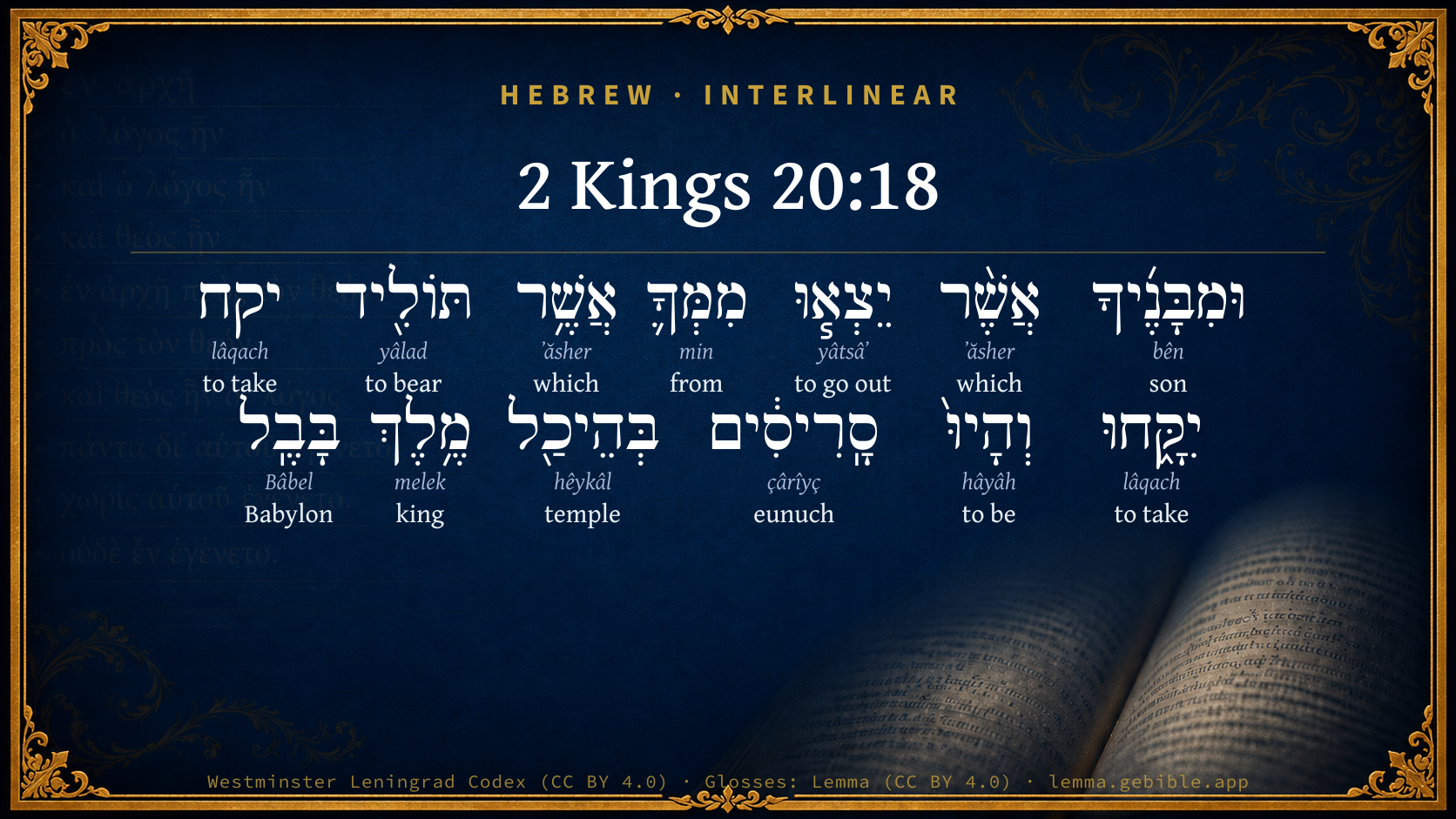
Hebrew (Westminster Leningrad Codex) 2 Kings 20:18 appears in the Hebrew Old Testament. The text above is from the Westminster Leningrad Codex. Each word links to its Strong’s number, a concise gloss, and parsing drawn from the Open Scriptures Hebrew Bible morphology. Click any word for its full Brown-Driver-Briggs (BDB) entry.
Download image
Cite this verse

2 Kings 20:18 (World English Bible). Public Domain. Lemma interlinear Bible study tool, https://lemma.gebible.app/v/2-kings/20/18.

Show BibTeX & RIS
BibTeX
RIS
English Translation
Of your sons who shall issue from you, whom you shall father, shall they take away; and they shall be eunuchs in the palace of the king of Babylon.
World English Bible · Public Domain
Download a study sheet

One document with this verse’s original text, its word-by-word gloss line, the meaning frame, cross-references with their text, attributed commentary, and full source and license credits — printable, and it pastes into notes with its structure intact.

This verse Autodidact and up

Study sheet (.html) Plain text (.txt)

A passage Seminary Student

Up to 50 verses in one chapter. A passage sheet keeps up to 6 commentary sources and 12 cross-references per verse, in the order this page ranks them, and says so on the sheet whenever that leaves anything out. Ask for a single verse and you get the Autodidact verse sheet above.

Everything on this page stays free to read, with no account — the sheet is a download of what is already on screen, not access to it.

Want to remove ads? Support Godless Engineer
Compare translations 3

The same verse in 3 English versions, stacked beneath the original-language interlinear above. Click any original word for its lexicon entry.

Each is an independent rendering of the whole verse — the interlinear is not word-aligned to these translations.

Highlighted words mark where these versions differ — a whole-verse word diff, not a word-by-word alignment.

  • World English Bible Public Domain
    Of your sons who shall issue from you, whom you shall father, shall they take away; and they shall be eunuchs in the palace of the king of Babylon.
  • King James Version Public Domain
    And of thy sons that shall issue from thee, which thou shalt beget, shall they take away; and they shall be eunuchs in the palace of the king of Babylon.
  • unfoldingWord Literal Text CC BY-SA 4.0
    ‘And they will take some of your sons who will come forth from you, whom you will beget, and they will be eunuchs in the palace of the king of Babylon.’”

unfoldingWord Literal Text — © unfoldingWord, licensed CC BY-SA 4.0. Word-aligned USFM3 via Door43 (git.door43.org/unfoldingWord/en_ult).

Versions to compare (up to 4)

3 of 4 selected

Show all 18 translations

Every available English version of this verse, each an independent rendering of the whole verse.

  • World English Bible Public Domain
    Of your sons who shall issue from you, whom you shall father, shall they take away; and they shall be eunuchs in the palace of the king of Babylon.
  • Berean Standard Bible Public Domain
    And some of your descendants, your own flesh and blood, will be taken away to be eunuchs in the palace of the king of Babylon.”
  • Majority Standard Bible Public Domain
    And some of your descendants, your own flesh and blood, will be taken away to be eunuchs in the palace of the king of Babylon.”
  • King James Version Public Domain
    And of thy sons that shall issue from thee, which thou shalt beget, shall they take away; and they shall be eunuchs in the palace of the king of Babylon.
  • American Standard Version (1901) Public Domain
    And of thy sons that shall issue from thee, whom thou shalt beget, shall they take away; and they shall be eunuchs in the palace of the king of Babylon.
  • Revised Version (1885) Public Domain
    And of thy sons that shall issue from thee, which thou shalt beget, shall they take away; and they shall be eunuchs in the palace of the king of Babylon.
  • Geneva Bible (1599) Public Domain
    And of thy sonnes, that shall proceede out of thee, and which thou shalt beget, shall they take away, and they shalbe eunuches in the palace of the King of Babel.
  • Douay-Rheims (1899) Public Domain
    And of thy sons also that shall issue from thee, whom thou shalt beget, they shall take away, and they shall be eunuchs in the palace of the king of Babylon.
  • Young's Literal Translation Public Domain
    and of thy sons who go out from thee, whom thou begettest, they take away, and they have been eunuchs in the palace of the king of Babylon.'
  • Literal Standard Version CC BY-SA 4.0
    and of your sons who go out from you, whom you beget, they take away, and they have been eunuchs in the palace of the king of Babylon.”
  • Unlocked Literal Bible CC BY-SA 4.0
    The sons born from you, whom you yourself have fathered—they will take them away, and they will become eunuchs in the palace of the king of Babylon.'”
  • unfoldingWord Literal Text CC BY-SA 4.0
    ‘And they will take some of your sons who will come forth from you, whom you will beget, and they will be eunuchs in the palace of the king of Babylon.’”
  • Darby Bible Public Domain
    And of thy sons that shall issue from thee, whom thou shalt beget, shall they take away; and they shall be chamberlains in the palace of the king of Babylon.
  • World Messianic Bible Public Domain
    ‘They will take away some of your sons who will issue from you, whom you will father; and they will be eunuchs in the palace of the king of Babylon.’”
  • Webster's Bible Public Domain
    And of thy sons that shall issue from thee, which thou shalt beget, shall they take away; and they shall be eunuchs in the palace of the king of Babylon.
  • Free Bible Version CC BY-SA 4.0
    Some of your sons, your own offspring, will be taken to serve as eunuchs in the palace of the king of Babylon.”
  • Bible in Basic English Public Domain
    And your sons, the offspring of your body, they will take away to be unsexed servants in the house of the king of Babylon.
  • JPS Tanakh (1917) Public Domain
    And of thy sons that shall issue from thee, whom thou shalt beget, shall they take away; and they shall be officers in the palace of the king of Babylon.'

Literal Standard Version (2020), Covenant Press — licensed CC BY-SA 4.0. Text via the HelloAO Bible API (eBible.org). Unlocked Literal Bible (unfoldingWord) — licensed CC BY-SA 4.0. Text via the HelloAO Bible API (eBible.org). unfoldingWord Literal Text — © unfoldingWord, licensed CC BY-SA 4.0. Word-aligned USFM3 via Door43 (git.door43.org/unfoldingWord/en_ult). Free Bible Version, Dr. Jonathan Gallagher — licensed CC BY-SA 4.0. Text via the HelloAO Bible API (eBible.org).

Word by word

More ways to search: Search by grammar → Find every occurrence → Compare this word →

Practice this passage: Drill this verse → Learn its vocabulary →

סָֽרִיסִ֔ים
çârîyç
H5631
“eunuchs”
Noun, Common, Masculine, Plural, Absolute
Part of Speech
Noun
Type
Common
Gender
Masculine
Number
Plural
State
Absolute
Full BDB Definition

Origin: from an unused root meaning to castrate

TWOT: 1545

official, eunuch
  1. וּמִבָּנֶ֜יךָ bên H1121 “and · from · sons · your” Conjunction + Preposition + Noun, Common, Masculine, Plural, Construct + Suffix, Personal, 2nd Person, Masculine, Singular
  2. אֲשֶׁ֨ר ʼăsher H834 “which” Particle, Relative
  3. יֵצְא֧וּ yâtsâʼ H3318 “to go out” Verb, Qal, Imperfect, 3rd Person, Masculine, Plural
  4. מִמְּךָ֛ min H4480 “from · you” Preposition + Suffix, Personal, 2nd Person, Masculine, Singular
  5. אֲשֶׁ֥ר ʼăsher H834 “which” Particle, Relative
  6. תּוֹלִ֖יד yâlad H3205 “to bear” Verb, Hiphil, Imperfect, 2nd Person, Masculine, Singular
  7. יקח lâqach H3947 “to take” Verb, Qal, Imperfect, 3rd Person, Masculine, Singular
  8. יִקָּ֑חוּ lâqach H3947 “to take” Verb, Qal, Imperfect, 3rd Person, Masculine, Plural
  9. וְהָיוּ֙ hâyâh H1961 “and · to be” Conjunction + Verb, Qal, Sequential Perfect, 3rd Person, Common, Plural
  10. בְּהֵיכַ֖ל hêykâl H1964 “in/at · temple of” Preposition + Noun, Common, Masculine, Singular, Construct
  11. מֶ֥לֶךְ melek H4428 “king of” Noun, Common, Masculine, Singular, Construct
  12. בָּבֶֽל Bâbel H894 “Babylon” Noun, Proper

About this verse

These counts appear in no published source. They are computed here, from the morphology-tagged text and Lemma’s own curated glosses. What Lemma adds →

13
words
11
distinct lemmas
Historical
section

Shared distinctive vocabulary

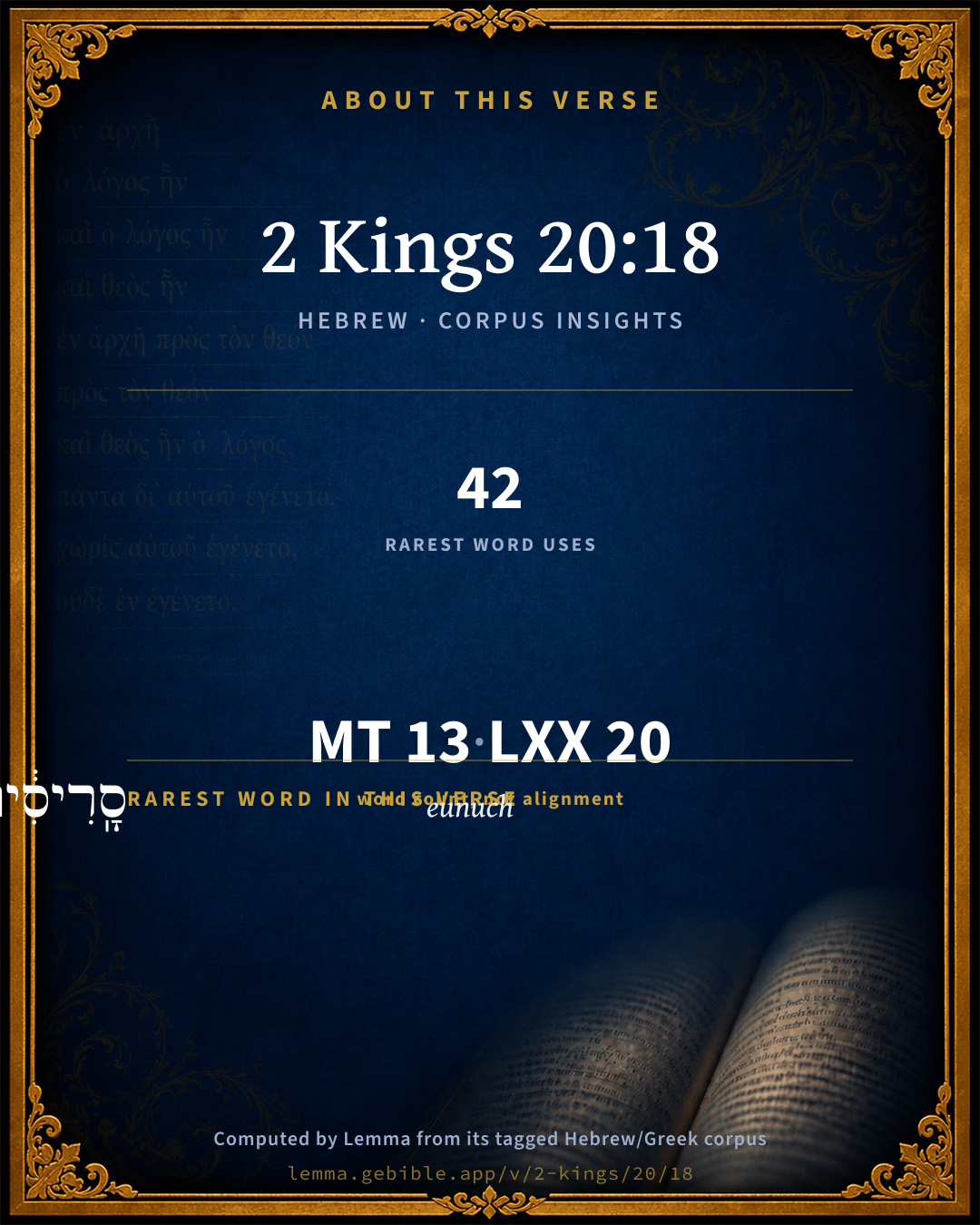
סָֽרִיסִ֔ים eunuch H5631 occurs in 42 verses of the Hebrew Bible. Also found in:

Grammatical profile

  • 5 verbs
  • 5 nouns
  • 1 preposition
  • 2 particles

Verb forms

  • יֵצְא֧וּ Qal · Imperfect
  • תּוֹלִ֖יד Hiphil · Imperfect
  • יקח Qal · Imperfect
  • יִקָּ֑חוּ Qal · Imperfect
  • וְהָיוּ֙ Qal · Sequential Perfect

Repetition

Words recur within this verse — often emphatic in Hebrew:

  • יקח to take H3947 ×2
  • אֲשֶׁ֨ר which H834 ×2

Hebrew & Septuagint length

In English translation the verse runs 29 words from the Hebrew and 33 from the Septuagint (LXX English) — closely comparable.

A rough comparison of the two English renderings, which tokenize alike — not a word-level alignment.

Word counts can differ between the Hebrew and the Greek without any difference in meaning — e.g. the Hebrew direct-object marker אֵת has no separate Greek word, and Greek often adds the article ὁ.

In the original languages it is 13 Hebrew tokens and 20 Greek tokens — but the two are counted differently (Hebrew bundles its prefixes and suffixes into one token; the Greek is in lemma form), so that isn’t a like-for-like length.

Cross-references

4

Topical passages linked to 2 Kings 20:18 in the Treasury of Scripture Knowledge — connected by theme and wording, ordered by reader-vote popularity; previews shown in the World English Bible.

  • 2 Chronicles 33:11 Therefore Yahweh brought on them the captains of the host of the king of Assyria, who took Manasseh in chains, and bound him with fetters, and carried him to Babylon.
  • 2 Kings 24:12 and Jehoiachin the king of Judah went out to the king of Babylon, he, and his mother, and his servants, and his princes, and his officers: and the king of Babylon took him in the eighth year of his reign.
  • Daniel 1:3 The king spoke to Ashpenaz the master of his eunuchs, that he should bring in [certain] of the children of Israel, even of the seed royal and of the nobles;
  • 2 Kings 25:6 Then they took the king, and carried him up to the king of Babylon to Riblah; and they gave judgment on him.

Cross-references courtesy of OpenBible.info (CC BY 4.0).

Hebrew and Greek witnesses Masoretic Hebrew ↔ Greek Septuagint

The same verse in the two great witnesses to the Old Testament, shown verse-for-verse.

These are two independent witnesses, not word-aligned to each other, and the Septuagint is shown in lemma (dictionary) form.

Hebrew 2 Kings 20:18 Masoretic · Westminster Leningrad Codex

וּמִבָּנֶ֜יךָ אֲשֶׁ֨ר יֵצְא֧וּ מִמְּךָ֛ אֲשֶׁ֥ר תּוֹלִ֖יד יקח יִקָּ֑חוּ וְהָיוּ֙ סָֽרִיסִ֔ים בְּהֵיכַ֖ל מֶ֥לֶךְ בָּבֶֽל

Of your sons who shall issue from you, whom you shall father, shall they take away; and they shall be eunuchs in the palace of the king of Babylon.

World English Bible · Public Domain

Greek LXX 2 Kings 20:18 Septuagint · lemma form

καί ὁ υἱός σύ ὅς ἐκἔρχομαι ἐκ σύ ὅς γεννάω λαμβάνω καί εἰμί εὐνοῦχος ἐν ὁ οἶκος ὁ βασιλεύς βαβυλών

And as for your sons which shall come forth of you, which you shall beget, the enemy shall take them, and they shall be eunuchs in the house of the king of Babylon.

LXX2012 (modern English Septuagint) · Public Domain

On this verse, The Pulpit Commentary discusses the Septuagint’s reading. Read the note in Commentary ↓

Hebrew: Westminster Leningrad Codex (CC BY 4.0). Greek: Septuagint (public domain); English from LXX2012 (modern English Septuagint) (Public Domain). How the Septuagint differs from the Hebrew →

Targum (Aramaic paraphrase)

1

The Targum is the ancient Jewish Aramaic paraphrase of the Hebrew Scriptures — an interpretive translation, not the Hebrew text itself. Onkelos (literal) and Pseudo-Jonathan (expansive) render the Torah, and Jonathan the Prophets. Coverage is partial: where no permissively-licensed English translation exists for a verse, only the Aramaic is shown. This is verse-level text, not a word-by-word alignment to the Hebrew.

  1. Targum Jonathan Prophets (Joshua–Malachi)
    וּמִבְּנָךְ דִי יִפְקוּן מִנָךְ דְתוֹלִיד יְדַבֵּר וִיהוֹן רַבְרְבִין בְּהֵיכָלָא דְמַלְכָּא דְבָבֶל:

    (no public-domain English translation for this verse)

    Targum Jonathan — Aramaic: “Mikraot Gedolot” (public domain). English: “Sefaria Community Translation” (CC0 1.0 (public-domain dedication)); “London "Chaldee Paraphrase," 1871” (public domain). Text via Sefaria.

Commentary

Notes on 2 Kings 20:18 from classic Christian and Jewish commentators (each source and its license shown beneath its notes). The classic Christian expositions comment on the surrounding passage and are grouped to its opening verse, so a note may address several verses; the Jewish commentaries on the Tanakh (Rashi and others) are per-verse, so they appear only where the commentator wrote on this verse.

Lemma curates 59 commentaries, every one of them public domain or Creative Commons licensed, each selected and text-cleaned for this edition rather than reprinted as found. About our sources →

Trapp's Complete Commentary

John Trapp

2Ki 20:18 And of thy sons that shall issue from thee, which thou shalt beget, shall they take away; and they shall be eunuchs in the palace of the king of Babylon.

Ver. 18. And of thy sons that shall issue from thee.] A heavy judgment on so good a man, on so light an offence, as some would think. But these spiritual lusts, as pride, carnal confidence, self-flattery, presumption, &c., in the saints, are great provocations, as lying more up in the heart of the country. Let us be wise by others’ woes; setting a memorandum on God’s punishments, and marking his spits with our stars.

John Trapp, A Commentary or Exposition upon All the Books of the Old and New Testament (1647–1656) — public domain. Text from a community e-Sword module.

Joseph Benson's Commentary

2Ki 20:18. And of thy sons, &c. — Thy grand-children, who are often called sons. They shall be eunuchs, &c. — They shall be servants to that heathen monarch, whereby both their bodies will be subject to slavery, and their souls exposed to the peril of idolatry, and all sorts of wickedness. This was a very sore judgment, and by it God would teach the world the great evil of sin; yea, even of those sins which are generally esteemed but small or venial.

Joseph Benson's Commentary on the Old and New Testaments (1811–1818) — public domain. Text from a community e-Sword module.

Tyndale Open Study Notes

Tyndale Open Resources

20:18 Some of your very own sons will be taken: Hezekiah’s son Manasseh was taken as a prisoner to Babylon (2 Chr 33:11-13). This prophecy found ultimate fulfillment in Hezekiah’s descendants during the Babylonian deportations of 605 BC (see 2 Kgs 24:1 and corresponding study note; Dan 1:1-7), 597 BC (2 Kgs 24:10-12; 2 Chr 36:10), and 586 BC (2 Kgs 25:5-7; 2 Chr 36:20; Jer 39:1-7; 52:4-15).

Tyndale Open Study Notes — © Tyndale Open Resources, licensed CC BY-SA 4.0. Text via the HelloAO Bible API.

Adam Clarke's Commentary

Verse 18. They shall be eunuchs] Perhaps this means no more than that they should become household servants to the kings of Babylon. See the fulfillment, 2Kg 24:13-15, and Da 1:1-3.

Adam Clarke's Commentary on the Bible (1810–1826) — public domain. Text from a community e-Sword/MySword module.

Ellicott's Commentary for English Readers

(18) Thy sons . . . beget—i.e., thy descendants. Comp, the fulfilment (Dan_1:3). Ewald refers to the captivity of Hezekiah’s own son Manasseh (2Ch_33:11).

Eunuchs.—Rather, courtiers, palace attendants (so Josephus). Cheyne, “chamberlains” (so Thenius: kämmerer).

A Bible Commentary for English Readers, edited by Charles John Ellicott (1878–1897) — public domain. Text from a community e-Sword module.

The Cambridge Bible for Schools and Colleges

gen. ed. J. J. S. Perowne

18. thy sons … shall they take away] This came to pass in the case of Manasseh, Hezekiah’s own son (2Ch_33:11), who was carried as a prisoner to Babylon. That was, however, but the beginning of the sorrows to which this prophecy of Isaiah looked forward.

in the palace of the king of Babylon] Examples of Jews chosen for menial duties in the palace of Nebuchadnezzar at Babylon are found in Dan_1:6.

The Cambridge Bible for Schools and Colleges (gen. ed. J. J. S. Perowne; Cambridge University Press, 1878–1918) — public domain. Text from a community e-Sword module.

Albert Barnes' Notes on the Bible

This prophecy had two fulfillments, each complementary to the other. Manasseh, Hezekiah’s actual son, was “carried to Babylon” 2Ch 33:11, but did not become a eunuch in the palace. Daniel and others, not his actual sons, but of the royal seed Dan 1:3, and therefore Hezekiah’s descendants, are thought by some to have literally fulfilled the latter part of the prophecy, being eunuchs in the palace of Nebuchadnezzar.

Albert Barnes' Notes on the Bible (1834–1885) — public domain. Text from a community e-Sword/MySword module.

Haydock's Catholic Bible Commentary

Eunuchs; servants, Daniel i. 3. We only read of Manasses, who was taken to Babylon. (Calmet) --- But he might have many brothers, who might be reduced to a menial condition; (Salien) as the text seems to refer to the immediate sons of Ezechias. (Haydock) --- It may, however, be explained of his descendants. (Menochius) (Chap. xxiv. 12.)

George Leo Haydock (1774–1849), Haydock's Catholic Family Bible and Commentary, 1859 edition — public domain. Excludes Psalms (Douay-Rheims chapter numbering differs from Protestant) and Deuterocanonical books (Catholic canon only).

Matthew Poole's English Annotations

Which thou shalt beget, i.e. of thy grandchildren, who are oft called sons. They shall be servants to that heathen monarch, whereby both their bodies will be subject to slavery, and the lusts of their lords, and their souls exposed to the peril of idolatry, and all sorts of wickedness; which must needs be very grievous to so good a man as Hezekiah, and was indeed a very sore judgment; whereby God would teach the world the great evil of sin, yea, even of those sins which are generally esteemed but small and venial; for such were those sins of Hezekiah, noted upon 2Ki 20:17.

Matthew Poole's English Annotations on the Holy Bible (1683–1685) — public domain. Text from a community e-Sword/MySword module.

Whedon's Commentary on the Bible

Daniel D. Whedon

18. Thy sons — Thy descendants. For the fulfilment of this prophecy, see 2Ki_24:11-16; 2Ki_25:1-21.

They shall be eunuchs — They shall serve the king of Babylon in all those offices in which eunuchs were accustomed to serve. The word need not be pressed in its most literal sense to signify that all the Jewish captives who thus served would be castrated, for many would serve, like Daniel and his companions, (Dan_1:3-7,) who were not eunuchs in the stricter sense.

Daniel D. Whedon (gen. ed.), Commentary on the Old and New Testaments (1874–1909) — public domain. Text from a community e-Sword module.

The Pulpit Commentary

And of thy sons that shall issue from thee, which thou shalt beget. Under "sons" are included by the Hebrew idiom all descendants, however remote (Pusey"s "Lectures on Daniel," pp. 406-409). The princes carried off from Jerusalem by Nebuchadnezzar were Hezekiah"s descendants, either in the fourth or the fifth generation. Shall they take away. Among the descendants of Hezekiah taken to Babyon by Nebuchadnezzar were Jehoiachin (2Ki_24:15) Zedekiah, (2Ki_25:7) Daniel, (Dan_1:3) and others. And they shall be eunuchs in the palace of the King of Babylon. Keil and Bahr translate in this place by "chamberlains" or "footmen;" but there is no reason why the word should not have its ordinary sense of "eunuchs". (see the Septuagint esontai eujnoucoi, and for the fulfillment, comp. Dan_1:3-18)

The Pulpit Commentary (1880–1919), ed. H.D.M. Spence-Jones & Joseph S. Exell — public domain. Text from a community e-Sword module.

John Wesley's Explanatory Notes

Thy sons - Of thy grand-children. Eunuchs - They shall be servants to that heathen monarch, whereby both their bodies will be subject to slavery, and their souls exposed to the peril of idolatry, and all sorts of wickedness.

John Wesley, Explanatory Notes Upon the Whole Bible (1754–1765) — public domain. Text via the GEBible commentary corpus.

Scofield Reference Notes

C. I. Scofield

they shall

Fulfilled. Dan 1:3.

The Scofield Reference Bible (1917 edition), notes by C. I. Scofield — public domain. Text from a community e-Sword module.

Rashi

Rabbi Shlomo Yitzchaki (Rashi)

And some of your sons. Chananyoh, Mishoeil, and Azaryoh.

Rashi on the Tanakh — English translations: “The Judaica Press complete Tanach with Rashi, translated by A. J. Rosenberg” (CC BY 4.0); “Pentateuch with Rashi's commentary by M. Rosenbaum and A.M. Silbermann, 1929-1934” (public domain); “The Metsudah Tanach series, Lakewood, N.J” (CC BY 4.0); and “The Book of Joshua, Metsudah Publications, 1997” (CC BY 4.0). Text via Sefaria.

Lesson kit

Teaching starters — assembled from the data on this page, not authored interpretation. Every prompt links to the verse data it draws on. Edit before teaching.

2 Kings, in the Historical, opens this verse with 13 words (11 distinct Hebrew lemmas). Its most distinctive word is çârîyç (“eunuch”). A historical commentator’s framing appears above. Read the whole chapter for the surrounding context.

Discussion questions

  1. The word çârîyç carries the sense “eunuch.” How does it shape the verse?
  2. How does Genesis 37:36, which shares the word «eunuch», read alongside this verse?
  3. What does the repetition of “to take” (2× in this one verse) do in this verse?
  4. These translations render this verse differently. What is at stake in choosing one wording over another?
  5. «יֵצְא֧וּ» is a Qal Imperfect verb. How does that grammatical form shape the action described?
  6. Compare how Trapp's Complete Commentary and Joseph Benson's Commentary read this verse. Where do they agree or differ?

Things to notice

Reading settings

Reading text

Shown beneath each verse's original-language words.

Old Testament
Old Testament edition

Read the OT as the Masoretic Hebrew (MT) or the Greek Septuagint (LXX).

English shown for the Greek Septuagint (in the Hebrew ↔ Greek comparison).

Comparing translations? Open the Compare panel on any verse page to stack up to four side by side.