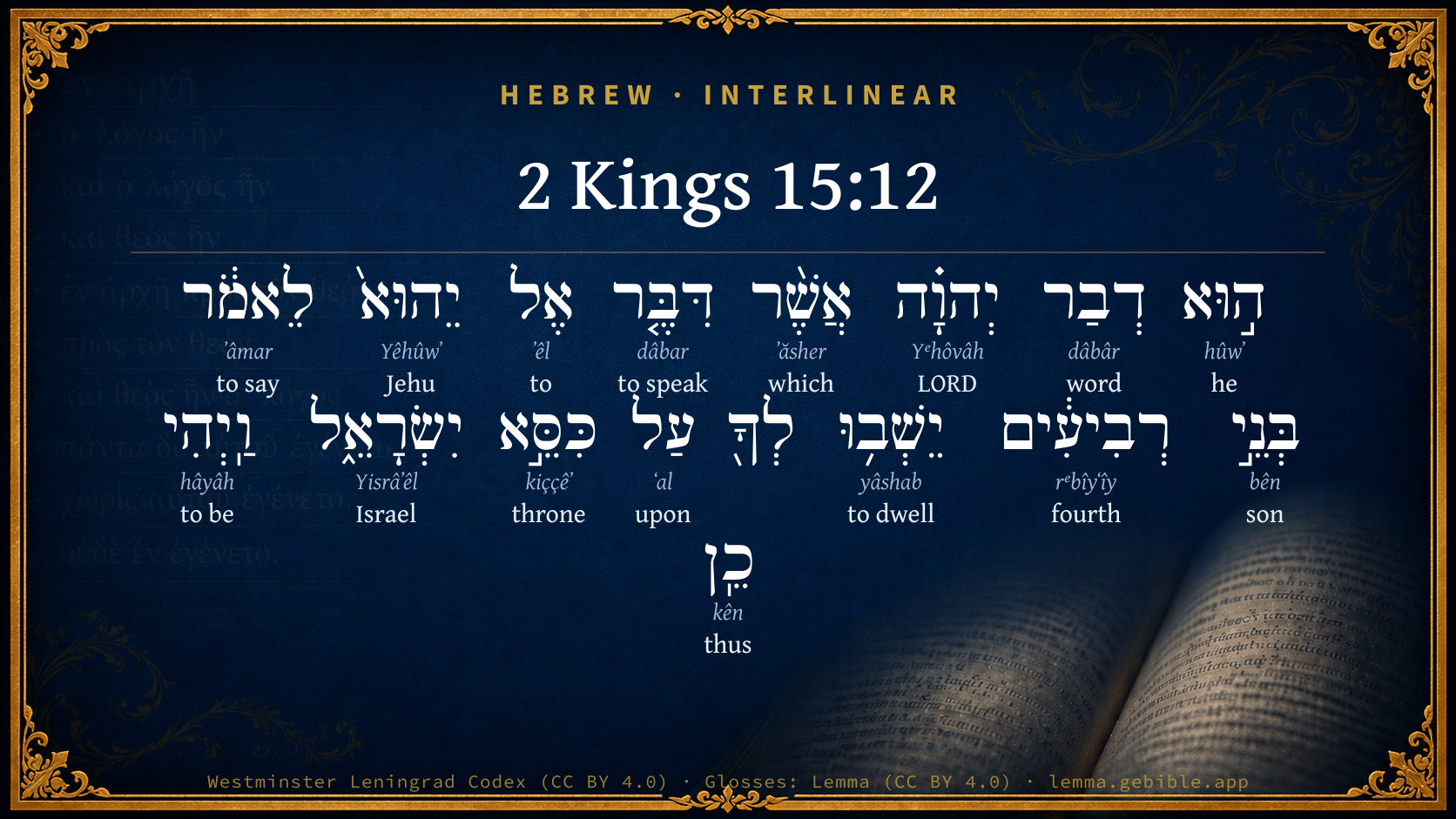
2 Kings 15:12

Hebrew (Westminster Leningrad Codex) 2 Kings 15:12 appears in the Hebrew Old Testament. The text above is from the Westminster Leningrad Codex. Each word links to its Strong’s number, a concise gloss, and parsing drawn from the Open Scriptures Hebrew Bible morphology. Click any word for its full Brown-Driver-Briggs (BDB) entry.
Download image
Cite this verse

2 Kings 15:12 (World English Bible). Public Domain. Lemma interlinear Bible study tool, https://lemma.gebible.app/v/2-kings/15/12.

Show BibTeX & RIS
BibTeX
RIS
English Translation
This was the word of Yahweh which he spoke to Jehu, saying, Your sons to the fourth generation shall sit on the throne of Israel. So it came to pass.
World English Bible · Public Domain
Download a study sheet

One document with this verse’s original text, its word-by-word gloss line, the meaning frame, cross-references with their text, attributed commentary, and full source and license credits — printable, and it pastes into notes with its structure intact.

This verse Autodidact and up

Study sheet (.html) Plain text (.txt)

A passage Seminary Student

Up to 50 verses in one chapter. A passage sheet keeps up to 6 commentary sources and 12 cross-references per verse, in the order this page ranks them, and says so on the sheet whenever that leaves anything out. Ask for a single verse and you get the Autodidact verse sheet above.

Everything on this page stays free to read, with no account — the sheet is a download of what is already on screen, not access to it.

Want to remove ads? Support Godless Engineer
Compare translations 3

The same verse in 3 English versions, stacked beneath the original-language interlinear above. Click any original word for its lexicon entry.

Each is an independent rendering of the whole verse — the interlinear is not word-aligned to these translations.

Highlighted words mark where these versions differ — a whole-verse word diff, not a word-by-word alignment.

  • World English Bible Public Domain
    This was the word of Yahweh which he spoke to Jehu, saying, Your sons to the fourth generation shall sit on the throne of Israel. So it came to pass.
  • King James Version Public Domain
    This was the word of the LORD which he spake unto Jehu, saying, Thy sons shall sit on the throne of Israel unto the fourth generation. And so it came to pass.
  • unfoldingWord Literal Text CC BY-SA 4.0
    It the word of Yahweh that he had spoken to Jehu, saying, “Sons of the fourth will sit for you on the throne of Israel.” And it was thus.

unfoldingWord Literal Text — © unfoldingWord, licensed CC BY-SA 4.0. Word-aligned USFM3 via Door43 (git.door43.org/unfoldingWord/en_ult).

Versions to compare (up to 4)

3 of 4 selected

Show all 18 translations

Every available English version of this verse, each an independent rendering of the whole verse.

  • World English Bible Public Domain
    This was the word of Yahweh which he spoke to Jehu, saying, Your sons to the fourth generation shall sit on the throne of Israel. So it came to pass.
  • Berean Standard Bible Public Domain
    So the word of the LORD spoken to Jehu was fulfilled: “Four generations of your sons will sit on the throne of Israel.”
  • Majority Standard Bible Public Domain
    So the word of the LORD spoken to Jehu was fulfilled: “Four generations of your sons will sit on the throne of Israel.”
  • King James Version Public Domain
    This was the word of the LORD which he spake unto Jehu, saying, Thy sons shall sit on the throne of Israel unto the fourth generation. And so it came to pass.
  • American Standard Version (1901) Public Domain
    This was the word of Jehovah which he spake unto Jehu, saying, Thy sons to the fourth generation shall sit upon the throne of Israel. And so it came to pass.
  • Revised Version (1885) Public Domain
    This was the word of the LORD which he spake unto Jehu, saying, Thy sons to the fourth generation shall sit upon the throne of Israel. And so it came to pass.
  • Geneva Bible (1599) Public Domain
    This was the word of the Lord, which he spake vnto Iehu, saying, Thy sonnes shall sit on the throne of Israel vnto the fourth generation after thee. And it came so to passe.
  • Douay-Rheims (1899) Public Domain
    This was the word of the Lord, which he spoke to Jehu, saying: Thy children to the fourth generation shall sit upon the throne of Israel. And so it came to pass.
  • Young's Literal Translation Public Domain
    It `is' the word of Jehovah that He spake unto Jehu, saying, `Sons of the fourth `generation' do sit for thee on the throne of Israel;' and it is so.
  • Literal Standard Version CC BY-SA 4.0
    It [is] the word of YHWH that He spoke to Jehu, saying, “Sons of the fourth [generation] sit on the throne of Israel for you”; and it is so.
  • Unlocked Literal Bible CC BY-SA 4.0
    This was the word of Yahweh that he spoke to Jehu, saying, “Your descendants will sit on the throne of Israel to the fourth generation.” That is what happened.
  • unfoldingWord Literal Text CC BY-SA 4.0
    It the word of Yahweh that he had spoken to Jehu, saying, “Sons of the fourth will sit for you on the throne of Israel.” And it was thus.
  • Darby Bible Public Domain
    This was the word of Jehovah which he spoke to Jehu saying, Thy sons shall sit upon the throne of Israel unto the fourth [generation]. And so it came to pass.
  • World Messianic Bible Public Domain
    This was the LORD’s word which he spoke to Jehu, saying, “Your sons to the fourth generation shall sit on the throne of Israel.” So it came to pass.
  • Webster's Bible Public Domain
    This was the word of the LORD which he spoke to Jehu, saying, Thy sons shall sit on the throne of Israel to the fourth generation. And so it came to pass.
  • Free Bible Version CC BY-SA 4.0
    In this way what the Lord told Jehu came true: “Your descendants will sit on the throne of Israel to the fourth generation.”
  • Bible in Basic English Public Domain
    This was what the Lord had said to Jehu, Your sons to the fourth generation will be kings of Israel. And so it came about.
  • JPS Tanakh (1917) Public Domain
    This was the word of the LORD which He spoke unto Jehu, saying: 'Thy sons to the fourth generation shall sit upon the throne of Israel.' And so it came to pass.

Literal Standard Version (2020), Covenant Press — licensed CC BY-SA 4.0. Text via the HelloAO Bible API (eBible.org). Unlocked Literal Bible (unfoldingWord) — licensed CC BY-SA 4.0. Text via the HelloAO Bible API (eBible.org). unfoldingWord Literal Text — © unfoldingWord, licensed CC BY-SA 4.0. Word-aligned USFM3 via Door43 (git.door43.org/unfoldingWord/en_ult). Free Bible Version, Dr. Jonathan Gallagher — licensed CC BY-SA 4.0. Text via the HelloAO Bible API (eBible.org).

Word by word

More ways to search: Search by grammar → Find every occurrence → Compare this word →

Practice this passage: Drill this verse → Learn its vocabulary →

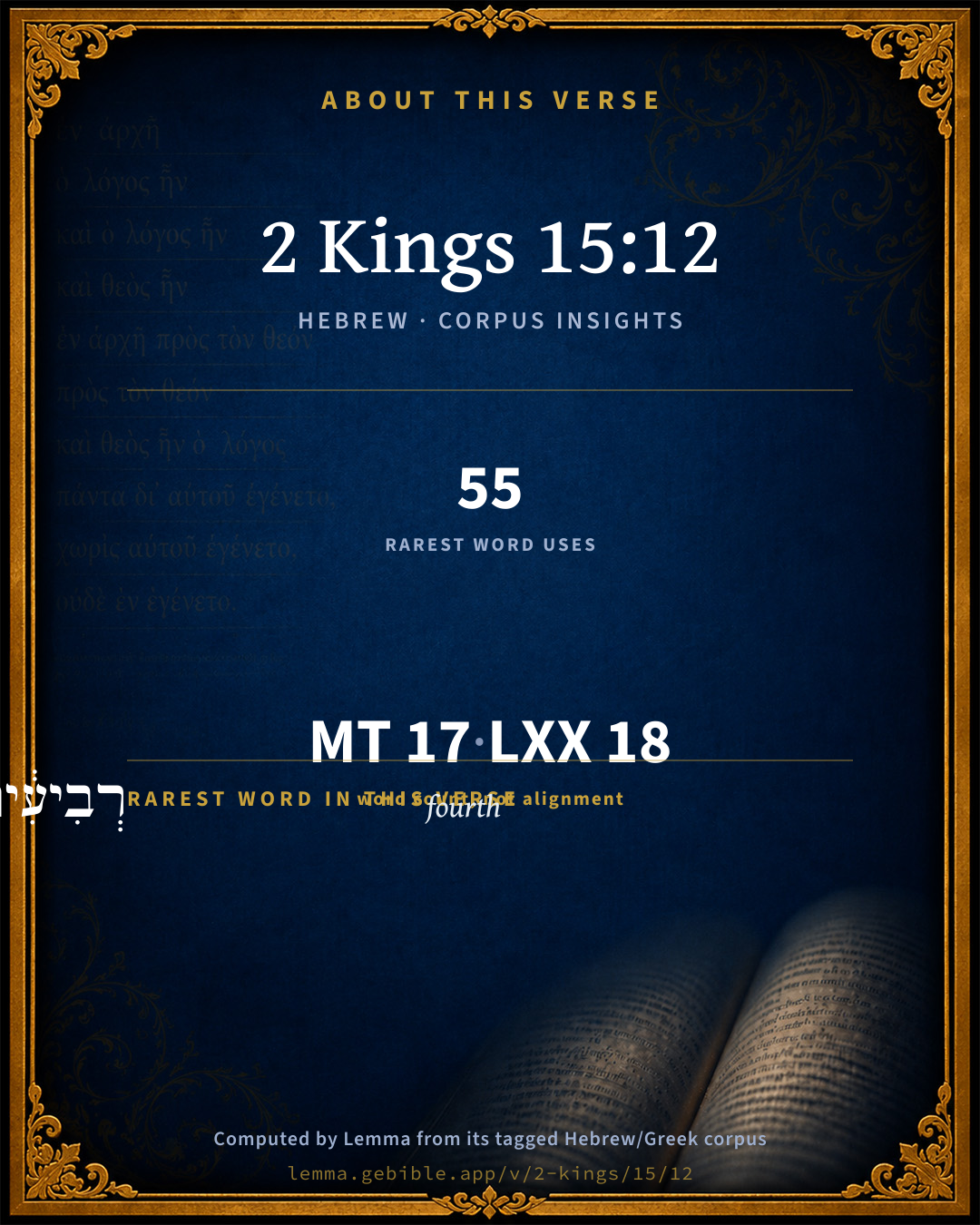
רְבִיעִ֔ים
rᵉbîyʻîy
H7243
“fourth”
Adjective, Ordinal number, Masculine, Plural, Absolute
Part of Speech
Adjective
Type
Ordinal number
Gender
Masculine
Number
Plural
State
Absolute
Full BDB Definition

Origin: from H7251

TWOT: 2107c

fourth - fourth - four square - fourth part
  1. ה֣וּא hûwʼ H1931 “he” Pronoun, Personal, 3rd Person, Masculine, Singular
  2. דְבַר dâbâr H1697 “word of” Noun, Common, Masculine, Singular, Construct
  3. יְהוָ֗ה Yᵉhôvâh H3068 “LORD” Noun, Proper
  4. אֲשֶׁ֨ר ʼăsher H834 “which” Particle, Relative
  5. דִּבֶּ֤ר dâbar H1696 “to speak” Verb, Piel, Perfect, 3rd Person, Masculine, Singular
  6. אֶל ʼêl H413 “to” Preposition
  7. יֵהוּא֙ Yêhûwʼ H3058 “Jehu” Noun, Proper
  8. לֵאמֹ֔ר ʼâmar H559 “to say” Preposition + Verb, Qal, Infinitive Construct
  9. בְּנֵ֣י bên H1121 “sons of” Noun, Common, Masculine, Plural, Construct
  10. יֵשְׁב֥וּ yâshab H3427 “to dwell” Verb, Qal, Imperfect, 3rd Person, Masculine, Plural
  11. עַל ʻal H5921 “upon” Preposition
  12. כִּסֵּ֣א kiççêʼ H3678 “throne of” Noun, Common, Masculine, Singular, Construct
  13. יִשְׂרָאֵ֑ל Yisrâʼêl H3478 “Israel” Noun, Proper
  14. וַֽיְהִי hâyâh H1961 “and · to be” Conjunction + Verb, Qal, Sequential Imperfect, 3rd Person, Masculine, Singular
  15. כֵֽן kên H3651 “thus” Adverb

About this verse

These counts appear in no published source. They are computed here, from the morphology-tagged text and Lemma’s own curated glosses. What Lemma adds →

17
words
16
distinct lemmas
Historical
section

Shared distinctive vocabulary

רְבִיעִ֔ים fourth H7243 occurs in 53 verses of the Hebrew Bible. Also found in:

Grammatical profile

  • 4 verbs
  • 6 nouns
  • 1 adjective
  • 1 pronoun
  • 3 prepositions
  • 1 adverb
  • 1 particle

Verb forms

  • דִּבֶּ֤ר Piel · Perfect
  • לֵאמֹ֔ר Qal · Infinitive Construct
  • יֵשְׁב֥וּ Qal · Imperfect
  • וַֽיְהִי Qal · Sequential Imperfect

Hebrew & Septuagint length

In English translation the verse runs 30 words from the Hebrew and 30 from the Septuagint (LXX English) — the same length.

A rough comparison of the two English renderings, which tokenize alike — not a word-level alignment.

Word counts can differ between the Hebrew and the Greek without any difference in meaning — e.g. the Hebrew direct-object marker אֵת has no separate Greek word, and Greek often adds the article ὁ.

In the original languages it is 17 Hebrew tokens and 18 Greek tokens — but the two are counted differently (Hebrew bundles its prefixes and suffixes into one token; the Greek is in lemma form), so that isn’t a like-for-like length.

Cross-references

15

Topical passages linked to 2 Kings 15:12 in the Treasury of Scripture Knowledge — connected by theme and wording, ordered by reader-vote popularity; previews shown in the World English Bible.

  • 2 Kings 10:30 Yahweh said to Jehu, Because you have done well in executing that which is right in my eyes, [and] have done to the house of Ahab according to all that was in my heart, your sons of the fourth generation shall sit on the throne of Israel.
  • 2 Kings 9:25–26 Then said [Jehu] to Bidkar his captain, Take up, and cast him in the portion of the field of Naboth the Jezreelite; for remember how that, when I and you rode together after Ahab his father, Yahweh laid this burden on him:
  • 2 Kings 13:10 In the thirty-seventh year of Joash king of Judah began Jehoash the son of Jehoahaz to reign over Israel in Samaria, [and reigned] sixteen years.
  • 2 Kings 13:13 Joash slept with his fathers; and Jeroboam sat on his throne: and Joash was buried in Samaria with the kings of Israel.
  • 2 Kings 14:29 Jeroboam slept with his fathers, even with the kings of Israel; and Zechariah his son reigned in his place.
  • Zechariah 1:6 But my words and my decrees, which I commanded my servants the prophets, didn't they overtake your fathers? "Then they repented and said, 'Just as Yahweh of Hosts determined to do to us, according to our ways, and according to our practices, so he has dealt with us.'"
  • Mark 13:31 Heaven and earth will pass away, but my words will not pass away.
  • John 10:35 If he called them gods, to whom the word of God came (and the Scripture can't be broken),
  • John 19:24 Then they said to one another, "Let's not tear it, but cast lots for it to decide whose it will be," that the Scripture might be fulfilled, which says, "They parted my garments among them. For my cloak they cast lots." Therefore the soldiers did these things.
  • John 19:36–37 For these things happened, that the Scripture might be fulfilled, "A bone of him will not be broken."
  • Acts 1:16 "Brothers, it was necessary that this Scripture should be fulfilled, which the Holy Spirit spoke before by the mouth of David concerning Judas, who was guide to those who took Jesus.
  • Numbers 23:19 God is not a man, that he should lie, Neither the son of man, that he should repent: Has he said, and will he not do it? Or has he spoken, and will he not make it good?
  • 2 Kings 9:36–37 Therefore they came back, and told him. He said, This is the word of Yahweh, which he spoke by his servant Elijah the Tishbite, saying, In the portion of Jezreel shall the dogs eat the flesh of Jezebel;
  • 2 Kings 13:1 In the three and twentieth year of Joash the son of Ahaziah, king of Judah, Jehoahaz the son of Jehu began to reign over Israel in Samaria, [and reigned] seventeen years.
  • 2 Kings 10:10 Know now that there shall fall to the earth nothing of the word of Yahweh, which Yahweh spoke concerning the house of Ahab: for Yahweh has done that which he spoke by his servant Elijah.

Cross-references courtesy of OpenBible.info (CC BY 4.0).

Hebrew and Greek witnesses Masoretic Hebrew ↔ Greek Septuagint

The same verse in the two great witnesses to the Old Testament, shown verse-for-verse.

These are two independent witnesses, not word-aligned to each other, and the Septuagint is shown in lemma (dictionary) form.

Hebrew 2 Kings 15:12 Masoretic · Westminster Leningrad Codex

ה֣וּא דְבַר יְהוָ֗ה אֲשֶׁ֨ר דִּבֶּ֤ר אֶל יֵהוּא֙ לֵאמֹ֔ר בְּנֵ֣י רְבִיעִ֔ים יֵשְׁב֥וּ לְךָ֖ עַל כִּסֵּ֣א יִשְׂרָאֵ֑ל וַֽיְהִי כֵֽן

This was the word of Yahweh which he spoke to Jehu, saying, Your sons to the fourth generation shall sit on the throne of Israel. So it came to pass.

World English Bible · Public Domain

Greek LXX 2 Kings 15:12 Septuagint · lemma form

ὁ λόγος κύριος ὅς λαλέω πρός ιου λέγω υἱός τέταρτος καταἧμαι σύ ἐπί θρόνος ἰσραήλ καί γίγνομαι οὕτως

This was the word of the Lord which he spoke to Ju, saying, Your sons of the fourth generation shall sit upon the throne of Israel: and it was so.

LXX2012 (modern English Septuagint) · Public Domain

Hebrew: Westminster Leningrad Codex (CC BY 4.0). Greek: Septuagint (public domain); English from LXX2012 (modern English Septuagint) (Public Domain). How the Septuagint differs from the Hebrew →

Targum (Aramaic paraphrase)

1

The Targum is the ancient Jewish Aramaic paraphrase of the Hebrew Scriptures — an interpretive translation, not the Hebrew text itself. Onkelos (literal) and Pseudo-Jonathan (expansive) render the Torah, and Jonathan the Prophets. Coverage is partial: where no permissively-licensed English translation exists for a verse, only the Aramaic is shown. This is verse-level text, not a word-by-word alignment to the Hebrew.

  1. Targum Jonathan Prophets (Joshua–Malachi)
    הוּא פִּתְגָמָא דַייָ דִי מַלֵיל עִם יֵהוּא לְמֵימָר בְּנִין רְבִיעָאִין יֵתְבוּן לָךְ עַל כּוּרְסֵי מַלְכוּתָא דְיִשְׂרָאֵל וַהֲוָה כֵן:

    (no public-domain English translation for this verse)

    Targum Jonathan — Aramaic: “Mikraot Gedolot” (public domain). English: “Sefaria Community Translation” (CC0 1.0 (public-domain dedication)); “London "Chaldee Paraphrase," 1871” (public domain). Text via Sefaria.

Commentary

Notes on 2 Kings 15:12 from classic Christian and Jewish commentators (each source and its license shown beneath its notes). The classic Christian expositions comment on the surrounding passage and are grouped to its opening verse, so a note may address several verses; the Jewish commentaries on the Tanakh (Rashi and others) are per-verse, so they appear only where the commentator wrote on this verse.

Lemma curates 59 commentaries, every one of them public domain or Creative Commons licensed, each selected and text-cleaned for this edition rather than reprinted as found. About our sources →

Trapp's Complete Commentary

John Trapp

2Ki 15:12 This [was] the word of the LORD which he spake unto Jehu, saying, Thy sons shall sit on the throne of Israel unto the fourth [generation]. And so it came to pass.

Ver. 12. And so it came to pass.] God keepeth promise with his foes: shall he fail his friends?

John Trapp, A Commentary or Exposition upon All the Books of the Old and New Testament (1647–1656) — public domain. Text from a community e-Sword module.

Joseph Benson's Commentary

2Ki 15:12. This was the word of the Lord, Thy sons, &c. — How unfaithful soever they proved to God, he faithfully performed the promise which he made to Jehu, whose sons, to the fourth generation, succeeded him in the throne of Israel. But this Shallum put an end to that family, and fulfilled the prophecy of Hosea, (Hos 1:4,) I will average the blood of Jezreel upon the house of Jehu, and will cause to cease the kingdom of the house of Israel. For though Jehu had a command from God to destroy the house of Ahab, yet because he did it not so much in obedience to God, and with a view to his glory, as to satisfy his own private ambition, and in a way of cruelty quite abhorrent to the divine nature, God cut his family short, as soon as he had fulfilled his promise, and avenged that blood by this man, who slew Zachariah, and the rest of his posterity, if there were any. At least, he made the kingdom to cease in his family, and, not long after, it ceased in all Israel, who were rooted out, and never restored to their own country, as Judah was.

Joseph Benson's Commentary on the Old and New Testaments (1811–1818) — public domain. Text from a community e-Sword module.

Adam Clarke's Commentary

Verse 12. This was the word of the Lord - unto Jehu] God had promised to Jehu that his sons should sit on the throne of Israel to the fourth generation; and so it came to pass, for Jehoahaz, Joash, Jeroboam, and Zachariah, succeeded Jehu, to whom this promise was made. But because he executed the Divine purpose with an uncommanded cruelty, therefore God cut his family short, according to his word by Hosea, I will avenge the blood of Jezreel upon the house of Jehu; and I will cause to cease the kingdom of the house of Israel, Ho 1:4.

Adam Clarke's Commentary on the Bible (1810–1826) — public domain. Text from a community e-Sword/MySword module.

Ellicott's Commentary for English Readers

(12) This was the word of the Lord.—Thenius considers this remark as added by the Judæan editor to the short abstract of Zachariah’s reign.

A Bible Commentary for English Readers, edited by Charles John Ellicott (1878–1897) — public domain. Text from a community e-Sword module.

The Cambridge Bible for Schools and Colleges

gen. ed. J. J. S. Perowne

12. the word of the Lord which he spake unto Jehu] For the promise, see above, 2Ki_10:30.

thy sons] The R.V. brings the words ‘to the fourth generation’ forward in the verse and places them after ‘sons’ thus making the sentence conform, as it does in the original, to the order of the words in the promise (2Ki_10:30).

The Cambridge Bible for Schools and Colleges (gen. ed. J. J. S. Perowne; Cambridge University Press, 1878–1918) — public domain. Text from a community e-Sword module.

John Gill's Exposition

And the rest of the acts of Shallum, and his conspiracy which he made, behold, they are written in the book of the chronicles of the kings of Israel. In which, no doubt, an account of the cause of the conspiracy, and of the persons assisting to him in it, was given, with other things done in his short reign.

And the rest of the acts of Shallum, and his conspiracy which he made, behold, they are written in the book of the chronicles of the kings of Israel. In which, no doubt, an account of the cause of the conspiracy, and of the persons assisting to him in it, was given, with other things done in his short reign.

2 Kings 15:16

kg2 15:16

kg2 15:16

kg2 15:16Then Menahem smote Tiphsah, and all that were therein, and the coasts thereof from Tirzah,.... The Jewish writers commonly take this Tiphsah to be without the land of Israel, the same with that in Kg1 4:24 on the borders of Syria, and near the Euphrates; but it seems to be some place nearer Samaria, and Tirzah; according to Bunting (t), it was but six miles from Samaria:

because they opened not to him, therefore he smote it; they refused to open the gates of their city to him, and receive him, and acknowledge him as their king; therefore he exercised severity on the inhabitants of it, and the parts adjacent, as far as Tirzah, putting them to the sword:

and all the women therein that were with child he ripped up: which was a most shocking instance of barbarity, and which he did, to terrify others from following their example. Ben Gersom interprets it of strong towers built on mountains, which he demolished, deriving "haroth", which we render "women with child", from "a mountain".

(t) Travels, &c. p. 169.

John Gill's Exposition of the Whole Bible (1746–1763) — public domain (CC PDM 1.0). Text via the HelloAO Bible API.

Whedon's Commentary on the Bible

Daniel D. Whedon

12. The word of the Lord… unto Jehu — See 2Ki_10:30, note. Keil here remarks how rapidly the kingdom of Israel, after the death of Jeroboam, hastened to its fall. “In sixty-two years from the death of Jeroboam to the conquest of Samaria by Shalmaneser, two anarchies, making up twenty years, prevailed, and six kings followed one another, of whom only one, Menahem, died a natural death, so that his son succeeded him on the throne. The remaining five were dethroned and murdered by rebels, so that, according to the just remark of Witsius, with the murder of Zachariah not only the sentence of Hosea, (Hos_1:4,) ‘I will visit the blood of Jezreel upon the house of Jehu,’ but also the sentence forming a parallel with it, ‘and will cause to cease the kingdom of the house of Israel,’ was carried into effect, inasmuch as with Zachariah the kingdom properly ceased in Israel.”

Daniel D. Whedon (gen. ed.), Commentary on the Old and New Testaments (1874–1909) — public domain. Text from a community e-Sword module.

The Pulpit Commentary

This was the word of the Lord which he spake unto Jehu, (2Ki_10:30) saying, Thy sons shall sit on the throne of Israel unto the fourth generation. The direct promise was, "Thy house shall hold the throne so long;" the implied prophecy, "They shall not hold it longer." There had not been wanting other indications of the coming troubles. Hosea had declared that God would avenge the blood of Jezreel upon the house of Jehu. (Hos_1:4) Amos had gone further, and had openly proclaimed that God would "rise against the house of Jeroboam with the sword". (Amo_7:9) The threat had been understood as a threat against Jeroboam himself, (Amo_7:11) but this was a misinterpretation. The words plainly pointed, to a revolution in the time of his son. And so it came to pass. The house of Jehu ceased to reign in the fourth generation of the descendants of its founder. No considerations of prudence or of gratitude could keep the nation faithful to any dynasty for a longer time than this. In breaking off from the divinely chosen house of David, and choosing to themselves a king, the Israelites had sown the seeds of instability in their state, and put themselves at the mercy of any ambitious pretender. Five dynasties had already borne rule in the two hundred years that the kingdom had lasted; four more were about to hold the throne in the remaining fifty years of its existence. "Unstable as water, thou shalt not excel," though said of Reuben only, (Gen_49:4) fairly expressed the character of the entire kingdom, with which Reuben cast in its lot at the time of the separation.

The Pulpit Commentary (1880–1919), ed. H.D.M. Spence-Jones & Joseph S. Exell — public domain. Text from a community e-Sword module.

Rashi

Rabbi Shlomo Yitzchaki (Rashi)

And it was so. Not that his kingdom deserved to last that long, but to fulfill the word of the King, as it is stated, ”So shall be My word, which will go forth from My mouth etc.”

Rashi on the Tanakh — English translations: “The Judaica Press complete Tanach with Rashi, translated by A. J. Rosenberg” (CC BY 4.0); “Pentateuch with Rashi's commentary by M. Rosenbaum and A.M. Silbermann, 1929-1934” (public domain); “The Metsudah Tanach series, Lakewood, N.J” (CC BY 4.0); and “The Book of Joshua, Metsudah Publications, 1997” (CC BY 4.0). Text via Sefaria.

Lesson kit

Teaching starters — assembled from the data on this page, not authored interpretation. Every prompt links to the verse data it draws on. Edit before teaching.

2 Kings, in the Historical, opens this verse with 17 words (16 distinct Hebrew lemmas). Its most distinctive word is rᵉbîyʻîy (“fourth”). A historical commentator’s framing appears above. Read the whole chapter for the surrounding context.

Discussion questions

  1. How does “fourth” (rᵉbîyʻîy) shape what this verse is saying?
  2. How does Genesis 1:19, which shares the word «fourth», read alongside this verse?
  3. These translations render this verse differently; the difference is in the English rendering, not the original. What questions does that raise?
  4. «דִּבֶּ֤ר» is a Piel Perfect verb. How does that grammatical form shape the action described?
  5. Compare how Trapp's Complete Commentary and Joseph Benson's Commentary read this verse. Where do they agree or differ?

Things to notice

Reading settings

Reading text

Shown beneath each verse's original-language words.

Old Testament
Old Testament edition

Read the OT as the Masoretic Hebrew (MT) or the Greek Septuagint (LXX).

English shown for the Greek Septuagint (in the Hebrew ↔ Greek comparison).

Comparing translations? Open the Compare panel on any verse page to stack up to four side by side.