1 Chronicles 4:2

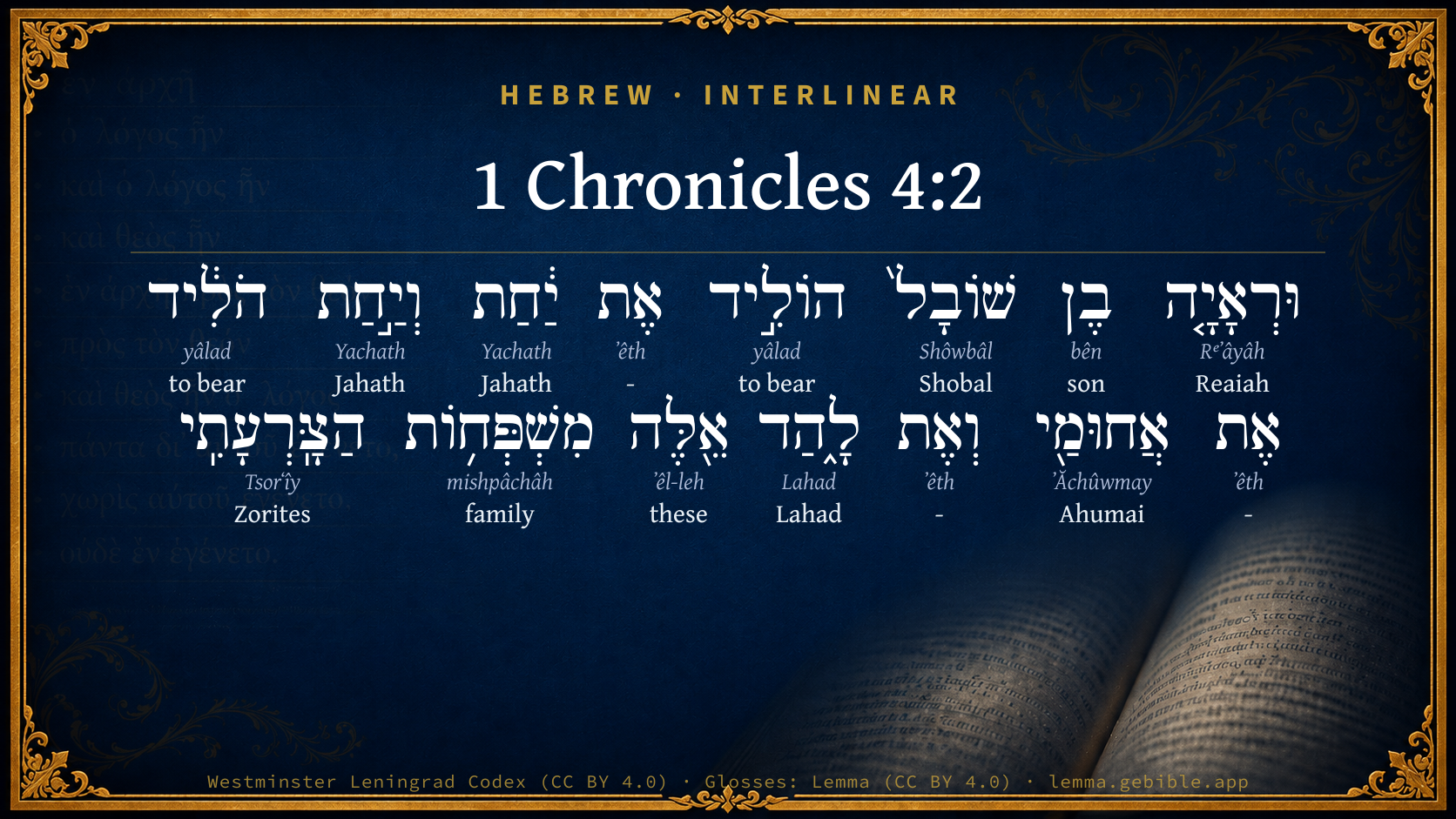
Hebrew (Westminster Leningrad Codex) 1 Chronicles 4:2 appears in the Hebrew Old Testament. The text above is from the Westminster Leningrad Codex. Each word links to its Strong’s number, a concise gloss, and parsing drawn from the Open Scriptures Hebrew Bible morphology. Click any word for its full Brown-Driver-Briggs (BDB) entry.
Download image
Cite this verse

1 Chronicles 4:2 (World English Bible). Public Domain. Lemma interlinear Bible study tool, https://lemma.gebible.app/v/1-chronicles/4/2.

Show BibTeX & RIS
BibTeX
RIS
English Translation
Reaiah the son of Shobal became the father of Jahath; and Jahath became the father of Ahumai and Lahad. These are the families of the Zorathites.
World English Bible · Public Domain
Highlights
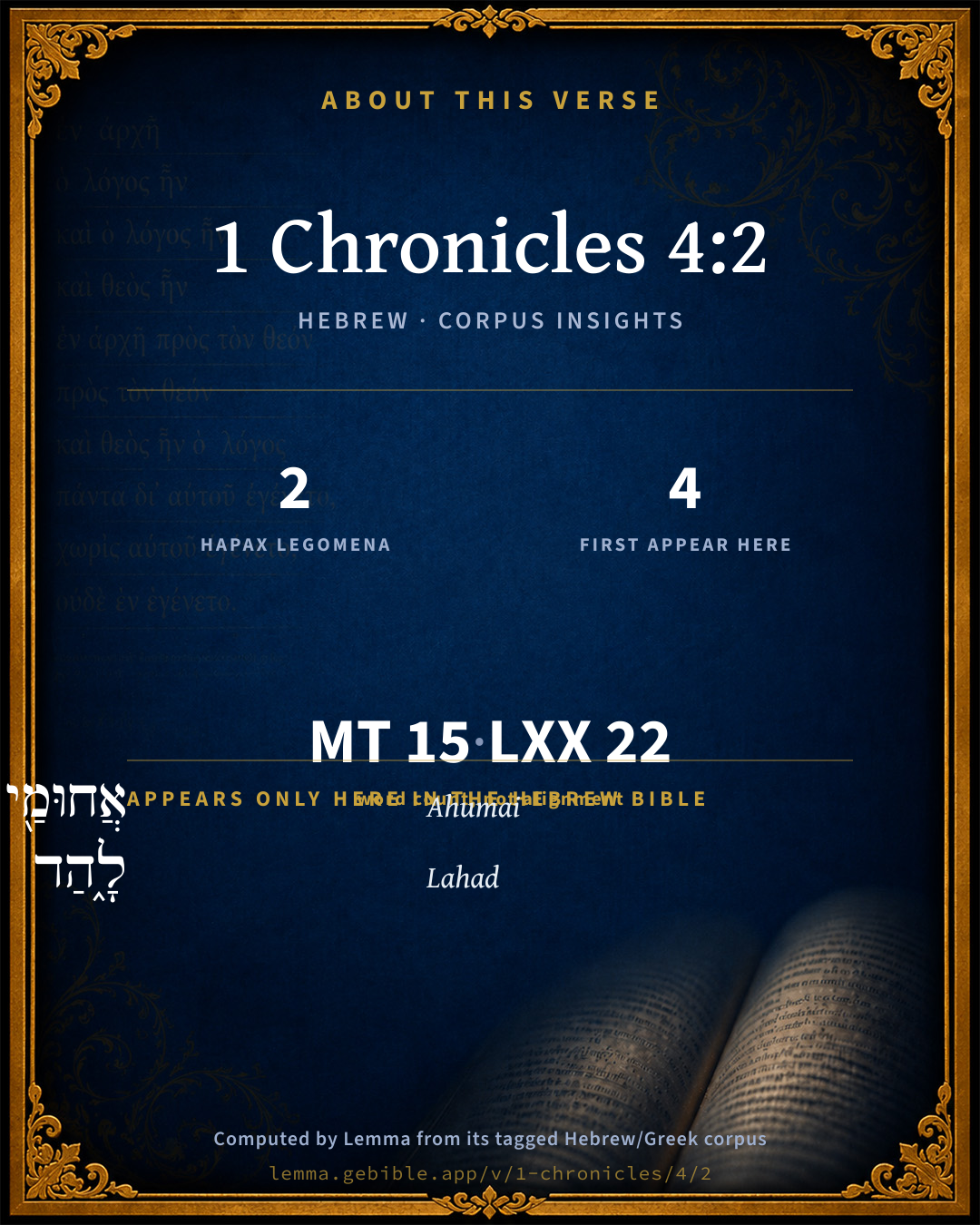
  • 2 hapax legomena — only here in the Hebrew Bible
  • 4 first appearances in the Hebrew Bible
Full analysis ↓
Download a study sheet

One document with this verse’s original text, its word-by-word gloss line, the meaning frame, cross-references with their text, attributed commentary, and full source and license credits — printable, and it pastes into notes with its structure intact.

This verse Autodidact and up

Study sheet (.html) Plain text (.txt)

A passage Seminary Student

Up to 50 verses in one chapter. A passage sheet keeps up to 6 commentary sources and 12 cross-references per verse, in the order this page ranks them, and says so on the sheet whenever that leaves anything out. Ask for a single verse and you get the Autodidact verse sheet above.

Everything on this page stays free to read, with no account — the sheet is a download of what is already on screen, not access to it.

Want to remove ads? Support Godless Engineer
Compare translations 3

The same verse in 3 English versions, stacked beneath the original-language interlinear above. Click any original word for its lexicon entry.

Each is an independent rendering of the whole verse — the interlinear is not word-aligned to these translations.

Highlighted words mark where these versions differ — a whole-verse word diff, not a word-by-word alignment.

  • World English Bible Public Domain
    Reaiah the son of Shobal became the father of Jahath; and Jahath became the father of Ahumai and Lahad. These are the families of the Zorathites.
  • King James Version Public Domain
    And Reaiah the son of Shobal begat Jahath; and Jahath begat Ahumai, and Lahad. These are the families of the Zorathites.
  • unfoldingWord Literal Text CC BY-SA 4.0
    And Reaiah, the son of Shobal, fathered Jahath. And Jahath fathered Ahumai and Lahad. These the clans of the Zorathites.

unfoldingWord Literal Text — © unfoldingWord, licensed CC BY-SA 4.0. Word-aligned USFM3 via Door43 (git.door43.org/unfoldingWord/en_ult).

Versions to compare (up to 4)

3 of 4 selected

Show all 18 translations

Every available English version of this verse, each an independent rendering of the whole verse.

  • World English Bible Public Domain
    Reaiah the son of Shobal became the father of Jahath; and Jahath became the father of Ahumai and Lahad. These are the families of the Zorathites.
  • Berean Standard Bible Public Domain
    Reaiah son of Shobal was the father of Jahath, and Jahath was the father of Ahumai and Lahad. These were the clans of the Zorathites.
  • Majority Standard Bible Public Domain
    Reaiah son of Shobal was the father of Jahath, and Jahath was the father of Ahumai and Lahad. These were the clans of the Zorathites.
  • King James Version Public Domain
    And Reaiah the son of Shobal begat Jahath; and Jahath begat Ahumai, and Lahad. These are the families of the Zorathites.
  • American Standard Version (1901) Public Domain
    And Reaiah the son of Shobal begat Jahath; and Jahath begat Ahumai and Lahad. These are the families of the Zorathites.
  • Revised Version (1885) Public Domain
    And Reaiah the son of Shobal begat Jahath; and Jahath begat Ahumai and Lahad. These are the families of the Zorathites.
  • Geneva Bible (1599) Public Domain
    And Reaiah the sonne of Shobal begat Iahath, and Iahath begate Ahumai, and Lahad: these are the families of the Zoreathites.
  • Douay-Rheims (1899) Public Domain
    And Raia the son of Sobal beget Jahath, of whom were born Ahumai, and Laad. These are the families of Sarathi.
  • Young's Literal Translation Public Domain
    And Reaiah son of Shobal begat Jahath, and Jahath begat Ahumai and Lahad; these `are' families of the Zorathite.
  • Literal Standard Version CC BY-SA 4.0
    And Reaiah son of Shobal begot Jahath, and Jahath begot Ahumai and Lahad; these [are] families of the Zorathite.
  • Unlocked Literal Bible CC BY-SA 4.0
    Shobal was the father of Reaiah. Reaiah was the father of Jahath. Jahath was the father of Ahumai and Lahad. These were of the clans of the Zorathites.
  • unfoldingWord Literal Text CC BY-SA 4.0
    And Reaiah, the son of Shobal, fathered Jahath. And Jahath fathered Ahumai and Lahad. These the clans of the Zorathites.
  • Darby Bible Public Domain
    And Reaiah the son of Shobal begot Jahath; and Jahath begot Ahumai and Lahad. These are the families of the Zoreathites.
  • World Messianic Bible Public Domain
    Reaiah the son of Shobal became the father of Jahath; and Jahath became the father of Ahumai and Lahad. These are the families of the Zorathites.
  • Webster's Bible Public Domain
    And Reaiah the son of Shobal begat Jahath; and Jahath begat Ahumai, and Lahad. These are the families of the Zorathites.
  • Free Bible Version CC BY-SA 4.0
    Reaiah, son of Shobal, was the father of Jahath. Jahath was the father of Ahumai and Lahad. These were the families of the Zorathites.
  • Bible in Basic English Public Domain
    And Reaiah, the son of Shobal, was the father of Jahath; and Jahath was the father of Ahumai and Lahad. These are the families of the Zorathites.
  • JPS Tanakh (1917) Public Domain
    And Reaiah the son of Shobal begot Jahath; and Jahath begot Ahumai, and Lahad. These are the families of the Zorathites.

Literal Standard Version (2020), Covenant Press — licensed CC BY-SA 4.0. Text via the HelloAO Bible API (eBible.org). Unlocked Literal Bible (unfoldingWord) — licensed CC BY-SA 4.0. Text via the HelloAO Bible API (eBible.org). unfoldingWord Literal Text — © unfoldingWord, licensed CC BY-SA 4.0. Word-aligned USFM3 via Door43 (git.door43.org/unfoldingWord/en_ult). Free Bible Version, Dr. Jonathan Gallagher — licensed CC BY-SA 4.0. Text via the HelloAO Bible API (eBible.org).

Word by word

More ways to search: Search by grammar → Find every occurrence → Compare this word →

Practice this passage: Drill this verse → Learn its vocabulary →

אֲחוּמַ֖י
ʼĂchûwmay
H267
“Ahumai”
Noun, Proper
Part of Speech
Noun
Type
Proper
Full BDB Definition

Origin: perhaps from H251 and H4325

TWOT: None

Ahumai = "a water reed: brother of waters" - grandson of Shobal, descendant of Judah
  1. וּרְאָיָ֤ה Rᵉʼâyâh H7211 “and · Reaiah” Conjunction + Noun, Proper
  2. בֶן bên H1121 “son of” Noun, Common, Masculine, Singular, Construct
  3. שׁוֹבָל֙ Shôwbâl H7732 “Shobal” Noun, Proper
  4. הוֹלִ֣יד yâlad H3205 “to bear” Verb, Hiphil, Perfect, 3rd Person, Masculine, Singular
  5. אֶת ʼêth H853 “-” Particle, Direct Object
  6. יַ֔חַת Yachath H3189 “Jahath” Noun, Proper
  7. וְיַ֣חַת Yachath H3189 “and · Jahath” Conjunction + Noun, Proper
  8. הֹלִ֔יד yâlad H3205 “to bear” Verb, Hiphil, Perfect, 3rd Person, Masculine, Singular
  9. אֶת ʼêth H853 “-” Particle, Direct Object
  10. וְאֶת ʼêth H853 “and · -” Conjunction + Particle, Direct Object
  11. לָ֑הַד Lahad H3855 “Lahad” Noun, Proper
  12. אֵ֖לֶּה ʼêl-leh H428 “these” Pronoun, Demonstrative, Common, Plural
  13. מִשְׁפְּח֥וֹת mishpâchâh H4940 “families of” Noun, Common, Feminine, Plural, Construct
  14. הַצָּֽרְעָתִֽי Tsorʻîy H6882 “the · Zorites” Particle, Definite Article + Noun, Gentilic, Masculine, Singular, Absolute

About this verse

These counts appear in no published source. They are computed here, from the morphology-tagged text and Lemma’s own curated glosses. What Lemma adds →

15
words
11
distinct lemmas
Historical
section

Notable vocabulary

2 hapax legomena — words that appear only here in the entire Hebrew Bible:

  • אֲחוּמַ֖י Ahumai H267
  • לָ֑הַד Lahad H3855

First appearance in Scripture

These words make their first canonical appearance in the Hebrew Bible here:

  • וּרְאָיָ֤ה Reaiah H7211
  • יַ֔חַת Jahath H3189
  • אֲחוּמַ֖י Ahumai H267
  • לָ֑הַד Lahad H3855

Shared distinctive vocabulary

הַצָּֽרְעָתִֽי Zorites H6882 occurs in 3 verses of the Hebrew Bible. Also found in:

Grammatical profile

  • 2 verbs
  • 9 nouns
  • 1 pronoun
  • 3 particles

Verb forms

  • הוֹלִ֣יד Hiphil · Perfect
  • הֹלִ֔יד Hiphil · Perfect

Repetition

Words recur within this verse — often emphatic in Hebrew:

  • הוֹלִ֣יד to bear H3205 ×2
  • יַ֔חַת Jahath H3189 ×2

Hebrew & Septuagint length

In English translation the verse runs 26 words from the Hebrew and 21 from the Septuagint (LXX English) — closely comparable.

A rough comparison of the two English renderings, which tokenize alike — not a word-level alignment.

Word counts can differ between the Hebrew and the Greek without any difference in meaning — e.g. the Hebrew direct-object marker אֵת has no separate Greek word, and Greek often adds the article ὁ.

In the original languages it is 15 Hebrew tokens and 22 Greek tokens — but the two are counted differently (Hebrew bundles its prefixes and suffixes into one token; the Greek is in lemma form), so that isn’t a like-for-like length.

Cross-references

3

Topical passages linked to 1 Chronicles 4:2 in the Treasury of Scripture Knowledge — connected by theme and wording, ordered by reader-vote popularity; previews shown in the World English Bible.

  • 1 Chronicles 2:52–54 Shobal the father of Kiriath Jearim had sons: Haroeh, half of the Menuhoth.
  • Joshua 15:33 In the lowland, Eshtaol, and Zorah, and Ashnah,
  • Judges 13:25 The Spirit of Yahweh began to move him in Mahaneh-dan, between Zorah and Eshtaol.

Cross-references courtesy of OpenBible.info (CC BY 4.0).

Hebrew and Greek witnesses Masoretic Hebrew ↔ Greek Septuagint

The same verse in the two great witnesses to the Old Testament, shown verse-for-verse.

These are two independent witnesses, not word-aligned to each other, and the Septuagint is shown in lemma (dictionary) form.

Hebrew 1 Chronicles 4:2 Masoretic · Westminster Leningrad Codex

וּרְאָיָ֤ה בֶן שׁוֹבָל֙ הוֹלִ֣יד אֶת יַ֔חַת וְיַ֣חַת הֹלִ֔יד אֶת אֲחוּמַ֖י וְאֶת לָ֑הַד אֵ֖לֶּה מִשְׁפְּח֥וֹת הַצָּֽרְעָתִֽי

Reaiah the son of Shobal became the father of Jahath; and Jahath became the father of Ahumai and Lahad. These are the families of the Zorathites.

World English Bible · Public Domain

Greek LXX 1 Chronicles 4:2 Septuagint · lemma form

καί ραια υἱός αὐτός καί σουβαλ γεννάω ὁ ιεθ καί ιεθ γεννάω ὁ αχιμι καί ὁ λααδ οὗτος ὁ γένεσις ὁ σαραθι

and Rada his son; and Subal begot Jeth; and Jeth begot Achimai, and Laad: these are the generations of the Arathites.

LXX2012 (modern English Septuagint) · Public Domain

Hebrew: Westminster Leningrad Codex (CC BY 4.0). Greek: Septuagint (public domain); English from LXX2012 (modern English Septuagint) (Public Domain). How the Septuagint differs from the Hebrew →

Commentary

Notes on 1 Chronicles 4:2 from classic Christian and Jewish commentators (each source and its license shown beneath its notes). The classic Christian expositions comment on the surrounding passage and are grouped to its opening verse, so a note may address several verses; the Jewish commentaries on the Tanakh (Rashi and others) are per-verse, so they appear only where the commentator wrote on this verse.

Lemma curates 59 commentaries, every one of them public domain or Creative Commons licensed, each selected and text-cleaned for this edition rather than reprinted as found. About our sources →

Joseph Benson's Commentary

1Ch 4:2-3. The families of the Zorathites — So denominated, not from a man, but a place named Zoreah, (1Ch 2:53, and Jos 15:33,) situated in the tribe of Judah. Here several families of that tribe settled; who were descended from Jahath, Ahumai, and Lahad, the sons and grandsons of Shobal. Of the father of Etam — Descended from the proprietor or chief man of a place, called Etam, which was in this tribe, 1Ch 4:32.

Joseph Benson's Commentary on the Old and New Testaments (1811–1818) — public domain. Text from a community e-Sword module.

Ellicott's Commentary for English Readers

(2) Reaiah (or Jehoraah) the son of Shobal . . .—See 1Ch_2:52, which also calls Shobal “father of Kirjath-jearim.” 1Ch_2:53 adds that the Zorathites (Authorised Version, Zareathites) came of the clans of Kirjath-jearim. The present verse supplements the data of 1 Chronicles 2, by putting the clans of Zorah in immediate genealogical connection with Shobal. Their names—Ahumai and Lahad—occur nowhere else.

(2-4) Branches and settlements of the Hurites.

A Bible Commentary for English Readers, edited by Charles John Ellicott (1878–1897) — public domain. Text from a community e-Sword module.

The Cambridge Bible for Schools and Colleges

gen. ed. J. J. S. Perowne

2. Reaiah] Cp. note on 1Ch_2:52.

the Zorathites] Cp. note on 1Ch_2:53.

The Cambridge Bible for Schools and Colleges (gen. ed. J. J. S. Perowne; Cambridge University Press, 1878–1918) — public domain. Text from a community e-Sword module.

John Gill's Exposition

And Reaiah the son of Shobal begat Jahath,.... Reaiah is the same with Haroeh, Ch1 2:52 the names are of the same signification:

and Jahath begat Ahumai, and Lahad. These are the families of the Zorathites; who inhabited Zoreah, as the Targum, at least part of it; see Ch1 2:53.

John Gill's Exposition of the Whole Bible (1746–1763) — public domain (CC PDM 1.0). Text via the HelloAO Bible API.

Haydock's Catholic Bible Commentary

Sarathi, who peopled Saraa. (Calmet)

George Leo Haydock (1774–1849), Haydock's Catholic Family Bible and Commentary, 1859 edition — public domain. Excludes Psalms (Douay-Rheims chapter numbering differs from Protestant) and Deuterocanonical books (Catholic canon only).

Matthew Poole's English Annotations

Reaiah; called Haroeh, 1Ch 2:52; of whom see there.

The families of the Zorathites; of whom see on 1Ch 2:53.

Matthew Poole's English Annotations on the Holy Bible (1683–1685) — public domain. Text from a community e-Sword/MySword module.

Keil & Delitzsch

C. F. Keil & F. Delitzsch

And Reaiah the son of Shobal begat Jahath,.... Reaiah is the same with Haroeh, Ch1 2:52 the names are of the same signification:

and Jahath begat Ahumai, and Lahad. These are the families of the Zorathites; who inhabited Zoreah, as the Targum, at least part of it; see Ch1 2:53.

Keil & Delitzsch — Biblical Commentary on the Old Testament (1861–1891) — public domain (CC PDM 1.0). Text via the HelloAO Bible API. (Old Testament only.)

Rashi

Rabbi Shlomo Yitzchaki (Rashi)

And Reaiah This is the manner in which this genealogy [is written]; although Reaiah, [and his father] were not enumerated above, [he is mentioned here] because the Chronicler reckons [only] certain generations. Likewise, (vs. 7f.): “And the sons of Helah: Zereth, and Zohar, and Ethnan. And Koz begot...” Although he did not yet mention Koz, he mentions his sons.

Rashi on the Tanakh — English translations: “The Judaica Press complete Tanach with Rashi, translated by A. J. Rosenberg” (CC BY 4.0); “Pentateuch with Rashi's commentary by M. Rosenbaum and A.M. Silbermann, 1929-1934” (public domain); “The Metsudah Tanach series, Lakewood, N.J” (CC BY 4.0); and “The Book of Joshua, Metsudah Publications, 1997” (CC BY 4.0). Text via Sefaria.

Lesson kit

Teaching starters — assembled from the data on this page, not authored interpretation. Every prompt links to the verse data it draws on. Edit before teaching.

1 Chronicles, in the Historical, opens this verse with 15 words (11 distinct Hebrew lemmas). Its most distinctive word is ʼĂchûwmay (“Ahumai”). A historical commentator’s framing appears above. Read the whole chapter for the surrounding context.

Discussion questions

  1. How does “Ahumai” (ʼĂchûwmay) shape what this verse is saying?
  2. 2 words here appear nowhere else in the Hebrew Bible. Why might the author reach for such rare wording?
  3. 4 words make their first appearance in Scripture here. What does this debut establish?
  4. How does 1 Chronicles 2:53, which shares the word «Zorites», read alongside this verse?
  5. What does the repetition of “to bear” (2× in this one verse) do in this verse?
  6. These translations render this verse differently. What is at stake in choosing one wording over another?
  7. «הוֹלִ֣יד» is a Hiphil Perfect verb. How does that grammatical form shape the action described?
  8. Compare how Joseph Benson's Commentary and Ellicott's Commentary for English Readers read this verse. Where do they agree or differ?

Things to notice

  • 2 words in this verse appear nowhere else in the Hebrew Bible.
  • 4 words make their first canonical appearance in Scripture here.
  • This verse counts 15 Hebrew ↔ 22 Greek words.
  • These translations choose different wording for 6 words in this verse.
  • “to bear” occurs 2× in this single verse.

Reading settings

Reading text

Shown beneath each verse's original-language words.

Old Testament
Old Testament edition

Read the OT as the Masoretic Hebrew (MT) or the Greek Septuagint (LXX).

English shown for the Greek Septuagint (in the Hebrew ↔ Greek comparison).

Comparing translations? Open the Compare panel on any verse page to stack up to four side by side.