
2 Kings 14:6

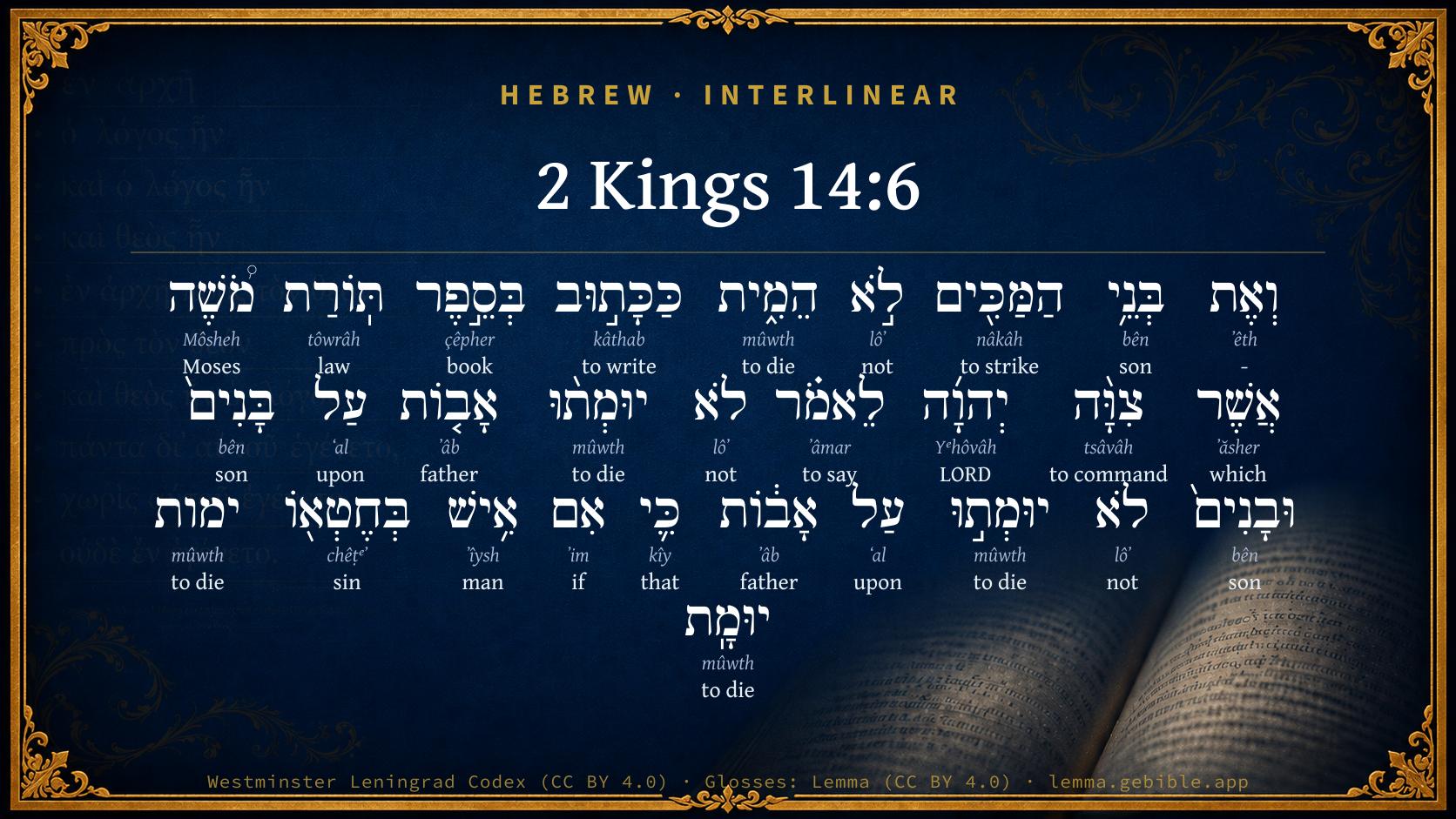
Hebrew (Westminster Leningrad Codex) 2 Kings 14:6 appears in the Hebrew Old Testament. The text above is from the Westminster Leningrad Codex. Each word links to its Strong’s number, a concise gloss, and parsing drawn from the Open Scriptures Hebrew Bible morphology. Click any word for its full Brown-Driver-Briggs (BDB) entry.
Download image
Cite this verse

2 Kings 14:6 (World English Bible). Public Domain. Lemma interlinear Bible study tool, https://lemma.gebible.app/v/2-kings/14/6.

Show BibTeX & RIS
BibTeX
RIS
English Translation
but the children of the murderers he didn't put to death; according to that which is written in the book of the law of Moses, as Yahweh commanded, saying, The fathers shall not be put to death for the children, nor the children be put to death for the fathers; but every man shall die for his own sin.
World English Bible · Public Domain
Download a study sheet

One document with this verse’s original text, its word-by-word gloss line, the meaning frame, cross-references with their text, attributed commentary, and full source and license credits — printable, and it pastes into notes with its structure intact.

This verse Autodidact and up

Study sheet (.html) Plain text (.txt)

A passage Seminary Student

Up to 50 verses in one chapter. A passage sheet keeps up to 6 commentary sources and 12 cross-references per verse, in the order this page ranks them, and says so on the sheet whenever that leaves anything out. Ask for a single verse and you get the Autodidact verse sheet above.

Everything on this page stays free to read, with no account — the sheet is a download of what is already on screen, not access to it.

Want to remove ads? Support Godless Engineer
Compare translations 3

The same verse in 3 English versions, stacked beneath the original-language interlinear above. Click any original word for its lexicon entry.

Each is an independent rendering of the whole verse — the interlinear is not word-aligned to these translations.

Highlighted words mark where these versions differ — a whole-verse word diff, not a word-by-word alignment.

  • World English Bible Public Domain
    but the children of the murderers he didn't put to death; according to that which is written in the book of the law of Moses, as Yahweh commanded, saying, The fathers shall not be put to death for the children, nor the children be put to death for the fathers; but every man shall die for his own sin.
  • King James Version Public Domain
    But the children of the murderers he slew not: according unto that which is written in the book of the law of Moses, wherein the LORD commanded, saying, The fathers shall not be put to death for the children, nor the children be put to death for the fathers; but every man shall be put to death for his own sin.
  • unfoldingWord Literal Text CC BY-SA 4.0
    But the sons of the ones striking, he did not kill, as written in the book of the law of Moses, what Yahweh commanded, saying, “Fathers shall not be killed for sons, and sons shall not be killed for fathers. Rather, a man shall be killed for his sin.”

unfoldingWord Literal Text — © unfoldingWord, licensed CC BY-SA 4.0. Word-aligned USFM3 via Door43 (git.door43.org/unfoldingWord/en_ult).

Versions to compare (up to 4)

3 of 4 selected

Show all 18 translations

Every available English version of this verse, each an independent rendering of the whole verse.

  • World English Bible Public Domain
    but the children of the murderers he didn't put to death; according to that which is written in the book of the law of Moses, as Yahweh commanded, saying, The fathers shall not be put to death for the children, nor the children be put to death for the fathers; but every man shall die for his own sin.
  • Berean Standard Bible Public Domain
    Yet he did not put the sons of the murderers to death, but acted according to what is written in the Book of the Law of Moses, where the LORD commanded: “Fathers must not be put to death for their children, and children must not be put to death for their fathers; each is to die for his own sin.”
  • Majority Standard Bible Public Domain
    Yet he did not put the sons of the murderers to death, but acted according to what is written in the Book of the Law of Moses, where the LORD commanded: “Fathers must not be put to death for their children, and children must not be put to death for their fathers; each is to die for his own sin.”
  • King James Version Public Domain
    But the children of the murderers he slew not: according unto that which is written in the book of the law of Moses, wherein the LORD commanded, saying, The fathers shall not be put to death for the children, nor the children be put to death for the fathers; but every man shall be put to death for his own sin.
  • American Standard Version (1901) Public Domain
    but the children of the murderers he put not to death; according to that which is written in the book of the law of Moses, as Jehovah commanded, saying, The fathers shall not be put to death for the children, nor the children be put to death for the fathers; but every man shall die for his own sin.
  • Revised Version (1885) Public Domain
    but the children of the murderers he put not to death: according to that which is written in the book of the law of Moses, as the LORD commanded, saying, The fathers shall not be put to death for the children, nor the children be put to death for the fathers; but every man shall die for his own sin.
  • Geneva Bible (1599) Public Domain
    But the children of those that did slay him, he slewe not, according vnto that that is written in the booke of the Lawe of Moses, wherein the Lord commanded, saying, The fathers shall not be put to death for the children, nor the children put to death for the fathers: but euery man shall be put to death for his owne sinne.
  • Douay-Rheims (1899) Public Domain
    But the children of the murderers he did not put to death, according to that which is written in the book of the law of Moses, wherein the Lord commanded, saying: The fathers shall not be put to death for the children, neither shall the children be put to death for the fathers: but every man shall die for his own sins.
  • Young's Literal Translation Public Domain
    and the sons of those smiting `him' he hath not put to death, as it is written in the book of the law of Moses that Jehovah commanded, saying, `Fathers are not put to death for sons, and sons are not put to death for fathers, but each for his own sin is put to death.'
  • Literal Standard Version CC BY-SA 4.0
    and the sons of those striking [him] he has not put to death, as it is written in the Scroll of the Law of Moses that YHWH commanded, saying, “Fathers are not put to death for sons, and sons are not put to death for fathers, but each is put to death for his own sin.”
  • Unlocked Literal Bible CC BY-SA 4.0
    Yet he did not put the sons of the murderers to death; instead, he acted according to what was written in the Book of the Law Moses, as Yahweh had commanded, saying, “The fathers must not be put to death for their children, neither must the children be put to death for their parents. Instead, every person must be put to death for his own sin.”
  • unfoldingWord Literal Text CC BY-SA 4.0
    But the sons of the ones striking, he did not kill, as written in the book of the law of Moses, what Yahweh commanded, saying, “Fathers shall not be killed for sons, and sons shall not be killed for fathers. Rather, a man shall be killed for his sin.”
  • Darby Bible Public Domain
    But the children of those that smote [him] he did not put to death; according to that which is written in the book of the law of Moses, wherein Jehovah commanded saying, The fathers shall not be put to death for the children, neither shall the children be put to death for the fathers; but every man shall be put to death for his own sin.
  • World Messianic Bible Public Domain
    but the children of the murderers he didn’t put to death, according to that which is written in the scroll of the Torah of Moses, as the LORD commanded, saying, “The fathers shall not be put to death for the children, nor the children be put to death for the fathers; but every man shall die for his own sin.”
  • Webster's Bible Public Domain
    But the children of the murderers he slew not: according to that which is written in the book of the law of Moses, in which the LORD commanded, saying, The fathers shall not be put to death for the children, nor the children be put to death for the fathers; but every man shall be put to death for his own sin.
  • Free Bible Version CC BY-SA 4.0
    But he did not execute the murderers' children, following the Lord's command in the law of Moses that “Fathers must not be put to death for their children's sins, and children must not be put to death for their father's sins. Everyone is to die for their own sin.”
  • Bible in Basic English Public Domain
    But he did not put their children to death; for the orders of the Lord recorded in the book of the law of Moses say, The fathers are not to be put to death for the children, or the children for their fathers; but a man is to be put to death for the sin which he himself has done.
  • JPS Tanakh (1917) Public Domain
    but the children of the murderers he put not to death; according to that which is written in the book of the law of Moses, as the LORD commanded saying: 'The fathers shall not be put to death for the children, nor the children be put to death for the fathers; but every man shall be put to death for his own sin.'

Literal Standard Version (2020), Covenant Press — licensed CC BY-SA 4.0. Text via the HelloAO Bible API (eBible.org). Unlocked Literal Bible (unfoldingWord) — licensed CC BY-SA 4.0. Text via the HelloAO Bible API (eBible.org). unfoldingWord Literal Text — © unfoldingWord, licensed CC BY-SA 4.0. Word-aligned USFM3 via Door43 (git.door43.org/unfoldingWord/en_ult). Free Bible Version, Dr. Jonathan Gallagher — licensed CC BY-SA 4.0. Text via the HelloAO Bible API (eBible.org).

Word by word

More ways to search: Search by grammar → Find every occurrence → Compare this word →

Practice this passage: Drill this verse → Learn its vocabulary →

בְּחֶטְא֖וֹ
chêṭᵉʼ
H2399
“in/at · sin · his”
Preposition + Noun, Common, Masculine, Singular, Construct + Suffix, Personal, 3rd Person, Masculine, Singular
Part of Speech
Preposition + Noun
Type
Common
Gender
Masculine
Number
Singular
State
Construct
Full BDB Definition

Origin: from H2398

TWOT: 638a

sin - sin - guilt for sin - punishment for sin
  1. וְאֶת ʼêth H853 “and · -” Conjunction + Particle, Direct Object
  2. בְּנֵ֥י bên H1121 “sons of” Noun, Common, Masculine, Plural, Construct
  3. הַמַּכִּ֖ים nâkâh H5221 “the · striking” Particle, Definite Article + Verb, Hiphil, Participle Active, Masculine, Plural, Absolute
  4. לֹ֣א lôʼ H3808 “not” Particle, Negative
  5. הֵמִ֑ית mûwth H4191 “to die” Verb, Hiphil, Perfect, 3rd Person, Masculine, Singular
  6. כַּכָּת֣וּב kâthab H3789 “like/as the · written” Preposition, Determined + Verb, Qal, Participle Passive, Masculine, Singular, Absolute
  7. בְּסֵ֣פֶר çêpher H5612 “in/at · book of” Preposition + Noun, Common, Masculine, Singular, Construct
  8. תּֽוֹרַת tôwrâh H8451 “law of” Noun, Common, Feminine, Singular, Construct
  9. מֹ֠שֶׁה Môsheh H4872 “Moses” Noun, Proper
  10. אֲשֶׁר ʼăsher H834 “which” Particle, Relative
  11. צִוָּ֨ה tsâvâh H6680 “to command” Verb, Piel, Perfect, 3rd Person, Masculine, Singular
  12. יְהוָ֜ה Yᵉhôvâh H3068 “LORD” Noun, Proper
  13. לֵאמֹ֗ר ʼâmar H559 “to say” Preposition + Verb, Qal, Infinitive Construct
  14. לֹא lôʼ H3808 “not” Particle, Negative
  15. יוּמְת֨וּ mûwth H4191 “to die” Verb, Hophal, Imperfect, 3rd Person, Masculine, Plural
  16. אָב֤וֹת ʼâb H1 “fathers” Noun, Common, Masculine, Plural, Absolute
  17. עַל ʻal H5921 “upon” Preposition
  18. בָּנִים֙ bên H1121 “sons” Noun, Common, Masculine, Plural, Absolute
  19. וּבָנִים֙ bên H1121 “and · sons” Conjunction + Noun, Common, Masculine, Plural, Absolute
  20. לֹא lôʼ H3808 “not” Particle, Negative
  21. יוּמְת֣וּ mûwth H4191 “to die” Verb, Hophal, Imperfect, 3rd Person, Masculine, Plural
  22. עַל ʻal H5921 “upon” Preposition
  23. אָב֔וֹת ʼâb H1 “fathers” Noun, Common, Masculine, Plural, Absolute
  24. כִּ֛י kîy H3588 “that” Conjunction
  25. אִם ʼim H518 “if” Conjunction
  26. אִ֥ישׁ ʼîysh H376 “man” Noun, Common, Masculine, Singular, Absolute
  27. ימות mûwth H4191 “to die” Verb, Qal, Imperfect, 3rd Person, Masculine, Singular
  28. יוּמָֽת mûwth H4191 “to die” Verb, Hophal, Imperfect, 3rd Person, Masculine, Singular

About this verse

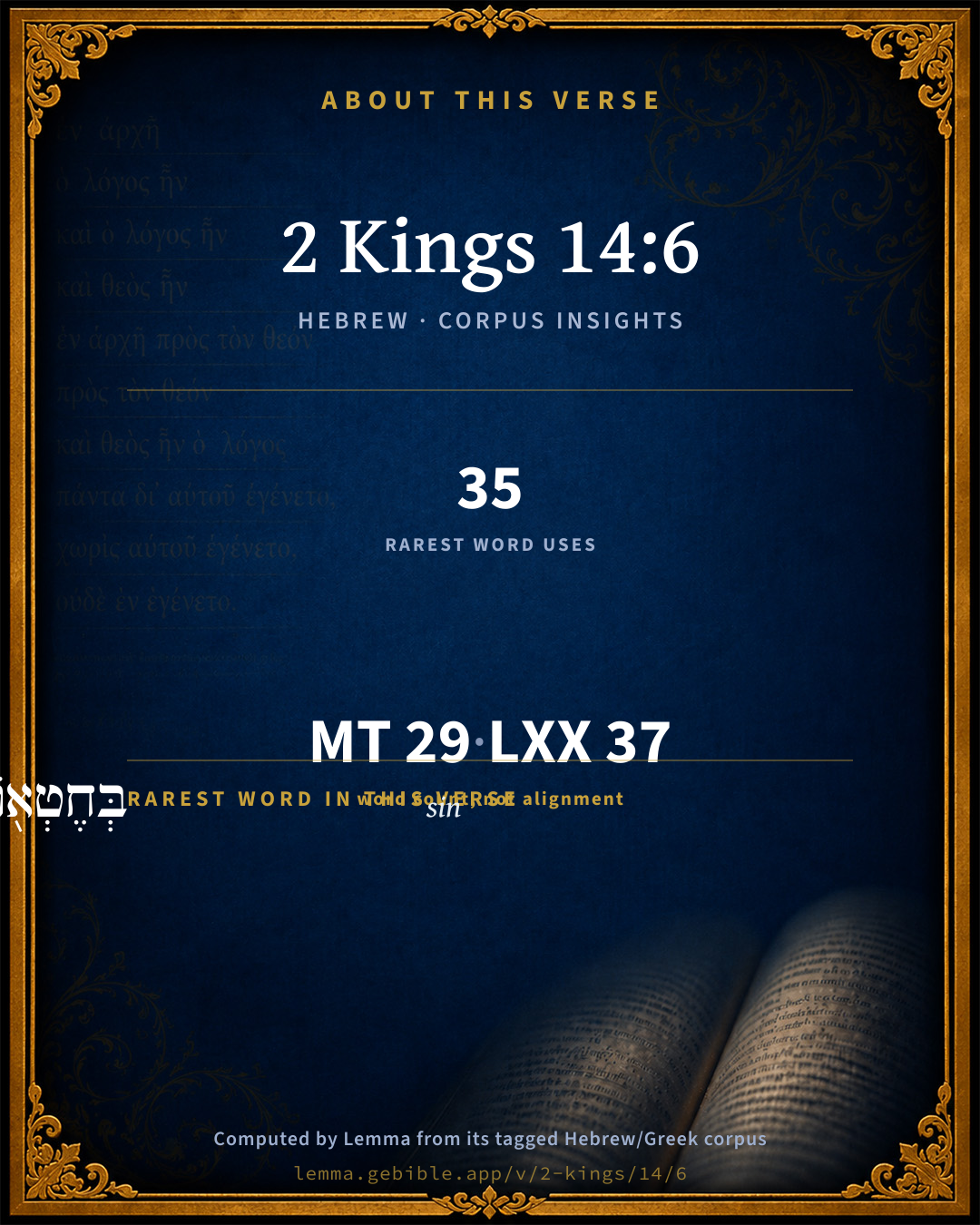
These counts appear in no published source. They are computed here, from the morphology-tagged text and Lemma’s own curated glosses. What Lemma adds →

29
words
19
distinct lemmas
Historical
section

Shared distinctive vocabulary

בְּחֶטְא֖וֹ sin H2399 occurs in 34 verses of the Hebrew Bible. Also found in:

Grammatical profile

  • 9 verbs
  • 11 nouns
  • 2 prepositions
  • 2 conjunctions
  • 5 particles

Verb forms

  • הַמַּכִּ֖ים Hiphil · Participle Active
  • הֵמִ֑ית Hiphil · Perfect
  • כַּכָּת֣וּב Qal · Participle Passive
  • צִוָּ֨ה Piel · Perfect
  • לֵאמֹ֗ר Qal · Infinitive Construct
  • יוּמְת֨וּ Hophal · Imperfect
  • יוּמְת֣וּ Hophal · Imperfect
  • ימות Qal · Imperfect
  • יוּמָֽת Hophal · Imperfect

Repetition

Words recur within this verse — often emphatic in Hebrew:

  • הֵמִ֑ית to die H4191 ×5
  • בְּנֵ֥י son H1121 ×3
  • אָב֤וֹת father H1 ×2
  • עַל upon H5921 ×2
  • לֹ֣א not H3808 ×3

Hebrew & Septuagint length

In English translation the verse runs 59 words from the Hebrew and 63 from the Septuagint (LXX English) — closely comparable.

A rough comparison of the two English renderings, which tokenize alike — not a word-level alignment.

Word counts can differ between the Hebrew and the Greek without any difference in meaning — e.g. the Hebrew direct-object marker אֵת has no separate Greek word, and Greek often adds the article ὁ.

In the original languages it is 29 Hebrew tokens and 37 Greek tokens — but the two are counted differently (Hebrew bundles its prefixes and suffixes into one token; the Greek is in lemma form), so that isn’t a like-for-like length.

Cross-references

4

Topical passages linked to 2 Kings 14:6 in the Treasury of Scripture Knowledge — connected by theme and wording, ordered by reader-vote popularity; previews shown in the World English Bible.

  • Deuteronomy 24:16 The fathers shall not be put to death for the children, neither shall the children be put to death for the fathers: every man shall be put to death for his own sin.
  • Ezekiel 18:20 The soul who sins, he shall die: the son shall not bear the iniquity of the father, neither shall the father bear the iniquity of the son; the righteousness of the righteous shall be on him, and the wickedness of the wicked shall be on him.
  • Ezekiel 18:4 Behold, all souls are mine; as the soul of the father, so also the soul of the son is mine: the soul who sins, he shall die.
  • Jeremiah 31:30 But everyone shall die for his own iniquity: every man who eats the sour grapes, his teeth shall be set on edge.

Cross-references courtesy of OpenBible.info (CC BY 4.0).

Hebrew and Greek witnesses Masoretic Hebrew ↔ Greek Septuagint

The same verse in the two great witnesses to the Old Testament, shown verse-for-verse.

These are two independent witnesses, not word-aligned to each other, and the Septuagint is shown in lemma (dictionary) form.

Hebrew 2 Kings 14:6 Masoretic · Westminster Leningrad Codex

וְאֶת בְּנֵ֥י הַמַּכִּ֖ים לֹ֣א הֵמִ֑ית כַּכָּת֣וּב בְּסֵ֣פֶר תּֽוֹרַת מֹ֠שֶׁה אֲשֶׁר צִוָּ֨ה יְהוָ֜ה לֵאמֹ֗ר לֹא יוּמְת֨וּ אָב֤וֹת עַל בָּנִים֙ וּבָנִים֙ לֹא יוּמְת֣וּ עַל אָב֔וֹת כִּ֛י אִם אִ֥ישׁ בְּחֶטְא֖וֹ ימות יוּמָֽת

but the children of the murderers he didn't put to death; according to that which is written in the book of the law of Moses, as Yahweh commanded, saying, The fathers shall not be put to death for the children, nor the children be put to death for the fathers; but every man shall die for his own sin.

World English Bible · Public Domain

Greek LXX 2 Kings 14:6 Septuagint · lemma form

καί ὁ υἱός ὁ πατάσσω οὐ θανατόω καθώς γράφω ἐν βιβλίον νόμος μωυσῆς ὡς ἐντέλλομαι κύριος λέγω οὐ ἀποθνήσκω πατήρ ὑπέρ υἱός καί υἱός οὐ ἀποθνήσκω ὑπέρ πατήρ ὅτι ἀλλά ἤ ἕκαστος ἐν ὁ ἁμαρτία αὐτός ἀποθνήσκω

But he killed not the sons of those that had slain him; according as it is written in the book of the laws of Moses, as the Lord gave commandment, saying, The fathers shall not be put to death for the children, and the children shall not be put to death for the fathers; but every one shall die for his own sins.

LXX2012 (modern English Septuagint) · Public Domain

Hebrew: Westminster Leningrad Codex (CC BY 4.0). Greek: Septuagint (public domain); English from LXX2012 (modern English Septuagint) (Public Domain). How the Septuagint differs from the Hebrew →

Targum (Aramaic paraphrase)

1

The Targum is the ancient Jewish Aramaic paraphrase of the Hebrew Scriptures — an interpretive translation, not the Hebrew text itself. Onkelos (literal) and Pseudo-Jonathan (expansive) render the Torah, and Jonathan the Prophets. Coverage is partial: where no permissively-licensed English translation exists for a verse, only the Aramaic is shown. This is verse-level text, not a word-by-word alignment to the Hebrew.

  1. Targum Jonathan Prophets (Joshua–Malachi)
    וְיַת בְּנֵי קַטְלַיָא לָא קְטַל כְּמָא דִכְתִיב בִּסְפַר אוֹרַיְתָא דְמֹשֶׁה דְפַקֵיד יְיָ לְמֵימָר לָא יוּמְתוּ אַבְהָן עַל פּוּם בְּנִין וּבְנִין לָא יוּמְתוּן עַל פּוּם אַבְהָן אֱלָהֵין אֱנַשׁ בְּחוֹבֵיהּ יְמוּת:

    (no public-domain English translation for this verse)

    Targum Jonathan — Aramaic: “Mikraot Gedolot” (public domain). English: “Sefaria Community Translation” (CC0 1.0 (public-domain dedication)); “London "Chaldee Paraphrase," 1871” (public domain). Text via Sefaria.

Commentary

Notes on 2 Kings 14:6 from classic Christian and Jewish commentators (each source and its license shown beneath its notes). The classic Christian expositions comment on the surrounding passage and are grouped to its opening verse, so a note may address several verses; the Jewish commentaries on the Tanakh (Rashi and others) are per-verse, so they appear only where the commentator wrote on this verse.

Lemma curates 59 commentaries, every one of them public domain or Creative Commons licensed, each selected and text-cleaned for this edition rather than reprinted as found. About our sources →

Trapp's Complete Commentary

John Trapp

2Ki 14:6 But the children of the murderers he slew not: according unto that which is written in the book of the law of Moses, wherein the LORD commanded, saying, The fathers shall not be put to death for the children, nor the children be put to death for the fathers; but every man shall be put to death for his own sin.

Ver. 6. But the children of the murderers he slew not.] Which yet carnal policy would have prompted him to do. See on 2Ki 10:6.

Nor the children be put to death, &c.] This was a law for man to follow; but God, the supreme Lord of life and death, is above law. {Jer 3:1}

John Trapp, A Commentary or Exposition upon All the Books of the Old and New Testament (1647–1656) — public domain. Text from a community e-Sword module.

Joseph Benson's Commentary

2Ki 14:6. But the children of the murderers he slew not — In this he acted like a good man, and showed both faith and courage, in that he would obey the command of God, though it might be attended with great hazard to himself, and was not moved to cut off the children, through fear lest they should raise a faction against him, and take revenge for their fathers’ death. Very different is the custom pursued in many kingdoms, in which, if any one be guilty of high treason, not only he, but his children likewise, who neither partake nor are conscious of his traitorous practices, are equally devoted to destruction.

Joseph Benson's Commentary on the Old and New Testaments (1811–1818) — public domain. Text from a community e-Sword module.

Geneva Bible (1599)

Geneva Bible translators

Because they neither consented nor were partakers with their fathers in that act.

Geneva Bible (1599) marginal notes — public domain. Text via Bolls.life.

Jamieson, Fausset & Brown

Robert Jamieson, A. R. Fausset & David Brown

But the children of the murderers he slew not--This moderation, inspired by the Mosaic law (Deu 24:16), displays the good character of this prince; for the course thus pursued toward the families of the regicides was directly contrary to the prevailing customs of antiquity, according to which all connected with the criminals were doomed to unsparing destruction.

Jamieson, Fausset & Brown — Commentary Critical and Explanatory on the Whole Bible (1871) — public domain (CC PDM 1.0). Text via the HelloAO Bible API.

Adam Clarke's Commentary

Verse 6. But the children of the murderers he slew not] Here he showed his conscientious regard for the law of Moses; for God had positively said, The fathers shall not be put to death for the children, neither shall the children be put to death for the fathers: every man shall be put to death for his own sin, De 24:16.

Adam Clarke's Commentary on the Bible (1810–1826) — public domain. Text from a community e-Sword/MySword module.

Ellicott's Commentary for English Readers

(6) The murderers.—Literally, the smiters.

According unto that which is written . . . law of Moses.—A quotation of Deu_24:16. This reference is from the pen of the Judæan editor.

Shall be put to death.—So the original passage and the Hebrew margin. Hebrew text, “shall die.”

This humane provision of the Jewish law contrasts favourably with the practice of other nations, ancient and modern. Readers of the classics will recollect the hideous story of the treatment of the young daughter of Sejanus (Tac. Ann. v. 9).

(6) Even with the kings of Israel.—Probably some words have fallen out, and the original text was. “and was buried in Samaria with the kings of Israel.” (Comp, 2Ki_14:16.) The Syriac and Arabic have, “and was buried.”

A Bible Commentary for English Readers, edited by Charles John Ellicott (1878–1897) — public domain. Text from a community e-Sword module.

The Cambridge Bible for Schools and Colleges

gen. ed. J. J. S. Perowne

6. the children of the murderers he slew not] R.V. he put not to death. The Hebrew has a different verb here from that which is twice over used for ‘to slay’ in the previous verse.

according unto that which is written in the book of the law of Moses] The compiler of Kings either took this statement from his original record, or he inserted it in his narrative because he felt that it was an act which accorded with the legal command. In either case he looked upon the law as existing and observed in the days of Amaziah, and therefore that Deu_24:16, where this command is recorded, was existent before Amaziah’s days, and therefore long before the days of Josiah, to which date some propose to refer the composition of the fifth book of Moses.

wherein [R.V. as] the Lord commanded] The change is in accordance with the Hebrew, cf. Exo_34:18. The relative is not here in its most usual form for the sense of ‘as’, but it could hardly be explained as=wherein. Another example of this less common use is in Jer_33:22.

every man shall be put to death [R.V. shall die] for his own sin] The Kethib gives a different form of the verb in the last clause and the R.V. has followed this. The text in Deu_24:16 agrees with the translation of A.V. and no doubt this was the reason why that form was preferred here also, being given by the Keri.

The Cambridge Bible for Schools and Colleges (gen. ed. J. J. S. Perowne; Cambridge University Press, 1878–1918) — public domain. Text from a community e-Sword module.

John Gill's Exposition

Then Amaziah sent messengers to Jehoash the son of Jehoahaz the son of Jehu king of Israel,.... The occasion of it was this, when Amaziah dismissed the hired soldiers of Israel they were displeased, and fell upon the cities of Judea from Samaria to Bethhoron, slew 3000 men, and took much spoil, Ch2 25:13, wherefore, when Amaziah returned from the slaughter of the Edomites, being elated with his victories, he sent the following message to the king of Israel, in order to revenge the injuries his soldiers had done; and perhaps retaining an old grudge for what Jehu, the grandfather of the king of Israel, had done to his ancestors, and it may be in hope of reducing the ten tribes to obedience to the house of David:

saying, come, let us look one another in the face; that is, in battle, as the Targum adds; it was a challenge to meet him in the field of battle, and fight with him, and try each other's courage, and see who was the best man.

John Gill's Exposition of the Whole Bible (1746–1763) — public domain (CC PDM 1.0). Text via the HelloAO Bible API.

Albert Barnes' Notes on the Bible

The children of the murderers he slew not - This seems to be noted as a rare instance of clemency (compare 2Ki 9:26 note). It is strange at first sight, that, when the Law contained so very plain a prohibition (marginal references), the contrary practice should have established itself. But we must remember, first, that the custom was that of the East generally (see Dan 6:24); and secondly, that it had the sanction of one who might be thought to have known thoroughly the mind of the legislator, namely, Joshua (see Jos 7:24-25).

Albert Barnes' Notes on the Bible (1834–1885) — public domain. Text from a community e-Sword/MySword module.

Haydock's Catholic Bible Commentary

Sin. This is the rule of human tribunals, to which God is not restrained. (Salien) (Ezechiel xviii. 20.) (Menochius) --- The action of Amasias is commended as something unusual (Calmet) among princes, who are but too apt to exceed the bounds of moderation (Haydock) to revenge their murdered parents. (Calmet)

George Leo Haydock (1774–1849), Haydock's Catholic Family Bible and Commentary, 1859 edition — public domain. Excludes Psalms (Douay-Rheims chapter numbering differs from Protestant) and Deuterocanonical books (Catholic canon only).

Matthew Poole's English Annotations

The children of the murderer he slew not; wherein he showed some faith and courage, that he would obey this command of God, though it was very hazardous to himself, such persons being likely to seek revenge for their father’s death.

Matthew Poole's English Annotations on the Holy Bible (1683–1685) — public domain. Text from a community e-Sword/MySword module.

Whedon's Commentary on the Bible

Daniel D. Whedon

6. The children of the murderers he slew not — In this he evidenced his desire to do right in the sight of God. He allowed judgment and reason to triumph over the passion for vengeance, at the same time that he showed respect for the law of God.

Book of the law of Moses — The passage referred to is found in Deu_24:16, and this reference and quotation conclusively prove the existence and authority of the Pentateuch in the time of Amaziah.

Put to death for his own sin — Personal guilt is neither transmissive nor transferable. Compare marginal references.

Daniel D. Whedon (gen. ed.), Commentary on the Old and New Testaments (1874–1909) — public domain. Text from a community e-Sword module.

The Pulpit Commentary

But the children of the murderers he slew not. It was the ordinary usage in the East for the sons of traitors to share the fate of their fathers. A Greek poet went so far as to say that a man was a fool who put to death the father, and allowed the son to live. The practice had a double ground. Sons, it might be assumed, would be cognizant of their father"s intention, and would so be accessories before the fact. And the law of claim, or "blood-feud," would make it dangerous to spare them, since they would be bound to avenge their father"s death on his destroyer. That the practice prevailed among the Israelites appears from Jos_7:24, where we find the children of Achan involved in his fate, and again from wOt 2Ki_9:26, where we are told that Naboth"s sons suffered with their father. But it was contrary to an express command of the Law, as the writer goes on to show. According unto that which is written in the book of the Law of Moses. "The book of the Law of Moses" (hvmAtr rpse) may be either the Pentateuch regarded as one book, or Deuteronomy, the particular" book" of the Pentateuch in which the passage occurs. In either case the passage is fatal to the theory of the late" composition of Deuteronomy, which is here found to have ruled the conduct of a Jewish king a hundred and fifty years before Manasseh, two hundred before Josiah, and two hundred and eighty before the return from the Captivity the dates assigned to Deuteronomy by recent "advanced" critics. Wherein the Lord commanded, saying, The fathers shall not be put to death for the children, nor the children be put to death for the fathers; but every man shall be put to death for his own sin. As usual, when one sacred writer quotes another, the quotation is not exact. "But" ( WKi) is inserted at the beginning of the final clause, and the form of the verb in the same clause is modified. It seems to be intended that we should be made to feel that it is the sentiment or meaning conveyed, and not the phraseology in which it is wrapped up, that is of importance.

The Pulpit Commentary (1880–1919), ed. H.D.M. Spence-Jones & Joseph S. Exell — public domain. Text from a community e-Sword module.

John Wesley's Explanatory Notes

Slew not - Wherein he shewed faith and courage, that he would obey this command of God, though it was hazardous to himself, such persons being likely to seek revenge for their father's death.

John Wesley, Explanatory Notes Upon the Whole Bible (1754–1765) — public domain. Text via the GEBible commentary corpus.

unfoldingWord translationNotes

Door43 World Missions Community

General Information:

The narrator tells about what king Amaziah did after his father King Joash was murdered.

Yet he did not put the sons of the murderers to death

King Amaziah did not order his servants to kill the children of the men who killed his father. If he was going to have them executed though, he would have commanded his servants do it, he would not have done it himself. AT: "But he did not tell his servants to execute those officials' children" (See: Synecdoche)

The fathers must not be put to death for their children, neither must the children be put to death for their parents

This can be stated in active form. AT: "People must not kill the fathers for the sins of their children, and they must not kill the children for the sins of their parents" (See: Active or Passive)

every person must be put to death for his own sin

This can be stated in active form. AT: "every person must die for his own sin" (See: Active or Passive)

He killed

Here "He" refers to his army. AT: "Amaziah's army killed" or "Amaziah's soldiers killed" (See: Synecdoche)

ten thousand soldiers

"10,000 soldiers" (See: Numbers)

Valley of Salt

This is the name of a place that is located south of the Dead Sea.

he also took Sela in war

Here the word "he" refers to King amaziah and represents himself and his army. AT: "King Amaziah's army captured the city of Sela" (See: Synecdoche)

Sela ... Joktheel

They renamed the city of Sela. The new name was Joktheel. (See: How to Translate Names)

translationWords

die

written

law

Moses

command

sin

Edom

unfoldingWord translationNotes — © Distant Shores Media and the Door43 World Missions Community, licensed CC BY-SA 4.0. Source: git.door43.org/Door43/en_tn.

Lesson kit

Teaching starters — assembled from the data on this page, not authored interpretation. Every prompt links to the verse data it draws on. Edit before teaching.

2 Kings, in the Historical, opens this verse with 29 words (19 distinct Hebrew lemmas). Its most distinctive word is chêṭᵉʼ (“sin”). A historical commentator’s framing appears above. Read the whole chapter for the surrounding context.

Discussion questions

  1. The word chêṭᵉʼ carries the sense “sin.” How does it shape the verse?
  2. How does Genesis 41:9, which shares the word «sin», read alongside this verse?
  3. What does the repetition of “to die” (5× in this one verse) do in this verse?
  4. These translations render this verse differently. What is at stake in choosing one wording over another?
  5. «הַמַּכִּ֖ים» is a Hiphil Participle Active verb. How does that grammatical form shape the action described?
  6. Compare how Trapp's Complete Commentary and Joseph Benson's Commentary read this verse. Where do they agree or differ?

Things to notice

Reading settings

Reading text

Shown beneath each verse's original-language words.

Old Testament
Old Testament edition

Read the OT as the Masoretic Hebrew (MT) or the Greek Septuagint (LXX).

English shown for the Greek Septuagint (in the Hebrew ↔ Greek comparison).

Comparing translations? Open the Compare panel on any verse page to stack up to four side by side.