Esther 9:10

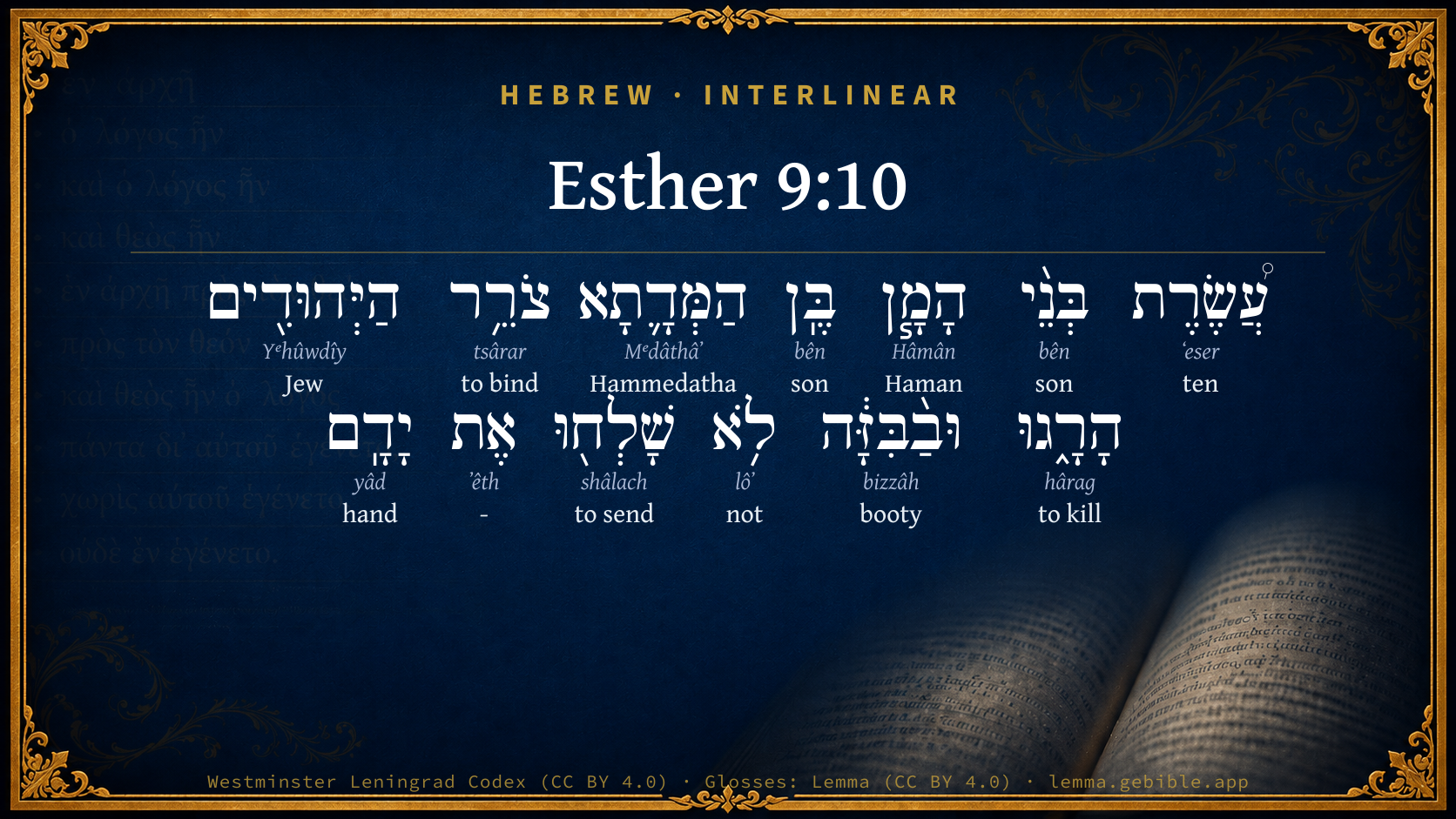
Hebrew (Westminster Leningrad Codex) Esther 9:10 appears in the Hebrew Old Testament. The text above is from the Westminster Leningrad Codex. Each word links to its Strong’s number, a concise gloss, and parsing drawn from the Open Scriptures Hebrew Bible morphology. Click any word for its full Brown-Driver-Briggs (BDB) entry.
Download image
Cite this verse

Esther 9:10 (World English Bible). Public Domain. Lemma interlinear Bible study tool, https://lemma.gebible.app/v/esther/9/10.

Show BibTeX & RIS
BibTeX
RIS
English Translation
the ten sons of Haman the son of Hammedatha, the Jew's enemy, killed they; but they didn't lay their hand on the spoil.
World English Bible · Public Domain
Download a study sheet

One document with this verse’s original text, its word-by-word gloss line, the meaning frame, cross-references with their text, attributed commentary, and full source and license credits — printable, and it pastes into notes with its structure intact.

This verse Autodidact and up

Study sheet (.html) Plain text (.txt)

A passage Seminary Student

Up to 50 verses in one chapter. A passage sheet keeps up to 6 commentary sources and 12 cross-references per verse, in the order this page ranks them, and says so on the sheet whenever that leaves anything out. Ask for a single verse and you get the Autodidact verse sheet above.

Everything on this page stays free to read, with no account — the sheet is a download of what is already on screen, not access to it.

Want to remove ads? Support Godless Engineer
Compare translations 3

The same verse in 3 English versions, stacked beneath the original-language interlinear above. Click any original word for its lexicon entry.

Each is an independent rendering of the whole verse — the interlinear is not word-aligned to these translations.

Highlighted words mark where these versions differ — a whole-verse word diff, not a word-by-word alignment.

  • World English Bible Public Domain
    the ten sons of Haman the son of Hammedatha, the Jew's enemy, killed they; but they didn't lay their hand on the spoil.
  • King James Version Public Domain
    The ten sons of Haman the son of Hammedatha, the enemy of the Jews, slew they; but on the spoil laid they not their hand.
  • unfoldingWord Literal Text CC BY-SA 4.0
    the ten sons of Haman, the son of Hammedatha, the adversary of the Jews, they slaughtered. But they did not stretch out their hand to the plunder.

unfoldingWord Literal Text — © unfoldingWord, licensed CC BY-SA 4.0. Word-aligned USFM3 via Door43 (git.door43.org/unfoldingWord/en_ult).

Versions to compare (up to 4)

3 of 4 selected

Show all 18 translations

Every available English version of this verse, each an independent rendering of the whole verse.

  • World English Bible Public Domain
    the ten sons of Haman the son of Hammedatha, the Jew's enemy, killed they; but they didn't lay their hand on the spoil.
  • Berean Standard Bible Public Domain
    They killed these ten sons of Haman son of Hammedatha, the enemy of the Jews, but they did not lay a hand on the plunder.
  • Majority Standard Bible Public Domain
    They killed these ten sons of Haman son of Hammedatha, the enemy of the Jews, but they did not lay a hand on the plunder.
  • King James Version Public Domain
    The ten sons of Haman the son of Hammedatha, the enemy of the Jews, slew they; but on the spoil laid they not their hand.
  • American Standard Version (1901) Public Domain
    the ten sons of Haman the son of Hammedatha, the Jew's enemy, slew they; but on the spoil they laid not their hand.
  • Revised Version (1885) Public Domain
    the ten sons of Haman the son of Hammedatha, the Jews’ enemy, slew they; but on the spoil they laid not their hand.
  • Geneva Bible (1599) Public Domain
    The ten sonnes of Haman, ye sonne of Ammedatha, the aduersarie of the Iewes slewe they: but they layd not their hands on the spoyle.
  • Douay-Rheims (1899) Public Domain
    And when they had slain them, they would not touch the spoils of their goods.
  • Young's Literal Translation Public Domain
    ten sons of Haman son of Hammedatha, adversary of the Jews, they have slain, and on the prey they have not put forth their hand.
  • Literal Standard Version CC BY-SA 4.0
    ten sons of Haman son of Hammedatha, adversary of the Jews, they have slain, and on the prey they have not put forth their hand.
  • Unlocked Literal Bible CC BY-SA 4.0
    and the ten sons of Haman son of Hammedatha, the enemy of the Jews. But they did not take any plunder.
  • unfoldingWord Literal Text CC BY-SA 4.0
    the ten sons of Haman, the son of Hammedatha, the adversary of the Jews, they slaughtered. But they did not stretch out their hand to the plunder.
  • Darby Bible Public Domain
    the ten sons of Haman the son of Hammedatha, the oppressor of the Jews, they slew; but they laid not their hands on the prey.
  • World Messianic Bible Public Domain
    the ten sons of Haman the son of Hammedatha, the Jews’ enemy, but they didn’t lay their hand on the plunder.
  • Webster's Bible Public Domain
    The ten sons of Haman the son of Hammedatha, the enemy of the Jews, they slew; but on the spoil they laid not their hand.
  • Free Bible Version CC BY-SA 4.0
    the ten sons of Haman, son of Hammedatha, the enemy of the Jews, but they did not take their possessions.
  • Bible in Basic English Public Domain
    The ten sons of Haman the son of Hammedatha, the hater of the Jews; but they put not a hand on any of their goods.
  • JPS Tanakh (1917) Public Domain
    the ten sons of Haman the son of Hammedatha, the Jews' enemy, slew they; but on the spoil they laid not their hand.

Literal Standard Version (2020), Covenant Press — licensed CC BY-SA 4.0. Text via the HelloAO Bible API (eBible.org). Unlocked Literal Bible (unfoldingWord) — licensed CC BY-SA 4.0. Text via the HelloAO Bible API (eBible.org). unfoldingWord Literal Text — © unfoldingWord, licensed CC BY-SA 4.0. Word-aligned USFM3 via Door43 (git.door43.org/unfoldingWord/en_ult). Free Bible Version, Dr. Jonathan Gallagher — licensed CC BY-SA 4.0. Text via the HelloAO Bible API (eBible.org).

Word by word

More ways to search: Search by grammar → Find every occurrence → Compare this word →

Practice this passage: Drill this verse → Learn its vocabulary →

הַמְּדָ֛תָא
Mᵉdâthâʼ
H4099
“Hammedatha”
Noun, Proper
Part of Speech
Noun
Type
Proper
Full BDB Definition

Origin: of Persian origin

TWOT: None

Hammedatha = "double" - father of Haman
  1. עֲ֠שֶׂרֶת ʻeser H6235 “ten” Adjective, Cardinal number, Masculine, Singular, Construct
  2. בְּנֵ֨י bên H1121 “sons of” Noun, Common, Masculine, Plural, Construct
  3. הָמָ֧ן Hâmân H2001 “Haman” Noun, Proper
  4. בֶּֽן bên H1121 “son of” Noun, Common, Masculine, Singular, Construct
  5. צֹרֵ֥ר tsârar H6887 “binding” Verb, Qal, Participle Active, Masculine, Singular, Construct
  6. הַיְּהוּדִ֖ים Yᵉhûwdîy H3064 “the · Jews” Particle, Definite Article + Noun, Gentilic, Masculine, Plural, Absolute
  7. הָרָ֑גוּ hârag H2026 “to kill” Verb, Qal, Perfect, 3rd Person, Common, Plural
  8. וּבַ֨בִּזָּ֔ה bizzâh H961 “and · in/at the · booty” Conjunction + Preposition, Determined + Noun, Common, Feminine, Singular, Absolute
  9. לֹ֥א lôʼ H3808 “not” Particle, Negative
  10. שָׁלְח֖וּ shâlach H7971 “to send” Verb, Qal, Perfect, 3rd Person, Common, Plural
  11. אֶת ʼêth H853 “-” Particle, Direct Object
  12. יָדָֽם yâd H3027 “hand · their” Noun, Common, Both, Singular, Construct + Suffix, Personal, 3rd Person, Masculine, Plural

About this verse

These counts appear in no published source. They are computed here, from the morphology-tagged text and Lemma’s own curated glosses. What Lemma adds →

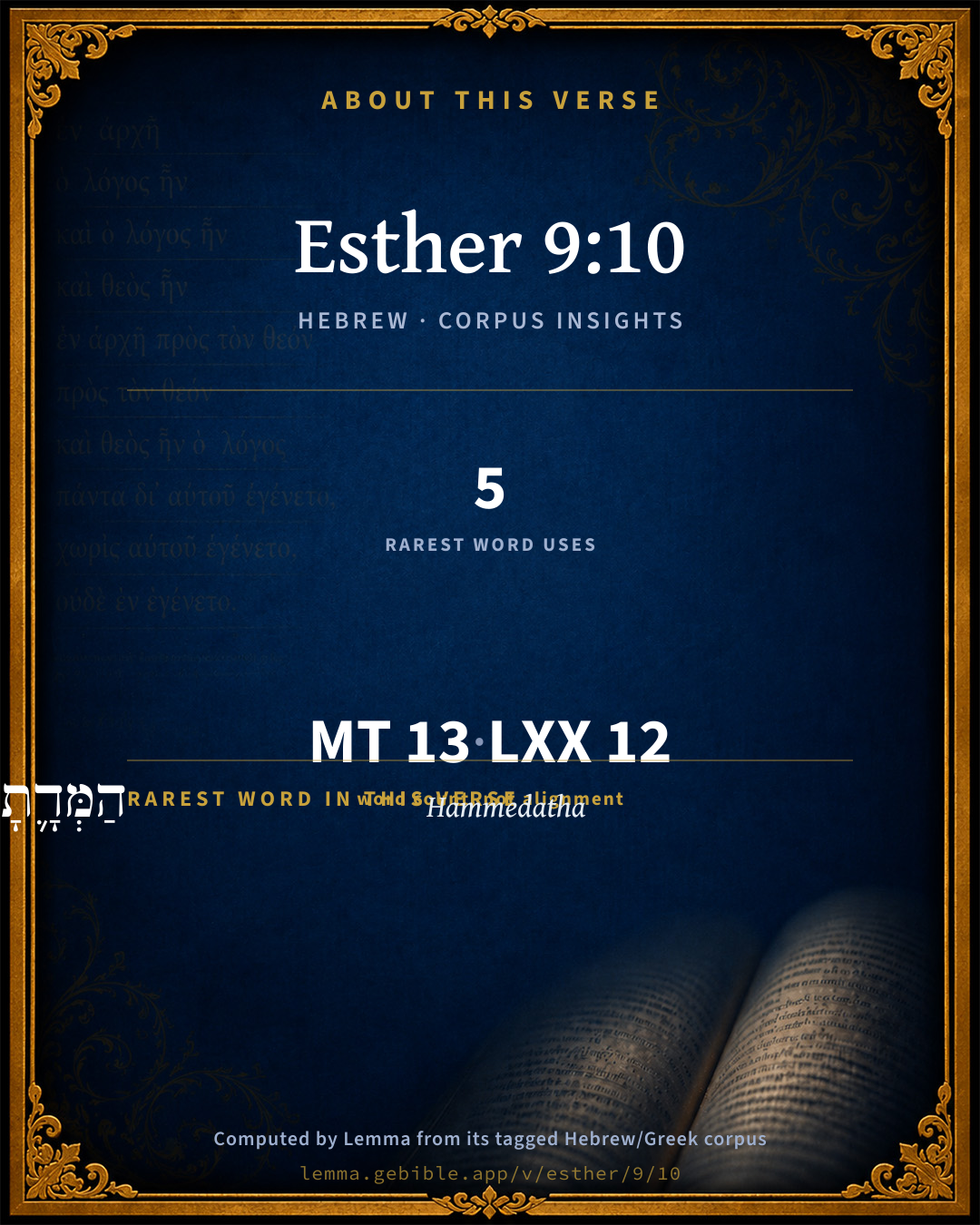
13
words
12
distinct lemmas
Historical
section

Notable vocabulary

The rarest word here is הַמְּדָ֛תָא Hammedatha H4099 — appearing just 5 times in the whole Hebrew Bible.

Shared distinctive vocabulary

הַמְּדָ֛תָא Hammedatha H4099 occurs in 5 verses of the Hebrew Bible. Also found in:

Grammatical profile

  • 3 verbs
  • 7 nouns
  • 1 adjective
  • 2 particles

Verb forms

  • צֹרֵ֥ר Qal · Participle Active
  • הָרָ֑גוּ Qal · Perfect
  • שָׁלְח֖וּ Qal · Perfect

Repetition

A word recurs within this verse — often emphatic in Hebrew:

  • בְּנֵ֨י son H1121 ×2

Hebrew & Septuagint length

In English translation the verse runs 23 words from the Hebrew and 25 from the Septuagint (LXX English) — closely comparable.

A rough comparison of the two English renderings, which tokenize alike — not a word-level alignment.

Word counts can differ between the Hebrew and the Greek without any difference in meaning — e.g. the Hebrew direct-object marker אֵת has no separate Greek word, and Greek often adds the article ὁ.

In the original languages it is 13 Hebrew tokens and 12 Greek tokens — but the two are counted differently (Hebrew bundles its prefixes and suffixes into one token; the Greek is in lemma form), so that isn’t a like-for-like length.

Cross-references

15

Topical passages linked to Esther 9:10 in the Treasury of Scripture Knowledge — connected by theme and wording, ordered by reader-vote popularity; previews shown in the World English Bible.

  • Esther 5:11 Haman recounted to them the glory of his riches, and the multitude of his children, and all the things in which the king had promoted him, and how he had advanced him above the princes and servants of the king.
  • Esther 8:11 in which the king granted the Jews who were in every city to gather themselves together, and to stand for their life, to destroy, to kill, and to cause to perish, all the power of the people and province that would assault them, [their] little ones and women, and to take the spoil of them for a prey,
  • Genesis 14:23 that I will not take a thread nor a shoe-latchet nor anything that is yours, lest you should say, 'I have made Abram rich.'
  • Job 18:18–19 He shall be driven from light into darkness, And chased out of the world.
  • Job 27:13–15 "This is the portion of a wicked man with God, The heritage of oppressors, which they receive from the Almighty.
  • Exodus 17:16 He said, "Yah has sworn: 'Yahweh will have war with Amalek from generation to generation.'"
  • Exodus 20:5 you shall not bow yourself down to them, nor serve them, for I, Yahweh your God, am a jealous God, visiting the iniquity of the fathers on the children, on the third and on the fourth generation of those who hate me,
  • Esther 3:1 After these things did king Ahasuerus promote Haman the son of Hammedatha the Agagite, and advanced him, and set his seat above all the princes who were with him.
  • Esther 7:4 for we are sold, I and my people, to be destroyed, to be slain, and to perish. But if we had been sold for bondservants and bondmaids, I had held my peace, although the adversary could not have compensated for the king's damage.
  • Esther 7:6 Esther said, An adversary and an enemy, even this wicked Haman. Then Haman was afraid before the king and the queen.
  • Esther 9:15–16 The Jews who were in Shushan gathered themselves together on the fourteenth day also of the month Adar, and killed three hundred men in Shushan; but they didn't lay their hand on the spoil.
  • Psalms 21:10 You will destroy their descendants from the earth, Their posterity from among the children of men.
  • Psalms 109:12–13 Let there be none to extend kindness to him, Neither let there be any to have pity on his fatherless children.
  • Romans 12:17 Repay no one evil for evil. Respect what is honorable in the sight of all men.
  • Philippians 4:8 Finally, brothers, whatever things are true, whatever things are honorable, whatever things are just, whatever things are pure, whatever things are lovely, whatever things are of good report; if there is any virtue, and if there is any praise, think about these things.

Cross-references courtesy of OpenBible.info (CC BY 4.0).

Hebrew and Greek witnesses Masoretic Hebrew ↔ Greek Septuagint

The same verse in the two great witnesses to the Old Testament, shown verse-for-verse.

These are two independent witnesses, not word-aligned to each other, and the Septuagint is shown in lemma (dictionary) form.

Hebrew Esther 9:10 Masoretic · Westminster Leningrad Codex

עֲ֠שֶׂרֶת בְּנֵ֨י הָמָ֧ן בֶּֽן הַמְּדָ֛תָא צֹרֵ֥ר הַיְּהוּדִ֖ים הָרָ֑גוּ וּבַ֨בִּזָּ֔ה לֹ֥א שָׁלְח֖וּ אֶת יָדָֽם

the ten sons of Haman the son of Hammedatha, the Jew's enemy, killed they; but they didn't lay their hand on the spoil.

World English Bible · Public Domain

Greek LXX Esther 9:10 Septuagint · lemma form

ὁ δέκα υἱός αμαν αμαδαθος βουγαῖος ὁ ἐχθρός ὁ ἰουδαῖος καί διαἁρπάζω

the ten sons of Aman the son of Amadathes the Bugaean, the enemy of the Jews, and they plundered their property on the same day:

LXX2012 (modern English Septuagint) · Public Domain

Hebrew: Westminster Leningrad Codex (CC BY 4.0). Greek: Septuagint (public domain); English from LXX2012 (modern English Septuagint) (Public Domain). How the Septuagint differs from the Hebrew →

Commentary

Notes on Esther 9:10 from classic Christian and Jewish commentators (each source and its license shown beneath its notes). The classic Christian expositions comment on the surrounding passage and are grouped to its opening verse, so a note may address several verses; the Jewish commentaries on the Tanakh (Rashi and others) are per-verse, so they appear only where the commentator wrote on this verse.

Lemma curates 59 commentaries, every one of them public domain or Creative Commons licensed, each selected and text-cleaned for this edition rather than reprinted as found. About our sources →

Trapp's Complete Commentary

John Trapp

Est 9:10 The ten sons of Haman the son of Hammedatha, the enemy of the Jews, slew they; but on the spoil laid they not their hand.

Ver. 10. The ten sons of Haman] Of whom he had so boasted, Est 5:12, and bore himself bold, as believing that being so full of children, he should leave the rest of his substance to his babes, Psa 17:14. These ten likely were ringleaders to those Hamanists in Shushan, that durst appear in so bad a cause, being evil eggs of an evil bird. Non enim fieri ullo mode potest, ut ex me et Agrippina vir bonus nascatur, said Domitius, the father of Nero; It cannot be that of myself and Agrippina should come any good man. Kακου κορακος κακυν ωον (Dio. in Ner.). Haman brought up his sons to bring down his house; and was a parricide to them rather than a parent. His darling Vajezatha he corrected not, but cockered; no wonder, therefore, that he proved to be of a gastrill-kind (disquieting his own nest), of a viperous brood; and, therefore, though not hanged together with his father, and the whole family (as the Apocryphal additions of Esther, Esther 16:18, tell us, but not truly), yet slain in this insurrection at Shushan, together with the rest of his brethren; the good people crying out, as once they did at Rome, when the son of Maximinus, the emperor, was put to death, Ex pessimo genere ne catulum quidem habendum, Let not one whelp be left of so evil a litter.

But on the spoil laid they not their hand] Lest the king should be damnified, or themselves justly taxed of covetousness and cruelty. "Give none offence, neither to the Jews, nor to the Gentiles, nor to the Church of God," 1Co 10:32. Non semper omnia quae licent sunt facienda Not everything which is permitted should be done. (Lavat.). This is oft repeated in this chapter, to their great commendation; that although, by the king’s grant, they might have taken the spoil, Est 8:11, yet they did it not: 1. To show that they were God’s executioners, not thieves and robbers. 2. To gratify the king for his courtesy towards them, by leaving the spoil wholly to his treasury. 3. It is not unlikely, saith an interpreter (Fevard), that Mordecai and Esther had admonished them how ill Saul had sped with his spoils of the Amalekites, and Achan with his wedge of gold, which served but to cleave his body and soul asunder, and his Babylonish garment, which proved to be his burial sheet.

John Trapp, A Commentary or Exposition upon All the Books of the Old and New Testament (1647–1656) — public domain. Text from a community e-Sword module.

The Biblical Illustrator

Joseph S. Exell

Est_9:10

But on the spoil laid they not their hand.

Leaving the spoilt

It is not always good to seize all the money to which one has a legal right. There are many cases in which a regard to ones own credit, and there are others in which a sense of duty, should bind up our hands from receiving what we might otherwise take without injustice. The kings edict gave the Jews the right to take the spoil of their enemies. If they had done so, the tongue of slanderers might have alleged that they had slain innocent persons to enrich themselves. (G. Lawson.)

The Biblical Illustrator, edited by Joseph S. Exell (c. 1880s–1900s) — public domain. Text from a community e-Sword module.

Joseph Benson's Commentary

Est 9:10. But on the spoil laid they not their hand — The king had granted them leave to take it, Est 8:11, but they declined to do it; that it might appear what they did was not done out of malice or covetousness, but out of mere necessity, and according to the great law of self-preservation; that they might not so much as seem to desire any thing but their own safety; and that the king might have the greater kindness for them, in whose exchequer these goods were to come, if he pleased so to appoint, or to go to the children of such as were slain.

Joseph Benson's Commentary on the Old and New Testaments (1811–1818) — public domain. Text from a community e-Sword module.

Tyndale Open Study Notes

Tyndale Open Resources

9:10 But they did not take any plunder: Although taking plunder from those who attacked was permitted (8:11), the Jews did not want anything to do with the defiled wealth of Haman’s sons. Many years earlier, Abram had refused his portion of the plunder from the king of Sodom (Gen 14:21-23).

Tyndale Open Study Notes — © Tyndale Open Resources, licensed CC BY-SA 4.0. Text via the HelloAO Bible API.

Geneva Bible (1599)

Geneva Bible translators

Whereby they declared that this was God’s just judgment upon the enemies of his Church, forasmuch as they sought not their own gain, but to execute his vengeance.

Geneva Bible (1599) marginal notes — public domain. Text via Bolls.life.

Adam Clarke's Commentary

Verse 10. The ten sons of Haman] Their names are given above. And it is remarked here, and in Es 9:16, where the account is given of the number slain in the provinces, that the Jews laid no hands on the spoil. They stood for their lives, and gave full proof that they sought their own personal safety, and not the property of their enemies, though the decree in their favour gave them authority to take the property of all those who were their adversaries, Es 8:11.

Adam Clarke's Commentary on the Bible (1810–1826) — public domain. Text from a community e-Sword/MySword module.

Ellicott's Commentary for English Readers

(10) On the spoil laid they not their hand.—This they might have done, according to the edict (Est_8:11).

A Bible Commentary for English Readers, edited by Charles John Ellicott (1878–1897) — public domain. Text from a community e-Sword module.

The Cambridge Bible for Schools and Colleges

gen. ed. J. J. S. Perowne

10. on the spoil they laid not their hand] although according to the terms of the edict (Est_8:11) they had a legal right to do this. Their desire was deliverance and also vengeance, but not material gain. Cp. the case of Abraham, when he refused to make himself liable to the imputation that he had been enriched by his overthrow of the king of Sodom’s enemies (Gen_14:23).

The Cambridge Bible for Schools and Colleges (gen. ed. J. J. S. Perowne; Cambridge University Press, 1878–1918) — public domain. Text from a community e-Sword module.

Haydock's Catholic Bible Commentary

Goods, in any place, (Tirinus) that they might not appear to be actuated by the desire of riches, (Calmet) to fall upon the innocent. How often does this fatal cause blind Christian conquerors! The sons of Aman were married, and had separate establishments, chap. viii. 1.

George Leo Haydock (1774–1849), Haydock's Catholic Family Bible and Commentary, 1859 edition — public domain. Excludes Psalms (Douay-Rheims chapter numbering differs from Protestant) and Deuterocanonical books (Catholic canon only).

Matthew Poole's English Annotations

Either because they were desirous it should come into the king’s treasury; or because they would leave it to their children, that it might appear that what they did that day was not done out of malice to their persons and families, or covetousness of their estates, but out of mere necessity, and by that great and approved law of self-preservation, and that they were ready to mix mercy with judgment and would not deal with their enemies so ill as it was apparent that their enemies intended to do against them.

Matthew Poole's English Annotations on the Holy Bible (1683–1685) — public domain. Text from a community e-Sword/MySword module.

Whedon's Commentary on the Bible

Daniel D. Whedon

10. On the spoil laid they not their hand — The king’s decree granted them, as it had done their enemies, the right to the spoils, (Est_3:13; Est_8:11,) but they showed that they had no desire to enrich themselves by the goods of their fallen foes.

Daniel D. Whedon (gen. ed.), Commentary on the Old and New Testaments (1874–1909) — public domain. Text from a community e-Sword module.

John Wesley's Explanatory Notes

But, &c. - Because they would leave it to their children, that it might appear what they did was not done out of malice, or covetousness, but out of mere necessity, and by that great law of self-preservation.

John Wesley, Explanatory Notes Upon the Whole Bible (1754–1765) — public domain. Text via the GEBible commentary corpus.

Rashi

Rabbi Shlomo Yitzchaki (Rashi)

The ten sons of Haman I saw in Seder Olam (ch. 29): These are the ten who wrote a [false] accusation against Judea and Jerusalem, as it is written in the Book of Ezra (4:6): “And in the reign of Ahasuerus, at the beginning of his reign, they wrote an accusation against the dwellers of Judea and Jerusalem.” Now what was the accusation? To stop those who ascended from the exile during the days of Cyrus, who had commenced to build the Temple, and the Cutheans slandered them and stopped them, and when Cyrus died, and Ahasuerus reigned, and Haman was promoted, he feared that those in Jerusalem would engage in the construction, and they sent in the name of Ahasuerus to the princes of the other side of the river to stop them.

but on the spoil they did not lay their hands so that the king should not cast an envious eye on their money.

Rashi on the Tanakh — English translations: “The Judaica Press complete Tanach with Rashi, translated by A. J. Rosenberg” (CC BY 4.0); “Pentateuch with Rashi's commentary by M. Rosenbaum and A.M. Silbermann, 1929-1934” (public domain); “The Metsudah Tanach series, Lakewood, N.J” (CC BY 4.0); and “The Book of Joshua, Metsudah Publications, 1997” (CC BY 4.0). Text via Sefaria.

Lesson kit

Teaching starters — assembled from the data on this page, not authored interpretation. Every prompt links to the verse data it draws on. Edit before teaching.

Esther, in the Historical, opens this verse with 13 words (12 distinct Hebrew lemmas). Its most distinctive word is Mᵉdâthâʼ (“Hammedatha”). A historical commentator’s framing appears above. Read the whole chapter for the surrounding context.

Discussion questions

  1. The word Mᵉdâthâʼ carries the sense “Hammedatha.” How does it shape the verse?
  2. How does Esther 3:1, which shares the word «Hammedatha», read alongside this verse?
  3. What does the repetition of “son” (2× in this one verse) do in this verse?
  4. These translations render this verse differently. What is at stake in choosing one wording over another?
  5. «צֹרֵ֥ר» is a Qal Participle Active verb. How does that grammatical form shape the action described?
  6. Compare how Trapp's Complete Commentary and The Biblical Illustrator read this verse. Where do they agree or differ?

Things to notice

Reading settings

Reading text

Shown beneath each verse's original-language words.

Old Testament
Old Testament edition

Read the OT as the Masoretic Hebrew (MT) or the Greek Septuagint (LXX).

English shown for the Greek Septuagint (in the Hebrew ↔ Greek comparison).

Comparing translations? Open the Compare panel on any verse page to stack up to four side by side.