1 Chronicles 2:42

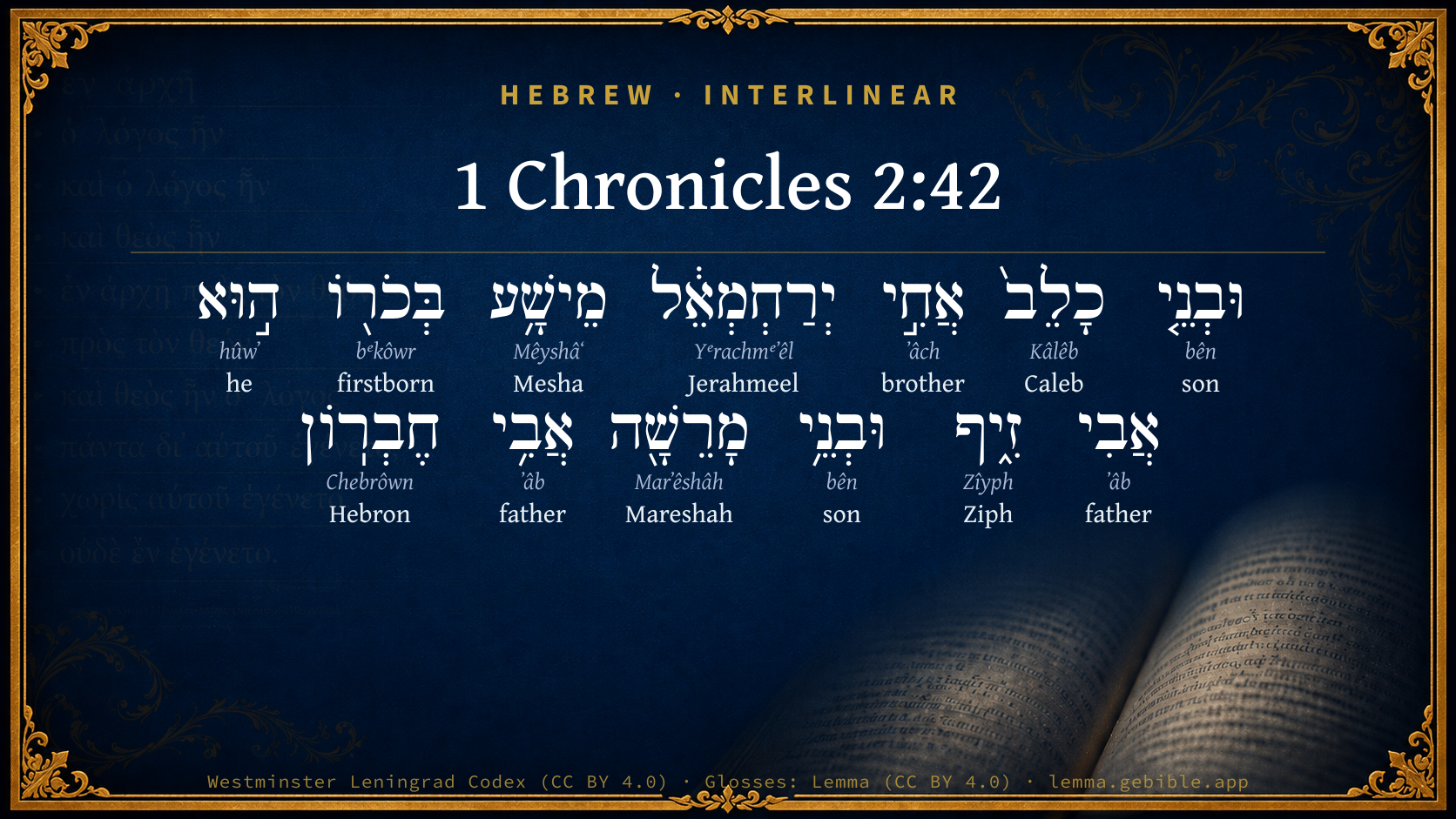
Hebrew (Westminster Leningrad Codex) 1 Chronicles 2:42 appears in the Hebrew Old Testament. The text above is from the Westminster Leningrad Codex. Each word links to its Strong’s number, a concise gloss, and parsing drawn from the Open Scriptures Hebrew Bible morphology. Click any word for its full Brown-Driver-Briggs (BDB) entry.
Download image
Cite this verse

1 Chronicles 2:42 (World English Bible). Public Domain. Lemma interlinear Bible study tool, https://lemma.gebible.app/v/1-chronicles/2/42.

Show BibTeX & RIS
BibTeX
RIS
English Translation
The sons of Caleb the brother of Jerahmeel were Mesha his firstborn, who was the father of Ziph; and the sons of Mareshah the father of Hebron.
World English Bible · Public Domain
Highlights
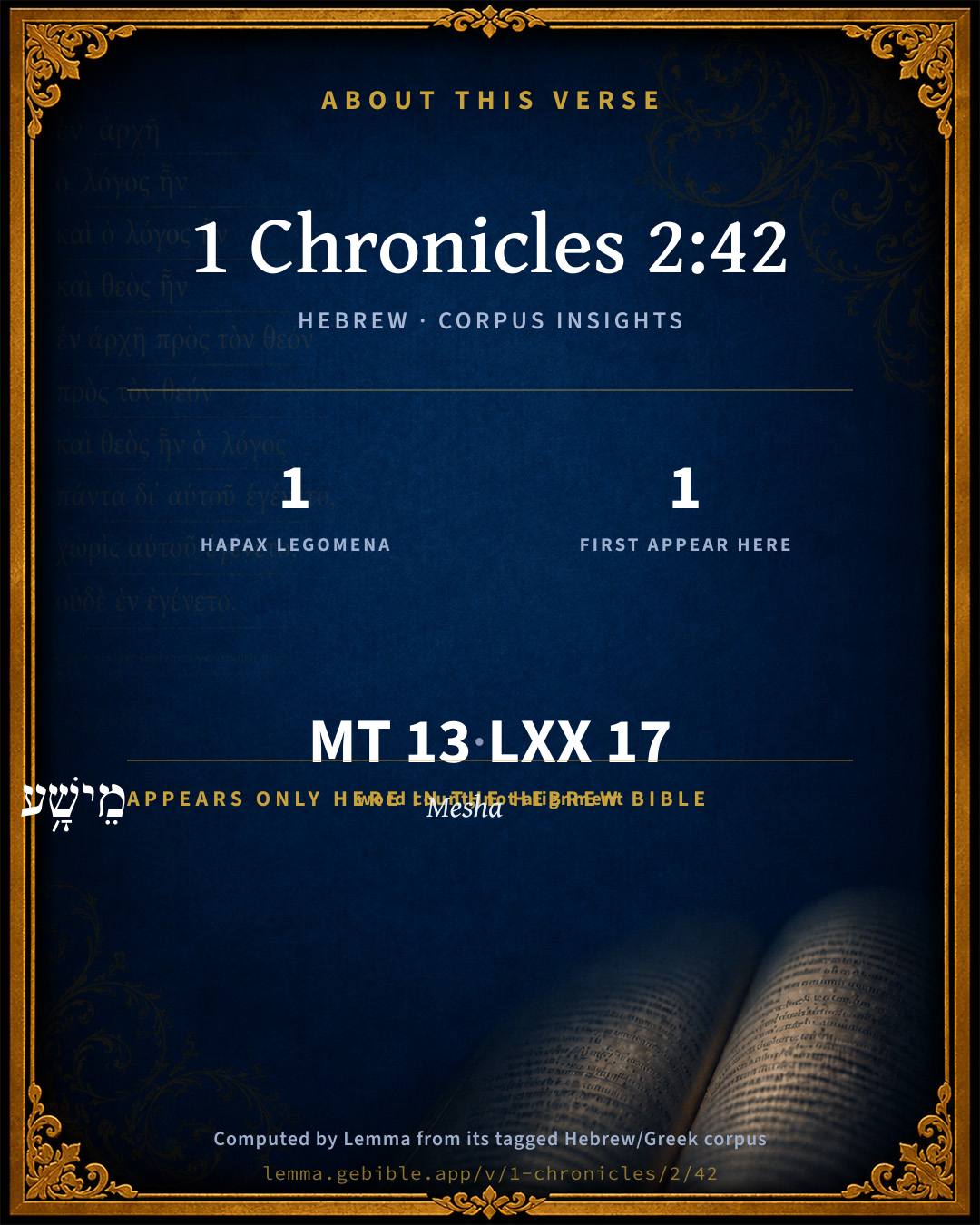
  • 1 hapax legomenon — only here in the Hebrew Bible
  • 1 first appearance in the Hebrew Bible
Full analysis ↓
Download a study sheet

One document with this verse’s original text, its word-by-word gloss line, the meaning frame, cross-references with their text, attributed commentary, and full source and license credits — printable, and it pastes into notes with its structure intact.

This verse Autodidact and up

Study sheet (.html) Plain text (.txt)

A passage Seminary Student

Up to 50 verses in one chapter. A passage sheet keeps up to 6 commentary sources and 12 cross-references per verse, in the order this page ranks them, and says so on the sheet whenever that leaves anything out. Ask for a single verse and you get the Autodidact verse sheet above.

Everything on this page stays free to read, with no account — the sheet is a download of what is already on screen, not access to it.

Want to remove ads? Support Godless Engineer
Compare translations 3

The same verse in 3 English versions, stacked beneath the original-language interlinear above. Click any original word for its lexicon entry.

Each is an independent rendering of the whole verse — the interlinear is not word-aligned to these translations.

Highlighted words mark where these versions differ — a whole-verse word diff, not a word-by-word alignment.

  • World English Bible Public Domain
    The sons of Caleb the brother of Jerahmeel were Mesha his firstborn, who was the father of Ziph; and the sons of Mareshah the father of Hebron.
  • King James Version Public Domain
    Now the sons of Caleb the brother of Jerahmeel were, Mesha his firstborn, which was the father of Ziph; and the sons of Mareshah the father of Hebron.
  • unfoldingWord Literal Text CC BY-SA 4.0
    And the sons of Caleb, the brother of Jerahmeel: Mareshah, his firstborn; he the father of Ziph. And the sons of Mareshah, the father of Hebron.

unfoldingWord Literal Text — © unfoldingWord, licensed CC BY-SA 4.0. Word-aligned USFM3 via Door43 (git.door43.org/unfoldingWord/en_ult).

Versions to compare (up to 4)

3 of 4 selected

Show all 18 translations

Every available English version of this verse, each an independent rendering of the whole verse.

  • World English Bible Public Domain
    The sons of Caleb the brother of Jerahmeel were Mesha his firstborn, who was the father of Ziph; and the sons of Mareshah the father of Hebron.
  • Berean Standard Bible Public Domain
    The sons of Caleb the brother of Jerahmeel: Mesha his firstborn, who was the father of Ziph, and Mareshah his second son, who was the father of Hebron.
  • Majority Standard Bible Public Domain
    The sons of Caleb the brother of Jerahmeel: Mesha his firstborn, who was the father of Ziph, and Mareshah his second son, who was the father of Hebron.
  • King James Version Public Domain
    Now the sons of Caleb the brother of Jerahmeel were, Mesha his firstborn, which was the father of Ziph; and the sons of Mareshah the father of Hebron.
  • American Standard Version (1901) Public Domain
    And the sons of Caleb the brother of Jerahmeel were Mesha his first-born, who was the father of Ziph; and the sons of Mareshah the father of Hebron.
  • Revised Version (1885) Public Domain
    And the sons of Caleb the brother of Jerahmeel were Mesha his firstborn, which was the father of Ziph; and the sons of Mareshah the father of Hebron.
  • Geneva Bible (1599) Public Domain
    Also the sonnes of Caleb the brother of Ierahmeel, were Mesha his eldest sonne, which was the father of Ziph: and the sonnes of Mareshah the father of Hebron.
  • Douay-Rheims (1899) Public Domain
    Now the sons of Caleb the brother of Jerameel were Mesa his firstborn, who was the father of Siph: and the sons of Maresa father of Hebron.
  • Young's Literal Translation Public Domain
    And sons of Caleb brother of Jerahmeel: Mesha his first-born, he `is' father of Ziph; and sons of Mareshah: Abi-Hebron.
  • Literal Standard Version CC BY-SA 4.0
    And sons of Caleb brother of Jerahmeel: Mesha his firstborn, he [is] father of Ziph; and sons of Mareshah: Abi-Hebron.
  • Unlocked Literal Bible CC BY-SA 4.0
    The sons of Caleb, the brother of Jerahmeel, were Mesha his firstborn, who was the father of Ziph. His second son, Mareshah, was the father of Hebron.
  • unfoldingWord Literal Text CC BY-SA 4.0
    And the sons of Caleb, the brother of Jerahmeel: Mareshah, his firstborn; he the father of Ziph. And the sons of Mareshah, the father of Hebron.
  • Darby Bible Public Domain
    And the sons of Caleb the brother of Jerahmeel were Mesha his firstborn, who was the father of Ziph; and the sons of Mareshah the father of Hebron.
  • World Messianic Bible Public Domain
    The sons of Caleb the brother of Jerahmeel were Mesha his firstborn, who was the father of Ziph, and the sons of Mareshah the father of Hebron.
  • Webster's Bible Public Domain
    Now the sons of Caleb the brother of Jerahmeel were, Mesha his first-born, who was the father of Ziph; and the sons of Mareshah the father of Hebron.
  • Free Bible Version CC BY-SA 4.0
    The sons of Caleb, the brother of Jerahmeel: Mesha his firstborn, who was the father of Ziph, and his son Mareshah, who was the father of Hebron.
  • Bible in Basic English Public Domain
    And the sons of Caleb, the brother of Jerahmeel, were Mareshah, his oldest son, who was the father of Ziph and Hebron.
  • JPS Tanakh (1917) Public Domain
    And the sons of Caleb the brother of Jerahmeel were Mesha his first-born, who was the father of Ziph, and the sons of Mareshah the father of Hebron.

Literal Standard Version (2020), Covenant Press — licensed CC BY-SA 4.0. Text via the HelloAO Bible API (eBible.org). Unlocked Literal Bible (unfoldingWord) — licensed CC BY-SA 4.0. Text via the HelloAO Bible API (eBible.org). unfoldingWord Literal Text — © unfoldingWord, licensed CC BY-SA 4.0. Word-aligned USFM3 via Door43 (git.door43.org/unfoldingWord/en_ult). Free Bible Version, Dr. Jonathan Gallagher — licensed CC BY-SA 4.0. Text via the HelloAO Bible API (eBible.org).

Word by word

More ways to search: Search by grammar → Find every occurrence → Compare this word →

Practice this passage: Drill this verse → Learn its vocabulary →

מֵישָׁ֥ע
Mêyshâʻ
H4337
“Mesha”
Noun, Proper
Part of Speech
Noun
Type
Proper
Full BDB Definition

Origin: from H3467

TWOT: None

Mesha = "deliverance" - the eldest son of Caleb by his wife Azubah and grandson of Hezron
  1. וּבְנֵ֤י bên H1121 “and · sons of” Conjunction + Noun, Common, Masculine, Plural, Construct
  2. כָלֵב֙ Kâlêb H3612 “Caleb” Noun, Proper
  3. אֲחִ֣י ʼâch H251 “brother of” Noun, Common, Masculine, Singular, Construct
  4. יְרַחְמְאֵ֔ל Yᵉrachmᵉʼêl H3396 “Jerahmeel” Noun, Proper
  5. בְּכֹר֖וֹ bᵉkôwr H1060 “firstborn · his” Noun, Common, Masculine, Singular, Construct + Suffix, Personal, 3rd Person, Masculine, Singular
  6. ה֣וּא hûwʼ H1931 “he” Pronoun, Personal, 3rd Person, Masculine, Singular
  7. אֲבִי ʼâb H1 “father of” Noun, Common, Masculine, Singular, Construct
  8. זִ֑יף Zîyph H2128 “Ziph” Noun, Proper
  9. וּבְנֵ֥י bên H1121 “and · sons of” Conjunction + Noun, Common, Masculine, Plural, Construct
  10. מָרֵשָׁ֖ה Marʼêshâh H4762 “Mareshah” Noun, Proper
  11. אֲבִ֥י ʼâb H1 “father of” Noun, Common, Masculine, Singular, Construct
  12. חֶבְרֽוֹן Chebrôwn H2275 “Hebron” Noun, Proper

About this verse

These counts appear in no published source. They are computed here, from the morphology-tagged text and Lemma’s own curated glosses. What Lemma adds →

13
words
11
distinct lemmas
Historical
section

Notable vocabulary

1 hapax legomenon — a word that appears only here in the entire Hebrew Bible:

  • מֵישָׁ֥ע Mesha H4337

First appearance in Scripture

This word makes its first canonical appearance in the Hebrew Bible here:

  • מֵישָׁ֥ע Mesha H4337

Shared distinctive vocabulary

יְרַחְמְאֵ֔ל Jerahmeel H3396 occurs in 8 verses of the Hebrew Bible. Also found in:

Grammatical profile

  • 12 nouns
  • 1 pronoun

Repetition

Words recur within this verse — often emphatic in Hebrew:

  • וּבְנֵ֤י son H1121 ×2
  • אֲבִי father H1 ×2

Hebrew & Septuagint length

In English translation the verse runs 27 words from the Hebrew and 27 from the Septuagint (LXX English) — the same length.

A rough comparison of the two English renderings, which tokenize alike — not a word-level alignment.

Word counts can differ between the Hebrew and the Greek without any difference in meaning — e.g. the Hebrew direct-object marker אֵת has no separate Greek word, and Greek often adds the article ὁ.

In the original languages it is 13 Hebrew tokens and 17 Greek tokens — but the two are counted differently (Hebrew bundles its prefixes and suffixes into one token; the Greek is in lemma form), so that isn’t a like-for-like length.

Cross-references

15

Topical passages linked to 1 Chronicles 2:42 in the Treasury of Scripture Knowledge — connected by theme and wording, ordered by reader-vote popularity; previews shown in the World English Bible.

  • Genesis 49:3 "Reuben, you are my firstborn, my might, and the beginning of my strength; The pre-eminence of dignity, and the pre-eminence of power.
  • Exodus 4:22–23 You shall tell Pharaoh, 'Thus says Yahweh, Israel is my son, my firstborn,
  • Joshua 15:24 Ziph, and Telem, and Bealoth,
  • 1 Samuel 23:19 Then came up the Ziphites to Saul to Gibeah, saying, Doesn't David hide himself with us in the strongholds in the wood, in the hill of Hachilah, which is on the south of the desert?
  • 1 Samuel 26:1 The Ziphites came to Saul to Gibeah, saying, Doesn't David hide himself in the hill of Hachilah, which is before the desert?
  • 1 Chronicles 2:18–19 Caleb the son of Hezron became the father of [children] of Azubah [his] wife, and of Jerioth; and these were her sons: Jesher, and Shobab, and Ardon.
  • 1 Chronicles 2:23–24 Geshur and Aram took the towns of Jair from them, with Kenath, and the villages of it, even sixty cities. All these were the sons of Machir the father of Gilead.
  • 1 Chronicles 2:45 The son of Shammai was Maon; and Maon was the father of Beth Zur.
  • 1 Chronicles 2:49 She bore also Shaaph the father of Madmannah, Sheva the father of Machbena, and the father of Gibea; and the daughter of Caleb was Achsah.
  • 1 Chronicles 2:52 Shobal the father of Kiriath Jearim had sons: Haroeh, half of the Menuhoth.
  • 1 Chronicles 8:29 In Gibeon there lived the father of Gibeon, [Jeiel], whose wife's name was Maacah;
  • Ezra 2:21–35 The children of Bethlehem, one hundred twenty-three.
  • Nehemiah 7:25–38 The children of Gibeon, ninety-five.
  • Romans 8:29 For whom he foreknew, he also predestined to be conformed to the image of his Son, that he might be the firstborn among many brothers.
  • Hebrews 12:23 to the general assembly and assembly of the firstborn who are enrolled in heaven, to God the Judge of all, to the spirits of just men made perfect,

Cross-references courtesy of OpenBible.info (CC BY 4.0).

Hebrew and Greek witnesses Masoretic Hebrew ↔ Greek Septuagint

The same verse in the two great witnesses to the Old Testament, shown verse-for-verse.

These are two independent witnesses, not word-aligned to each other, and the Septuagint is shown in lemma (dictionary) form.

Hebrew 1 Chronicles 2:42 Masoretic · Westminster Leningrad Codex

וּבְנֵ֤י כָלֵב֙ אֲחִ֣י יְרַחְמְאֵ֔ל מֵישָׁ֥ע בְּכֹר֖וֹ ה֣וּא אֲבִי זִ֑יף וּבְנֵ֥י מָרֵשָׁ֖ה אֲבִ֥י חֶבְרֽוֹן

The sons of Caleb the brother of Jerahmeel were Mesha his firstborn, who was the father of Ziph; and the sons of Mareshah the father of Hebron.

World English Bible · Public Domain

Greek LXX 1 Chronicles 2:42 Septuagint · lemma form

καί υἱός χαλεβ ἀδελφός ιερεμεηλ μαρισα ὁ πρωτότοκος αὐτός οὗτος πατήρ ζιφ καί υἱός μαρισα πατήρ χεβρων

And the sons of Chaleb the brother of Jerameel were, Marisa his firstborn, he is the father of Ziph:—and the sons of Marisa the father of Chebron.

LXX2012 (modern English Septuagint) · Public Domain

On this verse, Ellicott's Commentary for English Readers discusses the Septuagint’s reading. Read the note in Commentary ↓

Hebrew: Westminster Leningrad Codex (CC BY 4.0). Greek: Septuagint (public domain); English from LXX2012 (modern English Septuagint) (Public Domain). How the Septuagint differs from the Hebrew →

Commentary

Notes on 1 Chronicles 2:42 from classic Christian and Jewish commentators (each source and its license shown beneath its notes). The classic Christian expositions comment on the surrounding passage and are grouped to its opening verse, so a note may address several verses; the Jewish commentaries on the Tanakh (Rashi and others) are per-verse, so they appear only where the commentator wrote on this verse.

Lemma curates 59 commentaries, every one of them public domain or Creative Commons licensed, each selected and text-cleaned for this edition rather than reprinted as found. About our sources →

Ellicott's Commentary for English Readers

I.—1Ch_2:42-45 : Caleb brother of Jerahmeel = Caleb son of Hezron (1Ch_2:18) = Chelubai (1Ch_2:9).

(42) Mesha.—The name of a king of Moab (2Ki_3:4), whose monument of victory, the famous Moabite stone, was found in 1868 at Dibou. Here the name is probably that of a principal Calebite clan, settled at Ziph, near Hebron (Jos_15:54-55; 1Sa_23:14).

Father of Ziph.—Comp. 1Ch_2:21, “father of Gilead,” and 24.

And the sons of Mareshah the father of Hebron.—The statement of the verse is, “the sons of Mareshah were sons of Caleb,” that is, the Mareshathites, or people of Mareshah (Jos_15:44), a town in the Shephelah, were a Calebite clan. This branch of Caleb is called “father of Hebron,” because it had the chief part in colonising that old Canaanite city.

(43) Korah.—Elsewhere the name of a subdivision of the Kohathite Levites; in 1Ch_1:35 it was a tribe of Edomites. In this place, therefore, it may be a clan of Hebronites.

Tappuah.—A town in the Shephelah (Jos_15:34; Jos_16:8).

Rekem.—A Benjamite city (Jos_18:27); in 1Ch_7:16, a Machirite chieftain or clan.

Shema.—Occurs several times in the chronicle. In 1Ch_5:8; 1Ch_8:13 it appears to be the name of a clan; in 1Ch_11:44 and Neh_8:4 a person is meant.

(44) Jorkoam.—Occurs nowhere else in the Old Testament. The LXX. (Alex.) has Ἰεκλάν, Jeklan. Probably, therefore, the correct reading is Jokdeam. (For the change of Hebrew d to Greek l see 1Ki_5:11, where Hebrew Darda is represented by Δαραλά.) Jokdeam was a town in the hill-country of Judah (Jos_15:56). The chief or clan Raham is here called its father or founder.

Rekem.—The LXX. (Alex.) again has Jeklan (Jokdeam), which is as likely to be right as Rekem.

Shammai.—See 1Ch_2:28.

(45) Maon . . . Beth-zur.—Towns in the hill-country of Judah (Jos_15:55; Jos_15:58). Maon, now Main, south of Hebron. Beth-zur (2Ch_11:7), now Beit-sûr. In Jdg_10:12 Midianites, not Maonites, is the better reading.

(42-55) These verses revert to the Calebite stocks. Interpreted as merely bearing upon the extraction of individuals about whom, for the most part, nothing whatever is known beyond what these brief notices reveal, the section presents great difficulties. The key to it appears to be the assumption that it is an ancient record of the relations between certain great branches of the tribe of Judah, and their various settlements; in other words, these lists are tribal and topographical, rather than genealogical.

A Bible Commentary for English Readers, edited by Charles John Ellicott (1878–1897) — public domain. Text from a community e-Sword module.

Trapp's Complete Commentary

John Trapp

1Ch 2:42 Now the sons of Caleb the brother of Jerahmeel [were], Mesha his firstborn, which was the father of Ziph; and the sons of Mareshah the father of Hebron.

Ver. 42. He was the father of Hebron.] See on 1Ch 2:24.

John Trapp, A Commentary or Exposition upon All the Books of the Old and New Testament (1647–1656) — public domain. Text from a community e-Sword module.

Geneva Bible (1599)

Geneva Bible translators

That is, the chief governor or prince of the Ziphims, because the prince ought to have a fatherly care and affection toward his people.

Geneva Bible (1599) marginal notes — public domain. Text via Bolls.life.

Jamieson, Fausset & Brown

Robert Jamieson, A. R. Fausset & David Brown

the sons of Caleb--(compare Ch1 2:18, Ch1 2:25). The sons here noticed were the fruit of his union with a third wife.

Jamieson, Fausset & Brown — Commentary Critical and Explanatory on the Whole Bible (1871) — public domain (CC PDM 1.0). Text via the HelloAO Bible API.

Adam Clarke's Commentary

Verse 42. Now the sons of Caleb] This was not Caleb the son of Jephunneh, but Caleb the son of Hezron, 1Ch 2:18; 1Ch 2:50. But some think that Caleb the son of Hezron was the grandson of Caleb, son of Jephunneh; but this is probably fanciful.

The father of Ziph] "The prince of the Ziphites." - T.

Adam Clarke's Commentary on the Bible (1810–1826) — public domain. Text from a community e-Sword/MySword module.

The Cambridge Bible for Schools and Colleges

gen. ed. J. J. S. Perowne

42–49. The Descendants of Caleb

42. Caleb the brother of Jerahmeel] Called Chelubai (1Ch_2:9) and Caleb the son of Hezron (1Ch_2:18). There is nothing to shew what relationship existed between this Caleb and Caleb son of Jephunneh (1Ch_4:15 and Num_13:6). Perhaps they are to be identified; cp. 1Ch_2:49, note. Both are assigned to the tribe of Judah.

Several of the names, viz. Ziph (Jos_15:24 or 55), Mareshah (2Ch_11:8), Hebron, Tappuah (Jos_15:34), Maon (Jos_15:55), and Beth-zur (Jos_15:58) are names of towns in the S. or S.W. of Judah, and consequently may represent here the respective populations of those towns, and not individual descendants of Caleb.

Mesha] The Moabite king whose deeds are recorded on the Moabite stone bore this name. It means Victory, enlargement. LXX. reads Mareshah (Μαρεισά) as in the latter part of the verse.

The Cambridge Bible for Schools and Colleges (gen. ed. J. J. S. Perowne; Cambridge University Press, 1878–1918) — public domain. Text from a community e-Sword module.

John Gill's Exposition

She bare also Shaaph the father of Madmannah,.... Prince of a place so called, in the tribe of Judah, Jos 15:31.

Sheva the father of Machbenah, and the father of Gibeah; prince of two cities of those names in the same tribe; of the latter see Jos 15:57,

and the daughter of Caleb was Achsah; Caleb, the son of Jephunneh, had a daughter of this name, but neither he nor she are here meant, Jos 15:16 but by whom Caleb, the son of Hezron, had this daughter, is not said; perhaps by Maachah his concubine last mentioned.

John Gill's Exposition of the Whole Bible (1746–1763) — public domain (CC PDM 1.0). Text via the HelloAO Bible API.

Albert Barnes' Notes on the Bible

A third line of descent from Caleb, the son of Hezron, the issue probably of a different mother, perhaps Jerioth 1Ch 2:18. The supposed omissions in this verse have been supplied as follows:

(1) “Mesha, the father of Ziph; and the sons of Ziph, Mareshah, the father of Hebron;” or

(2) “Mareshah, the father of Ziph; and the sons of Mareshah, the father of Ziph, Hebron.”

Ziph, like Jorkoam 1Ch 2:44 and Beth-zur 1Ch 2:45, is the name of a place where the respective chiefs (“fathers”) settled. Similarly Madmannah, Machbenah, and Gibea 1Ch 2:49, Kirjath-jearim (Jos 9:17 note), Bethlehem and Beth-gader (Jedur, 1Ch 2:51) are unmistakeable names of places in the list, names which it is not probable were ever borne by persons.

Albert Barnes' Notes on the Bible (1834–1885) — public domain. Text from a community e-Sword/MySword module.

Haydock's Catholic Bible Commentary

Caleb, or Calubi, ver. 9. Ziph, Maresa, and Hebron, are the names of towns, as well as of men. The descendants of Mesa inhabited Ziph, and those of Maresa dwelt at Hebron. The same remark will hold good in other places, where the names of places are put for those who occupied them. (Calmet) --- And the sons. Hebrew, "and of the sons of Maresa." (Vatable) --- But it may be as well explained in the sense of the Vulgate. Septuagint, "Marisa, his first-born. He was the father of Ziph, and the sons of Marisa, of the father of Hebron." --- Father. Literally, "of the father," patris Hebron. (Haydock)

George Leo Haydock (1774–1849), Haydock's Catholic Family Bible and Commentary, 1859 edition — public domain. Excludes Psalms (Douay-Rheims chapter numbering differs from Protestant) and Deuterocanonical books (Catholic canon only).

Matthew Poole's English Annotations

The sons of Caleb, to wit, of that Caleb mentioned 1Ch 2:18, as appears by comparing that verse with 1Ch 2:21. And these are his sons by another and his third wife. See Poole "1Ch 2:18".

Ziph; the name either of a man, or of a place, of which see Jos 15:24,55; and then father is to be understood here, as 1Ch 2:23,24.

The father of Hebron; not the place so called, but a man, as is evident, because his sons here follow.

Matthew Poole's English Annotations on the Holy Bible (1683–1685) — public domain. Text from a community e-Sword/MySword module.

The Pulpit Commentary

Vers. 42-49. These verses are occupied with the resumption of descendants of Caleb the Caleb apparently of vers. 9 and 18, though, this being so, the last clause in ver. 49, the daughter of Caleb, Achsa, will require accounting for. This statement would lead us to suppose that we were assuredly reading of Caleb the son of Jephunneh; but it cannot be so. The name of Caleb, with the questions gathering round it, will be best considered here. Of the nine times in which it occurs in this chapter, the mere duplicates (of vers. 20, 46, 48) may be at once counted off. The compound "Caleb-ephratah" of ver. 24 has been already dealt with. Nor need we for the present suppose ver. 50 to have any real meaning inconsistent with its apparent meaning, viz. that Caleb is the name of a grandson (son of Hut) as well as of the grandfather. There remain the occasions of the occurring of the word in vers. 9, 18, 42, 49.

1. The first appearance, then, of the name in this chapter (ver. 9) exhibits itin a form different from that in which it appears the other times in this chapter or elsewhere, viz. as ybWlk, instead of blek; or once as a patronymic, 1Sa_25:3, yBilioK The Vulgate follows the Hebrew, but the Septuagint has at once substituted Caleb. The Syriac Version has Salchi, and the Arabic Sachli, both of them, no doubt, mere transcribers" errors through the mistake of a letter. This form "Chelubai" is, then, an apax legomenon, and no different account has yet been given of the name appearing thus on this one occasion. It may be described, with Lange ("Comm. Old Testament," in loc. ), as "adjectivus gentilis" to bWlk, which word, however, occur where it will, is never treated as a synonym with Caleb except by the Septuagint, and then but once, (1Ch_4:11) making Lange"s further claim of three forms for the name of Caleb wrong. The name might be translated the "Cheluban" or "Chelubite.

2. The Caleb called here first "Chelubai," again "Caleb the son of Hezron," and now "Caleb the brother of Jerahmeel," some, and Keil among them, have endeavoured to identify with Caleb the son of Jephunneh. This latter is a well-known figure in history. He, together with Joshua, was among those who, departing from Egypt, were pursued of Pharaoh, and of all the host these two alone lived to enter into the promised land. This is enough to give him distinction and a prominent place before the eye. To this Caleb unmistakable reference is made in twenty-eight passages, in sixteen of which he is called "son of Jephunneh," and in three of those sixteen "son of Jephunneh the Kenazite." Now, he tells us himself (Jos_14:7) that he was forty years old in the seceded year after the Exodus. But it seems (Gen_46:12, Gen_46:26) that Hezron, grandson of Judah, and the father of the Caleb of this chapter, was, however young, one of those who went down into Egypt with Jacob, at a date, according to any chronology, which must render it impossible for any son of his to have been alive and only forty years of age at the time of the Exodus. This being so, either the statement already referred to, found at the close of ver. 49, that "the daughter of Caleb was Achsa," must be an interpolation from some ignorant transcriber"s marginal annotation, or, unlikely as it is, Caleb the son of Hezron and Caleb the son of Jephunneh both named a daughter Achsa. It is, moreover, likely enough that the frequent describing of Caleb the son of Jephuuneli in this style was occasioned by the desire to distinguish him from some other Caleb, not a contemporary, indeed, but already well known m a generation preceding but not too remote. Other considerations decidedly concur with this view: e.g. Ram is brother of Caleb the son of Hezron; he has a grandson, Nahshon, of great distinction, "a prince of the children of Judah," whose sister Aaron married; he was the elect of the Judah tribe to assist Moses and Aaron in the first numbering of the people. (Num_1:7) Great prominence is given to him. (Num_7:12 Num_10:14) He was clearly (Mat_1:4; Luk_3:32) fifth in descent from Judah, in perfect agreement with the table of this chapter. Now, it was this grandson of the elder brother of Caleb who was contemporary with Caleb the son of Jephunneh. Similarly, the Bezaleel of this chapter (ver. 20), a great-grandson of Caleb the Hezronite, is spoken of (Exo_31:1 Exo_35:30) at the same date exactly at which Caleb the son of Jephunneh says he was still but forty years of age

3. The identity of the Caleb of ver. 50, son of Hut, with Caleb the son ofJephuuneh is supposed by some, but is not clear. It appears to be asserted, without explanation, in the arts. "Caleb" and "Ephrath," signed A. C. H., Smith"s "Bible Dictionary," though in the second part of the latter article it is alluded to as only possible. On the other hand, it may rather be that Caleb the son of Jephunneh, instead of being identical with this Caleb the son of Hur, is so called in order to distinguish him from this latter as a contemporary. Again, it has been happily conjectured ("Speaker"s Commentary," in loc. ) that just as ver. 33 closes the table of Jerahmeel with These were the sons of Jerahmeel ," so ver. 49 should close the table of Caleb (ver. 42) with the words, These were the Boris of Caleb. With a slight alteration, ver. 50 would then begin The sons of Hur, etc. This is, however, only conjecture. Ver. 42, then, must be considered to give us another family of Caleb, i.e. a family by another wife, of name not given, just possibly the Jerioth unaccounted for in ver. 18. The first statement lauds us in perplexity. Mesha (vyme) is the firstborn (i.e. by the wife or woman in question), and the founder of Ziph. And amid some omission or corruption of text, we are then confronted with the words, and the sons of Marsehah (hvyrem) the father (or again, perhaps founder) of Hebron. The reading of the Septuagint gives Mareshah in both of these passages, and may come from a Hebrew text that we have not. The substitution could, however, scarcely be accounted for as a mere clerical error, considering both the omission of a resh and the replacing of a he with an ayin. The sentence refuses at present any treatment except the unsatisfactory one of pure conjecture. But employing this, it may be noted that the omitting of the words, "the sons of," before Mareshah would most help to clear the verse of confusion. In this and following verses, Ziph, Hebron, Tappuah, Jorkoam, and Beth-zur, are all names of places certainly, whether or not they are all of persons.

The Pulpit Commentary (1880–1919), ed. H.D.M. Spence-Jones & Joseph S. Exell — public domain. Text from a community e-Sword module.

Keil & Delitzsch

C. F. Keil & F. Delitzsch

She bare also Shaaph the father of Madmannah,.... Prince of a place so called, in the tribe of Judah, Jos 15:31.

Sheva the father of Machbenah, and the father of Gibeah; prince of two cities of those names in the same tribe; of the latter see Jos 15:57,

and the daughter of Caleb was Achsah; Caleb, the son of Jephunneh, had a daughter of this name, but neither he nor she are here meant, Jos 15:16 but by whom Caleb, the son of Hezron, had this daughter, is not said; perhaps by Maachah his concubine last mentioned.

Keil & Delitzsch — Biblical Commentary on the Old Testament (1861–1891) — public domain (CC PDM 1.0). Text via the HelloAO Bible API. (Old Testament only.)

unfoldingWord translationNotes

Door43 World Missions Community

General Information:

All of the names here are the names of men. (See: How to Translate Names)

the father of Hebron ... the father of Raham, the father of Jorkeam ... the father of Shammai

Some versions read, "the founder of the clan of Hebron ... the founder of the clan of Raham, the founder of the clan of Jorkeam ... the founder of the clan of Shammai."

translationWords

firstborn

Korah

unfoldingWord translationNotes — © Distant Shores Media and the Door43 World Missions Community, licensed CC BY-SA 4.0. Source: git.door43.org/Door43/en_tn.

Rashi

Rabbi Shlomo Yitzchaki (Rashi)

And the sons of Caleb the brother of Jerahmeel Since he traced the lineage of part of the family of Caleb and interrupted in the lineage of Jerahmeel, it was necessary to say that Caleb was the brother of Jerahmeel, that this was not another Caleb. This is the manner of the entire genealogy: he does not trace lineages in sequence. He traces the lineage of part of such and such a family; he goes on to other families, and when he has completed part of this family, he goes back to tracing the lineage of the first family, and then returns to the other one, and the entire book of genealogy is mixed.

he was the father of Ziph The ruler of Ziph, the ruler of all the inhabitants of Mareshah, and the ruler of Hebron, and the names of these towns are mentioned in the Book of Joshua (15:24, 44, 54), as it is written: “Ziph, and Telem, and Bealoth, etc.” (And it is written there:) “And Keilah, and Achzib, and Mareshah, and Hebron (sic).”

Rashi on the Tanakh — English translations: “The Judaica Press complete Tanach with Rashi, translated by A. J. Rosenberg” (CC BY 4.0); “Pentateuch with Rashi's commentary by M. Rosenbaum and A.M. Silbermann, 1929-1934” (public domain); “The Metsudah Tanach series, Lakewood, N.J” (CC BY 4.0); and “The Book of Joshua, Metsudah Publications, 1997” (CC BY 4.0). Text via Sefaria.

Lesson kit

Teaching starters — assembled from the data on this page, not authored interpretation. Every prompt links to the verse data it draws on. Edit before teaching.

1 Chronicles, in the Historical, opens this verse with 13 words (11 distinct Hebrew lemmas). Its most distinctive word is Mêyshâʻ (“Mesha”). A historical commentator’s framing appears above. Read the whole chapter for the surrounding context.

Discussion questions

  1. How does “Mesha” (Mêyshâʻ) shape what this verse is saying?
  2. 1 word here appears nowhere else in the Hebrew Bible. Why might the author reach for such rare wording?
  3. This is the first place “Mesha” appears in Scripture (first appears here). What does its debut here establish?
  4. How does 1 Chronicles 2:9, which shares the word «Jerahmeel», read alongside this verse?
  5. What does the repetition of “son” (2× in this one verse) do in this verse?
  6. These translations render this verse differently; the difference is in the English rendering, not the original. What questions does that raise?
  7. Compare how Ellicott's Commentary for English Readers and Trapp's Complete Commentary read this verse. Where do they agree or differ?

Things to notice

  • 1 word in this verse appears nowhere else in the Hebrew Bible.
  • 1 word makes its first canonical appearance in Scripture here.
  • This verse counts 13 Hebrew ↔ 17 Greek words.
  • These translations choose different wording for 4 words in this verse.
  • “son” occurs 2× in this single verse.

Reading settings

Reading text

Shown beneath each verse's original-language words.

Old Testament
Old Testament edition

Read the OT as the Masoretic Hebrew (MT) or the Greek Septuagint (LXX).

English shown for the Greek Septuagint (in the Hebrew ↔ Greek comparison).

Comparing translations? Open the Compare panel on any verse page to stack up to four side by side.