
2 Kings 15:30

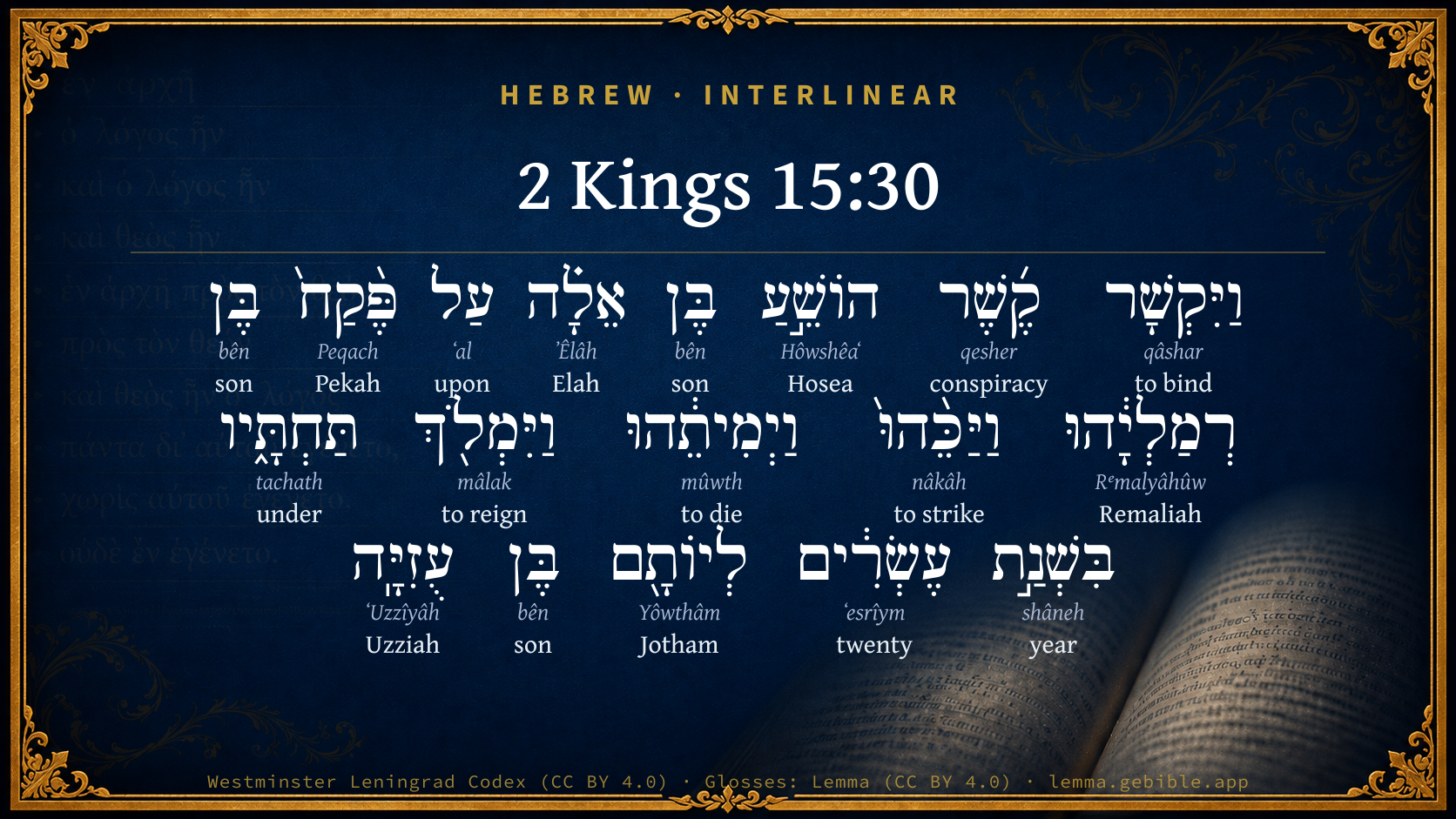
Hebrew (Westminster Leningrad Codex) 2 Kings 15:30 appears in the Hebrew Old Testament. The text above is from the Westminster Leningrad Codex. Each word links to its Strong’s number, a concise gloss, and parsing drawn from the Open Scriptures Hebrew Bible morphology. Click any word for its full Brown-Driver-Briggs (BDB) entry.
Download image
Cite this verse

2 Kings 15:30 (World English Bible). Public Domain. Lemma interlinear Bible study tool, https://lemma.gebible.app/v/2-kings/15/30.

Show BibTeX & RIS
BibTeX
RIS
English Translation
Hoshea the son of Elah made a conspiracy against Pekah the son of Remaliah, and struck him, and killed him, and reigned in his place, in the twentieth year of Jotham the son of Uzziah.
World English Bible · Public Domain
Download a study sheet

One document with this verse’s original text, its word-by-word gloss line, the meaning frame, cross-references with their text, attributed commentary, and full source and license credits — printable, and it pastes into notes with its structure intact.

This verse Autodidact and up

Study sheet (.html) Plain text (.txt)

A passage Seminary Student

Up to 50 verses in one chapter. A passage sheet keeps up to 6 commentary sources and 12 cross-references per verse, in the order this page ranks them, and says so on the sheet whenever that leaves anything out. Ask for a single verse and you get the Autodidact verse sheet above.

Everything on this page stays free to read, with no account — the sheet is a download of what is already on screen, not access to it.

Want to remove ads? Support Godless Engineer
Compare translations 3

The same verse in 3 English versions, stacked beneath the original-language interlinear above. Click any original word for its lexicon entry.

Each is an independent rendering of the whole verse — the interlinear is not word-aligned to these translations.

Highlighted words mark where these versions differ — a whole-verse word diff, not a word-by-word alignment.

  • World English Bible Public Domain
    Hoshea the son of Elah made a conspiracy against Pekah the son of Remaliah, and struck him, and killed him, and reigned in his place, in the twentieth year of Jotham the son of Uzziah.
  • King James Version Public Domain
    And Hoshea the son of Elah made a conspiracy against Pekah the son of Remaliah, and smote him, and slew him, and reigned in his stead, in the twentieth year of Jotham the son of Uzziah.
  • unfoldingWord Literal Text CC BY-SA 4.0
    And Hoshea, the son of Elah, conspired a conspiracy against Pekah, the son of Remaliah, and he struck him, and he killed him. And he reigned in his place, in the year of 20 to Jotham, the son of Uzziah.

unfoldingWord Literal Text — © unfoldingWord, licensed CC BY-SA 4.0. Word-aligned USFM3 via Door43 (git.door43.org/unfoldingWord/en_ult).

Versions to compare (up to 4)

3 of 4 selected

Show all 18 translations

Every available English version of this verse, each an independent rendering of the whole verse.

  • World English Bible Public Domain
    Hoshea the son of Elah made a conspiracy against Pekah the son of Remaliah, and struck him, and killed him, and reigned in his place, in the twentieth year of Jotham the son of Uzziah.
  • Berean Standard Bible Public Domain
    Then Hoshea son of Elah led a conspiracy against Pekah son of Remaliah. In the twentieth year of Jotham son of Uzziah, Hoshea attacked Pekah, killed him, and reigned in his place.
  • Majority Standard Bible Public Domain
    Then Hoshea son of Elah led a conspiracy against Pekah son of Remaliah. In the twentieth year of Jotham son of Uzziah, Hoshea attacked Pekah, killed him, and reigned in his place.
  • King James Version Public Domain
    And Hoshea the son of Elah made a conspiracy against Pekah the son of Remaliah, and smote him, and slew him, and reigned in his stead, in the twentieth year of Jotham the son of Uzziah.
  • American Standard Version (1901) Public Domain
    And Hoshea the son of Elah made a conspiracy against Pekah the son of Remaliah, and smote him, and slew him, and reigned in his stead, in the twentieth year of Jotham the son of Uzziah.
  • Revised Version (1885) Public Domain
    And Hoshea the son of Elah made a conspiracy against Pekah the son of Remaliah, and smote him, and slew him, and reigned in his stead, in the twentieth year of Jotham the son of Uzziah.
  • Geneva Bible (1599) Public Domain
    And Hoshea the sonne of Elah wrought treason against Pekah the sonne of Remaliah, and smote him, and slewe him, and reigned in his stead in the twentieth yeere of Iotham the sonne of Vzziah.
  • Douay-Rheims (1899) Public Domain
    Now Osee son of Ela conspired, and formed a plot against Phacee, the son of Romelia, and struck him, and slew him: and reigned in his stead in the twentieth year of Joatham the son of Ozias.
  • Young's Literal Translation Public Domain
    And make a conspiracy doth Hoshea son of Elah against Pekah son of Remaliah, and smiteth him, and putteth him to death, and reigneth in his stead, in the twentieth year of Jotham son of Uzziah.
  • Literal Standard Version CC BY-SA 4.0
    And Hoshea son of Elah makes a conspiracy against Pekah son of Remaliah, and strikes him, and puts him to death, and reigns in his stead, in the twentieth year of Jotham son of Uzziah.
  • Unlocked Literal Bible CC BY-SA 4.0
    So Hoshea son of Elah formed a conspiracy against Pekah son of Remaliah. He attacked him and killed him. Then he became king in his place, in the twentieth year of Jotham son of Uzziah.
  • unfoldingWord Literal Text CC BY-SA 4.0
    And Hoshea, the son of Elah, conspired a conspiracy against Pekah, the son of Remaliah, and he struck him, and he killed him. And he reigned in his place, in the year of 20 to Jotham, the son of Uzziah.
  • Darby Bible Public Domain
    And Hoshea the son of Elah made a conspiracy against Pekah the son of Remaliah, and smote him and slew him; and he reigned in his stead, in the twentieth year of Jotham the son of Uzziah.
  • World Messianic Bible Public Domain
    Hoshea the son of Elah made a conspiracy against Pekah the son of Remaliah, attacked him, killed him, and reigned in his place, in the twentieth year of Jotham the son of Uzziah.
  • Webster's Bible Public Domain
    And Hoshea the son of Elah made a conspiracy against Pekah the son of Remaliah, and smote him, and slew him, and reigned in his stead, in the twentieth year of Jotham the son of Uzziah.
  • Free Bible Version CC BY-SA 4.0
    Then Hoshea, son of Elah, plotted against Pekah, son of Remaliah. In the twentieth year of the reign of Jotham, son of Uzziah, Hoshea attacked Pekah, killed him, and took over as king.
  • Bible in Basic English Public Domain
    And Hoshea, the son of Elah, made a secret design against Pekah, the son of Remaliah, and, attacking him, put him to death and became king in his place, in the twentieth year of Jotham, the son of Uzziah.
  • JPS Tanakh (1917) Public Domain
    And Hoshea the son of Elah made a conspiracy against Pekah the son of Remaliah, and smote him, and slew him, and reigned in his stead, in the twentieth year of Jotham the son of Uzziah.

Literal Standard Version (2020), Covenant Press — licensed CC BY-SA 4.0. Text via the HelloAO Bible API (eBible.org). Unlocked Literal Bible (unfoldingWord) — licensed CC BY-SA 4.0. Text via the HelloAO Bible API (eBible.org). unfoldingWord Literal Text — © unfoldingWord, licensed CC BY-SA 4.0. Word-aligned USFM3 via Door43 (git.door43.org/unfoldingWord/en_ult). Free Bible Version, Dr. Jonathan Gallagher — licensed CC BY-SA 4.0. Text via the HelloAO Bible API (eBible.org).

Word by word

More ways to search: Search by grammar → Find every occurrence → Compare this word →

Practice this passage: Drill this verse → Learn its vocabulary →

פֶּ֨קַח֙
Peqach
H6492
“Pekah”
Noun, Proper
Part of Speech
Noun
Type
Proper
Full BDB Definition

Origin: from H6491

TWOT: None

Pekah = "opened" - son of Remaliah, originally a captain of king Pekahiah of Israel, murdered Pekahiah, usurped the throne and became the 18th king of the northern kingdom of Israel
  1. וַיִּקְשָׁר qâshar H7194 “and · to bind” Conjunction + Verb, Qal, Sequential Imperfect, 3rd Person, Masculine, Singular
  2. קֶ֜שֶׁר qesher H7195 “conspiracy” Noun, Common, Masculine, Singular, Absolute
  3. הוֹשֵׁ֣עַ Hôwshêaʻ H1954 “Hosea” Noun, Proper
  4. בֶּן bên H1121 “son of” Noun, Common, Masculine, Singular, Construct
  5. אֵלָ֗ה ʼÊlâh H425 “Elah” Noun, Proper
  6. עַל ʻal H5921 “upon” Preposition
  7. בֶּן bên H1121 “son of” Noun, Common, Masculine, Singular, Construct
  8. רְמַלְיָ֔הוּ Rᵉmalyâhûw H7425 “Remaliah” Noun, Proper
  9. וַיַּכֵּ֨הוּ֙ nâkâh H5221 “and · to strike · him” Conjunction + Verb, Hiphil, Sequential Imperfect, 3rd Person, Masculine, Singular + Suffix, Personal, 3rd Person, Masculine, Singular
  10. וַיְמִיתֵ֔הוּ mûwth H4191 “and · to die · him” Conjunction + Verb, Hiphil, Sequential Imperfect, 3rd Person, Masculine, Singular + Suffix, Personal, 3rd Person, Masculine, Singular
  11. וַיִּמְלֹ֖ךְ mâlak H4427 “and · to reign” Conjunction + Verb, Qal, Sequential Imperfect, 3rd Person, Masculine, Singular
  12. תַּחְתָּ֑יו tachath H8478 “under · him” Preposition + Suffix, Personal, 3rd Person, Masculine, Singular
  13. בִּשְׁנַ֣ת shâneh H8141 “in/at · year of” Preposition + Noun, Common, Feminine, Singular, Construct
  14. עֶשְׂרִ֔ים ʻesrîym H6242 “twenty” Adjective, Cardinal number, Both, Plural, Absolute
  15. לְיוֹתָ֖ם Yôwthâm H3147 “to/for · Jotham” Preposition + Noun, Proper
  16. בֶּן bên H1121 “son of” Noun, Common, Masculine, Singular, Construct
  17. עֻזִיָּֽה ʻUzzîyâh H5818 “Uzziah” Noun, Proper

About this verse

These counts appear in no published source. They are computed here, from the morphology-tagged text and Lemma’s own curated glosses. What Lemma adds →

18
words
16
distinct lemmas
Historical
section

Notable vocabulary

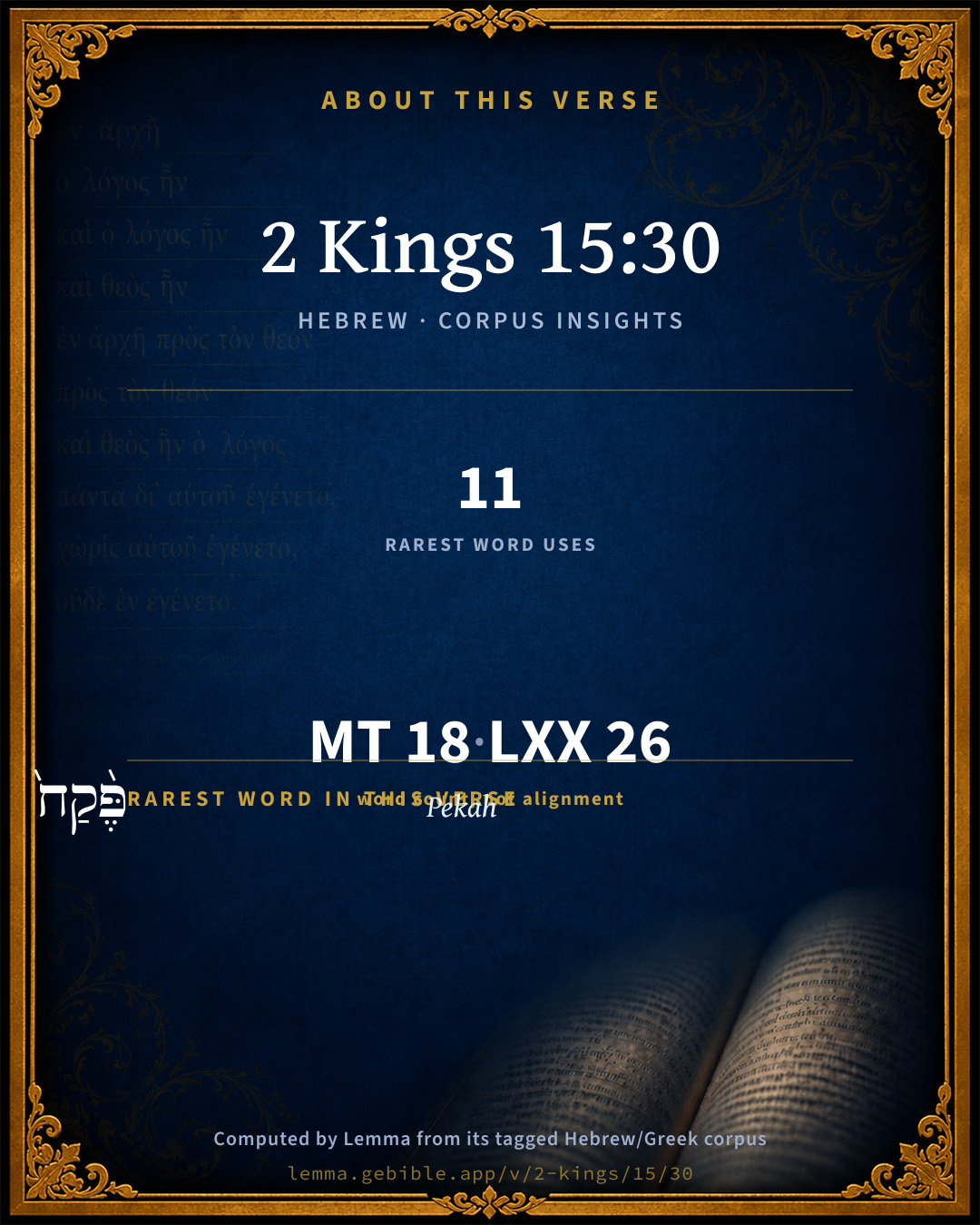
The rarest word here is פֶּ֨קַח֙ Pekah H6492 — appearing just 11 times in the whole Hebrew Bible.

Shared distinctive vocabulary

פֶּ֨קַח֙ Pekah H6492 occurs in 11 verses of the Hebrew Bible. Also found in:

Grammatical profile

  • 4 verbs
  • 11 nouns
  • 1 adjective
  • 2 prepositions

Verb forms

  • וַיִּקְשָׁר Qal · Sequential Imperfect
  • וַיַּכֵּ֨הוּ֙ Hiphil · Sequential Imperfect
  • וַיְמִיתֵ֔הוּ Hiphil · Sequential Imperfect
  • וַיִּמְלֹ֖ךְ Qal · Sequential Imperfect

Repetition

A word recurs within this verse — often emphatic in Hebrew:

Hebrew & Septuagint length

In English translation the verse runs 35 words from the Hebrew and 35 from the Septuagint (LXX English) — the same length.

A rough comparison of the two English renderings, which tokenize alike — not a word-level alignment.

Word counts can differ between the Hebrew and the Greek without any difference in meaning — e.g. the Hebrew direct-object marker אֵת has no separate Greek word, and Greek often adds the article ὁ.

In the original languages it is 18 Hebrew tokens and 26 Greek tokens — but the two are counted differently (Hebrew bundles its prefixes and suffixes into one token; the Greek is in lemma form), so that isn’t a like-for-like length.

Cross-references

12

Topical passages linked to 2 Kings 15:30 in the Treasury of Scripture Knowledge — connected by theme and wording, ordered by reader-vote popularity; previews shown in the World English Bible.

  • 2 Kings 17:1 In the twelfth year of Ahaz king of Judah began Hoshea the son of Elah to reign in Samaria over Israel, [and reigned] nine years.
  • 2 Kings 15:10 Shallum the son of Jabesh conspired against him, and struck him before the people, and killed him, and reigned in his place.
  • 2 Kings 15:25 Pekah the son of Remaliah, his captain, conspired against him, and struck him in Samaria, in the castle of the king's house, with Argob and Arieh; and with him were fifty men of the Gileadites: and he killed him, and reigned in his place.
  • 2 Kings 15:32–33 In the second year of Pekah the son of Remaliah king of Israel began Jotham the son of Uzziah king of Judah to reign.
  • 2 Kings 16:1 In the seventeenth year of Pekah the son of Remaliah Ahaz the son of Jotham king of Judah began to reign.
  • 2 Chronicles 28:4–6 He sacrificed and burnt incense in the high places, and on the hills, and under every green tree.
  • 2 Chronicles 28:16 At that time did king Ahaz send to the kings of Assyria to help him.
  • Isaiah 7:1–9 It happened in the days of Ahaz the son of Jotham, the son of Uzziah, king of Judah, that Rezin the king of Syria, and Pekah the son of Remaliah, king of Israel, went up to Jerusalem to war against it, but could not prevail against it.
  • Isaiah 8:6 Because this people have refused the waters of Shiloah that go softly, and rejoice in Rezin and Remaliah's son;
  • Hosea 10:3 Surely now they will say, "We have no king; for we don't fear Yahweh; And the king, what can he do for us?"
  • Hosea 10:7 Samaria and her king float away, Like a twig on the water.
  • Hosea 10:15 So Bethel will do to you because of your great wickedness. At daybreak the king of Israel will be destroyed.

Cross-references courtesy of OpenBible.info (CC BY 4.0).

Hebrew and Greek witnesses Masoretic Hebrew ↔ Greek Septuagint

The same verse in the two great witnesses to the Old Testament, shown verse-for-verse.

These are two independent witnesses, not word-aligned to each other, and the Septuagint is shown in lemma (dictionary) form.

Hebrew 2 Kings 15:30 Masoretic · Westminster Leningrad Codex

וַיִּקְשָׁר קֶ֜שֶׁר הוֹשֵׁ֣עַ בֶּן אֵלָ֗ה עַל פֶּ֨קַח֙ בֶּן רְמַלְיָ֔הוּ וַיַּכֵּ֨הוּ֙ וַיְמִיתֵ֔הוּ וַיִּמְלֹ֖ךְ תַּחְתָּ֑יו בִּשְׁנַ֣ת עֶשְׂרִ֔ים לְיוֹתָ֖ם בֶּן עֻזִיָּֽה

Hoshea the son of Elah made a conspiracy against Pekah the son of Remaliah, and struck him, and killed him, and reigned in his place, in the twentieth year of Jotham the son of Uzziah.

World English Bible · Public Domain

Greek LXX 2 Kings 15:30 Septuagint · lemma form

καί συνστρέφω σύστρεμμα ωσηε υἱός ηλα ἐπί φακεε υἱός ρομελιας καί πατάσσω αὐτός καί θανατόω αὐτός καί βασιλεύω ἀντί αὐτός ἐν ἔτος εἰκοστός ιωαθαμ υἱός αζαριας

And Osee son of Ela formed a conspiracy against Phakee the son of Romelias, and struck him, and killed him, and reigned in his stead, in the twentieth year of Joatham the son of Azarias.

LXX2012 (modern English Septuagint) · Public Domain

Hebrew: Westminster Leningrad Codex (CC BY 4.0). Greek: Septuagint (public domain); English from LXX2012 (modern English Septuagint) (Public Domain). How the Septuagint differs from the Hebrew →

Targum (Aramaic paraphrase)

1

The Targum is the ancient Jewish Aramaic paraphrase of the Hebrew Scriptures — an interpretive translation, not the Hebrew text itself. Onkelos (literal) and Pseudo-Jonathan (expansive) render the Torah, and Jonathan the Prophets. Coverage is partial: where no permissively-licensed English translation exists for a verse, only the Aramaic is shown. This is verse-level text, not a word-by-word alignment to the Hebrew.

  1. Targum Jonathan Prophets (Joshua–Malachi)
    וּמְרֵד מֵירְדָא הוֹשֵׁעַ בַּר אֵלָה עַל פֶּקַח בַּר רְמַלְיָהוּ וּמְחָהִי וְקַטְלֵיהּ וּמְלַךְ תְּחוֹתוֹהִי בִּשְׁנַת עַסְרִין לְיוֹתָם בַּר עֻזִיָה:

    (no public-domain English translation for this verse)

    Targum Jonathan — Aramaic: “Mikraot Gedolot” (public domain). English: “Sefaria Community Translation” (CC0 1.0 (public-domain dedication)); “London "Chaldee Paraphrase," 1871” (public domain). Text via Sefaria.

Commentary

Notes on 2 Kings 15:30 from classic Christian and Jewish commentators (each source and its license shown beneath its notes). The classic Christian expositions comment on the surrounding passage and are grouped to its opening verse, so a note may address several verses; the Jewish commentaries on the Tanakh (Rashi and others) are per-verse, so they appear only where the commentator wrote on this verse.

Lemma curates 59 commentaries, every one of them public domain or Creative Commons licensed, each selected and text-cleaned for this edition rather than reprinted as found. About our sources →

Adam Clarke's Commentary

Verse 30. Hoshea the son of Elah - in the twentieth year of Jotham] There are many difficulties in the chronology of this place. To reconcile the whole, Calmet says: "Hoshea conspired against Pekah, the twentieth year of the reign of this prince, which was the eighteenth after the beginning of the reign of Jotham, king of Judah. Two years after this, that is, the fourth year of Ahaz, and the twentieth of Jotham, Hoshea made himself master of a part of the kingdom, according to 2Kg 15:30. Finally, the twelfth year of Ahaz, Hoshea had peaceable possession of the whole kingdom, according to 2Kg 17:1."

Adam Clarke's Commentary on the Bible (1810–1826) — public domain. Text from a community e-Sword/MySword module.

Trapp's Complete Commentary

John Trapp

2Ki 15:30 And Hoshea the son of Elah made a conspiracy against Pekah the son of Remaliah, and smote him, and slew him, and reigned in his stead, in the twentieth year of Jotham the son of Uzziah.

Ver. 30. In the twentieth year of Jotham,] i.e., In the fourth year of Ahaz, to whom Jotham had resigned his kingdom, reserving to himself the title only.

John Trapp, A Commentary or Exposition upon All the Books of the Old and New Testament (1647–1656) — public domain. Text from a community e-Sword module.

Joseph Benson's Commentary

2Ki 15:30. Hosea made a conspiracy against Pekah, and smote him — It is probable that the people were provoked at him for leaving them exposed to a foreign enemy, while he invaded Judah; and that Hosea took advantage of their discontent and disgust to seize and slay him. Thus Pekah’s treason and violence returned upon himself at last. And reigned in his stead in the twentieth year of Jotham — The meaning is, that he began his reign in the twentieth year after the beginning of Jotham’s reign; or, which is the same thing, in the fourth year of Ahaz, son of Jotham.

Joseph Benson's Commentary on the Old and New Testaments (1811–1818) — public domain. Text from a community e-Sword module.

Jamieson, Fausset & Brown

Robert Jamieson, A. R. Fausset & David Brown

Hoshea the son of Elah made a conspiracy . . . and slew him--He did not, however, obtain possession of the kingdom till about nine or ten years after the perpetration of this crime [HALES].

in the twentieth year of Jotham--Jotham's reign lasted only sixteen years, but the meaning is that the reign of Hoshea began in the twentieth after the beginning of Jotham's reign. The sacred historian, having not yet introduced the name of Ahaz, reckoned the date by Jotham, whom he had already mentioned (see Ch2 27:8).

Jamieson, Fausset & Brown — Commentary Critical and Explanatory on the Whole Bible (1871) — public domain (CC PDM 1.0). Text via the HelloAO Bible API.

The Cambridge Bible for Schools and Colleges

gen. ed. J. J. S. Perowne

30. Hoshea the son of Elah] Josephus (Ant. IX. 13. 1) says Hoshea was a friend of Pekah. He is mentioned in the Assyrian inscriptions (Smith, Assyrian Discoveries, p. 285), and it appears from that record as if he had been set up by the Assyrian king. Perhaps Hoshea, having conspired and slain Pekah, put himself as a vassal under the protection of Assyria. The inscription speaks of the tribute which he was to pay to the Assyrians. Though the death of Pekah is here mentioned we have a further account of his attempts against Judah in the next chapter.

in the twentieth year of Jotham] As Jotham is said below in verse 33 to have reigned only sixteen years, there must be some mistake in the numbers either here or there. The occurrence of such variations makes the task of fixing the chronology very difficult, and probably no satisfactory solution will be discovered, to the several questions which arise on this subject, until more is known of the contemporary history. If ever the annals of Assyria and Egypt be brought into trustworthy order, the points of contact with Jewish affairs will help to settle some dates and to clear up what seems now irremediably obscure

The Cambridge Bible for Schools and Colleges (gen. ed. J. J. S. Perowne; Cambridge University Press, 1878–1918) — public domain. Text from a community e-Sword module.

Albert Barnes' Notes on the Bible

Hoshea, the son of Elah - One of Pekah’s friends, according to Josephus.

The twentieth year of Jotham - According to 2Ki 15:33 and 2Ch 27:1, Jotham reigned only 16 years. See also the suggestion in the margin. Strangely enough, this first year of Hoshea is also called, not the fourth, but the twelfth of Ahaz 2Ki 17:1. The chronological confusion of the history, as it stands, is striking.

Uzziah - i. e. Azariah. See 2Ki 15:1-4.

Albert Barnes' Notes on the Bible (1834–1885) — public domain. Text from a community e-Sword/MySword module.

Haydock's Catholic Bible Commentary

In the twentieth year of Joatham. That is, in the twentieth year from the beginning of Joatham’s reign. The sacred writer chooses rather to follow here this date, tan to speak of the years of Achaz, who had not yet been mentioned. (Challoner) --- But Joatham reigned only 16 years, (ver. 33.) so that this was the fourth year of Achaz. (Haydock) --- Usher says that Osee did not ascend the throne till nine years after the death of Phacee, as he is asserted to have commenced his reign in the twelfth year of Achaz, chap. xvii. 1. But another difficulty arises from the mention of this 20th year, as Phacee would have reigned 22, instead of 20; (ver. 27.) for Joatham only commenced in the second year of Phacee. To reconcile these passages, we may conclude that Osee conspired against the king of Israel in the 18th year of Joatham, gained possession of part of the kingdom in the 20th of the same prince, and of the whole in the 12th of Achaz. (Calmet) --- The pretended interregnum ought to be rejected, as the murderer of the late king would not delay to ascend the throne. Houbigant adds 10 years to the reign of Phacee, as well as to that of Zacharias: the dates assigned to the kings of Israel being otherwise so much deficient, p. 113.

George Leo Haydock (1774–1849), Haydock's Catholic Family Bible and Commentary, 1859 edition — public domain. Excludes Psalms (Douay-Rheims chapter numbering differs from Protestant) and Deuterocanonical books (Catholic canon only).

Matthew Poole's English Annotations

Smote him, and slew him; which he did more easily effect, because the people were enraged against Pekah, as the man who by his murder of king Pekahiah the son of Menahem, whom the Assyrian monarch set up and favoured, and by his unnecessary war with Ahaz, had brought the Assyrian upon them, and caused the loss of one half of that kingdom.

In the twentieth year of Jotham the son of Uzziah.

Quest. How could this be, when Jotham reigned only sixteen years, below, 2Ki 15:33?

Answ. The meaning is, that he began his reign in the twentieth year after the beginning of Jotham’s reign; or, which is the same thing, in the fourth year of Ahaz, son of Jotham, as appears from 2Ki 16:2. But the sacred writer, having not yet made mention of Ahaz, thought it more proper to number Hoshea’s years by Jotham, of whom he had spoken, than by Ahaz. Besides, as Jotham did reign divers years in his father’s life, so might Ahaz in Jotham’s life, and Jotham might for divers reasons (which it is needless here to inquire) resign up the administration of the kingdom wholly into Ahaz’s hands some years before his death, and therefore might be said to reign but sixteen years, though he lived longer.

Matthew Poole's English Annotations on the Holy Bible (1683–1685) — public domain. Text from a community e-Sword/MySword module.

Whedon's Commentary on the Bible

Daniel D. Whedon

30. Twentieth year of Jotham — That is, as Usher explains, the twentieth year after Jotham had begun to reign; which was, however, the fourth year of Ahaz, for Jotham reigned only sixteen years. The historian dates from the year of Jotham, because his son Ahaz has not yet been named in his records. But Bahr regards these words as a “false and late addition.” His argument, however, is inconclusive.

Daniel D. Whedon (gen. ed.), Commentary on the Old and New Testaments (1874–1909) — public domain. Text from a community e-Sword module.

The Pulpit Commentary

And Hoshea the son of Elah made a conspiracy against Pekah the son of Remaliah, and smote him, and slew him, and reigned in his stead. By a mutilated notice in the records of Tiglath-pileser, it appears that the revolution here related was the result of another invasion of the Israelite territory by that monarch. "The land of Beth-Croft," he says, "the tribe... the goods of its people and their furniture I sent to Assyria. Pekah their king I caused to be put to death? and Hoshea I appointed to the kingdom ever them; their tribute I received, and their treasures? to Assyria I sent" ("Eponym Canon," pp. 123, 124, lines 1519). It is probably this invasion of which the writer of Chronicles speaks (1Ch_5:26) as resulting in the deportation of the Reubenites, the Gadites, and the half-tribe of Manasseh. In the twentieth year of Jotham the son of Uzziah. This date stands in contradiction with ver. 33, where Jotham"s entire reign is reckoned at sixteen years, and apparently must be a corrupt reading.

The Pulpit Commentary (1880–1919), ed. H.D.M. Spence-Jones & Joseph S. Exell — public domain. Text from a community e-Sword module.

John Wesley's Explanatory Notes

Twentieth year - The meaning is, that he began his reign in the twentieth year after the beginning of Jotham's reign; or, which is the same thing, in the fourth year of Ahaz, son of Jotham.

John Wesley, Explanatory Notes Upon the Whole Bible (1754–1765) — public domain. Text via the GEBible commentary corpus.

Keil & Delitzsch

C. F. Keil & F. Delitzsch

Pekah met with his death in a conspiracy organized by Hosea the son of Elah, who made himself king "in the twentieth year of Jotham." There is something very strange in this chronological datum, as Jotham only reigned sixteen years (Kg2 15:33), and Ahaz began to reign in the seventeenth year of Pekah (Kg2 16:1); so that Pekah's death would fall in the fourth year of Ahaz. The reason for this striking statement can only be found, as Usher has shown (Chronol. sacr. p. 80), in the fact that nothing has yet been said about Jotham's successor Ahaz, because the reign of Jotham himself is not mentioned till Kg2 15:32.

(Note: Other attempts to solve this difficulty are either arbitrary and precarious, e.g., the conjectures of the earlier chronologists quoted by Winer (R. W. s. v. Jotham), or forced, like the notion of Vaihinger in Herzog's Cycl. (art. Jotham), that the words בן־עזיה ליותם are to be eliminated as an interpolation, in which case the datum "in the twentieth year" becomes perfectly enigmatical; and again the assertion of Hitzig (Comm. z. Jesaj. pp. 72, 73), that instead of in the twentieth year of Jotham, we should read "in the twentieth year of Ahaz the son of Jotham," which could only be consistently carried out by altering the text of not less than seven passages (viz., Kg2 15:33; Kg2 16:1, and Kg2 16:2, Kg2 16:17; Ch2 27:1 and Ch2 27:8, and Ch2 28:1); and lastly, the assumption of Thenius, that the words from בשׁנת to עזיה have crept into the text through a double mistake of the copyist and an arbitrary alteration of what had been thus falsely written, which is much too complicated to appear at all credible, even if the reasons which are supposed to render it probable had been more forcible and correct than they really are. For the first reason, viz., that the statement in what year of the contemporaneous ruler a king came to the throne is always first given when the history of this king commences, is disproved by Kg2 1:17; the second, that the name of the king by the year of whose reign the accession of another is defined is invariably introduced with the epithet king of Judah or king of Israel, is shown by Kg2 12:2 and Kg2 16:1 to be not in accordance with fact; and the third, that this very king is never described by the introduction of his father's name, as he is here, except where the intention is to prevent misunderstanding, as in Kg2 14:1, Kg2 14:23, or in the case of usurpers without ancestors (Kg2 15:32, Kg2 16:1 and Kg2 16:15), is also incorrect in its first portion, for in the case of Amaziah in Kg2 14:23 there was no misunderstanding to prevent, and even in the case of Joash in Kg2 14:1 the epithet king of Israel would have been quite sufficient to guard against any misunderstanding.)

Keil & Delitzsch — Biblical Commentary on the Old Testament (1861–1891) — public domain (CC PDM 1.0). Text via the HelloAO Bible API. (Old Testament only.)

Rashi

Rabbi Shlomo Yitzchaki (Rashi)

In the twentieth year of Yosam. He should have said, “in the fourth year of Achaz,” because Yosam's entire reign lasted [only] sixteen years, but since Achaz was wicked, Scripture prefers to count [the years with reference] to Yosam who was in the grave, rather than to Achaz, who was alive. Thus it is [stated] in Seder Olam.

Rashi on the Tanakh — English translations: “The Judaica Press complete Tanach with Rashi, translated by A. J. Rosenberg” (CC BY 4.0); “Pentateuch with Rashi's commentary by M. Rosenbaum and A.M. Silbermann, 1929-1934” (public domain); “The Metsudah Tanach series, Lakewood, N.J” (CC BY 4.0); and “The Book of Joshua, Metsudah Publications, 1997” (CC BY 4.0). Text via Sefaria.

Lesson kit

Teaching starters — assembled from the data on this page, not authored interpretation. Every prompt links to the verse data it draws on. Edit before teaching.

2 Kings, in the Historical, opens this verse with 18 words (16 distinct Hebrew lemmas). Its most distinctive word is Peqach (“Pekah”). A historical commentator’s framing appears above. Read the whole chapter for the surrounding context.

Discussion questions

  1. The word Peqach carries the sense “Pekah.” How does it shape the verse?
  2. How does 2 Kings 15:25, which shares the word «Pekah», read alongside this verse?
  3. What does the repetition of “son” (3× in this one verse) do in this verse?
  4. These translations render this verse differently. What is at stake in choosing one wording over another?
  5. «וַיִּקְשָׁר» is a Qal Sequential Imperfect verb. How does that grammatical form shape the action described?
  6. Compare how Adam Clarke's Commentary and Trapp's Complete Commentary read this verse. Where do they agree or differ?

Things to notice

Reading settings

Reading text

Shown beneath each verse's original-language words.

Old Testament
Old Testament edition

Read the OT as the Masoretic Hebrew (MT) or the Greek Septuagint (LXX).

English shown for the Greek Septuagint (in the Hebrew ↔ Greek comparison).

Comparing translations? Open the Compare panel on any verse page to stack up to four side by side.