
Ecclesiastes 5:14

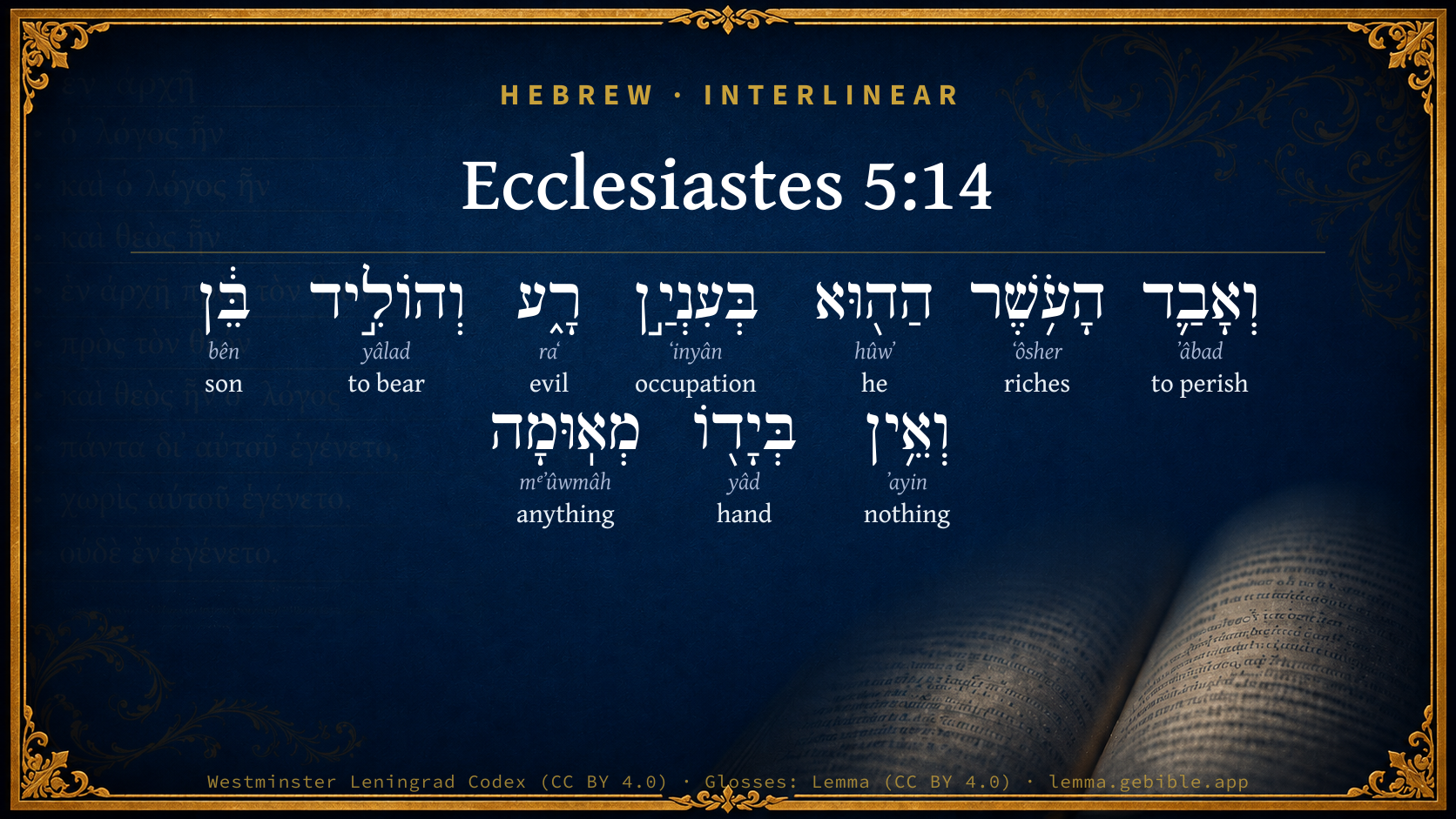
Hebrew (Westminster Leningrad Codex) Ecclesiastes 5:14 appears in the Hebrew Old Testament. The text above is from the Westminster Leningrad Codex. Each word links to its Strong’s number, a concise gloss, and parsing drawn from the Open Scriptures Hebrew Bible morphology. Click any word for its full Brown-Driver-Briggs (BDB) entry.
Download image
Cite this verse

Ecclesiastes 5:14 (World English Bible). Public Domain. Lemma interlinear Bible study tool, https://lemma.gebible.app/v/ecclesiastes/5/14.

Show BibTeX & RIS
BibTeX
RIS
English Translation
Those riches perish by misfortune, and if he has fathered a son, there is nothing in his hand.
World English Bible · Public Domain
Download a study sheet

One document with this verse’s original text, its word-by-word gloss line, the meaning frame, cross-references with their text, attributed commentary, and full source and license credits — printable, and it pastes into notes with its structure intact.

This verse Autodidact and up

Study sheet (.html) Plain text (.txt)

A passage Seminary Student

Up to 50 verses in one chapter. A passage sheet keeps up to 6 commentary sources and 12 cross-references per verse, in the order this page ranks them, and says so on the sheet whenever that leaves anything out. Ask for a single verse and you get the Autodidact verse sheet above.

Everything on this page stays free to read, with no account — the sheet is a download of what is already on screen, not access to it.

Want to remove ads? Support Godless Engineer
Compare translations 3

The same verse in 3 English versions, stacked beneath the original-language interlinear above. Click any original word for its lexicon entry.

Each is an independent rendering of the whole verse — the interlinear is not word-aligned to these translations.

Highlighted words mark where these versions differ — a whole-verse word diff, not a word-by-word alignment.

  • World English Bible Public Domain
    Those riches perish by misfortune, and if he has fathered a son, there is nothing in his hand.
  • King James Version Public Domain
    But those riches perish by evil travail: and he begetteth a son, and there is nothing in his hand.
  • unfoldingWord Literal Text CC BY-SA 4.0
    And that wealth perished in an unfortunate business. And he had fathered a son, but there was not in his hand anything.

unfoldingWord Literal Text — © unfoldingWord, licensed CC BY-SA 4.0. Word-aligned USFM3 via Door43 (git.door43.org/unfoldingWord/en_ult).

Versions to compare (up to 4)

3 of 4 selected

Show all 18 translations

Every available English version of this verse, each an independent rendering of the whole verse.

  • World English Bible Public Domain
    Those riches perish by misfortune, and if he has fathered a son, there is nothing in his hand.
  • Berean Standard Bible Public Domain
    or wealth lost in a failed venture, so when that man has a son there is nothing to pass on.
  • Majority Standard Bible Public Domain
    or wealth lost in a failed venture, so when that man has a son there is nothing to pass on.
  • King James Version Public Domain
    But those riches perish by evil travail: and he begetteth a son, and there is nothing in his hand.
  • American Standard Version (1901) Public Domain
    and those riches perish by evil adventure; and if he hath begotten a son, there is nothing in his hand.
  • Revised Version (1885) Public Domain
    and those riches perish by evil adventure; and if he hath begotten a son, there is nothing in his hand.
  • Geneva Bible (1599) Public Domain
    As hee came foorth of his mothers belly, he shall returne naked to goe as he came, and shall beare away nothing of his labour, which hee hath caused to passe by his hand.
  • Douay-Rheims (1899) Public Domain
    As he came forth naked from his mother's womb, so shall he return, and shall take nothing away with him of his labour.
  • Young's Literal Translation Public Domain
    And that wealth hath been lost in an evil business, and he hath begotten a son and there is nothing in his hand!
  • Literal Standard Version CC BY-SA 4.0
    And that wealth has been lost in an evil business, and he has begotten a son and there is nothing in his hand!
  • Unlocked Literal Bible CC BY-SA 4.0
    When the rich man loses his wealth through bad luck, his own son, one whom he has fathered, is left with nothing in his hands.
  • unfoldingWord Literal Text CC BY-SA 4.0
    And that wealth perished in an unfortunate business. And he had fathered a son, but there was not in his hand anything.
  • Darby Bible Public Domain
    or those riches perish by some evil circumstance, and if he have begotten a son, there is nothing in his hand.
  • World Messianic Bible Public Domain
    Those riches perish by misfortune, and if he has fathered a son, there is nothing in his hand.
  • Webster's Bible Public Domain
    \\5:15\\As he came into the world, naked shall he return to go as he came, and shall take nothing of his labor, which he may carry away in his hand.
  • Free Bible Version CC BY-SA 4.0
    They put their money into bad investments and lose everything. Now when we're born, we don't bring anything into the world.
  • Bible in Basic English Public Domain
    As he came from his mother at birth, so does he go again; he gets from his work no reward which he may take away in his hand.
  • JPS Tanakh (1917) Public Domain
    (5-13) and those riches perish by evil adventure; and if he hath begotten a son, there is nothing in his hand.

Literal Standard Version (2020), Covenant Press — licensed CC BY-SA 4.0. Text via the HelloAO Bible API (eBible.org). Unlocked Literal Bible (unfoldingWord) — licensed CC BY-SA 4.0. Text via the HelloAO Bible API (eBible.org). unfoldingWord Literal Text — © unfoldingWord, licensed CC BY-SA 4.0. Word-aligned USFM3 via Door43 (git.door43.org/unfoldingWord/en_ult). Free Bible Version, Dr. Jonathan Gallagher — licensed CC BY-SA 4.0. Text via the HelloAO Bible API (eBible.org).

Word by word

More ways to search: Search by grammar → Find every occurrence → Compare this word →

Practice this passage: Drill this verse → Learn its vocabulary →

בְּעִנְיַ֣ן
ʻinyân
H6045
“in/at · occupation”
Preposition + Noun, Common, Masculine, Singular, Absolute
Part of Speech
Preposition + Noun
Type
Common
Gender
Masculine
Number
Singular
State
Absolute
Full BDB Definition

Origin: from H6031

TWOT: 1651a

occupation, task, job
  1. וְאָבַ֛ד ʼâbad H6 “and · to perish” Conjunction + Verb, Qal, Perfect, 3rd Person, Masculine, Singular
  2. הָעֹ֥שֶׁר ʻôsher H6239 “the · riches” Particle, Definite Article + Noun, Common, Masculine, Singular, Absolute
  3. הַה֖וּא hûwʼ H1931 “the · he” Particle, Definite Article + Pronoun, Personal, 3rd Person, Masculine, Singular
  4. רָ֑ע raʻ H7451 “evil” Adjective, Adjective, Masculine, Singular, Absolute
  5. וְהוֹלִ֣יד yâlad H3205 “and · to bear” Conjunction + Verb, Hiphil, Perfect, 3rd Person, Masculine, Singular
  6. בֵּ֔ן bên H1121 “son” Noun, Common, Masculine, Singular, Absolute
  7. וְאֵ֥ין ʼayin H369 “and · nothing” Conjunction + Particle, Negative
  8. בְּיָד֖וֹ yâd H3027 “in/at · hand · his” Preposition + Noun, Common, Both, Singular, Construct + Suffix, Personal, 3rd Person, Masculine, Singular
  9. מְאֽוּמָה mᵉʼûwmâh H3972 “anything” Noun, Common, Feminine, Singular, Absolute

About this verse

These counts appear in no published source. They are computed here, from the morphology-tagged text and Lemma’s own curated glosses. What Lemma adds →

10
words
10
distinct lemmas
Wisdom
section

Notable vocabulary

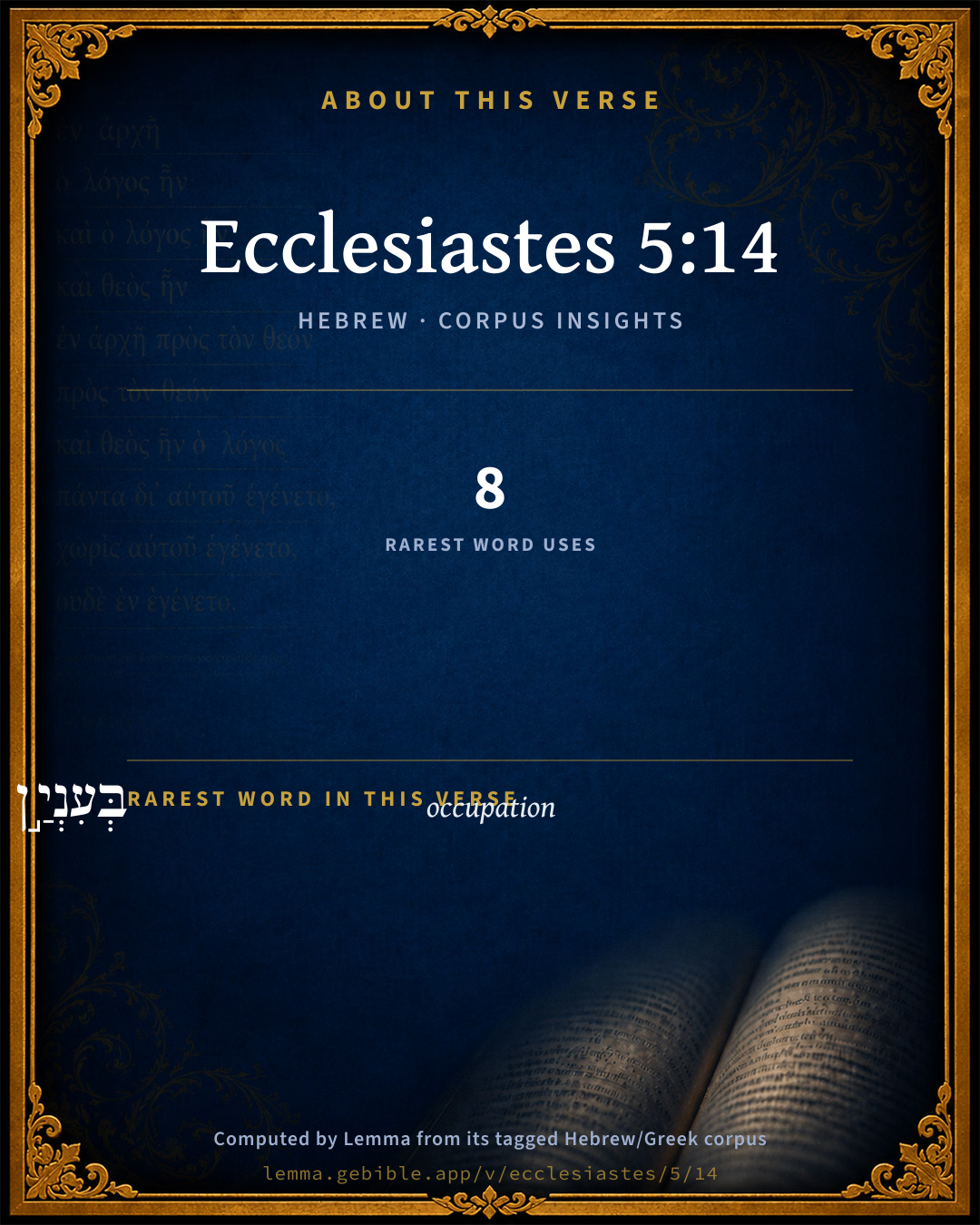
The rarest word here is בְּעִנְיַ֣ן occupation H6045 — appearing just 8 times in the whole Hebrew Bible.

Shared distinctive vocabulary

בְּעִנְיַ֣ן occupation H6045 occurs in 8 verses of the Hebrew Bible. Also found in:

Grammatical profile

  • 2 verbs
  • 5 nouns
  • 1 adjective
  • 1 pronoun
  • 1 particle

Verb forms

  • וְאָבַ֛ד Qal · Perfect
  • וְהוֹלִ֣יד Hiphil · Perfect

Hebrew & Septuagint length

In English translation the verse runs 18 words from the Hebrew and 33 from the Septuagint (LXX English) — the Septuagint runs noticeably longer here. See the side-by-side →

A rough comparison of the two English renderings, which tokenize alike — not a word-level alignment.

Word counts can differ between the Hebrew and the Greek without any difference in meaning — e.g. the Hebrew direct-object marker אֵת has no separate Greek word, and Greek often adds the article ὁ.

Cross-references

13

Topical passages linked to Ecclesiastes 5:14 in the Treasury of Scripture Knowledge — connected by theme and wording, ordered by reader-vote popularity; previews shown in the World English Bible.

  • Ecclesiastes 2:26 For to the man who pleases him, God gives wisdom, knowledge, and joy; but to the sinner he gives travail, to gather and to heap up, that he may give to him who pleases God. This also is vanity and a chasing after wind.
  • Job 5:5 Whose harvest the hungry eats up, And take it even out of the thorns; The snare gapes for their substance.
  • Job 20:15–29 He has swallowed down riches, and he shall vomit them up again. God will cast them out of his belly.
  • Proverbs 23:5 Why do you set your eyes on that which is not? For it certainly sprouts wings like an eagle and flies in the sky.
  • Haggai 1:9 "You looked for much, and, behold, it came to little; and when you brought it home, I blew it away. Why?" says Yahweh of Hosts, "Because of my house that lies waste, while each of you is busy with his own house.
  • Haggai 2:16–17 Through all that time, when one came to a heap of twenty measures, there were only ten. When one came to the wine vat to draw out fifty, there were only twenty.
  • Matthew 6:19–20 "Don't lay up treasures for yourselves on the earth, where moth and rust consume, and where thieves break through and steal;
  • 1 Samuel 2:6–8 Yahweh kills, and makes alive: He brings down to Sheol, and brings up.
  • 1 Samuel 2:36 It shall happen, that everyone who is left in your house shall come and bow down to him for a piece of silver and a loaf of bread, and shall say, Please put me into one of the priests' offices, that I may eat a morsel of bread.
  • 1 Kings 14:26 and he took away the treasures of the house of Yahweh, and the treasures of the king's house; he even took away all: and he took away all the shields of gold which Solomon had made.
  • Job 27:16–17 Though he heap up silver as the dust, And prepare clothing as the clay;
  • Psalms 39:6 "Surely every man walks like a shadow. Surely they busy themselves in vain. He heaps up, and doesn't know who shall gather.
  • Psalms 109:9–12 Let his children be fatherless, And his wife a widow.

Cross-references courtesy of OpenBible.info (CC BY 4.0).

Hebrew and Greek witnesses Masoretic Hebrew ↔ Greek Septuagint

The same verse in the two great witnesses to the Old Testament, shown verse-for-verse.

Here the Septuagint runs noticeably longer than the Hebrew — LXX2012 (modern English Septuagint) 33 words vs World English Bible 18. A rough length comparison of the two English translations, not a word-level alignment — read both below.

These are two independent witnesses, not word-aligned to each other, and the Septuagint is shown in lemma (dictionary) form.

Hebrew Ecclesiastes 5:14 Masoretic · Westminster Leningrad Codex

וְאָבַ֛ד הָעֹ֥שֶׁר הַה֖וּא בְּעִנְיַ֣ן רָ֑ע וְהוֹלִ֣יד בֵּ֔ן וְאֵ֥ין בְּיָד֖וֹ מְאֽוּמָה

Those riches perish by misfortune, and if he has fathered a son, there is nothing in his hand.

World English Bible · Public Domain

Greek LXX Ecclesiastes 5:14 Septuagint · lemma form

καθώς ἐκἔρχομαι ἀπό γαστήρ μήτηρ αὐτός γυμνός ἐπιστρέφω ὁ πορεύομαι ὡς ἥκω καί οὐδείς οὐ λαμβάνω ἐν μόχθος αὐτός ἵνα πορεύομαι ἐν χείρ αὐτός

As he came forth naked from his mother's womb, he shall return back as he came, and he shall receive nothing for his labor, that it should go with him in his hand.

LXX2012 (modern English Septuagint) · Public Domain

Hebrew: Westminster Leningrad Codex (CC BY 4.0). Greek: Septuagint (public domain); English from LXX2012 (modern English Septuagint) (Public Domain). How the Septuagint differs from the Hebrew →

Commentary

Notes on Ecclesiastes 5:14 from classic Christian and Jewish commentators (each source and its license shown beneath its notes). The classic Christian expositions comment on the surrounding passage and are grouped to its opening verse, so a note may address several verses; the Jewish commentaries on the Tanakh (Rashi and others) are per-verse, so they appear only where the commentator wrote on this verse.

Lemma curates 59 commentaries, every one of them public domain or Creative Commons licensed, each selected and text-cleaned for this edition rather than reprinted as found. About our sources →

Trapp's Complete Commentary

John Trapp

Ecc 5:14 But those riches perish by evil travail: and he begetteth a son, and [there is] nothing in his hand.

Ver. 14. But those riches perish by evil travail,] i.e., By evil trading, trafficking, or other cross event and accident. They waste and wither either by vanity or violence. They slip out of the hand, as the punting bird or wriggling eel. There is no hold to be taken of them - no trust to be put in them. They were never true to those that trusted in them. {See Trapp on "Pro 23:5"}

John Trapp, A Commentary or Exposition upon All the Books of the Old and New Testament (1647–1656) — public domain. Text from a community e-Sword module.

Geneva Bible (1599)

Geneva Bible translators

Job 1:21; 1 Tim. 6:7

Geneva Bible (1599) marginal notes — public domain. Text via Bolls.life.

Adam Clarke's Commentary

Verse 14. And he begetteth a son, and there is nothing in his hand.] He has been stripped of his property by unfortunate trade or by plunderers; and he has nothing to leave to his children.

Adam Clarke's Commentary on the Bible (1810–1826) — public domain. Text from a community e-Sword/MySword module.

Ellicott's Commentary for English Readers

(14) Evil travail.—Unsuccessful business.

Nothing in his hand.—The same words occur in a literal sense in Jdg_14:6.

A Bible Commentary for English Readers, edited by Charles John Ellicott (1878–1897) — public domain. Text from a community e-Sword module.

John Gill's Exposition

But those riches perish by evil travail,.... Or, "by an evil business or affair" (n). That is, such riches as are not well got, or are not used as they should be, these waste away and come to nothing; either by the owner's bad management, and misconduct in trade and business; or by fire, tempest, thieves, and robbers, and many other ways and means: these are very certain things; and there are various ways by which they make themselves wings and flee away, under the direction of a divine providence;

and he begetteth a son, and there is nothing in his hand; the riches he had hoarded up, he designed for his son; but being stripped of them by one means or another, when he comes to die, has nothing to leave his son: or if his riches do not perish in his own lifetime, yet they are quickly consumed by his son, who, in a short time, has nothing to live upon; and so being brought up a gentleman, and in no business, is in a worse condition than such who have been brought up to work for their living, and in no expectation of an estate after the decease of their friends. The Targum understands it in this latter sense, paraphrasing the words thus,

"and those riches, which he shall leave his son after his death, shall perish, because he hath gotten them in an evil way; and they shall not remain in the hand of the son whom he hath begotten; neither shall anything remain in his hand.''

(n) "occupatione, negotio, vel casu malo", Gejerus.

John Gill's Exposition of the Whole Bible (1746–1763) — public domain (CC PDM 1.0). Text via the HelloAO Bible API.

Albert Barnes' Notes on the Bible

Evil travail - Adverse accident, or unsuccessful employment (compare Ecc 1:13; Ecc 4:8).

Albert Barnes' Notes on the Bible (1834–1885) — public domain. Text from a community e-Sword/MySword module.

Haydock's Catholic Bible Commentary

Labour. All must die in this manner. But it is most afflicting that he was formerly rich, and must leave his son indigent. (Calmet)

George Leo Haydock (1774–1849), Haydock's Catholic Family Bible and Commentary, 1859 edition — public domain. Excludes Psalms (Douay-Rheims chapter numbering differs from Protestant) and Deuterocanonical books (Catholic canon only).

Matthew Poole's English Annotations

But, or for, or or, or moreover; for this particle is so rendered by divers others, both here and in other places of Scripture.

Those riches perish: if they be kept, it is to the owner’s hurt; and if not, they are lost to his grief.

By evil travail; by some wicked practices, either his own, or of other men; or by some secret hand of God cursing all his enterprises.

There is nothing in his hand; either,

1. In the father’s power to leave to his son, for whose sake he underwent all those hard labours; which is a great aggravation of his grief and misery. Or,

2. In the son’s possession after his father’s death.

Matthew Poole's English Annotations on the Holy Bible (1683–1685) — public domain. Text from a community e-Sword/MySword module.

Whedon's Commentary on the Bible

Daniel D. Whedon

14. Those riches perish — It is to be remembered that the heir for whom the keeping is done is now spoken of, and the case is viewed from the standpoint of his fortunes. By the time when he himself becomes a father the wealth hoarded for him is gone, and he — the heir and now the father — has nothing in his hand. By evil travail is meant some ruinous enterprise.

Daniel D. Whedon (gen. ed.), Commentary on the Old and New Testaments (1874–1909) — public domain. Text from a community e-Sword module.

The Pulpit Commentary

Those riches perish by evil travail; thing or circumstance. There is no need to confine the cause of the loss to unsuccessful business, as many commentators do. The rich man does not seem to be a tradesman or speculator; he loses his property, like Job, by visitations for which he is in no way answerable by storm or tempest, by robbers, by fire, by exactions, or by lawsuits. And he begetteth a son, and there is nothing in his hand. The verb rendered "begetteth" is in the past tense, and used as it were, hypothetically, equivalent to "hath he begotten a son," supposing he has a son. His misery is doubled by the reflection that he has lost all hope of securing a fortune for his children, or founding a family, or passing on an inheritance to posterity. It is doubtful to whom the pronoun "his" refers. Many consider that the father is meant, and the clause says that when he has begotten a son, he finds he has nothing to give him. But the suffix seems most naturally to refer to the son, who is thus left a pauper. Vulgate, Generavit filium qui in summa egestate erit. Having a thing in the hand moans having power over it, or possessing it.

The Pulpit Commentary (1880–1919), ed. H.D.M. Spence-Jones & Joseph S. Exell — public domain. Text from a community e-Sword module.

John Wesley's Explanatory Notes

Perish - By some wicked practices, either his own, or of other men. Nothing - In the son's possession after his father's death.

John Wesley, Explanatory Notes Upon the Whole Bible (1754–1765) — public domain. Text via the GEBible commentary corpus.

Rashi

Rabbi Shlomo Yitzchaki (Rashi)

and he will carry nothing with his toil When he dies, he will not take in his hand any merit of charity that he did with his money during his lifetime.

Rashi on the Tanakh — English translations: “The Judaica Press complete Tanach with Rashi, translated by A. J. Rosenberg” (CC BY 4.0); “Pentateuch with Rashi's commentary by M. Rosenbaum and A.M. Silbermann, 1929-1934” (public domain); “The Metsudah Tanach series, Lakewood, N.J” (CC BY 4.0); and “The Book of Joshua, Metsudah Publications, 1997” (CC BY 4.0). Text via Sefaria.

Lesson kit

Teaching starters — assembled from the data on this page, not authored interpretation. Every prompt links to the verse data it draws on. Edit before teaching.

Ecclesiastes, in the Wisdom, opens this verse with 10 words (10 distinct Hebrew lemmas). Its most distinctive word is ʻinyân (“occupation”). The Greek Septuagint runs longer here. A historical commentator’s framing appears above. Read the whole chapter for the surrounding context.

Discussion questions

  1. The word ʻinyân carries the sense “occupation.” How does it shape the verse?
  2. Ecclesiastes 1:13 shares the word «occupation» with this verse. How do the two illuminate each other?
  3. Compared with the Hebrew, the Septuagint runs longer here. What questions does that raise?
  4. These translations render this verse differently; the difference is in the English rendering, not the original. What questions does that raise?
  5. The verb «וְאָבַ֛ד» is Qal Perfect. How does its form color the action?
  6. Reading how Trapp's Complete Commentary and Geneva Bible (1599) read this verse, where do the two commentators agree and where do they part?

Things to notice

Reading settings

Reading text

Shown beneath each verse's original-language words.

Old Testament
Old Testament edition

Read the OT as the Masoretic Hebrew (MT) or the Greek Septuagint (LXX).

English shown for the Greek Septuagint (in the Hebrew ↔ Greek comparison).

Comparing translations? Open the Compare panel on any verse page to stack up to four side by side.