
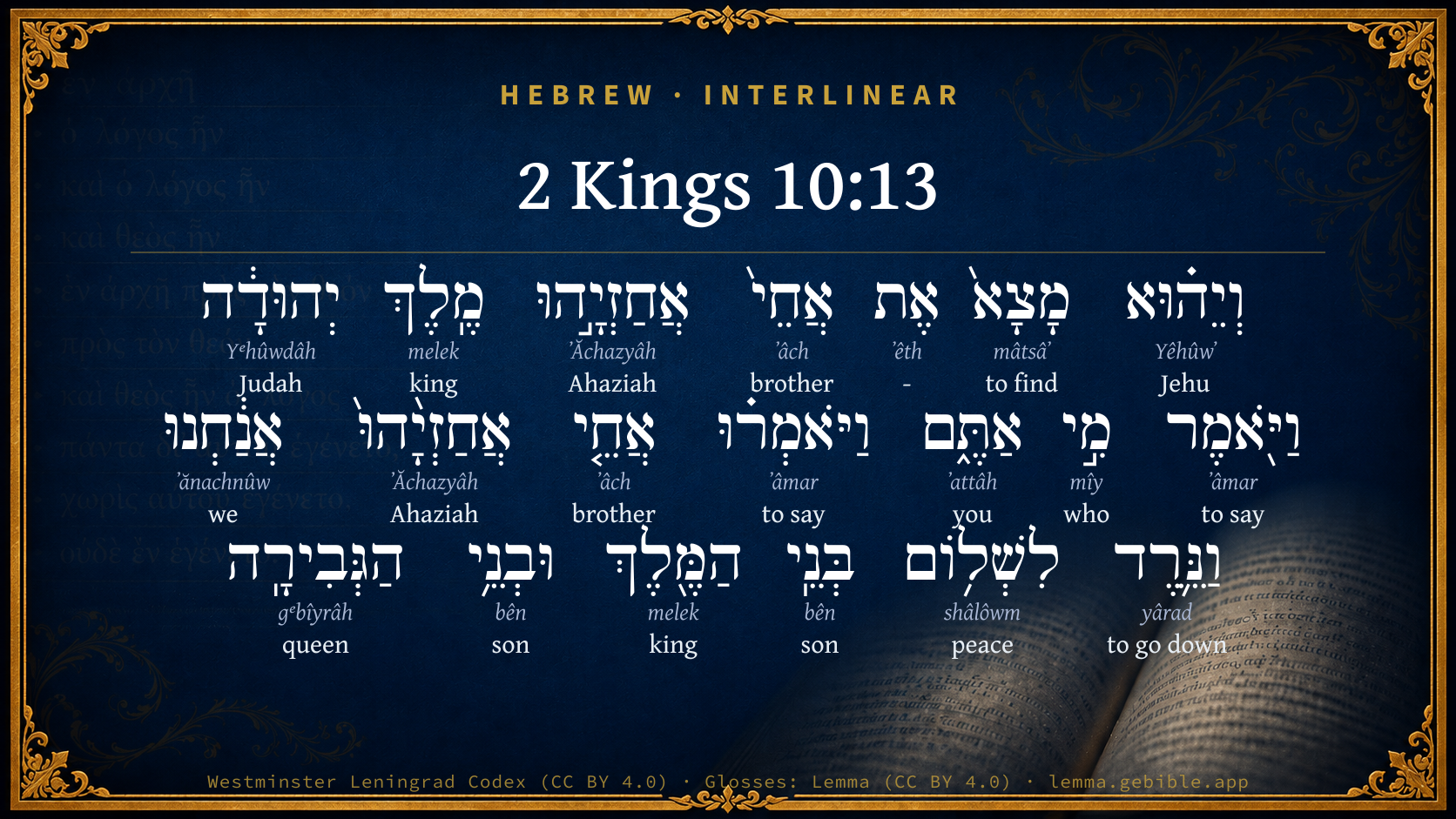
2 Kings 10:13

Hebrew (Westminster Leningrad Codex) 2 Kings 10:13 appears in the Hebrew Old Testament. The text above is from the Westminster Leningrad Codex. Each word links to its Strong’s number, a concise gloss, and parsing drawn from the Open Scriptures Hebrew Bible morphology. Click any word for its full Brown-Driver-Briggs (BDB) entry.
Download image
Cite this verse

2 Kings 10:13 (World English Bible). Public Domain. Lemma interlinear Bible study tool, https://lemma.gebible.app/v/2-kings/10/13.

Show BibTeX & RIS
BibTeX
RIS
English Translation
Jehu met with the brothers of Ahaziah king of Judah, and said, Who are you? They answered, We are the brothers of Ahaziah: and we go down to Greet the children of the king and the children of the queen.
World English Bible · Public Domain
Download a study sheet

One document with this verse’s original text, its word-by-word gloss line, the meaning frame, cross-references with their text, attributed commentary, and full source and license credits — printable, and it pastes into notes with its structure intact.

This verse Autodidact and up

Study sheet (.html) Plain text (.txt)

A passage Seminary Student

Up to 50 verses in one chapter. A passage sheet keeps up to 6 commentary sources and 12 cross-references per verse, in the order this page ranks them, and says so on the sheet whenever that leaves anything out. Ask for a single verse and you get the Autodidact verse sheet above.

Everything on this page stays free to read, with no account — the sheet is a download of what is already on screen, not access to it.

Want to remove ads? Support Godless Engineer
Compare translations 3

The same verse in 3 English versions, stacked beneath the original-language interlinear above. Click any original word for its lexicon entry.

Each is an independent rendering of the whole verse — the interlinear is not word-aligned to these translations.

Highlighted words mark where these versions differ — a whole-verse word diff, not a word-by-word alignment.

  • World English Bible Public Domain
    Jehu met with the brothers of Ahaziah king of Judah, and said, Who are you? They answered, We are the brothers of Ahaziah: and we go down to Greet the children of the king and the children of the queen.
  • King James Version Public Domain
    Jehu met with the brethren of Ahaziah king of Judah, and said, Who are ye? And they answered, We are the brethren of Ahaziah; and we go down to salute the children of the king and the children of the queen.
  • unfoldingWord Literal Text CC BY-SA 4.0
    and Jehu found the brothers of Ahaziah, the king of Judah. And he said, “Who you?” And they said, “We the brothers of Ahaziah, and we have come down for the welfare of the sons of the king and the sons of the queen mother.”

unfoldingWord Literal Text — © unfoldingWord, licensed CC BY-SA 4.0. Word-aligned USFM3 via Door43 (git.door43.org/unfoldingWord/en_ult).

Versions to compare (up to 4)

3 of 4 selected

Show all 18 translations

Every available English version of this verse, each an independent rendering of the whole verse.

  • World English Bible Public Domain
    Jehu met with the brothers of Ahaziah king of Judah, and said, Who are you? They answered, We are the brothers of Ahaziah: and we go down to Greet the children of the king and the children of the queen.
  • Berean Standard Bible Public Domain
    Jehu met some relatives of Ahaziah king of Judah and asked, “Who are you?” “We are relatives of Ahaziah,” they answered, “and we have come down to greet the sons of the king and of the queen mother.”
  • Majority Standard Bible Public Domain
    Jehu met some relatives of Ahaziah king of Judah and asked, “Who are you?” “We are relatives of Ahaziah,” they answered, “and we have come down to greet the sons of the king and of the queen mother.”
  • King James Version Public Domain
    Jehu met with the brethren of Ahaziah king of Judah, and said, Who are ye? And they answered, We are the brethren of Ahaziah; and we go down to salute the children of the king and the children of the queen.
  • American Standard Version (1901) Public Domain
    Jehu met with the brethren of Ahaziah king of Judah, and said, Who are ye? And they answered, We are the brethren of Ahaziah: and we go down to salute the children of the king and the children of the queen.
  • Revised Version (1885) Public Domain
    Jehu met with the brethren of Ahaziah king of Judah, and said, Who are ye? And they answered, We are the brethren of Ahaziah: and we go down to salute the children of the king and the children of the queen.
  • Geneva Bible (1599) Public Domain
    He met with the brethre of Ahaziah king of Iudah, and sayd, Who are ye? And they answered, We are the brethren of Ahaziah, and goe downe to salute the children of the King and the children of the Queene.
  • Douay-Rheims (1899) Public Domain
    He met with the brethren of Ochozias king of Juda, and he said to them: Who are you? And they answered: We are the brethren of Ochozias, and are come down to salute the sons of the king, and the sons of the queen.
  • Young's Literal Translation Public Domain
    and Jehu hath found the brethren of Ahaziah king of Judah, and saith, `Who `are' ye?' and they say, `Brethren of Ahaziah we `are', and we go down to salute the sons of the king, and the sons of the mistress.'
  • Literal Standard Version CC BY-SA 4.0
    and Jehu has found the brothers of Ahaziah king of Judah and says, “Who [are] you?” And they say, “We [are] brothers of Ahaziah, and we go down to greet the sons of the king and the sons of the mistress.”
  • Unlocked Literal Bible CC BY-SA 4.0
    he met brothers of Ahaziah king of Judah. Jehu said to them, “Who are you?” They answered, “We are brothers of Ahaziah, and we are going down to greet the children of the king and the children of Queen Jezebel.”
  • unfoldingWord Literal Text CC BY-SA 4.0
    and Jehu found the brothers of Ahaziah, the king of Judah. And he said, “Who you?” And they said, “We the brothers of Ahaziah, and we have come down for the welfare of the sons of the king and the sons of the queen mother.”
  • Darby Bible Public Domain
    Jehu found the brethren of Ahaziah king of Judah, and said, Who are ye? And they said, We are the brethren of Ahaziah; and have come down to salute the children of the king, and the children of the queen.
  • World Messianic Bible Public Domain
    Jehu met with the brothers of Ahaziah king of Judah, and said, “Who are you?” They answered, “We are the brothers of Ahaziah. We are going down to greet the children of the king and the children of the queen.”
  • Webster's Bible Public Domain
    Jehu met with the brethren of Ahaziah king of Judah, and said, Who are ye? And they answered, We are the brethren of Ahaziah; and we go down to salute the children of the king and the children of the queen.
  • Free Bible Version CC BY-SA 4.0
    he met some relatives of Ahaziah, king of Judah. “Who are you?” he asked them. “We're relatives of Ahaziah,” they replied. “We've come to visit the sons of the king and of the queen mother.”
  • Bible in Basic English Public Domain
    When he came across the brothers of Ahaziah, king of Judah, and said, Who are you? And they said, We are the brothers of Ahaziah, king of Judah; we are going down to see the children of the king and of the queen.
  • JPS Tanakh (1917) Public Domain
    Jehu met with the brethren of Ahaziah king of Judah, and said: 'Who are ye?' And they answered: 'We are the brethren of Ahaziah; and we go down to salute the children of the king and the children of the queen.'

Literal Standard Version (2020), Covenant Press — licensed CC BY-SA 4.0. Text via the HelloAO Bible API (eBible.org). Unlocked Literal Bible (unfoldingWord) — licensed CC BY-SA 4.0. Text via the HelloAO Bible API (eBible.org). unfoldingWord Literal Text — © unfoldingWord, licensed CC BY-SA 4.0. Word-aligned USFM3 via Door43 (git.door43.org/unfoldingWord/en_ult). Free Bible Version, Dr. Jonathan Gallagher — licensed CC BY-SA 4.0. Text via the HelloAO Bible API (eBible.org).

Word by word

More ways to search: Search by grammar → Find every occurrence → Compare this word →

Practice this passage: Drill this verse → Learn its vocabulary →

הַגְּבִירָֽה
gᵉbîyrâh
H1377
“the · queen”
Particle, Definite Article + Noun, Common, Feminine, Singular, Absolute
Part of Speech
Particle + Noun
Type
Common
Gender
Feminine
Number
Singular
State
Absolute
Full BDB Definition

Origin: from H1376

TWOT: 310d

queen, lady - queen-mother
  1. וְיֵה֗וּא Yêhûwʼ H3058 “and · Jehu” Conjunction + Noun, Proper
  2. מָצָא֙ mâtsâʼ H4672 “to find” Verb, Qal, Perfect, 3rd Person, Masculine, Singular
  3. אֶת ʼêth H853 “-” Particle, Direct Object
  4. אֲחֵי֙ ʼâch H251 “brothers of” Noun, Common, Masculine, Plural, Construct
  5. אֲחַזְיָ֣הוּ ʼĂchazyâh H274 “Ahaziah” Noun, Proper
  6. מֶֽלֶךְ melek H4428 “king of” Noun, Common, Masculine, Singular, Construct
  7. יְהוּדָ֔ה Yᵉhûwdâh H3063 “Judah” Noun, Proper
  8. וַיֹּ֖אמֶר ʼâmar H559 “and · to say” Conjunction + Verb, Qal, Sequential Imperfect, 3rd Person, Masculine, Singular
  9. מִ֣י mîy H4310 “who” Particle, Interrogative
  10. אַתֶּ֑ם ʼattâh H859 “you” Pronoun, Personal, 2nd Person, Masculine, Plural
  11. וַיֹּאמְר֗וּ ʼâmar H559 “and · to say” Conjunction + Verb, Qal, Sequential Imperfect, 3rd Person, Masculine, Plural
  12. אֲחֵ֤י ʼâch H251 “brothers of” Noun, Common, Masculine, Plural, Construct
  13. אֲחַזְיָ֨הוּ֙ ʼĂchazyâh H274 “Ahaziah” Noun, Proper
  14. אֲנַ֔חְנוּ ʼănachnûw H587 “we” Pronoun, Personal, 1st Person, Common, Plural
  15. וַנֵּ֛רֶד yârad H3381 “and · to go down” Conjunction + Verb, Qal, Sequential Imperfect, 1st Person, Common, Plural
  16. לִשְׁל֥וֹם shâlôwm H7965 “to/for · peace of” Preposition + Noun, Common, Masculine, Singular, Construct
  17. בְּנֵֽי bên H1121 “sons of” Noun, Common, Masculine, Plural, Construct
  18. הַמֶּ֖לֶךְ melek H4428 “the · king” Particle, Definite Article + Noun, Common, Masculine, Singular, Absolute
  19. וּבְנֵ֥י bên H1121 “and · sons of” Conjunction + Noun, Common, Masculine, Plural, Construct

About this verse

These counts appear in no published source. They are computed here, from the morphology-tagged text and Lemma’s own curated glosses. What Lemma adds →

20
words
15
distinct lemmas
Historical
section

Notable vocabulary

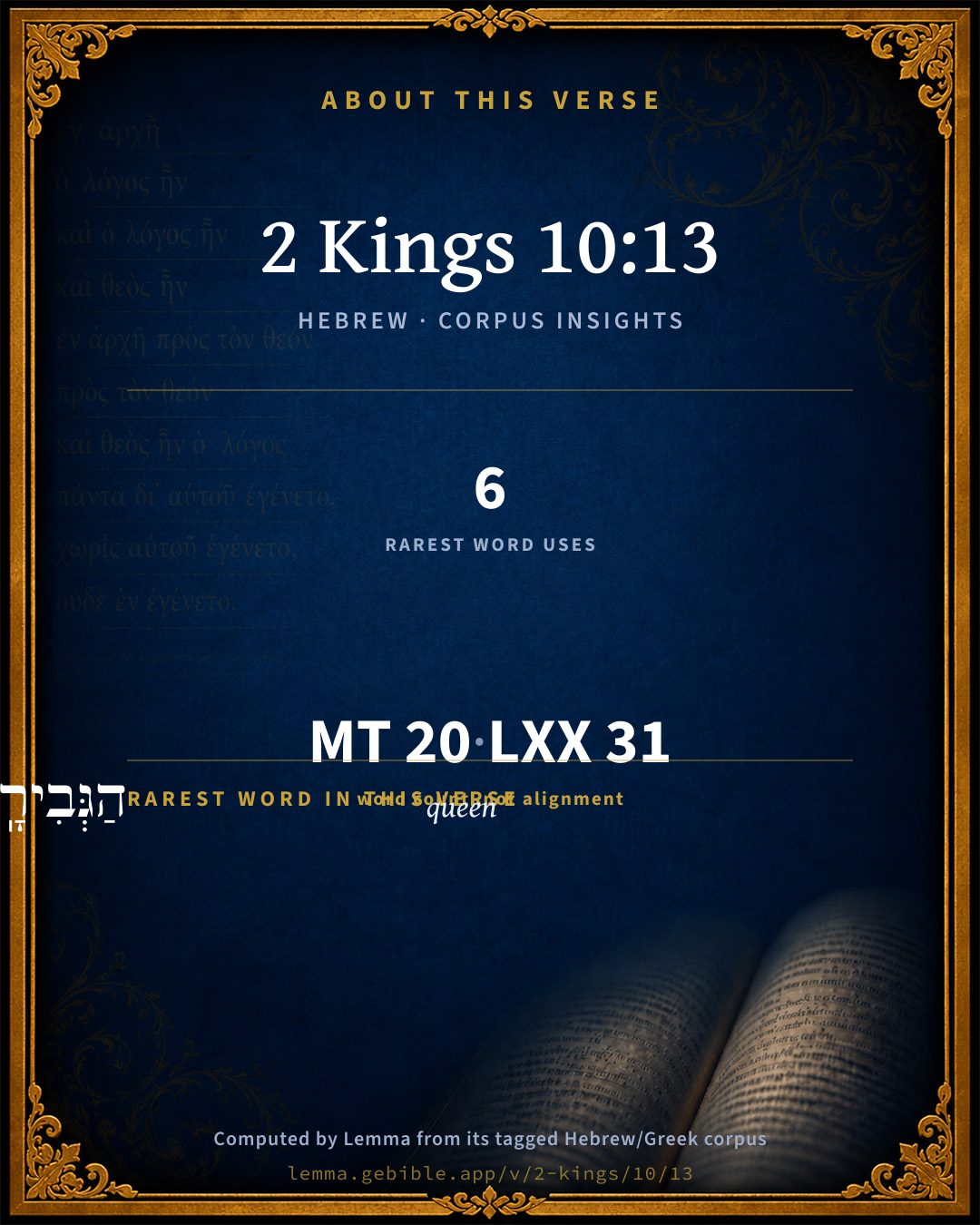
The rarest word here is הַגְּבִירָֽה queen H1377 — appearing just 6 times in the whole Hebrew Bible.

Shared distinctive vocabulary

הַגְּבִירָֽה queen H1377 occurs in 6 verses of the Hebrew Bible. Also found in:

Grammatical profile

  • 4 verbs
  • 12 nouns
  • 2 pronouns
  • 2 particles

Verb forms

  • מָצָא֙ Qal · Perfect
  • וַיֹּ֖אמֶר Qal · Sequential Imperfect
  • וַיֹּאמְר֗וּ Qal · Sequential Imperfect
  • וַנֵּ֛רֶד Qal · Sequential Imperfect

Repetition

Words recur within this verse — often emphatic in Hebrew:

  • אֲחֵי֙ brother H251 ×2
  • אֲחַזְיָ֣הוּ Ahaziah H274 ×2
  • מֶֽלֶךְ king H4428 ×2
  • וַיֹּ֖אמֶר to say H559 ×2
  • בְּנֵֽי son H1121 ×2

Hebrew & Septuagint length

In English translation the verse runs 40 words from the Hebrew and 42 from the Septuagint (LXX English) — closely comparable.

A rough comparison of the two English renderings, which tokenize alike — not a word-level alignment.

Word counts can differ between the Hebrew and the Greek without any difference in meaning — e.g. the Hebrew direct-object marker אֵת has no separate Greek word, and Greek often adds the article ὁ.

In the original languages it is 20 Hebrew tokens and 31 Greek tokens — but the two are counted differently (Hebrew bundles its prefixes and suffixes into one token; the Greek is in lemma form), so that isn’t a like-for-like length.

Cross-references

5

Topical passages linked to 2 Kings 10:13 in the Treasury of Scripture Knowledge — connected by theme and wording, ordered by reader-vote popularity; previews shown in the World English Bible.

  • 2 Kings 8:29 King Joram returned to be healed in Jezreel of the wounds which the Syrians had given him at Ramah, when he fought against Hazael king of Syria. Ahaziah the son of Jehoram king of Judah went down to see Joram the son of Ahab in Jezreel, because he was sick.
  • 2 Kings 8:24 Joram slept with his fathers, and was buried with his fathers in the city of David; and Ahaziah his son reigned in his place.
  • 2 Chronicles 21:17 and they came up against Judah, and broke into it, and carried away all the substance that was found in the king's house, and his sons also, and his wives; so that there was never a son left him, save Jehoahaz, the youngest of his sons.
  • 2 Kings 9:21–27 Joram said, Make ready. They made ready his chariot. Joram king of Israel and Ahaziah king of Judah went out, each in his chariot, and they went out to meet Jehu, and found him in the portion of Naboth the Jezreelite.
  • 2 Chronicles 22:1–10 The inhabitants of Jerusalem made Ahaziah his youngest son king in his place; for the band of men who came with the Arabians to the camp had slain all the eldest. So Ahaziah the son of Jehoram king of Judah reigned.

Cross-references courtesy of OpenBible.info (CC BY 4.0).

Hebrew and Greek witnesses Masoretic Hebrew ↔ Greek Septuagint

The same verse in the two great witnesses to the Old Testament, shown verse-for-verse.

These are two independent witnesses, not word-aligned to each other, and the Septuagint is shown in lemma (dictionary) form.

Hebrew 2 Kings 10:13 Masoretic · Westminster Leningrad Codex

וְיֵה֗וּא מָצָא֙ אֶת אֲחֵי֙ אֲחַזְיָ֣הוּ מֶֽלֶךְ יְהוּדָ֔ה וַיֹּ֖אמֶר מִ֣י אַתֶּ֑ם וַיֹּאמְר֗וּ אֲחֵ֤י אֲחַזְיָ֨הוּ֙ אֲנַ֔חְנוּ וַנֵּ֛רֶד לִשְׁל֥וֹם בְּנֵֽי הַמֶּ֖לֶךְ וּבְנֵ֥י הַגְּבִירָֽה

Jehu met with the brothers of Ahaziah king of Judah, and said, Who are you? They answered, We are the brothers of Ahaziah: and we go down to Greet the children of the king and the children of the queen.

World English Bible · Public Domain

Greek LXX 2 Kings 10:13 Septuagint · lemma form

καί ιου εὑρίσκω ὁ ἀδελφός οχοζιας βασιλεύς ιουδα καί εἶπον τίς σύ καί εἶπον ὁ ἀδελφός οχοζιας ἐγώ καί καταβαίνω εἰς εἰρήνη ὁ υἱός ὁ βασιλεύς καί ὁ υἱός ὁ δυναστεύω

And Ju found the brethren of Ochozias king of Juda, and said, Who are you⌃? And they said, We are the brethren of Ochozias, and we have come down to salute the sons of the king, and the sons of the queen.

LXX2012 (modern English Septuagint) · Public Domain

On this verse, The Cambridge Bible for Schools and Colleges discusses the Septuagint’s reading. Read the note in Commentary ↓

Hebrew: Westminster Leningrad Codex (CC BY 4.0). Greek: Septuagint (public domain); English from LXX2012 (modern English Septuagint) (Public Domain). How the Septuagint differs from the Hebrew →

Targum (Aramaic paraphrase)

1

The Targum is the ancient Jewish Aramaic paraphrase of the Hebrew Scriptures — an interpretive translation, not the Hebrew text itself. Onkelos (literal) and Pseudo-Jonathan (expansive) render the Torah, and Jonathan the Prophets. Coverage is partial: where no permissively-licensed English translation exists for a verse, only the Aramaic is shown. This is verse-level text, not a word-by-word alignment to the Hebrew.

  1. Targum Jonathan Prophets (Joshua–Malachi)
    וְיֵהוּא אַשְׁכַּח יַת אֲמֵי אֲחַזְיָה מֶלֶךְ שִׁבְטָא דְבֵית יְהוּדָה וַאֲמַר מַן אַתּוּן וַאֲמַרוּ אֲחֵי אֲחַזְיָהוּ אֲנַחְנָא וּנְחַתְנָא לְמִסְעַד שְׁלַם בְּנֵי מַלְכָּא וּבְנֵי מַלְכְּתָא:

    (no public-domain English translation for this verse)

    Targum Jonathan — Aramaic: “Mikraot Gedolot” (public domain). English: “Sefaria Community Translation” (CC0 1.0 (public-domain dedication)); “London "Chaldee Paraphrase," 1871” (public domain). Text via Sefaria.

Commentary

Notes on 2 Kings 10:13 from classic Christian and Jewish commentators (each source and its license shown beneath its notes). The classic Christian expositions comment on the surrounding passage and are grouped to its opening verse, so a note may address several verses; the Jewish commentaries on the Tanakh (Rashi and others) are per-verse, so they appear only where the commentator wrote on this verse.

Lemma curates 59 commentaries, every one of them public domain or Creative Commons licensed, each selected and text-cleaned for this edition rather than reprinted as found. About our sources →

Trapp's Complete Commentary

John Trapp

2Ki 10:13 Jehu met with the brethren of Ahaziah king of Judah, and said, Who [are] ye? And they answered, We [are] the brethren of Ahaziah; and we go down to salute the children of the king and the children of the queen.

Ver. 13. And Jehu met with the brethren of Ahaziah.] That is, his nephews and near kindred: for his brethren were all carried away by the Arabians. {2Ch 21:17}

John Trapp, A Commentary or Exposition upon All the Books of the Old and New Testament (1647–1656) — public domain. Text from a community e-Sword module.

Jamieson, Fausset & Brown

Robert Jamieson, A. R. Fausset & David Brown

We are the brethren of Ahaziah--that is, not full, but step-brothers, sons of Jehoram by various concubines. Ignorant of the revolution that had taken place, they were travelling to Samaria on a visit to their royal relatives of Israel, when they were seized and put to death, because of the apprehension that they might probably stimulate and strengthen the party that still remained faithful in their allegiance to Ahab's dynasty.

children of the queen--that is, of the queen mother, or regent, Jezebel.

Jamieson, Fausset & Brown — Commentary Critical and Explanatory on the Whole Bible (1871) — public domain (CC PDM 1.0). Text via the HelloAO Bible API.

Adam Clarke's Commentary

Verse 13. The brethren of Ahaziah] The relatives of his family; for it does not appear that he had any brethren, properly so called: but we know that the term brethren among the Jews signified the relatives of the same family, and especially brothers' and sisters' children: and that these-were such, see 2Ch 22:8.

We go down to salute, &c.] So promptly had Jehu executed all his measures, that even the nearest relatives of the murdered kings had not heard of their death, and consequently had no time to escape. They were all taken as in a net.

Adam Clarke's Commentary on the Bible (1810–1826) — public domain. Text from a community e-Sword/MySword module.

Ellicott's Commentary for English Readers

(13) Jehu met with.—Literally, And Jehu found.

The brethren of Ahaziah king of Judah—i.e., Ahaziah’s kinsmen. His brothers, in the strict sense of the word, were slain by a troop of Arabs, in the lifetime of his father Jehoram (2Ch_21:17; 2Ch_22:1). (See the Notes on 2Ch_22:8.)

We go down.—Rather, we have come down.

To salute—i.e., to inquire after their health, to visit them.

The children of the king—i.e., the sons of Joram.

The children of the queen.—Literally, the sons of the mistress (gebîrah)—i.e., the sons of the queen-mother, Jezebel, and so Joram’s brothers. Both these and the former are included in the “sons of Ahab” whom Jehu slew.

The news of the taking of Ramoth, and of Joram’s convalescence, may have reached Jerusalem, and induced these princes to make a visit of pleasure to the court of Jezreel, not suspecting the events which had meanwhile happened with the headlong rapidity characteristic of Jehu’s action.

A Bible Commentary for English Readers, edited by Charles John Ellicott (1878–1897) — public domain. Text from a community e-Sword module.

The Cambridge Bible for Schools and Colleges

gen. ed. J. J. S. Perowne

13. the brethren of Ahaziah] And so part of Ahab’s kinsfolk, of whom Jehu was commissioned to leave none remaining.

the children of the king] i.e. Of Joram. They manifestly knew nothing of what had happened in the last few days in Jezreel.

the children of the queen] The original is the word employed elsewhere for the ‘queen-mother’. Cf. 1Ki_15:13. So here the word must have reference to Jezebel, whose influence in Israel was very great. The LXX. notes the word by rendering it ἡ δυναστεύουσα.

The Cambridge Bible for Schools and Colleges (gen. ed. J. J. S. Perowne; Cambridge University Press, 1878–1918) — public domain. Text from a community e-Sword module.

John Gill's Exposition

Jehu met with the brethren of Ahaziah king of Judah,.... At the above place; these were the sons of his brethren, called his brethren, as Lot was called Abraham's brother, being his brother's son; for as for his brethren, they had been slain by the Arabians before he was made king, Ch2 22:1,

and said, who are ye? though perhaps he knew who they were:

and they answered, we are the brethren of Ahaziah; the sons of his brethren:

and we go down to salute the children of the king, and the children of the queen; meaning either the children of Ahab and Jezebel, or of Joram and his queen; for they knew nothing of the death of Joram and Jezebel, and the revolution made in the kingdom, and therefore with great simplicity tell who they were, and where they were going, and on what account.

John Gill's Exposition of the Whole Bible (1746–1763) — public domain (CC PDM 1.0). Text via the HelloAO Bible API.

Albert Barnes' Notes on the Bible

The brethren of Ahaziah - Not the actual brothers of Ahaziah, who had all been slain by the Arabs before his accession to the throne 2Ch 21:17; 2Ch 22:1; but his nephews, the sons of his brothers (marginal reference). It is remarkable that they should have penetrated so far into the kingdom of Israel without having heard of the revolution.

The children of the king ... - i. e.” the sons of Jehoram, and the children (sons and grandsons) of the queen-mother, Jezebel.” Some of both may well have been at Jezreel, though the younger branches of the royal family were at Samaria 2Ki 10:1.

Albert Barnes' Notes on the Bible (1834–1885) — public domain. Text from a community e-Sword/MySword module.

Haydock's Catholic Bible Commentary

Brethren. The Arabs had destroyed all his brothers by the same mother; (2 Paralipomenon xxii. 1.) but these were near relations, and they durst not deny the fact. (Menochius) --- In 2 Paralipomenon xxii. 8., they are styled princes of Juda, and sons of the brethren of Ochozias. Jehu must have used surprising diligence (Calmet) and secrecy (Haydock) to prevent the many important transactions and changes which had lately taken place from being known at Jerusalem, or even at Beth-heked, ver. 12., which was so little distant from Samaria. (Calmet) --- Queen. The wife of Joram, or the children of Jezabel, (Menochius) with whom they were connected by affinity and friendship, to their great detriment. (Haydock)

George Leo Haydock (1774–1849), Haydock's Catholic Family Bible and Commentary, 1859 edition — public domain. Excludes Psalms (Douay-Rheims chapter numbering differs from Protestant) and Deuterocanonical books (Catholic canon only).

Matthew Poole's English Annotations

The brethren; not strictly so, for they were killed before this, 2Ch 21:17; but his brethren’s sons, as they are called, 2Ch 22:8, or others of his near kinsmen, such being oft called brethren in Scripture; as Gen 13:8.

Matthew Poole's English Annotations on the Holy Bible (1683–1685) — public domain. Text from a community e-Sword/MySword module.

The Pulpit Commentary

Jehu met with the brethren of Ahaziah King of Judah. The actual "brethren" of Ahaziah had been carried off and slain by the Arabians in one of their raids into Palestine, as we learn from 2Ch_21:17 2Ch_22:1; the youths here mentioned were their sons, (2Ch_22:8) and therefore Ahaziah"s nephews. And said, Who are ye? Travelers in a foreign country were always liable to be questioned, and were expected to give an account of themselves. (see Gen_42:7-13; Story of Saneha, line 38; Herod, 2:159, etc.) The princes were thus not surprised at the inquiry, and readily answered it. And they answered, We are the brethren of Ahaziah; and we go down to salute the children of the king. There is something abnormal and needing explanation in this visit. Forty-two princes, with their retinues, do not, under ordinary circumstances, start off on a sudden from one capital, on a complimentary visit to their cousins at another. Perhaps Ewald is right in surmising that, "at the first report of disturbances in the kingdom of the ten tribes, they had been sent off by Athaliah to render any assistance that they could to the house of Ahab in its troubles" ("History of Israel," vol. 4. p. 100, Eng. trans.). In this case their answer must be regarded as insincere. Falling in with an armed force stronger than their own, they pretended ignorance of the revolution that had taken place, and sought to pass off their hostile purpose under the pretence of a visit of compliment. But the pretence did not deceive Jehu. And the children of the queen. The queen-mother, Jezebel, is probably intended. Her rank entitled her to special mention.

The Pulpit Commentary (1880–1919), ed. H.D.M. Spence-Jones & Joseph S. Exell — public domain. Text from a community e-Sword module.

Rashi

Rabbi Shlomo Yitzchaki (Rashi)

And the queen’s sons. Ezevel.

Rashi on the Tanakh — English translations: “The Judaica Press complete Tanach with Rashi, translated by A. J. Rosenberg” (CC BY 4.0); “Pentateuch with Rashi's commentary by M. Rosenbaum and A.M. Silbermann, 1929-1934” (public domain); “The Metsudah Tanach series, Lakewood, N.J” (CC BY 4.0); and “The Book of Joshua, Metsudah Publications, 1997” (CC BY 4.0). Text via Sefaria.

Lesson kit

Teaching starters — assembled from the data on this page, not authored interpretation. Every prompt links to the verse data it draws on. Edit before teaching.

2 Kings, in the Historical, opens this verse with 20 words (15 distinct Hebrew lemmas). Its most distinctive word is gᵉbîyrâh (“queen”). A historical commentator’s framing appears above. Read the whole chapter for the surrounding context.

Discussion questions

  1. What does “queen” (gᵉbîyrâh) contribute to the verse as a whole?
  2. How does 1 Kings 11:19, which shares the word «queen», read alongside this verse?
  3. What does the repetition of “brother” (2× in this one verse) do in this verse?
  4. The translations on this page render this verse differently — a whole-verse word diff, not a word-by-word alignment. What might account for the different wordings?
  5. «מָצָא֙» is a Qal Perfect verb. How does that grammatical form shape the action described?
  6. Compare how Trapp's Complete Commentary and Jamieson, Fausset & Brown read this verse. Where do they agree or differ?

Things to notice

Reading settings

Reading text

Shown beneath each verse's original-language words.

Old Testament
Old Testament edition

Read the OT as the Masoretic Hebrew (MT) or the Greek Septuagint (LXX).

English shown for the Greek Septuagint (in the Hebrew ↔ Greek comparison).

Comparing translations? Open the Compare panel on any verse page to stack up to four side by side.