
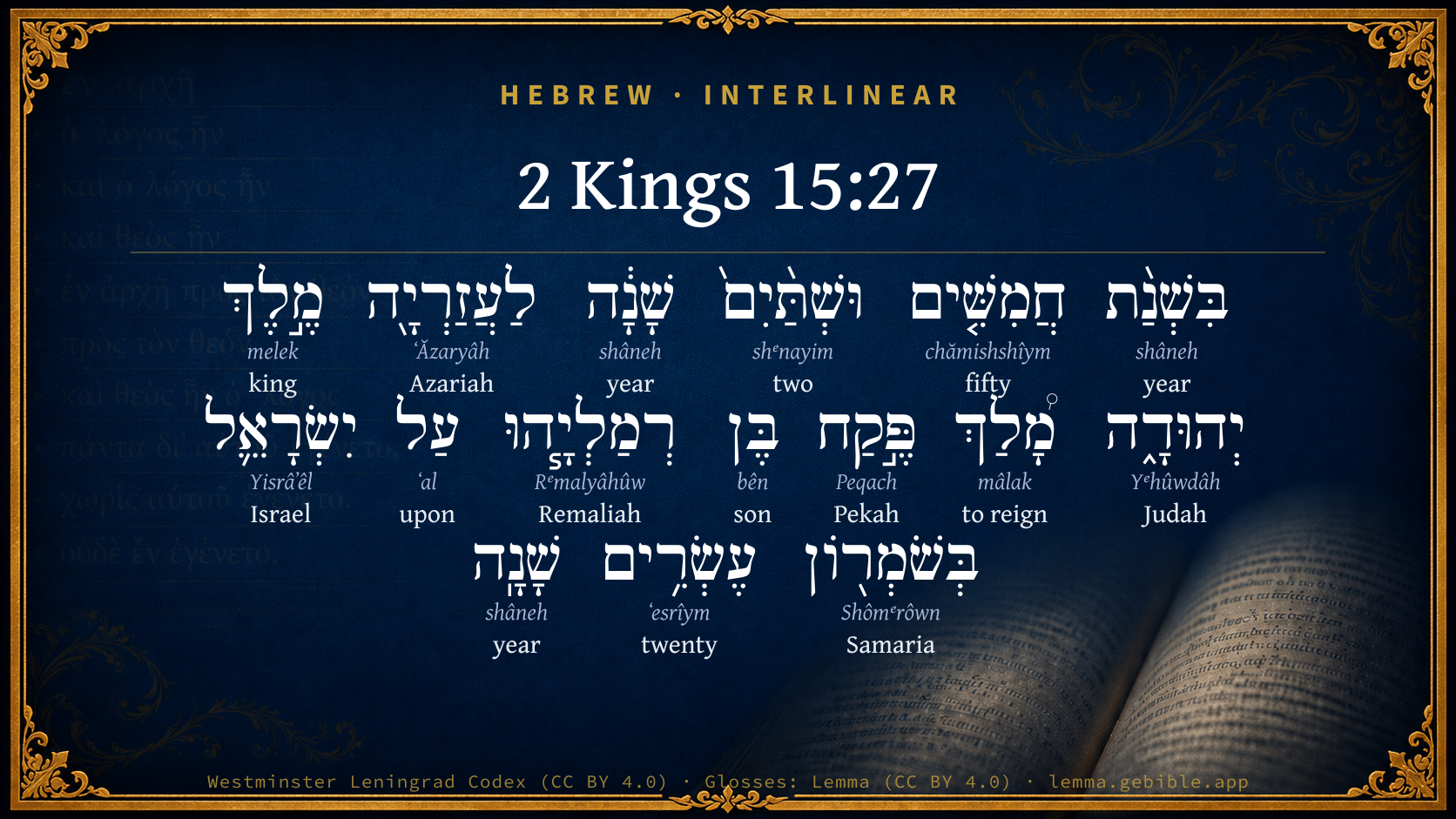
2 Kings 15:27

Hebrew (Westminster Leningrad Codex) 2 Kings 15:27 appears in the Hebrew Old Testament. The text above is from the Westminster Leningrad Codex. Each word links to its Strong’s number, a concise gloss, and parsing drawn from the Open Scriptures Hebrew Bible morphology. Click any word for its full Brown-Driver-Briggs (BDB) entry.
Download image
Cite this verse

2 Kings 15:27 (World English Bible). Public Domain. Lemma interlinear Bible study tool, https://lemma.gebible.app/v/2-kings/15/27.

Show BibTeX & RIS
BibTeX
RIS
English Translation
In the two and fiftieth year of Azariah king of Judah Pekah the son of Remaliah began to reign over Israel in Samaria, [and reigned] twenty years.
World English Bible · Public Domain
Download a study sheet

One document with this verse’s original text, its word-by-word gloss line, the meaning frame, cross-references with their text, attributed commentary, and full source and license credits — printable, and it pastes into notes with its structure intact.

This verse Autodidact and up

Study sheet (.html) Plain text (.txt)

A passage Seminary Student

Up to 50 verses in one chapter. A passage sheet keeps up to 6 commentary sources and 12 cross-references per verse, in the order this page ranks them, and says so on the sheet whenever that leaves anything out. Ask for a single verse and you get the Autodidact verse sheet above.

Everything on this page stays free to read, with no account — the sheet is a download of what is already on screen, not access to it.

Want to remove ads? Support Godless Engineer
Compare translations 3

The same verse in 3 English versions, stacked beneath the original-language interlinear above. Click any original word for its lexicon entry.

Each is an independent rendering of the whole verse — the interlinear is not word-aligned to these translations.

Highlighted words mark where these versions differ — a whole-verse word diff, not a word-by-word alignment.

  • World English Bible Public Domain
    In the two and fiftieth year of Azariah king of Judah Pekah the son of Remaliah began to reign over Israel in Samaria, [and reigned] twenty years.
  • King James Version Public Domain
    In the two and fiftieth year of Azariah king of Judah Pekah the son of Remaliah began to reign over Israel in Samaria, and reigned twenty years.
  • unfoldingWord Literal Text CC BY-SA 4.0
    In the year of 52, the year to Azariah, the king of Judah, Pekah, the son of Remaliah, reigned over Israel in Samaria, 20 years.

unfoldingWord Literal Text — © unfoldingWord, licensed CC BY-SA 4.0. Word-aligned USFM3 via Door43 (git.door43.org/unfoldingWord/en_ult).

Versions to compare (up to 4)

3 of 4 selected

Show all 18 translations

Every available English version of this verse, each an independent rendering of the whole verse.

  • World English Bible Public Domain
    In the two and fiftieth year of Azariah king of Judah Pekah the son of Remaliah began to reign over Israel in Samaria, [and reigned] twenty years.
  • Berean Standard Bible Public Domain
    In the fifty-second year of Azariah’s reign over Judah, Pekah son of Remaliah became king of Israel, and he reigned in Samaria twenty years.
  • Majority Standard Bible Public Domain
    In the fifty-second year of Azariah’s reign over Judah, Pekah son of Remaliah became king of Israel, and he reigned in Samaria twenty years.
  • King James Version Public Domain
    In the two and fiftieth year of Azariah king of Judah Pekah the son of Remaliah began to reign over Israel in Samaria, and reigned twenty years.
  • American Standard Version (1901) Public Domain
    In the two and fiftieth year of Azariah king of Judah Pekah the son of Remaliah began to reign over Israel in Samaria, `and reigned' twenty years.
  • Revised Version (1885) Public Domain
    In the two and fiftieth year of Azariah king of Judah Pekah the son of Remaliah began to reign over Israel in Samaria, and reigned twenty years.
  • Geneva Bible (1599) Public Domain
    In the two and fiftieth yere of Azariah King of Iudah began Pekah the sonne of Remaliah to reigne ouer Israel in Samaria, and reigned twentie yeere.
  • Douay-Rheims (1899) Public Domain
    In the two and fiftieth year of Azarias king of Juda reigned Phacee the son of Romelia over Israel in Samaria twenty years.
  • Young's Literal Translation Public Domain
    In the fifty and second year of Azariah king of Judah, reigned hath Pekah son of Remaliah over Israel, in Samaria -- twenty years,
  • Literal Standard Version CC BY-SA 4.0
    In the fifty-second year of Azariah king of Judah, Pekah son of Remaliah has reigned over Israel in Samaria, twenty years,
  • Unlocked Literal Bible CC BY-SA 4.0
    In the fifty-second year of Azariah king of Judah, Pekah son of Remaliah began to reign over Israel in Samaria; he reigned twenty years.
  • unfoldingWord Literal Text CC BY-SA 4.0
    In the year of 52, the year to Azariah, the king of Judah, Pekah, the son of Remaliah, reigned over Israel in Samaria, 20 years.
  • Darby Bible Public Domain
    In the fifty-second year of Azariah king of Judah, Pekah the son of Remaliah began to reign over Israel in Samaria, for twenty years.
  • World Messianic Bible Public Domain
    In the fifty-second year of Azariah king of Judah, Pekah the son of Remaliah began to reign over Israel in Samaria for twenty years.
  • Webster's Bible Public Domain
    In the two and fiftieth year of Azariah king of Judah, Pekah the son of Remaliah began to reign over Israel in Samaria, and reigned twenty years.
  • Free Bible Version CC BY-SA 4.0
    Pekah, son of Remaliah, became king of Israel in the fifty-second year of the reign of King Azariah of Judah. He reigned in Samaria for twenty years.
  • Bible in Basic English Public Domain
    In the fifty-second year of Azariah, king of Judah, Pekah, the son of Remaliah, became king over Israel in Samaria, ruling for twenty years.
  • JPS Tanakh (1917) Public Domain
    In the two and fiftieth year of Azariah king of Judah Pekah the son of Remaliah began to reign over Israel in Samaria, and reigned twenty years.

Literal Standard Version (2020), Covenant Press — licensed CC BY-SA 4.0. Text via the HelloAO Bible API (eBible.org). Unlocked Literal Bible (unfoldingWord) — licensed CC BY-SA 4.0. Text via the HelloAO Bible API (eBible.org). unfoldingWord Literal Text — © unfoldingWord, licensed CC BY-SA 4.0. Word-aligned USFM3 via Door43 (git.door43.org/unfoldingWord/en_ult). Free Bible Version, Dr. Jonathan Gallagher — licensed CC BY-SA 4.0. Text via the HelloAO Bible API (eBible.org).

Word by word

More ways to search: Search by grammar → Find every occurrence → Compare this word →

Practice this passage: Drill this verse → Learn its vocabulary →

פֶּ֣קַח
Peqach
H6492
“Pekah”
Noun, Proper
Part of Speech
Noun
Type
Proper
Full BDB Definition

Origin: from H6491

TWOT: None

Pekah = "opened" - son of Remaliah, originally a captain of king Pekahiah of Israel, murdered Pekahiah, usurped the throne and became the 18th king of the northern kingdom of Israel
  1. בִּשְׁנַ֨ת shâneh H8141 “in/at · year of” Preposition + Noun, Common, Feminine, Singular, Construct
  2. חֲמִשִּׁ֤ים chămishshîym H2572 “fifty” Adjective, Cardinal number, Both, Plural, Absolute
  3. וּשְׁתַּ֨יִם֙ shᵉnayim H8147 “and · two” Conjunction + Adjective, Cardinal number, Feminine, Dual, Absolute
  4. שָׁנָ֔ה shâneh H8141 “year” Noun, Common, Feminine, Singular, Absolute
  5. לַעֲזַרְיָ֖ה ʻĂzaryâh H5838 “to/for · Azariah” Preposition + Noun, Proper
  6. מֶ֣לֶךְ melek H4428 “king of” Noun, Common, Masculine, Singular, Construct
  7. יְהוּדָ֑ה Yᵉhûwdâh H3063 “Judah” Noun, Proper
  8. מָ֠לַךְ mâlak H4427 “to reign” Verb, Qal, Perfect, 3rd Person, Masculine, Singular
  9. בֶּן bên H1121 “son of” Noun, Common, Masculine, Singular, Construct
  10. רְמַלְיָ֧הוּ Rᵉmalyâhûw H7425 “Remaliah” Noun, Proper
  11. עַל ʻal H5921 “upon” Preposition
  12. יִשְׂרָאֵ֛ל Yisrâʼêl H3478 “Israel” Noun, Proper
  13. בְּשֹׁמְר֖וֹן Shômᵉrôwn H8111 “in/at · Samaria” Preposition + Noun, Proper
  14. עֶשְׂרִ֥ים ʻesrîym H6242 “twenty” Adjective, Cardinal number, Both, Plural, Absolute
  15. שָׁנָֽה shâneh H8141 “year” Noun, Common, Feminine, Singular, Absolute

About this verse

These counts appear in no published source. They are computed here, from the morphology-tagged text and Lemma’s own curated glosses. What Lemma adds →

16
words
14
distinct lemmas
Historical
section

Notable vocabulary

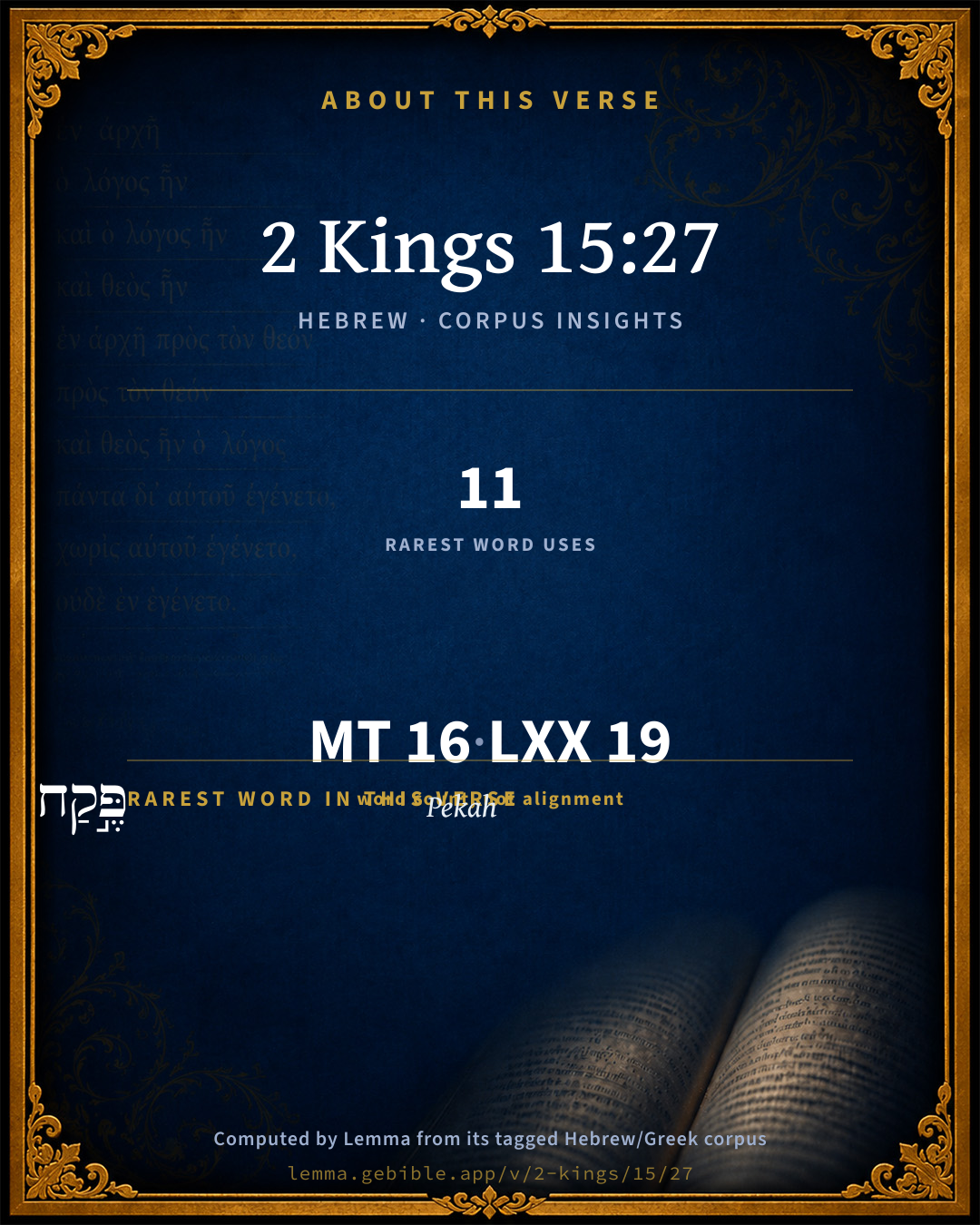
The rarest word here is פֶּ֣קַח Pekah H6492 — appearing just 11 times in the whole Hebrew Bible.

Shared distinctive vocabulary

פֶּ֣קַח Pekah H6492 occurs in 11 verses of the Hebrew Bible. Also found in:

Grammatical profile

  • 1 verb
  • 11 nouns
  • 3 adjectives
  • 1 preposition

Verb forms

  • מָ֠לַךְ Qal · Perfect

Repetition

A word recurs within this verse — often emphatic in Hebrew:

  • בִּשְׁנַ֨ת year H8141 ×3

Hebrew & Septuagint length

In English translation the verse runs 27 words from the Hebrew and 23 from the Septuagint (LXX English) — closely comparable.

A rough comparison of the two English renderings, which tokenize alike — not a word-level alignment.

Word counts can differ between the Hebrew and the Greek without any difference in meaning — e.g. the Hebrew direct-object marker אֵת has no separate Greek word, and Greek often adds the article ὁ.

In the original languages it is 16 Hebrew tokens and 19 Greek tokens — but the two are counted differently (Hebrew bundles its prefixes and suffixes into one token; the Greek is in lemma form), so that isn’t a like-for-like length.

Cross-references

10

Topical passages linked to 2 Kings 15:27 in the Treasury of Scripture Knowledge — connected by theme and wording, ordered by reader-vote popularity; previews shown in the World English Bible.

  • 2 Kings 15:23 In the fiftieth year of Azariah king of Judah Pekahiah the son of Menahem began to reign over Israel in Samaria, [and reigned] two years.
  • Isaiah 7:1 It happened in the days of Ahaz the son of Jotham, the son of Uzziah, king of Judah, that Rezin the king of Syria, and Pekah the son of Remaliah, king of Israel, went up to Jerusalem to war against it, but could not prevail against it.
  • Isaiah 7:4 Tell him, 'Be careful, and keep calm. Don't be afraid, neither let your heart be faint because of these two tails of smoking firebrands, for the fierce anger of Rezin and Syria, and of the son of Remaliah.
  • 2 Kings 15:2 Sixteen years old was he when he began to reign; and he reigned fifty-two years in Jerusalem: and his mother's name was Jecoliah of Jerusalem.
  • 2 Kings 15:8 In the thirty-eighth year of Azariah king of Judah did Zechariah the son of Jeroboam reign over Israel in Samaria six months.
  • 2 Kings 15:13 Shallum the son of Jabesh began to reign in the nine and thirtieth year of Uzziah king of Judah; and he reigned the space of a month in Samaria.
  • 2 Kings 15:25 Pekah the son of Remaliah, his captain, conspired against him, and struck him in Samaria, in the castle of the king's house, with Argob and Arieh; and with him were fifty men of the Gileadites: and he killed him, and reigned in his place.
  • 2 Kings 15:37 In those days Yahweh began to send against Judah Rezin the king of Syria, and Pekah the son of Remaliah.
  • 2 Chronicles 28:6 For Pekah the son of Remaliah killed in Judah one hundred twenty thousand in one day, all of them valiant men; because they had forsaken Yahweh, the God of their fathers.
  • Isaiah 7:9 and the head of Ephraim is Samaria, and the head of Samaria is Remaliah's son. If you will not believe, surely you shall not be established.'"

Cross-references courtesy of OpenBible.info (CC BY 4.0).

Hebrew and Greek witnesses Masoretic Hebrew ↔ Greek Septuagint

The same verse in the two great witnesses to the Old Testament, shown verse-for-verse.

These are two independent witnesses, not word-aligned to each other, and the Septuagint is shown in lemma (dictionary) form.

Hebrew 2 Kings 15:27 Masoretic · Westminster Leningrad Codex

בִּשְׁנַ֨ת חֲמִשִּׁ֤ים וּשְׁתַּ֨יִם֙ שָׁנָ֔ה לַעֲזַרְיָ֖ה מֶ֣לֶךְ יְהוּדָ֑ה מָ֠לַךְ פֶּ֣קַח בֶּן רְמַלְיָ֧הוּ עַל יִשְׂרָאֵ֛ל בְּשֹׁמְר֖וֹן עֶשְׂרִ֥ים שָׁנָֽה

In the two and fiftieth year of Azariah king of Judah Pekah the son of Remaliah began to reign over Israel in Samaria, [and reigned] twenty years.

World English Bible · Public Domain

Greek LXX 2 Kings 15:27 Septuagint · lemma form

ἐν ἔτος πεντηκοστός καί δεύτερος ὁ αζαριας βασιλεύς ιουδα βασιλεύω φακεε υἱός ρομελιας ἐπί ἰσραήλ ἐν σαμαρεία εἴκοσι ἔτος

In the fifty-second year of Azarias king of Juda began Phakee the son of Romelias to reign over Israel in Samaria twenty years.

LXX2012 (modern English Septuagint) · Public Domain

On this verse, Keil & Delitzsch discusses the Septuagint’s reading. Read the note in Commentary ↓

Hebrew: Westminster Leningrad Codex (CC BY 4.0). Greek: Septuagint (public domain); English from LXX2012 (modern English Septuagint) (Public Domain). How the Septuagint differs from the Hebrew →

Targum (Aramaic paraphrase)

1

The Targum is the ancient Jewish Aramaic paraphrase of the Hebrew Scriptures — an interpretive translation, not the Hebrew text itself. Onkelos (literal) and Pseudo-Jonathan (expansive) render the Torah, and Jonathan the Prophets. Coverage is partial: where no permissively-licensed English translation exists for a verse, only the Aramaic is shown. This is verse-level text, not a word-by-word alignment to the Hebrew.

  1. Targum Jonathan Prophets (Joshua–Malachi)
    בִּשְׁנַת חַמְשִׁין וְתַרְתֵּין שְׁנִין לַעֲזַרְיָה מֶלֶךְ שִׁבְטָא דְבֵית יְהוּדָה מְלַךְ פֶּקַח בַּר רְמַלְיָהוּ עַל יִשְׂרָאֵל בְּשֹׁמְרוֹן עַסְרִין שְׁנִין:

    (no public-domain English translation for this verse)

    Targum Jonathan — Aramaic: “Mikraot Gedolot” (public domain). English: “Sefaria Community Translation” (CC0 1.0 (public-domain dedication)); “London "Chaldee Paraphrase," 1871” (public domain). Text via Sefaria.

Commentary

Notes on 2 Kings 15:27 from classic Christian and Jewish commentators (each source and its license shown beneath its notes). The classic Christian expositions comment on the surrounding passage and are grouped to its opening verse, so a note may address several verses; the Jewish commentaries on the Tanakh (Rashi and others) are per-verse, so they appear only where the commentator wrote on this verse.

Lemma curates 59 commentaries, every one of them public domain or Creative Commons licensed, each selected and text-cleaned for this edition rather than reprinted as found. About our sources →

Trapp's Complete Commentary

John Trapp

2Ki 15:27 In the two and fiftieth year of Azariah king of Judah Pekah the son of Remaliah began to reign over Israel in Samaria, [and reigned] twenty years.

Ver. 27. And he reigned twenty years.] Not without many troubles, and at last a violent death. {2Ki 15:30}

John Trapp, A Commentary or Exposition upon All the Books of the Old and New Testament (1647–1656) — public domain. Text from a community e-Sword module.

Joseph Benson's Commentary

2Ki 15:27. In the two and fiftieth year of Azariah Pekah began to reign — This is the fifth king that reigned over Israel during the reign of Azariah king of Judah. Pekah, however, reigned much longer than any of the preceding four. For though he also, like Shallum and Menahem, got the kingdom by treason and blood, he kept possession of it twenty years. So long it was before his violent dealing returned upon his own head. And he made himself more noted abroad than any of these usurpers; for even in the latter part of his time, in the reign of Ahaz, (which began in his seventeenth year,) he was a great terror to the kingdom of Judah, as we find, Isa 7:1. Mr. Locke justly observes, that the prophecies of Hosea, Joel, and Amos, come in here, who all prophesied about this time.

Joseph Benson's Commentary on the Old and New Testaments (1811–1818) — public domain. Text from a community e-Sword module.

Whedon's Commentary on the Bible

Daniel D. Whedon

REIGN OF PEKAH, 2Ki_15:27-31.

27. Pekah… twenty years — According to Bahr we should here read thirty years. Pekah’s reign is especially noted for its connexion with Syrian and Assyrian wars. After Tiglath-pileser’s first invasion Pekah, and Rezin king of Syria, made a league against Judah, and proposed to reduce Jerusalem, and make a “son of Tabeal” king there in place of Ahaz. 2Ki_16:5; Isa_7:1-2; Isa_7:6. This led Ahaz to seek an alliance with Tiglath-pileser, who immediately marched against Damascus, captured the city, and carried its inhabitants into captivity. 2Ki_16:9.

Daniel D. Whedon (gen. ed.), Commentary on the Old and New Testaments (1874–1909) — public domain. Text from a community e-Sword module.

Tyndale Open Study Notes

Tyndale Open Resources

15:27 fifty-second year of King Uzziah’s reign: The date for Pekah’s accession is the final year of Uzziah’s reign (740 BC). Because of the standing relationship between Tiglath-pileser and Menahem, Pekah confined his influence to Gilead during Menahem’s reign (752–742 BC). With Menahem’s death, Pekahiah made Pekah an army commander. This provided Pekah with a broader base of support and gave him opportunity to seize the throne of Israel in 740 BC.

Tyndale Open Study Notes — © Tyndale Open Resources, licensed CC BY-SA 4.0. Text via the HelloAO Bible API.

Ellicott's Commentary for English Readers

(27-31) THE REIGN OF PEKAH, SON OF REMALIAH, IN SAMARIA.

(27) Reigned twenty years.—This does not agree with the duration assigned to the reign of Jotham (2Ki_15:33), and the year assigned as the beginning of Hoshea’s reign (2Ki_17:1). For, according to 2Ki_15:32, Pekah had reigned about two years when Jotham succeeded in Judah, and Jotham reigned sixteen years; and, according to 2Ki_17:1, Pekah was succeeded by Hoshea in the twelfth year of Jotham’s successor, Ahaz. These data make the duration of Pekah’s reign from twenty-eight to thirty years. We must, therefore, either assume, with Thenius, that “the numeral sign for 30 (ל) has been corrupted into 20 (כ),” or, with Ewald, that “and nine” has been accidentally omitted after “twenty.”

(29) Tiglath-pileser.—This Assyrian sovereign, who reigned from 745 to 727 B.C. , is called in his own inscriptions, Tukulti- (or Tuklat) ‘abal-Esarra, which Schrader renders, “my trust is Adar”—literally, Trust is the son of the temple of Sarra. (See Note on 1Ch_5:26.) “The idea we get of this king from the remains of these inscriptions corresponds throughout to what we know of him from the Bible. Everywhere he is presented as a powerful warrior-king, who subjugated the entire tract of anterior Asia, from the frontier mountains of Media in the east to the Mediterranean sea in the west, including a part of Cappadocia” (Schrader, K.A.T., p. 247).

Took Ijon, and Abel-beth-maachah . . . all the land of Naphtali.—Comp. 1Ki_15:20.

Janoah.—Not the border-town between Ephraim and Manasseh (Jos_16:6), as the context requires a place in the northernmost part of Israel.

Kedesh.—On the western shore of the waters of Merom (Jos_21:37).

Hazor.—See 1Ki_9:15.

Gilead.—See 2Ki_14:25; 1Ch_5:26. It was no long time since Jeroboam II. had recovered it for Israel. According to Schrader (K.A.T., pp. 254, seq.) the reference of the verse is to Tiglath Pileser’s expedition in B.C. 734, called in the Eponym list an expedition to the land of Pilista (Philistia). With this Schrader connects a fragment of the annals which begins with a list of towns conquered by Tiglath, and ends thus: . . . “the town of Gaal (ad) . . . (A) bil . . . of the upper part of the land of Beth-Omri (i.e., Samaria) . . . in its whole extent I annexed to the territory of Assyria; my prefects the sagans I appointed over them.” The fragment goes on to mention the flight of Hânûn, king of Gaza, to Egypt, and the carrying off of his goods and his gods by the conqueror. It is added, “The land of Beth-Omri . . . the whole body of his men, their goods, to the land of Assyria I led away, Pakaha (i.e., Pekah) their king I slew (so Schrader;? ‘they slew’), and A-u-si-ha (i.e., Hoshea) . . . over them I appointed. Ten (talents of gold, 1,000 talents of silver) 1 received from them.”

(30) Hoshea . . . slew him, and reigned in his stead.—See the inscription of Tiglath Pileser, quoted in the last Note, from which, as Schrader remarks, it is clear that Hoshea only secured his hold on the crown by recognition of the suzerainty of Assyria. The brief record of Kmgs does not mention this; but 2Ki_17:3 represents Hoshea as paying tribute to Shalmaneser IV., the successor of Tiglath.

In the twentieth year of Jotham.—This is a suspicious statement, as not agreeing with 2Ki_15:33, according to which Jotham reigned sixteen years only.

A Bible Commentary for English Readers, edited by Charles John Ellicott (1878–1897) — public domain. Text from a community e-Sword module.

The Cambridge Bible for Schools and Colleges

gen. ed. J. J. S. Perowne

27–31. Pekah king of Israel for twenty years. Invasion of Israel by Tiglath-pileser. Pekah is slain by Hoshea (Not in Chronicles)

27. Pekah the son of Remaliah] This king is chiefly remarkable because of the attempts which he made against the kingdom of Judah, and which gave rise to the prophecies recorded in Isaiah 7-9. On the history of these attacks on the sister kingdom, see notes on 2Ki_16:5-9. Isaiah often speaks of Pekah as ‘the son of Remaliah’ only, without mention of his own name, so that we are led to conclude that Remaliah must have been some well-known person.

The Cambridge Bible for Schools and Colleges (gen. ed. J. J. S. Perowne; Cambridge University Press, 1878–1918) — public domain. Text from a community e-Sword module.

John Gill's Exposition

And Jotham slept with his fathers, and was buried with his fathers in the city of David his father,.... Died, and was buried with the kings of Judah in their sepulchres:

and Ahaz his son reigned in his stead; an account of whose reign we have in the next chapter.

Next: 2 Kings Chapter 16

John Gill's Exposition of the Whole Bible (1746–1763) — public domain (CC PDM 1.0). Text via the HelloAO Bible API.

Haydock's Catholic Bible Commentary

Romelia. St. Jerome (ep. 142.) places the birth of Romulus in this year, which preceded the famous Olympiads. But Salien differs that event 14 years. (The year before Christ 769.) (Haydock)

George Leo Haydock (1774–1849), Haydock's Catholic Family Bible and Commentary, 1859 edition — public domain. Excludes Psalms (Douay-Rheims chapter numbering differs from Protestant) and Deuterocanonical books (Catholic canon only).

The Pulpit Commentary

Vers. 27-31. REIGN OF PEKAH. The writer is again exceedingly brief. Pekah"s reign was a remarkable one, and might have furnished much material to the historian. In conjunction with Rezin of Damascus, he made war upon Judaea, defeated Ahaz with great loss, (2Ch_28:6) and laid siege to Jerusalem. (Isa_7:1) Ahaz called in the aid or" Assyria, and Tiglath-pileser made two expeditions into Palestine the one mentioned in ver. 29, and another some years afterwards. In the latter he seems to have had the assistance of Hoshea, who, with his sanction, slew Pekah, and became king. The scanty notices of our author must be supplemented from 2Ch 28; Isa_7:1-9 Isa_8:1-8; and the Assyrian inscriptions. In the two and fiftieth year of Azariah King of Judah; rather, in the thirty-ninth or thirty-eighth year (see the comment on ver. 23). Pekahiah"s "two years" may not have been complete. Pekah the son of Remaliah began to reign over Israel in Samaria, and reigned twenty years. The Assyrian records make this number impossible. Tiglath-pileser"s entire reign lasted only eighteen years, yet it more than covered the entire reign of Pekah. When he first invaded the kingdom of Samaria, Menahem was upon the throne ("Eponym Canon," p. 120, line 29); when he last attacked it, probably in B.C. 730 two years before his death in B.C. 728 he set up Hoshea, or, at any rate, sanctioned his usurpation (ibid., pp. 123, 124, lines 15-18). Pekah"s entire reign must have come in the interval, which is certainly not more than one of fifteen, probably not more than one of ten years.

The Pulpit Commentary (1880–1919), ed. H.D.M. Spence-Jones & Joseph S. Exell — public domain. Text from a community e-Sword module.

Keil & Delitzsch

C. F. Keil & F. Delitzsch

Reign of Pekah. - Pekah the son of Remaliah reigned twenty years.

(Note: As this is apparently at variance not only with Kg2 15:30, according to which Pekah was slain in the twentieth year of Jotham, i.e., in the fourth year of Ahaz, abut also with Kg2 17:1, according to which Hosea the murderer of Pekah became king in the twelfth year of Ahaz and reigned nine years, Ewald has added ותשׁע after עשׂרים without any hesitation, and lengthened Pekah's reign to twenty-nine years, whereas Thenius proposes to alter twenty into thirty. But we do not thereby obtain an actual agreement either with Kg2 15:30 or with Kg2 17:1, so that in both these passages Thenius is obliged to make further alterations in the text. For instance, if Pekah had reigned for thirty years from the fifty-second or closing year of Uzziah's reign, Hosea would have ascended the throne in the fourteenth year of Ahaz, supposing that he really became king immediately after the murder of Pekah, and not in the twelfth, as is stated in Kg2 17:1. It is only with a reign of twenty-eight years and a few months (one year of Uzziah, sixteen of Jotham, and eleven of Ahaz), which might be called twenty-nine years, that the commencement of Hosea's reign could fall in the twelfth year of Ahaz. But the discrepancy with Kg2 15:30, that Hosea conspired against Pekah and slew him in the twentieth year of Jotham, is not removed thereby. For further remarks see at Kg2 15:30 and Kg2 17:1.)

During his reign the Assyrian king Tiglath-pileser came, and after conquering the fortified cities round Lake Merom took possession of Gilead and Galilee, namely the whole land of Naphtali, and led the inhabitants captive to Assyria. Tiglath-pileser (פּלאסר תּגלת or פּלסר תּגלת, Kg2 16:7; פּלנאסר or פּלנסר תּלגת פּלנסר, Ch1 5:26, and Ch2 28:20; Θεγλαθφαλασάρ or Θαλγαθφελλασάρ, lxx; written Tiglat-palatsira or Tiglat-palatsar on the Assyrian monuments, and interpreted by Gesenius and others "ruler of the Tigris," although the reading of the name upon the monuments is still uncertain, and the explanation given a very uncertain one, since Tiglat or Tilgat is hardly identical with Diglath = Tigris, but is probably a name of the goddess Derketo, Atergatis), was, according to M. v. Niebuhr (pp. 156, 157), the last king of the Derketade dynasty, who, when the Medes and Babylonians threw off the Assyrian supremacy after the death of Pul, attempted to restore and extend the ancient dominion.

(Note: M. Duncker (Gesch. des Alterthums, i. pp. 658, 659) also assumes that the dynasty changed with the overthrow of the Derketades, but he places it considerably earlier, about the year 900 or 950 b.c., because on the one hand Niebuhr's reasons for his view cannot be sustained, and on the other hand there are distinct indications that the change in the reigning family must have taken place about this time: viz., 1. in the ruins of the southern city of Nineveh, at Kalah, where we find the remains of the palace of two rulers, who sat upon the throne of Assyria between the years 900 and 830, whereas the castles of Ninos and his descendants must undoubtedly have stood in the northern city, in Nineveh; 2. in the circumstance that from the time mentioned the Assyrian kingdom advanced with fresh warlike strength and in a fresh direction, which would agree with the change in the dynasty. - Which of these two assumptions is the correct one, cannot yet be decided in the present state of the researches on this subject.)

His expedition against Israel falls, according to Kg2 15:29 and Kg2 16:9, in the closing years of Pekah, when Ahaz had come to the throne in Judah. The enumeration of his conquests in the kingdom of Israel commences with the most important cities, probably the leading fortifications. Then follow the districts of which he took possession, and the inhabitants of which he led into captivity. The cities mentioned are Ijon, probably the present Ayun on the north-eastern edge of the Merj Ayun; Abel-beth-maacah, the present Abil el Kamh, on the north-west of Lake Huleh (see at Kg1 15:20); Janoach, which must not be confounded with the Janocha mentioned in Jos 16:6-7, on the border of Ephraim and Manasseh, but is to be sought for in Galilee or the tribe-territory of Naphtali, and has not yet been discovered; Kedesh, on the mountains to the west of Lake Huleh, which has been preserved as an insignificant village under the ancient name (see at Jos 12:22); Hazor, in the same region, but not yet traced with certainty (see at Jos 11:1). Gilead is the whole of the land to the east of the Jordan, the territory of the tribes of Reuben, Gad, and half-Manasseh (Ch1 5:26), which had only been wrested from the Syrians again a short time before by Jeroboam II, and restored to Israel (Kg2 14:25). הגּלילה (the feminine form of הגּליל, see Ewald, 173, h.) is more precisely defined by the apposition "all the land of Naphtali" (see at Kg1 9:11). - In the place of אשּׁוּרה, "to the land of Assyria," the different regions to which the captives were transported are given in Ch1 5:26. For further remarks on this point see at Kg2 17:6.

Keil & Delitzsch — Biblical Commentary on the Old Testament (1861–1891) — public domain (CC PDM 1.0). Text via the HelloAO Bible API. (Old Testament only.)

unfoldingWord translationNotes

Door43 World Missions Community

In the fifty-second year of Azariah king of Judah

It can be stated clearly that this is the fifty-second year of his reign. AT: "In year 52 of the reign of Azariah king of Judah" (See: Assumed Knowledge and Implicit Information and Numbers)

what was evil in the sight of Yahweh

The sight of Yahweh represents Yahweh's judgment. See how you translated this in 2 Kings 3:2. AT: "what was evil in Yahweh's judgment" or "what Yahweh considers to be evil" (See: Metaphor)

He did not depart from the sins of Jeroboam son of Nebat

Departing from sins represents refusing to do those sins. AT: "Zechariah did not refuse to commit the sins of Jeroboam son of Nebat" or "He sinned as Jeroboam son of Nebat had sinned" (See: Metaphor)

translationWords

evil

Yahweh

sin

Jeroboam

unfoldingWord translationNotes — © Distant Shores Media and the Door43 World Missions Community, licensed CC BY-SA 4.0. Source: git.door43.org/Door43/en_tn.

Lesson kit

Teaching starters — assembled from the data on this page, not authored interpretation. Every prompt links to the verse data it draws on. Edit before teaching.

2 Kings, in the Historical, opens this verse with 16 words (14 distinct Hebrew lemmas). Its most distinctive word is Peqach (“Pekah”). A historical commentator’s framing appears above. Read the whole chapter for the surrounding context.

Discussion questions

  1. How does “Pekah” (Peqach) shape what this verse is saying?
  2. How does 2 Kings 15:25, which shares the word «Pekah», read alongside this verse?
  3. What does the repetition of “year” (3× in this one verse) do in this verse?
  4. These translations render this verse differently. What is at stake in choosing one wording over another?
  5. «מָ֠לַךְ» is a Qal Perfect verb. How does that grammatical form shape the action described?
  6. Compare how Trapp's Complete Commentary and Joseph Benson's Commentary read this verse. Where do they agree or differ?

Things to notice

Reading settings

Reading text

Shown beneath each verse's original-language words.

Old Testament
Old Testament edition

Read the OT as the Masoretic Hebrew (MT) or the Greek Septuagint (LXX).

English shown for the Greek Septuagint (in the Hebrew ↔ Greek comparison).

Comparing translations? Open the Compare panel on any verse page to stack up to four side by side.