
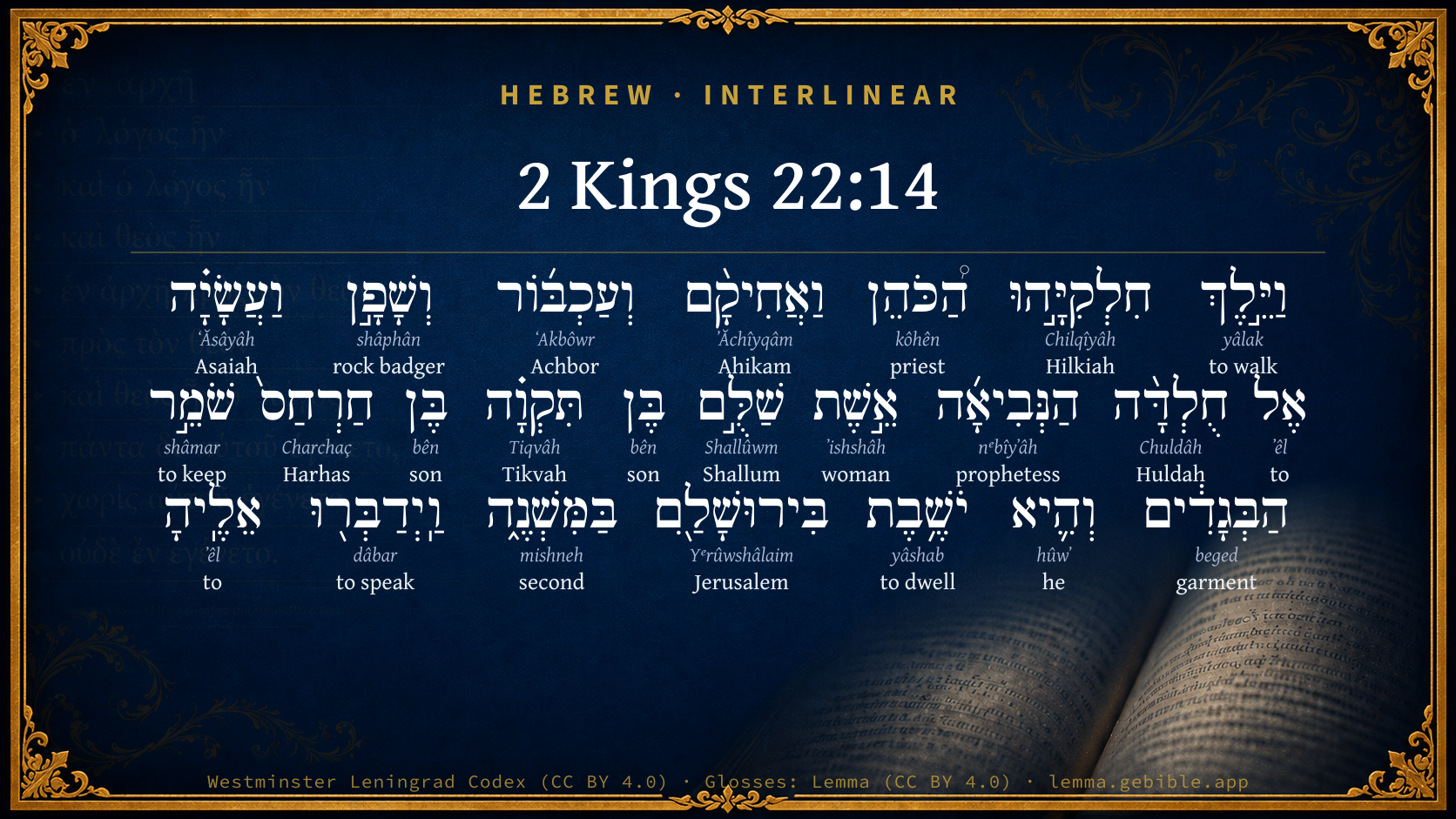
2 Kings 22:14

Hebrew (Westminster Leningrad Codex) 2 Kings 22:14 appears in the Hebrew Old Testament. The text above is from the Westminster Leningrad Codex. Each word links to its Strong’s number, a concise gloss, and parsing drawn from the Open Scriptures Hebrew Bible morphology. Click any word for its full Brown-Driver-Briggs (BDB) entry.
Download image
Cite this verse

2 Kings 22:14 (World English Bible). Public Domain. Lemma interlinear Bible study tool, https://lemma.gebible.app/v/2-kings/22/14.

Show BibTeX & RIS
BibTeX
RIS
English Translation
So Hilkiah the priest, and Ahikam, and Achbor, and Shaphan, and Asaiah, went to Huldah the prophetess, the wife of Shallum the son of Tikvah, the son of Harhas, keeper of the wardrobe (now she lived in Jerusalem in the second quarter); and they talked with her.
World English Bible · Public Domain
Highlights
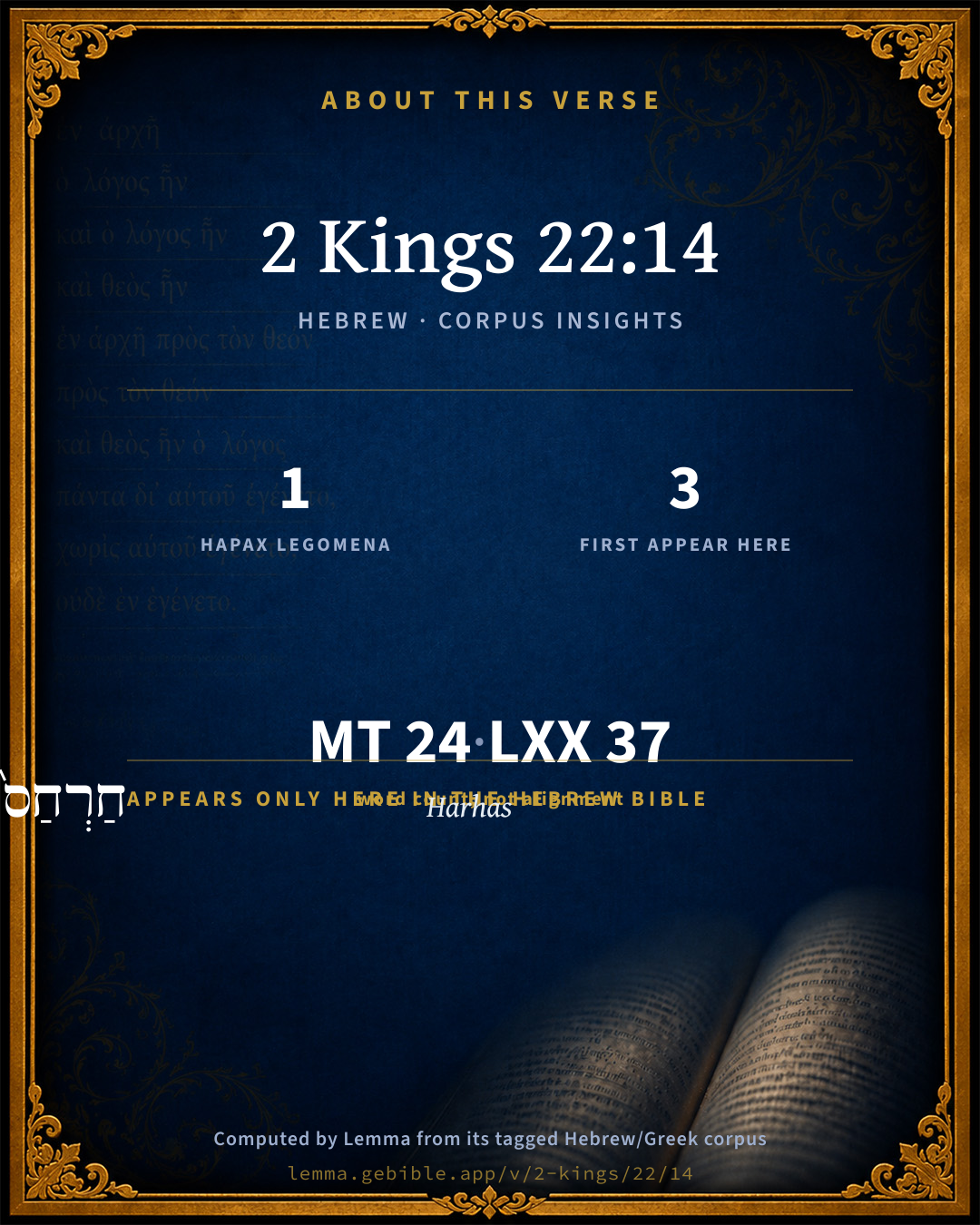
  • 1 hapax legomenon — only here in the Hebrew Bible
  • 3 first appearances in the Hebrew Bible
Full analysis ↓
Download a study sheet

One document with this verse’s original text, its word-by-word gloss line, the meaning frame, cross-references with their text, attributed commentary, and full source and license credits — printable, and it pastes into notes with its structure intact.

This verse Autodidact and up

Study sheet (.html) Plain text (.txt)

A passage Seminary Student

Up to 50 verses in one chapter. A passage sheet keeps up to 6 commentary sources and 12 cross-references per verse, in the order this page ranks them, and says so on the sheet whenever that leaves anything out. Ask for a single verse and you get the Autodidact verse sheet above.

Everything on this page stays free to read, with no account — the sheet is a download of what is already on screen, not access to it.

Want to remove ads? Support Godless Engineer
Compare translations 3

The same verse in 3 English versions, stacked beneath the original-language interlinear above. Click any original word for its lexicon entry.

Each is an independent rendering of the whole verse — the interlinear is not word-aligned to these translations.

Highlighted words mark where these versions differ — a whole-verse word diff, not a word-by-word alignment.

  • World English Bible Public Domain
    So Hilkiah the priest, and Ahikam, and Achbor, and Shaphan, and Asaiah, went to Huldah the prophetess, the wife of Shallum the son of Tikvah, the son of Harhas, keeper of the wardrobe (now she lived in Jerusalem in the second quarter); and they talked with her.
  • King James Version Public Domain
    So Hilkiah the priest, and Ahikam, and Achbor, and Shaphan, and Asahiah, went unto Huldah the prophetess, the wife of Shallum the son of Tikvah, the son of Harhas, keeper of the wardrobe; (now she dwelt in Jerusalem in the college;) and they communed with her.
  • unfoldingWord Literal Text CC BY-SA 4.0
    And Hilkiah the priest went with Ahikam and Akbor and Shaphan and Asaiah to Huldah the prophetess, the wife of Shallum, the son of Tikvah, the son of Harhas, the keeper of the clothes (now she was living in Jerusalem, in the Second Quarter), and they spoke to her.

unfoldingWord Literal Text — © unfoldingWord, licensed CC BY-SA 4.0. Word-aligned USFM3 via Door43 (git.door43.org/unfoldingWord/en_ult).

Versions to compare (up to 4)

3 of 4 selected

Show all 18 translations

Every available English version of this verse, each an independent rendering of the whole verse.

  • World English Bible Public Domain
    So Hilkiah the priest, and Ahikam, and Achbor, and Shaphan, and Asaiah, went to Huldah the prophetess, the wife of Shallum the son of Tikvah, the son of Harhas, keeper of the wardrobe (now she lived in Jerusalem in the second quarter); and they talked with her.
  • Berean Standard Bible Public Domain
    So Hilkiah the priest, Ahikam, Achbor, Shaphan, and Asaiah went and spoke to Huldah the prophetess, the wife of Shallum son of Tikvah, the son of Harhas, the keeper of the wardrobe. She lived in Jerusalem, in the Second District.
  • Majority Standard Bible Public Domain
    So Hilkiah the priest, Ahikam, Achbor, Shaphan, and Asaiah went and spoke to Huldah the prophetess, the wife of Shallum son of Tikvah, the son of Harhas, the keeper of the wardrobe. She lived in Jerusalem, in the Second District.
  • King James Version Public Domain
    So Hilkiah the priest, and Ahikam, and Achbor, and Shaphan, and Asahiah, went unto Huldah the prophetess, the wife of Shallum the son of Tikvah, the son of Harhas, keeper of the wardrobe; (now she dwelt in Jerusalem in the college;) and they communed with her.
  • American Standard Version (1901) Public Domain
    So Hilkiah the priest, and Ahikam, and Achbor, and Shaphan, and Asaiah, went unto Huldah the prophetess, the wife of Shallum the son of Tikvah, the son of Harhas, keeper of the wardrobe (now she dwelt in Jerusalem in the second quarter); and they communed with her.
  • Revised Version (1885) Public Domain
    So Hilkiah the priest, and Ahikam, and Achbor, and Shaphan, and Asaiah, went unto Huldah the prophetess, the wife of Shallum the son of Tikvah, the son of Harhas, keeper of the wardrobe; (now she dwelt in Jerusalem in the second quarter;) and they communed with her.
  • Geneva Bible (1599) Public Domain
    So Hilkiah the Priest and Ahikam, and Achbor and Shaphan, and Asahiah went vnto Huldah the Prophetesse the wife of Shallum, ye sonne of Tikuah, the sonne of Harhas keeper of the wardrobe: (and she dwelt in Ierusalem in the colledge) and they communed with her.
  • Douay-Rheims (1899) Public Domain
    So Helcias the priest, and Ahicam, and Achobor, and Saphan, and Asaia went to Holda the prophetess the wife of Sellum the son of Thecua, the son of Araas keeper of the wardrobe, who dwelt in Jerusalem in the Second: and they spoke to her.
  • Young's Literal Translation Public Domain
    And Hilkiah the priest goeth, and Ahikam, and Achbor, and Shaphan, and Asahiah, unto Huldah the prophetess, wife of Shallum, son of Tikvah, son of Harhas, keeper of the garments, and she is dwelling in Jerusalem in the second, and they speak unto her.
  • Literal Standard Version CC BY-SA 4.0
    And Hilkiah the priest goes, and Ahikam, and Achbor, and Shaphan, and Asahiah, to Huldah the prophetess, wife of Shallum, son of Tikvah, son of Harhas, keeper of the garments, and she is dwelling in Jerusalem in the second [quarter], and they speak to her.
  • Unlocked Literal Bible CC BY-SA 4.0
    So Hilkiah the priest, Ahikam, Akbor, Shaphan, and Asaiah went to Huldah the prophetess, the wife of Shallum son of Tikvah son of Harhas, keeper of the wardrobe (she lived in Jerusalem in the second quarter), and they spoke with her.
  • unfoldingWord Literal Text CC BY-SA 4.0
    And Hilkiah the priest went with Ahikam and Akbor and Shaphan and Asaiah to Huldah the prophetess, the wife of Shallum, the son of Tikvah, the son of Harhas, the keeper of the clothes (now she was living in Jerusalem, in the Second Quarter), and they spoke to her.
  • Darby Bible Public Domain
    And Hilkijah the priest, and Ahikam, and Achbor, and Shaphan, and Asaiah, went to Huldah the prophetess, the wife of Shallum the son of Tikvah, son of Harhas, keeper of the wardrobe: now she dwelt in Jerusalem in the second quarter [of the town]; and they spoke with her.
  • World Messianic Bible Public Domain
    So Hilkiah the priest, Ahikam, Achbor, Shaphan, and Asaiah went to Huldah the prophetess, the wife of Shallum the son of Tikvah, the son of Harhas, keeper of the wardrobe (now she lived in Jerusalem in the second quarter); and they talked with her.
  • Webster's Bible Public Domain
    So Hilkiah the priest, and Ahikam, and Achbor, and Shaphan, and Asahiah, went to Huldah the prophetess, the wife of Shallum the son of Tikvah, the son of Harhas, keeper of the wardrobe; (now she dwelt in Jerusalem in the college;) and they communed with her.
  • Free Bible Version CC BY-SA 4.0
    Hilkiah the priest, Ahikam, Acbor, Shaphan, and Asaiah went and spoke to Huldah the prophetess, the wife of Shallum, son of Tokhath, the son of Hasrah, custodian of the wardrobe. She lived in Jerusalem, in the city's second quarter.
  • Bible in Basic English Public Domain
    So Hilkiah the priest, and Ahikam and Achbor and Shaphan and Asaiah, went to Huldah the woman prophet, the wife of Shallum, the son of Tikvah, the son of Harhas, keeper of the robes, (now she was living in Jerusalem, in the second part of the town;) and they had talk with her.
  • JPS Tanakh (1917) Public Domain
    So Hilkiah the priest, and Ahikam, and Achbor, and Shaphan, and Asaiah, went unto Huldah the prophetess, the wife of Shallum the son of Tikvah, the son of Harhas, keeper of the wardrobe — now she dwelt in Jerusalem in the second quarter — and they spoke with her.

Literal Standard Version (2020), Covenant Press — licensed CC BY-SA 4.0. Text via the HelloAO Bible API (eBible.org). Unlocked Literal Bible (unfoldingWord) — licensed CC BY-SA 4.0. Text via the HelloAO Bible API (eBible.org). unfoldingWord Literal Text — © unfoldingWord, licensed CC BY-SA 4.0. Word-aligned USFM3 via Door43 (git.door43.org/unfoldingWord/en_ult). Free Bible Version, Dr. Jonathan Gallagher — licensed CC BY-SA 4.0. Text via the HelloAO Bible API (eBible.org).

Word by word

More ways to search: Search by grammar → Find every occurrence → Compare this word →

Practice this passage: Drill this verse → Learn its vocabulary →

חַרְחַס֙
Charchaç
H2745
“Harhas”
Noun, Proper
Part of Speech
Noun
Type
Proper
Full BDB Definition

Origin: from the same as H2775

TWOT: None

Harhas = "very poor" - grandfather of Shallum, the husband of Huldah, the prophetess
  1. וַיֵּ֣לֶךְ yâlak H3212 “and · to walk” Conjunction + Verb, Qal, Sequential Imperfect, 3rd Person, Masculine, Singular
  2. חִלְקִיָּ֣הוּ Chilqîyâh H2518 “Hilkiah” Noun, Proper
  3. הַ֠כֹּהֵן kôhên H3548 “the · priest” Particle, Definite Article + Noun, Common, Masculine, Singular, Absolute
  4. וַאֲחִיקָ֨ם ʼĂchîyqâm H296 “and · Ahikam” Conjunction + Noun, Proper
  5. וְעַכְבּ֜וֹר ʻAkbôwr H5907 “and · Achbor” Conjunction + Noun, Proper
  6. וְשָׁפָ֣ן shâphân H8227 “and · rock badger” Conjunction + Noun, Proper
  7. וַעֲשָׂיָ֗ה ʻĂsâyâh H6222 “and · Asaiah” Conjunction + Noun, Proper
  8. אֶל ʼêl H413 “to” Preposition
  9. חֻלְדָּ֨ה Chuldâh H2468 “Huldah” Noun, Proper
  10. הַנְּבִיאָ֜ה nᵉbîyʼâh H5031 “the · prophetess” Particle, Definite Article + Noun, Common, Feminine, Singular, Absolute
  11. אֵ֣שֶׁת ʼishshâh H802 “woman of” Noun, Common, Feminine, Singular, Construct
  12. שַׁלֻּ֣ם Shallûwm H7967 “Shallum” Noun, Proper
  13. בֶּן bên H1121 “son of” Noun, Common, Masculine, Singular, Construct
  14. תִּקְוָ֗ה Tiqvâh H8616 “Tikvah” Noun, Proper
  15. בֶּן bên H1121 “son of” Noun, Common, Masculine, Singular, Construct
  16. שֹׁמֵ֣ר shâmar H8104 “keeping” Verb, Qal, Participle Active, Masculine, Singular, Absolute
  17. הַבְּגָדִ֔ים beged H899 “the · garments” Particle, Definite Article + Noun, Common, Masculine, Plural, Absolute
  18. וְהִ֛יא hûwʼ H1931 “and · he” Conjunction + Pronoun, Personal, 3rd Person, Feminine, Singular
  19. יֹשֶׁ֥בֶת yâshab H3427 “dwelling” Verb, Qal, Participle Active, Feminine, Singular, Absolute
  20. בִּירוּשָׁלִַ֖ם Yᵉrûwshâlaim H3389 “in/at · Jerusalem” Preposition + Noun, Proper
  21. בַּמִּשְׁנֶ֑ה mishneh H4932 “in/at the · second” Preposition, Determined + Noun, Common, Masculine, Singular, Absolute
  22. וַֽיְדַבְּר֖וּ dâbar H1696 “and · to speak” Conjunction + Verb, Piel, Sequential Imperfect, 3rd Person, Masculine, Plural
  23. אֵלֶֽיהָ ʼêl H413 “to · her” Preposition + Suffix, Personal, 3rd Person, Feminine, Singular

About this verse

These counts appear in no published source. They are computed here, from the morphology-tagged text and Lemma’s own curated glosses. What Lemma adds →

24
words
22
distinct lemmas
Historical
section

Notable vocabulary

1 hapax legomenon — a word that appears only here in the entire Hebrew Bible:

  • חַרְחַס֙ Harhas H2745

First appearance in Scripture

These words make their first canonical appearance in the Hebrew Bible here:

  • חֻלְדָּ֨ה Huldah H2468
  • תִּקְוָ֗ה Tikvah H8616
  • חַרְחַס֙ Harhas H2745

Shared distinctive vocabulary

חֻלְדָּ֨ה Huldah H2468 occurs in 2 verses of the Hebrew Bible. Also found in:

Grammatical profile

  • 4 verbs
  • 17 nouns
  • 1 pronoun
  • 2 prepositions

Verb forms

  • וַיֵּ֣לֶךְ Qal · Sequential Imperfect
  • שֹׁמֵ֣ר Qal · Participle Active
  • יֹשֶׁ֥בֶת Qal · Participle Active
  • וַֽיְדַבְּר֖וּ Piel · Sequential Imperfect

Repetition

Words recur within this verse — often emphatic in Hebrew:

Hebrew & Septuagint length

In English translation the verse runs 47 words from the Hebrew and 44 from the Septuagint (LXX English) — closely comparable.

A rough comparison of the two English renderings, which tokenize alike — not a word-level alignment.

Word counts can differ between the Hebrew and the Greek without any difference in meaning — e.g. the Hebrew direct-object marker אֵת has no separate Greek word, and Greek often adds the article ὁ.

In the original languages it is 24 Hebrew tokens and 37 Greek tokens — but the two are counted differently (Hebrew bundles its prefixes and suffixes into one token; the Greek is in lemma form), so that isn’t a like-for-like length.

Cross-references

11

Topical passages linked to 2 Kings 22:14 in the Treasury of Scripture Knowledge — connected by theme and wording, ordered by reader-vote popularity; previews shown in the World English Bible.

  • Judges 4:4 Now Deborah, a prophetess, the wife of Lappidoth, she judged Israel at that time.
  • 2 Chronicles 34:22 So Hilkiah, and they whom the king [had commanded], went to Huldah the prophetess, the wife of Shallum the son of Tokhath, the son of Hasrah, keeper of the wardrobe; (now she lived in Jerusalem in the second quarter;) and they spoke to her to that effect.
  • Exodus 15:20 Miriam the prophetess, the sister of Aaron, took a tambourine in her hand; and all the women went out after her with tambourines and with dances.
  • 2 Kings 10:22 He said to him who was over the vestry, Bring forth vestments for all the worshippers of Baal. He brought them forth vestments.
  • Nehemiah 7:72 That which the rest of the people gave was twenty thousand darics of gold, and two thousand minas of silver, and sixty-seven priests' garments.
  • Micah 6:4 For I brought you up out of the land of Egypt, And redeemed you out of the house of bondage. I sent before you Moses, Aaron, and Miriam.
  • Zephaniah 1:10 In that day, says Yahweh, there will be the noise of a cry from the fish gate, a wailing from the second quarter, and a great crashing from the hills.
  • Luke 1:41–56 It happened, when Elizabeth heard Mary's greeting, that the baby leaped in her womb, and Elizabeth was filled with the Holy Spirit.
  • Luke 2:36 There was one Anna, a prophetess, the daughter of Phanuel, of the tribe of Asher (she was of a great age, having lived with a husband seven years from her virginity,
  • Acts 21:9 Now this man had four virgin daughters who prophesied.
  • 1 Corinthians 11:5 But every woman praying or prophesying with her head unveiled dishonors her head. For it is one and the same thing as if she were shaved.

Cross-references courtesy of OpenBible.info (CC BY 4.0).

Hebrew and Greek witnesses Masoretic Hebrew ↔ Greek Septuagint

The same verse in the two great witnesses to the Old Testament, shown verse-for-verse.

These are two independent witnesses, not word-aligned to each other, and the Septuagint is shown in lemma (dictionary) form.

Hebrew 2 Kings 22:14 Masoretic · Westminster Leningrad Codex

וַיֵּ֣לֶךְ חִלְקִיָּ֣הוּ הַ֠כֹּהֵן וַאֲחִיקָ֨ם וְעַכְבּ֜וֹר וְשָׁפָ֣ן וַעֲשָׂיָ֗ה אֶל חֻלְדָּ֨ה הַנְּבִיאָ֜ה אֵ֣שֶׁת שַׁלֻּ֣ם בֶּן תִּקְוָ֗ה בֶּן חַרְחַס֙ שֹׁמֵ֣ר הַבְּגָדִ֔ים וְהִ֛יא יֹשֶׁ֥בֶת בִּירוּשָׁלִַ֖ם בַּמִּשְׁנֶ֑ה וַֽיְדַבְּר֖וּ אֵלֶֽיהָ

So Hilkiah the priest, and Ahikam, and Achbor, and Shaphan, and Asaiah, went to Huldah the prophetess, the wife of Shallum the son of Tikvah, the son of Harhas, keeper of the wardrobe (now she lived in Jerusalem in the second quarter); and they talked with her.

World English Bible · Public Domain

Greek LXX 2 Kings 22:14 Septuagint · lemma form

καί πορεύομαι χελκιας ὁ ἱερεύς καί αχικαμ καί αχοβωρ καί σαφφαν καί ασαιας πρός ολδαν ὁ προφῆτις γυνή σελλημ υἱός θεκουε υἱός αραας ὁ ἱματιοφύλαξ καί αὐτός καταοἰκέω ἐν ἰερουσαλήμ ἐν ὁ μασενα καί λαλέω πρός αὐτός

So Chelcias the priest went, and Achicam, and Achobor, and Sapphan, and Asaias, to Olda the prophetess, the mother of Sellem the son of Thecuan son of Aras, keeper of the robes; and she lived in Jerusalem in Masena; and they spoke to her.

LXX2012 (modern English Septuagint) · Public Domain

On this verse, Trapp's Complete Commentary discusses the Septuagint’s reading. Read the note in Commentary ↓

Hebrew: Westminster Leningrad Codex (CC BY 4.0). Greek: Septuagint (public domain); English from LXX2012 (modern English Septuagint) (Public Domain). How the Septuagint differs from the Hebrew →

Targum (Aramaic paraphrase)

1

The Targum is the ancient Jewish Aramaic paraphrase of the Hebrew Scriptures — an interpretive translation, not the Hebrew text itself. Onkelos (literal) and Pseudo-Jonathan (expansive) render the Torah, and Jonathan the Prophets. Coverage is partial: where no permissively-licensed English translation exists for a verse, only the Aramaic is shown. This is verse-level text, not a word-by-word alignment to the Hebrew.

  1. Targum Jonathan Prophets (Joshua–Malachi)
    וַאֲזַל חִלְקִיָה כַהֲנָא וַאֲחִיקָם וְעַכְבּוֹר וְשָׁפָן וַעֲשָׂיָה לְוַת חֻלְדָה נְבִיָיתָא אִתַּת שַׁלֻם בַּר תִּקְוָה בַּר חַרְחַס נְטַר לְבוּשַׁיָא וְהִיא יַתְבָא בִירוּשְׁלֵם בְּבֵית אוּלְפָנָא וּמַלִילוּ עִמָהּ:

    (no public-domain English translation for this verse)

    Targum Jonathan — Aramaic: “Mikraot Gedolot” (public domain). English: “Sefaria Community Translation” (CC0 1.0 (public-domain dedication)); “London "Chaldee Paraphrase," 1871” (public domain). Text via Sefaria.

Commentary

Notes on 2 Kings 22:14 from classic Christian and Jewish commentators (each source and its license shown beneath its notes). The classic Christian expositions comment on the surrounding passage and are grouped to its opening verse, so a note may address several verses; the Jewish commentaries on the Tanakh (Rashi and others) are per-verse, so they appear only where the commentator wrote on this verse.

Lemma curates 59 commentaries, every one of them public domain or Creative Commons licensed, each selected and text-cleaned for this edition rather than reprinted as found. About our sources →

Trapp's Complete Commentary

John Trapp

2Ki 22:14 So Hilkiah the priest, and Ahikam, and Achbor, and Shaphan, and Asahiah, went unto Huldah the prophetess, the wife of Shallum the son of Tikvah, the son of Harhas, keeper of the wardrobe; (now she dwelt in Jerusalem in the college;) and they communed with her.

Ver. 14. Went unto Huldah the prophetess.] Souls have no sexes. They who vilify the female sex, especially with reference to religion, as some Papists have done, {a} may here observe in point of holy prophecy, that male and female are all one in God as in Christ. {Gal 3:28}

The wife of Shallum.] Who was, say the Rabbis, Jeremiah’s great-uncle, and much honoured in such a wife.

Now she dwelt in Jerusalem in the college.] Heb., In the second, in parte secunda ab eo, se., rege, in some part of the king’s palace; and therefore sent to her, as nigh at hand, and of known abilities. The Chaldee hath it, In the house of learning. The Septuagint, In Mishneh, as if it were the name of a certain street in Jerusalem. Others, in repetitionum loco, in the school or college where the law was repeated. The Hebrews call Deuteronomy, Mishneh Torah, the repetition of the law.

{a} Faemellae in Vet. Testamento non habuerunt spem salutis. - Collatores Bavar. Ap. Polyc. Lyser.

John Trapp, A Commentary or Exposition upon All the Books of the Old and New Testament (1647–1656) — public domain. Text from a community e-Sword module.

Joseph Benson's Commentary

2Ki 22:14. So Hilkiah the priest, &c., went unto Huldah the prophetess — This is the only mention we have of this prophetess; and certainly it tends much to her honour that she was consulted on this important occasion, when, it is supposed, that not only Jeremiah, but Zephaniah also, was a prophet in Judah. But Zephaniah, perhaps, might not at that time have commenced a prophet; because, although we are told he prophesied in the days of Josiah, (Zep 1:1,) yet we are nowhere informed in what part of Josiah’s reign he entered on the prophetic office. And Jeremiah might then be absent from Jerusalem, at his house at Anathoth, or some more remote part of the kingdom; so that, considering Josiah’s haste and impatience, there might be no other proper person to apply to than this prophetess. And the king and his ministers, who went to inquire, being well assured of her fidelity in delivering the counsel of God, concluded rightly, that it was much more to be regarded what message God sent, than by whom it was conveyed. — See Poole and Dodd. Now she dwelt in the college — Where the sons of the prophets, and others who devoted themselves to the study of God’s word, used to meet and discourse of the things of God, and receive the instructions of their teachers.

Joseph Benson's Commentary on the Old and New Testaments (1811–1818) — public domain. Text from a community e-Sword module.

The Preacher's Complete Homiletical Commentary

Joseph S. Exell (gen. ed.)

HOMILETICS OF 2Ki_22:14-20

THE REVELATION OF THE DIVINE PURPOSE

I. Is clearly interpreted by a duly authorised messenger (2Ki_22:14). Though little is known of Huldah, the prophetess, there is sufficient to indicate that she must have been a remarkably gifted woman. Her great influence in Jerusalem is shown by the fact that the high priest and the king’s most trusted ministers seek light from her. It is but rare that the prophetic function is bestowed on woman. There are only two other prophetesses mentioned in the Old Testament—Miriam (Exo_15:20), and Deborah (Jdg_9:4); but neither of these seemed to touch the high spiritual elevation reached by Huldah. In the spirit of ecstacy, they sang sacred songs and excited the enthusiasm of the people after signal victories; but they did not prophesy, like Huldah, in that higher sphere of Divine authority which warranted the use of the phrase—“Thus saith the Lord.” The Divine Spirit is no respecter of person or sex in the distribution of His precious gifts. The Divine word can be interpreted only by those who are taught by the Divine spirit. As the scientist should be most competent to interpret science, so the spiritual man should be the best authority in explaining spiritual things.

II. Furnishes reasons for the exercise of Divine vengeance (2Ki_22:15-17). God never strikes without sufficient warning and remonstrance. In this instance Huldah announces that punishment will be imposed because Judah had abandoned Jehovah, and rendered homage to other gods. This treachery was so bold, so persistent, so inveterate, that vengeance was inevitable. Still Jehovah pauses to reason, to explain, to make it clear He does not act from vindictiveness and passion; the offender provokes his own ruin. Napoleon once said, “Vengeance has no foresight;” and this is true regarding human vengeance. Not so with God; the reasons for the Divine procedure are so far revealed as to justify God, and leave man without excuse or cause of complaint.

III. Indicates the Divine willingness to show mercy to the sincerely penitent (2Ki_22:18-20.) The tears and pleadings of Josiah touched the heart of God, and he was spared the pain of witnessing the calamities of his country. How eager is our God to show mercy; how slow to punish.

Heaven has but

Our sorrow for our sins, and then delights

To pardon erring man. Sweet mercy seems

Its darling attribute, which limits justice,

As if there were degrees in infinite:

An infinite would rather want perfection,

Than punish to extent.

Dryden.

LESSONS:—

1. The Divine purpose may be deciphered in great national changes.

2. The Divine purpose is plainly revealed in rewards and punishments.

3. The Divine wrath may be averted by timely repentance and reform.

GERM NOTES ON THE VERSES

2Ki_22:14. The dignity of woman.

1. In being exalted to an office of great responsibility and power.

2. In being highly gifted with intellectual and spiritual insight.

3. In commanding the respect and homage of the great.

4. In being honoured and inspired to authoritatively interpret the will of God.

—The grave priest, the learned scribe, the honourable courtiers do not disdain to knock at the door of a prophetess; neither do any of them say, it were hard if we should not have as much acquaintance with God as a woman. But, in humble acknowledgment of her graces, they come to learn the will of God from her mouth. True piety is modest, and stands not upon terms of reputation in the businesses of God, but willingly honours his gifts in any subject, least of all in itself.—Bp. Hall.

2Ki_22:16-19. The Divine wrath.

1. Is explicitly declared against all workers of iniquity (2Ki_22:16).

2. Is unalterable in its attitude towards obstinate apostasy (2Ki_22:17).

3. Is postponed by sincere repentance and self-humiliation (2Ki_22:18-19).

4. Will inevitably overtake the impenitent wicked.

2Ki_22:19. A tender heart.

1. Is keenly susceptible to good influences.

2. Is powerfully affected with the malignant nature of sin.

3. Compassionates the terrible condition of the victims of sin.

4. Finds a profound and immediate response in the tender mercy of God.

—How happy a thing it is to be a reed unto God’s judgments, rather than an oak! The meek and gentle reed stoops, and therefore stands; the oak stands stiffly out against the strongest gust, and therefore is turned up by the roots. At least, let us lament those sins we have-not avoided; and mourn for the sins of others while we hate our own.—Bp. Hall

2Ki_22:19-20. Josiah, a pattern for the ignorant. Both the character and the fortunes of Josiah are described in these words: his character, his heart was tender and he feared God: his fortunes, an untimely death, designed as a reward for his obedience. Josiah was brought up among very wicked men, in a corrupt court, after an apostasy of more than half a century, far from God’s prophets and in the midst of idols. He had every temptation to go wrong; and had he done so, we might have made allowances, and said that he was not so bad as the other kings, for he knew no better; he had not sinned against light. Yes, he would have sinned against light—the event shows it; for if he had light enough to go right (which he had. for he did go right), it follows, that if he had gone wrong, it would have been against light. This is very important. Everyone, even the poorest and most ignorant, has knowledge enough to be religious. Education does not make a man religious; nor is it an excuse for a man’s disobedience that he has not been educated in his duty. Josiah had that which all men have, heathen as well as Christian, till they pervert or blunt it—a natural sense of right or wrong; and he did not blunt it. His heart was tender; he acknowledged a constraining force in the Divine voice within him; he heard and obeyed. Though all the world had told him otherwise, he could not believe and would not, that he might sin without offence, with impunity; that he might be sensual, or cruel, after the manner of idolaters, and nothing would come of it. And further, amid all the various worships offered to his acceptance, this same inward sense of his, strengthened by practice, unhesitatingly chose out the true one, the worship of the god of Israel. Such was the beginning of Josiah’s life. At sixteen he began to seek after the god of his fathers; at twenty he commenced his reformation with a resolute faith and true-hearted generous devotion. From the language of Scripture, it would seem, he began of himself; thus he is left a pattern to all ages of prompt obedience for conscience’ sake. At first not having the book of the law to guide him, he took such measures as natural conscience suggested; he put away idolatry generally. Thus he set out not knowing whither he went. But it is the rule of God’s providence that those who act up to their light shall be rewarded with clearer light. Accordingly, while he was thus engaged, after a few years, he found the book of the law in the course of his reformations. Josiah’s conduct on this discovery marks his character. Many men, certainly many young men, who had been so zealous as he had already shown himself for six years, would have prided themselves on what they had done, and though they began humbly, by this time would have become self-willed, self-confident, and hard-hearted. Far from it; his peculiar praise is singleness of mind, a pure conscience. His was not that stern enthusiasm which has displayed itself in some so-called reformations, fancying itself God’s peculiar choice, and despising others. Here we have the pattern of reformers, singleness of heart, gentleness of temper, in the midst of zeal, resoluteness and decision in action. All God’s saints have this union of opposite graces: Joseph, Moses, Samuel, David, Nehemiah, St. Paul; but in which of them all is the wonder-working power of grace shown more attractively than in Josiah? Observe his conduct when the law was read to him—“he rent his clothes.” He thought far more of what he had not done, than of what he had done. He felt how incomplete his reformation had been; and he felt how far more guilty his whole people were than he had supposed, receiving, as they had, such precise guidance in Scripture what to do, and such solemn command to do it; and he learned, moreover, the fearful punishment which was hanging over them, for in that Book of the Law were contained the threats of vengeance to be fulfilled in case of transgression. Observe in what Josiah’s chief excellence lay—“he turned not aside to the right hand or to the left” (2Ki_22:2). He kept the narrow middle way. Now what is this strict virtue called? It is called faith. It is no matter whether we call it faith or conscientiousness, they are in substance one and the same. Where there is faith there is conscientiousness, where there is conscientiousness there is faith. They may be distinguished from each other in words, but they are not divided in fact. They belong to one, and but one, habit of mind—dutifulness; they show themselves in obedience, in the careful, anxious observance of God’s will, however we learn it. And this is called faith, because it implies a reliance on the mere word of the unseen God overpowering the temptations of sin. May God grant that we, like Josiah, may improve our gifts, and trade and make merchandise with them, so that when he cometh to reckon with us, we may be accepted!—Condensed from J. H. Newman.

The Preacher's Complete Homiletical Commentary (gen. ed. Joseph S. Exell; Funk & Wagnalls, c. 1892) — public domain (pre-1929). A full-Bible homiletical/sermon-outline anthology covering 65 of 66 books (2 John is absent from the source module). Text from a community e-Sword module.

Tyndale Open Study Notes

Tyndale Open Resources

22:14 The prophet Huldah . . . was the wife of Shallum: Some have suggested that this Shallum was related to Jeremiah (Jer 32:7-12). Huldah’s family relationships might have allowed her to serve as a sort of court prophet (see also 2 Chr 34:22-28).

Tyndale Open Study Notes — © Tyndale Open Resources, licensed CC BY-SA 4.0. Text via the HelloAO Bible API.

Geneva Bible (1599)

Geneva Bible translators

Or the house of doctrine, which was near to the Temple, and where the learned assembled to entreat the Scriptures, and the doctrine of the Prophets.

Geneva Bible (1599) marginal notes — public domain. Text via Bolls.life.

Jamieson, Fausset & Brown

Robert Jamieson, A. R. Fausset & David Brown

Achbor--or Abdon (Ch2 34:20), a man of influence at court (Jer 26:22). The occasion was urgent, and therefore they were sent--not to Zephaniah (Zep 1:1), who was perhaps young--nor to Jeremiah, who was probably absent at his house in Anathoth, but to one who was at hand and known for her prophetic gifts--to Huldah, who was probably at this time a widow. Her husband Shallum was grandson of one Harhas, "keeper of the wardrobe." If this means the priestly wardrobe, [Harhas] must have been a Levite. But it probably refers to the royal wardrobe.

she dwelt . . . in the college--rather, "in the Misnah," taking the original word as a proper name, not a school or college, but a particular suburb of Jerusalem. She was held in such veneration that Jewish writers say she and Jehoiada the priest were the only persons not of the house of David (Ch2 24:15-16) who were ever buried in Jerusalem.

Jamieson, Fausset & Brown — Commentary Critical and Explanatory on the Whole Bible (1871) — public domain (CC PDM 1.0). Text via the HelloAO Bible API.

Adam Clarke's Commentary

Verse 14. Went unto Huldah the prophetess] This is a most singular circumstance: At this time Jeremiah was certainly a prophet in Israel, but it is likely he now dwelt at Anathoth. and could not be readily consulted; Zephaniah also prophesied under this reign, but probably he had not yet begun; Hilkiah was high priest, and the priest's lips should retain knowledge. Shaphan was scribe, and must have been conversant in sacred affairs to have been at all fit for his office; and yet Huldah, a prophetess, of whom we know nothing but by this circumstance, is consulted on the meaning of the book of the law; for the secret of the Lord was neither with Hilkiah the high priest, Shaphan the scribe, nor any other of the servants of the king, or ministers of the temple! We find from this, and we have many facts in all ages to corroborate it, that a pontiff, a pope, a bishop, or a priest, may, in some cases, not possess the true knowledge of God; and that a simple woman, possessing the life of God in her soul, may have more knowledge of the Divine testimonies than many of those whose office it is to explain and enforce them.

On this subject Dr. Priestley in his note makes the following very judicious remark: -

"It pleased God to distinguish several women with the spirit of prophecy, as well as other great attainments, to show that in his sight, and especially in things of a spiritual nature, there is no essential pre-eminence in the male sex, though in some things the female be subject to the male."

Adam Clarke's Commentary on the Bible (1810–1826) — public domain. Text from a community e-Sword/MySword module.

Ellicott's Commentary for English Readers

(14) Went unto Huldah the prophetess.—Why not to Jeremiah or Zephaniah? Apparently because Huldah “dwelt in Jerusalem,” and they did not, at least at this time. Anathoth in Benjamin was Jeremiah’s town. Huldah, however, must have enjoyed a high reputation, as prophets are mentioned in 2Ki_23:2.

Keeper of the wardrobe.—Either the royal wardrobe or that of the priests in the Temple. (Comp. 2Ki_10:22.) In either case Shallum was a person of consideration, as is further shown by the careful specification of his descent.

In the college.—This is the rendering of the Targum, as if mishneh (“second”) were equivalent to the later Mishna. The word really means the second part of the city—i.e., the lower city. (See Neh_11:9; Zep_1:10.)

A Bible Commentary for English Readers, edited by Charles John Ellicott (1878–1897) — public domain. Text from a community e-Sword module.

The Cambridge Bible for Schools and Colleges

gen. ed. J. J. S. Perowne

14. Huldah the prophetess] Except Miriam the sister of Moses, who is called ‘a prophetess’ in Exo_15:20, and Deborah (Jdg_6:4) in the days of the judges, Huldah is the only woman spoken of in the Old Testament as endowed with prophetic gifts. For the term ‘prophetess’ as used in Isa_8:3 signifies only ‘a prophet’s wife’. Of Huldah we know only what is told us in this history. She lived in Jerusalem, and her husband, Shallum, was probably a Levite, as he had charge of what must have been the wardrobe for the vestments of the priests. The narrative here shews in what esteem she was held both by king and people, and her language in her answer has quite the prophetic character. She speaks not her own words but the message of the Lord the God of Israel, and even as Isaiah in the case of Hezekiah, she promises to Josiah, in the Lord’s name, that his supplication shall be answered. For ‘wife’ the LXX. has μητέρα, ‘the mother’, of Shallum, but with no warrant from the Hebrew.

Tikvah … Harhas] These names appear in 2Ch_34:22 as Tikvath and Hasrah.

keeper of the wardrobe] See above on 2Ki_10:22. There seems no doubt that the robes here alluded to are the robes of the priests, which are called by the same Hebrew word (בנדים) in Exo_28:2-4; Exo_29:5 and many subsequent passages of Exodus, Leviticus and Numbers.

in the college] R.V. in the second quarter. The Hebrew word ‘Mishneh’ here rendered ‘college’ has always something to do with ‘second’ or ‘double’, and in Zep_1:10 it clearly refers to a part of the city of Jerusalem, and A.V. there translates it by ‘second’ (R.V. second quarter). Probably it was some additional suburban portion of the city, which was known by this name.

The Cambridge Bible for Schools and Colleges (gen. ed. J. J. S. Perowne; Cambridge University Press, 1878–1918) — public domain. Text from a community e-Sword module.

John Gill's Exposition

So Hilkiah the priest, and Ahikam, and Achbor, and Shaphan, and Asahiah, went down to Huldah the prophetess,.... Such as were Miriam and Deborah; in imitation of those Satan had very early his women prophetesses, the Sibyls, so called from their being the council and oracle of God, and consulted as such on occasion, as Huldah now was; and the first of the Sibyls, according to Suidas (n), was a Chaldean or a Persian; and some say an Hebrew; and Pausanias expressly says (o), that with the Hebrews above Palestine was a woman prophetess, whose name was Sabba, whom some called the Babylonian, others the Egyptian Sibyl. Aelian relates (p) that one of them was a Jewess:

the wife of Shallum, the son of Tikvah, the son of Harhas, keeper of the wardrobe; but whether the king's wardrobe in the palace, or the priest's in the temple, is not certain; he is called Hasrah, Ch2 34:22 who is here called Harhas:

now she dwelt in Jerusalem in the college; in the college of the prophets; in the house of instruction, as the Targum; the school where the young prophets were instructed and trained up; though Jarchi observes, that some interpret this "within the two walls"; Jerusalem it seems had three walls, and within the second this woman lived; there were gates in the temple, as he also observes, called the gates of Huldah (q), but whether from her cannot be said: this place of her dwelling seems to be mentioned as a reason why these messengers went to her, because she was near, as well as well known for her prophetic spirit, prudence, and faithfulness, and not to Jeremiah, who in all probability was at Anathoth; and so also is the reason why they went not to Zephaniah, if he as yet had begun to prophesy, because he might be at a distance also: and they communed with her; upon the subject the king sent them about.

(n) In voce (o) Phocica, sive, l. 10. p. 631. (p) Var. Hist. l. 12. c. 35. (q) Misn. Middot, c. 1. sect. 3.

John Gill's Exposition of the Whole Bible (1746–1763) — public domain (CC PDM 1.0). Text via the HelloAO Bible API.

Albert Barnes' Notes on the Bible

Went unto Huldah - It might have been expected that the royal commissioners would have gone to Jeremiah, on whom the prophetic spirit had descended in Josiah’s 13th year Jer 1:2, or five years previous to the finding of the Law. Perhaps he was at some distance from Jerusalem at the time; or his office may not yet have been fully recognized.

The prophetess - Compare the cases of Miriam Exo 15:20; Num 12:2 and Deborah Jdg 4:4.

Keeper of the wardrobe - literally, “of the robes.” Shallum had the superintendence, either of the vestments of the priests who served in the temple, or of the royal robe-room in which dresses of honor were stored, in case of their being needed for presents (see 2Ki 5:5 note).

In the college - The marginal translation “in the second part” is preferable; and probably refers to the new or outer city - that which had been enclosed by the wall of Manasseh, to the north of the old city 2Ch 33:14.

Albert Barnes' Notes on the Bible (1834–1885) — public domain. Text from a community e-Sword/MySword module.

Haydock's Catholic Bible Commentary

Holda. She is known only by this honourable embassy. It is rather wonderful that Jeremias was not consulted, as he had began to prophesy five years before. But he probably resided at Anathoth. Sophonias appeared, perhaps, only towards the end of the reign of Josias. (Calmet) --- The Second, a street, or part of the city so called; in Hebrew, Massem. (Challoner) --- The Septuagint retain this word, (Menochius) or rather, "in Masena;" Hebrew mishne. (Haydock) --- Manasses inclosed Jerusalem with a second wall, (2 Paralipomenon xxxiii. 14.; Calmet) unless this was done by his father, 2 Paralipomenon xxxii. 5. (Tirinus) --- Here Holda is said to have kept a school. (Calmet) --- Chaldean, "the house of doctrine," a lace next in importance to the temple. (Vatable) --- St. Jerome speaks of this Second, as of a gate, or part of Jerusalem, between the inner and the outer wall. (Contra Pelag, 2 Irad. in 2 Par. and in Sophon. i. 10.) (Menochius)

George Leo Haydock (1774–1849), Haydock's Catholic Family Bible and Commentary, 1859 edition — public domain. Excludes Psalms (Douay-Rheims chapter numbering differs from Protestant) and Deuterocanonical books (Catholic canon only).

Matthew Poole's English Annotations

Unto Huldah the prophetess; for we read of women prophetesses, both in the Old and New Testament; as Miriam, Exo 15:20, Deborah, Jdg 4:4, Hannah, 1Sa 2, Elisabeth, and the blessed Virgin, Lu 1, and Philip’s daughters, Act 21:9.

Quest. But why did he send to this woman, and not rather to Zephaniah, or Jeremiah, who were prophets in Josiah’s days?

Answ. Either, first, Because the king’s earnest affection in this business required great haste; and she was in Jerusalem, which is therefore noted in the following part of the verse, when Jeremiah might at this time be at Anathoth, or in some more remote part of the kingdom; and the like may be said of Zephaniah, who also might not be a prophet at this time, though he was afterward, in the days of Josiah, which is all that is affirmed of him, Zep 1:1. Or,

2. Because the king or his courtiers had longer and greater experience of the eminency of her prophetical gifts than of Jeremiah’s, who began not to prophesy till the thirteenth year of Josiah, Jer 1:2; and being well assured of her fidelity in delivering the mind and counsel of God to those that inquired of her, they rightly concluded that it was much more considerable what message God sent, than by whom it was conveyed to them. In the college; where the sons of the prophets, or others who devoted themselves to the study of God’s word, used to meet and discourse of the things of God, and receive the instructions of their teachers. Others both ancient and modern render it, in another or the second part, to wit, of the city, i.e. in the suburbs, which also were fortified and walled about by Hezekiah, 2Ch 32:5.

Matthew Poole's English Annotations on the Holy Bible (1683–1685) — public domain. Text from a community e-Sword/MySword module.

Whedon's Commentary on the Bible

Daniel D. Whedon

14. Huldah the prophetess — All we know of this celebrated woman is recorded here and in the parallel history of Chronicles. Even her husband and his ancestors are mentioned nowhere else. But this short narrative has immortalized her name, and her oracle on the occasion has given her a place above many of the prophets of Judah. The loftiness of her position is enhanced by the fact that the high priest and the king’s most honourable ministers seek knowledge at her hand. In the bestowal of the Divine gift of the Spirit Jehovah is no respecter of persons or of sex, yet in the field of prophecy woman has appeared less frequently than man. Only two other women of the Old Testament bear the title of prophetess, Miriam, the sister of Moses and Aaron, (Exo_15:20,) and Deborah, (Jdg_4:4;) but they seem not to have attained the spiritual elevation of Huldah. In the spirit of ecstasy they sang sacred songs, and aroused the people to enthusiasm after signal victories; but they did not prophesy in that loftier sphere of Divine authority which is expressed in “Thus saith Jehovah.” 2Ki_22:15-16.

The wardrobe — Either of the king or of the priests. Compare 2Ki_10:22.

In the college — This rendering seems to have been taken from the Targum of Jonathan, which reads, house of instruction, and probably originated in the supposition that Huldah had charge of a school of the prophets. The Hebrew is במשׁנה, in the Mishna, and is thus translated as a proper name in the Septuagint; but it means literally, in the second, and is so rendered in Zep_1:10, where it means the second part, or a later addition to the city. Thus the word designates the section or district of Jerusalem in which Huldah lived. This quarter of the city might have been called the second for various reasons now unknown to us. Josephus (Ant., 2Ki_15:11; 2Ki_15:5) speaks of the other city (αλλη πολις) as of a well-known section of Jerusalem.

Daniel D. Whedon (gen. ed.), Commentary on the Old and New Testaments (1874–1909) — public domain. Text from a community e-Sword module.

The Pulpit Commentary

So Hilkiah the priest, and Ahi-ham, and Achbor, and Shaphan, and Asa-hiah, went unto Huldah the prophetess, the wife of Shallum the son of Tikvah. The principal prophets at or very near the time were Jeremiah, whose mission had commenced in Josiah"s thirteenth (Jer_1:2) and Zephaniah, the son of Cushi, whose prophecy appears by internal evidence to have belonged to the earliest part of Josiah"s reign (Pusey, "Minor Prophets," p. 438). It might have been expected that the matter would have been laid before one of these two persons. Possibly, however, neither of them was at Jerusalem. Jeremiah"s early home was Anathoth, and Zephaniah may have finished his course before Josiah"s eighteenth year (see Pusey, l.s.c.). Huldah may thus have been the only possessor of the prophetic gift who was accessible. The son of Harhas, keeper of the wardrobe; literally, keeper of the garments: (2Ki_10:22) In Chronicles the name of the keeper is given as "Hasrah." Now she dwelt at Jerusalem in the college rather, in the lower city. (comp. Zep_1:10 and Neh_11:9; literally, in each place, "the second city and they communed with her; literally, spoke with her; ejlalhsan pron, LXX

The Pulpit Commentary (1880–1919), ed. H.D.M. Spence-Jones & Joseph S. Exell — public domain. Text from a community e-Sword module.

John Wesley's Explanatory Notes

Huldah - The king's earnest affection required great haste; and she was in Jerusalem, which is therefore noted in the following part of the verse, when Jeremiah might at this time be at Anathoth, or in some more remote part of the kingdom; and the like may be said of Zephaniah, who also might not be a prophet at this time, though he was afterward, in the days of Josiah. College - Where the sons of the prophets, or others, who devoted themselves to the study of God's word, used to meet and discourse of the things of God, and receive the instructions of their teachers.

John Wesley, Explanatory Notes Upon the Whole Bible (1754–1765) — public domain. Text via the GEBible commentary corpus.

Keil & Delitzsch

C. F. Keil & F. Delitzsch

Nothing further is known of the prophetess Huldah than what is mentioned here. All that we can infer from the fact that the king sent to her is, that she was highly distinguished on account of her prophetical gifts, and that none of the prophets of renown, such as Jeremiah and Zephaniah, were at that time in Jerusalem. Her father Shallum was keeper of the clothes, i.e., superintendent over either the priests' dresses that were kept in the temple (according to the Rabbins and Wits. de proph. in his Miscell. ss. i. p. 356, ed. 3), or the king's wardrobe. The names of his ancestors תּקוה and הרחס are written תּוקהת and חסרה in the Chronicles. Huldah lived at Jerusalem בּמּשׁנה, "in the second part" or district of the city, i.e., in the lower city, upon the hill Ἄκρα (Rob. Pal. i. p. 391), which is called המּשׁנה in Zep 1:10, and משׁנה העיר in Neh 11:9, and ἄλλη πόλις in Joseph. Ant. xv. 11, 5.

Keil & Delitzsch — Biblical Commentary on the Old Testament (1861–1891) — public domain (CC PDM 1.0). Text via the HelloAO Bible API. (Old Testament only.)

unfoldingWord translationNotes

Door43 World Missions Community

Huldah

This is a woman's name. (See: How to Translate Names)

Shallum ... Tikvah ... Harhas

These are men's names. (See: How to Translate Names)

keeper of the wardrobe

Possible meanings are 1) the person who took care of the clothing that priests wore in the temple or 2) the person who took care of the king's clothing.

she lived in Jerusalem in the second quarter

Here "second quarter" refers to the new part of the city that was built on the north side of Jerusalem. Also, "second" is the ordinal form of 2. AT: "she lived in Jerusalem in the new part of the city" or "she lived in the new part of Jerusalem" (See: Assumed Knowledge and Implicit Information and Ordinal Numbers)

the man who sent you to me

Here "the man" refers to King Josiah.

I will bring disaster to this place and to its inhabitants

Yahweh causing terrible things to happen is spoken of as if disaster were an object that he could bring to a place. AT: "I will cause terrible things to happen to this place and to those who live there" (See: Metaphor)

to this place

"to Jerusalem." This refers to the city of Jerusalem which represents the whole land of Judah. AT: "to Judah" (See: Synecdoche)

translationWords

prophet

Jerusalem

Yahweh

God

Israel

send

unfoldingWord translationNotes — © Distant Shores Media and the Door43 World Missions Community, licensed CC BY-SA 4.0. Source: git.door43.org/Door43/en_tn.

Rashi

Rabbi Shlomo Yitzchaki (Rashi)

To Chuldoh. Our Rabbis said that because a woman is more merciful than a man, he, therefore, did not send to Yirmiyohu [to inquire]. Others say that Yirmiyohu was not there because he went to bring back the ten tribes.

In the study house. [Targum Yonoson rendered,] in the study house. There is a gate in the Temple courtyard, named "the Gate of Chuldoh" [as stated] in Maseches Midos. Others interpret "במשנה" as "outside the wall/' [i.e.,] between the two walls, which are double [around] the city. (במשנה [i.e.,] she was teaching the Oral Law to the elders of the generation, i.e., the Mishnah. An annotation of Rabbi Akiva.) In the study house. (From, "These are the words," until "before the eyes of all Yisroel," i.e., the Book of Devarim, also known as Misheh Torah, and likewise all the things that are repeated in the Torah, she expounded on in public, and she revealed the punishments and the exiles which were doubled for those who transgress the secrets and the allusions of the Torah. The Secret of Righteousness.)

Rashi on the Tanakh — English translations: “The Judaica Press complete Tanach with Rashi, translated by A. J. Rosenberg” (CC BY 4.0); “Pentateuch with Rashi's commentary by M. Rosenbaum and A.M. Silbermann, 1929-1934” (public domain); “The Metsudah Tanach series, Lakewood, N.J” (CC BY 4.0); and “The Book of Joshua, Metsudah Publications, 1997” (CC BY 4.0). Text via Sefaria.

Lesson kit

Teaching starters — assembled from the data on this page, not authored interpretation. Every prompt links to the verse data it draws on. Edit before teaching.

2 Kings, in the Historical, opens this verse with 24 words (22 distinct Hebrew lemmas). Its most distinctive word is Charchaç (“Harhas”). A historical commentator’s framing appears above. Read the whole chapter for the surrounding context.

Discussion questions

  1. How does “Harhas” (Charchaç) shape what this verse is saying?
  2. 1 word here appears nowhere else in the Hebrew Bible. Why might the author reach for such rare wording?
  3. 3 words make their first appearance in Scripture here. What does this debut establish?
  4. How does 2 Chronicles 34:22, which shares the word «Huldah», read alongside this verse?
  5. What does the repetition of “son” (2× in this one verse) do in this verse?
  6. These translations render this verse differently; the difference is in the English rendering, not the original. What questions does that raise?
  7. «וַיֵּ֣לֶךְ» is a Qal Sequential Imperfect verb. How does that grammatical form shape the action described?
  8. Compare how Trapp's Complete Commentary and Joseph Benson's Commentary read this verse. Where do they agree or differ?

Things to notice

  • 1 word in this verse appears nowhere else in the Hebrew Bible.
  • 3 words make their first canonical appearance in Scripture here.
  • This verse counts 24 Hebrew ↔ 37 Greek words.
  • These translations choose different wording for 15 words in this verse.
  • “son” occurs 2× in this single verse.

Reading settings

Reading text

Shown beneath each verse's original-language words.

Old Testament
Old Testament edition

Read the OT as the Masoretic Hebrew (MT) or the Greek Septuagint (LXX).

English shown for the Greek Septuagint (in the Hebrew ↔ Greek comparison).

Comparing translations? Open the Compare panel on any verse page to stack up to four side by side.