Deuteronomy 1:38

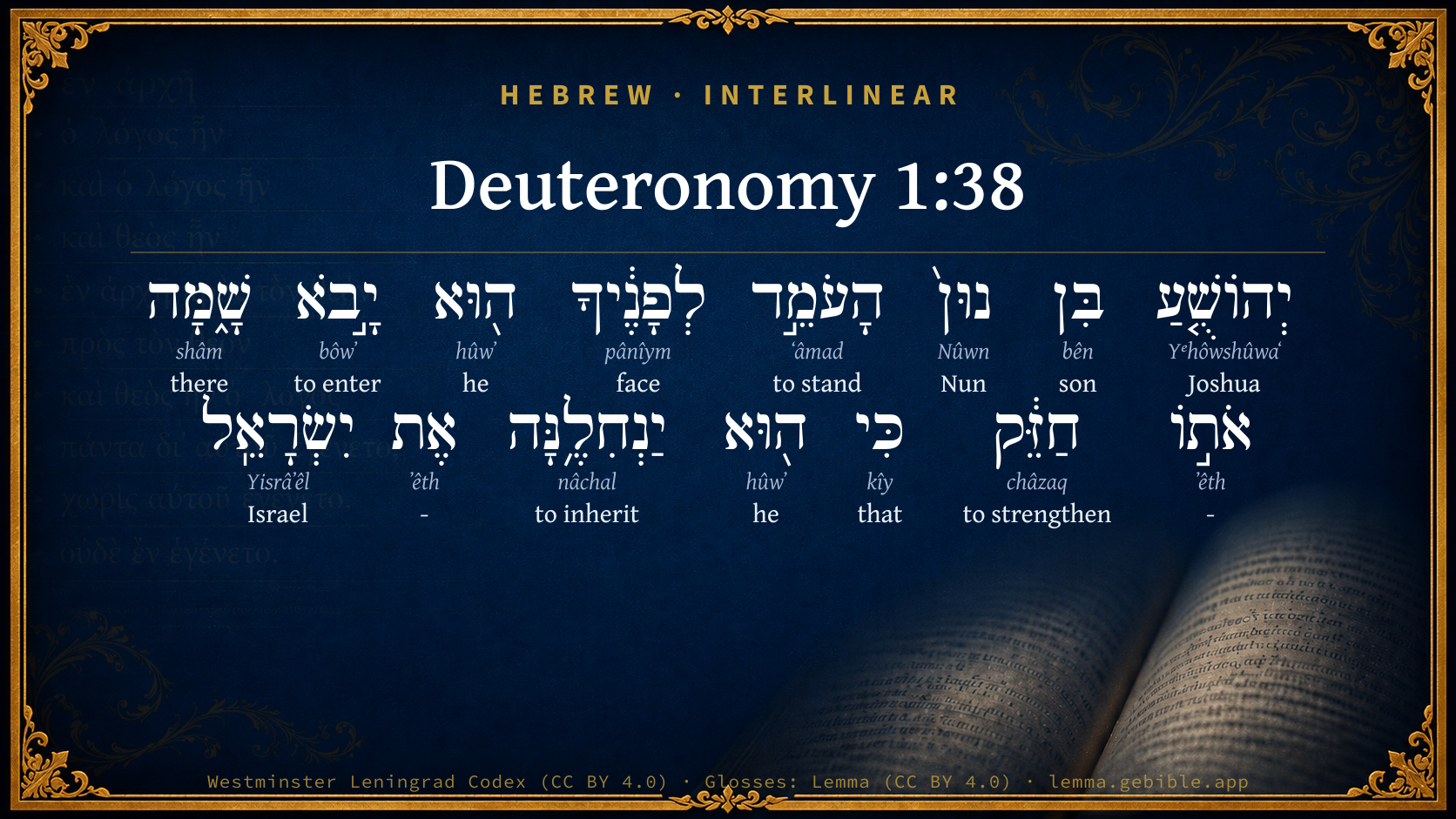
Hebrew (Westminster Leningrad Codex) Deuteronomy 1:38 appears in the Hebrew Old Testament. The text above is from the Westminster Leningrad Codex. Each word links to its Strong’s number, a concise gloss, and parsing drawn from the Open Scriptures Hebrew Bible morphology. Click any word for its full Brown-Driver-Briggs (BDB) entry.
Download image
Cite this verse

Deuteronomy 1:38 (World English Bible). Public Domain. Lemma interlinear Bible study tool, https://lemma.gebible.app/v/deuteronomy/1/38.

Show BibTeX & RIS
BibTeX
RIS
English Translation
Joshua the son of Nun, who stands before you, he shall go in there: encourage you him; for he shall cause Israel to inherit it.
World English Bible · Public Domain
Download a study sheet

One document with this verse’s original text, its word-by-word gloss line, the meaning frame, cross-references with their text, attributed commentary, and full source and license credits — printable, and it pastes into notes with its structure intact.

This verse Autodidact and up

Study sheet (.html) Plain text (.txt)

A passage Seminary Student

Up to 50 verses in one chapter. A passage sheet keeps up to 6 commentary sources and 12 cross-references per verse, in the order this page ranks them, and says so on the sheet whenever that leaves anything out. Ask for a single verse and you get the Autodidact verse sheet above.

Everything on this page stays free to read, with no account — the sheet is a download of what is already on screen, not access to it.

Want to remove ads? Support Godless Engineer
Compare translations 3

The same verse in 3 English versions, stacked beneath the original-language interlinear above. Click any original word for its lexicon entry.

Each is an independent rendering of the whole verse — the interlinear is not word-aligned to these translations.

Highlighted words mark where these versions differ — a whole-verse word diff, not a word-by-word alignment.

  • World English Bible Public Domain
    Joshua the son of Nun, who stands before you, he shall go in there: encourage you him; for he shall cause Israel to inherit it.
  • King James Version Public Domain
    But Joshua the son of Nun, which standeth before thee, he shall go in thither: encourage him: for he shall cause Israel to inherit it.
  • unfoldingWord Literal Text CC BY-SA 4.0
    Joshua, the son of Nun, who stands to your face, he will go in there; encourage him, for he will cause Israel to inherit it.

unfoldingWord Literal Text — © unfoldingWord, licensed CC BY-SA 4.0. Word-aligned USFM3 via Door43 (git.door43.org/unfoldingWord/en_ult).

Versions to compare (up to 4)

3 of 4 selected

Show all 18 translations

Every available English version of this verse, each an independent rendering of the whole verse.

  • World English Bible Public Domain
    Joshua the son of Nun, who stands before you, he shall go in there: encourage you him; for he shall cause Israel to inherit it.
  • Berean Standard Bible Public Domain
    Joshua son of Nun, who stands before you, will enter it. Encourage him, for he will enable Israel to inherit the land.
  • Majority Standard Bible Public Domain
    Joshua son of Nun, who stands before you, will enter it. Encourage him, for he will enable Israel to inherit the land.
  • King James Version Public Domain
    But Joshua the son of Nun, which standeth before thee, he shall go in thither: encourage him: for he shall cause Israel to inherit it.
  • American Standard Version (1901) Public Domain
    Joshua the son of Nun, who standeth before thee, he shall go in thither: encourage thou him; for he shall cause Israel to inherit it.
  • Revised Version (1885) Public Domain
    Joshua the son of Nun, which standeth before thee, he shall go in thither: encourage thou him; for he shall cause Israel to inherit it.
  • Geneva Bible (1599) Public Domain
    But Ioshua the sonne of Nun which standeth before thee, he shall go in thither: incourage him: for he shall cause Israel to inherite it.
  • Douay-Rheims (1899) Public Domain
    Except Caleb the son of Jephone: for he shall see it, and to him I will give the land that he hath trodden upon, and to his children, because he hath followed the Lord.
  • Young's Literal Translation Public Domain
    Joshua son of Nun, who is standing before thee, he goeth in thither; him strengthen thou; for he doth cause Israel to inherit.
  • Literal Standard Version CC BY-SA 4.0
    Joshua son of Nun, who is standing before you, he goes in there; strengthen him, for he causes Israel to inherit [it].
  • Unlocked Literal Bible CC BY-SA 4.0
    Joshua son of Nun, who stands before you, he will go in there; encourage him, for he will lead Israel to inherit it.
  • unfoldingWord Literal Text CC BY-SA 4.0
    Joshua, the son of Nun, who stands to your face, he will go in there; encourage him, for he will cause Israel to inherit it.
  • Darby Bible Public Domain
    Joshua the son of Nun, who standeth before thee, he shall go in thither: strengthen him, for he shall cause Israel to inherit it.
  • World Messianic Bible Public Domain
    Joshua the son of Nun, who stands before you, shall go in there. Encourage him, for he shall cause Israel to inherit it.
  • Webster's Bible Public Domain
    But Joshua the son of Nun, who standeth before thee, he shall go in thither. Encourage him: for he shall cause Israel to inherit it.
  • Free Bible Version CC BY-SA 4.0
    However, Joshua, son of Nun, your assistant, will enter it. Encourage him, for he will help Israel to occupy the land.
  • Bible in Basic English Public Domain
    Joshua, the son of Nun, your servant, he will go into the land: say to him that he is to be strong, for he will be Israel's guide into their heritage.
  • JPS Tanakh (1917) Public Domain
    Joshua the son of Nun, who standeth before thee, he shall go in thither; encourage thou him, for he shall cause Israel to inherit it.

Literal Standard Version (2020), Covenant Press — licensed CC BY-SA 4.0. Text via the HelloAO Bible API (eBible.org). Unlocked Literal Bible (unfoldingWord) — licensed CC BY-SA 4.0. Text via the HelloAO Bible API (eBible.org). unfoldingWord Literal Text — © unfoldingWord, licensed CC BY-SA 4.0. Word-aligned USFM3 via Door43 (git.door43.org/unfoldingWord/en_ult). Free Bible Version, Dr. Jonathan Gallagher — licensed CC BY-SA 4.0. Text via the HelloAO Bible API (eBible.org).

Word by word

More ways to search: Search by grammar → Find every occurrence → Compare this word →

Practice this passage: Drill this verse → Learn its vocabulary →

נוּן֙
Nûwn
H5126
“Nun”
Noun, Proper
Part of Speech
Noun
Type
Proper
Full BDB Definition

Origin: from H5125

TWOT: None

Nun = "fish" or " posterity" - father of Joshua the successor of Moses
  1. יְהוֹשֻׁ֤עַ Yᵉhôwshûwaʻ H3091 “Joshua” Noun, Proper
  2. בִּן bên H1121 “son of” Noun, Common, Masculine, Singular, Construct
  3. הָעֹמֵ֣ד ʻâmad H5975 “the · standing” Particle, Definite Article + Verb, Qal, Participle Active, Masculine, Singular, Absolute
  4. לְפָנֶ֔יךָ pânîym H6440 “to/for · face(s) · your” Preposition + Noun, Common, Both, Plural, Construct + Suffix, Personal, 2nd Person, Masculine, Singular
  5. ה֖וּא hûwʼ H1931 “he” Pronoun, Personal, 3rd Person, Masculine, Singular
  6. יָ֣בֹא bôwʼ H935 “to enter” Verb, Qal, Imperfect, 3rd Person, Masculine, Singular
  7. שָׁ֑מָּה shâm H8033 “there · toward” Adverb + Suffix, Demonstrative
  8. אֹת֣וֹ ʼêth H853 “- · him” Particle, Direct Object + Suffix, Personal, 3rd Person, Masculine, Singular
  9. חַזֵּ֔ק châzaq H2388 “strengthen” Verb, Piel, Imperative, 2nd Person, Masculine, Singular
  10. כִּי kîy H3588 “that” Conjunction
  11. ה֖וּא hûwʼ H1931 “he” Pronoun, Personal, 3rd Person, Masculine, Singular
  12. יַנְחִלֶ֥נָּה nâchal H5157 “to inherit · her” Verb, Hiphil, Imperfect, 3rd Person, Masculine, Singular + Suffix, Personal, 3rd Person, Feminine, Singular
  13. אֶת ʼêth H853 “-” Particle, Direct Object
  14. יִשְׂרָאֵֽל Yisrâʼêl H3478 “Israel” Noun, Proper

About this verse

These counts appear in no published source. They are computed here, from the morphology-tagged text and Lemma’s own curated glosses. What Lemma adds →

15
words
13
distinct lemmas
Pentateuch
section

Shared distinctive vocabulary

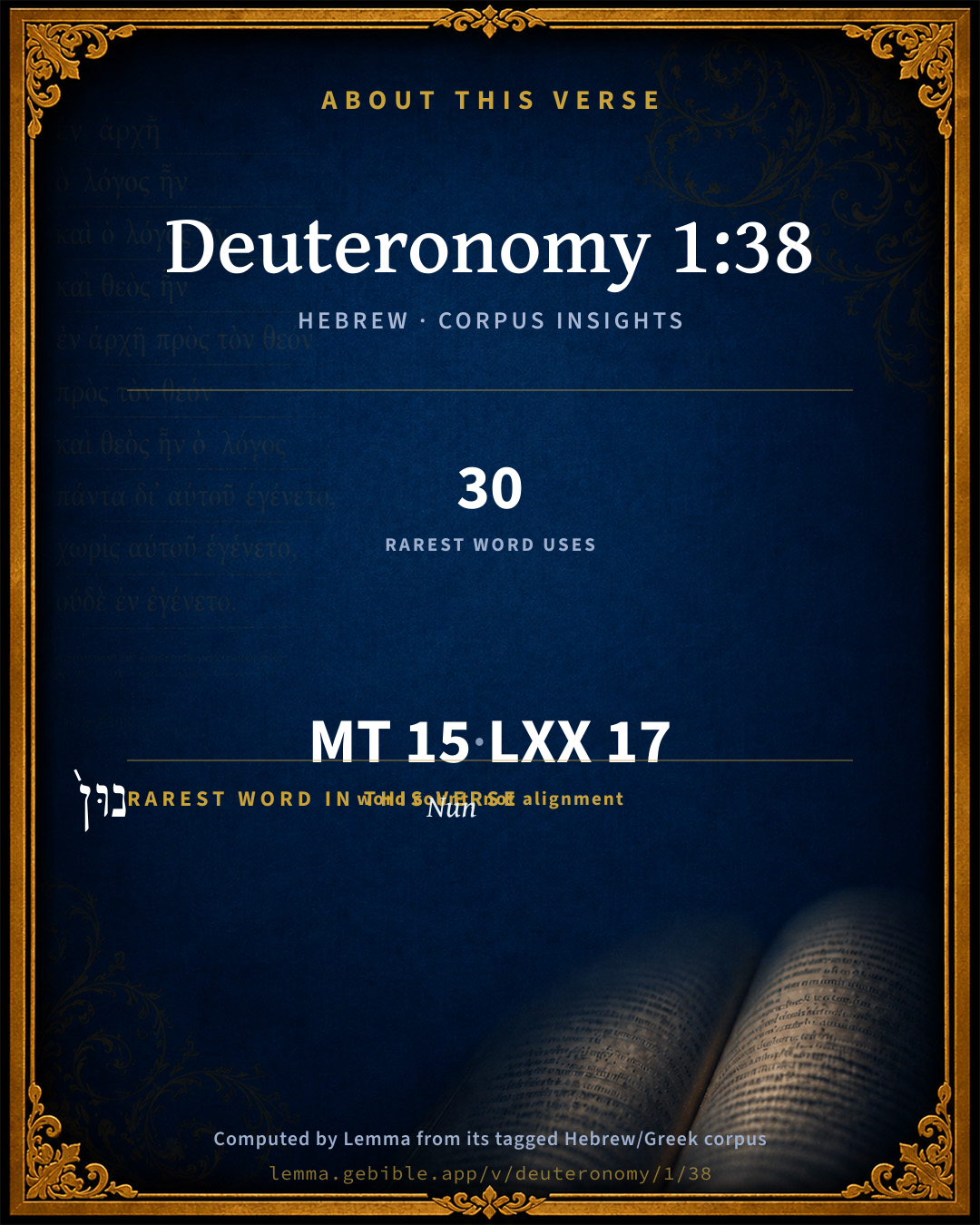
נוּן֙ Nun H5126 occurs in 30 verses of the Hebrew Bible. Also found in:

Grammatical profile

  • 4 verbs
  • 5 nouns
  • 2 pronouns
  • 1 conjunction
  • 1 adverb
  • 2 particles

Verb forms

  • הָעֹמֵ֣ד Qal · Participle Active
  • יָ֣בֹא Qal · Imperfect
  • חַזֵּ֔ק Piel · Imperative
  • יַנְחִלֶ֥נָּה Hiphil · Imperfect

Repetition

A word recurs within this verse — often emphatic in Hebrew:

  • ה֖וּא he H1931 ×2

Hebrew & Septuagint length

In English translation the verse runs 25 words from the Hebrew and 26 from the Septuagint (LXX English) — closely comparable.

A rough comparison of the two English renderings, which tokenize alike — not a word-level alignment.

Word counts can differ between the Hebrew and the Greek without any difference in meaning — e.g. the Hebrew direct-object marker אֵת has no separate Greek word, and Greek often adds the article ὁ.

In the original languages it is 15 Hebrew tokens and 17 Greek tokens — but the two are counted differently (Hebrew bundles its prefixes and suffixes into one token; the Greek is in lemma form), so that isn’t a like-for-like length.

Cross-references

17

Topical passages linked to Deuteronomy 1:38 in the Treasury of Scripture Knowledge — connected by theme and wording, ordered by reader-vote popularity; previews shown in the World English Bible.

  • Deuteronomy 3:28 But charge Joshua, and encourage him, and strengthen him; for he shall go over before this people, and he shall cause them to inherit the land which you shall see.
  • Numbers 14:30 surely you shall not come into the land, concerning which I swore that I would make you dwell therein, save Caleb the son of Jephunneh, and Joshua the son of Nun.
  • Deuteronomy 31:7–8 Moses called to Joshua, and said to him in the sight of all Israel, Be strong and of good courage: for you shall go with this people into the land which Yahweh has sworn to their fathers to give them; and you shall cause them to inherit it.
  • Deuteronomy 31:14 Yahweh said to Moses, Behold, your days approach that you must die: call Joshua, and present yourselves in the tent of meeting, that I may give him a charge. Moses and Joshua went, and presented themselves in the tent of meeting.
  • Deuteronomy 31:23 He gave Joshua the son of Nun a charge, and said, Be strong and of good courage; for you shall bring the children of Israel into the land which I swore to them: and I will be with you.
  • 1 Samuel 16:22 Saul sent to Jesse, saying, Please let David stand before me; for he has found favor in my sight.
  • Proverbs 22:29 Do you see a man skilled in his work? He will serve kings; He won't serve obscure men.
  • Exodus 17:9–14 Moses said to Joshua, "Choose men for us, and go out, fight with Amalek. Tomorrow I will stand on the top of the hill with God's rod in my hand."
  • Exodus 24:13 Moses rose up with Joshua, his servant, and Moses went up onto God's Mountain.
  • Exodus 33:11 Yahweh spoke to Moses face to face, as a man speaks to his friend. He turned again into the camp, but his servant Joshua, the son of Nun, a young man, didn't depart out of the Tent.
  • Numbers 13:8 Of the tribe of Ephraim, Hoshea the son of Nun.
  • Numbers 13:16 These are the names of the men who Moses sent to spy out the land. Moses called Hoshea the son of Nun Joshua.
  • Numbers 14:38 But Joshua the son of Nun, and Caleb the son of Jephunneh, remained alive of those men who went to spy out the land.
  • Numbers 26:65 For Yahweh had said of them, They shall surely die in the wilderness. There was not left a man of them, save Caleb the son of Jephunneh, and Joshua the son of Nun.
  • Numbers 27:18–23 Yahweh said to Moses, Take Joshua the son of Nun, a man in whom is the Spirit, and lay your hand on him;
  • Joshua 1:1 Now it happened after the death of Moses the servant of Yahweh, that Yahweh spoke to Joshua the son of Nun, Moses' minister, saying,
  • Joshua 1:6–9 Be strong and of good courage; for you shall cause this people to inherit the land which I swore to their fathers to give them.

Cross-references courtesy of OpenBible.info (CC BY 4.0).

Hebrew and Greek witnesses Masoretic Hebrew ↔ Greek Septuagint

The same verse in the two great witnesses to the Old Testament, shown verse-for-verse.

These are two independent witnesses, not word-aligned to each other, and the Septuagint is shown in lemma (dictionary) form.

Hebrew Deuteronomy 1:38 Masoretic · Westminster Leningrad Codex

יְהוֹשֻׁ֤עַ בִּן נוּן֙ הָעֹמֵ֣ד לְפָנֶ֔יךָ ה֖וּא יָ֣בֹא שָׁ֑מָּה אֹת֣וֹ חַזֵּ֔ק כִּי ה֖וּא יַנְחִלֶ֥נָּה אֶת יִשְׂרָאֵֽל

Joshua the son of Nun, who stands before you, he shall go in there: encourage you him; for he shall cause Israel to inherit it.

World English Bible · Public Domain

Greek LXX Deuteronomy 1:38 Septuagint · lemma form

ἰησοῦς υἱός ναυη ὁ παραἵστημι σύ οὗτος εἰςἔρχομαι ἐκεῖ αὐτός καταἰσχύω ὅτι αὐτός κατακληρονομέω αὐτός ὁ ἰσραήλ

Joshua the son of Naue, who stands by you, he shall enter in there; do you strengthen him, for he shall cause Israel to inherit it.

LXX2012 (modern English Septuagint) · Public Domain

Hebrew: Westminster Leningrad Codex (CC BY 4.0). Greek: Septuagint (public domain); English from LXX2012 (modern English Septuagint) (Public Domain). How the Septuagint differs from the Hebrew →

Targum (Aramaic paraphrase)

2

The Targum is the ancient Jewish Aramaic paraphrase of the Hebrew Scriptures — an interpretive translation, not the Hebrew text itself. Onkelos (literal) and Pseudo-Jonathan (expansive) render the Torah, and Jonathan the Prophets. Coverage is partial: where no permissively-licensed English translation exists for a verse, only the Aramaic is shown. This is verse-level text, not a word-by-word alignment to the Hebrew.

  1. Targum Onkelos Torah (Genesis–Deuteronomy)
    יְהוֹשֻׁעַ בַּר נוּן דְקָאֵים קֳדָמָךְ הוּא יֵיעוֹל תַּמָן יָתֵהּ תַּקֵף אֲרֵי הוּא יַחְסְנִנַהּ לְיִשְׂרָאֵל

    (no public-domain English translation for this verse)

    Targum Onkelos — Aramaic: “Onkelos Genesis” (public domain); “Onkelos Exodus” (public domain); “Onkelos Leviticus” (public domain); “Onkelos Numbers” (public domain); “Onkelos Deuteronomy” (public domain). English: “Sefaria Community Translation” (CC0 1.0 (public-domain dedication)); “J.W. Etheridge. The Targums of Onkelos and Jonathan Ben Uzziel on the Pentateuch. London: Longmans, Green, 1862” (public domain). Text via Sefaria.

  2. Targum Pseudo-Jonathan Torah (Genesis–Deuteronomy)
    יְהוֹשֻׁעַ בַּר נוּן דִּמְשַׁמֵּשׁ בְּבֵית אוּלְפָנָךְ הוּא יֵיעוֹל לְתַמָּן יָתֵיהּ תַּקִּיף אֲרוּם הוּא יַחְסְנִינָהּ יַת יִשְרָאֵל

    Jehoshua bar Nun, who ministereth in thy house of instruction, he is to go in thither: strengthen him, for he is to make Israel possess it.

    Targum Pseudo-Jonathan — Aramaic: “Targum Jonathan on Genesis” (public domain); “Targum Jonathan on Exodus” (public domain); “Targum Jonathan on Leviticus” (public domain); “Targum Jonathan on Numbers” (public domain); “Targum Jonathan on Deuteronomy” (public domain). English: “The Targum of Jonathan ben Uzziel, trans. J. W. Etheridge, London, 1862” (public domain). Text via Sefaria.

Commentary

Notes on Deuteronomy 1:38 from classic Christian and Jewish commentators (each source and its license shown beneath its notes). The classic Christian expositions comment on the surrounding passage and are grouped to its opening verse, so a note may address several verses; the Jewish commentaries on the Tanakh (Rashi and others) are per-verse, so they appear only where the commentator wrote on this verse.

Lemma curates 59 commentaries, every one of them public domain or Creative Commons licensed, each selected and text-cleaned for this edition rather than reprinted as found. About our sources →

Geneva Bible (1599)

Geneva Bible translators

Which ministreth unto thee.

Geneva Bible (1599) marginal notes — public domain. Text via Bolls.life.

The Cambridge Bible for Schools and Colleges

gen. ed. J. J. S. Perowne

38. Joshua the son of Nun] So Deu_3:28; P, Num_27:18 ff.; not given in JE.

which standeth before thee] Deu_10:8; so a servant stood before his lord, a courtier before his king, and the Levites before Jehovah. JE, Exo_24:13 f., the minister of Moses.

encourage thou him] lit. him make thou strong. The vb ḥizzeḳ, alone as here, or with the synonymous vb ’immeṣ Deu_3:28; or in their intransitive forms Deu_31:6-7; Deu_31:23. Cp. Deu_11:8, Deu_12:23 (be firm).

cause … to inherit] characteristic of D: used of Joshua here, Deu_3:28, Deu_31:7; Jos_1:6; but of God 12 to, Deu_19:3. Outside D only in Jer_3:18; Jer_12:14; Eze_46:18 and later writers. P uses another form of the vb, Num_34:29; Jos_13:32; Jos_14:1; Jos_19:51.

Further Note to Deu_1:36-38. Because Moses has just been described as seeking to turn the people from their sin, 29 ff., and it is therefore unreasonable to include him in their punishment; because Deu_1:37-38 needlessly anticipate Deu_3:26; Deu_3:28 and Deu_4:21; and because Deu_1:39 in whole or part follows suitably on Deu_1:36; therefore Deu_1:37-38 are taken by many (Dillm., W. R. Smith, Steuern., Berth, etc.) as a later addition to the text. And indeed the beginning of Deu_1:39 shows that the original has been disturbed by an editorial hand (see below). Steuern. would also omit Deu_1:36 on the ground that Kaleb has not been previously mentioned in this survey. But Kaleb is mentioned in JE on which this survey otherwise depends. In whatever way these textual questions may be decided, the parallel passages Deu_3:26 ff. and Deu_4:21 confirm the fact of a D tradition or statement that Jehovah was angry with Moses for the people’s sake. This can only mean, their guilt was great enough to include the very leader who had done his best to dissuade them from their disaffection! Now neither JE nor P gives any hint of so remarkable a judgement. On the contrary, P accounts for the exclusion of Moses by his own sin in striking the rock at Ḳadesh 37 years after this disaffection of Israel, Num_21:10 ff; Num_27:13 f.; Deu_32:50 f. The most reasonable explanation of such discrepancies is that they are discrepancies not of fact but or opinion. The earliest tradition, JE, merely held the facts that Kaleb survived and that Moses died on the eve of the possession of the Promised Land. The problem, which arose from this contrast of fortune, the deuteronomic writers solved by the statement that Moses was included in the guilt of the people when, startled by the report of the spies, they refused to invade Canaan from the S. in the second year of the wandering; and this agrees with the deuteronomic principle of the ethical solidarity of Israel. But the later priestly writer or writers, under the influence of the idea, first emphasized in the time of Jeremiah and Ezekiel (Jer_31:29 f., Ezekiel 18), that every man died because of his own sin, found a solution for the problem in Moses’ own guilt in presumptuously striking the rock at Ḳadesh, 37 years later. In this double engagement, from two different standpoints, with so difficult a problem, note the strong evidence that the survival of Kaleb and the death of Moses before Israel’s entrance to the Land were regarded as irremoveable elements of the early tradition.

The Cambridge Bible for Schools and Colleges (gen. ed. J. J. S. Perowne; Cambridge University Press, 1878–1918) — public domain. Text from a community e-Sword module.

John Gill's Exposition

But Joshua, the son of Nun, which standeth before thee,.... His servant and minister, which this phrase is expressive of:

he shall go in thither: into the good land, instead of Moses, and as his successor, and who was to go before the children of Israel, and introduce them into it, as a type of Christ, who brings many sons to glory:

encourage him; with the promise of the divine Presence with him, and of success in subduing the Canaanites, and settling the people of Israel in their land; and so we read that Moses did encourage him, Deu 31:7.

for he shall cause Israel to inherit it; go before them as their captain, and lead them into it; fight their battles for them, conquer their enemies, and divide the land by lot for an inheritance unto them; so the heavenly inheritance is not by the law of Moses, and the works of it, but by Joshua, or Jesus, the Saviour, by his achievements, victories, and conquests.

John Gill's Exposition of the Whole Bible (1746–1763) — public domain (CC PDM 1.0). Text via the HelloAO Bible API.

Matthew Poole's English Annotations

Which standeth before thee, i.e. who is now thy minister and servant, for such are oft described by this phrase, as 1Ki 1:2; Dan 1:5,19.

Matthew Poole's English Annotations on the Holy Bible (1683–1685) — public domain. Text from a community e-Sword/MySword module.

The Pulpit Commentary

Though the rebellious generation were to perish, and Moses was not to be permitted to enter Canaan, God would not depart from his promise, but would by another leader bring the people to the inheritance which he had sworn to their fathers to give them. (For the account of Joshua"s appointment and installation, see Num_27:15-23) Which standeth before thee; i.e. to be thy minister or servant (Exo_24:13; Num_11:28; comp. for the meaning of the phrase Deu_10:8 Deu_18:7; Dan_1:5) Encourage him; literally, strengthen him. (comp. Deu_3:21, 22 31:7, 8) Inherit it; the "it" refers back to ver. 35, "that good land." In vers. 8 and 21, the land is spoken of as to be possessed by the Israelites; here it is spoken of as to be inherited by them. The former has reference to their having to wrest the land by force from the Canaanites (vry; to occupy by force, to dispossess; Deu_2:12, Deu_2:21, Deu_2:22, where the verb is, in the Authorized Version, rendered by "destroy" the latter has reference to their receiving the land as a heritage (ljn) from God, who, when he divided to the nations their inheritance, assigned Canaan to the children of Israel. (Deu_32:8) "Joshua the executor of the inheritance" (Schroeder).

The Pulpit Commentary (1880–1919), ed. H.D.M. Spence-Jones & Joseph S. Exell — public domain. Text from a community e-Sword module.

John Wesley's Explanatory Notes

Who standeth - Who is now thy servant.

John Wesley, Explanatory Notes Upon the Whole Bible (1754–1765) — public domain. Text via the GEBible commentary corpus.

Lesson kit

Teaching starters — assembled from the data on this page, not authored interpretation. Every prompt links to the verse data it draws on. Edit before teaching.

Deuteronomy, in the Pentateuch, opens this verse with 15 words (13 distinct Hebrew lemmas). Its most distinctive word is Nûwn (“Nun”). A historical commentator’s framing appears above. Read the whole chapter for the surrounding context.

Discussion questions

  1. The word Nûwn carries the sense “Nun.” How does it shape the verse?
  2. How does Exodus 33:11, which shares the word «Nun», read alongside this verse?
  3. What does the repetition of “he” (2× in this one verse) do in this verse?
  4. The translations on this page render this verse differently — a whole-verse word diff, not a word-by-word alignment. What might account for the different wordings?
  5. «הָעֹמֵ֣ד» is a Qal Participle Active verb. How does that grammatical form shape the action described?
  6. Compare how Geneva Bible (1599) and The Cambridge Bible for Schools and Colleges read this verse. Where do they agree or differ?

Things to notice

Reading settings

Reading text

Shown beneath each verse's original-language words.

Old Testament
Old Testament edition

Read the OT as the Masoretic Hebrew (MT) or the Greek Septuagint (LXX).

English shown for the Greek Septuagint (in the Hebrew ↔ Greek comparison).

Comparing translations? Open the Compare panel on any verse page to stack up to four side by side.