
2 Kings 23:36

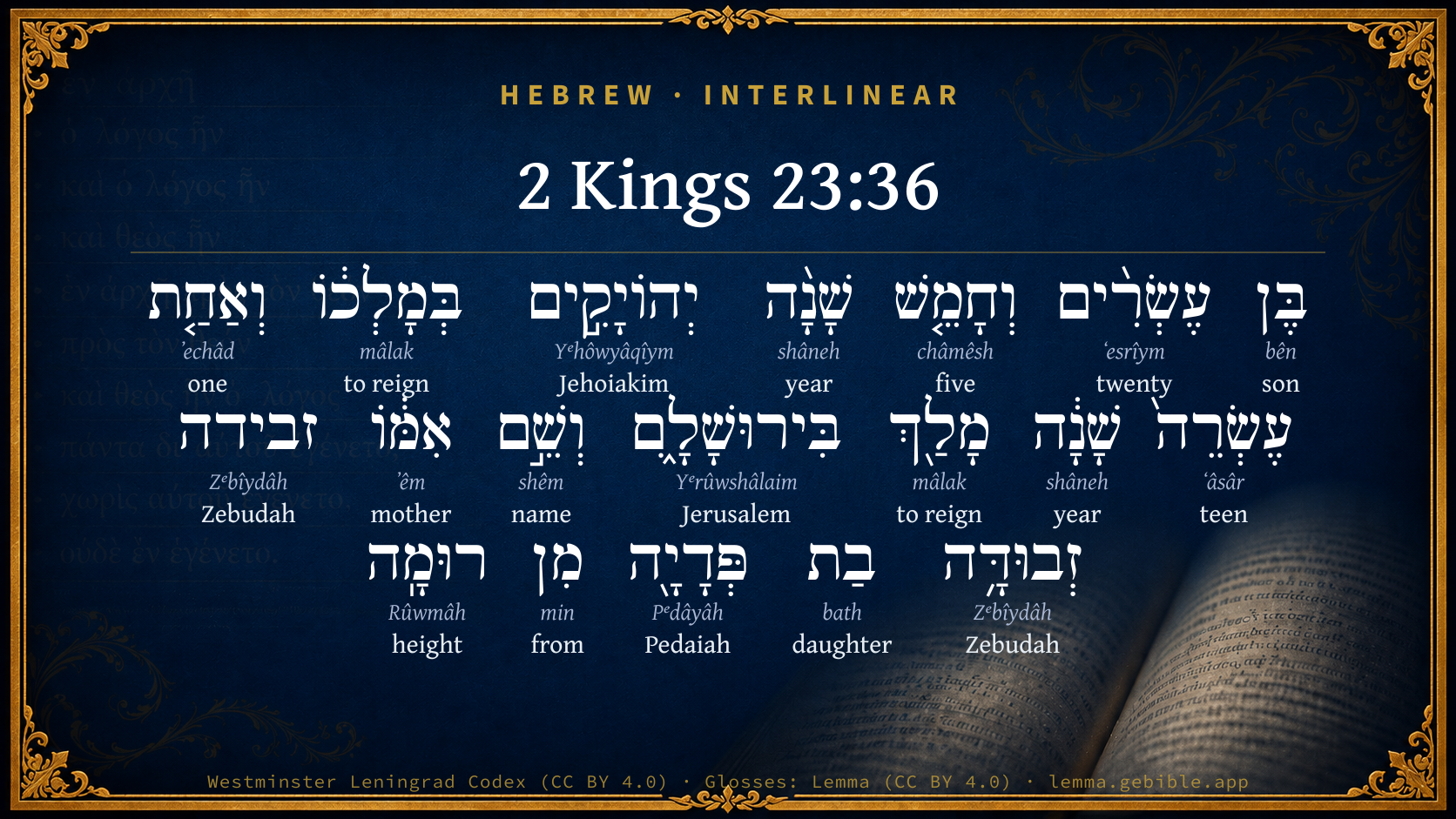
Hebrew (Westminster Leningrad Codex) 2 Kings 23:36 appears in the Hebrew Old Testament. The text above is from the Westminster Leningrad Codex. Each word links to its Strong’s number, a concise gloss, and parsing drawn from the Open Scriptures Hebrew Bible morphology. Click any word for its full Brown-Driver-Briggs (BDB) entry.
Download image
Cite this verse

2 Kings 23:36 (World English Bible). Public Domain. Lemma interlinear Bible study tool, https://lemma.gebible.app/v/2-kings/23/36.

Show BibTeX & RIS
BibTeX
RIS
English Translation
Jehoiakim was twenty-five years old when he began to reign; and he reigned eleven years in Jerusalem: and his mother's name was Zebidah the daughter of Pedaiah of Rumah.
World English Bible · Public Domain
Highlights
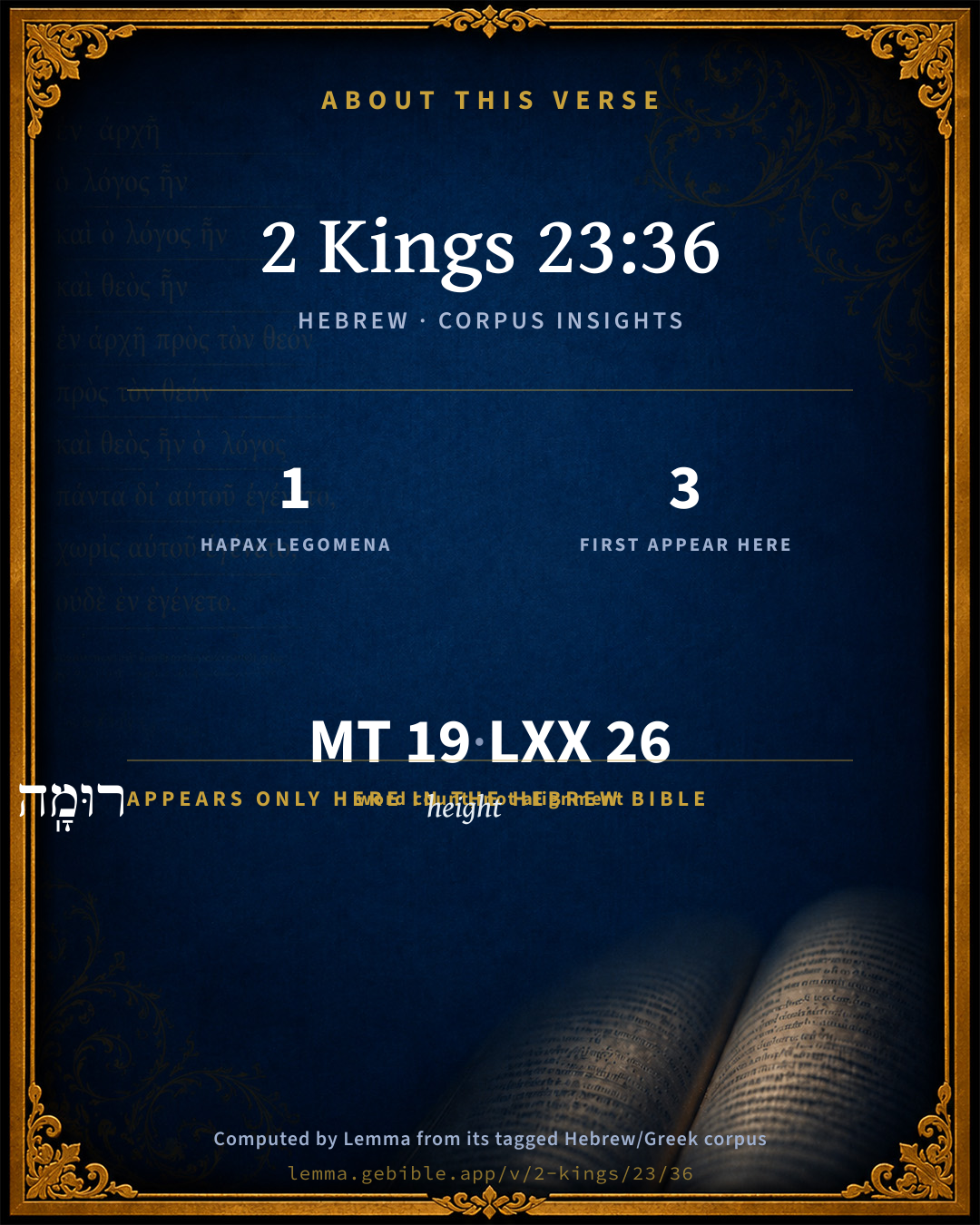
  • 1 hapax legomenon — only here in the Hebrew Bible
  • 3 first appearances in the Hebrew Bible
Full analysis ↓
Download a study sheet

One document with this verse’s original text, its word-by-word gloss line, the meaning frame, cross-references with their text, attributed commentary, and full source and license credits — printable, and it pastes into notes with its structure intact.

This verse Autodidact and up

Study sheet (.html) Plain text (.txt)

A passage Seminary Student

Up to 50 verses in one chapter. A passage sheet keeps up to 6 commentary sources and 12 cross-references per verse, in the order this page ranks them, and says so on the sheet whenever that leaves anything out. Ask for a single verse and you get the Autodidact verse sheet above.

Everything on this page stays free to read, with no account — the sheet is a download of what is already on screen, not access to it.

Want to remove ads? Support Godless Engineer
Compare translations 3

The same verse in 3 English versions, stacked beneath the original-language interlinear above. Click any original word for its lexicon entry.

Each is an independent rendering of the whole verse — the interlinear is not word-aligned to these translations.

Highlighted words mark where these versions differ — a whole-verse word diff, not a word-by-word alignment.

  • World English Bible Public Domain
    Jehoiakim was twenty-five years old when he began to reign; and he reigned eleven years in Jerusalem: and his mother's name was Zebidah the daughter of Pedaiah of Rumah.
  • King James Version Public Domain
    Jehoiakim was twenty and five years old when he began to reign; and he reigned eleven years in Jerusalem. And his mother's name was Zebudah, the daughter of Pedaiah of Rumah.
  • unfoldingWord Literal Text CC BY-SA 4.0
    Jehoiakim a son of 25 years when he reigned, and he reigned 11 years in Jerusalem. And the name of his mother Zebidah, the daughter of Pedaiah, from Rumah.

unfoldingWord Literal Text — © unfoldingWord, licensed CC BY-SA 4.0. Word-aligned USFM3 via Door43 (git.door43.org/unfoldingWord/en_ult).

Versions to compare (up to 4)

3 of 4 selected

Show all 18 translations

Every available English version of this verse, each an independent rendering of the whole verse.

  • World English Bible Public Domain
    Jehoiakim was twenty-five years old when he began to reign; and he reigned eleven years in Jerusalem: and his mother's name was Zebidah the daughter of Pedaiah of Rumah.
  • Berean Standard Bible Public Domain
    Jehoiakim was twenty-five years old when he became king, and he reigned in Jerusalem eleven years. His mother’s name was Zebidah daughter of Pedaiah; she was from Rumah.
  • Majority Standard Bible Public Domain
    Jehoiakim was twenty-five years old when he became king, and he reigned in Jerusalem eleven years. His mother’s name was Zebidah daughter of Pedaiah; she was from Rumah.
  • King James Version Public Domain
    Jehoiakim was twenty and five years old when he began to reign; and he reigned eleven years in Jerusalem. And his mother's name was Zebudah, the daughter of Pedaiah of Rumah.
  • American Standard Version (1901) Public Domain
    Jehoiakim was twenty and five years old when he began to reign; and he reigned eleven years in Jerusalem: and his mother's name was Zebidah the daughter of Pedaiah of Rumah.
  • Revised Version (1885) Public Domain
    Jehoiakim was twenty and five years old when he began to reign; and he reigned eleven years in Jerusalem: and his mother’s name was Zebidah the daughter of Pedaiah of Rumah.
  • Geneva Bible (1599) Public Domain
    Iehoiakim was fiue and twentie yere olde, when he began to reigne, and he reigned eleuen yeeres in Ierusalem. His mothers name also was Zebudah the daughter of Pedaiah of Rumah.
  • Douay-Rheims (1899) Public Domain
    Joakim was five and twenty years old when he began to reign: and he reigned eleven years in Jerusalem: the name of his mother was Zebida the daughter of Phadaia of Ruma.
  • Young's Literal Translation Public Domain
    A son of twenty and five years `is' Jehoiakim in his reigning, and eleven years he hath reigned in Jerusalem, and the name of his mother `is' Zebudah daughter of Pedaiah of Rumah,
  • Literal Standard Version CC BY-SA 4.0
    Jehoiakim [is] a son of twenty-five years in his reigning, and he has reigned eleven years in Jerusalem, and the name of his mother [is] Zebudah daughter of Pedaiah of Rumah,
  • Unlocked Literal Bible CC BY-SA 4.0
    Jehoiakim was twenty-five years old when he began to reign, and he reigned eleven years in Jerusalem. His mother's name was Zebidah; she was the daughter of Pedaiah of Rumah.
  • unfoldingWord Literal Text CC BY-SA 4.0
    Jehoiakim a son of 25 years when he reigned, and he reigned 11 years in Jerusalem. And the name of his mother Zebidah, the daughter of Pedaiah, from Rumah.
  • Darby Bible Public Domain
    Jehoiakim was twenty-five years old when he began to reign; and he reigned eleven years in Jerusalem; and his mother's name was Zebuddah, daughter of Pedaiah of Rumah.
  • World Messianic Bible Public Domain
    Jehoiakim was twenty-five years old when he began to reign, and he reigned eleven years in Jerusalem. His mother’s name was Zebidah the daughter of Pedaiah of Rumah.
  • Webster's Bible Public Domain
    Jehoiakim was twenty and five years old when he began to reign; and he reigned eleven years in Jerusalem. And his mother's name was Zebudah, the daughter of Pedaiah of Rumah.
  • Free Bible Version CC BY-SA 4.0
    Jehoiakim was twenty-five when he became king, and he reigned in Jerusalem for eleven years. His mother's name was Zebidah, daughter of Pedaiah She came from Rumah.
  • Bible in Basic English Public Domain
    Jehoiakim was twenty-five years old when he became king; he was ruling in Jerusalem for eleven years; his mother's name was Zebidah, the daughter of Pedaiah of Rumah.
  • JPS Tanakh (1917) Public Domain
    Jehoiakim was twenty and five years old when he began to reign; and he reigned eleven years in Jerusalem; and his mother's name was Zebudah the daughter of Pedaiah of Rumah.

Literal Standard Version (2020), Covenant Press — licensed CC BY-SA 4.0. Text via the HelloAO Bible API (eBible.org). Unlocked Literal Bible (unfoldingWord) — licensed CC BY-SA 4.0. Text via the HelloAO Bible API (eBible.org). unfoldingWord Literal Text — © unfoldingWord, licensed CC BY-SA 4.0. Word-aligned USFM3 via Door43 (git.door43.org/unfoldingWord/en_ult). Free Bible Version, Dr. Jonathan Gallagher — licensed CC BY-SA 4.0. Text via the HelloAO Bible API (eBible.org).

Word by word

More ways to search: Search by grammar → Find every occurrence → Compare this word →

Practice this passage: Drill this verse → Learn its vocabulary →

רוּמָֽה
Rûwmâh
H7316
“height”
Noun, Proper
Part of Speech
Noun
Type
Proper
Full BDB Definition

Origin: from H7311

TWOT: None

Rumah = "height" - home of the grandfather of king Jehoiakim of Judah
  1. בֶּן bên H1121 “son of” Noun, Common, Masculine, Singular, Construct
  2. עֶשְׂרִ֨ים ʻesrîym H6242 “twenty” Adjective, Cardinal number, Both, Plural, Absolute
  3. וְחָמֵ֤שׁ châmêsh H2568 “and · five” Conjunction + Adjective, Cardinal number, Feminine, Singular, Absolute
  4. שָׁנָ֨ה shâneh H8141 “year” Noun, Common, Feminine, Singular, Absolute
  5. יְהוֹיָקִ֣ים Yᵉhôwyâqîym H3079 “Jehoiakim” Noun, Proper
  6. בְּמָלְכ֔וֹ mâlak H4427 “in/at · to reign · him” Preposition + Verb, Qal, Infinitive Construct + Suffix, Personal, 3rd Person, Masculine, Singular
  7. וְאַחַ֤ת ʼechâd H259 “and · one” Conjunction + Adjective, Cardinal number, Feminine, Singular, Absolute
  8. עֶשְׂרֵה֙ ʻâsâr H6240 “teen” Adjective, Cardinal number, Feminine, Singular, Absolute
  9. שָׁנָ֔ה shâneh H8141 “year” Noun, Common, Feminine, Singular, Absolute
  10. מָלַ֖ךְ mâlak H4427 “to reign” Verb, Qal, Perfect, 3rd Person, Masculine, Singular
  11. בִּירוּשָׁלִָ֑ם Yᵉrûwshâlaim H3389 “in/at · Jerusalem” Preposition + Noun, Proper
  12. וְשֵׁ֣ם shêm H8034 “and · name of” Conjunction + Noun, Common, Masculine, Singular, Construct
  13. אִמּ֔וֹ ʼêm H517 “mother · his” Noun, Common, Feminine, Singular, Construct + Suffix, Personal, 3rd Person, Masculine, Singular
  14. זבידה Zᵉbîydâh H2080 “Zebudah” Noun, Proper
  15. זְבוּדָּ֥ה Zᵉbîydâh H2080 “Zebudah” Noun, Proper
  16. בַת bath H1323 “daughter of” Noun, Common, Feminine, Singular, Construct
  17. פְּדָיָ֖ה Pᵉdâyâh H6305 “Pedaiah” Noun, Proper
  18. מִן min H4480 “from” Preposition

About this verse

These counts appear in no published source. They are computed here, from the morphology-tagged text and Lemma’s own curated glosses. What Lemma adds →

19
words
16
distinct lemmas
Historical
section

Notable vocabulary

1 hapax legomenon — a word that appears only here in the entire Hebrew Bible:

  • רוּמָֽה height H7316

First appearance in Scripture

These words make their first canonical appearance in the Hebrew Bible here:

  • זבידה Zebudah H2080
  • פְּדָיָ֖ה Pedaiah H6305
  • רוּמָֽה height H7316

Grammatical profile

  • 2 verbs
  • 12 nouns
  • 4 adjectives
  • 1 preposition

Verb forms

  • בְּמָלְכ֔וֹ Qal · Infinitive Construct
  • מָלַ֖ךְ Qal · Perfect

Repetition

Words recur within this verse — often emphatic in Hebrew:

  • שָׁנָ֨ה year H8141 ×2
  • בְּמָלְכ֔וֹ to reign H4427 ×2
  • זבידה Zebudah H2080 ×2

Hebrew & Septuagint length

In English translation the verse runs 29 words from the Hebrew and 28 from the Septuagint (LXX English) — closely comparable.

A rough comparison of the two English renderings, which tokenize alike — not a word-level alignment.

Word counts can differ between the Hebrew and the Greek without any difference in meaning — e.g. the Hebrew direct-object marker אֵת has no separate Greek word, and Greek often adds the article ὁ.

In the original languages it is 19 Hebrew tokens and 26 Greek tokens — but the two are counted differently (Hebrew bundles its prefixes and suffixes into one token; the Greek is in lemma form), so that isn’t a like-for-like length.

Cross-references

4

Topical passages linked to 2 Kings 23:36 in the Treasury of Scripture Knowledge — connected by theme and wording, ordered by reader-vote popularity; previews shown in the World English Bible.

  • 2 Chronicles 36:5 Jehoiakim was Twenty-five years old when he began to reign; and he reigned eleven years in Jerusalem: and he did that which was evil in the sight of Yahweh his God.
  • 1 Chronicles 3:15 The sons of Josiah: the firstborn Johanan, the second Jehoiakim, the third Zedekiah, the fourth Shallum.
  • Jeremiah 1:3 It came also in the days of Jehoiakim the son of Josiah, king of Judah, to the end of the eleventh year of Zedekiah, the son of Josiah, king of Judah, to the carrying away of Jerusalem captive in the fifth month.
  • Jeremiah 26:1 In the beginning of the reign of Jehoiakim the son of Josiah, king of Judah, came this word from Yahweh, saying,

Cross-references courtesy of OpenBible.info (CC BY 4.0).

Hebrew and Greek witnesses Masoretic Hebrew ↔ Greek Septuagint

The same verse in the two great witnesses to the Old Testament, shown verse-for-verse.

These are two independent witnesses, not word-aligned to each other, and the Septuagint is shown in lemma (dictionary) form.

Hebrew 2 Kings 23:36 Masoretic · Westminster Leningrad Codex

בֶּן עֶשְׂרִ֨ים וְחָמֵ֤שׁ שָׁנָ֨ה יְהוֹיָקִ֣ים בְּמָלְכ֔וֹ וְאַחַ֤ת עֶשְׂרֵה֙ שָׁנָ֔ה מָלַ֖ךְ בִּירוּשָׁלִָ֑ם וְשֵׁ֣ם אִמּ֔וֹ זבידה זְבוּדָּ֥ה בַת פְּדָיָ֖ה מִן רוּמָֽה

Jehoiakim was twenty-five years old when he began to reign; and he reigned eleven years in Jerusalem: and his mother's name was Zebidah the daughter of Pedaiah of Rumah.

World English Bible · Public Domain

Greek LXX 2 Kings 23:36 Septuagint · lemma form

υἱός εἴκοσι καί πέντε ἔτος ιωακιμ ἐν ὁ βασιλεύω αὐτός καί ἕνδεκα ἔτος βασιλεύω ἐν ἰερουσαλήμ καί ὄνομα ὁ μήτηρ αὐτός ιελδαφ θυγάτηρ φεδεϊα ἐκ ρουμα

Twenty-five years old was Joakim when he began to reign, and he reigned eleven years in Jerusalem: and his mother's name was Jeldaph, daughter of Phadail of Ruma.

LXX2012 (modern English Septuagint) · Public Domain

On this verse, The Expositor's Bible discusses the Septuagint’s reading. Read the note in Commentary ↓

Hebrew: Westminster Leningrad Codex (CC BY 4.0). Greek: Septuagint (public domain); English from LXX2012 (modern English Septuagint) (Public Domain). How the Septuagint differs from the Hebrew →

Targum (Aramaic paraphrase)

1

The Targum is the ancient Jewish Aramaic paraphrase of the Hebrew Scriptures — an interpretive translation, not the Hebrew text itself. Onkelos (literal) and Pseudo-Jonathan (expansive) render the Torah, and Jonathan the Prophets. Coverage is partial: where no permissively-licensed English translation exists for a verse, only the Aramaic is shown. This is verse-level text, not a word-by-word alignment to the Hebrew.

  1. Targum Jonathan Prophets (Joshua–Malachi)
    בַּר עַסְרִין וְחָמֵשׁ שְׁנִין יְהוֹיָקִים כַּד מְלַךְ וַחֲדָא עַסְרֵי שְׁנִין מְלַךְ בִּירוּשְׁלֵם וְשׁוּם אִמֵיהּ זְבוּדָה בַּת פְּדָיָה מִן רוּמָה:

    (no public-domain English translation for this verse)

    Targum Jonathan — Aramaic: “Mikraot Gedolot” (public domain). English: “Sefaria Community Translation” (CC0 1.0 (public-domain dedication)); “London "Chaldee Paraphrase," 1871” (public domain). Text via Sefaria.

Commentary

Notes on 2 Kings 23:36 from classic Christian and Jewish commentators (each source and its license shown beneath its notes). The classic Christian expositions comment on the surrounding passage and are grouped to its opening verse, so a note may address several verses; the Jewish commentaries on the Tanakh (Rashi and others) are per-verse, so they appear only where the commentator wrote on this verse.

Lemma curates 59 commentaries, every one of them public domain or Creative Commons licensed, each selected and text-cleaned for this edition rather than reprinted as found. About our sources →

Trapp's Complete Commentary

John Trapp

2Ki 23:36 Jehoiakim [was] twenty and five years old when he began to reign; and he reigned eleven years in Jerusalem. And his mother’s name [was] Zebudah, the daughter of Pedaiah of Rumah.

Ver. 36. Jehoiakim was twenty-five years old.] See on 2Ki 23:31.

John Trapp, A Commentary or Exposition upon All the Books of the Old and New Testament (1647–1656) — public domain. Text from a community e-Sword module.

Whedon's Commentary on the Bible

Daniel D. Whedon

REIGN OF JEHOIAKIM, 2Ki_23:36 to 2Ki_24:7.

36. Twenty and five years old — About two years older than Jehoahaz. Compare 2Ki_23:31. All accounts of the reign of this prince agree in representing him as excessively given over to wickedness and cruelty. Especially do the prophecies of Jeremiah (compare Jeremiah 22-26) depict the fearful corruptions of his times.

His mother’s name was Zebudah — So he was a half brother to Jehoahaz. The locality of Rumah is unknown.

Daniel D. Whedon (gen. ed.), Commentary on the Old and New Testaments (1874–1909) — public domain. Text from a community e-Sword module.

The Expositor's Bible

JEHOIAKIM

B.C. 608-597

2Ki_23:36-37; 2Ki_24:1-7

"But those things that are recorded of him, and of his uncleanness and impiety, are written in the Chronicles of the Kings,"

- RAPC 1 Esdras 1:42

"When Jehoiakim succeeded to the throne, he said,"

"My predecessors knew not how to provoke God."

- Sanhedrin, f. 103, 2

"There is no strange handwriting on the wall, Through all the midnight hum no threatening call, Nor on the marble floor the stealthy fall Of fatal footsteps. All is safe.-Thou fool, The avenging deities are shod with wool!"

- W. ALLEN BUTLER

ELIAKIM succeeded to the throne at the age of twenty-five under very unenviable circumstances-as a nominal king, a helpless nominee and tributary of the Pharaoh. He seems to have been thoroughly distasteful to the people; and if we may judge from the fact that Ezekiel frankly ignores him and passes from Jehoabaz to Jehoachin, he was regarded as a tax-gathering usurper nominated by an alien tyrant. For after speaking of Jehoahaz, Ezekiel says, -

"Now when she [Judah] saw that she had waited [for the restoration of Jehoahaz], and her hope was lost, Then she took another of her whelps; A young lion she made him. He went up and down among the lions; He became a young lion."

The historian says that Necho turned the name of Eliakim ("God will establish") to Jehoiakim ("Jehovah will establish"); but by this can hardly be meant more than that he sanctioned the change of El into Jehovah on Eliakims installation upon the throne.

Jehoiakim is condemned in the same terms as all the other sons of Josiah. His misdoings are far more definitely recorded in the Prophets, who furnish us with details which are passed over by the historians. Some of his sins may have been due to the influence of his wife Nehushta, who was a daughter of Elnathan of Achbor, one of the princes of the heathen party. It was this Elnathan whom the king chose as a fitting ambassador to demand the extradition of the prophet Urijah from Egypt. One of the crimes with which Jehoiakim is charged is the building for himself of a sumptuous palace, and thus vainly trying to emulate the splendors of Assyrian, Babylonian, and Egyptian kings. In itself the act would not have been more wicked than it was in Solomon, whose architectural parade is dwelt upon with enthusiasm. But the circumstances were now wholly different. Solomon was at that time in all his glory, the possessor of boundless wealth, the ruler of an immense and united territory, the head of a powerful and prosperous people, the successor of an unconquered hero who had gone to his grave in peace; Jehoiakim, on the other hand, had succeeded a father who had died in defeat on the field of battle, and a brother who was hopelessly pining in an Egyptian prison. The Tribes had been carried into captivity by Assyria; the nation was beaten, oppressed, and poor; the king himself possessed but a shadow of royalty. In such a condition of things it would have been his glory to maintain a watchful and strenuous activity, and to devote himself in simplicity and self-denial to the good of his people. It showed a perverted and sensuous mind to insult the misery of his subjects at such a time by feeble attempts to rival heathen potentates in costly aestheticism. But this was not all; he carried out his ignoble selfishness at the cost of oppression and wrong.

It is possible that the prophet Habakkuk alludes to him in the words:

"Woe to him that getteth an evil gain for his house, that he may set his nest on high, that he may be delivered from the hand of evil! Thou hast consulted shame to thy house by cutting off many peoples, and hast sinned against thy soul. For the stone shall cry out of the wall, and the beam out of the timber shall answer it." {Hab_2:9-11}

The thought of the Jewish kings selfish expensiveness may have crossed the mind of Habakkuk, though the taunt is addressed directly to the Chaldaeans. and especially to Nebuchadrezzar, who was at that time reveling in the beautifying of Babylon, and especially of his own royal palace. On the other hand, the rebuke, or rather the denunciation, uttered by Jeremiah against the king for this line of conduct, and for the forced labor which it required, is terribly direct.

"Woe unto him that buildeth his house by unrighteousness,

And his chambers by wrong;

That useth his neighbors service without wages,

And giveth him not his hire;

That saith, "I will build me a wide house and spacious chambers,"

And cutteth out windows;

And it is ceiled with cedar, and painted with vermilion.

Shalt thou reign because thou viest with the cedar?

Did not thy father eat and drink, and do judgment and justice?

Then it was well with him! Was not this to know Me? saith the Lord.

But thine heart is not but for thy dishonest gain,

And for to shed innocent blood,

And for oppression and for violence to do it." {Jer_22:13-17}

Then follows the stern message of doom which we shall quote hereafter. The kings bad example stimulated or perhaps emulated similar folly and want of patriotism on the part of his nobles. They were shepherds who destroyed and scattered the sheep of Jehovahs pastures. But vain was their imagined security, and their ostentation. The judgment was imminent. {Jer_23:1}

"O inhabitress of Lebanon, that makest thy nest in the cedars," exclaims the prophet in bitter mockery, "how greatly wilt thou groan when pangs come upon thee, the pain as of a woman in travail!" {Jer_22:23}

But Jehoiakims offences were deadlier than this. The Chronicler speaks of "the abominations which he did"; and some have therefore supposed that the evil state of things described by Jeremiah (Jeremiah 19) refers to this reign. If so, he plunged into the idolatry which caused Judah to be shivered like a potters vessel. Certainly he sinned grievously against God in the person of His prophets.

Jeremiah was not the only prophet who disdained the easy and traitorous popularity which was to be won by prophesying "peace, peace," when there was no peace. He had for his contemporary another messenger of God, no less boldly explicit than himself-Urijah, the son of Shemaiah of Kirjath-Jearim. Jeremiah had as yet only prophesied in his humble native village of Anathoth; he had not been called upon to face "the swellings" or "the pride of Jordan." {Jer_12:5} Urijah had been in the fuller glare of publicity in the capital, and his bold declaration that Jerusalem should fall before Nebuchadrezzar and the Chaldaeans had excited such a fury of indignation that he escaped into Egypt for his life. Surely this should have appeased the rulers, even if they chose to pay no attention to the Divine menace. For the prophets were recognized deliverers of the messages of Jehovah; and with scarcely an exception, even in the most wicked reigns, their persons had been regarded as sacrosanct. But Jehoiakim would not let Urijah escape. He sent an embassy to Necho, headed by his father-in-law Elnathan, son of Achbor, requesting his extradition. Urijah had been dragged back from Egypt, and, to the horror of the people, the king had slain him with the sword, and flung his body into the graves of the common people. What made this conduct more monstrous was the precedent of Micah the Morasthite. He, in the days of Hezekiah, had prophesied, -

"Zion shall be ploughed as a field,

And Jerusalem shall become heaps,

And the Mountain of the House as the wooded heights." {Jer_26:18}

Yet so far from putting him to death, or even stirring a finger against him, the pious king had only been moved to repentance by the Divine threatenings. Thus the blood of the first martyr-prophet, if we except the case of Zechariah, had been shed by the son of Judahs most pious king. Jeremiah himself only narrowly escaped martyrdom. The precedent of Micah helped to save him, though it had not saved Urijah. He was far more powerfully protected by the patronage of the princes and the people. Standing in the Temple court, he had declared that, unless the nation repented, that house should be like Shiloh, and the city a curse to all the nations of the earth. Maddened by such words of bold rebuke, the priests and the prophets and the people had threatened him with death. But the princes took his part, and some of the people came over to them. His most powerful protector was Ahikam, the son of Shaphan, a member of a family of the utmost distinction.

Meanwhile, we must follow for a time the outward fortunes of the king and of the world.

Necho, after his successful advance, had retired to Egypt, and Jehoiakim continued to be for three years his obsequious servant. An event of tremendous importance for the world changed the entire fortunes of Egypt and of Judah. Nineveh fell with a crash which terrified the nations. We might apply to her the language which Isaiah applies to her successor, Babylon.

"Sheol from beneath is moved for thee to meet thee at thy coming: it stirreth up the shades for thee, even the Rephaim of the earth; it hath raised up from their thrones all the kings of the nations. All they shall answer and say unto thee, Art thou also become weak as we? art thou become like unto us? All the kings of the nations, all of them, sleep in glory, every one in his own house. But thou art cast forth away from thy sepulcher like an abominable branch, as the raiment of those that are slain, that are thrust through with the sword, that go down to the stones of the pit.. They that see thee shall narrowly look upon thee and say, Is this the man that made the earth to tremble? that did shake kingdoms? that made the world as a wilderness, and overthrew the cities thereof? that let not loose his prisoners to their home?"

Yes, Assyria had fallen like some mighty cedar in Libanus, and the nations gazed without pity and with exultation on his torn and scattered branches.

And coincident with the fate of Nineveh had been the rise of the Chaldaean power.

Nabupalussur had been a general of one of the last Assyrian kings, and had been sent by him with an army to quell a Babylonian revolt. Instead of this, he seized the city and made himself king. When the final overthrow and obliteration of Nineveh had secured his power, he sent his brave and brilliant son Nebuchadrezzar (B.C. 605) to secure the provinces which he had wrested from Assyria, and especially to regain possession of Carchemish, which commanded the river.

Necho marched to protect his conquests, and at Carchemish the hostile forces encountered each other in a tremendous battle, -immemorial Egypt under the representative of its age-long Pharaohs; Babylon, with her independence of yesterday, under a prince hitherto unknown, whose name was to become one of the most famous in the world. The result is described by Jeremiah. {Jer_46:1-12} Egypt was hopelessly defeated. Her splendidly arrayed warriors were panic-stricken and routed; her chief heroes were dashed to pieces by the heavy maces of the Babylonians, or fled without so much as looking back. The scene was one of "Magor-missabib"-terror on every side (Jer_46:5 ). Pharoahs host came up like the Nile in flood with its Ethiopian hoplites and Asiatic archers; but they were driven back. The daughter of Egypt received a wound which no balm of Gilead could cure. The nations heard of her shame, and the prophet pronounced her further chastisement by the hands of Nebuchadrezzar.

Then, in the fourth year of Jehoiakim, the young Babylonian conqueror swept down upon Syria and Palestine like a bounding leopard, like an avenging eagle. {Hab_1:7-8} Jehoiakim had no choice but to change his vassalhood to Necho for a vassalage to Nebuchadrezzar. He might have suffered severe consequences, but tidings came to the young Chaldaean that his father had ended his reign of twenty-one years and was dead. For fear lest disturbances might arise in his capital, he at once dashed home across the desert with some light troops by way of Tadmor, while he told his general to follow him home through Syria by the longer route. He seems, however, to have carried away with him some captives, among whom were Daniel, Ananias, Azarias, and Misael, {Dan_1:6} destined hereafter for such memorable fortunes. Jehoiakim himself was thrown into fetters to be carried into Babylon: but the conqueror changed his mind, and probably thought that it would be safer for the present to accept his pledges and assurances, and leave him as his viceroy. "He took an oath of him," says Ezekiel; {Eze_17:13} "he took also the Mighty of the land."

For three years this frivolous egotist who occupied the throne of Judah remained faithful to his covenant with the King of Babylon, but at the end of that time he rebelled. In this rebellion he was again deluded by the glamour of Egypt, and reliance on the empty promise of "horses and much people." Ezekiel openly disapproved of this policy, {Eze_17:15} and reproached the king for his faithlessness to his oath. Jeremiah went further, and declared in the plainest language that "Nebuchadrezzar would certainly come up and destroy this land, and cause to cease from thence both man and beast." {Jer_36:29; Jer_25:9; Jer_26:6}

Nearer and nearer the danger came. At first the King of Babylon was too busy to do more than send against the Jewish rebel marauding bands of Chaldaeans, who acted in concert with the hereditary depredators of Judah-Syrians, Moabites, and Ammonites. But the prophet knew that the danger would not end there, believing that God would yet "remove Judah out of His sight" for the unforgiven sins of Manasseh and the innocent blood with which he had filled Jerusalem. {2Ki_24:2-4} At last Nebuchadrezzar had time to turn closer attention to the affairs of Judah, and this became necessary because of the revolt of Tyre under its King Ithobalus. In the stress of the peril Jehoiakim proclaimed a fast and a day of humiliation in the Temple. Jeremiah was at this time "shut up"-either in hiding, or in some sort of custody. As he could not go and preach in person, he dictated his prophecy to Barnch, who wrote it on a scroll, and went in the prophets place to read it in the Lords House to the people there assembled from Jerusalem and all Judah in the chamber of Gemariah, the son of Shaphan, in the inner court, by the new gate. Gemariah was the brother of Ahikam, the protector of the prophet.

No one was more painfully alarmed by Jeremiahs prophecy than Micaiah, the son of Gemariah, and he thought it his duty to go and tell his father and the other princes what he had heard. They were assembled in the scribes chamber, and sent a courtier of Ethiopian race-Jehudi, the son of Cushi - bidding him to bring the scroll with him, and to come to them.

Baruch was a person of distinction. He was the brother of Seraiah, who is called in our A.V "a quiet prince," and in the margin "prince of Menucha" or "chief chamberlain," literally "master of the resting-place"; and he was the grandson of Maaseiah, "the governor" of the city. The office imposed on him by Jeremiah was so perilous and painful that it nearly broke his heart. He exclaimed to Jeremiah, "Woe is me now! the Lord hath added grief to my sorrow. I am weary with my sighing, and I find no rest." The answer which the prophet was commissioned to give him was very remarkable. It confirmed the terrible doom on his native land, but added, "And seekest thou great things for thyself? Seek them not. For, behold, I will bring evil upon all flesh, saith the Lord: but thy life will I give unto thee for a prey in all places whither thou goest." {Jer_45:1-5}

Baruch obeyed the summons of the princes, and at their request sat down with them and read the scroll in their ears. When they had heard the portentous prophecy, they turned shuddering to one another, and said, "We must tell the king of all these words." They asked Baruch how he had written them, and he said he had taken them down at the prophets dictation. Then, knowing the storm which would burst over the bold offenders, they said, "Go, hide thee, thou and Jeremiah, and let no man know where ye be."

Not daring to imperil the awful document, they laid it up in the chamber of Elishama, the scribe, but went to the king and told him its contents. He sent Jehudi to fetch it, and to read it in their hearing. Jehoiakim and the illustrious company were seated in the winter chamber; for it was October, and a fire was burning in the brazier, where Jehoiakim sat warming himself in the chilly weather.

As he listened, he was filled not only with fury, but with contempt. Such a message might well have caused him and his worst counselors to rend their clothes; but instead of this they adopted a tone of defiance. By the time that Jehudi had read three or four columns, Jehoiakim snatched the scribes knife which hung at his girdle, and began to cut up the scroll, with the intention of burning it. Seeing his purpose, Gemariah, Elnathan, and Seraiah entreated him not to destroy it. But he would not listen. He flung the fragments into the brazier, and they were consumed. He ordered his son Jerahmeel, with Seraiah and Shelemiah, to seize both Baruch and Jeremiah, and bring them before him for punishment. Doubtless they would have suffered the fate of Urijah, but "the Lord hid them." There were enough persons of power on their side to render their hiding-place secure.

But the kings impious indifference, so far from making any difference in the things that were, only brought down upon his guilt a fearful doom. Truth cannot be cut to pieces, or burnt, or mechanically suppressed.

"Truth, crushed to earth, shall rise again.

The eternal years of God are hers:

But error vanquished, writhes in pain,

And dies amid her worshippers."

All the former denunciations, and new ones added to them, were rewritten by Jeremiah and his faithful friend in their hiding-place, and among them these words:-

"Thus saith the Lord of Jehoiakim, King of Judah, He shall have none to sit upon the throne of David; and his dead body shall be cast out in the day to the heat, and in the night to the frost." A frightful drought added to the misery of this reign, but failed to bring the wretched king to his senses. Jeremiah describes it:-

"Judah mourneth, and the gates thereof languish; they bow down mourning unto the ground; and the cry of Jerusalem is gone up. And the nobles send their menials to the waters: they come to the pits, and find no water; they return with their vessels empty; they are ashamed and confounded, and cover their heads because of the ground which is chapped, for that no rain hath been in the land. Yea, the hind also in the field calveth, and forsaketh her young, because there is no grass. And the wild asses stand on the bare heights, they pant for air like jackals; their eyes fail, because there is no herbage."

Even this affliction, so vividly and pathetically described, failed to waken any repentance. And then the doom fell. Nebuchadrezzar advanced in person against Jerusalem. Even the hardy nomad Rechabites had to fly before the Chaldaeans, and to take refuge in the cities which they hated. The sacred historian tells us nothing as to the manner of the death of Jehoiakim, only saying that he "slept with his fathers": his narrative of this period is exceedingly meager. Josephus says that Nebuchadrezzar slew him and the flower of the citizens, and sent three thousand captives to Babylon. Some imagine that he was killed by the Babylonians in a raid outside the walls of Jerusalem, or "murdered by his own people, and his body thrown for a time outside the walls." If so, the Babylonians did not war with the dead. His remains, after this "burial of an ass," {Jer_36:30; Jer_22:19} may have been finally suffered to rest in a tomb. The Septuagint says {2Ch_36:8} that he was buried "in Ganosan," by which may be meant the sepulcher of Manasseh in the garden of Uzza. Not for him was the wailing cry "Hoi, adon! Hoi, hodo!" ("Ah, Lord! Ah, his glory!").

"The memory of the wicked shall rot." Certainly this was the ease with Jehoiakim. The Chronicler mysteriously alludes to "his abominations which he did, and that which was found in him." {2Ch_36:8} The Rabbis, interpreting this after their manner, say that "the thing found" was the name of the demon Codonazor, to whom he had sold himself, which after his death was discovered legibly written in Hebrew letters on his skin. "Rabbi Johanan and Rabbi Eleazar debated what was meant by that which was found on him." One said that "he tattooed the name of an idol upon his body (wtma), and the other said that he had tattooed the name of the god Recreon."

William Robertson Nicoll, ed., The Expositor's Bible (London: Hodder & Stoughton, 1887–1910) — public domain. 65 of 66 books (1 Corinthians is not separately keyed, as that volume carries no machine-parseable verse references); section-level commentary keyed to the opening verse. Introductory and overview sections not keyed to a specific passage are excluded.

Tyndale Open Study Notes

Tyndale Open Resources

23:36 Jehoiakim, Jehoahaz’s older brother (cp. 23:31), reigned eleven years (609–598 BC).

Tyndale Open Study Notes — © Tyndale Open Resources, licensed CC BY-SA 4.0. Text via the HelloAO Bible API.

The Cambridge Bible for Schools and Colleges

gen. ed. J. J. S. Perowne

36. His mother’s name was Zebudah] R.V. Zebidah. The R.V. follows the spelling of the Kethib. The name Rumah, the native place of Zebidah, is not mentioned elsewhere. It has been conjectured that it is the same as Dumah (ד and ר being in Hebrew writing most easily interchanged). Dumah (Jos_15:52) was in the hill country of Judah, near Hebron, from which neighbourhood (viz. Libnah) another of Josiah’s wives came. The R at the beginning is however represented by the LXX., which has Ῥουμά.

The Cambridge Bible for Schools and Colleges (gen. ed. J. J. S. Perowne; Cambridge University Press, 1878–1918) — public domain. Text from a community e-Sword module.

Albert Barnes' Notes on the Bible

Twenty and five years old - Jehoiakim was therefore two years older than his half-brother, Jehoahaz 2Ki 23:31. See his character in 2Ki 23:37; 2Ch 36:8; Eze 19:5-7; Jer 22:13-17; Jer 26:20-23, 36:

Albert Barnes' Notes on the Bible (1834–1885) — public domain. Text from a community e-Sword/MySword module.

Haydock's Catholic Bible Commentary

Old, of course Josias had him at 15. Some suspect we ought to read 15 here. (Du Hamel)

George Leo Haydock (1774–1849), Haydock's Catholic Family Bible and Commentary, 1859 edition — public domain. Excludes Psalms (Douay-Rheims chapter numbering differs from Protestant) and Deuterocanonical books (Catholic canon only).

Matthew Poole's English Annotations

When he began to reign; either,

1. When he began to reign alone, and with full power, or after Jehoahaz’s death; till which the people would not disown him whom they had anointed king, which was esteemed a great tie, 2Sa 19:10; nor own or accept Jehoiakim as their king, but only as his brother’s viceroy, though Pharaoh had by violence forced him upon them. And so Jehoahaz might be his elder brother, and the same who is called Johanan, and is first mentioned, as the eldest son, 1Ch 3:15, though he may be placed first not in regard of his birth, but of his dignity, the crown being first put upon his head. Or,

2. When he was first set up by Pharaoh; and so this was the elder brother, though by popular violence put by his right: See Poole "2Ki 23:30".

Matthew Poole's English Annotations on the Holy Bible (1683–1685) — public domain. Text from a community e-Sword/MySword module.

The Pulpit Commentary

Jehoiakim was twenty and five years old when he began to reign he was therefore two years older than his brother Jehoahaz (see the comment on ver. 31)and he reigned eleven years in Jerusalem probably from B.C. 608 to B.C. 597 and his mother"s name wasZebudah he was, therefore, only half-brother to Jehoahaz and Zedekiah, whose mother was "Hamutal" (see ver. 31 and 2Ki_24:18) the daughter of Pedaiah of Rumah. "Rumah" is probably the same city as the "Arumah" of Jud_1:9:41, which was in the vicinity of Shechem.

The Pulpit Commentary (1880–1919), ed. H.D.M. Spence-Jones & Joseph S. Exell — public domain. Text from a community e-Sword module.

Keil & Delitzsch

C. F. Keil & F. Delitzsch

Reign of Jehoiakim (cf. Ch2 36:5-8). - Jehoiakim reigned eleven years in the spirit of his ungodly forefathers (compare Kg2 23:37 with Kg2 23:32). Jeremiah represents him (Kg2 22:13.) as a bad prince, who enriched himself by the unjust oppression of his people, "whose eyes and heart were directed upon nothing but upon gain, and upon innocent blood to shed it, and upon oppression and violence to do them" (compare Kg2 24:4 and Jer 26:22-23). Josephus therefore describes him as τὴν φύσιν ἄδικος καὶ κακοῦργος, καὶ μήτε πρὸς Θεὸν ὅσιος, μήτε πρὸς ἀνθρώπους ἐπιεικής (Ant. x. 5, 2). The town of Rumah, from which his mother sprang, is not mentioned anywhere else, but it has been supposed to be identical with Aruma in the neighbourhood of Shechem (Jdg 9:41).

Keil & Delitzsch — Biblical Commentary on the Old Testament (1861–1891) — public domain (CC PDM 1.0). Text via the HelloAO Bible API. (Old Testament only.)

unfoldingWord translationNotes

Door43 World Missions Community

Zebidah

woman's name (See: How to Translate Names)

Pedaiah

man's name (See: How to Translate Names)

Rumah

place name (See: How to Translate Names)

did what was evil in the sight of Yahweh

The sight of Yahweh represents Yahweh's judgment or evaluation. See how you translated this in 2 Kings 3:2. AT: "what was evil in Yahweh's judgment" or "what Yahweh considers to be evil" (See: Metaphor)

translationWords

reign

Jerusalem

unfoldingWord translationNotes — © Distant Shores Media and the Door43 World Missions Community, licensed CC BY-SA 4.0. Source: git.door43.org/Door43/en_tn.

Lesson kit

Teaching starters — assembled from the data on this page, not authored interpretation. Every prompt links to the verse data it draws on. Edit before teaching.

2 Kings, in the Historical, opens this verse with 19 words (16 distinct Hebrew lemmas). Its most distinctive word is Rûwmâh (“height”). A historical commentator’s framing appears above. Read the whole chapter for the surrounding context.

Discussion questions

  1. How does “height” (Rûwmâh) shape what this verse is saying?
  2. This verse holds 1 word here found nowhere else in the Hebrew Bible. What might the rare word draw attention to?
  3. 3 words here appear for the first time in Scripture. What is being introduced at this debut?
  4. 2 Chronicles 36:5 shares this passage’s theme. How do the two illuminate each other?
  5. “year” occurs 2× in this one verse. What is the effect of the repetition?
  6. The translations on this page render this verse differently — a whole-verse word diff, not a word-by-word alignment. What might account for the different wordings?
  7. The verb «בְּמָלְכ֔וֹ» is Qal Infinitive Construct. How does its form color the action?
  8. Reading how Trapp's Complete Commentary and Whedon's Commentary on the Bible read this verse, where do the two commentators agree and where do they part?

Things to notice

  • 1 word in this verse appears nowhere else in the Hebrew Bible.
  • 3 words make their first canonical appearance in Scripture here.
  • This verse counts 19 Hebrew ↔ 26 Greek words.
  • These translations choose different wording for 14 words in this verse.
  • “year” occurs 2× in this single verse.

Reading settings

Reading text

Shown beneath each verse's original-language words.

Old Testament
Old Testament edition

Read the OT as the Masoretic Hebrew (MT) or the Greek Septuagint (LXX).

English shown for the Greek Septuagint (in the Hebrew ↔ Greek comparison).

Comparing translations? Open the Compare panel on any verse page to stack up to four side by side.