
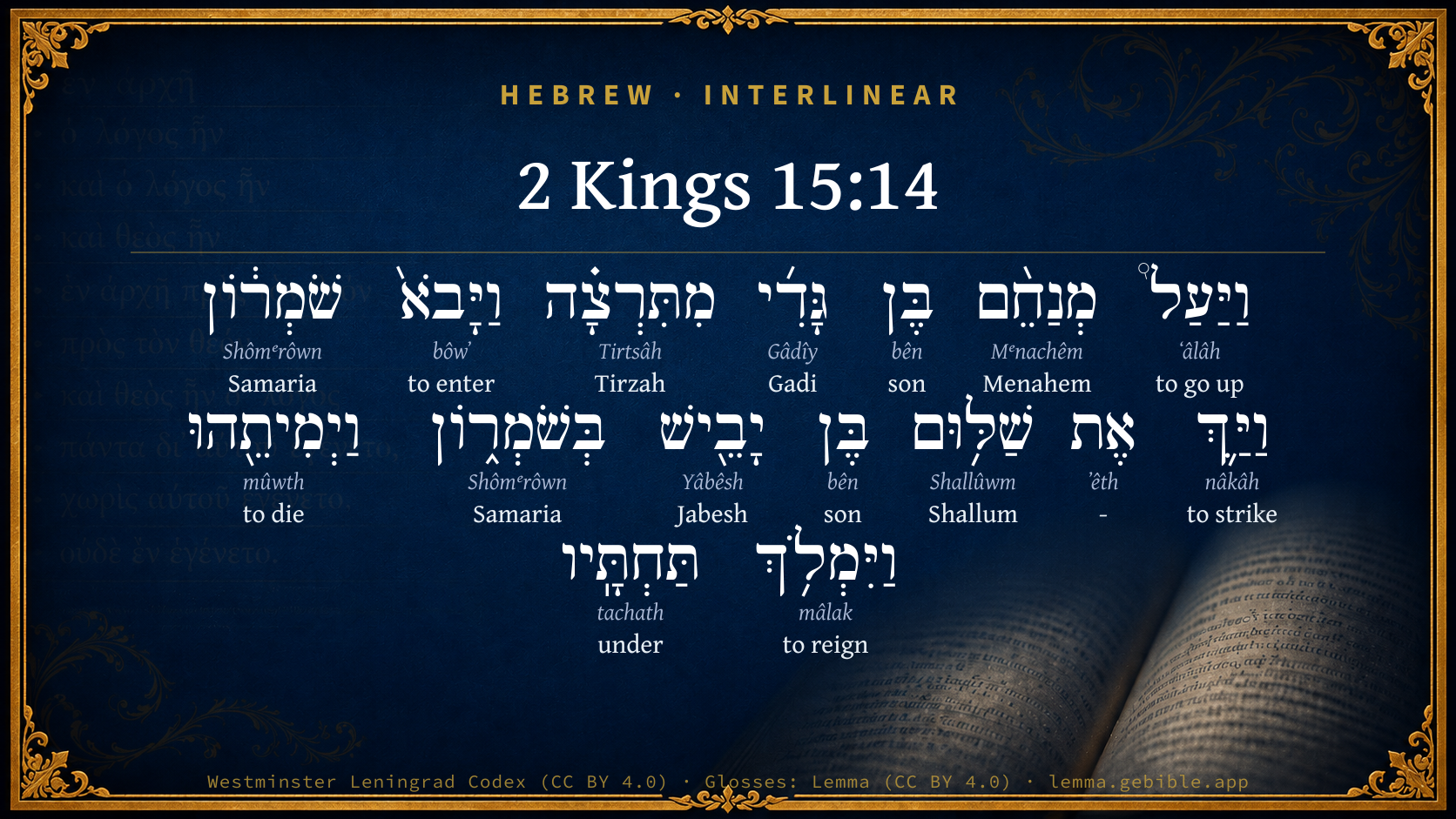
2 Kings 15:14

Hebrew (Westminster Leningrad Codex) 2 Kings 15:14 appears in the Hebrew Old Testament. The text above is from the Westminster Leningrad Codex. Each word links to its Strong’s number, a concise gloss, and parsing drawn from the Open Scriptures Hebrew Bible morphology. Click any word for its full Brown-Driver-Briggs (BDB) entry.
Download image
Cite this verse

2 Kings 15:14 (World English Bible). Public Domain. Lemma interlinear Bible study tool, https://lemma.gebible.app/v/2-kings/15/14.

Show BibTeX & RIS
BibTeX
RIS
English Translation
Menahem the son of Gadi went up from Tirzah, and came to Samaria, and struck Shallum the son of Jabesh in Samaria, and killed him, and reigned in his place.
World English Bible · Public Domain
Highlights
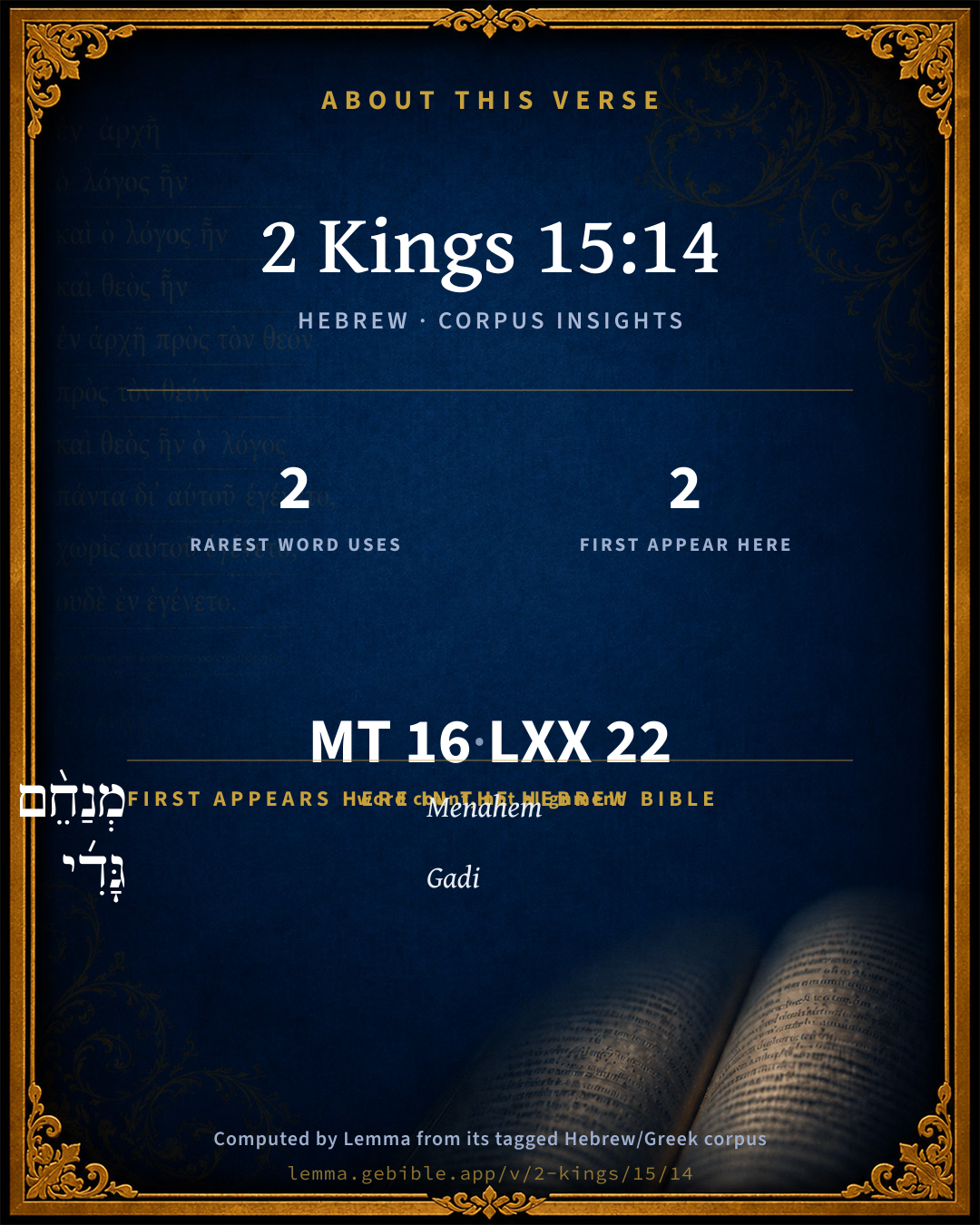
  • 2 first appearances in the Hebrew Bible
Full analysis ↓
Download a study sheet

One document with this verse’s original text, its word-by-word gloss line, the meaning frame, cross-references with their text, attributed commentary, and full source and license credits — printable, and it pastes into notes with its structure intact.

This verse Autodidact and up

Study sheet (.html) Plain text (.txt)

A passage Seminary Student

Up to 50 verses in one chapter. A passage sheet keeps up to 6 commentary sources and 12 cross-references per verse, in the order this page ranks them, and says so on the sheet whenever that leaves anything out. Ask for a single verse and you get the Autodidact verse sheet above.

Everything on this page stays free to read, with no account — the sheet is a download of what is already on screen, not access to it.

Want to remove ads? Support Godless Engineer
Compare translations 3

The same verse in 3 English versions, stacked beneath the original-language interlinear above. Click any original word for its lexicon entry.

Each is an independent rendering of the whole verse — the interlinear is not word-aligned to these translations.

Highlighted words mark where these versions differ — a whole-verse word diff, not a word-by-word alignment.

  • World English Bible Public Domain
    Menahem the son of Gadi went up from Tirzah, and came to Samaria, and struck Shallum the son of Jabesh in Samaria, and killed him, and reigned in his place.
  • King James Version Public Domain
    For Menahem the son of Gadi went up from Tirzah, and came to Samaria, and smote Shallum the son of Jabesh in Samaria, and slew him, and reigned in his stead.
  • unfoldingWord Literal Text CC BY-SA 4.0
    Then Menahem, the son of Gadi, came up from Tirzah, and he came Samaria. And he struck Shallum, the son of Jabesh, in Samaria, and he killed him. And he reigned in his place.

unfoldingWord Literal Text — © unfoldingWord, licensed CC BY-SA 4.0. Word-aligned USFM3 via Door43 (git.door43.org/unfoldingWord/en_ult).

Versions to compare (up to 4)

3 of 4 selected

Show all 18 translations

Every available English version of this verse, each an independent rendering of the whole verse.

  • World English Bible Public Domain
    Menahem the son of Gadi went up from Tirzah, and came to Samaria, and struck Shallum the son of Jabesh in Samaria, and killed him, and reigned in his place.
  • Berean Standard Bible Public Domain
    Then Menahem son of Gadi went up from Tirzah to Samaria, struck down and killed Shallum son of Jabesh, and reigned in his place.
  • Majority Standard Bible Public Domain
    Then Menahem son of Gadi went up from Tirzah to Samaria, struck down and killed Shallum son of Jabesh, and reigned in his place.
  • King James Version Public Domain
    For Menahem the son of Gadi went up from Tirzah, and came to Samaria, and smote Shallum the son of Jabesh in Samaria, and slew him, and reigned in his stead.
  • American Standard Version (1901) Public Domain
    And Menahem the son of Gadi went up from Tirzah, and came to Samaria, and smote Shallum the son of Jabesh in Samaria, and slew him, and reigned in his stead.
  • Revised Version (1885) Public Domain
    And Menahem the son of Gadi went up from Tirzah, and came to Samaria, and smote Shallum the son of Jabesh in Samaria, and slew him, and reigned in his stead.
  • Geneva Bible (1599) Public Domain
    For Menahem the sonne of Gadi went vp from Tirzah, and came to Samaria, and smote Shallum the sonne of Iabesh in Samaria, and slew him, and reigned in his stead.
  • Douay-Rheims (1899) Public Domain
    And Manahem the son of Gadi went up from Thersa: and he came into Samaria, and struck Sellum the son of Jabes in Samaria, and slew him, and reigned in his stead.
  • Young's Literal Translation Public Domain
    and go up doth Menahem son of Gadi from Tirzah and cometh in to Samaria, and smiteth Shallum son of Jabesh in Samaria, and putteth him to death, and reigneth in his stead.
  • Literal Standard Version CC BY-SA 4.0
    and Menahem son of Gadi goes up from Tirzah and comes to Samaria, and strikes Shallum son of Jabesh in Samaria, and puts him to death, and reigns in his stead.
  • Unlocked Literal Bible CC BY-SA 4.0
    Menahem son of Gadi went up from Tirzah to Samaria. There he attacked Shallum son of Jabesh, in Samaria. He killed him and became king in his place.
  • unfoldingWord Literal Text CC BY-SA 4.0
    Then Menahem, the son of Gadi, came up from Tirzah, and he came Samaria. And he struck Shallum, the son of Jabesh, in Samaria, and he killed him. And he reigned in his place.
  • Darby Bible Public Domain
    And Menahem the son of Gadi went up from Tirzah, and came to Samaria, and smote Shallum the son of Jabesh in Samaria, and slew him, and reigned in his stead.
  • World Messianic Bible Public Domain
    Menahem the son of Gadi went up from Tirzah, came to Samaria, struck Shallum the son of Jabesh in Samaria, killed him, and reigned in his place.
  • Webster's Bible Public Domain
    For Menahem the son of Gadi went up from Tirzah, and came to Samaria, and smote Shallum the son of Jabesh in Samaria, and slew him, and reigned in his stead.
  • Free Bible Version CC BY-SA 4.0
    Then Menahem, son of Gadi, went from Tirzah to Samaria, attacked and murdered Shallum, son of Jabesh, and took over as king.
  • Bible in Basic English Public Domain
    Then Menahem, the son of Gadi, went up from Tirzah and came to Samaria, and attacking Shallum, son of Jabesh, in Samaria, put him to death and made himself king in his place.
  • JPS Tanakh (1917) Public Domain
    And Menahem the son of Gadi went up from Tirzah, and came to Samaria, and smote Shallum the son of Jabesh in Samaria, and slew him, and reigned in his stead.

Literal Standard Version (2020), Covenant Press — licensed CC BY-SA 4.0. Text via the HelloAO Bible API (eBible.org). Unlocked Literal Bible (unfoldingWord) — licensed CC BY-SA 4.0. Text via the HelloAO Bible API (eBible.org). unfoldingWord Literal Text — © unfoldingWord, licensed CC BY-SA 4.0. Word-aligned USFM3 via Door43 (git.door43.org/unfoldingWord/en_ult). Free Bible Version, Dr. Jonathan Gallagher — licensed CC BY-SA 4.0. Text via the HelloAO Bible API (eBible.org).

Word by word

More ways to search: Search by grammar → Find every occurrence → Compare this word →

Practice this passage: Drill this verse → Learn its vocabulary →

גָּדִ֜י
Gâdîy
H1424
“Gadi”
Noun, Proper
Part of Speech
Noun
Type
Proper
Full BDB Definition

Origin: from H1409

TWOT: None

Gadi = "my fortune" - the Gadite father of Menahem, a king of Israel
  1. וַיַּעַל֩ ʻâlâh H5927 “and · to go up” Conjunction + Verb, Qal, Sequential Imperfect, 3rd Person, Masculine, Singular
  2. מְנַחֵ֨ם Mᵉnachêm H4505 “Menahem” Noun, Proper
  3. בֶּן bên H1121 “son of” Noun, Common, Masculine, Singular, Construct
  4. מִתִּרְצָ֗ה Tirtsâh H8656 “from · Tirzah” Preposition + Noun, Proper
  5. וַיָּבֹא֙ bôwʼ H935 “and · to enter” Conjunction + Verb, Qal, Sequential Imperfect, 3rd Person, Masculine, Singular
  6. שֹׁמְר֔וֹן Shômᵉrôwn H8111 “Samaria” Noun, Proper
  7. וַיַּ֛ךְ nâkâh H5221 “and · to strike” Conjunction + Verb, Hiphil, Sequential Imperfect, 3rd Person, Masculine, Singular
  8. אֶת ʼêth H853 “-” Particle, Direct Object
  9. שַׁלּ֥וּם Shallûwm H7967 “Shallum” Noun, Proper
  10. בֶּן bên H1121 “son of” Noun, Common, Masculine, Singular, Construct
  11. יָבֵ֖ישׁ Yâbêsh H3003 “Jabesh” Noun, Proper
  12. בְּשֹׁמְר֑וֹן Shômᵉrôwn H8111 “in/at · Samaria” Preposition + Noun, Proper
  13. וַיְמִיתֵ֖הוּ mûwth H4191 “and · to die · him” Conjunction + Verb, Hiphil, Sequential Imperfect, 3rd Person, Masculine, Singular + Suffix, Personal, 3rd Person, Masculine, Singular
  14. וַיִּמְלֹ֥ךְ mâlak H4427 “and · to reign” Conjunction + Verb, Qal, Sequential Imperfect, 3rd Person, Masculine, Singular
  15. תַּחְתָּֽיו tachath H8478 “under · him” Preposition + Suffix, Personal, 3rd Person, Masculine, Singular

About this verse

These counts appear in no published source. They are computed here, from the morphology-tagged text and Lemma’s own curated glosses. What Lemma adds →

16
words
14
distinct lemmas
Historical
section

Notable vocabulary

The rarest word here is גָּדִ֜י Gadi H1424 — appearing just 2 times in the whole Hebrew Bible.

First appearance in Scripture

These words make their first canonical appearance in the Hebrew Bible here:

  • מְנַחֵ֨ם Menahem H4505
  • גָּדִ֜י Gadi H1424

Shared distinctive vocabulary

גָּדִ֜י Gadi H1424 occurs in 2 verses of the Hebrew Bible. Also found in:

Grammatical profile

  • 5 verbs
  • 9 nouns
  • 1 preposition
  • 1 particle

Verb forms

  • וַיַּעַל֩ Qal · Sequential Imperfect
  • וַיָּבֹא֙ Qal · Sequential Imperfect
  • וַיַּ֛ךְ Hiphil · Sequential Imperfect
  • וַיְמִיתֵ֖הוּ Hiphil · Sequential Imperfect
  • וַיִּמְלֹ֥ךְ Qal · Sequential Imperfect

Repetition

Words recur within this verse — often emphatic in Hebrew:

  • בֶּן son H1121 ×2
  • שֹׁמְר֔וֹן Samaria H8111 ×2

Hebrew & Septuagint length

In English translation the verse runs 30 words from the Hebrew and 27 from the Septuagint (LXX English) — closely comparable.

A rough comparison of the two English renderings, which tokenize alike — not a word-level alignment.

Word counts can differ between the Hebrew and the Greek without any difference in meaning — e.g. the Hebrew direct-object marker אֵת has no separate Greek word, and Greek often adds the article ὁ.

In the original languages it is 16 Hebrew tokens and 22 Greek tokens — but the two are counted differently (Hebrew bundles its prefixes and suffixes into one token; the Greek is in lemma form), so that isn’t a like-for-like length.

Cross-references

6

Topical passages linked to 2 Kings 15:14 in the Treasury of Scripture Knowledge — connected by theme and wording, ordered by reader-vote popularity; previews shown in the World English Bible.

  • 1 Kings 14:17 Jeroboam's wife arose, and departed, and came to Tirzah: [and] as she came to the threshold of the house, the child died.
  • 1 Kings 15:21 It happened, when Baasha heard of it, that he left off building Ramah, and lived in Tirzah.
  • 1 Kings 15:33 In the third year of Asa king of Judah began Baasha the son of Ahijah to reign over all Israel in Tirzah, [and reigned] twenty-four years.
  • 1 Kings 16:8–9 In the twenty-sixth year of Asa king of Judah began Elah the son of Baasha to reign over Israel in Tirzah, [and reigned] two years.
  • 1 Kings 16:15 In the twenty-seventh year of Asa king of Judah did Zimri reign seven days in Tirzah. Now the people were encamped against Gibbethon, which belonged to the Philistines.
  • 1 Kings 16:17 Omri went up from Gibbethon, and all Israel with him, and they besieged Tirzah.

Cross-references courtesy of OpenBible.info (CC BY 4.0).

Hebrew and Greek witnesses Masoretic Hebrew ↔ Greek Septuagint

The same verse in the two great witnesses to the Old Testament, shown verse-for-verse.

These are two independent witnesses, not word-aligned to each other, and the Septuagint is shown in lemma (dictionary) form.

Hebrew 2 Kings 15:14 Masoretic · Westminster Leningrad Codex

וַיַּעַל֩ מְנַחֵ֨ם בֶּן גָּדִ֜י מִתִּרְצָ֗ה וַיָּבֹא֙ שֹׁמְר֔וֹן וַיַּ֛ךְ אֶת שַׁלּ֥וּם בֶּן יָבֵ֖ישׁ בְּשֹׁמְר֑וֹן וַיְמִיתֵ֖הוּ וַיִּמְלֹ֥ךְ תַּחְתָּֽיו

Menahem the son of Gadi went up from Tirzah, and came to Samaria, and struck Shallum the son of Jabesh in Samaria, and killed him, and reigned in his place.

World English Bible · Public Domain

Greek LXX 2 Kings 15:14 Septuagint · lemma form

καί ἀναβαίνω μαναημ υἱός γαδδι ἐκ θαρσιλα καί ἔρχομαι εἰς σαμαρεία καί πατάσσω ὁ σελλουμ υἱός ιαβις ἐν σαμαρεία καί θανατόω αὐτός

And Manaem the son of Gaddi went up out of Tharsila, and came to Samaria, and struck Sellum the son of Jabis in Samaria, and killed him.

LXX2012 (modern English Septuagint) · Public Domain

On this verse, The Cambridge Bible for Schools and Colleges discusses the Septuagint’s reading. Read the note in Commentary ↓

Hebrew: Westminster Leningrad Codex (CC BY 4.0). Greek: Septuagint (public domain); English from LXX2012 (modern English Septuagint) (Public Domain). How the Septuagint differs from the Hebrew →

Targum (Aramaic paraphrase)

1

The Targum is the ancient Jewish Aramaic paraphrase of the Hebrew Scriptures — an interpretive translation, not the Hebrew text itself. Onkelos (literal) and Pseudo-Jonathan (expansive) render the Torah, and Jonathan the Prophets. Coverage is partial: where no permissively-licensed English translation exists for a verse, only the Aramaic is shown. This is verse-level text, not a word-by-word alignment to the Hebrew.

  1. Targum Jonathan Prophets (Joshua–Malachi)
    וּסְלִיק מְנַחֵם בַּר גָדִי מִתִּרְצָה וַאֲתָא לְשֹׁמְרוֹן וּמְחָא יַת שַׁלוּם בַּר יָבֵשׁ בְּשֹׁמְרוֹן וְקַטְלֵיהּ וּמְלַךְ תְּחוֹתוֹהִי:

    (no public-domain English translation for this verse)

    Targum Jonathan — Aramaic: “Mikraot Gedolot” (public domain). English: “Sefaria Community Translation” (CC0 1.0 (public-domain dedication)); “London "Chaldee Paraphrase," 1871” (public domain). Text via Sefaria.

Commentary

Notes on 2 Kings 15:14 from classic Christian and Jewish commentators (each source and its license shown beneath its notes). The classic Christian expositions comment on the surrounding passage and are grouped to its opening verse, so a note may address several verses; the Jewish commentaries on the Tanakh (Rashi and others) are per-verse, so they appear only where the commentator wrote on this verse.

Lemma curates 59 commentaries, every one of them public domain or Creative Commons licensed, each selected and text-cleaned for this edition rather than reprinted as found. About our sources →

Trapp's Complete Commentary

John Trapp

2Ki 15:14 For Menahem the son of Gadi went up from Tirzah, and came to Samaria, and smote Shallum the son of Jabesh in Samaria, and slew him, and reigned in his stead.

Ver. 14. For Menahem the son of Gadi.] Who was general of Zachariah’s army, saith Josephus: {a} as Omri was of drunken Elah’s. This Menahem is by Sulpitius Severus called Manes: as was also the first founder of the Manichees, those ancient heretics. The name signifieth Paracletum, a comforter: but they proved nothing less.

And slew him.] This was interitus tyranno dignus.

{a} Hist., lib. i.

John Trapp, A Commentary or Exposition upon All the Books of the Old and New Testament (1647–1656) — public domain. Text from a community e-Sword module.

Tyndale Open Study Notes

Tyndale Open Resources

15:14 Tirzah had been capital of the northern kingdom during Israel’s first two dynasties (1 Kgs 14:17; 15:21, 33; 16:8). • Menahem was an army commander.

Tyndale Open Study Notes — © Tyndale Open Resources, licensed CC BY-SA 4.0. Text via the HelloAO Bible API.

Ellicott's Commentary for English Readers

(14) For.—And.

Menahem.—Tiglath Pileser II. records in his annals that in his eighth regnal year (i.e., B.C. 738) he took tribute of “Raçunnu (Rezin) the Damascene, and Menihimmè Samerinâ’a”—i.e., Menahem the Samaritan.

Gadi.—Or, a Gadite.

Went up from Tirzah.—Menahem was Zachariah’s general, who at the time was quartered with the troops at Tirzah, near Samaria (1Ki_14:17). On the news of the murder of Zachariah, Menahem marched to tHe capital. The month of Shallum’s reign was probably taken up with preparations for hostilities on both sides. A battle at Samaria decided matters (Josephus). Perhaps, however, Menahem simply entered Samaria with a part of his forces.

A Bible Commentary for English Readers, edited by Charles John Ellicott (1878–1897) — public domain. Text from a community e-Sword module.

The Cambridge Bible for Schools and Colleges

gen. ed. J. J. S. Perowne

14. Menahem the son of Gadi] It has been suggested that Menahem was an officer of king Zechariah and advanced from Tirzah, where he was stationed, to Samaria to avenge the murder of his master. This may have been so, but if the expression ‘before the people’ in verse 10 be correct, it would appear as if Zechariah had few to take his part.

Tirzah] Was made a royal residence by Jeroboam I. (1Ki_14:17). The site of Tirzah has not been identified, but its beauty is extolled in Son_6:4. We learn from 1Ki_16:17 that it was a fortress capable of standing a siege, and so may have been a military post, and Menahem an officer there.

and reigned in his stead] These words are not represented in the LXX.

The Cambridge Bible for Schools and Colleges (gen. ed. J. J. S. Perowne; Cambridge University Press, 1878–1918) — public domain. Text from a community e-Sword module.

John Gill's Exposition

And Pul the king of Assyria came against the land,.... The land of Israel, he invaded it; a Jewish chronologer (u) calls him Pulbelicho; and he is generally thought to be the same with Belochus or Belesis, governor of Babylon, who, with Arbaces the Mede, slew Sardanapalus, said to be the last of the Assyrian kings, and translated the empire to the Chaldeans; he ruling over Babylon and Nineveh, and Arbaces over the Medes and Persians; but Pul was not a Babylonian, but an Assyrian (w), and the first king of the Assyrians, at least, the Scriptures speak of: we read no more of him; but one Metasthenes, a Persian historian, feigned and published by Annius, and so named by him instead of Megasthenes, calls him Phulbelochus, and says (x) he reigned forty eight years:

and Menahem gave Pul a thousand talents of silver; and a talent of silver, according to Brerewood (y) was three hundred and seventy five pounds; but Bishop Cumberland (z) calculates it at three hundred and fifty three pounds eleven shillings and ten pence half penny; 1,000 of them made a large sum of money, according to the former 375,000 pounds; and this he gave to him, not only to desist from the invasion of his land, but

that his hand might be with him; and not against him:

and to confirm the kingdom in his hand; which being got by usurpation, and supported by cruelty, was but tottering.

(u) David Ganz. Tzemach David, par. 2. fol. 5. 2. (w) See the Universal History, vol. 4. B. 1. ch. 8. sect. 5. (x) De Judicio Temp. & Annal. Pers. fol. 221. 2. (y) De Ponder & Pret. Vet. Num. c. 4. (z) Scripture Weights and Measures, c. 4. p. 120.

John Gill's Exposition of the Whole Bible (1746–1763) — public domain (CC PDM 1.0). Text via the HelloAO Bible API.

Albert Barnes' Notes on the Bible

Tirzah, the old capital, once more appears as a place of importance, giving birth to the pretender, who alone of all these later kings died a natural death, and left the crown to his son 2Ki 15:22. It would seem from the present passage to have been on lower ground than Samaria.

Albert Barnes' Notes on the Bible (1834–1885) — public domain. Text from a community e-Sword/MySword module.

Haydock's Catholic Bible Commentary

Manahem, general of Zacharias, revenged his death, and then returning to Tharsa[Thersa?], treated it and the neighbouring city, Thapsa, with the utmost fury. So Josephus, [Antiquities?] ix. 11. But his conjectures are to be received with caution.

George Leo Haydock (1774–1849), Haydock's Catholic Family Bible and Commentary, 1859 edition — public domain. Excludes Psalms (Douay-Rheims chapter numbering differs from Protestant) and Deuterocanonical books (Catholic canon only).

Whedon's Commentary on the Bible

Daniel D. Whedon

14. Menahem… went up from Tirzah — According to Josephus and most expositors, Menahem was the general of Zachariah’s army, and had his headquarters at Tirzah, the former residence of the kings of Israel, (see note on 1Ki_14:17,) and when he heard of the assassination of the king, he marched immediately with all his forces to Samaria. and slew the usurper Shallum, and took the kingdom into his own hand.

Daniel D. Whedon (gen. ed.), Commentary on the Old and New Testaments (1874–1909) — public domain. Text from a community e-Sword module.

The Pulpit Commentary

For Manahem the son of Gadi went up from Tirzah. Ewald supposes Tirzah to have been the "native city" of Menahem; but this is not stated. According to Josephus (l.s.c. ), he was commander-in-chief, and happened to be in Tirzeh at the time. (On the probable site of Tirzeh, see the comment on 1Ki_14:17) It was the royal city of the kingdom of the ten tribes from the later part of Jeroboam"s reign to the building of Samaria by Omri. (see 1Ki_14:17 1Ki_16:6, 1Ki_16:8, 1Ki_16:15, 1Ki_16:23) And came to Samaria, and smote Shallum the son of Jabesh in Samaria Josephus says that there was a battle, in which Shallum was slainand slew him, and reigned in his stead.

The Pulpit Commentary (1880–1919), ed. H.D.M. Spence-Jones & Joseph S. Exell — public domain. Text from a community e-Sword module.

Lesson kit

Teaching starters — assembled from the data on this page, not authored interpretation. Every prompt links to the verse data it draws on. Edit before teaching.

2 Kings, in the Historical, opens this verse with 16 words (14 distinct Hebrew lemmas). Its most distinctive word is Gâdîy (“Gadi”). A historical commentator’s framing appears above. Read the whole chapter for the surrounding context.

Discussion questions

  1. The word Gâdîy carries the sense “Gadi.” How does it shape the verse?
  2. 2 words make their first appearance in Scripture here. What does this debut establish?
  3. How does 2 Kings 15:17, which shares the word «Gadi», read alongside this verse?
  4. What does the repetition of “son” (2× in this one verse) do in this verse?
  5. The translations on this page render this verse differently — a whole-verse word diff, not a word-by-word alignment. What might account for the different wordings?
  6. «וַיַּעַל֩» is a Qal Sequential Imperfect verb. How does that grammatical form shape the action described?
  7. Compare how Trapp's Complete Commentary and Tyndale Open Study Notes read this verse. Where do they agree or differ?

Things to notice

Reading settings

Reading text

Shown beneath each verse's original-language words.

Old Testament
Old Testament edition

Read the OT as the Masoretic Hebrew (MT) or the Greek Septuagint (LXX).

English shown for the Greek Septuagint (in the Hebrew ↔ Greek comparison).

Comparing translations? Open the Compare panel on any verse page to stack up to four side by side.