
2 Kings 14:9

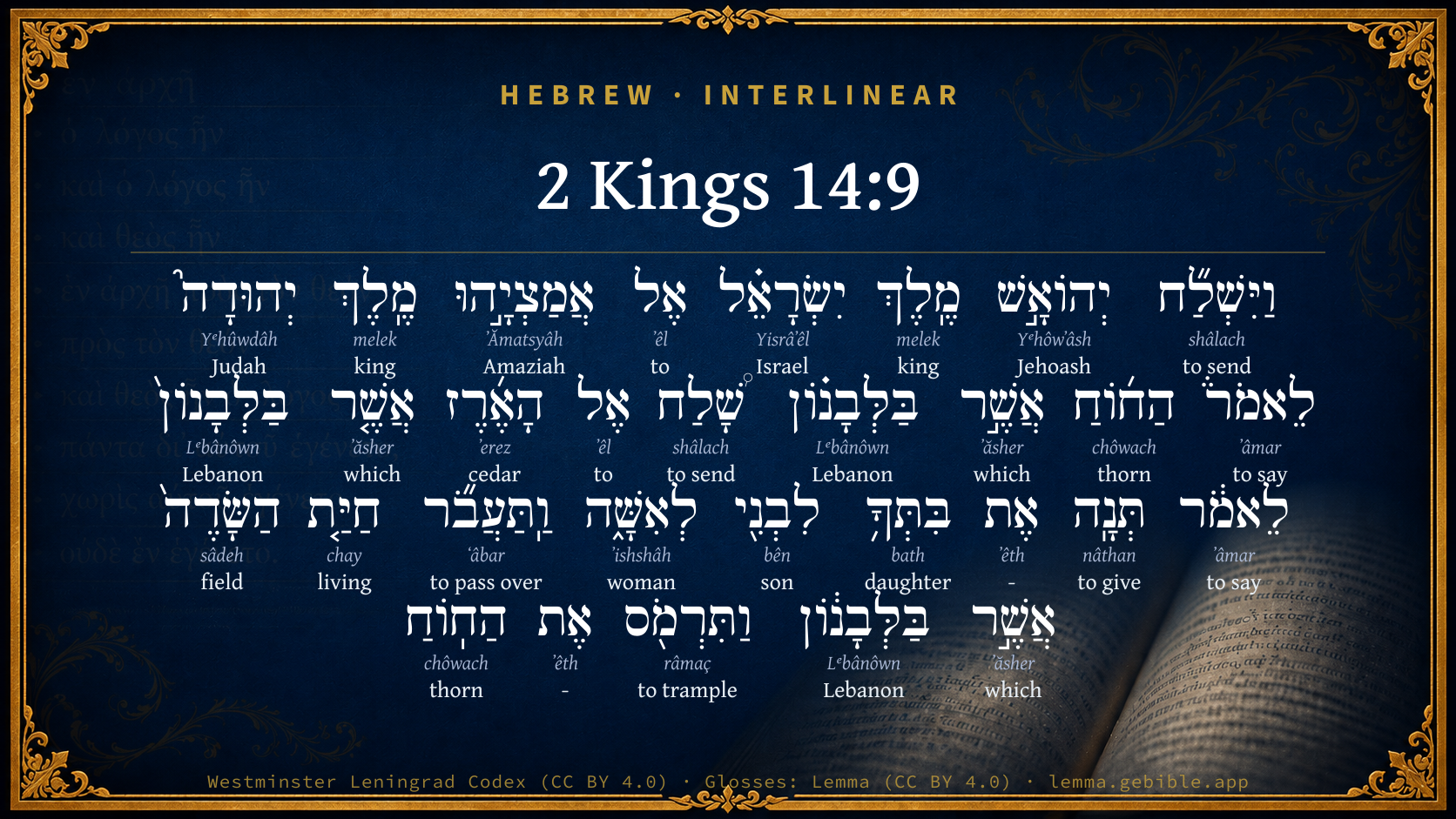
Hebrew (Westminster Leningrad Codex) 2 Kings 14:9 appears in the Hebrew Old Testament. The text above is from the Westminster Leningrad Codex. Each word links to its Strong’s number, a concise gloss, and parsing drawn from the Open Scriptures Hebrew Bible morphology. Click any word for its full Brown-Driver-Briggs (BDB) entry.
Download image
Cite this verse

2 Kings 14:9 (World English Bible). Public Domain. Lemma interlinear Bible study tool, https://lemma.gebible.app/v/2-kings/14/9.

Show BibTeX & RIS
BibTeX
RIS
English Translation
Jehoash the king of Israel sent to Amaziah king of Judah, saying, The thistle that was in Lebanon sent to the cedar that was in Lebanon, saying, Give your daughter to my son as wife: and there passed by a wild animal that was in Lebanon, and trod down the thistle.
World English Bible · Public Domain
Highlights
  • 1 first appearance in the Hebrew Bible
Full analysis ↓
Download a study sheet

One document with this verse’s original text, its word-by-word gloss line, the meaning frame, cross-references with their text, attributed commentary, and full source and license credits — printable, and it pastes into notes with its structure intact.

This verse Autodidact and up

Study sheet (.html) Plain text (.txt)

A passage Seminary Student

Up to 50 verses in one chapter. A passage sheet keeps up to 6 commentary sources and 12 cross-references per verse, in the order this page ranks them, and says so on the sheet whenever that leaves anything out. Ask for a single verse and you get the Autodidact verse sheet above.

Everything on this page stays free to read, with no account — the sheet is a download of what is already on screen, not access to it.

Want to remove ads? Support Godless Engineer
Compare translations 3

The same verse in 3 English versions, stacked beneath the original-language interlinear above. Click any original word for its lexicon entry.

Each is an independent rendering of the whole verse — the interlinear is not word-aligned to these translations.

Highlighted words mark where these versions differ — a whole-verse word diff, not a word-by-word alignment.

  • World English Bible Public Domain
    Jehoash the king of Israel sent to Amaziah king of Judah, saying, The thistle that was in Lebanon sent to the cedar that was in Lebanon, saying, Give your daughter to my son as wife: and there passed by a wild animal that was in Lebanon, and trod down the thistle.
  • King James Version Public Domain
    And Jehoash the king of Israel sent to Amaziah king of Judah, saying, The thistle that was in Lebanon sent to the cedar that was in Lebanon, saying, Give thy daughter to my son to wife: and there passed by a wild beast that was in Lebanon, and trode down the thistle.
  • unfoldingWord Literal Text CC BY-SA 4.0
    And Jehoash, the king of Israel, sent to Amaziah, the king of Judah, saying, “A thornbush that in Lebanon sent to a cedar that in Lebanon, saying, ‘Give your daughter to my son as a wife.’ But a beast of the field that in Lebanon passed by, and it trampled the thornbush.

unfoldingWord Literal Text — © unfoldingWord, licensed CC BY-SA 4.0. Word-aligned USFM3 via Door43 (git.door43.org/unfoldingWord/en_ult).

Versions to compare (up to 4)

3 of 4 selected

Show all 18 translations

Every available English version of this verse, each an independent rendering of the whole verse.

  • World English Bible Public Domain
    Jehoash the king of Israel sent to Amaziah king of Judah, saying, The thistle that was in Lebanon sent to the cedar that was in Lebanon, saying, Give your daughter to my son as wife: and there passed by a wild animal that was in Lebanon, and trod down the thistle.
  • Berean Standard Bible Public Domain
    But Jehoash king of Israel replied to Amaziah king of Judah: “A thistle in Lebanon sent a message to a cedar in Lebanon, saying, ‘Give your daughter to my son in marriage.’ Then a wild beast in Lebanon came along and trampled the thistle.
  • Majority Standard Bible Public Domain
    But Jehoash king of Israel replied to Amaziah king of Judah: “A thistle in Lebanon sent a message to a cedar in Lebanon, saying, ‘Give your daughter to my son in marriage.’ Then a wild beast in Lebanon came along and trampled the thistle.
  • King James Version Public Domain
    And Jehoash the king of Israel sent to Amaziah king of Judah, saying, The thistle that was in Lebanon sent to the cedar that was in Lebanon, saying, Give thy daughter to my son to wife: and there passed by a wild beast that was in Lebanon, and trode down the thistle.
  • American Standard Version (1901) Public Domain
    And Jehoash the king of Israel sent to Amaziah king of Judah, saying, The thistle that was in Lebanon sent to the cedar that was in Lebanon, saying, Give thy daughter to my son to wife: and there passed by a wild beast that was in Lebanon, and trod down the thistle.
  • Revised Version (1885) Public Domain
    And Jehoash the king of Israel sent to Amaziah king of Judah, saying, The thistle that was in Lebanon sent to the cedar that was in Lebanon, saying, Give thy daughter to my son to wife: and there passed by a wild beast that was in Lebanon, and trode down the thistle.
  • Geneva Bible (1599) Public Domain
    Then Iehoash the King of Israel sent to Amaziah King of Iudah, saying, The thistle that is in Lebanon, sent to the cedar that is in Lebanon, saying, Giue thy daughter to my sonne to wife: and the wilde beast that was in Lebanon, went and trode downe the thistle.
  • Douay-Rheims (1899) Public Domain
    And Joas king of Israel sent again to Amasias king of Juda, saying: A thistle of Libanus sent to a cedar tree, which is in Libanus, saying: Give thy daughter to my son to wife. And the beasts of the forest, that are in Libanus, passed and trod down the thistle.
  • Young's Literal Translation Public Domain
    And Jehoash king of Israel sendeth unto Amaziah king of Judah, saying, `The thorn that `is' in Lebanon hath sent unto the cedar that `is' in Lebanon, saying, Give thy daughter to my son for a wife; and pass by doth a beast of the field that `is' in Lebanon, and treadeth down the thorn.
  • Literal Standard Version CC BY-SA 4.0
    And Jehoash king of Israel sends to Amaziah king of Judah, saying, “The thorn that [is] in Lebanon has sent to the cedar that [is] in Lebanon, saying, Give your daughter to my son for a wife; and a beast of the field that [is] in Lebanon passes by, and treads down the thorn.
  • Unlocked Literal Bible CC BY-SA 4.0
    But Jehoash the king of Israel sent messengers back to Amaziah king of Judah, saying, “A thistle that was in Lebanon sent a message to a cedar in Lebanon, saying, 'Give your daughter to my son for a wife,' but a wild beast in Lebanon walked by and trampled down the thistle.
  • unfoldingWord Literal Text CC BY-SA 4.0
    And Jehoash, the king of Israel, sent to Amaziah, the king of Judah, saying, “A thornbush that in Lebanon sent to a cedar that in Lebanon, saying, ‘Give your daughter to my son as a wife.’ But a beast of the field that in Lebanon passed by, and it trampled the thornbush.
  • Darby Bible Public Domain
    And Jehoash king of Israel sent to Amaziah king of Judah, saying, The thorn-bush that is in Lebanon sent to the cedar that is in Lebanon, saying, Give thy daughter to my son as wife; and there passed by the wild beast that is in Lebanon, and trode down the thorn-bush.
  • World Messianic Bible Public Domain
    Jehoash the king of Israel sent to Amaziah king of Judah, saying, “The thistle that was in Lebanon sent to the cedar that was in Lebanon, saying, ‘Give your daughter to my son as wife.’ Then a wild animal that was in Lebanon passed by, and trampled down the thistle.
  • Webster's Bible Public Domain
    And Jehoash the king of Israel sent to Amaziah king of Judah, saying, The thistle that was in Lebanon sent to the cedar that was in Lebanon, saying, Give thy daughter to my son for a wife: and there passed by a wild beast that was in Lebanon, and trod down the thistle.
  • Free Bible Version CC BY-SA 4.0
    Jehoash, king of Israel, replied to Amaziah, king of Judah: “In Lebanon a thistle sent a message to a cedar, saying, ‘Give your daughter as a wife to my son.’ But a wild animal of Lebanon came by and trampled down the thistle.
  • Bible in Basic English Public Domain
    And Jehoash, king of Israel, sent to Amaziah, king of Judah, saying, The thorn-tree in Lebanon sent to the cedar in Lebanon, saying, Give your daughter to my son for a wife: and a beast from the woodland in Lebanon went by, crushing the thorn under his feet.
  • JPS Tanakh (1917) Public Domain
    And Jehoash the king of Israel sent to Amaziah king of Judah, saying: 'The thistle that was in Lebanon sent to the cedar that was in Lebanon, saying: Give thy daughter to my son to wife; and there passed by the wild beasts that were in Lebanon, and trod down the thistle.

Literal Standard Version (2020), Covenant Press — licensed CC BY-SA 4.0. Text via the HelloAO Bible API (eBible.org). Unlocked Literal Bible (unfoldingWord) — licensed CC BY-SA 4.0. Text via the HelloAO Bible API (eBible.org). unfoldingWord Literal Text — © unfoldingWord, licensed CC BY-SA 4.0. Word-aligned USFM3 via Door43 (git.door43.org/unfoldingWord/en_ult). Free Bible Version, Dr. Jonathan Gallagher — licensed CC BY-SA 4.0. Text via the HelloAO Bible API (eBible.org).

Word by word

More ways to search: Search by grammar → Find every occurrence → Compare this word →

Practice this passage: Drill this verse → Learn its vocabulary →

הַח֜וֹחַ
chôwach
H2336
“the · thorn”
Particle, Definite Article + Noun, Common, Masculine, Singular, Absolute
Part of Speech
Particle + Noun
Type
Common
Gender
Masculine
Number
Singular
State
Absolute
Full BDB Definition

Origin: from an unused root apparently meaning to pierce

TWOT: 620a , 620b

thorn, brier, bramble, thornbush, thicket - hook, ring, fetter
  1. וַיִּשְׁלַ֞ח shâlach H7971 “and · to send” Conjunction + Verb, Qal, Sequential Imperfect, 3rd Person, Masculine, Singular
  2. יְהוֹאָ֣שׁ Yᵉhôwʼâsh H3060 “Jehoash” Noun, Proper
  3. מֶֽלֶךְ melek H4428 “king of” Noun, Common, Masculine, Singular, Construct
  4. יִשְׂרָאֵ֗ל Yisrâʼêl H3478 “Israel” Noun, Proper
  5. אֶל ʼêl H413 “to” Preposition
  6. אֲמַצְיָ֣הוּ ʼĂmatsyâh H558 “Amaziah” Noun, Proper
  7. מֶֽלֶךְ melek H4428 “king of” Noun, Common, Masculine, Singular, Construct
  8. יְהוּדָה֮ Yᵉhûwdâh H3063 “Judah” Noun, Proper
  9. לֵאמֹר֒ ʼâmar H559 “to say” Preposition + Verb, Qal, Infinitive Construct
  10. אֲשֶׁ֣ר ʼăsher H834 “which” Particle, Relative
  11. בַּלְּבָנ֗וֹן Lᵉbânôwn H3844 “in/at the · Lebanon” Preposition, Determined + Noun, Proper
  12. שָׁ֠לַח shâlach H7971 “to send” Verb, Qal, Perfect, 3rd Person, Masculine, Singular
  13. אֶל ʼêl H413 “to” Preposition
  14. הָאֶ֜רֶז ʼerez H730 “the · cedar” Particle, Definite Article + Noun, Common, Masculine, Singular, Absolute
  15. אֲשֶׁ֤ר ʼăsher H834 “which” Particle, Relative
  16. בַּלְּבָנוֹן֙ Lᵉbânôwn H3844 “in/at the · Lebanon” Preposition, Determined + Noun, Proper
  17. לֵאמֹ֔ר ʼâmar H559 “to say” Preposition + Verb, Qal, Infinitive Construct
  18. תְּנָֽה nâthan H5414 “give” Verb, Qal, Imperative, 2nd Person, Masculine, Singular + Suffix, h
  19. אֶת ʼêth H853 “-” Particle, Direct Object
  20. בִּתְּךָ֥ bath H1323 “daughter · your” Noun, Common, Feminine, Singular, Construct + Suffix, Personal, 2nd Person, Masculine, Singular
  21. לִבְנִ֖י bên H1121 “to/for · son · my” Preposition + Noun, Common, Masculine, Singular, Construct + Suffix, Personal, 1st Person, Common, Singular
  22. לְאִשָּׁ֑ה ʼishshâh H802 “to/for · woman” Preposition + Noun, Common, Feminine, Singular, Absolute
  23. וַֽתַּעֲבֹ֞ר ʻâbar H5674 “and · to pass over” Conjunction + Verb, Qal, Sequential Imperfect, 3rd Person, Feminine, Singular
  24. חַיַּ֤ת chay H2416 “living of” Noun, Common, Feminine, Singular, Construct
  25. הַשָּׂדֶה֙ sâdeh H7704 “the · field” Particle, Definite Article + Noun, Common, Masculine, Singular, Absolute
  26. אֲשֶׁ֣ר ʼăsher H834 “which” Particle, Relative
  27. בַּלְּבָנ֔וֹן Lᵉbânôwn H3844 “in/at the · Lebanon” Preposition, Determined + Noun, Proper
  28. וַתִּרְמֹ֖ס râmaç H7429 “and · to trample” Conjunction + Verb, Qal, Sequential Imperfect, 3rd Person, Feminine, Singular
  29. אֶת ʼêth H853 “-” Particle, Direct Object
  30. הַחֽוֹחַ chôwach H2336 “the · thorn” Particle, Definite Article + Noun, Common, Masculine, Singular, Absolute

About this verse

These counts appear in no published source. They are computed here, from the morphology-tagged text and Lemma’s own curated glosses. What Lemma adds →

31
words
21
distinct lemmas
Historical
section

Notable vocabulary

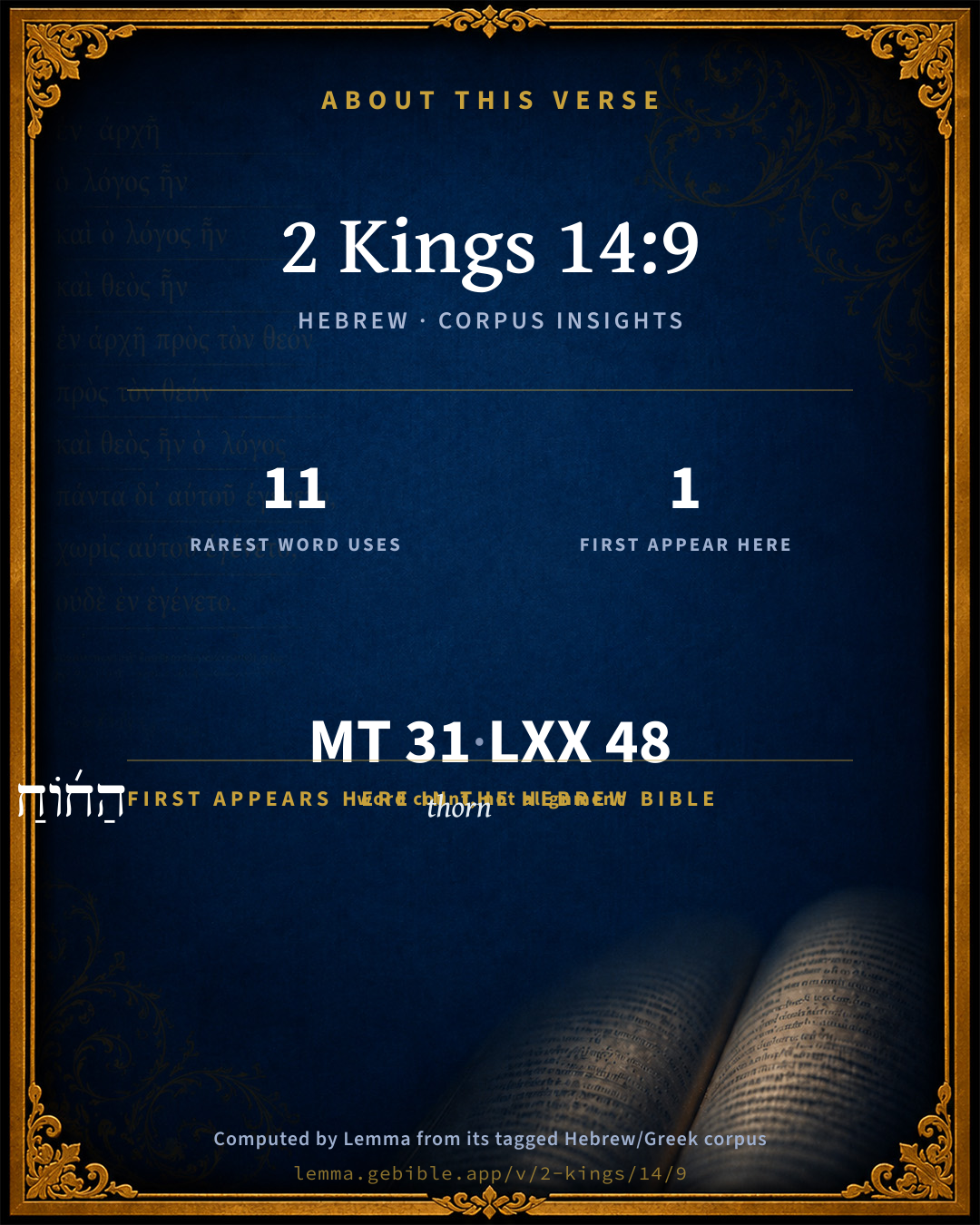
The rarest word here is הַח֜וֹחַ thorn H2336 — appearing just 11 times in the whole Hebrew Bible.

First appearance in Scripture

This word makes its first canonical appearance in the Hebrew Bible here:

  • הַח֜וֹחַ thorn H2336

Shared distinctive vocabulary

הַח֜וֹחַ thorn H2336 occurs in 9 verses of the Hebrew Bible. Also found in:

Grammatical profile

  • 7 verbs
  • 17 nouns
  • 2 prepositions
  • 5 particles

Verb forms

  • וַיִּשְׁלַ֞ח Qal · Sequential Imperfect
  • לֵאמֹר֒ Qal · Infinitive Construct
  • שָׁ֠לַח Qal · Perfect
  • לֵאמֹ֔ר Qal · Infinitive Construct
  • תְּנָֽה Qal · Imperative
  • וַֽתַּעֲבֹ֞ר Qal · Sequential Imperfect
  • וַתִּרְמֹ֖ס Qal · Sequential Imperfect

Repetition

Words recur within this verse — often emphatic in Hebrew:

  • בַּלְּבָנ֗וֹן Lebanon H3844 ×3
  • וַיִּשְׁלַ֞ח to send H7971 ×2
  • מֶֽלֶךְ king H4428 ×2
  • לֵאמֹר֒ to say H559 ×2
  • הַח֜וֹחַ thorn H2336 ×2
  • אֲשֶׁ֣ר which H834 ×3
  • אֶל to H413 ×2

Hebrew & Septuagint length

In English translation the verse runs 51 words from the Hebrew and 54 from the Septuagint (LXX English) — closely comparable.

A rough comparison of the two English renderings, which tokenize alike — not a word-level alignment.

Word counts can differ between the Hebrew and the Greek without any difference in meaning — e.g. the Hebrew direct-object marker אֵת has no separate Greek word, and Greek often adds the article ὁ.

In the original languages it is 31 Hebrew tokens and 48 Greek tokens — but the two are counted differently (Hebrew bundles its prefixes and suffixes into one token; the Greek is in lemma form), so that isn’t a like-for-like length.

Cross-references

13

Topical passages linked to 2 Kings 14:9 in the Treasury of Scripture Knowledge — connected by theme and wording, ordered by reader-vote popularity; previews shown in the World English Bible.

  • Judges 9:8–15 The trees went forth on a time to anoint a king over them; and they said to the olive tree, Reign you over us.
  • 1 Samuel 13:6 When the men of Israel saw that they were in a strait (for the people were distressed), then the people did hide themselves in caves, and in thickets, and in rocks, and in coverts, and in pits.
  • 2 Samuel 12:1–4 Yahweh sent Nathan to David. He came to him, and said to him, "There were two men in one city; the one rich, and the other poor.
  • 1 Kings 4:33 He spoke of trees, from the cedar that is in Lebanon even to the hyssop that springs out of the wall; he spoke also of animals, and of birds, and of creeping things, and of fish.
  • 2 Chronicles 25:10–13 Then Amaziah separated them, [to wit], the army that had come to him out of Ephraim, to go home again: therefore their anger was greatly kindled against Judah, and they returned home in fierce anger.
  • 2 Chronicles 25:18 Joash king of Israel sent to Amaziah king of Judah, saying, The thistle that was in Lebanon sent to the cedar that was in Lebanon, saying, Give your daughter to my son as wife: and there passed by a wild animal that was in Lebanon, and trod down the thistle.
  • 2 Chronicles 33:11 Therefore Yahweh brought on them the captains of the host of the king of Assyria, who took Manasseh in chains, and bound him with fetters, and carried him to Babylon.
  • Job 31:18 (No, from my youth he grew up with me as with a father, Her have I guided from my mother's womb);
  • Proverbs 26:9 Like a thornbush that goes into the hand of a drunkard, So is a parable in the mouth of fools.
  • Song of Solomon 2:2 As a lily among thorns, So is my love among the daughters. Beloved
  • Isaiah 34:13 Thorns shall come up in its palaces, nettles and thistles in the fortresses of it; and it shall be a habitation of jackals, a court for ostriches.
  • Ezekiel 20:49 Then said I, Ah Lord Yahweh! they say of me, Isn't he a speaker of parables?
  • Hosea 9:6 For, behold, they have gone away from destruction. Egypt will gather them up. Memphis will bury them. Nettles will possess their pleasant things of silver. Thorns will be in their tents.

Cross-references courtesy of OpenBible.info (CC BY 4.0).

Hebrew and Greek witnesses Masoretic Hebrew ↔ Greek Septuagint

The same verse in the two great witnesses to the Old Testament, shown verse-for-verse.

These are two independent witnesses, not word-aligned to each other, and the Septuagint is shown in lemma (dictionary) form.

Hebrew 2 Kings 14:9 Masoretic · Westminster Leningrad Codex

וַיִּשְׁלַ֞ח יְהוֹאָ֣שׁ מֶֽלֶךְ יִשְׂרָאֵ֗ל אֶל אֲמַצְיָ֣הוּ מֶֽלֶךְ יְהוּדָה֮ לֵאמֹר֒ הַח֜וֹחַ אֲשֶׁ֣ר בַּלְּבָנ֗וֹן שָׁ֠לַח אֶל הָאֶ֜רֶז אֲשֶׁ֤ר בַּלְּבָנוֹן֙ לֵאמֹ֔ר תְּנָֽה אֶת בִּתְּךָ֥ לִבְנִ֖י לְאִשָּׁ֑ה וַֽתַּעֲבֹ֞ר חַיַּ֤ת הַשָּׂדֶה֙ אֲשֶׁ֣ר בַּלְּבָנ֔וֹן וַתִּרְמֹ֖ס אֶת הַחֽוֹחַ

Jehoash the king of Israel sent to Amaziah king of Judah, saying, The thistle that was in Lebanon sent to the cedar that was in Lebanon, saying, Give your daughter to my son as wife: and there passed by a wild animal that was in Lebanon, and trod down the thistle.

World English Bible · Public Domain

Greek LXX 2 Kings 14:9 Septuagint · lemma form

καί ἀποστέλλω ιωας βασιλεύς ἰσραήλ πρός αμεσσιας βασιλεύς ιουδα λέγω ὁ ακαν ὁ ἐν ὁ λίβανος ἀποστέλλω πρός ὁ κέδρος ὁ ἐν ὁ λίβανος λέγω δίδωμι ὁ θυγάτηρ σύ ὁ υἱός ἐγώ εἰς γυνή καί διαἔρχομαι ὁ θηρίον ὁ ἀγρός ὁ ἐν ὁ λίβανος καί συνπατέω ὁ ακανα

And Joas the king of Israel sent to Amessias king of Juda, saying, The thistle that was in Libanus sent to the cedar that was in Libanus, saying, Give my daughter to your son to wife: and the wild beasts of the field that were in Libanus passed by and trod down the thistle.

LXX2012 (modern English Septuagint) · Public Domain

On this verse, Ellicott's Commentary for English Readers discusses the Septuagint’s reading. Read the note in Commentary ↓

Hebrew: Westminster Leningrad Codex (CC BY 4.0). Greek: Septuagint (public domain); English from LXX2012 (modern English Septuagint) (Public Domain). How the Septuagint differs from the Hebrew →

Targum (Aramaic paraphrase)

1

The Targum is the ancient Jewish Aramaic paraphrase of the Hebrew Scriptures — an interpretive translation, not the Hebrew text itself. Onkelos (literal) and Pseudo-Jonathan (expansive) render the Torah, and Jonathan the Prophets. Coverage is partial: where no permissively-licensed English translation exists for a verse, only the Aramaic is shown. This is verse-level text, not a word-by-word alignment to the Hebrew.

  1. Targum Jonathan Prophets (Joshua–Malachi)
    וּשְׁלַח יְהוֹאָשׁ מַלְכָּא דְיִשְׂרָאֵל לְוַת אֲמַצְיָה מֶלֶךְ שִׁבְטָא דְבֵית יְהוּדָה לְמֵימָר חוֹחָא דִי בְלִבְנָן שְׁלַח לְאַרְזָא דִי בְלִבְנָן לְמֵימָר הַב יַת בְּרַתָךְ לִבְרִי לְאִתּוּ וַעֲבָרַת חֵיוַת בְּרָא דִי בְלִבְנָן וְדָשַׁת יַת חוֹחָא:

    (no public-domain English translation for this verse)

    Targum Jonathan — Aramaic: “Mikraot Gedolot” (public domain). English: “Sefaria Community Translation” (CC0 1.0 (public-domain dedication)); “London "Chaldee Paraphrase," 1871” (public domain). Text via Sefaria.

Commentary

Notes on 2 Kings 14:9 from classic Christian and Jewish commentators (each source and its license shown beneath its notes). The classic Christian expositions comment on the surrounding passage and are grouped to its opening verse, so a note may address several verses; the Jewish commentaries on the Tanakh (Rashi and others) are per-verse, so they appear only where the commentator wrote on this verse.

Lemma curates 59 commentaries, every one of them public domain or Creative Commons licensed, each selected and text-cleaned for this edition rather than reprinted as found. About our sources →

Trapp's Complete Commentary

John Trapp

2Ki 14:9 And Jehoash the king of Israel sent to Amaziah king of Judah, saying, The thistle that [was] in Lebanon sent to the cedar that [was] in Lebanon, saying, Give thy daughter to my son to wife: and there passed by a wild beast that [was] in Lebanon, and trode down the thistle.

Ver. 9. The thistle that was in Lebanon.] Not the shrub, but the thistle, which is prickly indeed, and can say Nemo me impune lacessit, but a low, vile, weak weed, and not to be named in the same day with the cedar, that tallest and firmest of trees. Thus Joash setteth Amaziah at nought, and looketh upon him as a petty king in comparison of himself.

Give thy daughter to my son,] q.d., I would scorn to have any affinity with thee, though we were never so good friends.

And there passed by a wild beast.] Whereby he meaneth his own forces. Bellum quasi belluinum: soldiers are brutish and barbarous, skilful to destroy; and the time of war is fitly called "a time of trouble, and of treading down." {Isa 22:5}

John Trapp, A Commentary or Exposition upon All the Books of the Old and New Testament (1647–1656) — public domain. Text from a community e-Sword module.

The Biblical Illustrator

Joseph S. Exell

2Ki_14:9-10

The thistle that was in Lebanon sent to the cedar.

The parable of Jehoash

I. three things led to the utterance of this short parable.

1. A relative success.

2. An under-estimate of a superior.

3. An insolent challenge.

(1) Success is a relative term, and must be estimated with reference to the circumstances accompanying it. A man who guides his vessel safely across the English Channel achieves a certain success. But this is a short and comparatively easy voyage, and is not to be placed by the side of a successful crossing of the Atlantic Ocean, in rough and stormy weather. The captain who can bring his vessel safely through the dangers to be encountered in such a voyage, has fairly earned the right to be called successful. It by no means follows that the man who could execute the first would be equal to the second, nor does it follow that a military commander who could defeat the tribes of Africa in battle would be able to gain a victory over the armies of Europe. But this was the conclusion at which Amaziah, King of Judah, had arrived. He had subdued the Edomites and slain ten thousand men, and he therefore concluded that he should be equally successful against the king and armies of Israel, who were much more formidable foes. This conclusion arose from--

(2) An under-estimate of his superiors in the art of war. The man who undertakes to swim a river ought to be well acquainted with the strength of the current in comparison with his own bodily strength. A mistake on these points may be fatal. It is plain that Amaziah undervalued the military strength and capacity of his opponent; for when they did meet, Judah was put to the worse before Israel, and they fled every man to their tents (2Ki_14:12). This undervalue of a man who was a greater warrior than himself led to

(3) an insolent challenge. Come, let us look one another in the face (2Ki_14:8). Success in an undertaking sometimes fills an ignorant man with such an insolent pride, that he thinks nothing can stand before him. Amaziah was such a man, because he had defeated the Edomites, he thought that the army of Israel would be but as chaff before him. Hence his invitation to Jehoash.

II. The parable by which Jehoash reproved him conveys that kings sense of his superiority by a similitude drawn from nature. The contrast between the cedar standing in all its glory upon the mountain of Lebanon and the worthless thistle which has sprung up at its foot is very great, and conveys the King of Israels contempt for his rival in forcible terms. The cedar of a thousand years could not be uprooted or removed by the strongest earthly power, while the thistle of yesterday was at the mercy of the first beast of the forest who passed by that way. There is also a reference to Oriental custom. The man who asked the daughter of another in marriage was expected to be his equal in rank, otherwise the request was regarded as an insult. Therefore the proposal of the thistle to the cedar is a declaration of supposed equality, and is placed by Jehoash on a level with Ahaziahs challenge to himself. The fate of the thistle sets forth what would be the result of the self-esteem of the King of Judah if he did not take the advice which is the application of the whole. Tarry at home, for why shouldest thou meddle to thine hurt (2Ki_14:10).

III. Note the success and the non-success of the parable. It was a success inasmuch as it was a true picture of the character of the man whom it was intended to represent. If those who can give a correct outline of the face upon canvas are regarded as successful artists, those whose word-painting can show us the features of the soul are at least as successful. But it failed in producing a beneficial effect upon the person to whom it was addressed. Amaziah did not wish to see his own likeness. Those who are deformed do not derive pleasure from seeing themselves reflected in a faithful mirror. The parables of Christ often failed to gain the approbation of His hearers on this account. Lessons:

1. One proud man may become, in the providence of God, the means of humiliation to another. There was much arrogance in the man who compared himself to a cedar, as well as in him whom he reproved.

2. Men who are prone to seek quarrels will find that, in so doing, they have sought their own ruin. Nations and rulers who enter into war from ambitious motives, will but hasten their own destruction. With what measure ye meet, it shall be measured unto you again.

3. He that has achieved a fair measure of success by the exercise of a fair measure of ability may lose what he has gained by attempting a task beyond his capabilities. A gambler who has won a fortune in a contest with a man no more clever than himself, will most likely lose it all if he attempts to play with a much more skilful gamester. It would have been Amaziahs wisdom to have been content with his conquest of Edom; he would then have been spared the humiliation of a defeat at the hands of the King of Israel.

4. Those who become proud and insolent by prosperity turn a blessing into a curse, and thus defeat the Divine intention. Success in our undertakings is intended to produce gratitude and humility; the fault is in us if these effects are not produced.

5. The great lesson of the history is: that Pride goeth before destruction, and a haughty spirit before a fall (Pro_16:18). (Outlines from Sermons by a London Minister.)

The Biblical Illustrator, edited by Joseph S. Exell (c. 1880s–1900s) — public domain. Text from a community e-Sword module.

Joseph Benson's Commentary

2Ki 14:9. Jehoash sent to Amaziah, saying, The thistle, &c. — By the thistle, a mean, despicable, and yet troublesome weed, he understands Amaziah, and by the cedar, himself, whom he intimates to be far stronger than he, and out of his reach. Considering the circumstances of the person addressed, who was a petty prince, flushed with a little good success, and thereupon impatient to enlarge his kingdom, no similitude could be better adapted than that of a thistle, a low, contemptible shrub, but, upon its having drawn blood of some traveller, grown proud and affecting an equality with the cedar, a tall stately tree, the pride and ornament of the wood, till, in the midst of all its arrogance and presumption, it is unhappily trodden down by the beasts of the forest, which Jehoash intimates would be Amaziah’s fate, if he continued to provoke a prince of his superior power and strength. See Calmet and Scheuchzer. Saying, Give me thy daughter to wife — Let us make a match, that is, let us fight; only he expresses his bloody and destructive work in a civil manner, as Amaziah had done, (2Ki 14:8,) and as Abner did, 2Sa 2:14 : or, Let thy kingdom and mine be united under one king, as formerly they were; and let us decide, by a pitched battle, whether thou or I shall be that king. A wild beast trode down the thistle — And so put an end to his treaty with the cedar: and with no less ease shall my soldiers tread down thee and thy forces.

Joseph Benson's Commentary on the Old and New Testaments (1811–1818) — public domain. Text from a community e-Sword module.

Tyndale Open Study Notes

Tyndale Open Resources

14:9-10 Jehoash’s reply came as a parable (see Judg 9:7-15). In essence, Amaziah had as much of a chance of defeating Israel in war as a thistle trying to make demands against a mighty cedar tree. Amaziah and Judah would be defeated as easily as a random step would crush the proud thistle.

Tyndale Open Study Notes — © Tyndale Open Resources, licensed CC BY-SA 4.0. Text via the HelloAO Bible API.

Geneva Bible (1599)

Geneva Bible translators

By this parable Jehoash compareth himself to a cedar tree, because of his great kingdom over ten tribes, and Amaziah to a thistle, because he ruled but over two tribes, and the wild beasts are Jehoash’s soldiers, that spoiled the cities of Judah.

Geneva Bible (1599) marginal notes — public domain. Text via Bolls.life.

Jamieson, Fausset & Brown

Robert Jamieson, A. R. Fausset & David Brown

Jehoash the king of Israel sent to Amaziah--People in the East very often express their sentiments in a parabolic form, especially when they intend to convey unwelcome truths or a contemptuous sneer. This was the design of the admonitory fable related by Joash in his reply. The thistle, a low shrub, might be chosen to represent Amaziah, a petty prince; the cedar, the powerful sovereign of Israel, and the wild beast that trampled down the thistle the overwhelming army with which Israel could desolate Judah. But, perhaps, without making so minute an application, the parable may be explained generally, as describing in a striking manner the effects of pride and ambition, towering far beyond their natural sphere, and sure to fall with a sudden and ruinous crash. The moral of the fable is contained in Kg2 14:10.

Jamieson, Fausset & Brown — Commentary Critical and Explanatory on the Whole Bible (1871) — public domain (CC PDM 1.0). Text via the HelloAO Bible API.

Adam Clarke's Commentary

Verse 9. Jehoash - sent to Amaziah - saying] The meaning of this parable is plain. The thistle that was in Lebanon - Amaziah, king of Judah, sent to the cedar that was in Lebanon - Jehoash, king of Israel, saying, Give thy daughter - a part of thy kingdom, to my son to wife - to be united to, and possessed by the kings of Judah. And there passed by a wild beast - Jehoash and his enraged army, and trode down the thistle - utterly discomfited Amaziah and his troops, pillaged the temple, and broke down the walls of Jerusalem: see 2Kg 14:12-14. Probably Amaziah had required certain cities of Israel to be given up to Judah; if so, this accounts for that part of the parable, Give thy daughter to my son to wife.

Adam Clarke's Commentary on the Bible (1810–1826) — public domain. Text from a community e-Sword/MySword module.

Ellicott's Commentary for English Readers

(9) The thistle.—Or bramble or briar. (Comp. Job_31:40; Son_2:2.) The LXX. and Vulg. render “thistle;” the Syriac, “blackthorn” (Prunus silvestris).

Give thy daughter to my son to wife.—Perhaps hinting at Amaziah’s demand for the surrender of Israel (the “daughter” of Jehoash) to Judah (the “son” of Amaziah).

And there passed by a wild beast that was in Lebanon.—Rather, and the wild beasts that were in Lebanon passed over it. So LXX. and Vulg. It is obvious to compare with this brief but most pithy parable that of Jotham (Jdg_9:8-15). The contrast between the northern and southern kingdoms in point of military strength and resources, and the disdainful tolerance with which the former regarded the latter, could hardly have found more forcible expression.

A Bible Commentary for English Readers, edited by Charles John Ellicott (1878–1897) — public domain. Text from a community e-Sword module.

The Cambridge Bible for Schools and Colleges

gen. ed. J. J. S. Perowne

9. the thistle … sent to the cedar] What Jehoash wishes to convey is that he feels himself utterly Amaziah’s superior, and that he can take no notice of his message. This he does by an apologue (cf. Jdg_9:8-15) in which he speaks not of war but of marriage. The application is however quite clear. The thistle, who asks for the daughter of the cedar, is trodden down by some passing beast and perishes unregarded, while the cedar stands unharmed. Words could hardly convey more strongly the low opinion which Jehoash entertained of Amaziah’s power.

The Cambridge Bible for Schools and Colleges (gen. ed. J. J. S. Perowne; Cambridge University Press, 1878–1918) — public domain. Text from a community e-Sword module.

John Gill's Exposition

But Amaziah would not hear,.... Being given up to a judicial hardness of heart through pride; for this was of God, and by his overruling providence, that he might be punished for his idolatry, in setting up the gods of Edom to be his gods, and offering to them, Ch2 25:14.

therefore Jehoash king Israel went up; from Samaria to the land of Judah, which was higher ground:

and he and Amaziah looked one another in the face; in the field of battle:

at Bethshemesh, which belongeth to Judah; which is observed, not merely to distinguish it from another Bethshemesh in Naphtali, but to observe, that the king of Israel waited not for him to give him the challenge, but met his adversary in his own country, whither he carried the war, not suffering him to come into his.

John Gill's Exposition of the Whole Bible (1746–1763) — public domain (CC PDM 1.0). Text via the HelloAO Bible API.

Albert Barnes' Notes on the Bible

The Oriental use of apologues on the most solemn and serious occasions is well known to all, and scarcely needs illustration (compare marginal reference). It is a common feature of such apologues that they are not exact parallels to the case whereto they are applied, but only general or partial resemblances. Hence, there is need of caution in applying the several points of the illustration.

Albert Barnes' Notes on the Bible (1834–1885) — public domain. Text from a community e-Sword/MySword module.

Haydock's Catholic Bible Commentary

Thistle. Hebrew choach, something prickly; (Haydock) "a thorn." Syriac and Arabic, "a plum-tree." Nothing could be more cutting (Calmet) than this answer of Joas, to shew the king of Juda how much he despised his power. (Haydock) --- The ancients were much pleased with such ingenious similes. See Judges ix. 7.

George Leo Haydock (1774–1849), Haydock's Catholic Family Bible and Commentary, 1859 edition — public domain. Excludes Psalms (Douay-Rheims chapter numbering differs from Protestant) and Deuterocanonical books (Catholic canon only).

Matthew Poole's English Annotations

By the

thistle, a low and contemptible, yet troublesome shrub, he understands Amaziah; and by the cedar, himself, whom he intimates to be far stronger than he, and out of his reach,

Give thy daughter to my son to wife; let us make a match, i.e. let us fight; only he expresseth this bloody work in a civil manner, as Amaziah had done, 2Ki 14:8, and as Abner did, 2Sa 2:14. Or, let thy kingdom and mine be united under one king, as formerly they were; and let us decide it by a pitched battle, whether thou or I shall be that king. Or, as some expound it, by affirming that it was great arrogancy and presumption for him to desire a friendly league or affinity with him, he leaves him to guess how intolerable it was that he should undertake to wage war against him.

Trod down the thistle; and with no less ease shall my soldiers tread down thee and thy forces.

Matthew Poole's English Annotations on the Holy Bible (1683–1685) — public domain. Text from a community e-Sword/MySword module.

Whedon's Commentary on the Bible

Daniel D. Whedon

9. The thistle… the cedar — This answer of Jehoash reminds us of the fable of Jotham. Jdg_9:8. The thistle here, like the bramble there, represents a low, worthless, and offensive thing, and is a stinging reflection on Amaziah and his kingdom. By the cedar the king of Israel pompously suggests to his foe his own magnificence and power, and afterwards plainly says that a war between them must needs result in Judah’s downfall. Both the thistle and the cedar are represented as in Lebanon, which may have been designed to suggest that a worthless king may sometimes be found in a lofty position, and thence through pride aspire to things beyond his sphere.

Give thy daughter to my son — We need not suppose that Amaziah had asked Jehoash to give a daughter in marriage to his son, but it is possible that he had demanded satisfaction for the cities and spoil which the Israelitish soldiers had taken from Judah, or that he had pompously threatened to subdue the kingdom of Israel and unite it again with Judah.

There passed by a wild beast — Image of an unexpected dispensation of judgment moving forth to the sudden destruction of the haughty schemer. The destroyer is represented as passing by, not as sent out by the cedar. So Jehoash might wish to suggest to Amaziah that in case he meddled with things beyond his province he would be suddenly smitten by some judgment of the Almighty. He does not proudly boast and presume to tread down Amaziah and Judah by his own warriors and martial prowess.

Daniel D. Whedon (gen. ed.), Commentary on the Old and New Testaments (1874–1909) — public domain. Text from a community e-Sword module.

The Pulpit Commentary

And Jehoash the King of Israel sent to Amaziah King of Judah, saying. According to Josephus, the reply to the challenge was given in a formal letter, of which he presents us with a copy

King Joash to King Amaziah sends greeting:

upon a time there was in Mount Lebanon a very tall cypress, and also there was a thistle. And the thistle sent to the cypress, saying," Contract thy daughter in marriage to my son." And while this was transacting, a wild beast passed by and trod down the thistle. Let this be a warning to thee not to cherish immoderate desires, and not, because thou hast had success against Amalek, to pride thyself thereupon, and so draw down dangers both upon thee and upon thy kingdom.

The force of the original message is much weakened in this paraphrase. The thistle that was in Lebanon. "Thistle" is a better translation than "thorn-bush" (Keil), first, as a meaner, growth, and secondly, as more likely to be trodden down by a wild beast. The monarch intends to say that the meanest thing in the vegetable world sent to the grandest, claiming equality. Sent to the cedar certainly "the cedar." and not "the cypress," as translated by Josephus that was in Lebanon, saying, Give thy daughter to my son to wife. Nube pari was a Roman maxim; and the rule was one generally established throughout the ancient world. To ask a man"s daughter in marriage for one"s self or for one"s son was to claim to be his equal. And there passed by a wild beast literally, a beast of the field that was in Lebanon (on Lebanon as the haunt of wild beasts, see Son_4:8), and trode down the thistle. So leveling with the dust the pride of the impertinent one. We must not seek an exact application of all the details either of a fable or of a parable. It is not required that metaphors should "run on all fours."

The Pulpit Commentary (1880–1919), ed. H.D.M. Spence-Jones & Joseph S. Exell — public domain. Text from a community e-Sword module.

John Wesley's Explanatory Notes

Saying, &c. - By the thistle, a low and contemptible, yet troublesome shrub, he understands Amaziah; and by the cedar, himself, whom he intimates to be far stronger than he, and out of his reach. Trod down - And with no less ease shall my soldiers tread down thee and thy forces.

John Wesley, Explanatory Notes Upon the Whole Bible (1754–1765) — public domain. Text via the GEBible commentary corpus.

Rashi

Rabbi Shlomo Yitzchaki (Rashi)

“The thistle that was in Levanon. Shechem son of Chamor.

Sent [a message] to the cedar tree. Yaakov.

And it passed by the wild beast [that was in Levanon]. “Yaakov’s sons came upon the slain.” Here too, you come to compare yourself to me. This comparison was to humiliate him, for he likened him [Amatzyohu] to a thistle, and himself to a cedar [tree].

And the wild beast that was in Levanon passed by and trampled, etc. Because you are arrogant, the troops of my armies will trample you too.

Rashi on the Tanakh — English translations: “The Judaica Press complete Tanach with Rashi, translated by A. J. Rosenberg” (CC BY 4.0); “Pentateuch with Rashi's commentary by M. Rosenbaum and A.M. Silbermann, 1929-1934” (public domain); “The Metsudah Tanach series, Lakewood, N.J” (CC BY 4.0); and “The Book of Joshua, Metsudah Publications, 1997” (CC BY 4.0). Text via Sefaria.

Lesson kit

Teaching starters — assembled from the data on this page, not authored interpretation. Every prompt links to the verse data it draws on. Edit before teaching.

2 Kings, in the Historical, opens this verse with 31 words (21 distinct Hebrew lemmas). Its most distinctive word is chôwach (“thorn”). A historical commentator’s framing appears above. Read the whole chapter for the surrounding context.

Discussion questions

  1. How does “thorn” (chôwach) shape what this verse is saying?
  2. The word “thorn” first appears here in Scripture. What is being introduced at this debut?
  3. 2 Chronicles 25:18 shares the word «thorn» with this verse. How do the two illuminate each other?
  4. “Lebanon” occurs 3× in this one verse. What is the effect of the repetition?
  5. These translations render this verse differently. What is at stake in choosing one wording over another?
  6. The verb «וַיִּשְׁלַ֞ח» is Qal Sequential Imperfect. How does its form color the action?
  7. Reading how Trapp's Complete Commentary and The Biblical Illustrator read this verse, where do the two commentators agree and where do they part?

Things to notice

Reading settings

Reading text

Shown beneath each verse's original-language words.

Old Testament
Old Testament edition

Read the OT as the Masoretic Hebrew (MT) or the Greek Septuagint (LXX).

English shown for the Greek Septuagint (in the Hebrew ↔ Greek comparison).

Comparing translations? Open the Compare panel on any verse page to stack up to four side by side.