
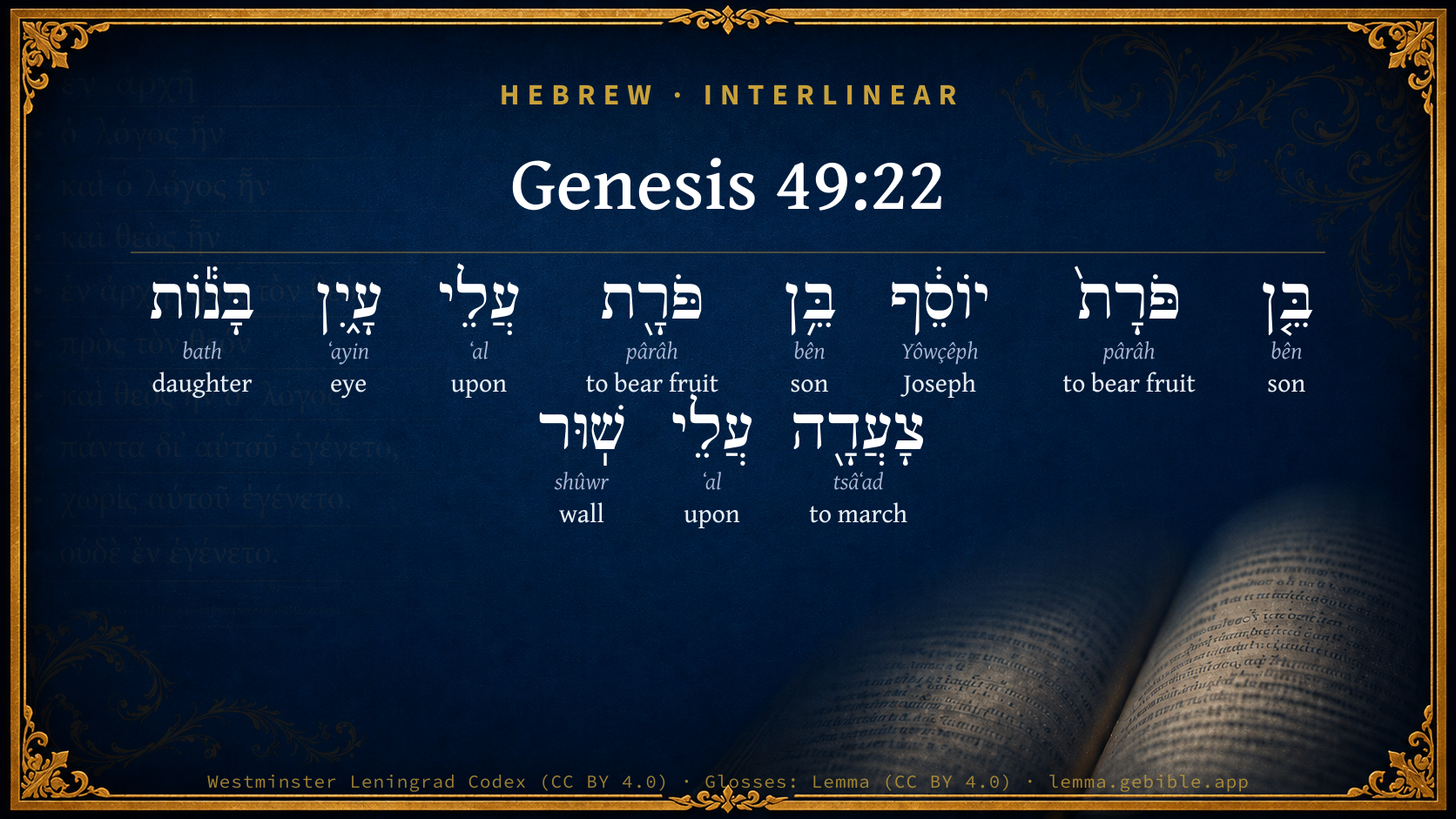
Genesis 49:22

Hebrew (Westminster Leningrad Codex) Genesis 49:22 appears in the Hebrew Old Testament. The text above is from the Westminster Leningrad Codex. Each word links to its Strong’s number, a concise gloss, and parsing drawn from the Open Scriptures Hebrew Bible morphology. Click any word for its full Brown-Driver-Briggs (BDB) entry.
Download image
Cite this verse

Genesis 49:22 (World English Bible). Public Domain. Lemma interlinear Bible study tool, https://lemma.gebible.app/v/genesis/49/22.

Show BibTeX & RIS
BibTeX
RIS
English Translation
"Joseph is a fruitful vine, A fruitful vine by a spring; His branches run over the wall.
World English Bible · Public Domain
Highlights
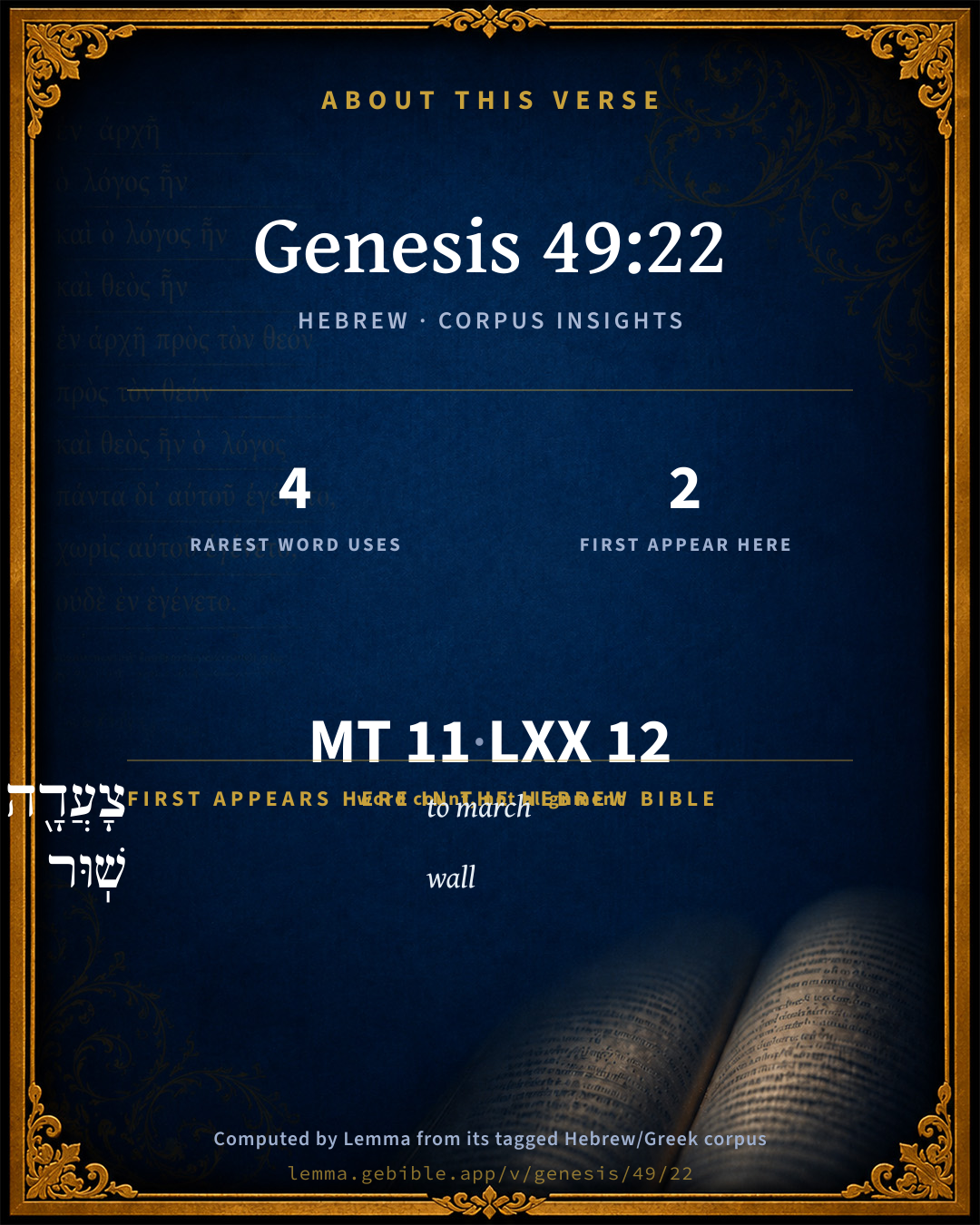
  • 2 first appearances in the Hebrew Bible
Full analysis ↓
Download a study sheet

One document with this verse’s original text, its word-by-word gloss line, the meaning frame, cross-references with their text, attributed commentary, and full source and license credits — printable, and it pastes into notes with its structure intact.

This verse Autodidact and up

Study sheet (.html) Plain text (.txt)

A passage Seminary Student

Up to 50 verses in one chapter. A passage sheet keeps up to 6 commentary sources and 12 cross-references per verse, in the order this page ranks them, and says so on the sheet whenever that leaves anything out. Ask for a single verse and you get the Autodidact verse sheet above.

Everything on this page stays free to read, with no account — the sheet is a download of what is already on screen, not access to it.

Want to remove ads? Support Godless Engineer
Compare translations 3

The same verse in 3 English versions, stacked beneath the original-language interlinear above. Click any original word for its lexicon entry.

Each is an independent rendering of the whole verse — the interlinear is not word-aligned to these translations.

Highlighted words mark where these versions differ — a whole-verse word diff, not a word-by-word alignment.

  • World English Bible Public Domain
    "Joseph is a fruitful vine, A fruitful vine by a spring; His branches run over the wall.
  • King James Version Public Domain
    Joseph is a fruitful bough, even a fruitful bough by a well; whose branches run over the wall:
  • unfoldingWord Literal Text CC BY-SA 4.0
    Joseph the son of a fruit-bearing, the son of a fruit-bearing beside a spring, daughters go up over a wall.

unfoldingWord Literal Text — © unfoldingWord, licensed CC BY-SA 4.0. Word-aligned USFM3 via Door43 (git.door43.org/unfoldingWord/en_ult).

Versions to compare (up to 4)

3 of 4 selected

Show all 18 translations

Every available English version of this verse, each an independent rendering of the whole verse.

  • World English Bible Public Domain
    "Joseph is a fruitful vine, A fruitful vine by a spring; His branches run over the wall.
  • Berean Standard Bible Public Domain
    Joseph is a fruitful vine—a fruitful vine by a spring, whose branches scale the wall.
  • Majority Standard Bible Public Domain
    Joseph is a fruitful vine—a fruitful vine by a spring, whose branches scale the wall.
  • King James Version Public Domain
    Joseph is a fruitful bough, even a fruitful bough by a well; whose branches run over the wall:
  • American Standard Version (1901) Public Domain
    Joseph is a fruitful bough, A fruitful bough by a fountain; His branches run over the wall.
  • Revised Version (1885) Public Domain
    Joseph is a fruitful bough, A fruitful bough by a fountain; His branches run over the wall.
  • Geneva Bible (1599) Public Domain
    Ioseph shalbe a fruitefull bough, euen a fruitful bough by the well side: the small boughs shall runne vpon the wall.
  • Douay-Rheims (1899) Public Domain
    Aser, his bread shall be fat, and he shall yield dainties to kings.
  • Young's Literal Translation Public Domain
    Joseph `is' a fruitful son; A fruitful son by a fountain, Daughters step over the wall;
  • Literal Standard Version CC BY-SA 4.0
    Joseph [is] a fruitful son; A fruitful son by a fountain, || Daughters step over the wall;
  • Unlocked Literal Bible CC BY-SA 4.0
    Joseph is a fruitful bough, a fruitful bough near a spring, whose branches climb over the wall.
  • unfoldingWord Literal Text CC BY-SA 4.0
    Joseph the son of a fruit-bearing, the son of a fruit-bearing beside a spring, daughters go up over a wall.
  • Darby Bible Public Domain
    Joseph is a fruitful bough; A fruitful bough by a well; [His] branches shoot over the wall.
  • World Messianic Bible Public Domain
    “Joseph is a fruitful vine, a fruitful vine by a spring. His branches run over the wall.
  • Webster's Bible Public Domain
    Joseph is a fruitful bough, even a fruitful bough by a well; whose branches run over the wall:
  • Free Bible Version CC BY-SA 4.0
    Joseph is a fruitful tree, a fruitful tree beside a spring, whose branches climb over the wall.
  • Bible in Basic English Public Domain
    Joseph is a young ox, whose steps are turned to the fountain;
  • JPS Tanakh (1917) Public Domain
    Joseph is a fruitful vine, a fruitful vine by a fountain; its branches run over the wall.

Literal Standard Version (2020), Covenant Press — licensed CC BY-SA 4.0. Text via the HelloAO Bible API (eBible.org). Unlocked Literal Bible (unfoldingWord) — licensed CC BY-SA 4.0. Text via the HelloAO Bible API (eBible.org). unfoldingWord Literal Text — © unfoldingWord, licensed CC BY-SA 4.0. Word-aligned USFM3 via Door43 (git.door43.org/unfoldingWord/en_ult). Free Bible Version, Dr. Jonathan Gallagher — licensed CC BY-SA 4.0. Text via the HelloAO Bible API (eBible.org).

Word by word

More ways to search: Search by grammar → Find every occurrence → Compare this word →

Practice this passage: Drill this verse → Learn its vocabulary →

About this verse

These counts appear in no published source. They are computed here, from the morphology-tagged text and Lemma’s own curated glosses. What Lemma adds →

11
words
8
distinct lemmas
Pentateuch
section

Notable vocabulary

The rarest word here is שֽׁוּר wall H7791 — appearing just 4 times in the whole Hebrew Bible.

First appearance in Scripture

These words make their first canonical appearance in the Hebrew Bible here:

  • צָעֲדָ֖ה to march H6805
  • שֽׁוּר wall H7791

Shared distinctive vocabulary

שֽׁוּר wall H7791 occurs in 4 verses of the Hebrew Bible. Also found in:

Grammatical profile

  • 3 verbs
  • 6 nouns
  • 2 prepositions

Verb forms

  • פֹּרָת֙ Qal · Participle Active
  • פֹּרָ֖ת Qal · Participle Active
  • צָעֲדָ֖ה Qal · Perfect

Repetition

Words recur within this verse — often emphatic in Hebrew:

  • בֵּ֤ן son H1121 ×2
  • פֹּרָת֙ to bear fruit H6509 ×2
  • עֲלֵי upon H5921 ×2

Hebrew & Septuagint length

In English translation the verse runs 17 words from the Hebrew and 17 from the Septuagint (LXX English) — the same length.

A rough comparison of the two English renderings, which tokenize alike — not a word-level alignment.

Word counts can differ between the Hebrew and the Greek without any difference in meaning — e.g. the Hebrew direct-object marker אֵת has no separate Greek word, and Greek often adds the article ὁ.

In the original languages it is 11 Hebrew tokens and 12 Greek tokens — but the two are counted differently (Hebrew bundles its prefixes and suffixes into one token; the Greek is in lemma form), so that isn’t a like-for-like length.

Cross-references

15

Topical passages linked to Genesis 49:22 in the Treasury of Scripture Knowledge — connected by theme and wording, ordered by reader-vote popularity; previews shown in the World English Bible.

  • Genesis 41:52 The name of the second, he called Ephraim: "For God has made me fruitful in the land of my affliction."
  • Psalms 1:1–3 Blessed is the man who doesn't walk in the counsel of the wicked, Nor stand in the way of sinners, Nor sit in the seat of scoffers;
  • Psalms 128:3 Your wife will be as a fruitful vine, In the innermost parts of your house; Your children like olive plants, Around your table.
  • Genesis 30:22–24 God remembered Rachel, and God listened to her, and opened her womb.
  • Genesis 46:27 The sons of Joseph, who were born to him in Egypt, were two souls. All the souls of the house of Jacob, who came into Egypt, were seventy.
  • Joshua 16:1–10 The lot came out for the children of Joseph from the Jordan at Jericho, at the waters of Jericho on the east, even the wilderness, going up from Jericho through the hill-country to Bethel;
  • Joshua 17:14–17 The children of Joseph spoke to Joshua, saying, Why have you given me but one lot and one part for an inheritance, seeing I am a great people, because hitherto Yahweh has blessed me?
  • Genesis 48:1 It happened after these things, that someone said to Joseph, "Behold, your father is sick." He took with him his two sons, Manasseh and Ephraim.
  • Genesis 48:5 Now your two sons, who were born to you in the land of Egypt before I came to you into Egypt, are mine; Ephraim and Manasseh, even as Reuben and Simeon, will be mine.
  • Genesis 48:16 the angel who has redeemed me from all evil, bless the lads, and let my name be named on them, and the name of my fathers Abraham and Isaac. Let them grow into a multitude in the midst of the earth."
  • Genesis 48:19–20 His father refused, and said, "I know, my son, I know. He also will become a people, and he also will be great. However, his younger brother will be greater than he, and his seed will become a multitude of nations."
  • Numbers 32:1–42 Now the children of Reuben and the children of Gad had a very great multitude of cattle: and when they saw the land of Jazer, and the land of Gilead, that behold, the place was a place for cattle;
  • Deuteronomy 33:13–17 Of Joseph he said, Blessed of Yahweh be his land, For the precious things of the heavens, for the dew, For the deep that couches beneath,
  • Psalms 128:1 Blessed is everyone who fears Yahweh, Who walks in his ways.
  • Ezekiel 19:11 It had strong rods for the scepters of those who bore rule, and their stature was exalted among the thick boughs, and they were seen in their height with the multitude of their branches.

Cross-references courtesy of OpenBible.info (CC BY 4.0).

Hebrew and Greek witnesses Masoretic Hebrew ↔ Greek Septuagint

The same verse in the two great witnesses to the Old Testament, shown verse-for-verse.

These are two independent witnesses, not word-aligned to each other, and the Septuagint is shown in lemma (dictionary) form.

Hebrew Genesis 49:22 Masoretic · Westminster Leningrad Codex

בֵּ֤ן פֹּרָת֙ יוֹסֵ֔ף בֵּ֥ן פֹּרָ֖ת עֲלֵי עָ֑יִן בָּנ֕וֹת צָעֲדָ֖ה עֲלֵי שֽׁוּר

"Joseph is a fruitful vine, A fruitful vine by a spring; His branches run over the wall.

World English Bible · Public Domain

Greek LXX Genesis 49:22 Septuagint · lemma form

υἱός αὐξάνω ιωσηφ υἱός αὐξάνω ζηλωτός υἱός ἐγώ νέος πρός ἐγώ ἀναστρέφω

Joseph is a son increased; my dearly loved son is increased; my youngest son, turn to me.

LXX2012 (modern English Septuagint) · Public Domain

On this verse, Keil & Delitzsch discusses the Septuagint’s reading. Read the note in Commentary ↓

Hebrew: Westminster Leningrad Codex (CC BY 4.0). Greek: Septuagint (public domain); English from LXX2012 (modern English Septuagint) (Public Domain). How the Septuagint differs from the Hebrew →

Targum (Aramaic paraphrase)

2

The Targum is the ancient Jewish Aramaic paraphrase of the Hebrew Scriptures — an interpretive translation, not the Hebrew text itself. Onkelos (literal) and Pseudo-Jonathan (expansive) render the Torah, and Jonathan the Prophets. Coverage is partial: where no permissively-licensed English translation exists for a verse, only the Aramaic is shown. This is verse-level text, not a word-by-word alignment to the Hebrew.

  1. Targum Onkelos Torah (Genesis–Deuteronomy)
    בְּרִי דְיִסְגֵּי יוֹסֵף בְּרִי דְיִתְבָּרַךְ כְּגֹפֶן דִּנְצִב עַל עֵינָא דְמַיָּא תְּרֵין שִׁבְטִין יִפְּקוּן מִבְּנוֹהִי יְקַבְּלוּן חוּלָקָא וְאַחֲסַנְתָּא

    (no public-domain English translation for this verse)

    Targum Onkelos — Aramaic: “Onkelos Genesis” (public domain); “Onkelos Exodus” (public domain); “Onkelos Leviticus” (public domain); “Onkelos Numbers” (public domain); “Onkelos Deuteronomy” (public domain). English: “Sefaria Community Translation” (CC0 1.0 (public-domain dedication)); “J.W. Etheridge. The Targums of Onkelos and Jonathan Ben Uzziel on the Pentateuch. London: Longmans, Green, 1862” (public domain). Text via Sefaria.

  2. Targum Pseudo-Jonathan Torah (Genesis–Deuteronomy)
    בְּרִי דְרָבִית יוֹסֵף בְּרִי דְרָבִית וּתְקֵיפַת וְסוֹף הֲוָה עֲלָךְ לְמִתְקַף דְכַבְּשַׁת יִצְרָךְ בְּעוּבְדָא דְרִבּוֹנְתָּךְ וּבְעוּבְדָא דְאָחָךְ מְדַמֵי אֲנָא לָךְ לְגוּפָן שְׁתִילָא עַל מַבּוּעִין דְמַיִין דִשְׁלָחָת שׁוּרְשָׁהָא וְתַבְרַת שִׁינֵי כֵיפַיָא וּבְעוּבְרָתָהָא כַּבְשַׁת כָּל אִילָנֵי סַרְקָא כֵּן כָּבַשְׁתָּא יוֹסֵף בְּרִי בְּחָכְמָתָךְ וּבְעוֹבָדָךְ טַבְיָא כָּל חָרְשֵׁי מִצְרָאֵי וְכַד הֲווֹ מְקַלְסִין קֳדָמָךְ הֲווֹ בְּנַתְהוֹן דְשִׁלְטוֹנַיָא מְהַלְכַן עַל טוּרַיָיא וְשַׁדְיָין לְקַמָךְ שִׁירִין וְקַטְלָאִין דְדַהֲבָא מִן בִּגְלַל דְתִתְּלֵי עֵינָךְ בָּהֵן וְלָא תָלִיתָא עֵינָךְ בַּחֲדָא מִנְהוֹן לְמִתְחַיְיבָא בְּהוֹן לְיוֹם דִינָא רַבָּא

    Joseph, my son, thou hast become great; Joseph, my son, thou hast become great and mighty; the end (determined) on thee was (that thou shouldst) be mighty, because thou didst subdue thy inclination in the matter of thy mistress, and in the work of thy brethren. Thee will I liken to a vine planted by fountains of water, which sendeth forth her roots, and overrunneth the ridges of stone, and covereth by her branches all unfruitful trees; even so didst thou my son Joseph subject by thy wisdom and thy good works all the magicians of Mizraim; and when, celebrating thy praises, the daughters of princes walking on the high places cast before thee bracelets and chains of gold, that thou shouldst lift up thine eyes upon them, thine eyes thou wouldst not lift up on one of them, to become guilty in the great day of judgment.

    Targum Pseudo-Jonathan — Aramaic: “Targum Jonathan on Genesis” (public domain); “Targum Jonathan on Exodus” (public domain); “Targum Jonathan on Leviticus” (public domain); “Targum Jonathan on Numbers” (public domain); “Targum Jonathan on Deuteronomy” (public domain). English: “The Targum of Jonathan ben Uzziel, trans. J. W. Etheridge, London, 1862” (public domain). Text via Sefaria.

Commentary

Notes on Genesis 49:22 from classic Christian and Jewish commentators (each source and its license shown beneath its notes). The classic Christian expositions comment on the surrounding passage and are grouped to its opening verse, so a note may address several verses; the Jewish commentaries on the Tanakh (Rashi and others) are per-verse, so they appear only where the commentator wrote on this verse.

Lemma curates 59 commentaries, every one of them public domain or Creative Commons licensed, each selected and text-cleaned for this edition rather than reprinted as found. About our sources →

Matthew Henry's Commentary

He closes with the blessings of his best beloved sons, Joseph and Benjamin; with these he will breathe his last.

I. The blessing of Joseph, which is very large and full. He is compared (Gen 49:22) to a fruitful bouth, or young tree; for God had made him fruitful in the land of his affliction; he owned it. Gen 41:52. His two sons were as branches of a vine, or other spreading plant, running over the wall. Note, God can make those fruitful, great comforts to themselves and others, who have been looked upon as dry and withered. More is recorded in the history concerning Joseph than concerning any other of Jacob's sons; and therefore what Jacob says of him is historical as well as prophetical. Observe,

1. The providences of God concerning Joseph, Gen 49:23, Gen 49:24. These are mentioned to the glory of God, and for the encouragement of Jacob's faith and hope, that God had blessings in store for his seed. Here observe (1.) Joseph's straits and troubles, Gen 49:23. Though he now lived at ease and in honour, Jacob reminds him of the difficulties he had formerly waded through. He had had many enemies, here called archers, being skilful to do mischief, masters of their art of persecution. They hated him: there persecution begins. They shot their poisonous darts at him, and thus they sorely grieved him. His brethren, in his father's house, were very spiteful towards him, mocked him, stripped him, threatened him, sold him, thought they had been the death of him. His mistress, in the house of Potiphar, sorely grieved him, and shot at him, when she impudently assaulted his chastity (temptations are fiery darts, thorns in the flesh, sorely grievous to gracious souls); when she prevailed not in this, she hated him, and shot at him by her false accusations, arrows against which there is little fence but the hold God has in the consciences of the worst of men. Doubtless he had enemies in the court of Pharaoh, that envied his preferment, and sought to undermine him. (2.) Joseph's strength and support under all these troubles (Gen 49:24): His bow abode in strength, that is, his faith did not fail, but he kept his ground, and came off a conqueror. The arms of his hands were made strong, that is, his other graces did their part, his wisdom, courage, and patience, which are better than weapons of war. In short, he maintained both his integrity and his comfort through all his trials; he bore all his burdens with an invincible resolution, and did not sink under them, nor do any thing unbecoming him. (3.) The spring and fountain of this strength; it was by the hands of the mighty God, who was therefore able to strengthen him, and the God of Jacob, a God in covenant with him, and therefore engaged to help him. All our strength for the resisting of temptations, and the bearing of afflictions, comes from God: his grace is sufficient, and his strength is perfected in our weakness. (4.) The state of honour and usefulness to which he was subsequently advanced: Thence (from this strange method of providence) he became the shepherd and stone, the feeder and supporter, of God's Israel, Jacob and his family. Herein Joseph was a type, [1.] Of Christ; he was shot at and hated, but borne up under his sufferings (Isa 50:7-9), and was afterwards advanced to be the shepherd and stone. [2.] Of the church in general, and particular believers; hell shoots its arrows against the saints, but Heaven protects and strengthens them, and will crown them.

2. The promises of God to Joseph. See how these are connected with the former: Even by the God of thy father Jacob, who shall help thee, Gen 49:25. Note, Our experiences of God's power and goodness in strengthening us hitherto are our encouragements still to hope for help from him; he that has helped us will help: we may build much upon our Eben-ezers. See what Joseph may expect from the Almighty, even the God of his father. (1.) He shall help thee in difficulties and dangers which may yet be before thee, help thy seed in their wars. Joshua came from him, who commanded in chief in the wars of Canaan. (2.) He shall bless thee; and he only blesses indeed. Jacob prays for a blessing upon Joseph, but the God of Jacob commands the blessing. Observe the blessings conferred on Joseph. [1.] Various and abundant blessings: Blessings of heaven above (rain in its season, and fair weather in its season, and the benign influences of the heavenly bodies); blessings of the deep that lieth under this earth, which, compared with the upper world, is but a great deep, with subterraneous mines and springs. Spiritual blessings are blessings of heaven above, which we ought to desire and seek for in the first place, and to which we must give the preference; while temporal blessings, those of this earth, must lie under in our account and esteem. Blessings of the womb and the breasts are given when children are safely born and comfortably nursed. In the word of God, by which we are born again, and nourished up (Pe1 1:23; Pe1 2:2), there are to the new man blessings both of the womb and the breasts. [2.] Eminent and transcendent blessings, which prevail above the blessings of my progenitors, Gen 49:26. His father Isaac had but one blessing, and, when he had given that to Jacob, he was at a loss for a blessing to bestow upon Esau; but Jacob had a blessing for each of his twelve sons, and now, at the latter end, a copious one for Joseph. The great blessing entailed upon that family was increase, which did not so immediately and so signally follow the blessings which Abraham and Isaac gave to their sons as it followed the blessing which Jacob gave to his; for, soon after his death, they multiplied exceedingly. [3.] Durable and extensive blessings: Unto the utmost bounds of the everlasting hills, including all the productions of the most fruitful hills, and lasting as long as they last, Isa 54:10. Note, the blessings of the everlasting God include the riches of the everlasting hills, and much more. Well, of these blessings it is here said, They shall be, so it is a promise, or, Let them be, so it is a prayer, on the head of Joseph, to which let them be as a crown to adorn it and a helmet to protect it. Joseph was separated from his brethren (so we read it) for a time; yet, as others read it, he was a Nazarite among his brethren, better and more excellent than they. Note, It is no new thing for the best men to meet with the worst usage, for Nazarites among their brethren to be cast out and separated from their brethren; but the blessing of God will make it up to them.

II. The blessing of Benjamin (Gen 49:27): He shall raven as a wolf; it is plain by this that Jacob was guided in what he said by a spirit of prophecy, and not by natural affection; else he would have spoken with more tenderness of his beloved son Benjamin, concerning whom he only foresees and foretels this, that his posterity should be a warlike tribe, strong and daring, and that they should enrich themselves with the spoils of their enemies - that they should be active and busy in the world, and a tribe as much feared by their neighbours as any other: In the morning, he shall devour the prey, which he seized and divided over night. Or, in the first times of Israel, they shall be noted for activity, though many of them left-handed, Jdg 3:15; Jdg 20:16. Ehud the second judge, and Saul the first king, were of this tribe; and so also in the last times Esther and Mordecai, by whom the enemies of the Jews were destroyed, were of this tribe. The Benjamites ravened like wolves when they desperately espoused the cause of the men of Gibeah, those men of Belial, Jdg 20:14. Blessed Paul was of this tribe (Rom 11:1; Phi 3:5); and he did, in the morning of his day, devour the prey as a persecutor, but, in the evening, divided the spoil as a preacher. Note, God can serve his own purposes by the different tempers of men; the deceived and the deceiver are his.

Matthew Henry's Commentary on the Whole Bible (1708–1710) — public domain (CC PDM 1.0). Text via the HelloAO Bible API.

Jamieson, Fausset & Brown

Robert Jamieson, A. R. Fausset & David Brown

JOSEPH-- (Gen 49:22-26)

a fruitful bough, &c.--denotes the extraordinary increase of that tribe (compare Num 1:33-35; Jos 17:17; Deu 33:17). The patriarch describes him as attacked by envy, revenge, temptation, ingratitude; yet still, by the grace of God, he triumphed over all opposition, so that he became the sustainer of Israel; and then he proceeds to shower blessings of every kind upon the head of this favorite son. The history of the tribes of Ephraim and Manasseh shows how fully these blessings were realized.

Jamieson, Fausset & Brown — Commentary Critical and Explanatory on the Whole Bible (1871) — public domain (CC PDM 1.0). Text via the HelloAO Bible API.

The Cambridge Bible for Schools and Colleges

gen. ed. J. J. S. Perowne

22. Joseph] The blessing of Joseph extends over Gen_49:22-26. Its subject matter falls into four divisions: (1) Joseph’s prosperity under the simile of a vine (Gen_49:22); (2) his contest with bitter foes (Gen_49:23); (3) the invocation for aid from the God of Jacob (Gen_49:24-25 a); (4) the blessing from heaven, sea, and earth, pronounced upon Joseph (25b, 26).

The elaborate eulogy pronounced on Joseph reflects the predominance of Ephraim and Manasseh among the tribes of Israel, in virtue both of their central position in Canaan and of their power and wealth. The impression we derive from this description of Joseph is that of 1Ch_5:1-2, “his (Reuben’s) birthright was given unto the sons of Joseph … Judah prevailed above his brethren, and of him came the prince; but the birthright was Joseph’s.”

The text in the following verses has in several places suffered from corruption. The meaning is often very obscure, and no certainty of translation is to be looked for.

A fruitful bough] Heb. the son of a fruitful tree. The word “fruitful” in the original contains a play upon the name “Ephraim”; see note on Gen_41:52; cf. Jos_17:14 ff. “Bough” is probably that of a vine. Cf. Psa_128:3; Isa_32:12, “the fruitful vine.” The simile is that of a young fruitful tree, planted near a spring, whose tendrils trail down over the wall.

by a fountain] i.e. in a fertile spot. In Canaan, wherever there was moisture, there was fertility.

The versions give an entirely different rendering.

run over the wall] The branches and tendrils of the strongly growing vine throw themselves over the wall, which has been built for their protection and training. They hang down in graceful luxuriance, a pretty metaphor from nature.

The Cambridge Bible for Schools and Colleges (gen. ed. J. J. S. Perowne; Cambridge University Press, 1878–1918) — public domain. Text from a community e-Sword module.

Trapp's Complete Commentary

John Trapp

Gen 49:22 Joseph [is] a fruitful bough, [even] a fruitful bough by a well; [whose] branches run over the wall:

Ver. 22. Joseph is a fruitful bough.] Of the vine, saith the Chaldee Paraphrast. But it may be, Jacob meant it of the Egyptian fig tree, whereof Solinus reporteth that it beareth fruit seven times in the year; pull one fig, and another presently puts forth, saith he. {a}

{a} Uno anno septies fructus sufficit. Unde pomum decerpseris, alterum sine mora protuberat. - Solin.

John Trapp, A Commentary or Exposition upon All the Books of the Old and New Testament (1647–1656) — public domain. Text from a community e-Sword module.

The Biblical Illustrator

Joseph S. Exell

Gen_49:22-26

Joseph is a fruitful bough

The blessing of Joseph:

I.

PREDICTION OF HIS FUTURE GREATNESS.

1. His extraordinary increase.

2. His great prosperity.

(1) All kinds of blessings were promised.

(2) His blessings were to surpass all former instances.

(3) His blessings are traced to their source.

II. PRAISE OF HIS CHARACTER.

1. He had been a much-tried man (verse23).

(1) The archers of envy and hatred.

(2) The archers of temptation.

(3) The archers of persecution.

(4) The archers of neglect and ingratitude.

2. He had gained the victory over his trials (Gen_49:24).

III. HIS DESTINY THE NATURAL RESULT OF HIS CHARACTER.

1. His filial obedience.

2. His desire for Gods glory.

3. The operation of that principle by which God rewards in kind.

4. The principle that Gods dealings in the past constitute a ground of hope and trust for the future.

5. The principle by which a firm and well-established godliness tends to continue. (T. H. Leale.)

The fruitful bough:

I. IN HIS UNION WITH CHRIST, THE CHRISTIAN IS AS A BOUGH.

1. Union with Christ.

2. Dependence upon Christ.

3. Sustentation from Christ.

II. IN THE RESULTS OF HIS UNION WITH CHRIST, THE CHRISTIAN IS AS A FRUITFUL BOUGH.

1. Some united, but dead.

2. Some living, but fruitless.

III. IN THE SOURCE OF HIS FERTILITY, THE CHRISTIAN IS AS A FRUITFUL BOUGH BY A WELL. As the bough drinks of the spring through the tree, so the Christian drinks of spiritual blessings through Christ.

1. Secretly.

2. Constantly.

IV. IN THE HIGHER ATTAINMENTS OF SPIRITUAL LIFE, THE CHRISTIAN IS AS A FRUITFUL BOUGH BY A WELL WHOSE BRANCHES RUN OVER THE WALL.

1. Over the wall of sectarian prejudices.

2. Over the wall of unbelieving doubt.

3. Over the wall that separates the world from the Church, and blesses the dying, with fruit.

4. Over the wall that separates earth from heaven, and looks

within the veil. (W. H. Burton.)

The blessing of Joseph--Joseph is a fruitful bough, even a fruitful bough by a well. In these words we are reminded of our Lords own statement (Joh_15:5), I am the vine, ye are the branches. The Christian is only a bough of the Tree of Life. But he is to be a fruitful bough. Herein is My Father glorified, said our blessed Lord, that ye bear much fruit; so shall ye be My disciples. And how is this fruitfulness produced? The passage shows us: a fruitful bough by a well. The believer is to live near to Christ, the well of living waters, and to be drawing forth all his nourishment from Christ by the Holy Spirit. The roots of the tree draw forth the waters from the well, and send them up into all its branches. Thus the bough becomes beautiful and fruitful. And the well is hidden. The process goes on in secret, but, notwithstanding, it is an unceasing process. Mark, also, that the branches of this fruitful bough are said to run over the wall. The believers fruit must be seen--seen by all who pass by. Alas! only the foliage is too often seen l But the world looks beneath all. But now observe how the patriarch passes rapidly from the figure of a fruitful branch to that of a military warrior: But his bow abode in strength, and the arms of his hands were made strong by the hands of the mighty God of Jacob. True faithfulness is ever linked with the cross, and also with warfare. Fight the good fight of faith; put on the whole armour of God; quit you like men; be strong--such are the expressions used to show us our true position in this world. There is an inseparable connection between life and faithfulness, between the cross and the warfare. But the bow abiding in strength points also to Christ. It tells us of the strong, unyielding position in which He would carry on His government (see Rev_6:1-2). And we see the arms of the hands of the true Joseph made strong--in the power of His exalted position at the right hand of the Father--by the mighty God of Jacob. In beautiful keeping with this we see the white horse--always the emblem of victory--victory in holiness, purity, and truth. Let us now return to the rest of the passage: from thence--i.e., the mighty God--is the Shepherd, the Stone of Israel. We must read the passage correctly: The arms of his hands were made strong by the hands of the mighty God of Jacob, even from the Shepherd and Stone of Israel. Thus we find here that Josephs hands were made strong for his work by the mighty God of Jacob, the Shepherd and Stone of Israel. He who is the mighty God is the great Shepherd of His sheep, and the great Foundation Stone of Israel. And now the blessings promised and to be prayed for are described: blessings of heaven above, blessings of the deep that lieth under. They begin with heaven, and they take in the earth. This is ever Gods order. The patriarch continues: blessings of the breast and the womb. Jacob prays that his son may be blessed from heaven with rain and dew, and with fountains and brooks which spring from the great deep or abyss of the earth, so that everything that had womb and breast in the natural world should become pregnant, bring forth, and suckle. He then continues: The blessings of thy father have prevailed above the blessings of my progenitors, unto the utmost bound of the everlasting hills. The blessings which Jacob implored for his son Joseph were to surpass the blessings which his parents had transmitted to him, as far as the great mountains towered above the earth. These blessings were to descend upon the head of Joseph, and on the crown of the head of the separated one from among his brethren. As we read these promises and prayers for blessing on Joseph, our thoughts are carried forward to the Lord Jesus Christ. Language seems to fail the old patriarch in his longings for blessings on his son; but as we see Jesus, the separated One, we behold these desires fulfilled. (F. Whitfield, M. A.)

Over-the-wall fruitfulness

Joseph is a fruitful bough, whose branches run over the wall (Gen_49:22). These words remind us of our Lord saying, I am the vine, ye are the branches; he that abideth in Me, and I in him, the same bringeth forth much fruit. And they take our thoughts to an eastern vineyard, where the trellis bends with clusters, and a few strong shoots are left by the kindly husbandman to overhang the enclosure for the passer-by.

I. In the first place, consider THE BRANCH THAT BEARS FRUIT OVER THE WALL. It is one thing to bear fruit in the vineyard, and another to have such vigour that we also bear fruit beyond; and we speak now of the latter.

1. Fruitfulness to more than have claim upon us. Some have such claim; their relationship, their desert, their needs, appeal to us so forcibly and reasonably, that we wrong them if we refuse our sympathy and help; these are they who have right to the vintage--the children of the husbandmen, as it were, for whom the vine exists, and who are somewhat free to the grapes. But others have no such right, or have forfeited the right they had, the unloving and unlovable, those who abuse your kindness, those who bring their troubles on themselves, those who again fall when they have many times been raised, those who seem hopelessly bad and to have no redeeming trait. And there are those, of whom all this cannot be said, who are deserving, and yet have no claim on us--whose rights extend to some other vineyard, but not to ours. Now we take our text as symbolically speaking of usefulness to all these, the branch breaking away from its support, and reaching, with its grateful fruit, to those outside. And do we not need, my friends, to consider that? The good Samaritan in his kindness to the Jew that had fallen among thieves, was a branch that ran over the wall. Our Lords deed of mercy to the Syro-Phoenician woman was a branch that ran over the wall. Anal whilst it is right to give the bin-Jest of our life to those who have claim on the vine, it must be right to let some shoots trail to the larger world outside, and to the very grating of the prisoners cell.

2. Ministry to those outside our particular vineyard. Into every department of life Christianity casts some healing influence. There is much, indeed, for it to do yet; but it has been the originator or beneficent ally of all onward movements in the history of the race. See how its branches run over the wall; how contrary it is to the spirit of exclusiveness! Its blessings are for the Church, but, in a less degree, it blesses the world as well. And that warns us Christian people against exclusiveness in religious sympathy; exclusiveness is not Christianity. It were a bad day for any church when its thought, and effort, and means are spent only on its own work and wants, and it ceases to care with brotherly interest for other churches, Gods vast world-wide work. Let the main clusters, if you will, be for those for whom

God planted the vine, but see to it that strong fruitful branches run over the wall.

3. Refreshment to the casual passer-by. The text was suggested in passing a vineyard on the south side of the Alps, as outside the enclosure some unpruned shoots, with their just-formed grapes, were waving in the wind, to be perhaps a refreshment to some traveller in the summers heat. It is the picture of a Christian whose abundant inner life comes out unawares, as it were, for the benediction of any who may pass that way. Tired pilgrims pass us every hour, some oppressed with their burden, some parched with the worlds dust, some who have lost their strength in conflict, and some who thirst but for a tender look, a friendly utterance, a sympathetic grasp, and with these would go their way revived. Think of such finding this reviving in us!

II. Consider, secondly, THAT THIS IS THE MARK OF THE BRANCH OF THE TRUE VINE.

1. Christianity tends to the enlarging of our sympathies. It brings us into contact with Christ, and makes us partakers in His Spirit. Nothing is more striking or blessed in Scripture than the absence of exclusiveness in our Lords love and readiness to bless. Christianity is the being joined to Him, and he that is joined to the Lord is one spirit. In His people, then, this spirit of unexclusive sympathy exists in germ; and as they commune with Him it grows, and they spontaneously care for those He cares for.

2. Beside this, Christianity claims a deliberate consideration of others wants. We, then, that are strong, ought to bear the infirmities of the weak, and not to please ourselves; let every one of us please his neighbour for his good, for even Christ pleased not Himself; bear ye one anothers burdens, and so fulfil the law of Christ.

3. And Christianity results in unconscious, unchecked fruitfulness. Christianity is not so much a doing as a being. We are not Christians because we do this or that. Many will say to Me in that day, Lord, Lord, have we not prophesied in Thy name, and in Thy name have cast out devils, and in Thy name done many wonderful works? And then will I profess unto them: I never knew you; depart from Me ye that work iniquity. Christianity is a new nature taking the place of ours, by which heart and mind, and character and life become Divine. Now our nature cannot appoint set times in which to express itself, nor fence off a few to whom alone it shall make itself known. Every branch of the Vine which

Jesus is, necessarily runs over the wall somewhere, bearing unconscious fruit not only for the vineyard it is expected to enrich, but also for the passer-by outside to pluck.

III. Then CONSIDER HOW THIS OVER-THE-WALL FRUITFULNESS MAY RE SECURED. The very word fruit teaches us. Distinguish between works and fruit. Works, says one, may be the actings of a legal spirit; they are done in obedience to laws; they may be performed perfunctorily, and are no part of ones nature. But fruit is the sign of life; it is not due to commands, nor even to effort; it is life spontaneously, naturally, sweetly giving itself forth. Now it is fruit of which we speak, fruit that Christ wants. Herein is My Father glorified that ye bear much fruit, so shall ye be My disciples. Then what is needed for this over-the-wall fruitfulness is the earnest culture of our spirituality. Culture the life, and the fruit comes of its own accord; branches running over the wall are but the exuberance of life. Let me give these three brief rules:

1. It depends on the measure in which we receive the life of Christ. Joseph is a fruitful bough. Only a bough. We are boughs, that is all; therefore we have no life in ourselves, and God does not require us to have any; the life is in the Vine--our life is hid with Christ; as a branch cannot bear fruit of itself except it abide in the vine, no more can ye except ye abide in Me . . . severed from Me, ye can do nothing.

2. And it depends on our fruitfulness to those nearest to us. For the strong shoots that trail outside will spring from the strong wood in the vineyard itself, and the dresser of the vines, we may be sure, will only permit the branch that does its duty first within to carry strength elsewhere. To bear fruit over the wall only, or chiefly, is to rob the Husbandman, for where He has planted us He means our richest grapes to grow. We must love our own best--our own family, our own church; our deepest sympathies and best energies are for those to whom God has given most claim upon them; and only when we have done that, He would have us not forget them that are without. Learn first to show piety at home; do good unto all men, but specially to them that are of the household of faith. And that is the successful order. It is by putting strength into our nearest duties, and fulfilling Christian love to those nearest to us, that we get the power for the ministry beyond. Bear ripe good fruit within the wall, then--for then it will be possible, and the Husbandman will permit it--let some branches run over.

3. And it depends on our submission to the Divine culture of our piety. For Joseph was the fruitful bough--Joseph, of whom it was said God made him fruitful in the land of his affliction. Every branch in Me that beareth fruit, He purgeth it, that it may bring forth more fruit. The fruitful branch is pruned closest, and if the shoots that stray over the enclosure are to bear grapes, some others must be nipped. Is not that blessed compensation (even were it all) for Christian suffering--more fruit to God and man? That is a price that must be paid for fruitfulness. The vine that bears much fruit is proud to stoop with it; the palm stands upright in a realm of sand. (C. New.)

The archers shot at him, but his bow abode in strength, and the arms of his hands were made strong by the hands of the mighty God of Jacob

Man helped by God:

I. STRENGTH FOR CONFLICT by contact with the strength of God. The word here rendered made strong might be translated made pliable, or flexible, conveying the notion of deftness and dexterity rather than of simple strength. It is practised strength that He will give, the educated hand and arm master of all the manipulation of the weapon.

II. The text not only gives the fact of Divine strength being bestowed, but also THE MANNER OF THE GIFT. What boldness of reverent familiarity there is in that symbol of the hands of God laid on the hand of the man. A true touch, as of hand to hand, conveys the grace. Nothing but contact will give us strength for conflict and for conquest. And the plain lesson, therefore, is--See to it that the contact is not broken by you. In all these things weare more than conquerors through Him that loved us. (A. Maclaren, D. D.)

Joseph attacked by the archers:

I. THE CRUEL ATTACK. The archers have sorely grieved him. Josephs enemies were archers. The original has it, masters of the arrows, that is, men who were well skilled in the use of the arrow. Though all weapons are alike approved by the warrior in his thirst for blood, there seems something more cowardly in the attack of the archer, than in that of the swordsman. The swordsman plants himself near you, foot to foot, and let you defend yourself and deal your blows against him; but the archer stands at a distance, hides himself in ambuscade, and without you knowing it, the arrow comes whizzing through the air, and perhaps penetrates your heart. Just so are the enemies of Gods people.

1. First, Joseph had to endure the archers of envy. When he was a boy, his father loved him. Therefore, his brethren hated him. Full often did they jeer at the youthful Joseph, when he retired to his prayers; when he was with them at a distance from his fathers house, he was their drudge, their slave; the taunt, the jeer, did often wound his heart, and the young child endured much secret sorrow. Truly the archers sorely shot at him. And, my brethren, do you hope, if you are the Lords Josephs, that you shall escape envy? I tell you, nay; that green-eyed monster envy lives in London as well as elsewhere, and he creeps into Gods church, moreover. Oh! it is hardest of all to be envied by ones brethren.

2. But a worse trial than this was to overtake him. The archers of temptation shot at him. You know it is opportunity that makes a man criminal, and he had abundant opportunity; but importunity will drive most men astray. To be haunted day by day by solicitations of the softest kind--to be tempted hour by hour--oh! it needs a strength superangelic, a might more than human, a strength which only God can grant, for a young man thus to cleanse his way, and take heed thereto according to Gods word. Truly the archers sorely grieved him and shot at him; but his bow abode in strength.

3. Then another host of archers assailed him: these were the archers of malicious calumny. Seeing that he would not yield to temptation, his mistress falsely accused him to her husband, and his lord, believing the voice of his wife, cast him into prison. There was poor Joseph. His character ruined in the eyes of man, and very likely looked upon with scorn even in the prison-house; base criminals went away from him as if they thought him viler than themselves, as if they were angels in comparison with him. Oh I it is no easy thing to feel your character gone, to think that you are slandered, that things are said of you that are untrue. Many a mans heart has been broken by this, when nothing else could make him yield. The archers sorely grieved him when he was so maligned, so slandered. Oh child of God, dost thou expect to escape these archers? Wilt thou never be slandered? Shalt thou never be calumniated? It is the lot of Gods servants, in proportion to their zeal, to be evil spoken of.

II. We have seen these archers shoot their flights of arrows; we will now go up the hill a little, behind a rock, to look at the SHIELDED WARRIOR and see how his courage is while the archers have sorely grieved him. What is he doing? His bow abideth in strength. Let us picture Gods favourite. The archers are down below. There is a parapet of rock before him; now and then he looks over it to see what the archers are about, but generally he keeps behind. In heavenly security he is set upon a rock, careless of all below. Let us follow the track of the wild goat, and behold the warrior in his fastness.

1. First, we notice that he has a bow himself, for we read that his bow abode in strength. He could have retaliated if he pleased, but he was very quiet and would not combat with them.

2. Mark well his quietness. His bow abideth. It is not rattling, it is not always moving, but it abides, it is quite still; he takes no notice of the attack. The archers sorely grieved Joseph, but his bow was not turned against them, it abode in strength. He turned not his bow on them. He rested while they raged. Doth the moon stay herself to lecture every dog that bayeth her? Doth the lion turn aside to rend each cur that barketh at him? Do the stars cease to shine because the nightingales reprove them for their dimness? Doth the sun stop in its course because of the officious cloud which veils it? Or doth the river stay because the willow dippeth its leaves into its waters? Ah! no; Gods universe moves on, and if men will oppose it, it heeds them not.

3. But we must not forget the next word: His bow abode in strength. Though his bow was quiet, it was not because it was broken. Josephs bow was like that of William the Conqueror, no man could bend it but Joseph himself; it abode in strength. I see the warrior bending his bow, how with his mighty arms he pulls it down and draws the string to make it ready. His bow abode in strength; it did not snap, it did not start aside. His chastity was his bow, and he did not lose that; his faith was his bow, and that did not yield, it did not break; his courage was his bow, and that did not fail him; his character, his honesty was his bow; nor did he cast it away.

III. The third thing in our text is the SECRET STRENGTH. The arms of his hands were made strong by the hands of the mighty God of Jacob.

1. First, notice concerning his strength, that it was real strength. It says, the arms of his hands, not his hands only. You know some people can do a great deal with their hands, but then it is often fictitious power; there is no might in the arm, there is no muscles, but of Joseph it is said, the arms of his hands were made strong. It was real potency, true muscle, real sinew, real nerve. Oh ye foes of God, ye think Gods people are despicable and powerless; but know that they have true strength from the omnipotence of their Father, a might substantial and divine. Your own shall melt away, and droop and die, like the snow upon the low mountains top, when the sun shines upon it, it melteth into water; but our vigour shall abide like the snow on the summit of the Alps, undiminished for ages. It is real strength.

2. Then observe that the strength of Gods Joseph is divine strength. His arms were made strong by God. Why does one of Gods ministers preach the Gospel powerfully? Because God gives him assistance. Why does Joseph stand against temptation? Because God gives him aid. The strength of a Christian is divine strength.

3. Again: I would have you notice in the text in what a blessedly familiar way God gives this strength to Joseph. It says, the arms of his hands were made strong by the hands of the mighty God of Jacob. Thus it represents God as putting his hands on Josephs hands, placing his arms on Josephs arms. In old times, when every boy had to be trained up to archery, if his father were worth so many pounds a year, you might see the father putting his hands on his boys hands and pulling the bow for him, saying, There, my son, in this manner draw the bow. So the text represents God as putting His hand on the hand of Joseph, and laying His broad arm along the arm of His chosen child, that he might be made strong. Like as a father teaches his children, so the Lord teaches them that fear Him. He puts His arms upon them.

4. This strength was covenant strength, for it is said, The arms of his hands were made strong by the hands of the mighty God of Jacob. Now, wherever you read of God of Jacob in the Bible, you may know that that respects Gods covenant with Jacob. Covenant mercies, covenant grace, covenant promises, covenant blessings, covenant help, covenant everything--the Christian must receive if he would enter into heaven. Now,Christian, the archers have sorely grieved you, and shot at you, and wounded you; but your bow abides in strength, and the arms of your hands are made strong. But do you know, O believer, that you are like your Master in this?

IV. That is our fourth point--A GLORIOUS PARALLEL. From thence is the shepherd, the stone of Israel, Jesus Christ was served just the same; the Shepherd, the Stone of Israel, passed through similar trials; He was shot at by the archers, He was grieved and wounded, but His bow abode in strength; His arms were made strong by the God of Jacob, and now every blessing rests upon the crown of the head of Him who was separated from His brethren. (C. H. Spurgeon.)

The Biblical Illustrator, edited by Joseph S. Exell (c. 1880s–1900s) — public domain. Text from a community e-Sword module.

Joseph Benson's Commentary

Gen 49:22. Joseph is a fruitful bough — Shooting forth two luxuriant stems or branches, the two numerous tribes which proceeded from his sons; by a well — Or fountain, or water-course, where plants grow fastest. Thus David compares a godly man to “a tree planted by the rivers of waters:” Whose branches run over the wall — The heat of which furthers their growth no less than the moisture received from the water.

Joseph Benson's Commentary on the Old and New Testaments (1811–1818) — public domain. Text from a community e-Sword module.

The Preacher's Complete Homiletical Commentary

Joseph S. Exell (gen. ed.)

CRITICAL NOTES.—

Gen_49:22. Whose branches run over the wall.] “Transcend all the usual boundaries of a well-enclosed garden. Joseph is, in prospect, the twofold tribe that bursts the bounds assigned to a twelfth of the chosen people, and overspreads the area of two tribes.” (Murphy.)—

Gen_49:24. The shepherd the stone of Israel.] “His rock at Bethel, on whose support he slept as he pillowed his head upon the stone.” (Lange) “The fostering guardian as well as the solid foundation of his being.” (Murphy.)—

Gen_49:26. Separate from his brethren.] Distinguished from his brethren. “A separate one—in his personal consecration, as well as in his historical dignity.” (Lange.)—

Gen_49:27. Benjamin shall ravin as a wolf; in the morning he shall devour the prey, and at night he shall divide the spoil.] The warlike boldness of the tribe appears in the history (Jdg_5:14); its distinguished archers and slingers (Jdg_20:16; 1Ch_8:39-40; 1Ch_12:2; 2Ch_14:7-8; 2Ch_17:17). Saul and Jonathan sprang from this tribe.

MAIN HOMILETICS OF THE PARAGRAPH.—Gen_49:22-26

THE BLESSING OF JOSEPH

The patriarch delights to dwell on this theme. The whole tone of his language changes; and he pours out his full soul in blessings upon the head of his long lost, but now restored and exalted son. He has the richest and largest benedictions for him who was the saviour of his house and the type of the coming Deliverer. All the father’s heart is here. There are three elements in this blessing of Joseph.

I. Prediction of his future greatness.

1. His extraordinary increase. He was to be as a “fruitful bough” planted “by a well.” His descendants would spread and flourish, like a tree planted by the rivers of water. (Psa_1:3). His “branches” would even “run over the wall;” they would outgrow their boundaries. The remarkable increase of this adopted tribe is recorded in Num_1:33-35; Joshua 16; Joshua 17; Deu_33:17.

2. His great prosperity.

(1.) All kinds of blessings were promised. “Blessings of heaven above.” (Gen_49:25). The uses and favours bestowed by the air, the rain, and the sun; and above all, spiritual blessings from on high, of which these were the natural symbols. “Blessings of the deep that lieth under.” The springs and streams, and the fertile soil; and chiefly those gifts which arise from God’s deep fountains of love, from Him with whom is the well of life. “Blessings of the breasts and of the womb.” A numerous offspring, children of the home, flocks and herds in abundance.

(2.) His blessings were to surpass all former instances. “The blessings of my father have prevailed above the blessings of my progenitors.” (Gen_49:26). They were to surpass those blessings which came upon Jacob from his father, as far as the old mountains tower above the earth. They were to rise until they reach the summits of the everlasting hills; as it were, a complete deluge of blessing.

(3.) His blessings are traced to their source. “The God of thy father who shall help thee.” “The Almighty,” who is able to control all adverse powers and to accomplish His will, who has the ability as well as the disposition to be good.

II. Praise of his character. He dwells upon what Joseph was and had been.

1. He had been a much tried man. “The archers have sorely grieved him, and shot at him, and hated him.” (Gen_49:23.)

(1.) The archers of envy and hatred. The envy of his brethren wounded his feelings, their cruel words like arrows pierced his soul, their hatred sold him into slavery.

(2.) The archers of temptation. He was tempted by an adulterous mistress. (Gen_39:7-19.)

(3.) The archers of persecution. He was imprisoned by his master, though he was innocent of wrong. Though supported by his integrity, yet he felt the trial. The iron entered his soul.

(4.) The archers of neglect and ingratitude. His patience was sorely tried by his fellow prisoner, who forgot him, leaving him to languish in his long imprisonment, when a word spoken in praise of such a benefactor might have brought deliverance.

2. He had gained the victory over his trials. “His bow abode in strength.” (Gen_49:24.) It was kept strongly strong, was never allowed to weaken or slacken, was always ready. (Job_29:20.) He was not one of those who faint in adversity. (Pro_24:10.) He always had great moral strength and firmness of character. His courage and self-possession never forsook him. The patriarch does not forget the Divine source of his strength; “The arms of his hands were made strong by the hands of the mighty God of Jacob.” (Gen_49:24.) The God who had shown His mightiness in Jacob’s own deliverance. “The stone of Israel” was the strong foundation of his life. “The Shepherd” of Israel was his guide and defence, his living, personal God.

III. His destiny the natural result of his character. His future might be judged from his past; for that contains in itself all the elements of true greatness.

1. His filial obedience. This was his peculiarity. He kept that commandment which has promise. He had learned to obey, and so he was fit to rule.

2. His desire for God’s glory. He had the fear of God before his eyes, and considered that his life was ordered by Divine wisdom for the good of others. (Gen_45:7-8.) He who thus glorifies God must be blessed. To show, further, how his future might be inferred from his past, consider:—

3. The operation of that principle by which God rewards in kind. Joseph was “separate from his brethren;” first by a painful exile, and now by a glorious promotion and distinction. This separation had the effect of forcing him back upon himself, and of fetching out and bringing to the surface the true greatness of his character. He was rewarded in kind—separated first by adversity, and then by superior rank and blessing.

4. The principle that God’s dealings in the past constitute a ground of hope and trust for the future. God hath and God shall is sound Scripture logic. (Psa_85:1-4; 2Co_1:10.) The goodness and grace of the past is a pledge for the future. We may be sure that our God will be always like Himself. “Because thou hast been my help, therefore in the shadow of thy wings will I rejoice.” (Psa_63:7.)

5. The principle by which a firm and well-established godliness tends to continue. The figure which represented the vitality and increase of Joseph’s family was also true of his spiritual nature. His soul was like a tree planted by the rivers of water, ever full of vigorous life and bringing forth abundant fruit. He had overcome temptation, and thus had proved the strength of his character. He had been used to the ways of obedience until they had grown into a habit. He had enjoyed the favour of God until it became his chief delight. The natural tendency of a godly life (natural with the new nature) is to continue. “The righteous also shall hold on his way, and he that hath clean hands shall be stronger and stronger.” (Job_17:9.)

SUGGESTIVE COMMENTS ON THE VERSES

Gen_49:22. The emblem of the “vine running over the wall” aptly denotes a population swelling beyond the compass of the bounds which they were to occupy. How strikingly this was fulfilled in the case of Joseph! (Jos_17:14-18.)—(Bush.)

Gen_49:23-24. The Divine favour forsook him not; he was preserved and relieved by the mighty God of Jacob, by whom he was delivered when his death was designed; preserved chaste when tempted to sin; rendered prosperous from the depth of his affliction; and finally advanced to great dignity, and made an instrument of most signal good to others. Thus his “low abode in strength,” denoting unconquered perseverance in a particular state or condition.—(Bush.)

The sound heart stands firm under greatest pressures (2Co_1:9; 2Co_1:12). Whereas, if a bone be broke, or but the skin rubbed up and raw, the lightest load will be troublesome. Hang heavy weights upon rotten boughs, they presently break. But Joseph’s were green, and had sap.—(Trapp.)

Gen_49:25. God “shall hear the heaven, the heaven shall hear the earth, and the earth shall hear the corn, wine, and oil;” the genealogy of all which is resolved into God (Hos_2:21-22).—(Trapp.)

The earth shall rise up against the wicked, and the heavens shall reveal their iniquity; but heaven and earth, and the waters below the earth, shall combine, under the control of Divine Providence, to furnish blessings to God’s people.—(Bush.)

Gen_49:26. To Joseph is given a double portion with a double measure of affection from a father’s heart. Like an overflowing flood his blessings have risen to the very summits of the perpetual hills in the conceptions of the venerable patriarch.—(Murphy.)

The spirit of his benediction was, by how much he was afflicted for the sake of others, by so much let him be blessed and honoured, and that to the latest posterity! And such is the mind of God, and all His true friends concerning a greater than Joseph (Heb_2:9; Rev_5:11-12; Rev_1:5-6).—(Fuller.)

The Preacher's Complete Homiletical Commentary (gen. ed. Joseph S. Exell; Funk & Wagnalls, c. 1892) — public domain (pre-1929). A full-Bible homiletical/sermon-outline anthology covering 65 of 66 books (2 John is absent from the source module). Text from a community e-Sword module.

Keil & Delitzsch

C. F. Keil & F. Delitzsch

Turning to Joseph, the patriarch's heart swelled with grateful love, and in the richest words and figures he implored the greatest abundance of blessings upon his head.

Gen 49:22

"Son of a fruit-tree is Joseph, son of a fruit-tree at the well, daughters run over the wall." Joseph is compared to the branch of a fruit-tree planted by a well (Psa 1:3), which sends it shoots over the wall, and by which, according to Ps 80, we are probably to understand a vine. בּן an unusual form of the construct state for בּן, and פּרת equivalent to פּריּה with the old feminine termination ath, like זמרת, Exo 15:2. - בּנות are the twigs and branches, formed by the young fruit-tree. The singular צעדה is to be regarded as distributive, describing poetically the moving forward, i.e., the rising up of the different branches above the wall (Ges. 146, 4). עלי, a poetical form, as in Gen 49:17.

Gen 49:23-24

"Archers provoke him, and shoot and hate him; but his bow abides in strength, and the arms of his hands remain pliant, from the hands of the Mighty One of Jacob, from thence, from the Shepherd, the Stone of Israel." From the simile of the fruit-tree Jacob passed to a warlike figure, and described the mighty and victorious unfolding of the tribe of Joseph in conflict with all its foes, describing with prophetic intuition the future as already come (vid., the perf. consec.). The words are not to be referred to the personal history of Joseph himself, to persecutions received by him from his brethren, or to his sufferings in Egypt; still less to any warlike deeds of his in Egypt (Diestel): they merely pointed to the conflicts awaiting his descendants, in which they would constantly overcome all hostile attacks. מרר: Piel, to embitter, provoke, lacessere. רבּוּ: perf. o from רבב to shoot. בּאיתן: "in a strong, unyielding position" (Del.). פּזז: to be active, flexible; only found here, and in Sa2 6:16 of a brisk movement, skipping or jumping. זרעי: the arms, "without whose elasticity the hands could not hold or direct the arrow." The words which follow, "from the hands of the Mighty One of Jacob," are not to be linked to what follows, in opposition to the Masoretic division of the verses; they rather form one sentence with what precedes: "pliant remain the arms of his hands from the hands of God," i.e., through the hands of God supporting them. "The Mighty One of Jacob," He who had proved Himself to be the Mighty One by the powerful defence afforded to Jacob; a title which is copied from this passage in Isa 1:24, etc. "From thence," an emphatic reference to Him, from whom all perfection comes - "from the Shepherd (Gen 48:15) and Stone of Israel." God is called "the Stone," and elsewhere "the Rock" (Deu 32:4, Deu 32:18, etc.), as the immoveable foundation upon which Israel might trust, might stand firm and impregnably secure.

Gen 49:25-26

"From the God of thy father, may He help thee, and with the help of the Almighty, may He bless thee, (may there come) blessings of heaven from above, blessings of the deep, that lieth beneath, blessings of the breast and of the womb. The blessing of thy father surpass the blessings of my progenitors to the border of the everlasting hills, may they come upon the head of Joseph, and upon the crown of the illustrious among his brethren." From the form of a description the blessing passes in Gen 49:25 into the form of a desire, in which the "from" of the previous clause is still retained. The words "and may He help thee," "may He bless thee," form parentheses, for "who will help and bless thee." ואת is neither to be altered into ואל (and from God), as Ewald suggests, in accordance with the lxx, Sam., Syr., and Vulg., nor into מאת as Knobel proposes; and even the supplying of מן before את from the parallel clause (Ges. 154, 4) is scarcely allowable, since the repetition of מן before another preposition cannot be supported by any analogous case; but את may be understood here, as in Gen 4:1; Gen 5:24, in the sense of helpful communion: "and with," i.e., with (in) the fellowship of, "the Almighty, may He bless thee, let there be (or come) blessings," etc. The verb תּחיין follows in Gen 49:26 after the whole subject, which is formed of many parallel members. The blessings were to come from heaven above and from the earth beneath. From the God of Jacob and by the help of the Almighty should the rain and dew of heaven (Gen 27:28), and fountains and brooks which spring from the great deep or the abyss of the earth, pour their fertilizing waters over Joseph's land, "so that everything that had womb and breast should become pregnant, bring forth, and suckle."

(Note: "Thus is the whole composed in pictorial words. Whatever of man and cattle can be fruitful shall multiply and have enough. Childbearing, and the increase of cattle, and of the corn in the field, are not our affair, but the mercy and blessing of God." - Luther.)

הרים from הרה signifies parentes (Chald., Vulg.); and תּאוה signifies not desiderium from אוה, but boundary from תּאה, Num 34:7-8, = תּוה, Sa1 21:14; Eze 9:4, to mark or bound off, as most of the Rabbins explain it. על גּבר to be strong above, i.e., to surpass. The blessings which the patriarch implored for Joseph were to surpass the blessings which his parents transmitted to him, to the boundary of the everlasting hills, i.e., surpass them as far as the primary mountains tower above the earth, or so that they should reach to the summits of the primeval mountains. There is no allusion to the lofty and magnificent mountain-ranges of Ephraim, Bashan, and Gilead, which fell to the house of Joseph, either here or in Deu 33:15. These blessings were to descend upon the head of Joseph, the נזיר among his brethren, i.e., "the separated one," from נזר separavit. Joseph is so designated, both here and Deu 33:16, not on account of his virtue and the preservation of his chastity and piety in Egypt, but propter dignitatem, qua excellit, ab omnibus sit segregatus (Calv.), on account of the eminence to which he attained in Egypt. For this meaning see Lam 4:7; whereas no example can be found of the transference of the idea of Nasir to the sphere of morality.

Keil & Delitzsch — Biblical Commentary on the Old Testament (1861–1891) — public domain (CC PDM 1.0). Text via the HelloAO Bible API. (Old Testament only.)

Tyndale Open Study Notes

Tyndale Open Resources

49:22-26 This oracle treats Joseph more expansively than any of the others, for here the main blessing lay (see 1 Chr 5:1-2). Jacob lavished promises of victory and prosperity on Joseph’s two tribes. Ephraimites recorded as victorious in battle include Joshua (Josh 6, 8, 10, 12) and Deborah (Judg 4). Victorious descendants of Manasseh include Gideon (Judg 6–8) and Jephthah (Judg 11:1–12:7).

Tyndale Open Study Notes — © Tyndale Open Resources, licensed CC BY-SA 4.0. Text via the HelloAO Bible API.

Geneva Bible (1599)

Geneva Bible translators

Hebrew, a son of increase.

Hebrew, daughters.

Geneva Bible (1599) marginal notes — public domain. Text via Bolls.life.

Adam Clarke's Commentary

22. The son of a fruitful (vine) is Joseph;

The son of a fruitful (vine) by the fountain:

The daughters (branches) shoot over the wall.

23. They sorely afflicted him and contended with him;

The chief archers had him in hatred.

24. But his bow remained in strength,

And the arms of his hands were made strong

By the hand of the Mighty One of Jacob:

By the name of the Shepherd, the Rock of Israel.

25. By the God of thy father, for he helped thee;

And God All-sufficient, he blessed thee,

The blessing of the heavens from above,

And the blessings lying in the deep beneath,

The blessings of the breasts and of the womb

26. The blessings of thy father have prevailed

Over the blessings of the eternal mountains,

And the desirable things of the everlasting hills.

These shall be on the head of Joseph,

And on his crown who was separated from his brethren.

Verse 22. The sum of a fruitful vine] This appears to me to refer to Jacob himself, who was blessed with such a numerous posterity that in two hundred and fifteen years after this his own descendants amounted to upwards of 600,000 effective men; and the figures here are intended to point out the continual growth and increase of his posterity. Jacob was a fruitful tree planted by a fountain, which because it was good would yield good fruit; and because it was planted near a fountain, from being continually watered, would be perpetually fruitful. The same is used and applied to Jacob, De 33:28: The FOUNTAIN of JACOB shall be upon a land of corn, and wine, &c.

The daughters, בנות banoth, put here for branches, shoot over or run upon the wall.] Alluding probably to the case of the vine, which requires to be supported by a wall, trees, &c. Some commentators have understood this literally, and have applied it to the Egyptian women, who were so struck with the beauty of Joseph as to get upon walls, the tops of houses, &c., to see him as he passed by. This is agreeable to the view taken of the subject by the Koran. See Clarke on Ge 39:6.

Adam Clarke's Commentary on the Bible (1810–1826) — public domain. Text from a community e-Sword/MySword module.

John Calvin's Commentaries

22. Joseph is a fruitful bough. Others translate it, “a son of honor,” and both are suitable; but I rather incline to the former sense, because it seems to me that it refers to the name Joseph, by which addition or increase is signified; although I have no objection to the similitude taken from a tree, vehicle, being planted near a fountain, draws from the watered earth the moisture and sap by which it grows the faster. The sum of the figure is, that he is born to grow like a tree situated near a fountain, so that, by its beauty and lofty stature, it may surmount the obstacles around it. For I do not interpret the words which follow to mean that there will be an assemblage of virgins upon the walls, whom the sight of the tree shall have attracted; but, by a continued metaphor, I suppose the tender and smaller branches to be called daughters. And they are said “to run over the wall” when they spread themselves far and wide. Besides, Jacob’s discourse does not relate simply to the whole tribe, nor is it a mere prophecy of future times; but the personal history of Joseph is blended with that of his descendants. Thus some things are peculiar to himself, and others belong to the two tribes of Ephraim and Manasseh. So when Joseph is said to have been “grieved,” this is wont to be referred especially to himself. And whereas Jacob has compared him to a tree; so he calls both his brethren and Potiphar, with his wife, “archers.” Afterwards, however, he changes the figure by making Joseph himself like a strenuous archer, whose bow abides in strength, and whose arms are not relaxed, nor have lost, in any degree, their vigor; by which expressions he predicts the invincible fortitude of Joseph, because he has yielded to no blows however hard and severe. At the same time we are taught that he stood, not by the power of his own arm, but as being strengthened by the hand of God, whom he distinguishes by the peculiar title of “the mighty God of Jacob,” because he designed his power to be chiefly conspicuous, and to shine most brightly in the Church. Meanwhile, he declares that the help by which Joseph was assisted, arose from hence, that God had chosen that family for himself For the holy fathers were extremely solicitous that the gratuitous covenant of God should be remembered by themselves and by their children, whenever any benefit was granted unto them. And truly it is a mark of shameful negligence, not to inquire from what fountain we drink water. In the mean time he tacitly censures the impious and ungodly fury of his ten sons; because, by attempting the murder of their brother, they, like the giants, had carried on war against God. He also admonishes them for the future, that they should rather choose to be protected by the guardianship of God, than to make him their enemy, seeing that he is alike willing to give help to all. And hence arises a consideration consolatory to all the pious, when they hear that the power of God resides in the midst of the Church, if they do but glory in him alone; as the Psalm teaches,

“Some trust in chariots, and some in horses; but we will invoke the name of the Lord our God.” (Psalm 20:7.)

The sons of Jacob, therefore, must take care lest they, by confiding in their own strength, precipitate themselves into ruin; but must rather bear themselves nobly and triumphantly in the Lord.

What follows admits of various interpretations. Some translate it, “From thence is the shepherd, the stone of Israel;” as if Jacob would say, that Joseph had been the nourisher and rock, or stay of his house. Others read, “the shepherd of the stone,” in the genitive case, which I approve, except that they mistake the sense, by taking “stone” to mean family. I refer it to God, who assigned the office of shepherd to his servant Joseph, in the manner in which any one uses the service of a hireling to feed his flock. For whence did it arise that he nourished his own people, except that he was the dispenser of the Divine beneficence? Moreover, under this type, the image of Christ is depicted to us, who, before he should come forth as the conqueror of death and the author of life, was set as a mark of contradiction, (Hebrews 12:3,) against whom all cast their darts; as now also, after his example, the Church also must be transfixed with many arrows, that she may be kept by the wonderful help of God. Moreover, lest the brethren should maliciously envy Joseph, Jacob sets his victory in an amiable point of view to them, by saying that he had been liberated in order that he might become their nourisher or shepherd.

John Calvin's Commentaries (1540-1563) — public domain. Text from the Calvin Translation Society English edition (1840s-50s) via the Christian Classics Ethereal Library (ccel.org). Calvin's coverage is partial (roughly two-thirds of the Bible); uncommented books and verses are honest gaps, never fabricated. The 19th-century editor's footnotes and remarks are omitted so the notes are faithfully Calvin's own voice.

Ellicott's Commentary for English Readers

(22) A fruitful bough.—Literally the words are, “Son of a fruitful tree is Joseph; son of a fruitful tree by a fountain: the daughters spread over the wall.” That is, Joseph is like a fruitful tree planted near a fountain of living water, and of which the branches, or suckers, springing from it overtop the wall built round the spring for its protection. This fruitfulness of Joseph was shown by the vast number of his descendants.

(22-26) Joseph.—The blessing of Joseph is, in many particulars, the most remarkable of them all. Jacob throughout it seems struggling with himself, and anxious to bestow more than was in his power. Joseph was his dearest son, the child of his chief and most beloved wife; he was, too, the saviour of Israel’s family, and the actual ruler of Egypt; and his father had even bestowed upon him the portion of the firstborn in giving him two tribes, and to the rest but one. Nevertheless, he cannot bestow upon him the sovereignty. In clear terms he had described Judah as the lion, whose lordly strength should give Israel victory and dominion, and the sceptre must remain his until He whose right it is to rule should come. And thus Jacob magnifies again and again, but in obscure terms, his blessing upon Joseph, which, when analyzed, amounts simply to excessive fruitfulness, with no Messianic or spiritual prerogative. Beginning with this, Jacob next dwells upon Joseph’s trials, and upon the manliness with which he had borne and overcome them; and then magnifies the blessedness of the earthly lot of his race, won for them by the personal worth of Joseph, with a description of which Jacob ends his words.

A Bible Commentary for English Readers, edited by Charles John Ellicott (1878–1897) — public domain. Text from a community e-Sword module.

John Gill's Exposition

Even by the God of thy father, who shall help thee,.... The same with the mighty God of Jacob, by whom his hands had been made strong, and he would be still helped, protected, and defended against his powerful enemies; and by whom Christ, the antitype, was helped as man and Mediator against his enemies, and to do all the work he engaged in; and by whom all the Lord's people are helped to fight his battles with their spiritual enemies, to withstand temptations, exercise every grace, and do the will and work of God:

and by the Almighty, who shall bless thee with blessings of heaven above; with those blessings which may be ascribed to the sun, moon, and stars, and their influences as means, and to the rain and dew which descend from thence; and as with such temporal blessings, so with spiritual ones in heavenly things in Christ:

blessings of the deep that lieth under; of rivers, fountains and springs that rise out of the earth from below, which water and make fruitful:

blessings of the breasts, and of the womb an increase of children, and of cattle, and those healthy, thriving, and prosperous, which are great temporal mercies; as are the word and ordinances spiritual ones, those breasts of consolation, which such that are born again partake of, and grow thereby.

John Gill's Exposition of the Whole Bible (1746–1763) — public domain (CC PDM 1.0). Text via the HelloAO Bible API.

Haydock's Catholic Bible Commentary

CHAPTER XLIX.

Run to and fro, &c. To behold his beauty; whilst his envious brethren turned their darts against him, &c. (Challoner) --- Joseph continued increasing, in spite of the envy of his brethren, and the calumny of Putiphar’s wife, who was too much enamoured of his beauty. (Haydock)

George Leo Haydock (1774–1849), Haydock's Catholic Family Bible and Commentary, 1859 edition — public domain. Excludes Psalms (Douay-Rheims chapter numbering differs from Protestant) and Deuterocanonical books (Catholic canon only).

Matthew Poole's English Annotations

A fruitful bough, in regard of those two numerous tribes which proceeded from his two sons.

By a well, or fountain, or water-course, which situation doth much further the growth of trees. See Psa 1:3; Eze 19:10.

Whose branches run over the wall, i. e: which is planted by a wall, whose heat furthers its growth no less than the moisture of the water doth.

Matthew Poole's English Annotations on the Holy Bible (1683–1685) — public domain. Text from a community e-Sword/MySword module.

Whedon's Commentary on the Bible

Daniel D. Whedon

22. Joseph — When the patriarch turns to Joseph, all the affection and tenderness of his soul seem to break forth in rapturous song. It remains for him now only to bless the two sons of Rachel, and then die. Three expressions in this verse serve to portray the fruitfulness and glory of the tribe of Joseph. 1) Son of a fruit tree; that is, branch, scion, or outgrowth of a fruit tree; transplanted from the main stock. 2) The fruitfulness of the tree and its branches is enhanced by its standing over a fountain. Comp. Psa_1:3. 3) So fruitful and luxuriant is the tree that its boughs beget other boughs; the sons beget daughters, which spread and climb upon the wall beside which the tree is supposed to be planted. This great luxuriance of growth points to Joseph as having, through his two sons, a double inheritance; for this was the birthright given to him. 1Ch_5:1.

Daniel D. Whedon (gen. ed.), Commentary on the Old and New Testaments (1874–1909) — public domain. Text from a community e-Sword module.

The Pulpit Commentary

Vers. 22-26. Joseph is a fruitful bough, even a fruitful bough by a well; whose branches run over the wall literally, son of a fruit tree, Joseph; son o/a fruit tree at the well; daughters run (each one of them: vide Gesenius, "Grammar," 4) over the wall. The structure of the clauses, the order of the words, the repetition of the thoughts, supply a glimpse into the fond emotion with which the aged prophet approached the blessing of his beloved son Joseph. Under the image of a fruit tree, probably a vine, as in Psalm 80., planted by a well, whence it draws forth necessary moisture, and, sending forth its young twigs or offshoots over the supporting walls, he pictures the fruitfulness and prosperity which should afterwards attend the tribes of Ephraim and Manasseh, as the twofold representative of Joseph, with perhaps a backward glance at the service which Joseph had performed in Egypt by gathering up and dispensing the produce of the land for the salvation of his family and people. The archers have sorely grieved him, and shot at him, and hated him literally, they provoked him, and shot at, and laid snares for him, masters of arrows, though Kalisch translates Wbrow; and they assembled in multitudes, which yields a sense sufficiently clear. It is sometimes alleged (Keil, Lange, "Speaker"s Commentary") that the words contain no allusion to the personal history of Joseph, but solely to the later fortunes of the tribes of Ephraim and Manasseh; but even if they do point to the subsequent hostilities which Joseph"s descendants should incur (Jos_17:16-18; Jud 12:4-6) it is almost morally certain that the image of the shooting archers which he selects to depict their adversaries was suggested to his mind by the early lot of his beloved son (Calvin, Rosenm Kalisch, Gerlach, Murphy, and others). But his bow abode in strength, and the arms of his hands were made strong by the hands of the mighty God of Jacob. Notwithstanding the multitudinous and fierce assaults which had been made on Joseph, he had risen superior to his adversaries; his bow had continued firm and unbroken (cf. 1Sa_2:4; Job_12:19 Job_33:19) and his arms had been rendered activeand flexible neither ejxeluqh tanwn ceirov aujtwn, (LXX), dissoluta sunt vincula brachiorum et manuum (Vulgate), as if Joseph s enemies were the subjects referred to; nor, "Therefore gold was placed upon his arms (Onkelos, Raehi, and others), referring to the gift of Pharaoh"s ring by the hands of the Mighty One of Jacob, i.e. God, who had proved himself to be Jacob"s Mighty One by the powerful protection vouchsafed to his servant The title here ascribed to God occurs afterwards Isa_1:24. From thence is the shepherd, the stone of Israel. If the clause is parenthetical, it may signify either that from the time of Joseph"s exaltation he became the shepherd (who sustained) and the stone of (i.e. the rock which supported) Israel (Oleaster); or that from God, the Mighty One of Jacob, Joseph received strength to become the shepherd and stone of Israel (Pererius, Ainsworth, Lawson, Patrick, and others), in which capacity he served as a prefiguration of the Good Shepherd who was also to become the Rock or Foundation of his Church (Calvin, Pererius, Candiish, &c.); but if the clause is rather co-ordinate with that which precedes and that which follows, as the introductory particle mi appears to suggest, then the words "shepherd and stone of Israel" will apply to God, and the sentiment will be that the hands of Joseph were made strong from the hands of the Mighty One of Jacob, from there (i.e. from there where is, or from him who is) the Shepherd, the Stone of Israel (Keil, Kalisch, Murphy, Gerlach, Lange, et alii). Even by the God of thy father, who shall help thee (literally, from the (led of thy father, and he shall help thee, i.e. who shall help thee); and by the Almighty, who shall bless thee literally, and with (sc. the aid of) the Almighty, and he shall bless thee. It is unnecessary to change taew. into laew (LXX, Vulgate, Samaritan, Syriac, Ewald), or to insert mi before tae, as thus, taeme (Knobel, Rosenm Kalisch), since tae may be understood here, as in Gen_4:1 Gen_5:24, in the sense of helpful communion (Keil) with blessings of heaven above, blessings of the deep that lieth under, blessings of the breasts, and of the womb. "From the God of Jacob, and by the help of the Almighty, should the rain and dew of heaven, (Gen_27:28) and fountains and brooks which spring from the great deep or the abyss of the earth, pour their fertilizing waters over Joseph"s land, so that everything that had womb and breast should become pregnant, bring forth and suckle" (Keil). The blessings of thy father have prevailed above the blessings of my progenitors unto the utmost bound of the everlasting hills. The meaning is, according to this rendering, which some adopt (the Targums, Vulgate, Syriac, Saadias, Rosenm Lange, Murphy, et alii), that the blessings which Jacob pronounced upon Joseph surpassed those which he himself had received from Abraham and Isaac, either as far as the primary mountains towered above the earth (Keil, Murphy), or, while exceeding the benedictions of his ancestors, those now delivered by himself would last while the hills endured (Rosenm "Speaker"s Commentary"). But the words may be otherwise rendered: "The blessings of thy father prevail over, are mightier than the blessings of the mountains of eternity, the delight, or glory, or loveliness of the hills of eternity (LXX, Dathe, Michaelis, Gesenius, Bohlen, Kalisch, Gerlach, and others); and in favor of this may be adduced the beautiful parallelism between the last two clauses, which the received translation overlooks. They shall be on the head of Joseph, and on the crown of the head of him that was separate from his brethren literally, of him, the separated (from nazar, to separate) from his brethren (Onkelos, Rashi, Rosenm Keil, and others), though by some different renderings are preferred, as, e.g., the crowned among his brethren (LXX Syriac, Targum of Jerusalem, Kimchi, Kalisch, Gerlach), taking nazir to signify he who wears the nezer, or royal diadem.

The Pulpit Commentary (1880–1919), ed. H.D.M. Spence-Jones & Joseph S. Exell — public domain. Text from a community e-Sword module.

John Wesley's Explanatory Notes

Joseph is a fruitful bough, or young tree, for God had made him fruitful in the land of his affliction, as branches of a vine, or other spreading plant, running over the wall.

John Wesley, Explanatory Notes Upon the Whole Bible (1754–1765) — public domain. Text via the GEBible commentary corpus.

unfoldingWord translationNotes

Door43 World Missions Community

Joseph is a fruitful bough

Here "Joseph" is a metonym that stands for his descendants. Jacob speaks about them as if they were a tree branch that produces a lot of fruit. This emphasizes that they will greatly increase in number. AT: "The descendants of Joseph are a fruitful bough" (See: Metonymy and Metaphor)

bough

a main branch of a tree

whose branches climb over the wall

Branches that grow and extend over a wall are spoken of as if they were climbing. (See: Metaphor)

translationWords

Joseph (OT)

fruit

fountain

archer

unfoldingWord translationNotes — © Distant Shores Media and the Door43 World Missions Community, licensed CC BY-SA 4.0. Source: git.door43.org/Door43/en_tn.

Rashi

Rabbi Shlomo Yitzchaki (Rashi)

בן פרת means a graceful son. It is an expression used in Aramaic: אפרין נמטיה “Let us treat gracefully (literally, let us make a triumphal procession for) R. Simeon”, and may be found at the end of Bava Metzia 119a.

בן פרת עלי עין means his gracefulness attacks the eye that looks at him.

בנות צעדה עלי שור DAUGHTERS TREAD ON THE WALL — The daughters of Egypt used to climb up to gaze at his beauty בנות is plural — many daughters, whilst צעדה is singular, but the words should be translated thus: many daughters climbed, each of them to any place from which she could best obtain a glimpse of him.

עלי שור means for the purpose of looking at him, similar to (Numbers 24:17) I behold him (אשורנו) but not nigh”. There are many Midrashic explanations but this inclines nearest to the literal sense of the verse פרת — The ת in this word is added for elegance of style (i.e. it is not a sign of the feminine), as the ת in דברת which is instead of דבר in (Ecclesiastes 3:18) “It is because of (על דברת) the sons of men”.

שור is an infinitive the same as לשור, to look.

עלי שור consequently means in order to look (i.e. עלי, a poetical form of על, means “for the purpose of”). The translation of Onkelos of בנות צעדה עלי שור is: two tribes will come out of his sons etc., and according to this Scripture writes בנות (though one would expect בנים) with reference to the women of Manasseh — the daughters of Zelophehad — who received a portion of land on both sides of the Jordan (Midrash Tanchuma, Pinchas 9). And in accordance with this paraphrase the Targum translated the preceding words בן פרת by ברי דיסגי יוסף, Joseph is a son who shall increase and become, two tribes connecting פרת with the expression [פריה [ורביה “fruitfulness and increase”. There are Midrashim (Genesis Rabbah 78:9) that fit in with the text: When Esau came to meet Jacob all the other matriarchs walked in front of their children to prostrate themselves but of Rachel it states (33:7) “[and afterwards] came Joseph near and Rachel (i.e. Joseph before Rachel) and they bowed down”. Joseph said, “This wicked man has a haughty look (is bold and impudent) he may set his fancy upon my mother”. He therefore stepped in front of her, drawing himself up to his full height, in order to hide her from Esau’s eyes. It was in reference to this that his father when blessing him called him a בן פורת, a son who grew in size: You, Joseph, stretched yourself to a great height to protect your mother against Esau’s glance, therefore you deserved to become great. (This has reference to the distinguished position he attained in Egypt.).

In accordance with this Midrash the words בנות צעדה עלי שור mean they climbed up to get a good view of you when you went forth in the procession as Viceroy over Egypt. They (the Rabbis) gave a further interpretation of it, taking עלי עין as עוּלֵי עין,“raised above the eye”, in the sense that the Evil Eye would have no effect on his children (Berakhot 20a). So, too, when he blessed Manasseh and Ephraim he blessed them, praying that they should become as fishes on which the Evil Eye has no effect.

Rashi on the Tanakh — English translations: “The Judaica Press complete Tanach with Rashi, translated by A. J. Rosenberg” (CC BY 4.0); “Pentateuch with Rashi's commentary by M. Rosenbaum and A.M. Silbermann, 1929-1934” (public domain); “The Metsudah Tanach series, Lakewood, N.J” (CC BY 4.0); and “The Book of Joshua, Metsudah Publications, 1997” (CC BY 4.0). Text via Sefaria.

Ramban (Nachmanides)

Rabbi Moshe ben Nachman (Ramban / Nachmanides)

‘BEIN PORATH YOSEPH.’ A graceful son. It is an expression used in Aramaic: “Apiryon namtai (Let us gracefully treat) Rabbi Shimon.” Bein porath alei ayin. His gracefulness attracts the eye that sees him. This is the language of Rashi.Now it is farfetched to base the interpretation of the word porath upon this Aramaic expression, for such expressions in the Talmud — be they Greek, Persian, or other languages — have no kinship with the Sacred Language. Moreover, each example found of this word is only an expression of blessing and praise, not grace, and the letter nun [in the word apiryon] is a root letter. has no nun. How then can Rashi explain the word porath as being similar to apiryon in which the nun is a root letter? It is so mentioned in Bereshith Rabbah: “And they blessed Rebekah. They were depressed and mean. They were m’pharnin (blessing) only with their mouth.”It appears to me that the meaning of porath is as in the expression, “Purna belongs to the orphans,” where purna means the improvement in the value [of the orphans’ portion of the dowry which] belongs to the orphans. The Rabbis further called the kethubah (the written marriage-contract) purna, saying, “A woman collects the purna from them,”, 67a. meaning the kethubah which constitutes the benefit from her father’s house. They similarly said that “mohar (dowry) means pranun.” But bein porath in the present verse is to be interpreted either as Onkelos has it as being an expression of fruitfulness and abundance, or as the grammarians. — who derived the word porath from the phrase, And its branches (‘p’orothav’) became long — would have it. They further said that the word bein is similar in meaning to “a plant” or “branch”, and they bring a similar verse as proof: And of the stock which Thy right hand hath planted, and the branch (‘bein’) that Thou madest strong for Thyself. Thus the purport of the verse is as if Jacob had said: “Joseph is a planting containing many branches.”In my opinion, the word bein is to be understood in its ordinary sense, namely, “son,” with the verse stating that Joseph is a son who is similar to a many branched tree, planted beside a spring whose waters fail not, and whose branches in turn gave forth offspring, [i.e., other boughs]. [On account of their heaviness] these tread upon the sky-high walls. He called the boughs which come forth from the branches as banoth (daughters), for they are “the daughters” of the great branches. This is stylistic elegance for the expression, bein porath. The word bein, accordingly, is not in the conjunctive mode to the word porath, but instead is like: The Assyrian was a cedar in Lebanon; Naphtali is a hind sent forth; Benjamin is a wolf. It is for this reason that it is vowelled with a tzeirei — [bein] — for if its interpretation were “a plant of boughs,” are in the constructive mode (“a plant of…”), the word should have been ben and not bein, as is the rule. the word bein should have been vowelled with a segol, [thus rendering it ben rather than bein]. The reason he uses the term bein (son) is to show affection, just as: From the prey, my son, thou art gone up. In general it is proper to interpret Joseph’s blessing as alluding to the two tribes which came from him, and this could be based upon the words porath (branches) and banoth (boughs). However, since he mentioned Levi, and the tribes of Israel number only twelve, he did not treat them as two separate tribes in his blessing, but he does allude to them. Moses our teacher, likewise, in his blessing, compared Joseph to the bullock and the wild-ox, and mentioned “the horns” in connection with him as each one constitutes a distinct body from which two horns branch out. There, however, because Moses our teacher did not mention Simeon by name, he explicitly said, And they are the ten thousands of Ephraim, and they are the thousands of Menasheh.

Ramban (Nachmanides) on the Tanakh — English translation: “Commentary on the Torah by Ramban (Nachmanides). Translated and annotated by Charles B. Chavel. New York, Shilo Pub. House, 1971-1976” (CC BY 4.0). Text via Sefaria.

Radak

Rabbi David Kimhi (Radak)

בן פרת יוסף בן פרת עלי עין, the branch סעיף, is referred to as בן, as it is an offshoot of the tree. Seeing that it is called בן in the masculine mode, he word פרת, the adjective modifying it, ought to be in the masculine mode also, but it is not. Suddenly, the Torah changes grammar in mid-stream and speaks of בנות צעדה עלי עין instead of בנים צעדו עלי עין, “his branches spilling (running) over the wall.” The reason is that the word סעיף also occurs as a feminine noun, as in Ezekiel 31,6 בסעפתיו קננו, “in its boughs they made their nest.” Such nouns in a dual role are not that rare, as for instance we find the חמור, male donkey, treated as if it were an אתון, the she-ass in Samuel II 19,27 אחבשה לי החמור וארכב עליה, “I will saddle my donkey and ride on her.” The donkey is both a beast, בהמה, a feminine noun, and a male of its species. We are therefore free to use either gender when referring to it. A similar example is found in Exodus 22,25 where the Torah describes the word שלמה, dress, as masculine although generally we always use it as feminine. The fact is that the specific garment “dress, שלמה,” is at the same time a garment, בגד, a noun describing all garments, a masculine noun. While a bough, פארה, is indeed a feminine noun, referring to a specific type of branch, the word סעיף includes many types of branches and is a masculine noun. There are quite a few examples of this grammatical phenomenon. As to the addition of the letter ת in פרת, it substitutes for the letter ה as it does on many occasions. Look at Deuteronomy 31,29 for instance, where we have וקראת instead of וקראה.

בן פרת עלי עין, its leaves will not wilt and it will prove to be very fruitful as per Psalms 1,3 והיה כעץ שמול על פלגי מים, “he will be as a tree planted by springs of water, etc.” The reason for this apparent duplication is that Joseph would be split into two of the twelve tribes, hence the blessing had to be twofold.

בנות צעדה עלי שור, these two branches (from the בן above) would grow and branch out so much until they would spillover the protective wall around the orchard, just as grapevines are in the habit of doing when they require trellises to support them..

Radak on the Tanakh — English translations: “Sefaria Community Translation” (CC0 1.0 (public-domain dedication)); “Eliyahu Munk, HaChut Hameshulash” (CC BY 4.0); “Rabbi Mike Feuer, Jerusalem Anthology” (CC BY 4.0); and “R. David Kimhi on the first book of Psalms, Translated by R.G. Finch, London, 1919” (public domain). Text via Sefaria.

Lesson kit

Teaching starters — assembled from the data on this page, not authored interpretation. Every prompt links to the verse data it draws on. Edit before teaching.

Genesis, in the Pentateuch, opens this verse with 11 words (8 distinct Hebrew lemmas). Its most distinctive word is shûwr (“wall”). A historical commentator’s framing appears above. Read the whole chapter for the surrounding context.

Discussion questions

  1. What does “wall” (shûwr) contribute to the verse as a whole?
  2. 2 words make their first appearance in Scripture here. What does this debut establish?
  3. How does 2 Samuel 22:30, which shares the word «wall», read alongside this verse?
  4. What does the repetition of “son” (2× in this one verse) do in this verse?
  5. These translations render this verse differently; the difference is in the English rendering, not the original. What questions does that raise?
  6. «פֹּרָת֙» is a Qal Participle Active verb. How does that grammatical form shape the action described?
  7. Compare how Matthew Henry's Commentary and Jamieson, Fausset & Brown read this verse. Where do they agree or differ?

Things to notice

Reading settings

Reading text

Shown beneath each verse's original-language words.

Old Testament
Old Testament edition

Read the OT as the Masoretic Hebrew (MT) or the Greek Septuagint (LXX).

English shown for the Greek Septuagint (in the Hebrew ↔ Greek comparison).

Comparing translations? Open the Compare panel on any verse page to stack up to four side by side.