
1 Chronicles 3:10

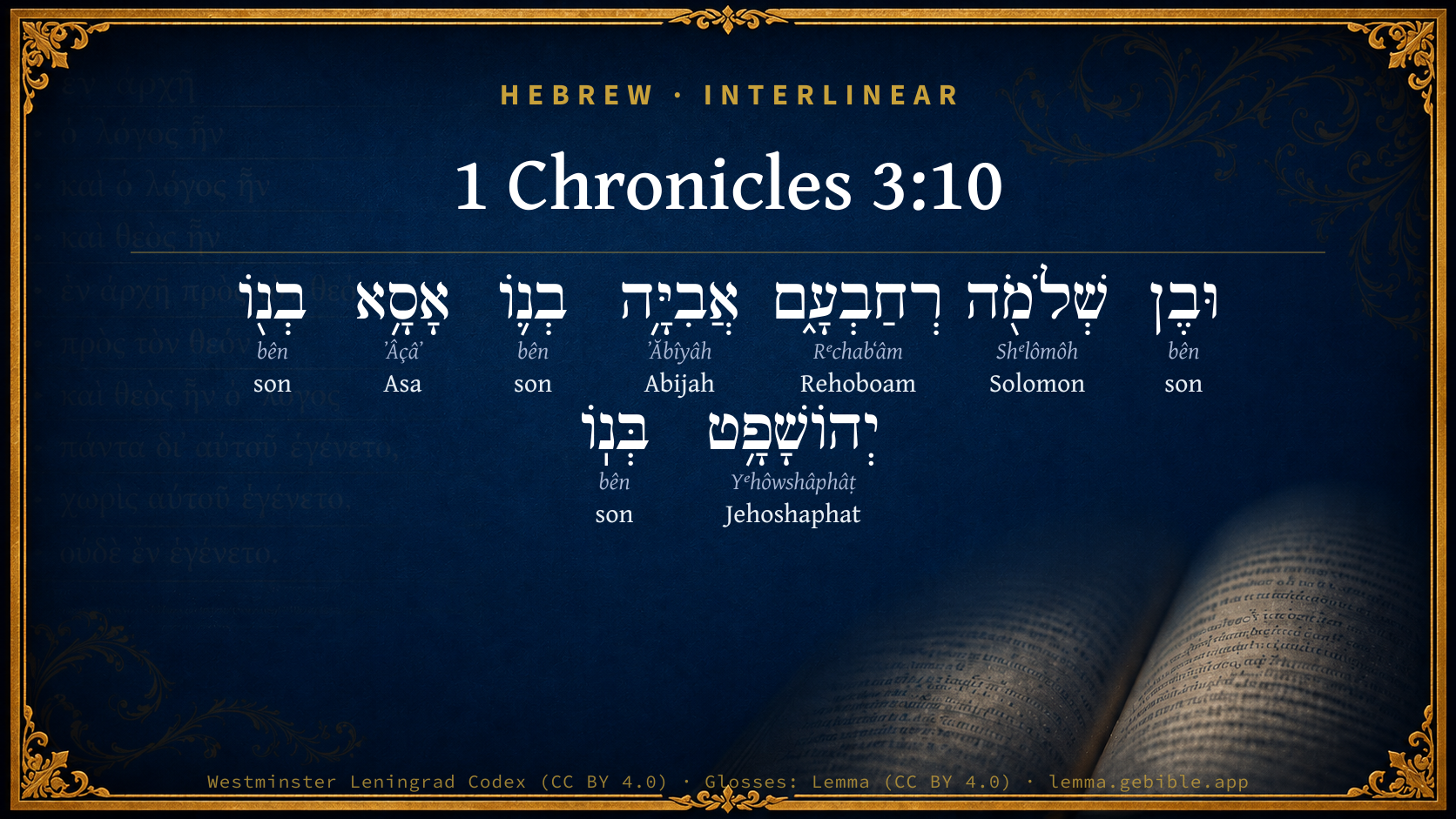
Hebrew (Westminster Leningrad Codex) 1 Chronicles 3:10 appears in the Hebrew Old Testament. The text above is from the Westminster Leningrad Codex. Each word links to its Strong’s number, a concise gloss, and parsing drawn from the Open Scriptures Hebrew Bible morphology. Click any word for its full Brown-Driver-Briggs (BDB) entry.
Download image
Cite this verse

1 Chronicles 3:10 (World English Bible). Public Domain. Lemma interlinear Bible study tool, https://lemma.gebible.app/v/1-chronicles/3/10.

Show BibTeX & RIS
BibTeX
RIS
English Translation
Solomon's son was Rehoboam, Abijah his son, Asa his son, Jehoshaphat his son,
World English Bible · Public Domain
Download a study sheet

One document with this verse’s original text, its word-by-word gloss line, the meaning frame, cross-references with their text, attributed commentary, and full source and license credits — printable, and it pastes into notes with its structure intact.

This verse Autodidact and up

Study sheet (.html) Plain text (.txt)

A passage Seminary Student

Up to 50 verses in one chapter. A passage sheet keeps up to 6 commentary sources and 12 cross-references per verse, in the order this page ranks them, and says so on the sheet whenever that leaves anything out. Ask for a single verse and you get the Autodidact verse sheet above.

Everything on this page stays free to read, with no account — the sheet is a download of what is already on screen, not access to it.

Want to remove ads? Support Godless Engineer
Compare translations 3

The same verse in 3 English versions, stacked beneath the original-language interlinear above. Click any original word for its lexicon entry.

Each is an independent rendering of the whole verse — the interlinear is not word-aligned to these translations.

Highlighted words mark where these versions differ — a whole-verse word diff, not a word-by-word alignment.

  • World English Bible Public Domain
    Solomon's son was Rehoboam, Abijah his son, Asa his son, Jehoshaphat his son,
  • King James Version Public Domain
    And Solomon's son was Rehoboam, Abia his son, Asa his son, Jehoshaphat his son,
  • unfoldingWord Literal Text CC BY-SA 4.0
    And the son of Solomon, Rehoboam; Abijah, his son; Asa, his son; Jehoshaphat, his son;

unfoldingWord Literal Text — © unfoldingWord, licensed CC BY-SA 4.0. Word-aligned USFM3 via Door43 (git.door43.org/unfoldingWord/en_ult).

Versions to compare (up to 4)

3 of 4 selected

Show all 18 translations

Every available English version of this verse, each an independent rendering of the whole verse.

  • World English Bible Public Domain
    Solomon's son was Rehoboam, Abijah his son, Asa his son, Jehoshaphat his son,
  • Berean Standard Bible Public Domain
    Solomon’s son was Rehoboam: Abijah was his son, Asa his son, Jehoshaphat his son,
  • Majority Standard Bible Public Domain
    Solomon’s son was Rehoboam: Abijah was his son, Asa his son, Jehoshaphat his son,
  • King James Version Public Domain
    And Solomon's son was Rehoboam, Abia his son, Asa his son, Jehoshaphat his son,
  • American Standard Version (1901) Public Domain
    And Solomon's son was Rehoboam, Abijah his son, Asa his son, Jehoshaphat his son,
  • Revised Version (1885) Public Domain
    And Solomon’s son was Rehoboam, Abijah his son, Asa his son, Jehoshaphat his son;
  • Geneva Bible (1599) Public Domain
    And Salomons sonne was Rehoboam, whose sonne was Abiah, and Asa his sonne, and Iehoshaphat his sonne,
  • Douay-Rheims (1899) Public Domain
    And Solomon's son was Roboam: whose son Abia beget Asa. And his son was Josaphat,
  • Young's Literal Translation Public Domain
    And the son of Solomon `is' Rehoboam, Abijah his son, Asa his son, Jehoshaphat his son,
  • Literal Standard Version CC BY-SA 4.0
    And the son of Solomon [is] Rehoboam, Abijah his son, Asa his son, Jehoshaphat his son,
  • Unlocked Literal Bible CC BY-SA 4.0
    Solomon's son was Rehoboam. Rehoboam's son was Abijah. Abijah's son was Asa. Asa's son was Jehoshaphat.
  • unfoldingWord Literal Text CC BY-SA 4.0
    And the son of Solomon, Rehoboam; Abijah, his son; Asa, his son; Jehoshaphat, his son;
  • Darby Bible Public Domain
    And Solomon's son was Rehoboam; Abijah his son, Asa his son, Jehoshaphat his son,
  • World Messianic Bible Public Domain
    Solomon’s son was Rehoboam, Abijah his son, Asa his son, Jehoshaphat his son,
  • Webster's Bible Public Domain
    And Solomon's son was Rehoboam, Abia his son, Asa his son, Jehoshaphat his son,
  • Free Bible Version CC BY-SA 4.0
    The male lineage from Solomon was: Rehoboam, Abijah, Asa,
  • Bible in Basic English Public Domain
    And Solomon's son was Rehoboam, Abijah was his son, Asa his son, Jehoshaphat his son,
  • JPS Tanakh (1917) Public Domain
    And Solomon's son was Rehoboam; Abijah his son, Asa his son, Jehoshaphat his son;

Literal Standard Version (2020), Covenant Press — licensed CC BY-SA 4.0. Text via the HelloAO Bible API (eBible.org). Unlocked Literal Bible (unfoldingWord) — licensed CC BY-SA 4.0. Text via the HelloAO Bible API (eBible.org). unfoldingWord Literal Text — © unfoldingWord, licensed CC BY-SA 4.0. Word-aligned USFM3 via Door43 (git.door43.org/unfoldingWord/en_ult). Free Bible Version, Dr. Jonathan Gallagher — licensed CC BY-SA 4.0. Text via the HelloAO Bible API (eBible.org).

Word by word

More ways to search: Search by grammar → Find every occurrence → Compare this word →

Practice this passage: Drill this verse → Learn its vocabulary →

אֲבִיָּ֥ה
ʼĂbîyâh
H29
“Abijah”
Noun, Proper
Part of Speech
Noun
Type
Proper
Full BDB Definition

Origin: from H1 and H3050

TWOT: None

Abia or Abiah or Abijah = "Jehovah is (my) father" - king of Judah, son and successor of Rehoboam - second son of Samuel - son of Jeroboam the first, king of Israel - son of Becher, a Benjamite - head of a priestly house (one of the 24 Levite groups) - head of a priestly house (after the exile) - wife of Hezron - mother of Hezekiah (compare H21 )
  1. וּבֶן bên H1121 “and · son of” Conjunction + Noun, Common, Masculine, Singular, Construct
  2. שְׁלֹמֹ֖ה Shᵉlômôh H8010 “Solomon” Noun, Proper
  3. רְחַבְעָ֑ם Rᵉchabʻâm H7346 “Rehoboam” Noun, Proper
  4. בְנ֛וֹ bên H1121 “son · his” Noun, Common, Masculine, Singular, Construct + Suffix, Personal, 3rd Person, Masculine, Singular
  5. אָסָ֥א ʼÂçâʼ H609 “Asa” Noun, Proper
  6. בְנ֖וֹ bên H1121 “son · his” Noun, Common, Masculine, Singular, Construct + Suffix, Personal, 3rd Person, Masculine, Singular
  7. יְהוֹשָׁפָ֥ט Yᵉhôwshâphâṭ H3092 “Jehoshaphat” Noun, Proper
  8. בְּנֽוֹ bên H1121 “son · his” Noun, Common, Masculine, Singular, Construct + Suffix, Personal, 3rd Person, Masculine, Singular

About this verse

These counts appear in no published source. They are computed here, from the morphology-tagged text and Lemma’s own curated glosses. What Lemma adds →

9
words
6
distinct lemmas
Historical
section

Notable vocabulary

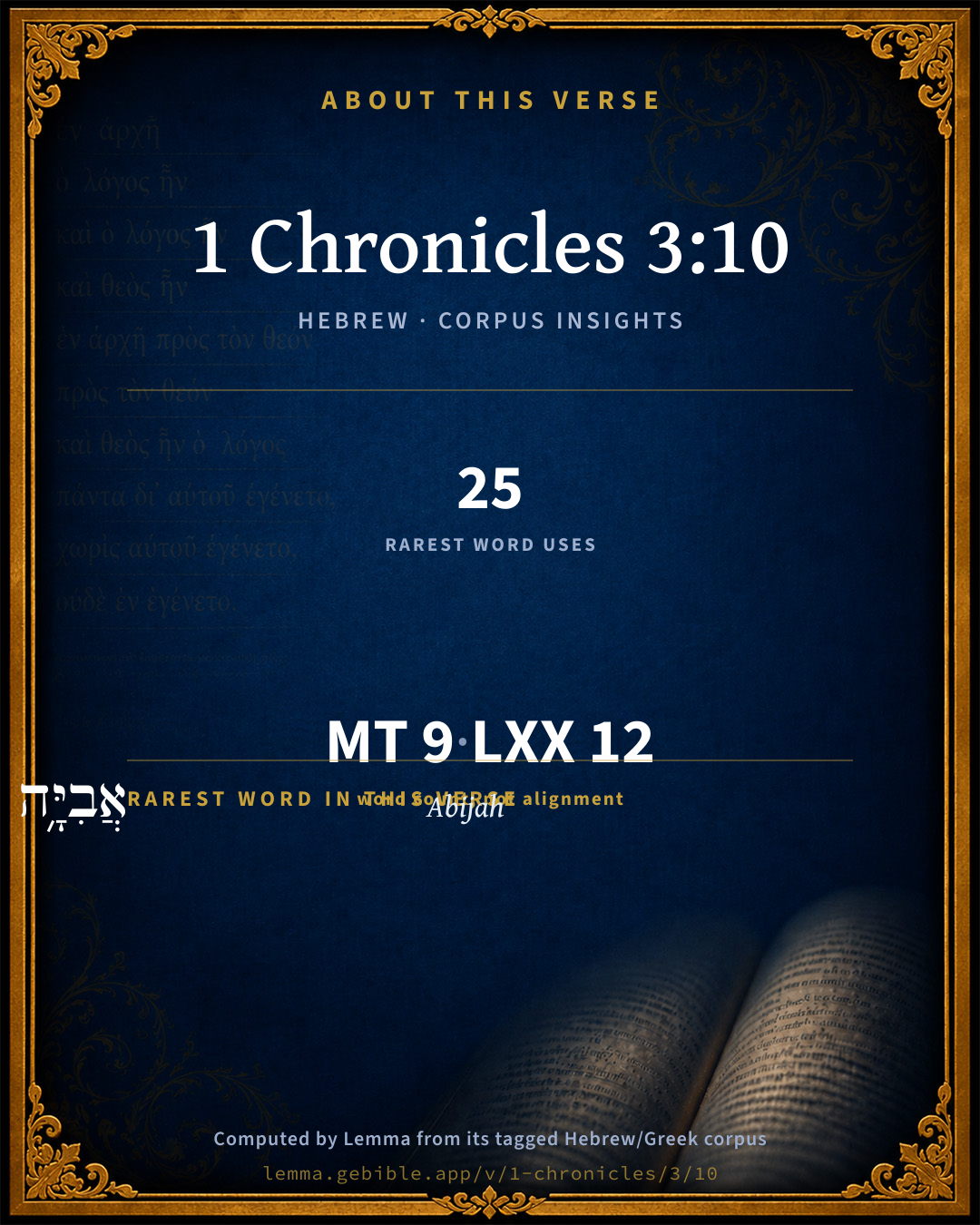
The rarest word here is אֲבִיָּ֥ה Abijah H29 — appearing just 25 times in the whole Hebrew Bible.

Shared distinctive vocabulary

אֲבִיָּ֥ה Abijah H29 occurs in 25 verses of the Hebrew Bible. Also found in:

Grammatical profile

  • 9 nouns

Repetition

A word recurs within this verse — often emphatic in Hebrew:

  • וּבֶן son H1121 ×4

Hebrew & Septuagint length

In English translation the verse runs 13 words from the Hebrew and 14 from the Septuagint (LXX English) — closely comparable.

A rough comparison of the two English renderings, which tokenize alike — not a word-level alignment.

Word counts can differ between the Hebrew and the Greek without any difference in meaning — e.g. the Hebrew direct-object marker אֵת has no separate Greek word, and Greek often adds the article ὁ.

In the original languages it is 9 Hebrew tokens and 12 Greek tokens — but the two are counted differently (Hebrew bundles its prefixes and suffixes into one token; the Greek is in lemma form), so that isn’t a like-for-like length.

Cross-references

9

Topical passages linked to 1 Chronicles 3:10 in the Treasury of Scripture Knowledge — connected by theme and wording, ordered by reader-vote popularity; previews shown in the World English Bible.

  • 1 Kings 11:43 Solomon slept with his fathers, and was buried in the city of David his father: and Rehoboam his son reigned in his place.
  • 1 Kings 14:31–15:1 Rehoboam slept with his fathers, and was buried with his fathers in the city of David: and his mother's name was Naamah the Ammonitess. Abijam his son reigned in his place.
  • 1 Kings 15:8 Abijam slept with his fathers; and they buried him in the city of David: and Asa his son reigned in his place.
  • 1 Kings 15:24 Asa slept with his fathers, and was buried with his fathers in the city of David his father; and Jehoshaphat his son reigned in his place.
  • 2 Chronicles 17:1 Jehoshaphat his son reigned in his place, and strengthened himself against Israel.
  • 1 Kings 15:6 Now there was war between Rehoboam and Jeroboam all the days of his life.
  • 2 Chronicles 13:1 In the eighteenth year of king Jeroboam began Abijah to reign over Judah.
  • 2 Chronicles 14:1 So Abijah slept with his fathers, and they buried him in the city of David; and Asa his son reigned in his place. In his days the land was quiet ten years.
  • Matthew 1:7–8 Solomon became the father of Rehoboam. Rehoboam became the father of Abijah. Abijah became the father of Asa.

Cross-references courtesy of OpenBible.info (CC BY 4.0).

Hebrew and Greek witnesses Masoretic Hebrew ↔ Greek Septuagint

The same verse in the two great witnesses to the Old Testament, shown verse-for-verse.

These are two independent witnesses, not word-aligned to each other, and the Septuagint is shown in lemma (dictionary) form.

Hebrew 1 Chronicles 3:10 Masoretic · Westminster Leningrad Codex

וּבֶן שְׁלֹמֹ֖ה רְחַבְעָ֑ם אֲבִיָּ֥ה בְנ֛וֹ אָסָ֥א בְנ֖וֹ יְהוֹשָׁפָ֥ט בְּנֽוֹ

Solomon's son was Rehoboam, Abijah his son, Asa his son, Jehoshaphat his son,

World English Bible · Public Domain

Greek LXX 1 Chronicles 3:10 Septuagint · lemma form

υἱός σαλωμών ροβοαμ αβια υἱός αὐτός ασα υἱός αὐτός ιωσαφατ υἱός αὐτός

The sons of Solomon; Roboam, Abia his son, Asa his son, Josaphat his son,

LXX2012 (modern English Septuagint) · Public Domain

On this verse, Ellicott's Commentary for English Readers discusses the Septuagint’s reading. Read the note in Commentary ↓

Hebrew: Westminster Leningrad Codex (CC BY 4.0). Greek: Septuagint (public domain); English from LXX2012 (modern English Septuagint) (Public Domain). How the Septuagint differs from the Hebrew →

Commentary

Notes on 1 Chronicles 3:10 from classic Christian and Jewish commentators (each source and its license shown beneath its notes). The classic Christian expositions comment on the surrounding passage and are grouped to its opening verse, so a note may address several verses; the Jewish commentaries on the Tanakh (Rashi and others) are per-verse, so they appear only where the commentator wrote on this verse.

Lemma curates 59 commentaries, every one of them public domain or Creative Commons licensed, each selected and text-cleaned for this edition rather than reprinted as found. About our sources →

Jamieson, Fausset & Brown

Robert Jamieson, A. R. Fausset & David Brown

HIS LINE TO ZEDEKIAH. (Ch1 3:10-16)

Solomon's son was Rehoboam, &c.--David's line is here drawn down to the captivity, through a succession of good and bad, but still influential and celebrated, monarchs. It has rarely happened that a crown has been transmitted from father to son, in lineal descent, for seventeen reigns. But this was the promised reward of David's piety. There is, indeed, observable some vacillation towards the close of this period--the crown passing from one brother to another, an even from uncle to nephew--a sure sign of disorderly times and a disjointed government.

Jamieson, Fausset & Brown — Commentary Critical and Explanatory on the Whole Bible (1871) — public domain (CC PDM 1.0). Text via the HelloAO Bible API.

Ellicott's Commentary for English Readers

II.—The kings of the house of David, as otherwise known from the books of Kings (1Ch_3:10-16).

(10) Rehoboam.—So LXX. Ροβοαμ. Heb., Rĕhab-‘âm (“the Kinsman,” i.e., God hath enlarged).

Abia.—LXX., Αβια; Heb., Abîyâh (Iah is father), of which Abijam (Abîyâm) is a mimmated form.

Asa.—Healer.

Jehoshaphat.—Iahweh judgeth.

A Bible Commentary for English Readers, edited by Charles John Ellicott (1878–1897) — public domain. Text from a community e-Sword module.

Trapp's Complete Commentary

John Trapp

1Ch 3:10 And Solomon’s son [was] Rehoboam, Abia his son, Asa his son, Jehoshaphat his son,

Ver. 10. Abia his son, Asa his son.] These Books of Chronicles pursue the genealogy and history of the kings of Judah only: and yet are more sparing in relating the sins of David and Solomon. Those things which are here set down in this chapter were chiefly written in reference to the genealogy of Christ.

John Trapp, A Commentary or Exposition upon All the Books of the Old and New Testament (1647–1656) — public domain. Text from a community e-Sword module.

Tyndale Open Study Notes

Tyndale Open Resources

3:10-16 The Chronicler lists the kings of Judah in father-to-son progression from Solomon to the Exile.

Tyndale Open Study Notes — © Tyndale Open Resources, licensed CC BY-SA 4.0. Text via the HelloAO Bible API.

Matthew Henry's Commentary

David having nineteen sons, we may suppose them to have raised many noble families in Israel whom we never hear of in the history. But the scripture gives us an account only of the descendants of Solomon here, and of Nathan, Lu. 3. The rest had the honour to be the sons of David; but these only had the honour to be related to the Messiah. The sons of Nathan were his fathers as man, the sons of Solomon his predecessors as king. We have here, 1. The great and celebrated names by which the line of David is drawn down to the captivity, the kings of Judah in a lineal succession, the history of whom we have had at large in the two books of Kings and shall meet with again in the second book of Chronicles. Seldom has a crown gone in a direct line from father to son for seventeen descents together, as here. This was the recompence of David's piety. About the time of the captivity the lineal descent was interrupted, and the crown went from one brother to another and from a nephew to an uncle, which was a presage of the eclipsing of the glory of that house. 2. The less famous, and most of them very obscure, names, in which the house of David subsisted after the captivity. The only famous man of that house that we meet with at their return from captivity was Zerubbabel, elsewhere called the son of Salathiel, but appearing here to be his grandson (Ch1 3:17-19), which is usual in scripture. Belshazzar is called Nebuchadnezzar's son, but was his grandson. Salathiel is said to be the son of Jeconiah because adopted by him, and because, as some think, he succeeded him in the dignity to which he was restored by Evil-merodach. Otherwise Jeconiah was written childless: he was the signet God plucked from his right hand (Jer 22:24), and in his room Zerubbabel was placed, and therefore God saith to him (Hag 2:23), I will make thee as a signet. The posterity of Zerubbabel here bear not the same names that they do in the genealogies (Mt. 1, or Lu. 3), but those no doubt were taken from the then herald's office, the public registers which the priests kept of all the families of Judah, especially that of David. The last person named in this chapter is Anani, of whom bishop Patrick says that the Targum adds these words, He is the king Messiah, who is to be revealed, and some of the Jewish writers give this reason, because it is said (Dan 7:13), the son of man came gnim gnanani - with the clouds of heaven. The reason indeed is very foreign and far-fetched; but that learned man thinks it may be made use of as an evidence that their minds were always full of the thoughts of the Messiah and that they expected it would not be very long after the days of Zerubbabel before the set time of his approach would come.

Matthew Henry's Commentary on the Whole Bible (1708–1710) — public domain (CC PDM 1.0). Text via the HelloAO Bible API.

The Cambridge Bible for Schools and Colleges

gen. ed. J. J. S. Perowne

10. Abia] R.V. Abijah, as in 2Ch_13:1 ff. He is called Abijam in 1Ki_14:31; 1Ki_15:1 ff. Abia is the Greek form of the name; Mat_1:7 (A.V.).

10–16. The Line of Davidic Kings

Two things are to be noted in this list: (1) Johanan’s name is given in 1Ch_3:15, though he was never king, (2) Zedekiah’s name appears to be twice given, once among the sons of Josiah (1Ch_3:15) and again in his place according to the succession (1Ch_3:16).

The Cambridge Bible for Schools and Colleges (gen. ed. J. J. S. Perowne; Cambridge University Press, 1878–1918) — public domain. Text from a community e-Sword module.

John Gill's Exposition

And the sons of Josiah were, the firstborn Johanan,.... Of whom we nowhere else read; he probably died before his father Josiah:

the second Jehoiakim: whose name was Eliakim, changed for the former by the king of Egypt, when, he deposed his younger brother, and set him on the throne, Kg2 23:24.

the third Zedekiah; whose name was Mattaniah, but changed by the king of Babylon, when he placed him on the throne in the room of his brother's son, Kg2 24:17,

the fourth Shallum: the same with Jehoahaz, who was first made king in the room of his father; but reigning so short a time, and making so mean a figure, is mentioned last, see Jer 22:11.

John Gill's Exposition of the Whole Bible (1746–1763) — public domain (CC PDM 1.0). Text via the HelloAO Bible API.

Albert Barnes' Notes on the Bible

Abia - Rather, “Abijah,” as in 2 Chr. 11–14, where the Hebrew word is exactly the same.

Albert Barnes' Notes on the Bible (1834–1885) — public domain. Text from a community e-Sword/MySword module.

The Pulpit Commentary

Vers. 10-16. The line of royal descent from David, is now rapidly carried down in these verses first, as far as good King Josiah, sixteen generations in all (omitting, quite consistently, Athalia, who reigned by her own usurpation for six years on the death of her son Azariah); and then, by four successions (viz. two brothers, sons of Josiah, and a grandson and great-grandson of Josiah), to the Captivity.

Though the Authorized Version has Abia the Hebrew word is hYbia (both here and in), 2Ch_13:1, 2Ch_13:2, 3 (or Authorized Version, 14:1), in both of which passages, as also elsewhere, our Authorized Version has Abijah. Another form is Abijam ( as in 1Ki_14:31 and elsewhere. A corrupt form (WjYbia) is found in 2Ch_13:20. We have the name in the New Testament genealogy. (Mat_1:7, Mat_1:8) Vers. 10-24.

The best rewards of piety, etc.

This list of the names of the sons of David before and after the Captivity suggest three truths

I THE BEST REWARDS OF PIETY. To David God gave the promise that his children should sit upon his throne; to Solomon he gave a brilliant court and large exchequer. David had the high and lofty satisfaction of looking forward to future years, and knowing that his descendants would be wielding power and exerting influence for many generations. Solomon had his reward in the "things which are seen and temporal in great wealth, in a large harem, in foreign alliances, in growing merchandise, etc. The one reward was elevating, ennobling; the other proved to be hurtful and demoralizing. We are very apt to look for temporal prosperity, earthly honour, material gratification, as the guerdon of devotion; but if this should be given us, it may end at last in spiritual depression and failure. God may give us our request, and send leanness into our soul. (Psa_106:15) We should rather desire mental and spiritual bestowments, delights of the soul, gladness of the heart

The joys which satisfy

And sanctify the mind;

those which have no tendency to enfeeble or to mislead, but which tend rather to enrich and to enlarge the soul.

II THE VANITY OF HUMAN FAME. It is impossible not to be struck with the obscurity of the names which occur in some of these verses (vers. 10-24). It is something, indeed, that a man"s name should find a place, however humble, in such an imperishable record. But these men lived and died without enjoying any such anticipation, and it is nothing to them now. The desire for distinction is natural to noble minds; and if it be honourable fame, and not mere worthless notoriety they seek, we must pay them praise and not accord them blame. But the fact that, as time proceeds, human fame becomes of less account, and that the very names of succeeding kings may become nothing more than a tedious chronicle, only read by way of duty, may well lead us to choose a more worthy and a more lasting portion. There are blessings to be sought and gained, the value of which does not decline with the passage of the years or even of the centuries. It is these which the wise will covet, which the holy will secure.

III THE EXCELLENCY OF GODLY ZEAL. There is one name in this list which stands out among the rest as that of a man whom all the servants of God "delight to honour Zerubbabel (ver. 19). To have been the ancestor or the descendant of such a man was itself an honour. We regard his career as one of the worthiest and most fruitful which even the Holy Scriptures have recorded. His godly zeal did much to carry on the purpose of Jehovah from the return of the captives to the coming of the Lord. To have lived such a life and to have done such a work may satisfy the very largest ambition which the heart of man can hold. To look back from the spiritual world on such a work accomplished must be an increase to heavenly joy. There are few satisfactions, if there be any, which give a truer, deeper, diviner delight to the regenerated soul than the conviction that, by the help and grace of God, we are sowing the seeds of holy usefulness, of which future generations will reap the blessed harvest. C. Vers. 10-24.

Kings of the royal line Zedekiah: the lesson of his life.

The portraiture of the Holy Spirit would be incomplete without that of Zedekiah. In him we see how every work of God may be undone, how the fairest fabric may become a wreck. If in David and Solomon we have that which will encourage, we have here a note of solemn warning. What is the lesson thus solemnly taught? That sin undid all the work of David and Solomon. Sin ruined the kingdom, and lay desolate the temple of God. And in what did that sin consist? In that which is the fertile source of all sin idolatry. Idolatry is the heart going after something else than God. Its gross form is image-worship. Its more refined and general form is the love of something lower than Christ. The latter is the guiltier, because done under greater light. From this single source everything follows loss of peace, darkness of soul, weakness of intellect, immorality of life, judicial blindness, and the entire spiritual wreck of everything, whether it be in an individual soul or in a nation. Let God be supplanted, and there is no abyss into which one and the other will not ultimately fall. God"s first law to Israel was, "Thou shalt have none other gods before me;" and it is his first law still. Well might the beloved apostle say, "Little children, keep yourselves from idols." The utter ruin of the kingdoms of Israel and Judah, and the desolation of the temple, had one source, consummated by Zedekiah idolatry. This brought down upon them that wrath of God which has been resting like a dark cloud on the nation ever since. If David and Solomon show us how we may pass through conflict to peace, Zedekiah shows us how we may pass from it all to utter desolation. Needful warning to complete this spiritual picture. W. Vers. 10-19.

Review of the kings.

It is specially worthy of notice that, according to his promise, God preserved the Davidic line among all the changes through which the kingdom of Judah passed; and this became a public testimony to the Divine faithfulness, and a constant plea against them when they publicly broke their side of the conditions of the national covenant. We may dwell on

I WHAT THIS UNFOLDS OF GOD"S LONG-SUFFERING MERCY. For some of the kings of Judah were rebellious and idolatrous; some, as, for instance, Ahaz and Manasseh, so very bad that we marvel at the mercy which held back judgment on the Davidic dynasty. Exactly what we have ever to wonder over is the Divine long-suffering towards us, towards his Church, towards men. God is infinitely jealous of the honour of his Name as the Promise-maker and the Promise-keeper, and we may even think of God as infinitely hopeful concerning his people, waiting on and on, bearing long with them, quite sure that they will yet turn to him and live. But every new impression of God"s patient mercy made upon our hearts only shows up the more hatefully our sin in keeping on and "despising the riches of his mercy.

II WHAT THIS UNFOLDS OF GOD"S WITNESS TO HIMSELF. God"s dealings with men are the revelation of God"s character. What he does is designed to unfold before us what he is, and so to ensure personal trust in him. Here mercy blends with faithfulness, and we gain the conception of his righteousness blending with his love, justice and mercy going hand in hand, the King and the Father making the sublime unity of the Divine King-Father. Sometimes we gain impressions of Divine justice, at other times impressions of Divine mercy, and we err if we keep these apart. We only conceive God himself aright when we can blend them to make the perfect harmony of him who is faithful, to all his words faithful to punish and faithful to pity and faithful to preserve.

III WHAT THIS UNFOLDS OF GOD"S HIGHER AND SPIRITUAL PURPOSES. For from the preservation of a particular dynasty we rise to the promise of the world"s Messiah, who was to be recognized by coming in the Davidic line, and bear a royalty which should be a sublime spiritual royalty, and found a kingdom which should be an invisible but everlasting kingdom. David"s kingdom was, by the promise, to be continued for ever; and so it is in that Son of David, who yet was David"s Lord, and who bath now both an "unchangeable priesthood" and an "unchangeable kingship." His dominion shall yet prove to be an "everlasting dominion;" he "shall have the heathen for his inheritance, and the uttermost parts of the earth for his possession." And into the eternal Davidic kingdom we should enter, and we may enter, for the King throws wide the door, and calls "whosoever will" to come. R.T.

The Pulpit Commentary (1880–1919), ed. H.D.M. Spence-Jones & Joseph S. Exell — public domain. Text from a community e-Sword module.

Keil & Delitzsch

C. F. Keil & F. Delitzsch

And the sons of Josiah were, the firstborn Johanan,.... Of whom we nowhere else read; he probably died before his father Josiah:

the second Jehoiakim: whose name was Eliakim, changed for the former by the king of Egypt, when, he deposed his younger brother, and set him on the throne, Kg2 23:24.

the third Zedekiah; whose name was Mattaniah, but changed by the king of Babylon, when he placed him on the throne in the room of his brother's son, Kg2 24:17,

the fourth Shallum: the same with Jehoahaz, who was first made king in the room of his father; but reigning so short a time, and making so mean a figure, is mentioned last, see Jer 22:11.

Keil & Delitzsch — Biblical Commentary on the Old Testament (1861–1891) — public domain (CC PDM 1.0). Text via the HelloAO Bible API. (Old Testament only.)

unfoldingWord translationNotes

Door43 World Missions Community

General Information:

This is the beginning of the list of David's descendants who became king. All of the names in this list are the names of men. (See: How to Translate Names)

Solomon's son was Rehoboam. Rehoboam's son was Abijah

Solomon had more than one son. The same is true of other men in the list. AT: "Solomon was the father of Rehoboam. Rehoboam was the father of Abijah"

Azariah

This was another name for Uzziah, the better-known name for this king. Translators may decide to use "Uzziah" everywhere for this king.

translationWords

Rehoboam

Abijah

Asa

Jehoshaphat

Jehoram

Ahaziah

Joash

Amaziah

Azariah

Jotham

unfoldingWord translationNotes — © Distant Shores Media and the Door43 World Missions Community, licensed CC BY-SA 4.0. Source: git.door43.org/Door43/en_tn.

Lesson kit

Teaching starters — assembled from the data on this page, not authored interpretation. Every prompt links to the verse data it draws on. Edit before teaching.

1 Chronicles, in the Historical, opens this verse with 9 words (6 distinct Hebrew lemmas). Its most distinctive word is ʼĂbîyâh (“Abijah”). A historical commentator’s framing appears above. Read the whole chapter for the surrounding context.

Discussion questions

  1. The word ʼĂbîyâh carries the sense “Abijah.” How does it shape the verse?
  2. How does 1 Samuel 8:2, which shares the word «Abijah», read alongside this verse?
  3. What does the repetition of “son” (4× in this one verse) do in this verse?
  4. These translations render this verse differently; the difference is in the English rendering, not the original. What questions does that raise?
  5. Compare how Jamieson, Fausset & Brown and Ellicott's Commentary for English Readers read this verse. Where do they agree or differ?

Things to notice

Reading settings

Reading text

Shown beneath each verse's original-language words.

Old Testament
Old Testament edition

Read the OT as the Masoretic Hebrew (MT) or the Greek Septuagint (LXX).

English shown for the Greek Septuagint (in the Hebrew ↔ Greek comparison).

Comparing translations? Open the Compare panel on any verse page to stack up to four side by side.