
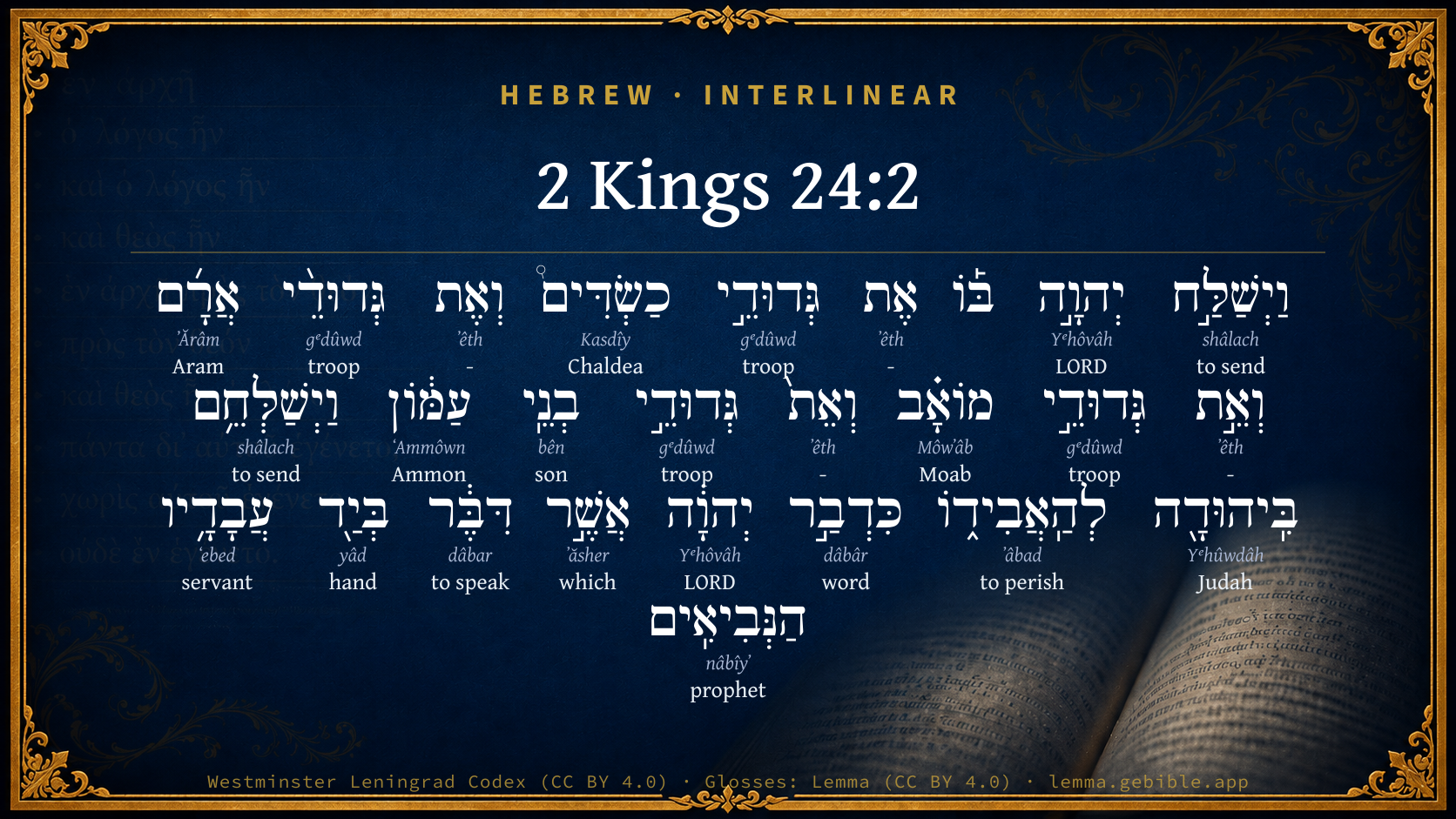
2 Kings 24:2

Hebrew (Westminster Leningrad Codex) 2 Kings 24:2 appears in the Hebrew Old Testament. The text above is from the Westminster Leningrad Codex. Each word links to its Strong’s number, a concise gloss, and parsing drawn from the Open Scriptures Hebrew Bible morphology. Click any word for its full Brown-Driver-Briggs (BDB) entry.
Download image
Cite this verse

2 Kings 24:2 (World English Bible). Public Domain. Lemma interlinear Bible study tool, https://lemma.gebible.app/v/2-kings/24/2.

Show BibTeX & RIS
BibTeX
RIS
English Translation
Yahweh sent against him bands of the Chaldeans, and bands of the Syrians, and bands of the Moabites, and bands of the children of Ammon, and sent them against Judah to destroy it, according to the word of Yahweh, which he spoke by his servants the prophets.
World English Bible · Public Domain
Download a study sheet

One document with this verse’s original text, its word-by-word gloss line, the meaning frame, cross-references with their text, attributed commentary, and full source and license credits — printable, and it pastes into notes with its structure intact.

This verse Autodidact and up

Study sheet (.html) Plain text (.txt)

A passage Seminary Student

Up to 50 verses in one chapter. A passage sheet keeps up to 6 commentary sources and 12 cross-references per verse, in the order this page ranks them, and says so on the sheet whenever that leaves anything out. Ask for a single verse and you get the Autodidact verse sheet above.

Everything on this page stays free to read, with no account — the sheet is a download of what is already on screen, not access to it.

Want to remove ads? Support Godless Engineer
Compare translations 3

The same verse in 3 English versions, stacked beneath the original-language interlinear above. Click any original word for its lexicon entry.

Each is an independent rendering of the whole verse — the interlinear is not word-aligned to these translations.

Highlighted words mark where these versions differ — a whole-verse word diff, not a word-by-word alignment.

  • World English Bible Public Domain
    Yahweh sent against him bands of the Chaldeans, and bands of the Syrians, and bands of the Moabites, and bands of the children of Ammon, and sent them against Judah to destroy it, according to the word of Yahweh, which he spoke by his servants the prophets.
  • King James Version Public Domain
    And the LORD sent against him bands of the Chaldees, and bands of the Syrians, and bands of the Moabites, and bands of the children of Ammon, and sent them against Judah to destroy it, according to the word of the LORD, which he spake by his servants the prophets.
  • unfoldingWord Literal Text CC BY-SA 4.0
    And Yahweh sent against him raiding bands of Chaldeans and raiding bands of Aram and raiding bands of Moab and raiding bands of the sons of Ammon. And he sent them against Judah to destroy it, according to the word of Yahweh that he had spoken by the hand of his servants the prophets.

unfoldingWord Literal Text — © unfoldingWord, licensed CC BY-SA 4.0. Word-aligned USFM3 via Door43 (git.door43.org/unfoldingWord/en_ult).

Versions to compare (up to 4)

3 of 4 selected

Show all 18 translations

Every available English version of this verse, each an independent rendering of the whole verse.

  • World English Bible Public Domain
    Yahweh sent against him bands of the Chaldeans, and bands of the Syrians, and bands of the Moabites, and bands of the children of Ammon, and sent them against Judah to destroy it, according to the word of Yahweh, which he spoke by his servants the prophets.
  • Berean Standard Bible Public Domain
    And the LORD sent Chaldean, Aramean, Moabite, and Ammonite raiders against Jehoiakim in order to destroy Judah, according to the word that the LORD had spoken through His servants the prophets.
  • Majority Standard Bible Public Domain
    And the LORD sent Chaldean, Aramean, Moabite, and Ammonite raiders against Jehoiakim in order to destroy Judah, according to the word that the LORD had spoken through His servants the prophets.
  • King James Version Public Domain
    And the LORD sent against him bands of the Chaldees, and bands of the Syrians, and bands of the Moabites, and bands of the children of Ammon, and sent them against Judah to destroy it, according to the word of the LORD, which he spake by his servants the prophets.
  • American Standard Version (1901) Public Domain
    And Jehovah sent against him bands of the Chaldeans, and bands of the Syrians, and bands of the Moabites, and bands of the children of Ammon, and sent them against Judah to destroy it, according to the word of Jehovah, which he spake by his servants the prophets.
  • Revised Version (1885) Public Domain
    And the LORD sent against him bands of the Chaldeans, and bands of the Syrians, and bands of the Moabites, and bands of the children of Ammon, and sent them against Judah to destroy it, according to the word of the LORD, which he spake by the hand of his servants the prophets.
  • Geneva Bible (1599) Public Domain
    And the Lord sent against him bandes of the Caldees, and bands of the Aramites, and bands of the Moabites, and bandes of the Ammonites, and he sent them against Iudah to destroy it, according to the worde of the Lord, which he spake by his seruants the Prophets.
  • Douay-Rheims (1899) Public Domain
    And the Lord sent against him the rovers of the Chaldees, and the rovers of Syria, and the rovers of Moab, and the rovers of the children of Ammon: and he sent them against Juda, to destroy it, according to the word of the Lord, which he had spoken by his servants the prophets.
  • Young's Literal Translation Public Domain
    and Jehovah sendeth against him the troops of the Chaldeans, and the troops of Aram, and the troops of Moab, and the troops of the sons of Ammon, and He sendeth them against Judah to destroy it, according to the word of Jehovah, that He spake by the hand of His servants the prophets;
  • Literal Standard Version CC BY-SA 4.0
    and YHWH sends against him the troops of the Chaldeans, and the troops of Aram, and the troops of Moab, and the troops of the sons of Ammon, and He sends them against Judah to destroy it, according to the word of YHWH that He spoke by the hand of His servants the prophets;
  • Unlocked Literal Bible CC BY-SA 4.0
    Yahweh sent against Jehoiakim bands of Chaldeans, Arameans, Moabites, and Ammonites; he sent them against Judah to destroy it. This was in conformity with the word of Yahweh that had been spoken through his servants the prophets.
  • unfoldingWord Literal Text CC BY-SA 4.0
    And Yahweh sent against him raiding bands of Chaldeans and raiding bands of Aram and raiding bands of Moab and raiding bands of the sons of Ammon. And he sent them against Judah to destroy it, according to the word of Yahweh that he had spoken by the hand of his servants the prophets.
  • Darby Bible Public Domain
    And Jehovah sent against him the bands of the Chaldeans, and the bands of the Syrians, and the bands of the Moabites, and the bands of the children of Ammon, and sent them against Judah to destroy it, according to the word of Jehovah, which he spoke through his servants the prophets.
  • World Messianic Bible Public Domain
    The LORD sent against him bands of the Kasdim, bands of the Syrians, bands of the Moabites, and bands of the children of Ammon, and sent them against Judah to destroy it, according to the LORD’s word which he spoke by his servants the prophets.
  • Webster's Bible Public Domain
    And the LORD sent against him bands of the Chaldees, and bands of the Syrians, and bands of the Moabites, and bands of the children of Ammon, and sent them against Judah to destroy it, according to the word of the LORD, which he spoke by his servants the prophets.
  • Free Bible Version CC BY-SA 4.0
    Then the Lord sent bands of raiders against Judah to destroy them. They came from Babylonia, Aram, Moab, and Ammon, just as the Lord had said through his servants the prophets.
  • Bible in Basic English Public Domain
    And the Lord sent against him bands of the Chaldaeans and of the Edomites and of the Moabites and of the children of Ammon; sending them against Judah for its destruction, as he had said by his servants the prophets.
  • JPS Tanakh (1917) Public Domain
    And the LORD sent against him bands of the Chaldeans, and bands of the Arameans, and bands of the Moabites, and bands of the children of Ammon, and sent them against Judah to destroy it, according to the word of the LORD, which He spoke by the hand of His servants the prophets.

Literal Standard Version (2020), Covenant Press — licensed CC BY-SA 4.0. Text via the HelloAO Bible API (eBible.org). Unlocked Literal Bible (unfoldingWord) — licensed CC BY-SA 4.0. Text via the HelloAO Bible API (eBible.org). unfoldingWord Literal Text — © unfoldingWord, licensed CC BY-SA 4.0. Word-aligned USFM3 via Door43 (git.door43.org/unfoldingWord/en_ult). Free Bible Version, Dr. Jonathan Gallagher — licensed CC BY-SA 4.0. Text via the HelloAO Bible API (eBible.org).

Word by word

More ways to search: Search by grammar → Find every occurrence → Compare this word →

Practice this passage: Drill this verse → Learn its vocabulary →

גְּדוּדֵ֣י
gᵉdûwd
H1416
“troops of”
Noun, Common, Masculine, Plural, Construct
Part of Speech
Noun
Type
Common
Gender
Masculine
Number
Plural
State
Construct
Full BDB Definition

Origin: from H1413

TWOT: 313a

a band, troop, marauding band - marauding band, raiding band - troop, band (of divisions of army) - foray, raid
  1. וַיְשַׁלַּ֣ח shâlach H7971 “and · to send” Conjunction + Verb, Piel, Sequential Imperfect, 3rd Person, Masculine, Singular
  2. יְהוָ֣ה Yᵉhôvâh H3068 “LORD” Noun, Proper
  3. אֶת ʼêth H853 “-” Particle, Direct Object
  4. כַשְׂדִּים֩ Kasdîy H3778 “Chaldea” Noun, Proper
  5. וְאֶת ʼêth H853 “and · -” Conjunction + Particle, Direct Object
  6. גְּדוּדֵ֨י gᵉdûwd H1416 “troops of” Noun, Common, Masculine, Plural, Construct
  7. אֲרָ֜ם ʼĂrâm H758 “Aram” Noun, Proper
  8. וְאֵ֣ת ʼêth H853 “and · -” Conjunction + Particle, Direct Object
  9. גְּדוּדֵ֣י gᵉdûwd H1416 “troops of” Noun, Common, Masculine, Plural, Construct
  10. מוֹאָ֗ב Môwʼâb H4124 “Moab” Noun, Proper
  11. וְאֵת֙ ʼêth H853 “and · -” Conjunction + Particle, Direct Object
  12. גְּדוּדֵ֣י gᵉdûwd H1416 “troops of” Noun, Common, Masculine, Plural, Construct
  13. בְנֵֽי bên H1121 “sons of” Noun, Common, Masculine, Plural, Construct
  14. עַמּ֔וֹן ʻAmmôwn H5983 “Ammon” Noun, Proper
  15. וַיְשַׁלְּחֵ֥ם shâlach H7971 “and · to send · them” Conjunction + Verb, Piel, Sequential Imperfect, 3rd Person, Masculine, Singular + Suffix, Personal, 3rd Person, Masculine, Plural
  16. בִּֽיהוּדָ֖ה Yᵉhûwdâh H3063 “in/at · Judah” Preposition + Noun, Proper
  17. לְהַֽאֲבִיד֑וֹ ʼâbad H6 “to perish · him” Preposition + Verb, Hiphil, Infinitive Construct + Suffix, Personal, 3rd Person, Masculine, Singular
  18. כִּדְבַ֣ר dâbâr H1697 “like/as · word of” Preposition + Noun, Common, Masculine, Singular, Construct
  19. יְהוָ֔ה Yᵉhôvâh H3068 “LORD” Noun, Proper
  20. אֲשֶׁ֣ר ʼăsher H834 “which” Particle, Relative
  21. דִּבֶּ֔ר dâbar H1696 “to speak” Verb, Piel, Perfect, 3rd Person, Masculine, Singular
  22. בְּיַ֖ד yâd H3027 “in/at · hand of” Preposition + Noun, Common, Both, Singular, Construct
  23. עֲבָדָ֥יו ʻebed H5650 “servants · his” Noun, Common, Masculine, Plural, Construct + Suffix, Personal, 3rd Person, Masculine, Singular
  24. הַנְּבִיאִֽים nâbîyʼ H5030 “the · prophets” Particle, Definite Article + Noun, Common, Masculine, Plural, Absolute

About this verse

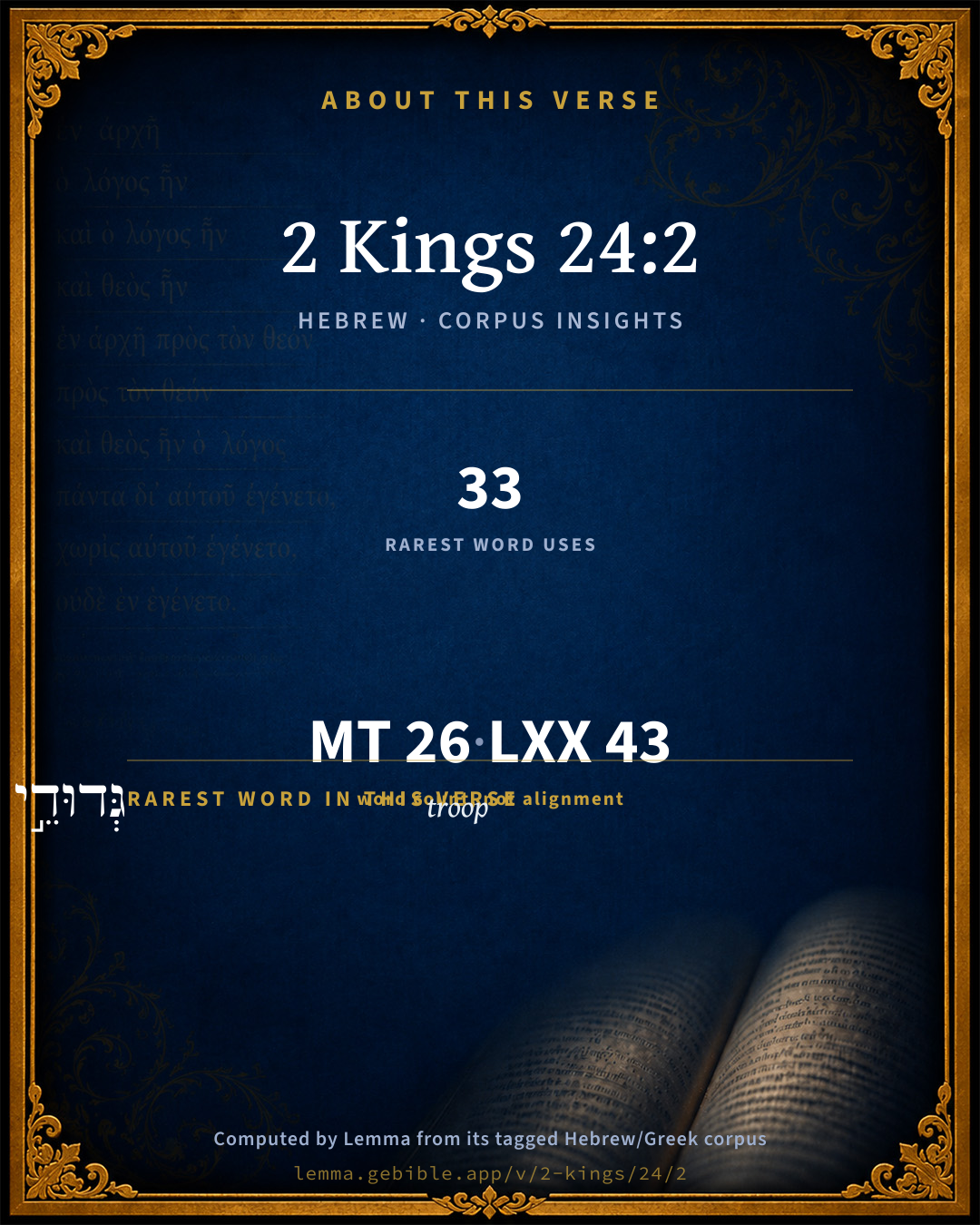
These counts appear in no published source. They are computed here, from the morphology-tagged text and Lemma’s own curated glosses. What Lemma adds →

26
words
17
distinct lemmas
Historical
section

Shared distinctive vocabulary

גְּדוּדֵ֣י troop H1416 occurs in 29 verses of the Hebrew Bible. Also found in:

Grammatical profile

  • 4 verbs
  • 16 nouns
  • 1 preposition
  • 5 particles

Verb forms

  • וַיְשַׁלַּ֣ח Piel · Sequential Imperfect
  • וַיְשַׁלְּחֵ֥ם Piel · Sequential Imperfect
  • לְהַֽאֲבִיד֑וֹ Hiphil · Infinitive Construct
  • דִּבֶּ֔ר Piel · Perfect

Repetition

Words recur within this verse — often emphatic in Hebrew:

  • גְּדוּדֵ֣י troop H1416 ×4
  • וַיְשַׁלַּ֣ח to send H7971 ×2
  • יְהוָ֣ה LORD H3068 ×2

Hebrew & Septuagint length

In English translation the verse runs 47 words from the Hebrew and 56 from the Septuagint (LXX English) — closely comparable.

A rough comparison of the two English renderings, which tokenize alike — not a word-level alignment.

Word counts can differ between the Hebrew and the Greek without any difference in meaning — e.g. the Hebrew direct-object marker אֵת has no separate Greek word, and Greek often adds the article ὁ.

In the original languages it is 26 Hebrew tokens and 43 Greek tokens — but the two are counted differently (Hebrew bundles its prefixes and suffixes into one token; the Greek is in lemma form), so that isn’t a like-for-like length.

Cross-references

18

Topical passages linked to 2 Kings 24:2 in the Treasury of Scripture Knowledge — connected by theme and wording, ordered by reader-vote popularity; previews shown in the World English Bible.

  • Jeremiah 35:11 But it happened, when Nebuchadrezzar king of Babylon came up into the land, that we said, Come, and let us go to Jerusalem for fear of the army of the Chaldeans, and for fear of the army of the Syrians; so we dwell at Jerusalem.
  • 2 Kings 23:27 Yahweh said, I will remove Judah also out of my sight, as I have removed Israel, and I will cast off this city which I have chosen, even Jerusalem, and the house of which I said, My name shall be there.
  • 2 Kings 21:12–14 therefore thus says Yahweh, the God of Israel, Behold, I bring such evil on Jerusalem and Judah, that whoever hears of it, both his ears shall tingle.
  • Jeremiah 25:9 behold, I will send and take all the families of the north, says Yahweh, and [I will send] to Nebuchadrezzar the king of Babylon, my servant, and will bring them against this land, and against the inhabitants of it, and against all these nations round about; and I will utterly destroy them, and make them an astonishment, and a hissing, and perpetual desolations.
  • Jeremiah 32:28 Therefore thus says Yahweh: Behold, I will give this city into the hand of the Chaldeans, and into the hand of Nebuchadrezzar king of Babylon, and he shall take it:
  • 2 Kings 6:23 He prepared great provision for them; and when they had eaten and drunk, he sent them away, and they went to their master. The bands of Syria came no more into the land of Israel.
  • 2 Kings 20:17 Behold, the days come, that all that is in your house, and that which your fathers have laid up in store to this day, shall be carried to Babylon: nothing shall be left, says Yahweh.
  • Ezekiel 19:8 Then the nations set against him on every side from the provinces; and they spread their net over him; he was taken in their pit.
  • Deuteronomy 28:49–50 Yahweh will bring a nation against you from far, from the end of the earth, as the eagle flies; a nation whose language you shall not understand;
  • 2 Kings 13:20–21 Elisha died, and they buried him. Now the bands of the Moabites invaded the land at the coming in of the year.
  • 2 Chronicles 33:11 Therefore Yahweh brought on them the captains of the host of the king of Assyria, who took Manasseh in chains, and bound him with fetters, and carried him to Babylon.
  • Job 1:17 While he was still speaking, there came also another, and said, "The Chaldeans made three bands, and swept down on the camels, and have taken them away, yes, and killed the servants with the edge of the sword; and I alone have escaped to tell you."
  • Isaiah 6:11–12 Then I said, "Lord, how long?" He answered, "Until cities are waste without inhabitant, And houses without man, And the land becomes utterly waste,
  • Isaiah 7:17 Yahweh will bring on you, on your people, and on your father's house, days that have not come, from the day that Ephraim departed from Judah; even the king of Assyria.
  • Isaiah 13:5 They come from a far country, from the uttermost part of heaven, even Yahweh, and the weapons of his indignation, to destroy the whole land.
  • Jeremiah 26:6 then will I make this house like Shiloh, and will make this city a curse to all the nations of the earth.
  • Jeremiah 26:20 There was also a man who prophesied in the name of Yahweh, Uriah the son of Shemaiah of Kiriath Jearim; and he prophesied against this city and against this land according to all the words of Jeremiah:
  • Micah 3:12 Therefore Zion for your sake will be plowed like a field, And Jerusalem will become heaps of rubble, And the mountain of the temple like the high places of a forest.

Cross-references courtesy of OpenBible.info (CC BY 4.0).

Hebrew and Greek witnesses Masoretic Hebrew ↔ Greek Septuagint

The same verse in the two great witnesses to the Old Testament, shown verse-for-verse.

These are two independent witnesses, not word-aligned to each other, and the Septuagint is shown in lemma (dictionary) form.

Hebrew 2 Kings 24:2 Masoretic · Westminster Leningrad Codex

וַיְשַׁלַּ֣ח יְהוָ֣ה בּ֡וֹ אֶת גְּדוּדֵ֣י כַשְׂדִּים֩ וְאֶת גְּדוּדֵ֨י אֲרָ֜ם וְאֵ֣ת גְּדוּדֵ֣י מוֹאָ֗ב וְאֵת֙ גְּדוּדֵ֣י בְנֵֽי עַמּ֔וֹן וַיְשַׁלְּחֵ֥ם בִּֽיהוּדָ֖ה לְהַֽאֲבִיד֑וֹ כִּדְבַ֣ר יְהוָ֔ה אֲשֶׁ֣ר דִּבֶּ֔ר בְּיַ֖ד עֲבָדָ֥יו הַנְּבִיאִֽים

Yahweh sent against him bands of the Chaldeans, and bands of the Syrians, and bands of the Moabites, and bands of the children of Ammon, and sent them against Judah to destroy it, according to the word of Yahweh, which he spoke by his servants the prophets.

World English Bible · Public Domain

Greek LXX 2 Kings 24:2 Septuagint · lemma form

καί ἀποστέλλω αὐτός ὁ μονόζωνος ὁ χαλδαῖος καί ὁ μονόζωνος συρία καί ὁ μονόζωνος μωαβ καί ὁ μονόζωνος υἱός αμμων καί ἐκ ἀποστέλλω αὐτός ἐν ὁ γῆ ιουδα ὁ καταἰσχύω κατά ὁ λόγος κύριος ὅς λαλέω ἐν χείρ ὁ δοῦλος αὐτός ὁ προφήτης

And the lord sent against him the bands of the Chaldeans, and the bands of Syria, and the bans of Moab, and the bands of the children of Ammon, and sent them into the land of Juda to prevail against it, according to the word of the Lord, which he spoke by his servants the prophets.

LXX2012 (modern English Septuagint) · Public Domain

Hebrew: Westminster Leningrad Codex (CC BY 4.0). Greek: Septuagint (public domain); English from LXX2012 (modern English Septuagint) (Public Domain). How the Septuagint differs from the Hebrew →

Targum (Aramaic paraphrase)

1

The Targum is the ancient Jewish Aramaic paraphrase of the Hebrew Scriptures — an interpretive translation, not the Hebrew text itself. Onkelos (literal) and Pseudo-Jonathan (expansive) render the Torah, and Jonathan the Prophets. Coverage is partial: where no permissively-licensed English translation exists for a verse, only the Aramaic is shown. This is verse-level text, not a word-by-word alignment to the Hebrew.

  1. Targum Jonathan Prophets (Joshua–Malachi)
    וְגָרֵי יְיָ בֵּיהּ יַת מַשִׁרְיַת כַּסְדָאֵי וְיַת מַשִׁרְיַת אֲרָם וְיַת מַשִׁרְיַת מוֹאָב וְיַת מַשִׁרְיַת בְּנֵי עַמוֹן וְגָרִינוּן בִּדְבֵית יְהוּדָה לְאוֹבָדֵיהוֹן כְּפִתְגָמָא דַייָ דִי מַלֵיל בְּיַד עַבְדוֹהִי נְבִיַיָא:

    (no public-domain English translation for this verse)

    Targum Jonathan — Aramaic: “Mikraot Gedolot” (public domain). English: “Sefaria Community Translation” (CC0 1.0 (public-domain dedication)); “London "Chaldee Paraphrase," 1871” (public domain). Text via Sefaria.

Commentary

Notes on 2 Kings 24:2 from classic Christian and Jewish commentators (each source and its license shown beneath its notes). The classic Christian expositions comment on the surrounding passage and are grouped to its opening verse, so a note may address several verses; the Jewish commentaries on the Tanakh (Rashi and others) are per-verse, so they appear only where the commentator wrote on this verse.

Lemma curates 59 commentaries, every one of them public domain or Creative Commons licensed, each selected and text-cleaned for this edition rather than reprinted as found. About our sources →

Trapp's Complete Commentary

John Trapp

2Ki 24:2 And the LORD sent against him bands of the Chaldees, and bands of the Syrians, and bands of the Moabites, and bands of the children of Ammon, and sent them against Judah to destroy it, according to the word of the LORD, which he spake by his servants the prophets.

Ver. 2. And the Lord sent against him bands.] Latrunculos the Vulgate renders it. Soldiers that fight in an evil cause are no better than robbers and spoilers. Josephus saith that Nebuchadnezzar, bringing from that siege of Tyre {Eze 26:7} some part of his army, entered therewith Jerusalem, slew Jehoiakim, and cast him out unburied, according to Jer 22:18-19, carrying away three thousand and three and twenty Jews. {Jer 52:28} And here began the seventy years’ captivity: now was Daniel and his companions brought to Babylon, {Dan 1:3-7} according to Isa 39:7.

John Trapp, A Commentary or Exposition upon All the Books of the Old and New Testament (1647–1656) — public domain. Text from a community e-Sword module.

Joseph Benson's Commentary

2Ki 24:2. The Lord sent against him bands of the Chaldees — Including, probably, Syrians, Moabites, and Ammonites, who were all now subject to the king of Babylon, and many of them engaged as soldiers in his service. Doubtless they were ordered by Nebuchadnezzar to attack and chastise Jehoiakim and the revolted Jews; yet no mention is here made of their commission from the king of Babylon, but only of that from the King of kings: the Lord sent them. And again, (2Ki 24:3,) Surely upon the commandment of the Lord came this upon Judah; otherwise the order of Nebuchadnezzar could not have brought it. Many are serving God’s purposes, who are not aware of it.

Joseph Benson's Commentary on the Old and New Testaments (1811–1818) — public domain. Text from a community e-Sword module.

Tyndale Open Study Notes

Tyndale Open Resources

24:2 Nebuchadnezzar bided his time between 601 and 598 BC while consolidating his hold on the west, sending various raiders to harass Judah.

Tyndale Open Study Notes — © Tyndale Open Resources, licensed CC BY-SA 4.0. Text via the HelloAO Bible API.

Adam Clarke's Commentary

Verse 2. According to the word of the Lord] See what Huldah predicted, 2Kg 22:16, and see chap. 14, 15, and 16 of Jeremiah.

Adam Clarke's Commentary on the Bible (1810–1826) — public domain. Text from a community e-Sword/MySword module.

Ellicott's Commentary for English Readers

(2) And the Lord sent against him bands of the Chaldees.—Jehoiakim’s revolt was no doubt instigated by Egypt. Whilst Nebuchadnezzar himself was engaged elsewhere in his great empire, predatory bands of Chaldeans, and of the neighbouring peoples the hereditary enemies of Judah, who had submitted to Nebuchadnezzar, and were nothing loth to make reprisals for the power which Josiah had, perhaps, exercised over them, ravaged the Judæan territory (comp. Jer_12:8-17, concerning Judah’s “evil neighbours”).

According to the word of the Lord.—Isaiah, Micah, Urijah (Jer_26:20), Huldah, Jeremiah, Habakkuk, and doubtless others whose names and writings have not been transmitted, had foretold the fate that was now closing in upon Judah.

A Bible Commentary for English Readers, edited by Charles John Ellicott (1878–1897) — public domain. Text from a community e-Sword module.

The Cambridge Bible for Schools and Colleges

gen. ed. J. J. S. Perowne

2. And the Lord sent against him bands of the Chaldees] R.V. Chaldæans. The bands were irregular marauding parties which were allowed, perhaps encouraged, to overrun the country of the rebellious vassal before the great king could put his trained force in motion. These marauders did not consist only of Babylonians (Chaldæans) but comprised also bodies from the surrounding people, Syria, Moab and Ammon, whom Nebuchadnezzar had compelled to acknowledge the supremacy of Babylon in the same way as Judah had done. On this mixed army of assailants cf. Jer_25:9.

according to the word of the Lord, which he spake by [R.V. by the hand of] his servants the prophets] Much more stress is laid in Kings on the judgement being Jehovah’s work than in Chronicles. ‘The Lord sent the bands’, they came ‘according to the Lord’s word’ and ‘at His commandment’. The prophets had been predicting judgements to come ever since the days of Ahaz, when Isaiah prophesied. Jeremiah says, in the chapter just quoted (2Ki_25:3), that his own appeals had been long and unavailing. A special prophecy of Isaiah concerning these events is found above (2Ki_20:17).

The Cambridge Bible for Schools and Colleges (gen. ed. J. J. S. Perowne; Cambridge University Press, 1878–1918) — public domain. Text from a community e-Sword module.

John Gill's Exposition

And the Lord sent against him,.... By Nebuchadnezzar, against whom he rebelled:

bands of the Chaldees, and bands of the Syrians, and bands of the Moabites, and bands of the children of Ammon; who were all subject to the king of Babylon, or were voluntary troops in his service, and bore an hatred to the Jews: according to Eupolemus (o), this army consisted of Medes and Babylonians, and, besides 10,000 chariots, there were in it 180,000 foot, and 120,000 horse:

and sent them against Judah to destroy it; this was not until the eleventh of Jehoiakim, Nebuchadnezzar being diverted by the siege of Tyre, or other important business, from chastising the king of Judah until this time:

according to the word of the Lord, which he spake by his servants the prophets; Isaiah, Jeremiah, Zephaniah, and Huldah the prophetess.

(o) Apud Euseb. Evangel. Praepar. l. 9. c. 39. p. 454.

John Gill's Exposition of the Whole Bible (1746–1763) — public domain (CC PDM 1.0). Text via the HelloAO Bible API.

Albert Barnes' Notes on the Bible

See the marginal references. Instead of coming up in person Nebuchadnezzar sent against Jehoiakim his own troops and those of the neighboring nations.

The ravages of the Moabites and the Ammonites are especially alluded to in the following passages: Jer 48:26-27; Jer 49:1; Eze 25:3-6; Zep 2:8.

Albert Barnes' Notes on the Bible (1834–1885) — public domain. Text from a community e-Sword/MySword module.

Haydock's Catholic Bible Commentary

The rovers. Latrunculos. Bands or parties of men, who pillaged and plundered wherever they came. (Challoner) See chap. v. 2., and Judges xi. 3. --- Nabuchodonosor could not come in person. --- Prophets. Holda, supra chap. xxii. 16., and Isaias xx. 17., and Jeremias xiv., xv., xvi., &c.

George Leo Haydock (1774–1849), Haydock's Catholic Family Bible and Commentary, 1859 edition — public domain. Excludes Psalms (Douay-Rheims chapter numbering differs from Protestant) and Deuterocanonical books (Catholic canon only).

Matthew Poole's English Annotations

Nebuchadnezzar’s army was made up of several nations, who were willing to fight under the banner of such a puissant and victorious emperor.

Matthew Poole's English Annotations on the Holy Bible (1683–1685) — public domain. Text from a community e-Sword/MySword module.

Whedon's Commentary on the Bible

Daniel D. Whedon

2. The Lord sent — In this verse and the next, the writer emphasizes the thought that the afflictions of Judah were a direct judgment of Jehovah for the sins of the nation, especially those of Manasseh.

Bands — Predatory troops; not an organized army.

Chaldees — Natives of Babylonia, or Chaldea, whom, perhaps, Nebuchadnezzar had left to garrison certain frontier towns. They may have warred against Judah by command of Nebuchadnezzar, who, at the time, was unable to attend to the rebellious nation.

Syrians… Moabites… children of Ammon — Neighbouring tribes on the north and west of Judah, who were all, doubtless, subject to Nebuchadnezzar, and, as Thenius suggests, were pleased with an opportunity of gratifying their ancient hatred against the Jewish people.

To destroy it — They aimed to ruin Judah but it seems they were not able to take the city.

By… the prophets — Chief among whom were Isaiah, Micah, Habakkuk, Huldah, and Jeremiah. Compare the marginal references.

Daniel D. Whedon (gen. ed.), Commentary on the Old and New Testaments (1874–1909) — public domain. Text from a community e-Sword module.

The Pulpit Commentary

And the Lord sent against him bands of the Chaldees. That Nebuchadnezzar did not promptly march against Jehoiakim to suppress his rebellion, but contented himself with sending against him a few "bands" (ydeWdg) of Chaldeans, and exciting the neighboring Syrians, Ammonites, and Moabites to invade and ravage his territory, can scarcely be otherwise accounted for than by supposing that he was detained in Middle Asia by wars or rebellious nearer home. It may have been a knowledge of these embarrassments that induced Jehoiakim to lend an ear to the persuasions of Nechoh. And bands of the Syrians, and bands of the Moabites, and bands of the children of Ammon, (comp. Eze_19:8, "Then the nations set against him on every side from the provinces, and spread their net over him: he was taken in their pit and sent them against Judah to destroy iti.e. to begin that waste and ruin which should terminate ultimately in the complete destruction and obliteration of the Judaean kingdomaccording to the word of the Lord, which he spoke by his servants the prophets. As Isaiah, Micah, Habakkuk, Jeremiah, Zephaniah, and Huldah. (see 2Ki_22:16-20)

The Pulpit Commentary (1880–1919), ed. H.D.M. Spence-Jones & Joseph S. Exell — public domain. Text from a community e-Sword module.

John Wesley's Explanatory Notes

Bands - For Nebuchadnezzar's army was made up of several nations, who were willing to fight under the banner of such a puissant and victorious emperor.

John Wesley, Explanatory Notes Upon the Whole Bible (1754–1765) — public domain. Text via the GEBible commentary corpus.

Keil & Delitzsch

C. F. Keil & F. Delitzsch

To punish Jehoiakim's rebellion, Jehovah sent hosts of Chaldaeans, Aramaeans, Moabites, and Ammonites against him and against Judah to destroy it (להאבידו). Nebuchadnezzar was probably too much occupied with other matters relating to his kingdom, during the earliest years of his reign after his father's death, to be able to proceed at once against Jehoiakim and punish him for his revolt.

(Note: Compare the remarks of M. v. Niebuhr on this point (Gesch. pp. 208,209) and his summary at p. 209: "Nebuchadnezzar had enough to do in Babylon and the eastern half of his kingdom, to complete the organization of the new kingdom, to make the military roads to the western half of the kingdom along the narrow valley of the Euphrates and through the desert, and also to fortify them and provide them with watering stations and every other requisite, to repair the damages of the Scythian hordes and the long contest with Nineveh, to restore the shattered authority, and to bring Arabs and mountain-tribes to order. All this was more important than a somewhat more rapid termination of the Egyptian war and the pacification of Syria.")

He may also have thought it a matter of too little importance for him to go himself, as there was not much reason to be afraid of Egypt since its first defeat (cf. M. v. Niebuhr, p. 375). He therefore merely sent such troops against him as were in the neighbourhood of Judah at the time. The tribes mentioned along with the Chaldaeans were probably all subject to Nebuchadnezzar, so that they attacked Judah at his command in combination with the Chaldaean tribes left upon the frontier. How much they effected is not distinctly stated; but it is evident that they were not able to take Jerusalem, from the fact that after the death of Jehoiakim his son was able to ascend the throne (Kg2 24:6). - The sending of these troops is ascribed to Jehovah, who, as the supreme controller of the fate of the covenant-nation, punished Jehoiakim for his rebellion. For, after the Lord had given Judah into the hands of the Chaldaeans as a punishment for its apostasy from Him, all revolt from them was rebellion against the Lord. "According to the word of Jehovah, which He spake by His servants the prophets," viz., Isaiah, Micah, Habakkuk, Jeremiah, and others.

Kg2 24:3-5

יי על־פּי אך: "only according to the mouth (command) of Jehovah did this take place against Judah," i.e., for no other reason than because the Lord had determined to put away Judah from before His face because of Manasseh's sins (cf. Kg2 21:12-16, and Kg2 23:27). "And Jehovah would not forgive," even if the greatest intercessors, Moses and Samuel, had come before Him (Jer 15:1.), because the measure of the sins was full, so that God was obliged to punish according to His holy righteousness. We must repeat בּ from the preceding words before הנּקי דּם.

Kg2 24:6-7

"Jehoiakim lay down to (fell asleep with) his fathers, and Jehoiachin his son became king in his stead." That this statement is not in contradiction to the prophecies of Jer 22:19 : "Jehoiakim shall be buried like an ass, carried away and cast out far away from the gates of Jerusalem," and Jer 36:30 : "no son of his shall sit upon the throne of David, and his body shall lie exposed to the heat by day and to the cold by night," is now generally admitted, as it has already been by J. D. Michaelis and Winer. But the solution proposed by Michaelis, Winer, and M. v. Niebuhr (Gesch. p. 376) is not sufficient, namely, that at the conquest of Jerusalem, which took place three months after the death of Jehoiakim, his bones were taken out of the grave, either by the victors out of revenge for his rebellion, or by the fury of the people, and cast out before the city gate; for Jeremiah expressly predicts that he shall have no funeral and no burial whatever. We must therefore assume that he was slain in a battle fought with the troops sent against him, and was not buried at all; an assumption which is not at variance with the words, "he laid himself down to his fathers,"' since this formula does not necessarily indicate a peaceful death by sickness, but is also applied to king Ahab, who was slain in battle (Kg1 22:40, cf. Kg2 22:20).

(Note: The supposition of Ewald (Gesch. iii. p. 733), that Jehoiakim was enticed out of the capital by a stratagem of the enemy, and taken prisoner, and because he made a furious resistance was hurried off in a scuffle and mercilessly slaughtered, is at variance with the fact that, according to v. 10, it was not till after his death that the army of the enemy advanced to the front of Jerusalem and commenced the siege.)

- And even though his son Jehoiachin ascended the throne after his father's death and maintained his position for three months against the Chaldaeans, until at length he fell into their hands and was carried away alive to Babylon, the prophet might very truly describe this short reign as not sitting upon the throne of David (cf. Graf on Jer 22:19). - To the death of Jehoiakim there is appended the notice in Kg2 24:7, that the king of Egypt did not go out of his own land any more, because the king of Babylon had taken away everything that had belonged to the king of Egypt, from the brook of Egypt to the river Euphrates. The purpose of this notice is to indicate, on the one hand, what attitude Necho, whose march to the Euphrates was previously mentioned, had assumed on the conquest of Judah by the Chaldaeans, and on the other hand, that under these circumstances a successful resistance to the Chaldaeans on the part of Judah was not for a moment to be thought of.

Keil & Delitzsch — Biblical Commentary on the Old Testament (1861–1891) — public domain (CC PDM 1.0). Text via the HelloAO Bible API. (Old Testament only.)

Lesson kit

Teaching starters — assembled from the data on this page, not authored interpretation. Every prompt links to the verse data it draws on. Edit before teaching.

2 Kings, in the Historical, opens this verse with 26 words (17 distinct Hebrew lemmas). Its most distinctive word is gᵉdûwd (“troop”). A historical commentator’s framing appears above. Read the whole chapter for the surrounding context.

Discussion questions

  1. The word gᵉdûwd carries the sense “troop.” How does it shape the verse?
  2. Genesis 49:19 shares the word «troop» with this verse. How do the two illuminate each other?
  3. “troop” occurs 4× in this one verse. What is the effect of the repetition?
  4. The translations on this page render this verse differently — a whole-verse word diff, not a word-by-word alignment. What might account for the different wordings?
  5. The verb «וַיְשַׁלַּ֣ח» is Piel Sequential Imperfect. How does its form color the action?
  6. Reading how Trapp's Complete Commentary and Joseph Benson's Commentary read this verse, where do the two commentators agree and where do they part?

Things to notice

Reading settings

Reading text

Shown beneath each verse's original-language words.

Old Testament
Old Testament edition

Read the OT as the Masoretic Hebrew (MT) or the Greek Septuagint (LXX).

English shown for the Greek Septuagint (in the Hebrew ↔ Greek comparison).

Comparing translations? Open the Compare panel on any verse page to stack up to four side by side.