1 Chronicles 3:24

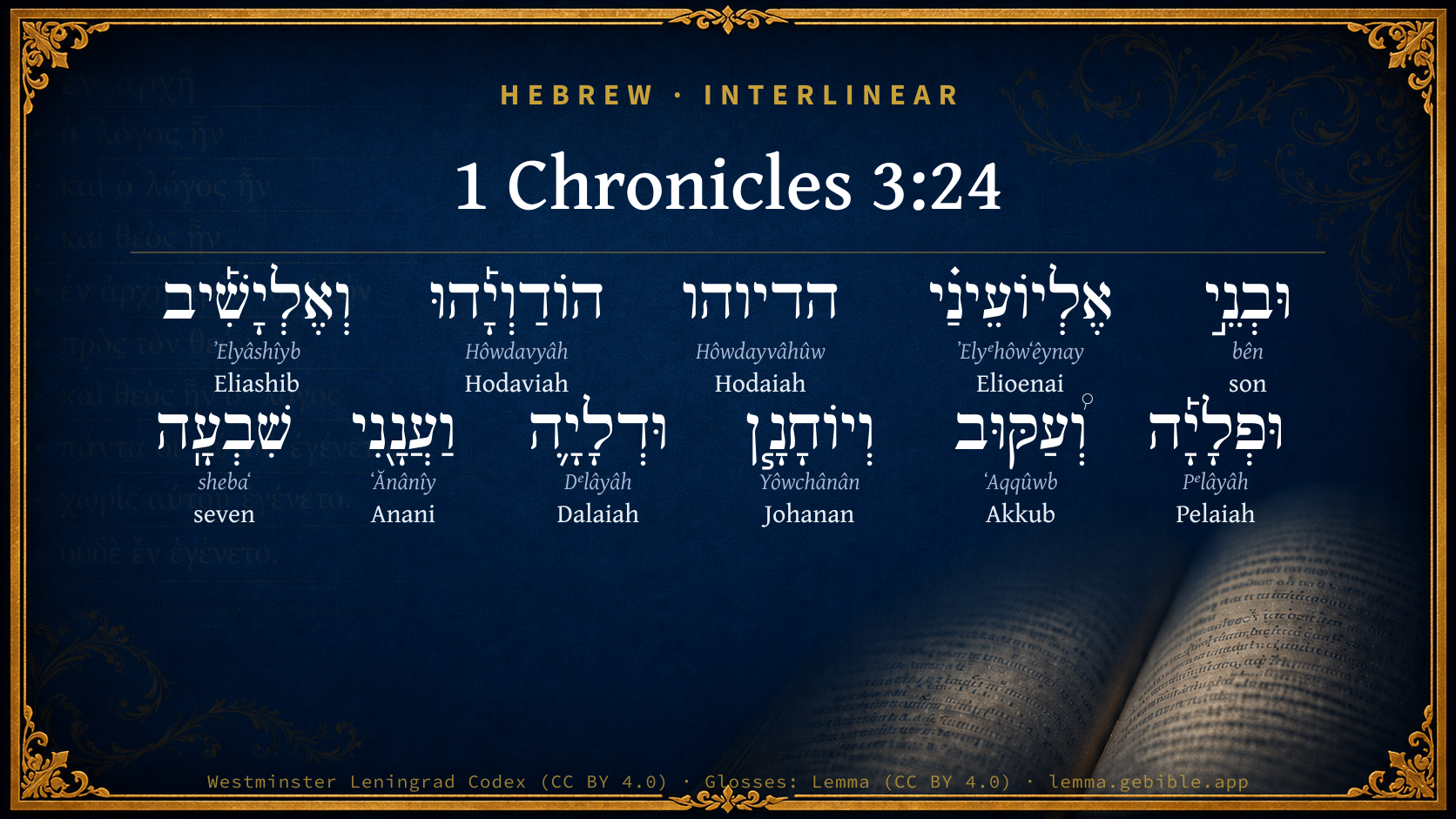
Hebrew (Westminster Leningrad Codex) 1 Chronicles 3:24 appears in the Hebrew Old Testament. The text above is from the Westminster Leningrad Codex. Each word links to its Strong’s number, a concise gloss, and parsing drawn from the Open Scriptures Hebrew Bible morphology. Click any word for its full Brown-Driver-Briggs (BDB) entry.
Download image
Cite this verse

1 Chronicles 3:24 (World English Bible). Public Domain. Lemma interlinear Bible study tool, https://lemma.gebible.app/v/1-chronicles/3/24.

Show BibTeX & RIS
BibTeX
RIS
English Translation
The sons of Elioenai: Hodaviah, and Eliashib, and Pelaiah, and Akkub, and Johanan, and Delaiah, and Anani, seven.
World English Bible · Public Domain
Highlights
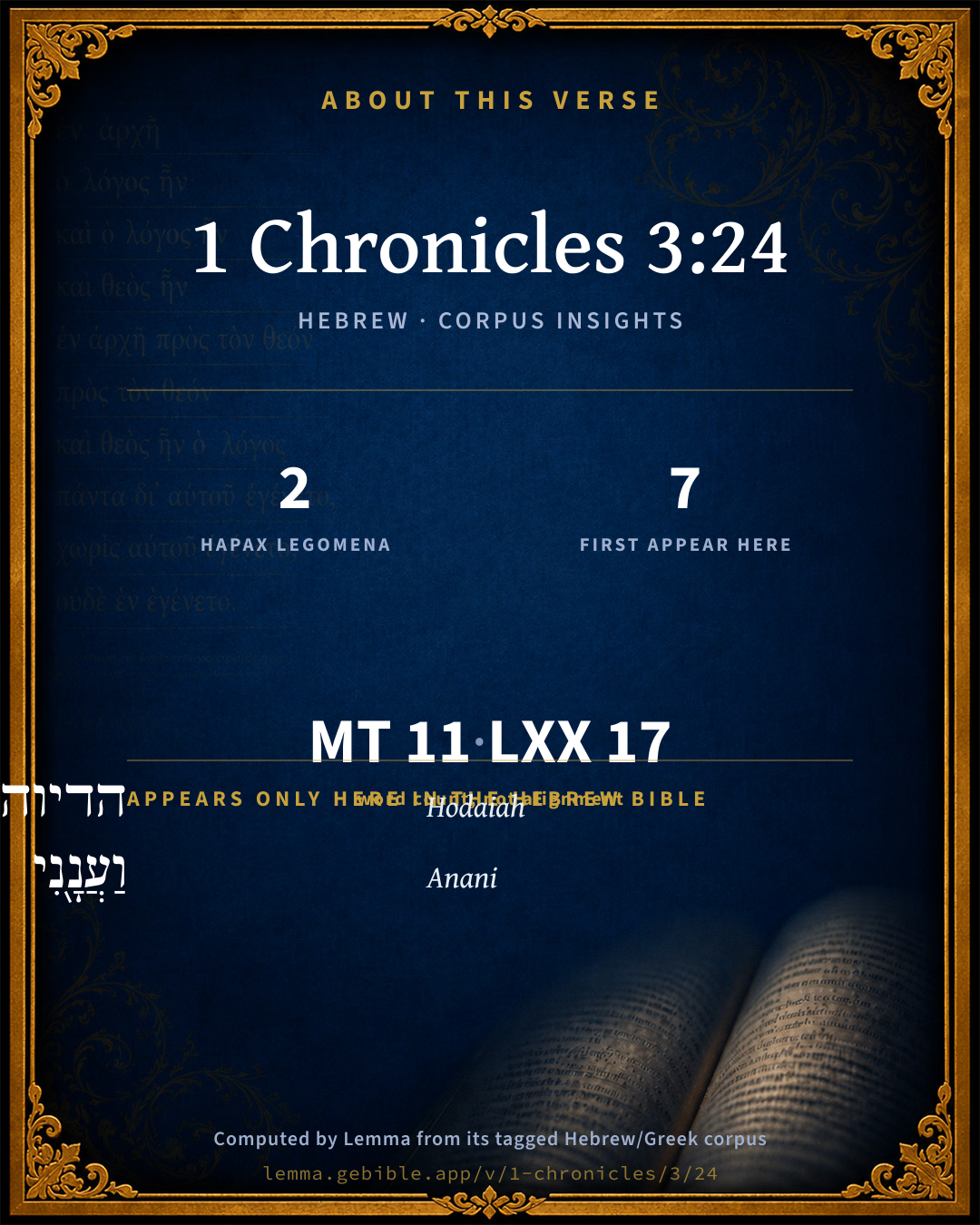
  • 2 hapax legomena — only here in the Hebrew Bible
  • 7 first appearances in the Hebrew Bible
Full analysis ↓
Download a study sheet

One document with this verse’s original text, its word-by-word gloss line, the meaning frame, cross-references with their text, attributed commentary, and full source and license credits — printable, and it pastes into notes with its structure intact.

This verse Autodidact and up

Study sheet (.html) Plain text (.txt)

A passage Seminary Student

Up to 50 verses in one chapter. A passage sheet keeps up to 6 commentary sources and 12 cross-references per verse, in the order this page ranks them, and says so on the sheet whenever that leaves anything out. Ask for a single verse and you get the Autodidact verse sheet above.

Everything on this page stays free to read, with no account — the sheet is a download of what is already on screen, not access to it.

Want to remove ads? Support Godless Engineer
Compare translations 3

The same verse in 3 English versions, stacked beneath the original-language interlinear above. Click any original word for its lexicon entry.

Each is an independent rendering of the whole verse — the interlinear is not word-aligned to these translations.

Highlighted words mark where these versions differ — a whole-verse word diff, not a word-by-word alignment.

  • World English Bible Public Domain
    The sons of Elioenai: Hodaviah, and Eliashib, and Pelaiah, and Akkub, and Johanan, and Delaiah, and Anani, seven.
  • King James Version Public Domain
    And the sons of Elioenai were, Hodaiah, and Eliashib, and Pelaiah, and Akkub, and Johanan, and Dalaiah, and Anani, seven.
  • unfoldingWord Literal Text CC BY-SA 4.0
    And the sons of Elioenai: Hodaviah and Eliashib and Pelaiah and Akkub and Johanan and Delaiah and Anani—seven.

unfoldingWord Literal Text — © unfoldingWord, licensed CC BY-SA 4.0. Word-aligned USFM3 via Door43 (git.door43.org/unfoldingWord/en_ult).

Versions to compare (up to 4)

3 of 4 selected

Show all 18 translations

Every available English version of this verse, each an independent rendering of the whole verse.

  • World English Bible Public Domain
    The sons of Elioenai: Hodaviah, and Eliashib, and Pelaiah, and Akkub, and Johanan, and Delaiah, and Anani, seven.
  • Berean Standard Bible Public Domain
    The sons of Elioenai: Hodaviah, Eliashib, Pelaiah, Akkub, Johanan, Delaiah, and Anani—seven in all.
  • Majority Standard Bible Public Domain
    The sons of Elioenai: Hodaviah, Eliashib, Pelaiah, Akkub, Johanan, Delaiah, and Anani—seven in all.
  • King James Version Public Domain
    And the sons of Elioenai were, Hodaiah, and Eliashib, and Pelaiah, and Akkub, and Johanan, and Dalaiah, and Anani, seven.
  • American Standard Version (1901) Public Domain
    And the sons of Elioenai: Hodaviah, and Eliashib, and Pelaiah, and Akkub, and Johanan, and Delaiah, and Anani, seven.
  • Revised Version (1885) Public Domain
    And the sons of Elioenai; Hodaviah, and Eliashib, and Pelaiah, and Akkub, and Johanan, and Delaiah, and Anani, seven.
  • Geneva Bible (1599) Public Domain
    And the sonnes of Elioenai were Hodaiah, and Eliashib, and Pelaiah, and Akkub, and Iohanan, and Delaiah, and Anani, seuen.
  • Douay-Rheims (1899) Public Domain
    The sons of Elioenai, Oduia, and Eliasub, and Pheleia, and Accub, and Johanan, and Dalaia, and Anani, seven.
  • Young's Literal Translation Public Domain
    And sons of Elioenai: Hodaiah, and Eliashib, and Pelaiah, and Akkub, and Johanan, and Delaiah, and Anani, seven.
  • Literal Standard Version CC BY-SA 4.0
    And sons of Elioenai: Hodaiah, and Eliashib, and Pelaiah, and Akkub, and Johanan, and Delaiah, and Anani—seven.
  • Unlocked Literal Bible CC BY-SA 4.0
    Elioenai's seven sons were Hodaviah, Eliashib, Pelaiah, Akkub, Johanan, Delaiah, and Anani.
  • unfoldingWord Literal Text CC BY-SA 4.0
    And the sons of Elioenai: Hodaviah and Eliashib and Pelaiah and Akkub and Johanan and Delaiah and Anani—seven.
  • Darby Bible Public Domain
    And the sons of Elioenai: Hodaviah, and Eliashib, and Pelaiah, and Akkub, and Johanan, and Delaiah, and Anani, seven.
  • World Messianic Bible Public Domain
    The sons of Elioenai: Hodaviah, Eliashib, Pelaiah, Akkub, Yochanan, Delaiah, and Anani, seven.
  • Webster's Bible Public Domain
    And the sons of Elioenai were, Hodaiah, and Eliashib, and Pelaiah, and Akkub, and Johanan, and Delaiah, and Anani, seven.
  • Free Bible Version CC BY-SA 4.0
    The sons of Elioenai: Hodaviah, Eliashib, Pelaiah, Akkub, Johanan, Delaiah, and Anani—a total of seven.
  • Bible in Basic English Public Domain
    And the sons of Elioenai: Hodaviah and Eliashib and Pelaiah and Akkub and Johanan and Delaiah and Anani, seven.
  • JPS Tanakh (1917) Public Domain
    And the sons of Elioenai: Hodaviah, and Eliashib, and Pelaiah, and Akkub, and Johanan, and Delaiah, and Anani, seven.

Literal Standard Version (2020), Covenant Press — licensed CC BY-SA 4.0. Text via the HelloAO Bible API (eBible.org). Unlocked Literal Bible (unfoldingWord) — licensed CC BY-SA 4.0. Text via the HelloAO Bible API (eBible.org). unfoldingWord Literal Text — © unfoldingWord, licensed CC BY-SA 4.0. Word-aligned USFM3 via Door43 (git.door43.org/unfoldingWord/en_ult). Free Bible Version, Dr. Jonathan Gallagher — licensed CC BY-SA 4.0. Text via the HelloAO Bible API (eBible.org).

Word by word

More ways to search: Search by grammar → Find every occurrence → Compare this word →

Practice this passage: Drill this verse → Learn its vocabulary →

About this verse

These counts appear in no published source. They are computed here, from the morphology-tagged text and Lemma’s own curated glosses. What Lemma adds →

11
words
11
distinct lemmas
Historical
section

Notable vocabulary

2 hapax legomena — words that appear only here in the entire Hebrew Bible:

  • הדיוהו Hodaiah H1939
  • וַעֲנָ֖נִי Anani H6054

First appearance in Scripture

These words make their first canonical appearance in the Hebrew Bible here:

  • הדיוהו Hodaiah H1939
  • הוֹדַוְיָ֡הוּ Hodaviah H1938
  • וְאֶלְיָשִׁ֡יב Eliashib H475
  • וּפְלָיָ֡ה Pelaiah H6411
  • וְ֠עַקּוּב Akkub H6126
  • וּדְלָיָ֛ה Dalaiah H1806
  • וַעֲנָ֖נִי Anani H6054

Shared distinctive vocabulary

וּפְלָיָ֡ה Pelaiah H6411 occurs in 3 verses of the Hebrew Bible. Also found in:

Grammatical profile

  • 10 nouns
  • 1 adjective

Hebrew & Septuagint length

In English translation the verse runs 18 words from the Hebrew and 19 from the Septuagint (LXX English) — closely comparable.

A rough comparison of the two English renderings, which tokenize alike — not a word-level alignment.

Word counts can differ between the Hebrew and the Greek without any difference in meaning — e.g. the Hebrew direct-object marker אֵת has no separate Greek word, and Greek often adds the article ὁ.

In the original languages it is 11 Hebrew tokens and 17 Greek tokens — but the two are counted differently (Hebrew bundles its prefixes and suffixes into one token; the Greek is in lemma form), so that isn’t a like-for-like length.

Hebrew and Greek witnesses Masoretic Hebrew ↔ Greek Septuagint

The same verse in the two great witnesses to the Old Testament, shown verse-for-verse.

These are two independent witnesses, not word-aligned to each other, and the Septuagint is shown in lemma (dictionary) form.

Hebrew 1 Chronicles 3:24 Masoretic · Westminster Leningrad Codex

וּבְנֵ֣י אֶלְיוֹעֵינַ֗י הדיוהו הוֹדַוְיָ֡הוּ וְאֶלְיָשִׁ֡יב וּפְלָיָ֡ה וְ֠עַקּוּב וְיוֹחָנָ֧ן וּדְלָיָ֛ה וַעֲנָ֖נִי שִׁבְעָֽה

The sons of Elioenai: Hodaviah, and Eliashib, and Pelaiah, and Akkub, and Johanan, and Delaiah, and Anani, seven.

World English Bible · Public Domain

Greek LXX 1 Chronicles 3:24 Septuagint · lemma form

καί υἱός ελιθεναν οδουια καί ελιασιβ καί φαλαια καί ακουν καί ιωαναν καί δαλαια καί ανανι ἑπτά

And the sons of Elithenan; Odolia, and Heliasebon, and Phadaia, and Akub, and Joanan, and Dalaaia, and Anan, seven.

LXX2012 (modern English Septuagint) · Public Domain

On this verse, Ellicott's Commentary for English Readers discusses the Septuagint’s reading. Read the note in Commentary ↓

Hebrew: Westminster Leningrad Codex (CC BY 4.0). Greek: Septuagint (public domain); English from LXX2012 (modern English Septuagint) (Public Domain). How the Septuagint differs from the Hebrew →

Commentary

Notes on 1 Chronicles 3:24 from classic Christian and Jewish commentators (each source and its license shown beneath its notes). The classic Christian expositions comment on the surrounding passage and are grouped to its opening verse, so a note may address several verses; the Jewish commentaries on the Tanakh (Rashi and others) are per-verse, so they appear only where the commentator wrote on this verse.

Lemma curates 59 commentaries, every one of them public domain or Creative Commons licensed, each selected and text-cleaned for this edition rather than reprinted as found. About our sources →

Adam Clarke's Commentary

Verse 24. And Anani] "This is the King Messiah who is to be revealed." - T. Jarchi says the same, and refers to Da 7:13: Behold, one like the Son of man came with the clouds (ענני ananey) of heaven. For this application of the word he gives a fanciful reason, not worthy to be repeated. The Syriac and Arabic omit several names in this table, and make only twenty-three verses in the chapter: but such differences are frequent in the books of Chronicles.

Adam Clarke's Commentary on the Bible (1810–1826) — public domain. Text from a community e-Sword/MySword module.

Ellicott's Commentary for English Readers

(24) The sons of Elioenai . . . Hodaiah.—These sons of Elioenai are the sixth generation from Zerubbabel (536-515 B.C. ), that is to say, they were living about 345 B.C. , under Artaxerxes Ochus. If the reading of the LXX. in 1Ch_3:21 be correct, their date is four generations later, or about 225 B.C. The result is to bring down the date of the chronicle a century lower than the best critics approve. (See Introduction.)

A Bible Commentary for English Readers, edited by Charles John Ellicott (1878–1897) — public domain. Text from a community e-Sword module.

The Cambridge Bible for Schools and Colleges

gen. ed. J. J. S. Perowne

24. Hodaiah] R.V. Hodaviah (as in 1Ch_5:24). Another significant name “Thank ye Jehovah.”

The Cambridge Bible for Schools and Colleges (gen. ed. J. J. S. Perowne; Cambridge University Press, 1878–1918) — public domain. Text from a community e-Sword module.

Haydock's Catholic Bible Commentary

Oduia, the 12th from Zorobabel, which shews that this has been inserted since the time of Esdras, and that the author was very careful to preserve the genealogical tables, as it was not known from what family of the descendants of David the Messias should be born. (Calmet) --- St. Matthew gives us a different genealogy. (Du Hamel) (Calmet)

George Leo Haydock (1774–1849), Haydock's Catholic Family Bible and Commentary, 1859 edition — public domain. Excludes Psalms (Douay-Rheims chapter numbering differs from Protestant) and Deuterocanonical books (Catholic canon only).

Lesson kit

Teaching starters — assembled from the data on this page, not authored interpretation. Every prompt links to the verse data it draws on. Edit before teaching.

1 Chronicles, in the Historical, opens this verse with 11 words (11 distinct Hebrew lemmas). Its most distinctive word is Hôwdayvâhûw (“Hodaiah”). A historical commentator’s framing appears above. Read the whole chapter for the surrounding context.

Discussion questions

  1. The word Hôwdayvâhûw carries the sense “Hodaiah.” How does it shape the verse?
  2. This verse holds 2 words here found nowhere else in the Hebrew Bible. What might the rare words draw attention to?
  3. 7 words here appear for the first time in Scripture. What is being introduced at this debut?
  4. Nehemiah 8:7 shares the word «Pelaiah» with this verse. How do the two illuminate each other?
  5. These translations render this verse differently. What is at stake in choosing one wording over another?
  6. Reading how Adam Clarke's Commentary and Ellicott's Commentary for English Readers read this verse, where do the two commentators agree and where do they part?

Things to notice

Reading settings

Reading text

Shown beneath each verse's original-language words.

Old Testament
Old Testament edition

Read the OT as the Masoretic Hebrew (MT) or the Greek Septuagint (LXX).

English shown for the Greek Septuagint (in the Hebrew ↔ Greek comparison).

Comparing translations? Open the Compare panel on any verse page to stack up to four side by side.