
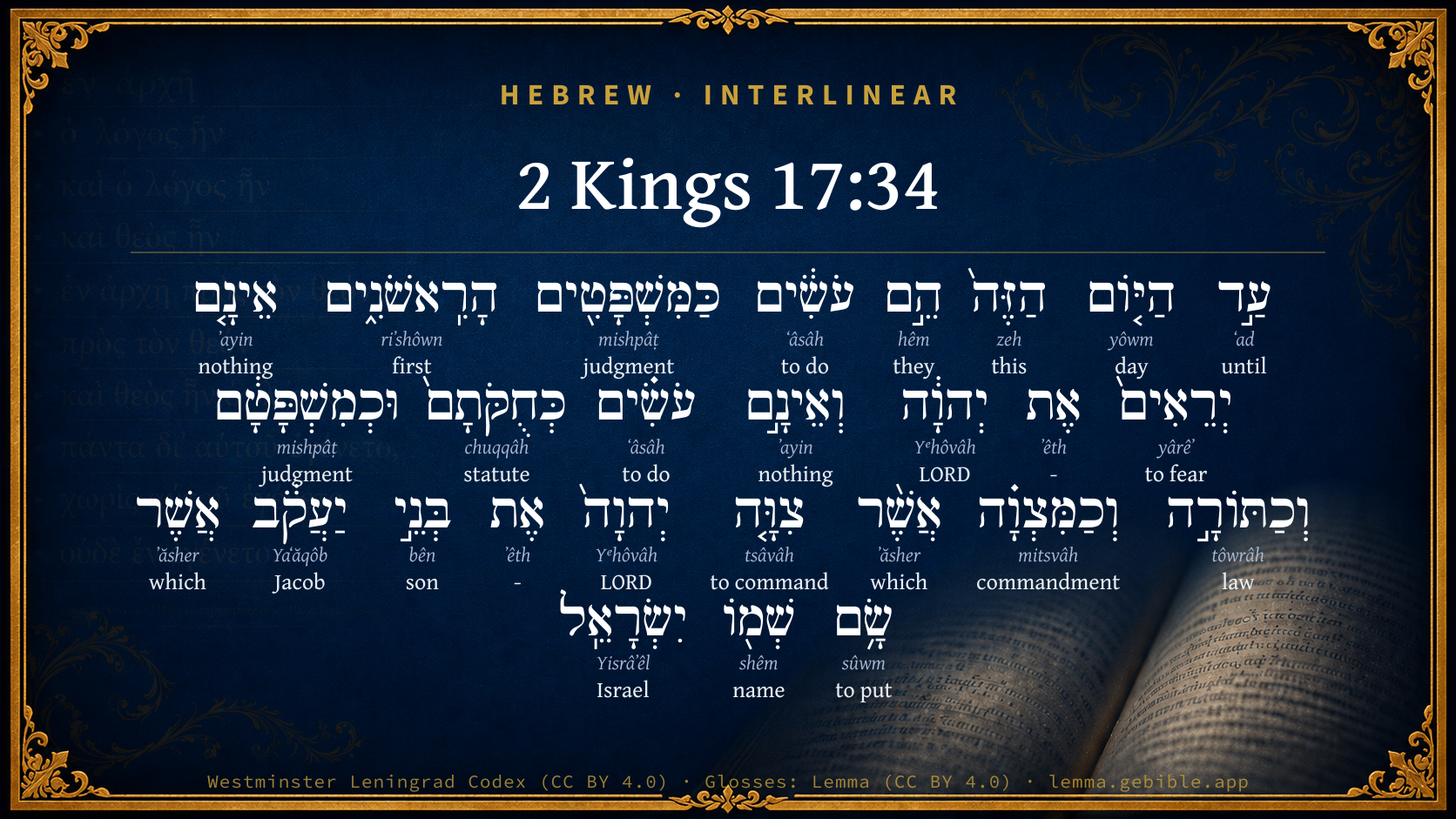
2 Kings 17:34

Hebrew (Westminster Leningrad Codex) 2 Kings 17:34 appears in the Hebrew Old Testament. The text above is from the Westminster Leningrad Codex. Each word links to its Strong’s number, a concise gloss, and parsing drawn from the Open Scriptures Hebrew Bible morphology. Click any word for its full Brown-Driver-Briggs (BDB) entry.
Download image
Cite this verse

2 Kings 17:34 (World English Bible). Public Domain. Lemma interlinear Bible study tool, https://lemma.gebible.app/v/2-kings/17/34.

Show BibTeX & RIS
BibTeX
RIS
English Translation
To this day they do after the former manner: they don't fear Yahweh, neither do they after their statutes, or after their ordinances, or after the law or after the commandment which Yahweh commanded the children of Jacob, whom he named Israel;
World English Bible · Public Domain
Download a study sheet

One document with this verse’s original text, its word-by-word gloss line, the meaning frame, cross-references with their text, attributed commentary, and full source and license credits — printable, and it pastes into notes with its structure intact.

This verse Autodidact and up

Study sheet (.html) Plain text (.txt)

A passage Seminary Student

Up to 50 verses in one chapter. A passage sheet keeps up to 6 commentary sources and 12 cross-references per verse, in the order this page ranks them, and says so on the sheet whenever that leaves anything out. Ask for a single verse and you get the Autodidact verse sheet above.

Everything on this page stays free to read, with no account — the sheet is a download of what is already on screen, not access to it.

Want to remove ads? Support Godless Engineer
Compare translations 3

The same verse in 3 English versions, stacked beneath the original-language interlinear above. Click any original word for its lexicon entry.

Each is an independent rendering of the whole verse — the interlinear is not word-aligned to these translations.

Highlighted words mark where these versions differ — a whole-verse word diff, not a word-by-word alignment.

  • World English Bible Public Domain
    To this day they do after the former manner: they don't fear Yahweh, neither do they after their statutes, or after their ordinances, or after the law or after the commandment which Yahweh commanded the children of Jacob, whom he named Israel;
  • King James Version Public Domain
    Unto this day they do after the former manners: they fear not the LORD, neither do they after their statutes, or after their ordinances, or after the law and commandment which the LORD commanded the children of Jacob, whom he named Israel;
  • unfoldingWord Literal Text CC BY-SA 4.0
    To this day, they are acting according to the first customs. They are not fearing Yahweh, and they are not acting according to their statutes or according to their judgment or according to the law or according to the commandment that Yahweh commanded the sons of Jacob, whose name he made Israel.

unfoldingWord Literal Text — © unfoldingWord, licensed CC BY-SA 4.0. Word-aligned USFM3 via Door43 (git.door43.org/unfoldingWord/en_ult).

Versions to compare (up to 4)

3 of 4 selected

Show all 18 translations

Every available English version of this verse, each an independent rendering of the whole verse.

  • World English Bible Public Domain
    To this day they do after the former manner: they don't fear Yahweh, neither do they after their statutes, or after their ordinances, or after the law or after the commandment which Yahweh commanded the children of Jacob, whom he named Israel;
  • Berean Standard Bible Public Domain
    To this day they are still practicing their former customs. None of them worship the LORD or observe the statutes, ordinances, laws, and commandments that the LORD gave the descendants of Jacob, whom He named Israel.
  • Majority Standard Bible Public Domain
    To this day they are still practicing their former customs. None of them worship the LORD or observe the statutes, ordinances, laws, and commandments that the LORD gave the descendants of Jacob, whom He named Israel.
  • King James Version Public Domain
    Unto this day they do after the former manners: they fear not the LORD, neither do they after their statutes, or after their ordinances, or after the law and commandment which the LORD commanded the children of Jacob, whom he named Israel;
  • American Standard Version (1901) Public Domain
    Unto this day they do after the former manner: they fear not Jehovah, neither do they after their statutes, or after their ordinances, or after the law or after the commandment which Jehovah commanded the children of Jacob, whom he named Israel;
  • Revised Version (1885) Public Domain
    Unto this day they do after the former manners: they fear not the LORD, neither do they after their statutes, or after their ordinances, or after the law or after the commandment which the LORD commanded the children of Jacob, whom he named Israel;
  • Geneva Bible (1599) Public Domain
    Vnto this day they doe after the olde maner: they neyther feare God, neyther doe after their ordinances, nor after their customes, nor after the Lawe, nor after the commandement, which the Lord commanded the children of Iaakob, whom he named Israel,
  • Douay-Rheims (1899) Public Domain
    Unto this day they followed the old manner: they fear not the Lord, neither do they keep his ceremonies, and judgments, and law, and the commandment, which the Lord commanded the children of Jacob, whom he surnamed Israel:
  • Young's Literal Translation Public Domain
    Unto this day they are doing according to the former customs -- they are not fearing Jehovah, and are not doing according to their statutes, and according to their ordinances, and according to the law, and according to the command, that Jehovah commanded the sons of Jacob whose name He made Israel,
  • Literal Standard Version CC BY-SA 4.0
    To this day they are doing according to the former customs—they are not fearing YHWH, and are not doing according to their statutes, and according to their ordinances, and according to the Law, and according to the command, that YHWH commanded the sons of Jacob whose name He made Israel,
  • Unlocked Literal Bible CC BY-SA 4.0
    To this day they persist in their old customs. They neither honor Yahweh, nor do they follow the statutes, decrees, the law, or the commandments that Yahweh gave to the people of Jacob—whom he named Israel—
  • unfoldingWord Literal Text CC BY-SA 4.0
    To this day, they are acting according to the first customs. They are not fearing Yahweh, and they are not acting according to their statutes or according to their judgment or according to the law or according to the commandment that Yahweh commanded the sons of Jacob, whose name he made Israel.
  • Darby Bible Public Domain
    To this day they do after their former customs: they fear not Jehovah, neither do they after their statutes or after their ordinances, nor after the law and commandment that Jehovah commanded the sons of Jacob, whom he named Israel.
  • World Messianic Bible Public Domain
    To this day they do what they did before. They don’t fear the LORD, and they do not follow the statutes, or the ordinances, or the law, or the commandment which the LORD commanded the children of Jacob, whom he named Israel;
  • Webster's Bible Public Domain
    To this day they do after the former manners: they fear not the LORD, neither do they after their statutes, or after their ordinances, or after the law and commandment which the LORD commanded the children of Jacob, whom he named Israel;
  • Free Bible Version CC BY-SA 4.0
    Even to this day they are still following their former practices. None of them truly worships the Lord or observes the regulations, requirements, laws, and commandments that the Lord gave to the descendants of Jacob, the one he named Israel.
  • Bible in Basic English Public Domain
    So to this day they go on in their old ways, not worshipping the Lord or keeping his orders or his ways or the law and the rule which the Lord gave to the children of Jacob, to whom he gave the name Israel;
  • JPS Tanakh (1917) Public Domain
    Unto this day they do after the former manners: they fear not the LORD, neither do they after their statutes, or after their ordinances, or after the law or after the commandment which the LORD commanded the children of Jacob, whom He named Israel;

Literal Standard Version (2020), Covenant Press — licensed CC BY-SA 4.0. Text via the HelloAO Bible API (eBible.org). Unlocked Literal Bible (unfoldingWord) — licensed CC BY-SA 4.0. Text via the HelloAO Bible API (eBible.org). unfoldingWord Literal Text — © unfoldingWord, licensed CC BY-SA 4.0. Word-aligned USFM3 via Door43 (git.door43.org/unfoldingWord/en_ult). Free Bible Version, Dr. Jonathan Gallagher — licensed CC BY-SA 4.0. Text via the HelloAO Bible API (eBible.org).

Word by word

More ways to search: Search by grammar → Find every occurrence → Compare this word →

Practice this passage: Drill this verse → Learn its vocabulary →

כְּחֻקֹּתָם֙
chuqqâh
H2708
“like/as · statutes · their”
Preposition + Noun, Common, Both, Plural, Construct + Suffix, Personal, 3rd Person, Masculine, Plural
Part of Speech
Preposition + Noun
Type
Common
Gender
Both
Number
Plural
State
Construct
Full BDB Definition

Origin: from H2706

TWOT: 728b

statute, ordinance, limit, enactment, something prescribed - statute
  1. עַ֣ד ʻad H5704 “until” Preposition
  2. הַיּ֤וֹם yôwm H3117 “the · day” Particle, Definite Article + Noun, Common, Masculine, Singular, Absolute
  3. הַזֶּה֙ zeh H2088 “the · this” Particle, Definite Article + Pronoun, Demonstrative, Masculine, Singular
  4. הֵ֣ם hêm H1992 “they” Pronoun, Personal, 3rd Person, Masculine, Plural
  5. עֹשִׂ֔ים ʻâsâh H6213 “doing” Verb, Qal, Participle Active, Masculine, Plural, Absolute
  6. כַּמִּשְׁפָּטִ֖ים mishpâṭ H4941 “like/as the · judgments” Preposition, Determined + Noun, Common, Masculine, Plural, Absolute
  7. הָרִֽאשֹׁנִ֑ים riʼshôwn H7223 “the · first” Particle, Definite Article + Adjective, Adjective, Masculine, Plural, Absolute
  8. אֵינָ֤ם ʼayin H369 “nothing · them” Particle, Negative + Suffix, Personal, 3rd Person, Masculine, Plural
  9. יְרֵאִים֙ yârêʼ H3372 “fearing” Adjective, Adjective, Masculine, Plural, Absolute
  10. אֶת ʼêth H853 “-” Particle, Direct Object
  11. יְהוָ֔ה Yᵉhôvâh H3068 “LORD” Noun, Proper
  12. וְאֵינָ֣ם ʼayin H369 “and · nothing · them” Conjunction + Particle, Negative + Suffix, Personal, 3rd Person, Masculine, Plural
  13. עֹשִׂ֗ים ʻâsâh H6213 “doing” Verb, Qal, Participle Active, Masculine, Plural, Absolute
  14. וּכְמִשְׁפָּטָ֔ם mishpâṭ H4941 “and · like/as · judgment · their” Conjunction + Preposition + Noun, Common, Masculine, Singular, Construct + Suffix, Personal, 3rd Person, Masculine, Plural
  15. וְכַתּוֹרָ֣ה tôwrâh H8451 “and · like/as the · law” Conjunction + Preposition, Determined + Noun, Common, Feminine, Singular, Absolute
  16. וְכַמִּצְוָ֗ה mitsvâh H4687 “and · like/as the · commandment” Conjunction + Preposition, Determined + Noun, Common, Feminine, Singular, Absolute
  17. אֲשֶׁ֨ר ʼăsher H834 “which” Particle, Relative
  18. צִוָּ֤ה tsâvâh H6680 “to command” Verb, Piel, Perfect, 3rd Person, Masculine, Singular
  19. יְהוָה֙ Yᵉhôvâh H3068 “LORD” Noun, Proper
  20. אֶת ʼêth H853 “-” Particle, Direct Object
  21. בְּנֵ֣י bên H1121 “sons of” Noun, Common, Masculine, Plural, Construct
  22. יַעֲקֹ֔ב Yaʻăqôb H3290 “Jacob” Noun, Proper
  23. אֲשֶׁר ʼăsher H834 “which” Particle, Relative
  24. שָׂ֥ם sûwm H7760 “to put” Verb, Qal, Perfect, 3rd Person, Masculine, Singular
  25. שְׁמ֖וֹ shêm H8034 “name · his” Noun, Common, Masculine, Singular, Construct + Suffix, Personal, 3rd Person, Masculine, Singular
  26. יִשְׂרָאֵֽל Yisrâʼêl H3478 “Israel” Noun, Proper

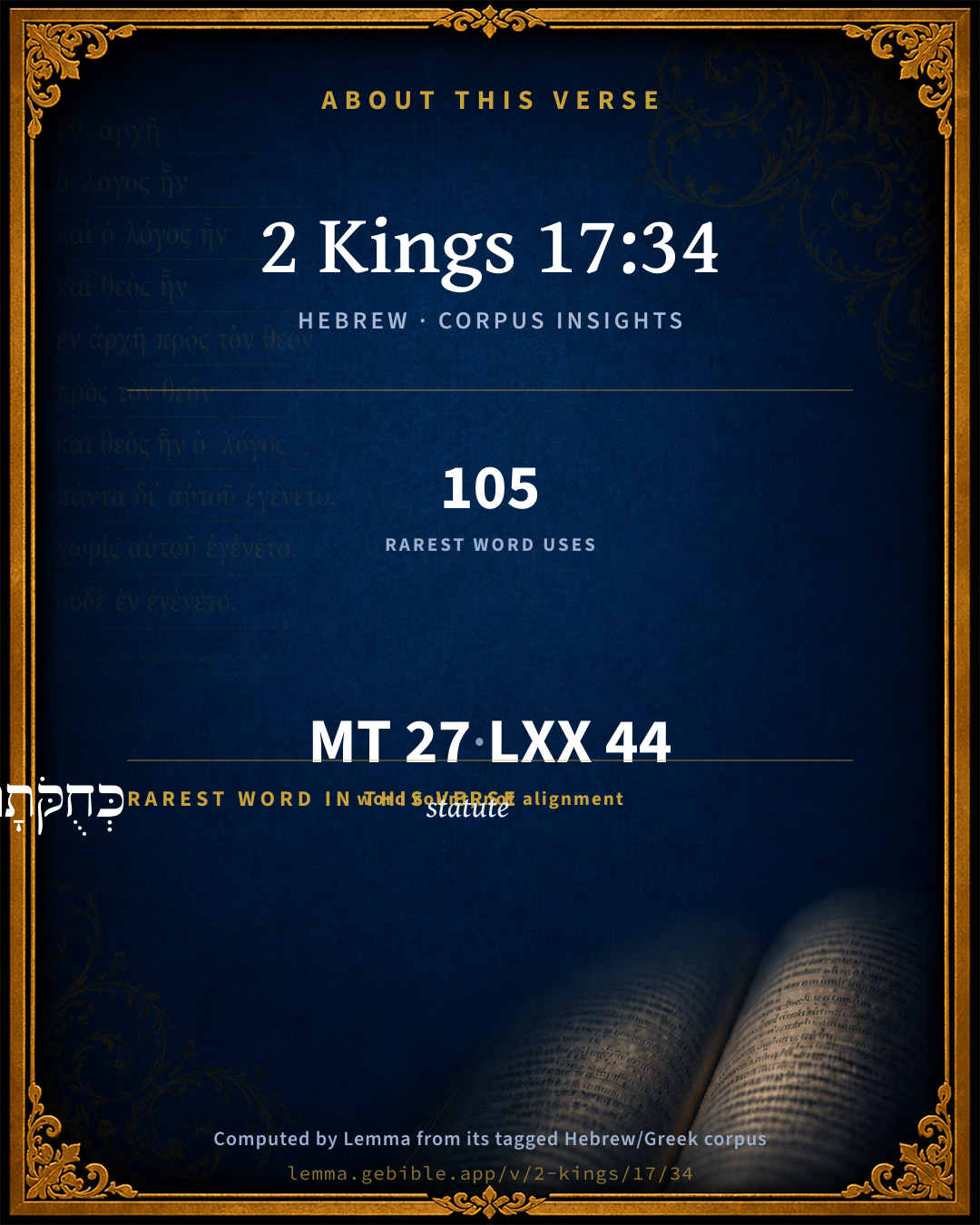
About this verse

These counts appear in no published source. They are computed here, from the morphology-tagged text and Lemma’s own curated glosses. What Lemma adds →

27
words
21
distinct lemmas
Historical
section

Grammatical profile

  • 4 verbs
  • 12 nouns
  • 2 adjectives
  • 2 pronouns
  • 1 preposition
  • 6 particles

Verb forms

  • עֹשִׂ֔ים Qal · Participle Active
  • עֹשִׂ֗ים Qal · Participle Active
  • צִוָּ֤ה Piel · Perfect
  • שָׂ֥ם Qal · Perfect

Repetition

Words recur within this verse — often emphatic in Hebrew:

  • עֹשִׂ֔ים to do H6213 ×2
  • כַּמִּשְׁפָּטִ֖ים judgment H4941 ×2
  • אֵינָ֤ם nothing H369 ×2
  • יְהוָ֔ה LORD H3068 ×2
  • אֲשֶׁ֨ר which H834 ×2

Hebrew & Septuagint length

In English translation the verse runs 42 words from the Hebrew and 48 from the Septuagint (LXX English) — closely comparable.

A rough comparison of the two English renderings, which tokenize alike — not a word-level alignment.

Word counts can differ between the Hebrew and the Greek without any difference in meaning — e.g. the Hebrew direct-object marker אֵת has no separate Greek word, and Greek often adds the article ὁ.

In the original languages it is 27 Hebrew tokens and 44 Greek tokens — but the two are counted differently (Hebrew bundles its prefixes and suffixes into one token; the Greek is in lemma form), so that isn’t a like-for-like length.

Cross-references

10

Topical passages linked to 2 Kings 17:34 in the Treasury of Scripture Knowledge — connected by theme and wording, ordered by reader-vote popularity; previews shown in the World English Bible.

  • Genesis 32:28 He said, "Your name will no longer be called 'Jacob,' but, 'Israel,' for you have fought with God and with men, and have prevailed."
  • Genesis 35:10 God said to him, "Your name is Jacob. Your name shall not be Jacob any more, but your name will be Israel." He named him Israel.
  • 1 Kings 18:31 Elijah took twelve stones, according to the number of the tribes of the sons of Jacob, to whom the word of Yahweh came, saying, Israel shall be your name.
  • 2 Kings 17:25 So it was, at the beginning of their dwelling there, that they didn't fear Yahweh: therefore Yahweh sent lions among them, which killed some of them.
  • 2 Kings 17:27–28 Then the king of Assyria commanded, saying, Carry there one of the priests whom you brought from there; and let them go and dwell there, and let him teach them the law of the god of the land.
  • 2 Kings 17:33 They feared Yahweh, and served their own gods, after the manner of the nations from among whom they had been carried away.
  • Isaiah 48:1 Hear you this, house of Jacob, who are called by the name of Israel, and are come forth out of the waters of Judah; who swear by the name of Yahweh, and make mention of the God of Israel, but not in truth, nor in righteousness
  • Genesis 33:20 He erected an altar there, and called it El Elohe Israel.
  • 1 Kings 11:31 He said to Jeroboam, Take ten pieces; for thus says Yahweh, the God of Israel, Behold, I will tear the kingdom out of the hand of Solomon, and will give ten tribes to you
  • 1 Kings 18:11 Now you say, Go, tell your lord, Behold, Elijah [is here].

Cross-references courtesy of OpenBible.info (CC BY 4.0).

Hebrew and Greek witnesses Masoretic Hebrew ↔ Greek Septuagint

The same verse in the two great witnesses to the Old Testament, shown verse-for-verse.

These are two independent witnesses, not word-aligned to each other, and the Septuagint is shown in lemma (dictionary) form.

Hebrew 2 Kings 17:34 Masoretic · Westminster Leningrad Codex

עַ֣ד הַיּ֤וֹם הַזֶּה֙ הֵ֣ם עֹשִׂ֔ים כַּמִּשְׁפָּטִ֖ים הָרִֽאשֹׁנִ֑ים אֵינָ֤ם יְרֵאִים֙ אֶת יְהוָ֔ה וְאֵינָ֣ם עֹשִׂ֗ים כְּחֻקֹּתָם֙ וּכְמִשְׁפָּטָ֔ם וְכַתּוֹרָ֣ה וְכַמִּצְוָ֗ה אֲשֶׁ֨ר צִוָּ֤ה יְהוָה֙ אֶת בְּנֵ֣י יַעֲקֹ֔ב אֲשֶׁר שָׂ֥ם שְׁמ֖וֹ יִשְׂרָאֵֽל

To this day they do after the former manner: they don't fear Yahweh, neither do they after their statutes, or after their ordinances, or after the law or after the commandment which Yahweh commanded the children of Jacob, whom he named Israel;

World English Bible · Public Domain

Greek LXX 2 Kings 17:34 Septuagint · lemma form

ἕως ὁ ἡμέρα οὗτος αὐτός ποιέω κατά ὁ κρίμα αὐτός αὐτός φοβέω καί αὐτός ποιέω κατά ὁ δικαίωμα αὐτός καί κατά ὁ κρίσις αὐτός καί κατά ὁ νόμος καί κατά ὁ ἐντολή ὅς ἐντέλλομαι κύριος ὁ υἱός ἰακώβ ὅς τίθημι ὁ ὄνομα αὐτός ἰσραήλ

Until this day they did according to their manner: they fear the Lord, and they do according to their customs, and according to their manner, and according to the law, and according to the commandment which the Lord commanded the sons of Jacob, whose name he made Israel.

LXX2012 (modern English Septuagint) · Public Domain

On this verse, Ellicott's Commentary for English Readers discusses the Septuagint’s reading. Read the note in Commentary ↓

Hebrew: Westminster Leningrad Codex (CC BY 4.0). Greek: Septuagint (public domain); English from LXX2012 (modern English Septuagint) (Public Domain). How the Septuagint differs from the Hebrew →

Targum (Aramaic paraphrase)

1

The Targum is the ancient Jewish Aramaic paraphrase of the Hebrew Scriptures — an interpretive translation, not the Hebrew text itself. Onkelos (literal) and Pseudo-Jonathan (expansive) render the Torah, and Jonathan the Prophets. Coverage is partial: where no permissively-licensed English translation exists for a verse, only the Aramaic is shown. This is verse-level text, not a word-by-word alignment to the Hebrew.

  1. Targum Jonathan Prophets (Joshua–Malachi)
    עַד יוֹמָא הָדֵין אִינוּן עָבְדִין כְּנִימוּסֵי קַדְמָאֵי לֵיתִינוּן דַחֲלִין מִן קֳדָם יְיָ וְלֵיתִינוּן עָבְדִין כִּגְזֵירַתְהוֹן וְכִדְחָזֵי לְהוֹן וּכְאוֹרַיְתָא וּכְתַפְקֵידְתָּא דְפַקֵיד יְיָ יַת בְּנֵי יַעֲקֹב דְשַׁוִי שְׁמֵיהּ יִשְׂרָאֵל:

    (no public-domain English translation for this verse)

    Targum Jonathan — Aramaic: “Mikraot Gedolot” (public domain). English: “Sefaria Community Translation” (CC0 1.0 (public-domain dedication)); “London "Chaldee Paraphrase," 1871” (public domain). Text via Sefaria.

Commentary

Notes on 2 Kings 17:34 from classic Christian and Jewish commentators (each source and its license shown beneath its notes). The classic Christian expositions comment on the surrounding passage and are grouped to its opening verse, so a note may address several verses; the Jewish commentaries on the Tanakh (Rashi and others) are per-verse, so they appear only where the commentator wrote on this verse.

Lemma curates 59 commentaries, every one of them public domain or Creative Commons licensed, each selected and text-cleaned for this edition rather than reprinted as found. About our sources →

Trapp's Complete Commentary

John Trapp

2Ki 17:34 Unto this day they do after the former manners: they fear not the LORD, neither do they after their statutes, or after their ordinances, or after the law and commandment which the LORD commanded the children of Jacob, whom he named Israel;

Ver. 34. They fear not the Lord.] Rightly they feared him not, because neither truly nor totally: their religion was a galimaufrey, a mixture of true and false, which is as good as none; for God will not part stakes with the devil at any hand. Such a religion is a mere irreligion, because contrary, (1.) To God’s law, which rejecteth heathen rites; {2Ki 17:34; 2Ki 17:36-37; 2Ki 17:39-40} (2.) To God’s covenant, which heathens have nothing to do with. {2Ki 17:33; 2Ki 17:38} The mongrel religion of the Samaritans was afterwards refined by Manasseh, a Jewish priest, that in Alexander’s time made a defection to them, and brought many Jews with him.

John Trapp, A Commentary or Exposition upon All the Books of the Old and New Testament (1647–1656) — public domain. Text from a community e-Sword module.

Joseph Benson's Commentary

2Ki 17:34. Unto this day, &c. — That is, till the time when this book was written, and long after, about three hundred years in all, till the time of Alexander the Great, when Manasseh, brother to Jaddus the high-priest of the Jews, having married the daughter of Sanballat, governor of the Samaritans, went over to them, and, obtaining leave of Alexander to build a temple on mount Gerizim, drew over many of the Jews to him, and prevailed with the Samaritans to cast away their idols, and to worship the God of Israel only. Yet their worship was mixed with so much superstition, that our Lord tells them they knew not what they worshipped. They do after the former manners — As the Israelites, before their captivity, (2Ki 17:33,) gave these nations an ill example, in serving the Lord and Baal together; so these nations both worshipped the God of Israel, and those other gods. But, adds the historian, they feared not the Lord — Their pretended fear of him, and serving him together with their idols, was not worthy of the name of piety, or the fear of the Lord: nor would God accept such a mongrel religion and false worship as they offered to him. Neither do they after their statutes — God’s law delivered to the Israelites, and to them as their inheritance, Psa 119:111. This is alleged as an evidence that they did not fear the Lord, whatsoever they pretended, because they lived in the constant breach of his statutes. Which the Lord commanded the children of Jacob, whom he named Israel — A name signifying Jacob’s special interest in God, and power with him, which was given to him, not only for himself, but for his posterity also, whom God frequently honoured with that name. And by this great favour he aggravates the sin, both of the Israelites, and of those nations planted in their land, who professed to learn their way of worshipping God, and to imitate it.

Joseph Benson's Commentary on the Old and New Testaments (1811–1818) — public domain. Text from a community e-Sword module.

Geneva Bible (1599)

Geneva Bible translators

He meaneth this by the Israelites to whom God had given his commandments.

Geneva Bible (1599) marginal notes — public domain. Text via Bolls.life.

Jamieson, Fausset & Brown

Robert Jamieson, A. R. Fausset & David Brown

Unto this day--the time of the Babylonian exile, when this book was composed. Their religion was a strange medley or compound of the service of God and the service of idols. Such was the first settlement of the people, afterwards called Samaritans, who were sent from Assyria to colonize the land, when the kingdom of Israel, after having continued three hundred fifty-six years, was overthrown.

Next: 2 Kings Chapter 18

Jamieson, Fausset & Brown — Commentary Critical and Explanatory on the Whole Bible (1871) — public domain (CC PDM 1.0). Text via the HelloAO Bible API.

Ellicott's Commentary for English Readers

(34-41) THE RELIGIOUS STATE OF THE MIXED POPULATION OF SAMARIA IN THE TIME OF THE EDITOR.

(34) They do after the former manners.—They still keep up the religious customs of the first colonists.

They fear not the Lord.—They fear Him not in the sense of a right fear; they do not honour Him in the way He has prescribed in the Torah. The LXX. omits both nots in this verse.

After their statutes, or after their ordinances.—The writer here thinks of the remnant of the Ten Tribes who amalgamated with the new settlers (2Ki_23:19; 2Ch_34:6; 2Ch_34:9; 2Ch_34:33; Joh_4:12).

Ordinances.—Heb., ordinance, or judgment.

Or after the law and commandment.—This pair of terms is exegetical of the preceding pair. Probably, however, the original reading was, “after the statutes, and after the ordinances,” as in 2Ki_17:37, where the same four terms recur. Then the sense will simply be, that the Samaritans contemporary with the writer do not worship Jehovah according to the Torah.

A Bible Commentary for English Readers, edited by Charles John Ellicott (1878–1897) — public domain. Text from a community e-Sword module.

The Cambridge Bible for Schools and Colleges

gen. ed. J. J. S. Perowne

34. they fear not the Lord] i.e. This worship of Jehovah, merely because they regard Him as the local deity of the land, is no worship at all. God will not be served from policy. There need be no difficulty in understanding the words here in contrast to ‘they feared the Lord’ in verses 32, 33, 41. These latter express what the new colonists thought they were doing, and what they also thought to be enough. This verse expresses what the writer knew to be the truth as God regarded the service.

neither do they after their statutes] ‘Their’ refers by anticipation to ‘the children of Jacob’, who are mentioned at the close of the verse.

after the law and commandment] As the preposition is twice expressed in Hebrew, R.V. has or after the commandment.

whom he named Israel] See Gen_32:28.

The Cambridge Bible for Schools and Colleges (gen. ed. J. J. S. Perowne; Cambridge University Press, 1878–1918) — public domain. Text from a community e-Sword module.

John Gill's Exposition

With whom the Lord had made a covenant,.... As he did at Sinai, Kg2 17:15.

and charged them, saying, ye shall not fear other gods, nor bow yourselves to them, nor serve them, nor sacrifice to them; all which is contained in the first and second commandments of the law.

John Gill's Exposition of the Whole Bible (1746–1763) — public domain (CC PDM 1.0). Text via the HelloAO Bible API.

Albert Barnes' Notes on the Bible

They fear not the Lord - The new-comers in one sense feared Yahweh 2Ki 17:33, 2Ki 17:41. They acknowledged His name, admitted Him among their gods, and kept up His worship at the high place at Bethel according to the rites instituted by Jeroboam 2Ki 17:28. But in another sense they did not fear Him. To acknowledge Yahweh together with other gods is not really to acknowledge Him at all.

Albert Barnes' Notes on the Bible (1834–1885) — public domain. Text from a community e-Sword/MySword module.

Haydock's Catholic Bible Commentary

His ceremonies. Hebrew, "they fear not the Lord, neither do they after their statutes." (Protestants) (Haydock) --- This involves a sort of contradiction, unless we explain it of the Israelites; thought hey had not been mentioned before. There is a confusion in the original text; and ver. 41 seems to require that we should understand it in this manner, as the Cutheans could hardly be blamed for neglecting a thing of which they had before no knowledge. The Israelites are justly blamed for obstinately continuing in their prevarication, even in the midst of their captivity. The Syriac and Arabic translate, "The Israelites have been forced to leave their country, because they have abandoned the Lord; and they have not obeyed his laws, his precepts, and his ordinances, which he gave to," &c. Many adopt this explanation. (Junius; Vatable, &c.) (Calmet) --- Septuagint make these people unite the true and the false worship, as ver. 41. "They did according to their judgment. These fear, and do according to their justifications (Greek: dikaiomata) and decision; and according to the law," &c. (Haydock)

George Leo Haydock (1774–1849), Haydock's Catholic Family Bible and Commentary, 1859 edition — public domain. Excludes Psalms (Douay-Rheims chapter numbering differs from Protestant) and Deuterocanonical books (Catholic canon only).

Matthew Poole's English Annotations

Unto this day they do; either,

1. The Samaritans, whose religion he hath hitherto been describing, and to the description whereof he returns, 2Ki 17:41. So the following verses are a digression, wherein he designs only to take an occasion to compare them with the Israelites, and to aggravate the sins of the Israelites above theirs, which he doth, 2Ki 17:35, &c., and then returns to the former description, 2Ki 17:41. Or rather,

2. The Israelites, who are the principal subjects of this whole discourse; and of whom he unquestionably speaks, 2Ki 17:35, and thence to 2Ki 17:41, of whom also the last words of 2Ki 17:33 are to be understood; and from thence he takes an occasion to return to his main business, to relate and aggravate the sins of Israel, and thereby to justify his severe proceedings against them to all the world. So the sense of the place is this, As the Israelites before their captivity gave these nations an ill example, in serving the Lord and Baal together; so, or after their former manner, they do unto this day, in the land of their captivity. They fear not the Lord; though they pretended to fear and serve both the Lord and idols, yet in truth they did not, and do not fear or worship the Lord, but their own calves, or other vain inventions; and God will not accept that mongrel and false worship, which they pretend to give to the true God. Or this may intimate that the Israelites were worse than their successors, because these feared the Lord and idols too; but they did quite cast off the fear and worship of God in their captivity, and wholly degenerate into heathenish idolatry. Their statutes, i.e. God’s law delivered to their fathers, and to them, as their inheritance, Psa 119:111. This is alleged as an evidence that they did not fear the Lord, whatsoever they pretended because they lived in the constant breach of his statutes. The children of Jacob, i.e. themselves; the noun put for the pronoun; which is usual among the Hebrews. Israel; a name signifying his special interest in God, and power with him, which was given to him, not only for himself, but for his posterity also, whom God frequently honours with that name. And by this great favour he aggravates their sin.

Matthew Poole's English Annotations on the Holy Bible (1683–1685) — public domain. Text from a community e-Sword/MySword module.

Whedon's Commentary on the Bible

Daniel D. Whedon

34. They do — They here refers to the mixed population, composed of the colonists from the several Eastern nations mentioned in the preceding verses.

After the former manners — They continued in our historian’s day to practice the mixed religion described in 2Ki_17:29-33.

They fear not the Lord — That is, as is immediately explained, they do not reverence and worship him according to the requirements of that holy law which he gave to the people whom he named Israel. There was at least a portion of them who, like the teaching priest and other Israelites at Beth-el, worshipped Jehovah in connexion with images like the golden calves of Jeroboam; but this was a form of worship so akin to idolatry, and so alien to the requirements of the law, that our author does not attempt to distinguish particularly the different classes of the people, but treats them all as being in irreconcilable antagonism to the statutes and ordinances of the true Israel.

Thus these Samaritans continued till the return of the Jews from exile, when they desired to unite with Zerubbabel and the chief of the fathers in rebuilding the temple at Jerusalem. Ezr_4:2. The latter denied their request, and thenceforth the Samaritans were regarded as “the adversaries of Judah and Benjamin.” They long hindered the rebuilding of the temple, and also opposed Nehemiah in rebuilding the walls of Jerusalem. Nehemiah 4. Subsequently a son of Jehoiada, the high priest, married the daughter of Sanballat the Samaritan governor, (Neh_13:28,) and was expelled from Jerusalem, whereupon he withdrew to the Samaritans, and Sanballat built for him a temple on Mount Gerizim to rival that at Jerusalem. JOSEPHUS, Antiq., 2Ki_11:8; 2Ki_11:2; 2Ki_11:4. From this time the Samaritans seem to have gradually abandoned their earlier idolatry, and became thoroughly monotheistic, but the enmity between them and the Jews never ceased. It rather became intensified, and in the time of our Lord the two nations had no dealings with each other. Joh_4:9. Compare note on Mat_10:5. A remnant of the Samaritans still linger in the vale of Shechem, and three times a year go up to the top of Mount Gerizim to worship.

Daniel D. Whedon (gen. ed.), Commentary on the Old and New Testaments (1874–1909) — public domain. Text from a community e-Sword module.

The Pulpit Commentary

Unto this dayi.e. , the time at which Kings was written (about B.C. 580-560)they do after the former manners that is, they maintain the mixed religion, which they set up on the coming of the Samaritan priest from Assyria a hundred and fifty or sixty years previouslythey fear not the Lord. This statement seems directly opposed to the thrice-repeated one (vers. 32, 33, 41), "They feared the Lord;" but the apparent contradiction is easily reconciled. The new immigrants "feared Jehovah" in a certain sense, i.e. externally. They admitted him into their pantheon, and had ritual observances in his honor. But they did not really fear him in their hearts. Had they done so, they would have inquired what were his laws, statutes, and ordinances, and would have set themselves to obey them. This they did not think of doing. Neither do they after their statutes, or after their ordinances either the "statutes" and "ordinances" are regarded as having become de jure theirs" by their occupation of the Holy Land, or "their" refers by anticipation to "the children of Jacob" towards the close of the verseor after the Law rather, and after the Law and commandment which the Lord commanded the children of Jacob, whom he named Israel. (see Gen_32:28)

The Pulpit Commentary (1880–1919), ed. H.D.M. Spence-Jones & Joseph S. Exell — public domain. Text from a community e-Sword module.

John Wesley's Explanatory Notes

Unto this day - That is, till the time when this book was written, above three hundred years in all, till the time of Alexander the Great, when they were prevailed upon to call away their idols. Former manners - As the Israelites before their captivity, gave these nations an ill example, in serving the Lord, and Baal together; so, or after their former manner, they do unto this day, in the land of their captivity. They fear not - Though they pretended to fear, and serve both the Lord and idols, yet in truth they did not, and do not fear or worship the Lord, but their own calves, or other vain inventions: and God will not accept that mongrel and false worship, which they pretend to give to the true God. Statutes - God's law delivered to their fathers, and to them, as their inheritance, Psalm 1xix, 111. This is alleged as an evidence, that they did not fear the Lord, whatsoever they pretended, because they lived in the constant breach of his statutes. Israel - A name, signifying his special interest in God, and power with him, which was given to him, not only for himself, but for his posterity also, whom God frequently honours with that name. And by this great favour he aggravates their sin.

John Wesley, Explanatory Notes Upon the Whole Bible (1754–1765) — public domain. Text via the GEBible commentary corpus.

unfoldingWord translationNotes

Door43 World Missions Community

they persist in their old customs

"they continue in the same habits as before"

They neither honor Yahweh

The people were only interested in appeasing Yahweh. They were either not interested or not aware Yahweh was interested in a relationship with them.

translationWords

statute

decree

law

Jacob

Israel

covenant

fear

bow

worship

sacrifice

unfoldingWord translationNotes — © Distant Shores Media and the Door43 World Missions Community, licensed CC BY-SA 4.0. Source: git.door43.org/Door43/en_tn.

Rashi

Rabbi Shlomo Yitzchaki (Rashi)

They do not fear Adonoy. A complete fear as is the custom of the [Bnei] Yisroel. And although they converted out of fear of the lions, [nonetheless,] their fear of Adonoy was not a complete fear, (like [Bnei] Yisroel's custom) as it goes on to elaborate, that they were not engaged in Torah [study] and [in performing] the commandments which God commanded the Bnei Yaakov, and they do not practice according to their statutes and according to their law, which they are obligated to practice once they converted, but as the priest who was of the people of Shomron, instructed them. —who were idolatrous,

Rashi on the Tanakh — English translations: “The Judaica Press complete Tanach with Rashi, translated by A. J. Rosenberg” (CC BY 4.0); “Pentateuch with Rashi's commentary by M. Rosenbaum and A.M. Silbermann, 1929-1934” (public domain); “The Metsudah Tanach series, Lakewood, N.J” (CC BY 4.0); and “The Book of Joshua, Metsudah Publications, 1997” (CC BY 4.0). Text via Sefaria.

Lesson kit

Teaching starters — assembled from the data on this page, not authored interpretation. Every prompt links to the verse data it draws on. Edit before teaching.

2 Kings, in the Historical, opens this verse with 27 words (21 distinct Hebrew lemmas). Its most distinctive word is chuqqâh (“statute”). A historical commentator’s framing appears above. Read the whole chapter for the surrounding context.

Discussion questions

  1. How does “statute” (chuqqâh) shape what this verse is saying?
  2. How does Genesis 32:28, which shares this passage’s theme, read alongside this verse?
  3. What does the repetition of “to do” (2× in this one verse) do in this verse?
  4. The translations on this page render this verse differently — a whole-verse word diff, not a word-by-word alignment. What might account for the different wordings?
  5. «עֹשִׂ֔ים» is a Qal Participle Active verb. How does that grammatical form shape the action described?
  6. Compare how Trapp's Complete Commentary and Joseph Benson's Commentary read this verse. Where do they agree or differ?

Things to notice

Reading settings

Reading text

Shown beneath each verse's original-language words.

Old Testament
Old Testament edition

Read the OT as the Masoretic Hebrew (MT) or the Greek Septuagint (LXX).

English shown for the Greek Septuagint (in the Hebrew ↔ Greek comparison).

Comparing translations? Open the Compare panel on any verse page to stack up to four side by side.