1 Chronicles 1:19

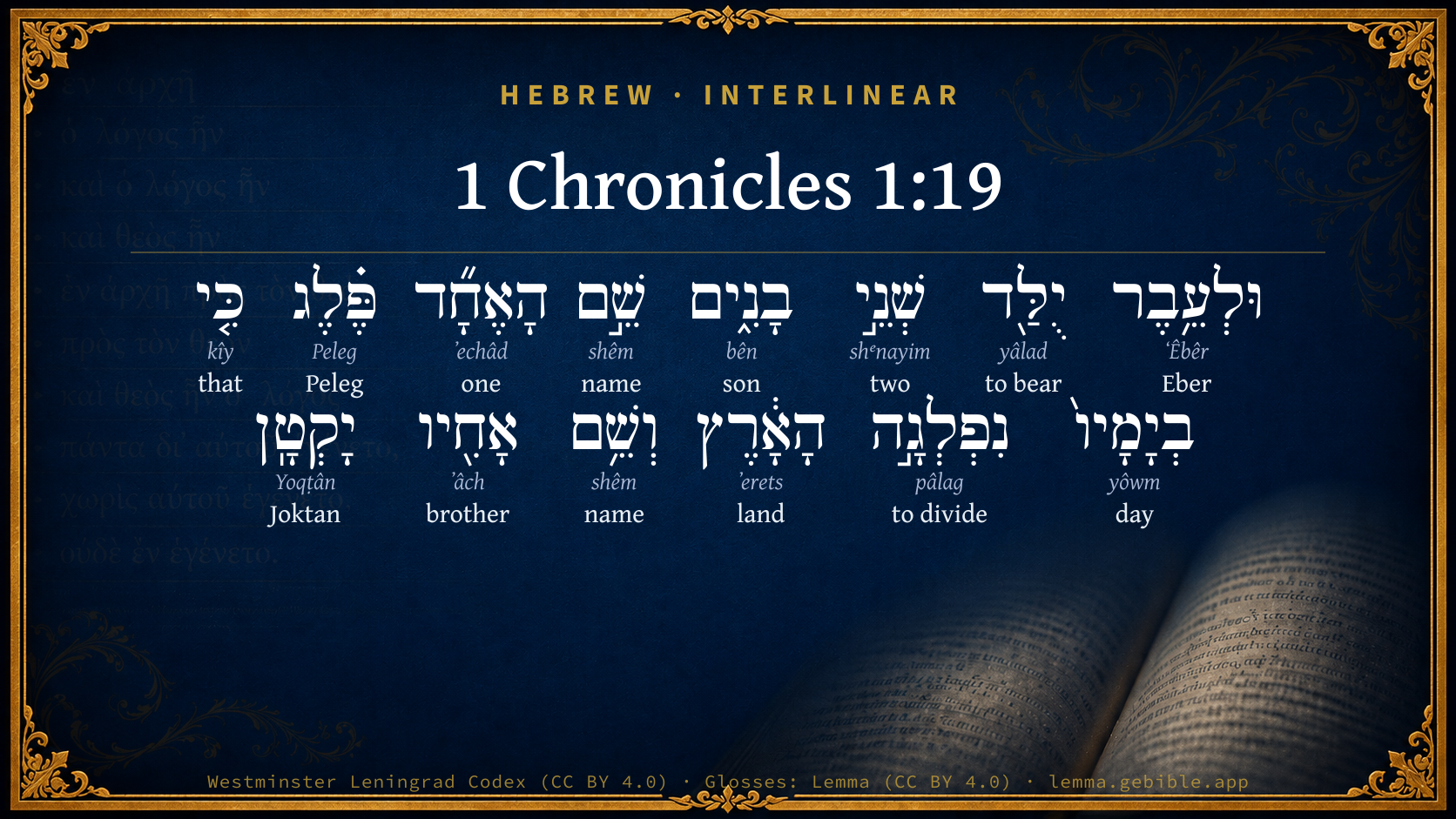
Hebrew (Westminster Leningrad Codex) 1 Chronicles 1:19 appears in the Hebrew Old Testament. The text above is from the Westminster Leningrad Codex. Each word links to its Strong’s number, a concise gloss, and parsing drawn from the Open Scriptures Hebrew Bible morphology. Click any word for its full Brown-Driver-Briggs (BDB) entry.
Download image
Cite this verse

1 Chronicles 1:19 (World English Bible). Public Domain. Lemma interlinear Bible study tool, https://lemma.gebible.app/v/1-chronicles/1/19.

Show BibTeX & RIS
BibTeX
RIS
English Translation
To Eber were born two sons: the name of the one was Peleg; for in his days the earth was divided; and his brother's name was Joktan.
World English Bible · Public Domain
Download a study sheet

One document with this verse’s original text, its word-by-word gloss line, the meaning frame, cross-references with their text, attributed commentary, and full source and license credits — printable, and it pastes into notes with its structure intact.

This verse Autodidact and up

Study sheet (.html) Plain text (.txt)

A passage Seminary Student

Up to 50 verses in one chapter. A passage sheet keeps up to 6 commentary sources and 12 cross-references per verse, in the order this page ranks them, and says so on the sheet whenever that leaves anything out. Ask for a single verse and you get the Autodidact verse sheet above.

Everything on this page stays free to read, with no account — the sheet is a download of what is already on screen, not access to it.

Want to remove ads? Support Godless Engineer
Compare translations 3

The same verse in 3 English versions, stacked beneath the original-language interlinear above. Click any original word for its lexicon entry.

Each is an independent rendering of the whole verse — the interlinear is not word-aligned to these translations.

Highlighted words mark where these versions differ — a whole-verse word diff, not a word-by-word alignment.

  • World English Bible Public Domain
    To Eber were born two sons: the name of the one was Peleg; for in his days the earth was divided; and his brother's name was Joktan.
  • King James Version Public Domain
    And unto Eber were born two sons: the name of the one was Peleg; because in his days the earth was divided: and his brother's name was Joktan.
  • unfoldingWord Literal Text CC BY-SA 4.0
    And to Eber were born two sons. The name of the one Peleg, for in his days the earth was divided. And the name of his brother Joktan. ts\*

unfoldingWord Literal Text — © unfoldingWord, licensed CC BY-SA 4.0. Word-aligned USFM3 via Door43 (git.door43.org/unfoldingWord/en_ult).

Versions to compare (up to 4)

3 of 4 selected

Show all 18 translations

Every available English version of this verse, each an independent rendering of the whole verse.

  • World English Bible Public Domain
    To Eber were born two sons: the name of the one was Peleg; for in his days the earth was divided; and his brother's name was Joktan.
  • Berean Standard Bible Public Domain
    Two sons were born to Eber: One was named Peleg, because in his days the earth was divided, and his brother was named Joktan.
  • Majority Standard Bible Public Domain
    Two sons were born to Eber: One was named Peleg, because in his days the earth was divided, and his brother was named Joktan.
  • King James Version Public Domain
    And unto Eber were born two sons: the name of the one was Peleg; because in his days the earth was divided: and his brother's name was Joktan.
  • American Standard Version (1901) Public Domain
    And unto Eber were born two sons: the name of the one was Peleg; for in his days the earth was divided; and his brother's name was Joktan.
  • Revised Version (1885) Public Domain
    And unto Eber were born two sons: the name of the one was Peleg; for in his days the earth was divided; and his brother’s name was Joktan.
  • Geneva Bible (1599) Public Domain
    Vnto Eber also were borne two sonnes: the name of the one was Peleg: for in his dayes was ye earth deuided: and his brothers name was Ioktan.
  • Douay-Rheims (1899) Public Domain
    And to Heber were born two sons, the name of the one was Phaleg, because In his days the earth was divided; and the name of his brother was Jectan.
  • Young's Literal Translation Public Domain
    And to Eber have been born two sons, the name of the one `is' Peleg, for in his days hath the land been divided, and the name of his brother is Joktan.
  • Literal Standard Version CC BY-SA 4.0
    And two sons have been born to Eber, the name of the first [is] Peleg, for in his days the earth has been divided, and the name of his brother is Joktan.
  • Unlocked Literal Bible CC BY-SA 4.0
    Eber had two sons. The name of the one was Peleg, for in his days the earth was divided. His brother's name was Joktan.
  • unfoldingWord Literal Text CC BY-SA 4.0
    And to Eber were born two sons. The name of the one Peleg, for in his days the earth was divided. And the name of his brother Joktan. ts\*
  • Darby Bible Public Domain
    And to Eber were born two sons: the name of the one was Peleg, for in his days was the earth divided; and his brother's name was Joktan.
  • World Messianic Bible Public Domain
    To Eber were born two sons: the name of the one was Peleg, for in his days the earth was divided; and his brother’s name was Joktan.
  • Webster's Bible Public Domain
    And to Eber were born two sons: the name of the one was Peleg; because in his days the earth was divided: and his brother's name was Joktan.
  • Free Bible Version CC BY-SA 4.0
    Eber had two sons. One was named Peleg, because in his time the earth was divided; the name of his brother was Joktan.
  • Bible in Basic English Public Domain
    And Eber had two sons: the name of the one was Peleg, because in his days a division was made of the earth; and his brother's name was Joktan.
  • JPS Tanakh (1917) Public Domain
    And unto Eber were born two sons: the name of the one was Peleg; for in his days the earth was divided; and his brother's name was Joktan.

Literal Standard Version (2020), Covenant Press — licensed CC BY-SA 4.0. Text via the HelloAO Bible API (eBible.org). Unlocked Literal Bible (unfoldingWord) — licensed CC BY-SA 4.0. Text via the HelloAO Bible API (eBible.org). unfoldingWord Literal Text — © unfoldingWord, licensed CC BY-SA 4.0. Word-aligned USFM3 via Door43 (git.door43.org/unfoldingWord/en_ult). Free Bible Version, Dr. Jonathan Gallagher — licensed CC BY-SA 4.0. Text via the HelloAO Bible API (eBible.org).

Word by word

More ways to search: Search by grammar → Find every occurrence → Compare this word →

Practice this passage: Drill this verse → Learn its vocabulary →

נִפְלְגָ֣ה
pâlag
H6385
“to divide”
Verb, Niphal, Perfect, 3rd Person, Feminine, Singular
Part of Speech
Verb
Stem
Niphal
Form
Perfect
Person
3rd Person
Gender
Feminine
Number
Singular
Full BDB Definition

Origin: a primitive root

TWOT: 1769

to divide, split - (Niphal) to be split, be divided - (Piel) - to split, cleave - to divide
  1. וּלְעֵ֥בֶר ʻÊbêr H5677 “and · to/for · Eber” Conjunction + Preposition + Noun, Proper
  2. יֻלַּ֖ד yâlad H3205 “to bear” Verb, Pual, Perfect, 3rd Person, Masculine, Singular
  3. שְׁנֵ֣י shᵉnayim H8147 “two” Adjective, Cardinal number, Masculine, Dual, Construct
  4. בָנִ֑ים bên H1121 “sons” Noun, Common, Masculine, Plural, Absolute
  5. שֵׁ֣ם shêm H8034 “name of” Noun, Common, Masculine, Singular, Construct
  6. הָאֶחָ֞ד ʼechâd H259 “the · one” Particle, Definite Article + Adjective, Cardinal number, Masculine, Singular, Absolute
  7. פֶּ֗לֶג Peleg H6389 “Peleg” Noun, Proper
  8. כִּ֤י kîy H3588 “that” Conjunction
  9. בְיָמָיו֙ yôwm H3117 “in/at · days · his” Preposition + Noun, Common, Masculine, Plural, Construct + Suffix, Personal, 3rd Person, Masculine, Singular
  10. הָאָ֔רֶץ ʼerets H776 “the · land” Particle, Definite Article + Noun, Common, Both, Singular, Absolute
  11. וְשֵׁ֥ם shêm H8034 “and · name of” Conjunction + Noun, Common, Masculine, Singular, Construct
  12. אָחִ֖יו ʼâch H251 “brother · his” Noun, Common, Masculine, Singular, Construct + Suffix, Personal, 3rd Person, Masculine, Singular
  13. יָקְטָֽן Yoqṭân H3355 “Joktan” Noun, Proper

About this verse

These counts appear in no published source. They are computed here, from the morphology-tagged text and Lemma’s own curated glosses. What Lemma adds →

14
words
13
distinct lemmas
Historical
section

Notable vocabulary

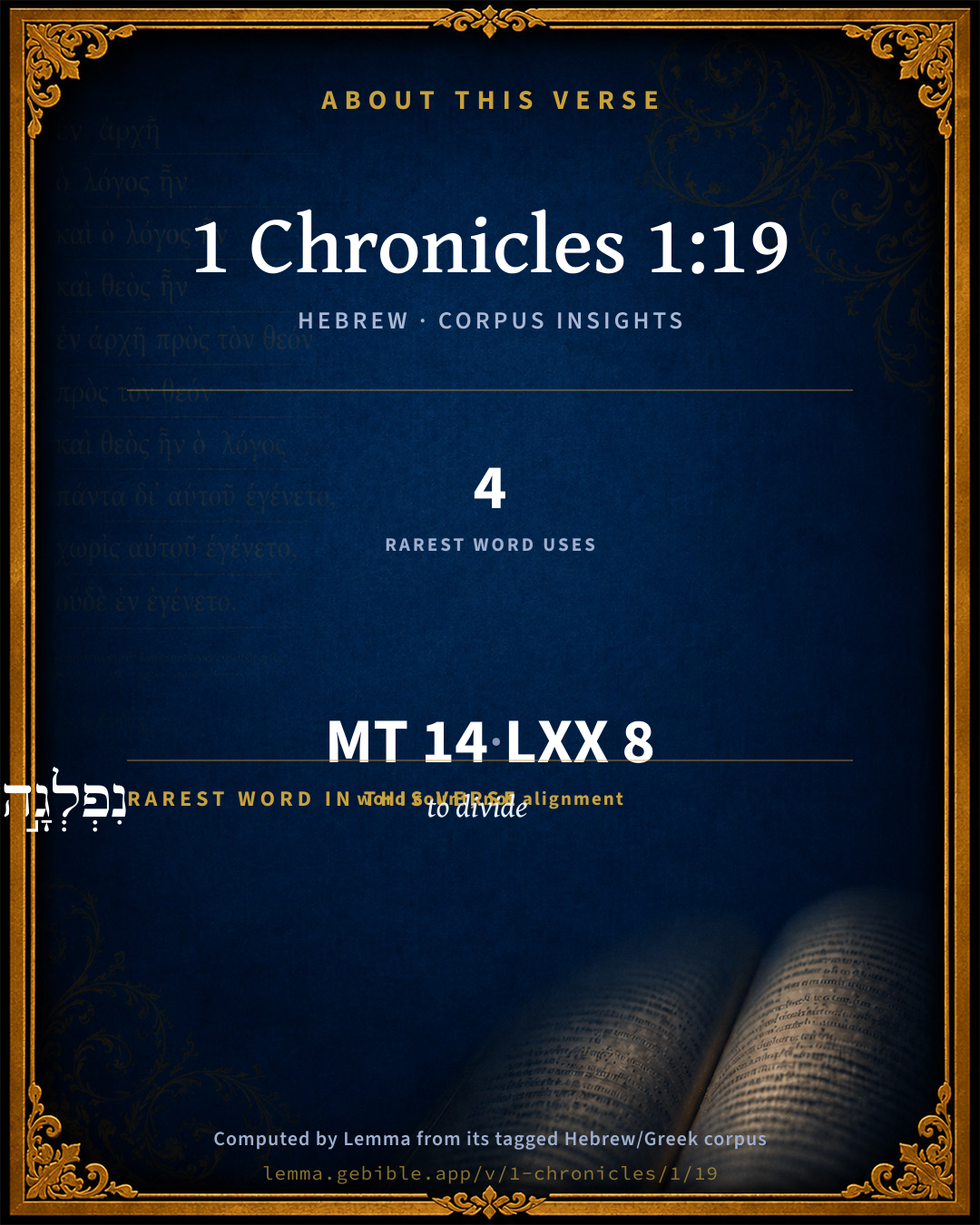
The rarest word here is נִפְלְגָ֣ה to divide H6385 — appearing just 4 times in the whole Hebrew Bible.

Shared distinctive vocabulary

נִפְלְגָ֣ה to divide H6385 occurs in 4 verses of the Hebrew Bible. Also found in:

Grammatical profile

  • 2 verbs
  • 9 nouns
  • 2 adjectives
  • 1 conjunction

Verb forms

  • יֻלַּ֖ד Pual · Perfect
  • נִפְלְגָ֣ה Niphal · Perfect

Repetition

A word recurs within this verse — often emphatic in Hebrew:

  • שֵׁ֣ם name H8034 ×2

Hebrew & Septuagint length

In the original languages it is 14 Hebrew tokens and 8 Greek tokens — but the two are counted differently (Hebrew bundles its prefixes and suffixes into one token; the Greek is in lemma form), so that isn’t a like-for-like length.

Cross-references

4

Topical passages linked to 1 Chronicles 1:19 in the Treasury of Scripture Knowledge — connected by theme and wording, ordered by reader-vote popularity; previews shown in the World English Bible.

  • Genesis 10:21 To Shem, the father of all the children of Eber, the elder brother of Japheth, to him also were children born.
  • Genesis 10:25 To Eber were born two sons. The name of the one was Peleg, for in his days was the earth divided. His brother's name was Joktan.
  • Genesis 11:16–17 Eber lived thirty-four years, and became the father of Peleg.
  • Numbers 24:24 But ships [shall come] from the coast of Kittim, They shall afflict Asshur, and shall afflict Eber; He also shall come to destruction.

Cross-references courtesy of OpenBible.info (CC BY 4.0).

Hebrew and Greek witnesses Masoretic Hebrew ↔ Greek Septuagint

The same verse in the two great witnesses to the Old Testament, shown verse-for-verse.

These are two independent witnesses, not word-aligned to each other, and the Septuagint is shown in lemma (dictionary) form.

Hebrew 1 Chronicles 1:19 Masoretic · Westminster Leningrad Codex

וּלְעֵ֥בֶר יֻלַּ֖ד שְׁנֵ֣י בָנִ֑ים שֵׁ֣ם הָאֶחָ֞ד פֶּ֗לֶג כִּ֤י בְיָמָיו֙ נִפְלְגָ֣ה הָאָ֔רֶץ וְשֵׁ֥ם אָחִ֖יו יָקְטָֽן

To Eber were born two sons: the name of the one was Peleg; for in his days the earth was divided; and his brother's name was Joktan.

World English Bible · Public Domain

Greek LXX 1 Chronicles 1:19 Septuagint · lemma form

ιεττουρ ναφες καί κεδμα οὗτος εἰμί υἱός ισμαηλ

No English rendering of this Greek verse — the small residue in the structurally divergent books.

Hebrew: Westminster Leningrad Codex (CC BY 4.0). Greek: Septuagint (public domain); English from a public-domain English Septuagint. How the Septuagint differs from the Hebrew →

Commentary

Notes on 1 Chronicles 1:19 from classic Christian and Jewish commentators (each source and its license shown beneath its notes). The classic Christian expositions comment on the surrounding passage and are grouped to its opening verse, so a note may address several verses; the Jewish commentaries on the Tanakh (Rashi and others) are per-verse, so they appear only where the commentator wrote on this verse.

Lemma curates 59 commentaries, every one of them public domain or Creative Commons licensed, each selected and text-cleaned for this edition rather than reprinted as found. About our sources →

The Biblical Illustrator

Joseph S. Exell

1Ch_1:19

Because in his days the earth was divided.

The division of the earth

The chief value of the genealogical records consists--

1. In enabling us to view the origin of nations historically.

2. In enabling us to trace out the various tribes of the sons of Jacob.

3. In enabling us to prove the lineal descent of Christ to have been of the house and lineage of David; and that He was the fulfiller of the promise to Abraham, In thy seed shall all nations of the earth be blessed.

4. Independently of all this we meet with a sentence or a paragraph suggestive of the deepest thought, or illuminating a principle expressed in another part of the Scriptures with light as clear and bright as it is beautiful and enchanting. Such an instance we have in the text.

I. Consider the division of the earth as ordained without sin. Sin alters and affects everything. There is not a duty you perform or matter you can engage in, in which you do not find sin exerting a pernicious influence. And here it is, I think, that many persons make great error when seeking to interpret to themselves the trials and calamities which come upon them. Providence ordained it, is the common philosophy on the matter, when I humbly think the truer account of every calamity would be, Providence ordained and desired my happiness, but sin has deformed it, and for a time blasted the intended joys and filled me with anxieties. The division which God intended would be but a repetition in every case of what He had done at the beginning; there would have been allotted to the sons of men certain portions of this fair earth to govern and to till, and every child of Adam would be taught, in the beautiful homilies of nature, the first principles at least of homage to the Creator, and of confidence, and of love. The division Jehovah ordained was division without disunion. Distinction, but not discord. Partition, but still perfect peace. This first inquiry, then, is of much value, and will prove, ere many years, of vast importance in refuting the errors of the sceptical writers which abound. Nor will it perhaps be without its use, to have noticed the character of that division which God intended among the sons of men, one which should have promoted the equal comfort of all, amidst the blessings of universal peace and brotherhood. It may be, that when grace shall have triumphed in our sin-stained earth even but a little more, you may see a disposition to revert to these very principles of division which the Eternal desired to be followed, but which (as we shall notice directly) have been marvellously distorted ever since the day of which it is recorded in the text--Unto Eber were born two sons: the name of the one was Peleg; because in his days the earth was divided.

II. Now let us inquire into the division of the earth among nations as it does exist, under the influence of sin. Now you notice, by referring to the text (Gen_10:25), that the division took place before the building of Babel, and according to some persons, some considerable period before that epoch. At all events, the narrative implies that this division preceded the dispersion, and must therefore have occurred when all men spoke but one language. Remember, then, that Gods will was that men should divide (though without discord) and replenish all the earth. Recollect, too, that from the text we learn that the first step in this had been taken, even as Eber names his child Peleg (division) in memory of the event. Observe, then, what we are told immediately after the division in the days of Peleg. You read in the eleventh chapter of Genesis that the whole earth was of one language and of one speech; but that in their journeyings from the east, instead of dividing (as probably was the intention when they started), finding a large and inviting plain in Shinar, they counsel each other: Let us build a city and tower whose top may reach to heaven, and let us make us a name lest (mark) we be scattered abroad on the face of the whole earth. So that sin at once interrupted the beneficent designs of God, and interposing its corrupting leaven, sought to change His ordinances by promising greater benefits than He, but which have ever been found productive of evil. And now, that which was ordained for a blessing in every age, forthwith becomes a curse while it is yet obeyed; for God coming down, and seeing the injurious moral effect which would follow from this congregating together, disperses them by a division wholly unlooked for. God confounded their speech, made them talk in different languages, and they are obliged in consequence to disperse, and the division is accomplished. But how? Not in peace and harmony, and with a God be with you. But brother utters jargon to brother, and words of blessing and adieu are impossible, and now it is no more division with love, but confusion, and disunion, and discord, and ill-will. For I ask you what is the history of nations, but a continuation of this story? Nations for the most part are distinguished from one another by their difference of speech. But this is not the only difference. Scarcely a nation in the world but has at one time or another, been at war with other nations, and almost every kingdom of importance has, in its turn, encountered the armies of all other kingdoms in the dread attack of war and slaughter, at some period of their history. And this is the place for observing another very striking result of sin in the division of the earth. God, we saw, intended it so to be conducted as to subserve the advantage of all; but man decreed in his pride of intellect and reasoning that he would live in the dense vastness of a thickly populated city. And though God indeed dispersed them from Babel, the tendency of our nature seems to be far from eradicated. Still mankind crowd into cities, until they are so closely populated, that disease and death are fearfully increased. So you may notice how the retributive hand of judgment has followed these transactions. Man is a social being, and intended by God to congregate, but intended not so to congregate as we find he has done, and will still persist in doing, until by a strange anomaly his next-door neighbour is the veriest stranger to him. God ordered earth to be divided; and the plan by which thousands are huddled in close, dark, narrow alleys and areas is only sins development of its influences, as it reverses Gods intended method of division, and says with towering vanity, Go to, let us build rather a city that we may not be scattered. It is a known fact, that there is less religion in large towns than small ones, and far less where the poor are obliged to pack together as I have described. The reason is also plain. The cause is, that since the days of Peleg, the earth has been divided according to sin, and the dispersion of nations is the result of Gods anger, in confounding their speech. But the reason is, because the human mind, cut off from the beauties of nature, and those countless sources which it possesses for preparing the mind for religion, becomes prejudiced in its fearfully artificial state of town life, and by the evil customs and habits which surround it, against every sense of real godliness, which it thus learns to regard as belonging only to the rich.

III. But though you see sin so plainly operating, you are assured that christ will conquer, and grace finally prevail. In the day of glory which awaits you (described in the last two chapters of the Revelation), it is very interesting to observe that the city of the new Jerusalem described there bears a peculiar likeness to those which would have existed if the division of the world had been such as God ordained, and which began in the days of Peleg. In Christs kingdom there will be division without discord, that is, every person in his right place, in perfect love, and unity with all the rest.

The Biblical Illustrator, edited by Joseph S. Exell (c. 1880s–1900s) — public domain. Text from a community e-Sword module.

Jamieson, Fausset & Brown

Robert Jamieson, A. R. Fausset & David Brown

Peleg--(See on Gen 10:25).

Jamieson, Fausset & Brown — Commentary Critical and Explanatory on the Whole Bible (1871) — public domain (CC PDM 1.0). Text via the HelloAO Bible API.

Adam Clarke's Commentary

Verse 19. The name of the one was Peleg] "Because in his days the inhabitants of the earth were divided according to their languages. And the name of his brother was Joktan, because in his days the years of men began to be shortened, on account of their iniquities." - T.

Adam Clarke's Commentary on the Bible (1810–1826) — public domain. Text from a community e-Sword/MySword module.

The Cambridge Bible for Schools and Colleges

gen. ed. J. J. S. Perowne

19. the earth was divided] i.e. there was a great dispersion of the population of the earth. Peleg means “Separation” or “Division.”

The Cambridge Bible for Schools and Colleges (gen. ed. J. J. S. Perowne; Cambridge University Press, 1878–1918) — public domain. Text from a community e-Sword module.

Matthew Poole's English Annotations

The earth was divided in their languages and habitation; of which see Gen 11:7.

Matthew Poole's English Annotations on the Holy Bible (1683–1685) — public domain. Text from a community e-Sword/MySword module.

The Pulpit Commentary

The divided earth.

Here a man"s name is employed to fix an important historical fact. The word Peleg means "division," but it is uncertain whether allusion is intended to the dispersion of the people from Babel, or a later separation of the Shemitic race to which this Peleg belonged. "The two races which sprang from Eber soon separated very widely from each other the one, Eber and his family, spreading north-westward towards Mesopotamia and Syria; the other, the Joktanides, southward into Arabia. We dwell on the general facts of the division, again and again, of the human race, and endeavour to understand how by this the Divine dealings with the race are illustrated. It is important that we should apprehend what may be called the experimental character of the Divine dealings with man. There is a true and reverent sense in which we may speak of God as experimenting. If it pleased him, in his infinite wisdom and goodness, to make men, and to entrust them with a measure of independence and free-will, then God designed to leave it to be seen how men would act under these conditions; and he must have intended to leave his relations with them open to modification, so that he might meet their varying requirements. God is said to "repent" when he thus graciously adapts his dealings to new circumstances which man, in his self-will, may have created. Such a view of God"s dealings is quite consistent with his foreknowledge. Man, in his most wilful ways, can never take God at unawares, for he "seeth the end from the beginning." But he may see and know all without active interference until his own good time.

I MAN IS ALONE A SINGLE PAIR. What, may we say, is the experiment here? It is this: given every surrounding condition helpful; no others to confuse the mind or the choice; sufficient knowledge of what their God will have them do and not do; will man use his independence aright? Will he set his will on God? Alas! he failed, "serving the creature more than the Creator." Man"s moral trial could never be set under greater advantages; and it becomes evident, in the very first instance, that free-willed man"s only hope rests on his receiving into his will the grace and the strength of the Spirit of his God. And this lesson is further pressed home by every experiment, whether it be made by the race, any portion of the race, or the individual. The issue is to convince us that it is "not in man that walketh to direct his steps." He must learn to say, "Hold thou me up, and I shall be safe." The next form of the experiment is

II MAN IS IN ONE GREAT SOCIETY. Virtually dwelling together, in large and ever-increasing masses. What comes of this experiment? Utter lawlessness, such wild riotings, such debasing vice, that mankind is utterly and hopelessly corrupt, and God can but cleanse the earth of their presence and their defilement. Man is no stronger for moral right when he is found in masses than when he is found alone. Nay, aggregation only gives man"s will more terrible possibilities of evil power to develop crimes that debase to the uttermost. The third experiment is the one which God has been pleased to continue through the long ages

III MAN IS IN A NUMBER OF SOCIETIES, VARIOUSLY LOCATED AND VARIOUSLY RELATED. God never lets these grow too large; famine, pestilence, war, and emigration are always putting limits on excessive populations. So humanity repeats its moral trial under all possible natural conditions, in plains, on mountain sides, at sea-beards. etc., ever proving again and again its absolute need of the Divine strengthening of the will for the attaining of all moral good. Impress these points.

1. God presides over the moral culture of not too large communities.

2. God works by the special genius with which he is pleased to endowparticular nations. Illustrate by Rome, Greece, Judaea, etc.

3. God works by the mutual relations of the divided nations. Show howthese are maintained in the interests of commerce.

4. God works to secure the permanent moral unity of the race in itsdependence on him, and to this end he has graciously introduced his redemptive agency. R.T.

Ver. 19.

The human race; unity and division.

In the midst of this genealogical table we have a statement that "the earth was divided." We are reminded of the same fact of the dispersion of mankind by the reference to different families and separate countries. But all are shown to spring from one source, to have a common origin in the first father whose name heads the list, and is the first word of the Book of Chronicles. We are thus admonished of that twofold fact which is daily confronting us.

I THE DIVERSITY WHICH MANKIND PRESENTS. These are distinguished from one another by many features, and are separated from one another by many barriers. Distinguishing or dividing us, man from man, are

(1) physical obstacles (seas, mountains, varieties of climate);

(2) colour;

(3) creed;

(4) language;

(5) social habits, mental tastes, and moral dispositions.

II THE ESSENTIAL ONENESS OF THE HUMAN WORLD. Notwithstanding all interposing obstacles and all separating divergences, man is everywhere the same. The blood of one human father is in his veins. One human nature, bodily and spiritual, he inherits; above it he cannot rise, and beneath it he cannot fall. He is the son of Adam, and he "was the son of God". (Luk_3:38) Sin has scattered and slain him, but he may rise and be revivified. In him still are those germs of good which, under heavenly culture, may spring into the most perfect flowers that can adorn the garden of the Lord. In mankind, under all conceivable diversities, are

(1) the same animal instincts,

(2) the same family attachments,

(3) the same capacity of mental culture,

(4) the same spiritual nature,

which is able to receive the truth and know the will and live the life of the eternal God himself. The unity and diversity of our kind suggest to us:

1. That there are variations and separations which are due to God"sprovidence rather than to our sin. These are either to be cheerfully borne or bravely and intelligently overcome. They are given us either to try our faith and patience or to excite our enterprise and activity.

2. That there are separations and distinctions which are the penalty of sin; these should humble us.

3. That in the gospel of Christ we have resources which can raise thelowest and reunite the most spiritually distant. The hour will come when the "earth that was divided" so long ago will be united in one most blessed bond, worshipping one God, loving one Father, trusting one Saviour, living one life, travelling to one home. C.

The Pulpit Commentary (1880–1919), ed. H.D.M. Spence-Jones & Joseph S. Exell — public domain. Text from a community e-Sword module.

John Wesley's Explanatory Notes

Divided - In their languages and habitations.

John Wesley, Explanatory Notes Upon the Whole Bible (1754–1765) — public domain. Text via the GEBible commentary corpus.

Rashi

Rabbi Shlomo Yitzchaki (Rashi)

the earth was parted The days of the people were divided and diminished, for at first people lived nine hundred years or more, and in the days of Arpachshad and thereafter, [they were diminished] to four hundred years or more, and from Peleg and thereafter, they were divided in half, to two hundred years out of those four hundred years.

Rashi on the Tanakh — English translations: “The Judaica Press complete Tanach with Rashi, translated by A. J. Rosenberg” (CC BY 4.0); “Pentateuch with Rashi's commentary by M. Rosenbaum and A.M. Silbermann, 1929-1934” (public domain); “The Metsudah Tanach series, Lakewood, N.J” (CC BY 4.0); and “The Book of Joshua, Metsudah Publications, 1997” (CC BY 4.0). Text via Sefaria.

Lesson kit

Teaching starters — assembled from the data on this page, not authored interpretation. Every prompt links to the verse data it draws on. Edit before teaching.

1 Chronicles, in the Historical, opens this verse with 14 words (13 distinct Hebrew lemmas). Its most distinctive word is pâlag (“to divide”). A historical commentator’s framing appears above. Read the whole chapter for the surrounding context.

Discussion questions

  1. The word pâlag carries the sense “to divide.” How does it shape the verse?
  2. Genesis 10:25 shares the word «to divide» with this verse. How do the two illuminate each other?
  3. “name” occurs 2× in this one verse. What is the effect of the repetition?
  4. The translations on this page render this verse differently — a whole-verse word diff, not a word-by-word alignment. What might account for the different wordings?
  5. The verb «יֻלַּ֖ד» is Pual Perfect. How does its form color the action?
  6. Reading how The Biblical Illustrator and Jamieson, Fausset & Brown read this verse, where do the two commentators agree and where do they part?

Things to notice

Reading settings

Reading text

Shown beneath each verse's original-language words.

Old Testament
Old Testament edition

Read the OT as the Masoretic Hebrew (MT) or the Greek Septuagint (LXX).

English shown for the Greek Septuagint (in the Hebrew ↔ Greek comparison).

Comparing translations? Open the Compare panel on any verse page to stack up to four side by side.