
2 Kings 13:25

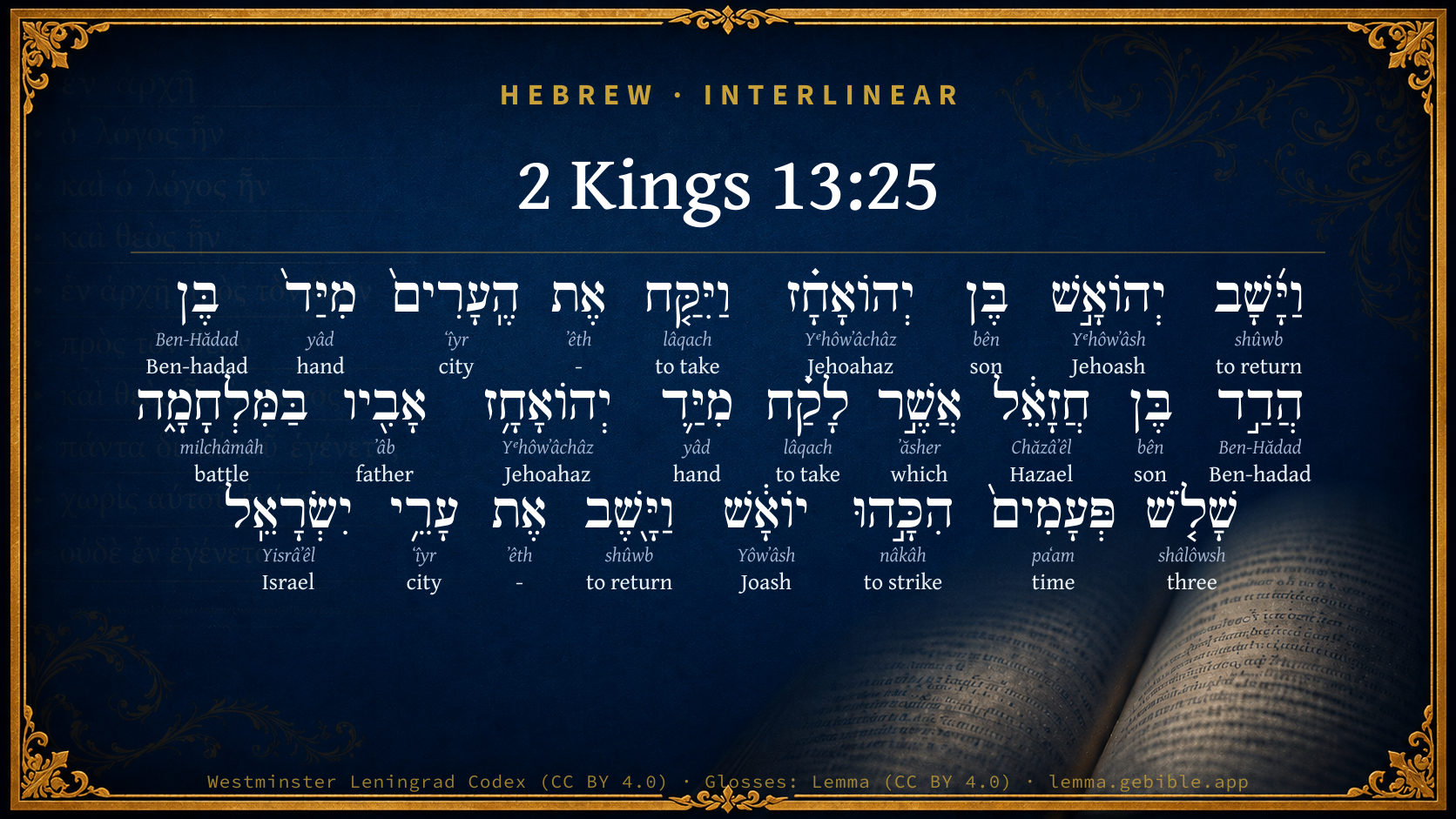
Hebrew (Westminster Leningrad Codex) 2 Kings 13:25 appears in the Hebrew Old Testament. The text above is from the Westminster Leningrad Codex. Each word links to its Strong’s number, a concise gloss, and parsing drawn from the Open Scriptures Hebrew Bible morphology. Click any word for its full Brown-Driver-Briggs (BDB) entry.
Download image
Cite this verse

2 Kings 13:25 (World English Bible). Public Domain. Lemma interlinear Bible study tool, https://lemma.gebible.app/v/2-kings/13/25.

Show BibTeX & RIS
BibTeX
RIS
English Translation
Jehoash the son of Jehoahaz took again out of the hand of Benhadad the son of Hazael the cities which he had taken out of the hand of Jehoahaz his father by war. Three times did Joash strike him, and recovered the cities of Israel.
World English Bible · Public Domain
Download a study sheet

One document with this verse’s original text, its word-by-word gloss line, the meaning frame, cross-references with their text, attributed commentary, and full source and license credits — printable, and it pastes into notes with its structure intact.

This verse Autodidact and up

Study sheet (.html) Plain text (.txt)

A passage Seminary Student

Up to 50 verses in one chapter. A passage sheet keeps up to 6 commentary sources and 12 cross-references per verse, in the order this page ranks them, and says so on the sheet whenever that leaves anything out. Ask for a single verse and you get the Autodidact verse sheet above.

Everything on this page stays free to read, with no account — the sheet is a download of what is already on screen, not access to it.

Want to remove ads? Support Godless Engineer
Compare translations 3

The same verse in 3 English versions, stacked beneath the original-language interlinear above. Click any original word for its lexicon entry.

Each is an independent rendering of the whole verse — the interlinear is not word-aligned to these translations.

Highlighted words mark where these versions differ — a whole-verse word diff, not a word-by-word alignment.

  • World English Bible Public Domain
    Jehoash the son of Jehoahaz took again out of the hand of Benhadad the son of Hazael the cities which he had taken out of the hand of Jehoahaz his father by war. Three times did Joash strike him, and recovered the cities of Israel.
  • King James Version Public Domain
    And Jehoash the son of Jehoahaz took again out of the hand of Benhadad the son of Hazael the cities, which he had taken out of the hand of Jehoahaz his father by war. Three times did Joash beat him, and recovered the cities of Israel.
  • unfoldingWord Literal Text CC BY-SA 4.0
    And Jehoash, the son of Jehoahaz, returned and took the cities from the hand of Ben Hadad, the son of Hazael, that he had taken from the hand of Jehoahaz his father in battle. Three times Joash struck him, and he made the cities of Israel return.

unfoldingWord Literal Text — © unfoldingWord, licensed CC BY-SA 4.0. Word-aligned USFM3 via Door43 (git.door43.org/unfoldingWord/en_ult).

Versions to compare (up to 4)

3 of 4 selected

Show all 18 translations

Every available English version of this verse, each an independent rendering of the whole verse.

  • World English Bible Public Domain
    Jehoash the son of Jehoahaz took again out of the hand of Benhadad the son of Hazael the cities which he had taken out of the hand of Jehoahaz his father by war. Three times did Joash strike him, and recovered the cities of Israel.
  • Berean Standard Bible Public Domain
    Then Jehoash son of Jehoahaz took back from Ben-hadad son of Hazael the cities that Hazael had taken in battle from his father Jehoahaz. Jehoash defeated Ben-hadad three times, and so recovered the cities of Israel.
  • Majority Standard Bible Public Domain
    Then Jehoash son of Jehoahaz took back from Ben-hadad son of Hazael the cities that Hazael had taken in battle from his father Jehoahaz. Jehoash defeated Ben-hadad three times, and so recovered the cities of Israel.
  • King James Version Public Domain
    And Jehoash the son of Jehoahaz took again out of the hand of Benhadad the son of Hazael the cities, which he had taken out of the hand of Jehoahaz his father by war. Three times did Joash beat him, and recovered the cities of Israel.
  • American Standard Version (1901) Public Domain
    And Jehoash the son of Jehoahaz took again out of the hand of Benhadad the son of Hazael the cities which he had taken out of the hand of Jehoahaz his father by war. Three times did Joash smite him, and recovered the cities of Israel.
  • Revised Version (1885) Public Domain
    And Jehoash the son of Jehoahaz took again out of the hand of Ben-hadad the son of Hazael the cities which he had taken out of the hand of Jehoahaz his father by war. Three times did Joash smite him; and recovered the cities of Israel.
  • Geneva Bible (1599) Public Domain
    Therefore Iehoash the sonne of Iehoahaz returned, and tooke out of the hand of Ben-hadad the sonne of Hazael the cities which he had taken away by warre out of the hand of Iehoahaz his father: for three times did Ioash beate him, and restored the cities vnto Israel.
  • Douay-Rheims (1899) Public Domain
    Now Joas d the son of Joachaz, took the cities out of the hand of Benadad, the son of Hazael, which he had taken out of the hand of Joachaz his father by war, three times did Joas beat him, and he restored the cities to Israel.
  • Young's Literal Translation Public Domain
    and Jehoash son of Jehoahaz turneth and taketh the cities out of the hand of Ben-Hadad son of Hazael that he had taken out of the hand of Jehoahaz his father in war; three times hath Joash smitten him, and he bringeth back the cities of Israel.
  • Literal Standard Version CC BY-SA 4.0
    and Jehoash son of Jehoahaz turns and takes the cities out of the hand of Ben-Hadad son of Hazael that he had taken out of the hand of his father Jehoahaz in war; Joash has struck him three times, and he brings back the cities of Israel.
  • Unlocked Literal Bible CC BY-SA 4.0
    Jehoash son of Jehoahaz took back from Ben Hadad son of Hazael the cities that had been taken from Jehoahaz his father by war. Jehoash attacked him three times, and he recovered those cities of Israel.
  • unfoldingWord Literal Text CC BY-SA 4.0
    And Jehoash, the son of Jehoahaz, returned and took the cities from the hand of Ben Hadad, the son of Hazael, that he had taken from the hand of Jehoahaz his father in battle. Three times Joash struck him, and he made the cities of Israel return.
  • Darby Bible Public Domain
    And Jehoash the son of Jehoahaz took again out of the hand of Ben-Hadad the son of Hazael the cities which he had taken out of the hand of Jehoahaz his father in the war. Three times did Joash beat him, and recovered the cities of Israel.
  • World Messianic Bible Public Domain
    Jehoash the son of Jehoahaz took again out of the hand of Benhadad the son of Hazael the cities which he had taken out of the hand of Jehoahaz his father by war. Joash struck him three times, and recovered the cities of Israel.
  • Webster's Bible Public Domain
    And Jehoash the son of Jehoahaz took again from the hand of Ben-hadad the son of Hazael the cities, which he had taken from the hand of Jehoahaz his father by war. Three times Joash defeated him, and recovered the cities of Israel.
  • Free Bible Version CC BY-SA 4.0
    Then Jehoash, son of Jehoahaz, recovered from Ben-hadad son of Hazael, the towns that Hazael had captured from his father Jehoahaz. Jehoash defeated Ben-hadad three times, and so recaptured the Israelite towns.
  • Bible in Basic English Public Domain
    And Jehoash, the son of Jehoahaz, took again from Ben-hadad, the son of Hazael, the towns which he had taken from Jehoahaz his father in war. Three times Jehoash overcame him and got back the towns of Israel.
  • JPS Tanakh (1917) Public Domain
    And Jehoash the son of Jehoahaz took again out of the hand of Ben-hadad the son of Hazael the cities which he had taken out of the hand of Jehoahaz his father by war. Three times did Joash smite him, and recovered the cities of Israel.

Literal Standard Version (2020), Covenant Press — licensed CC BY-SA 4.0. Text via the HelloAO Bible API (eBible.org). Unlocked Literal Bible (unfoldingWord) — licensed CC BY-SA 4.0. Text via the HelloAO Bible API (eBible.org). unfoldingWord Literal Text — © unfoldingWord, licensed CC BY-SA 4.0. Word-aligned USFM3 via Door43 (git.door43.org/unfoldingWord/en_ult). Free Bible Version, Dr. Jonathan Gallagher — licensed CC BY-SA 4.0. Text via the HelloAO Bible API (eBible.org).

Word by word

More ways to search: Search by grammar → Find every occurrence → Compare this word →

Practice this passage: Drill this verse → Learn its vocabulary →

יְהוֹאָ֣שׁ
Yᵉhôwʼâsh
H3060
“Jehoash”
Noun, Proper
Part of Speech
Noun
Type
Proper
Full BDB Definition

Origin: from H3068 and (perhaps) H784

TWOT: None

Jehoash = "given by the Lord" - son of king Ahaziah and the 8th king of Judah - son of king Jehoahaz and the 12th king of the northern kingdom of Israel
  1. וַיָּ֜שָׁב shûwb H7725 “and · to return” Conjunction + Verb, Qal, Sequential Imperfect, 3rd Person, Masculine, Singular
  2. בֶּן bên H1121 “son of” Noun, Common, Masculine, Singular, Construct
  3. יְהוֹאָחָ֗ז Yᵉhôwʼâchâz H3059 “Jehoahaz” Noun, Proper
  4. וַיִּקַּ֤ח lâqach H3947 “and · to take” Conjunction + Verb, Qal, Sequential Imperfect, 3rd Person, Masculine, Singular
  5. אֶת ʼêth H853 “-” Particle, Direct Object
  6. הֶֽעָרִים֙ ʻîyr H5892 “the · cities” Particle, Definite Article + Noun, Common, Feminine, Plural, Absolute
  7. מִיַּד֙ yâd H3027 “from · hand of” Preposition + Noun, Common, Both, Singular, Construct
  8. בֶּן Ben-Hădad H1130 “Ben-hadad” Noun, Proper
  9. הֲדַ֣ד Ben-Hădad H1130 “Ben-hadad” Noun, Proper
  10. בֶּן bên H1121 “son of” Noun, Common, Masculine, Singular, Construct
  11. חֲזָאֵ֔ל Chăzâʼêl H2371 “Hazael” Noun, Proper
  12. אֲשֶׁ֣ר ʼăsher H834 “which” Particle, Relative
  13. לָקַ֗ח lâqach H3947 “to take” Verb, Qal, Perfect, 3rd Person, Masculine, Singular
  14. מִיַּ֛ד yâd H3027 “from · hand of” Preposition + Noun, Common, Both, Singular, Construct
  15. יְהוֹאָחָ֥ז Yᵉhôwʼâchâz H3059 “Jehoahaz” Noun, Proper
  16. אָבִ֖יו ʼâb H1 “father · his” Noun, Common, Masculine, Singular, Construct + Suffix, Personal, 3rd Person, Masculine, Singular
  17. בַּמִּלְחָמָ֑ה milchâmâh H4421 “in/at the · battle” Preposition, Determined + Noun, Common, Feminine, Singular, Absolute
  18. שָׁלֹ֤שׁ shâlôwsh H7969 “three” Adjective, Cardinal number, Feminine, Singular, Absolute
  19. פְּעָמִים֙ paʻam H6471 “times” Noun, Common, Feminine, Plural, Absolute
  20. הִכָּ֣הוּ nâkâh H5221 “to strike · him” Verb, Hiphil, Perfect, 3rd Person, Masculine, Singular + Suffix, Personal, 3rd Person, Masculine, Singular
  21. יוֹאָ֔שׁ Yôwʼâsh H3101 “Joash” Noun, Proper
  22. וַיָּ֖שֶׁב shûwb H7725 “and · to return” Conjunction + Verb, Hiphil, Sequential Imperfect, 3rd Person, Masculine, Singular
  23. אֶת ʼêth H853 “-” Particle, Direct Object
  24. עָרֵ֥י ʻîyr H5892 “cities of” Noun, Common, Feminine, Plural, Construct
  25. יִשְׂרָאֵֽל Yisrâʼêl H3478 “Israel” Noun, Proper

About this verse

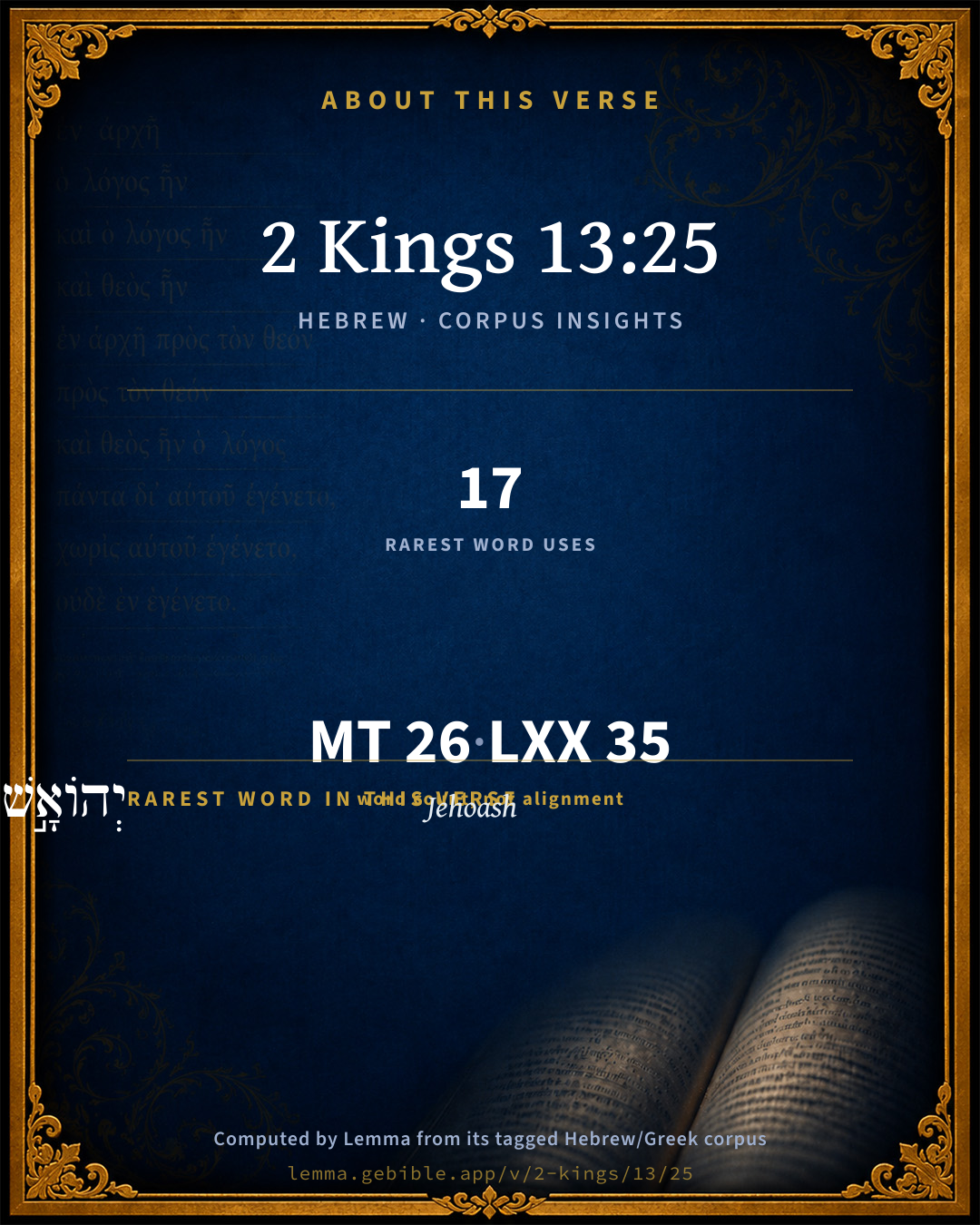
These counts appear in no published source. They are computed here, from the morphology-tagged text and Lemma’s own curated glosses. What Lemma adds →

26
words
18
distinct lemmas
Historical
section

Notable vocabulary

The rarest word here is יְהוֹאָ֣שׁ Jehoash H3060 — appearing just 17 times in the whole Hebrew Bible.

Shared distinctive vocabulary

יְהוֹאָ֣שׁ Jehoash H3060 occurs in 16 verses of the Hebrew Bible. Also found in:

Grammatical profile

  • 5 verbs
  • 17 nouns
  • 1 adjective
  • 3 particles

Verb forms

  • וַיָּ֜שָׁב Qal · Sequential Imperfect
  • וַיִּקַּ֤ח Qal · Sequential Imperfect
  • לָקַ֗ח Qal · Perfect
  • הִכָּ֣הוּ Hiphil · Perfect
  • וַיָּ֖שֶׁב Hiphil · Sequential Imperfect

Repetition

Words recur within this verse — often emphatic in Hebrew:

  • וַיָּ֜שָׁב to return H7725 ×2
  • בֶּן son H1121 ×2
  • יְהוֹאָחָ֗ז Jehoahaz H3059 ×2
  • וַיִּקַּ֤ח to take H3947 ×2
  • הֶֽעָרִים֙ city H5892 ×2
  • מִיַּד֙ hand H3027 ×2
  • בֶּן Ben-hadad H1130 ×2

Hebrew & Septuagint length

In English translation the verse runs 45 words from the Hebrew and 51 from the Septuagint (LXX English) — closely comparable.

A rough comparison of the two English renderings, which tokenize alike — not a word-level alignment.

Word counts can differ between the Hebrew and the Greek without any difference in meaning — e.g. the Hebrew direct-object marker אֵת has no separate Greek word, and Greek often adds the article ὁ.

In the original languages it is 26 Hebrew tokens and 35 Greek tokens — but the two are counted differently (Hebrew bundles its prefixes and suffixes into one token; the Greek is in lemma form), so that isn’t a like-for-like length.

Cross-references

3

Topical passages linked to 2 Kings 13:25 in the Treasury of Scripture Knowledge — connected by theme and wording, ordered by reader-vote popularity; previews shown in the World English Bible.

  • 2 Kings 13:18–19 He said, Take the arrows; and he took them. He said to the king of Israel, Smite on the ground; and he struck thrice, and stayed.
  • 2 Kings 10:32 In those days Yahweh began to cut off from Israel: and Hazael struck them in all the borders of Israel;
  • 2 Kings 14:25 He restored the border of Israel from the entrance of Hamath to the sea of the Arabah, according to the word of Yahweh, the God of Israel, which he spoke by his servant Jonah the son of Amittai, the prophet, who was of Gath Hepher.

Cross-references courtesy of OpenBible.info (CC BY 4.0).

Hebrew and Greek witnesses Masoretic Hebrew ↔ Greek Septuagint

The same verse in the two great witnesses to the Old Testament, shown verse-for-verse.

These are two independent witnesses, not word-aligned to each other, and the Septuagint is shown in lemma (dictionary) form.

Hebrew 2 Kings 13:25 Masoretic · Westminster Leningrad Codex

וַיָּ֜שָׁב יְהוֹאָ֣שׁ בֶּן יְהוֹאָחָ֗ז וַיִּקַּ֤ח אֶת הֶֽעָרִים֙ מִיַּד֙ בֶּן הֲדַ֣ד בֶּן חֲזָאֵ֔ל אֲשֶׁ֣ר לָקַ֗ח מִיַּ֛ד יְהוֹאָחָ֥ז אָבִ֖יו בַּמִּלְחָמָ֑ה שָׁלֹ֤שׁ פְּעָמִים֙ הִכָּ֣הוּ יוֹאָ֔שׁ וַיָּ֖שֶׁב אֶת עָרֵ֥י יִשְׂרָאֵֽל

Jehoash the son of Jehoahaz took again out of the hand of Benhadad the son of Hazael the cities which he had taken out of the hand of Jehoahaz his father by war. Three times did Joash strike him, and recovered the cities of Israel.

World English Bible · Public Domain

Greek LXX 2 Kings 13:25 Septuagint · lemma form

καί ἐπιστρέφω ιωας υἱός ιωαχας καί λαμβάνω ὁ πόλις ἐκ χείρ υἱός αδερ υἱός αζαηλ ὅς λαμβάνω ἐκ χείρ ιωαχας ὁ πατήρ αὐτός ἐν ὁ πόλεμος τρίς πατάσσω αὐτός ιωας καί ἐπιστρέφω ὁ πόλις ἰσραήλ

And Joas the son of Joachaz returned, and took the cities out of the hand of the son of Ader the son of Azael, which he had taken out of the hand of Joachaz his father in the war: thrice did Joas strike him, and he recovered the cities of Israel.

LXX2012 (modern English Septuagint) · Public Domain

Hebrew: Westminster Leningrad Codex (CC BY 4.0). Greek: Septuagint (public domain); English from LXX2012 (modern English Septuagint) (Public Domain). How the Septuagint differs from the Hebrew →

Targum (Aramaic paraphrase)

1

The Targum is the ancient Jewish Aramaic paraphrase of the Hebrew Scriptures — an interpretive translation, not the Hebrew text itself. Onkelos (literal) and Pseudo-Jonathan (expansive) render the Torah, and Jonathan the Prophets. Coverage is partial: where no permissively-licensed English translation exists for a verse, only the Aramaic is shown. This is verse-level text, not a word-by-word alignment to the Hebrew.

  1. Targum Jonathan Prophets (Joshua–Malachi)
    וְתַב יְהוֹאָשׁ בַּר יְהוֹאָחָז וּנְסִיב יַת קִירְוַיָא מִיַד בַּר הֲדַד בַּר חֲזָאֵל דִי נְסִיב מִן יְהוֹאָחָז אֲבוּהִי בִּקְרָבָא תְּלַת זִמְנִין מְחָהִי יוֹאָשׁ וַאֲתֵיב יַת קִירְוֵי יִשְׂרָאֵל:

    (no public-domain English translation for this verse)

    Targum Jonathan — Aramaic: “Mikraot Gedolot” (public domain). English: “Sefaria Community Translation” (CC0 1.0 (public-domain dedication)); “London "Chaldee Paraphrase," 1871” (public domain). Text via Sefaria.

Commentary

Notes on 2 Kings 13:25 from classic Christian and Jewish commentators (each source and its license shown beneath its notes). The classic Christian expositions comment on the surrounding passage and are grouped to its opening verse, so a note may address several verses; the Jewish commentaries on the Tanakh (Rashi and others) are per-verse, so they appear only where the commentator wrote on this verse.

Lemma curates 59 commentaries, every one of them public domain or Creative Commons licensed, each selected and text-cleaned for this edition rather than reprinted as found. About our sources →

Trapp's Complete Commentary

John Trapp

2Ki 13:25 And Jehoash the son of Jehoahaz took again out of the hand of Benhadad the son of Hazael the cities, which he had taken out of the hand of Jehoahaz his father by war. Three times did Joash beat him, and recovered the cities of Israel.

Ver. 25. Three times did Joash beat him.] And this he had by way of recompense for his so kindly visiting Elisha in his sickness; to stir men up to kindness and respect to God’s ministers, as Wolphius here well observeth.

John Trapp, A Commentary or Exposition upon All the Books of the Old and New Testament (1647–1656) — public domain. Text from a community e-Sword module.

Joseph Benson's Commentary

2Ki 13:25. And Jehoash took again the cities, &c. — This was a great kindness to the cities themselves, which were hereby rescued from the yoke of oppression, and to the whole kingdom, which was much strengthened by the reduction of those cities. Three times did Joash beat him — Just as oft as he had struck the ground with the arrows, and then a full stop was put to the course of his victories. Many have repented, when it was too late, of their unbelief, distrust, and the straitness of their desires.

Joseph Benson's Commentary on the Old and New Testaments (1811–1818) — public domain. Text from a community e-Sword module.

Adam Clarke's Commentary

Verse 25. Three times did Joash beat him] The particulars of these battles we have not; but these three victories were according to the prediction of Elisha, 2Kg 13:19. That these victories were very decisive we learn from their fruits, for Joash took from the Syrians the cities which Hazael had taken from Israel: viz., Gilead, the possessions of Reuben, Gad, and the half-tribe of Manasseh, and the country of Bashan; see 2Kg 10:33.

Thus God accomplished his word of judgment, and his word of mercy. The Syrians found themselves to be but men, and the Israelites found they could do nothing without God. In the dispensations of his justice and mercy, God has ever in view, not only the comfort, support, and salvation of his followers, but also the conviction and salvation of his enemies; and by his judgments many of these have been awakened out of their sleep, turned to God, learned righteousness, and finally become as eminent for their obedience, as they were before for their rebellion.

Adam Clarke's Commentary on the Bible (1810–1826) — public domain. Text from a community e-Sword/MySword module.

Ellicott's Commentary for English Readers

(25) The cities, which he had taken—i.e., which Hazael had taken. The cities referred to must have been cities on the west of Jordan (comp, 2Ki_13:3; 2Ki_13:7), for the trans-Jordan had been subdued by Hazael in the time of Jehu (2Ki_10:32, seq.). Jeroboam II, the son of Joash, restored the ancient boundaries of Israel (2Ki_14:25).

By war.—Or, in the war.

Beat him.—Rather, smite him (2Ki_13:19).

A Bible Commentary for English Readers, edited by Charles John Ellicott (1878–1897) — public domain. Text from a community e-Sword module.

The Cambridge Bible for Schools and Colleges

gen. ed. J. J. S. Perowne

25. And Jehoash … took again … the cities] Ben-hadad must have been a very different monarch from his father. The fifty horsemen and ten chariots and ten thousand footmen (verse 7) must have been allowed to increase very rapidly to effect so complete a change in the relations between Syria and Israel as is here represented. We are forced to think again of Assyrian help to Israel before we can realize the altered state of things.

Three times did Joash beat [R.V. smite] him] The history is introduced that the prophecy of Elisha may be pointed out as fulfilled. By these three victories Syria must have been driven from the west side of the Jordan, the land which had been conquered by Hazael in the reign of Jehoahaz. The eastern side of Jordan was already in the hand of Syria before Jehoahaz came to the throne. It had been conquered by Hazael in the days of Jehu (2Ki_10:32-33).

The Cambridge Bible for Schools and Colleges (gen. ed. J. J. S. Perowne; Cambridge University Press, 1878–1918) — public domain. Text from a community e-Sword module.

Albert Barnes' Notes on the Bible

The cities which ... - Probably cities west of the Jordan, since the tract east of that river was conquered, mainly if not wholly, in the reign of Jehu 2Ki 10:33.

Albert Barnes' Notes on the Bible (1834–1885) — public domain. Text from a community e-Sword/MySword module.

Haydock's Catholic Bible Commentary

Israel, on the east side of the Jordan; (chap. x. 33.; Calmet) at least (Haydock) those which had been taken from his father. Jeroboam retook what had been lost by Jehu. (Menochius) --- Hence both these kings are styled saviours, ver. 5., and chap. xiv. 27. (Salien)

George Leo Haydock (1774–1849), Haydock's Catholic Family Bible and Commentary, 1859 edition — public domain. Excludes Psalms (Douay-Rheims chapter numbering differs from Protestant) and Deuterocanonical books (Catholic canon only).

Matthew Poole's English Annotations

According to the prediction above, 2Ki 13:19.

Matthew Poole's English Annotations on the Holy Bible (1683–1685) — public domain. Text from a community e-Sword/MySword module.

Whedon's Commentary on the Bible

Daniel D. Whedon

25. Three times did Joash beat him — And so proved himself to be a “saviour” to Israel, (2Ki_13:5;) but instead of following up his victories to the utter annihilation of the Syrian power, he was content with these three triumphs, and so justified the rebuke, and fulfilled the prophecy, of the dying Elisha. 2Ki_13:19. Israel soon fell back into most bitter afflictions and extremity, (2Ki_14:26,) and another saviour was raised up in Jeroboam the son of Joash. 2Ki_14:27.

Daniel D. Whedon (gen. ed.), Commentary on the Old and New Testaments (1874–1909) — public domain. Text from a community e-Sword module.

The Pulpit Commentary

And Jehoash the son of Jehoahaz took again out of the hand of Benhadad the son of Hazael the cities, which he had taken out of the hand of Jehoahaz his father by war. The capture of these cities by Ben-hadad had not been previously mentioned. It appears by the present passage, compared with ver. 22, that, during the lifetime of his father, Benhadad had led expeditions into the land of Israel, acting as his father"s representative and general, and had made himself master of several Israelite towns. These were now recovered by Jehoash. They lay probably in the Cis-Jordanic territory. Three times did Joash beat him; and recovered the cities of Israel (comp. ver. 19). Thrice defeated, Hazael was forced to abandon his conquests in Western Samaria. He retained, however, the trans-Jordanic territory, which was not recovered by the Israelites till the reign of Jeroboam II. (see 2Ki_14:25)

The Pulpit Commentary (1880–1919), ed. H.D.M. Spence-Jones & Joseph S. Exell — public domain. Text from a community e-Sword module.

Lesson kit

Teaching starters — assembled from the data on this page, not authored interpretation. Every prompt links to the verse data it draws on. Edit before teaching.

2 Kings, in the Historical, opens this verse with 26 words (18 distinct Hebrew lemmas). Its most distinctive word is Yᵉhôwʼâsh (“Jehoash”). A historical commentator’s framing appears above. Read the whole chapter for the surrounding context.

Discussion questions

  1. The word Yᵉhôwʼâsh carries the sense “Jehoash.” How does it shape the verse?
  2. How does 2 Kings 11:21, which shares the word «Jehoash», read alongside this verse?
  3. What does the repetition of “to return” (2× in this one verse) do in this verse?
  4. These translations render this verse differently; the difference is in the English rendering, not the original. What questions does that raise?
  5. «וַיָּ֜שָׁב» is a Qal Sequential Imperfect verb. How does that grammatical form shape the action described?
  6. Compare how Trapp's Complete Commentary and Joseph Benson's Commentary read this verse. Where do they agree or differ?

Things to notice

Reading settings

Reading text

Shown beneath each verse's original-language words.

Old Testament
Old Testament edition

Read the OT as the Masoretic Hebrew (MT) or the Greek Septuagint (LXX).

English shown for the Greek Septuagint (in the Hebrew ↔ Greek comparison).

Comparing translations? Open the Compare panel on any verse page to stack up to four side by side.