
2 Kings 16:7

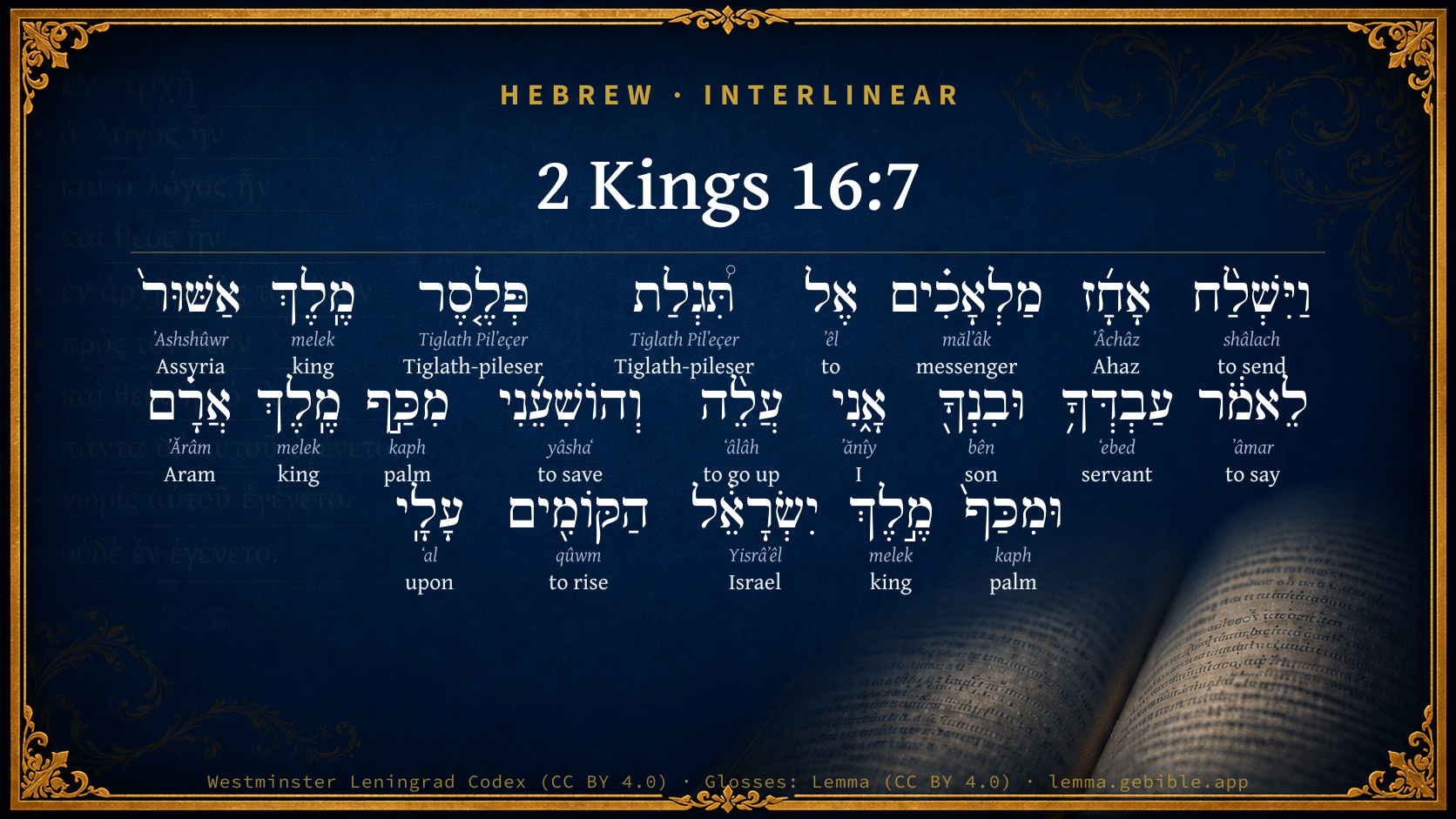
Hebrew (Westminster Leningrad Codex) 2 Kings 16:7 appears in the Hebrew Old Testament. The text above is from the Westminster Leningrad Codex. Each word links to its Strong’s number, a concise gloss, and parsing drawn from the Open Scriptures Hebrew Bible morphology. Click any word for its full Brown-Driver-Briggs (BDB) entry.
Download image
Cite this verse

2 Kings 16:7 (World English Bible). Public Domain. Lemma interlinear Bible study tool, https://lemma.gebible.app/v/2-kings/16/7.

Show BibTeX & RIS
BibTeX
RIS
English Translation
So Ahaz sent messengers to Tiglath Pileser king of Assyria, saying, I am your servant and your son: come up, and save me out of the hand of the king of Syria, and out of the hand of the king of Israel, who rise up against me.
World English Bible · Public Domain
Download a study sheet

One document with this verse’s original text, its word-by-word gloss line, the meaning frame, cross-references with their text, attributed commentary, and full source and license credits — printable, and it pastes into notes with its structure intact.

This verse Autodidact and up

Study sheet (.html) Plain text (.txt)

A passage Seminary Student

Up to 50 verses in one chapter. A passage sheet keeps up to 6 commentary sources and 12 cross-references per verse, in the order this page ranks them, and says so on the sheet whenever that leaves anything out. Ask for a single verse and you get the Autodidact verse sheet above.

Everything on this page stays free to read, with no account — the sheet is a download of what is already on screen, not access to it.

Want to remove ads? Support Godless Engineer
Compare translations 3

The same verse in 3 English versions, stacked beneath the original-language interlinear above. Click any original word for its lexicon entry.

Each is an independent rendering of the whole verse — the interlinear is not word-aligned to these translations.

Highlighted words mark where these versions differ — a whole-verse word diff, not a word-by-word alignment.

  • World English Bible Public Domain
    So Ahaz sent messengers to Tiglath Pileser king of Assyria, saying, I am your servant and your son: come up, and save me out of the hand of the king of Syria, and out of the hand of the king of Israel, who rise up against me.
  • King James Version Public Domain
    So Ahaz sent messengers to Tiglathpileser king of Assyria, saying, I am thy servant and thy son: come up, and save me out of the hand of the king of Syria, and out of the hand of the king of Israel, which rise up against me.
  • unfoldingWord Literal Text CC BY-SA 4.0
    And Ahaz sent messengers to Tiglath Pileser, the king of Assyria, saying, “I your servant and your son. Come up and save me from the palm of the king of Aram and from the palm of the king of Israel, the ones having arisen against me.”

unfoldingWord Literal Text — © unfoldingWord, licensed CC BY-SA 4.0. Word-aligned USFM3 via Door43 (git.door43.org/unfoldingWord/en_ult).

Versions to compare (up to 4)

3 of 4 selected

Show all 18 translations

Every available English version of this verse, each an independent rendering of the whole verse.

  • World English Bible Public Domain
    So Ahaz sent messengers to Tiglath Pileser king of Assyria, saying, I am your servant and your son: come up, and save me out of the hand of the king of Syria, and out of the hand of the king of Israel, who rise up against me.
  • Berean Standard Bible Public Domain
    So Ahaz sent messengers to Tiglath-pileser king of Assyria, saying, “I am your servant and your son. Come up and save me from the hands of the kings of Aram and Israel, who are rising up against me.”
  • Majority Standard Bible Public Domain
    So Ahaz sent messengers to Tiglath-pileser king of Assyria, saying, “I am your servant and your son. Come up and save me from the hands of the kings of Aram and Israel, who are rising up against me.”
  • King James Version Public Domain
    So Ahaz sent messengers to Tiglathpileser king of Assyria, saying, I am thy servant and thy son: come up, and save me out of the hand of the king of Syria, and out of the hand of the king of Israel, which rise up against me.
  • American Standard Version (1901) Public Domain
    So Ahaz sent messengers to Tiglath-pileser king of Assyria, saying, I am thy servant and thy son: come up, and save me out of the hand of the king of Syria, and out of the hand of the king of Israel, who rise up against me.
  • Revised Version (1885) Public Domain
    So Ahaz sent messengers to Tiglath-pileser king of Assyria, saying, I am thy servant and thy son: come up, and save me out of the hand of the king of Syria, and out of the hand of the king of Israel, which rise up against me.
  • Geneva Bible (1599) Public Domain
    Then Ahaz sent messengers to Tiglath Pileser king of Asshur, saying, I am thy seruant and thy sonne: come vp, and deliuer me out of the hand of the king of Aram, and out of the hand of the King of Israel which rise vp against me.
  • Douay-Rheims (1899) Public Domain
    And Achaz sent messengers to Theglathphalasar king of the Assyrians, saying: I am thy servant, and thy son: come up, and save me out of the hand of the king of Syria, and out of the hand of the king of Israel, who are risen up together against me.
  • Young's Literal Translation Public Domain
    And Ahaz sendeth messengers unto Tiglath-Pileser king of Asshur, saying, `Thy servant and thy son `am' I; come up and save me out of the hand of the king of Aram, and out of the hand of the king of Israel, who are rising up against me.'
  • Literal Standard Version CC BY-SA 4.0
    And Ahaz sends messengers to Tiglath-Pileser king of Asshur, saying, “I [am] your servant and your son; come up and save me out of the hand of the king of Aram, and out of the hand of the king of Israel, who are rising up against me.”
  • Unlocked Literal Bible CC BY-SA 4.0
    So Ahaz sent messengers to Tiglath-Pileser king of Assyria, saying, “I am your servant and your son. Come up and save me from the hand of the king of Aram and from the hand of the king of Israel, who have attacked me.”
  • unfoldingWord Literal Text CC BY-SA 4.0
    And Ahaz sent messengers to Tiglath Pileser, the king of Assyria, saying, “I your servant and your son. Come up and save me from the palm of the king of Aram and from the palm of the king of Israel, the ones having arisen against me.”
  • Darby Bible Public Domain
    And Ahaz sent messengers to Tiglath-Pileser king of Assyria, saying, I am thy servant and thy son: come up, and save me out of the hand of the king of Syria, and out of the hand of the king of Israel, who have risen up against me.
  • World Messianic Bible Public Domain
    So Ahaz sent messengers to Tiglath Pileser king of Assyria, saying, “I am your servant and your son. Come up and save me out of the hand of the king of Syria and out of the hand of the king of Israel, who rise up against me.”
  • Webster's Bible Public Domain
    So Ahaz sent messengers to Tiglath-pileser king of Assyria, saying, I am thy servant and thy son: come up, and save me from the hand of the king of Syria, and from the hand of the king of Israel, who rise up against me.
  • Free Bible Version CC BY-SA 4.0
    Ahaz sent messengers to Tiglath-pileser, king of Assyria, saying, “I'm your servant, and your son. Please come and rescue me from the kings of Aram and Israel who are attacking me.”
  • Bible in Basic English Public Domain
    So Ahaz sent representatives to Tiglath-pileser, king of Assyria, saying, I am your servant and your son; come to my help against the kings of Aram and Israel who have taken up arms against me.
  • JPS Tanakh (1917) Public Domain
    So Ahaz sent messengers to Tiglath-pileser king of Assyria, saying: 'I am thy servant and thy son; come up, and save me out of the hand of the king of Aram, and out of the hand of the king of Israel, who rise up against me.'

Literal Standard Version (2020), Covenant Press — licensed CC BY-SA 4.0. Text via the HelloAO Bible API (eBible.org). Unlocked Literal Bible (unfoldingWord) — licensed CC BY-SA 4.0. Text via the HelloAO Bible API (eBible.org). unfoldingWord Literal Text — © unfoldingWord, licensed CC BY-SA 4.0. Word-aligned USFM3 via Door43 (git.door43.org/unfoldingWord/en_ult). Free Bible Version, Dr. Jonathan Gallagher — licensed CC BY-SA 4.0. Text via the HelloAO Bible API (eBible.org).

Word by word

More ways to search: Search by grammar → Find every occurrence → Compare this word →

Practice this passage: Drill this verse → Learn its vocabulary →

תִּ֠גְלַת
Tiglath Pilʼeçer
H8407
“Tiglath-pileser”
Noun, Proper
Part of Speech
Noun
Type
Proper
Full BDB Definition

Origin: of foreign derivation

TWOT: None

Tiglath-pileser or Tilgath-pilneser = "thou will uncover the wonderful bond" - an Assyrian king who attacked Samaria or northern kingdom of Israel in the reign of Pekah
  1. וַיִּשְׁלַ֨ח shâlach H7971 “and · to send” Conjunction + Verb, Qal, Sequential Imperfect, 3rd Person, Masculine, Singular
  2. אָחָ֜ז ʼÂchâz H271 “Ahaz” Noun, Proper
  3. מַלְאָכִ֗ים mălʼâk H4397 “messengers” Noun, Common, Masculine, Plural, Absolute
  4. אֶל ʼêl H413 “to” Preposition
  5. פְּלֶ֤סֶר Tiglath Pilʼeçer H8407 “Tiglath-pileser” Noun, Proper
  6. מֶֽלֶךְ melek H4428 “king of” Noun, Common, Masculine, Singular, Construct
  7. אַשּׁוּר֙ ʼAshshûwr H804 “Assyria” Noun, Proper
  8. לֵאמֹ֔ר ʼâmar H559 “to say” Preposition + Verb, Qal, Infinitive Construct
  9. עַבְדְּךָ֥ ʻebed H5650 “servant · your” Noun, Common, Masculine, Singular, Construct + Suffix, Personal, 2nd Person, Masculine, Singular
  10. וּבִנְךָ֖ bên H1121 “and · son · your” Conjunction + Noun, Common, Masculine, Singular, Construct + Suffix, Personal, 2nd Person, Masculine, Singular
  11. אָ֑נִי ʼănîy H589 “I” Pronoun, Personal, 1st Person, Common, Singular
  12. עֲלֵ֨ה ʻâlâh H5927 “go up” Verb, Qal, Imperative, 2nd Person, Masculine, Singular
  13. וְהוֹשִׁעֵ֜נִי yâshaʻ H3467 “and · save · me” Conjunction + Verb, Hiphil, Imperative, 2nd Person, Masculine, Singular + Suffix, Personal, 1st Person, Common, Singular
  14. מִכַּ֣ף kaph H3709 “from · palm of” Preposition + Noun, Common, Feminine, Singular, Construct
  15. מֶֽלֶךְ melek H4428 “king of” Noun, Common, Masculine, Singular, Construct
  16. אֲרָ֗ם ʼĂrâm H758 “Aram” Noun, Proper
  17. וּמִכַּף֙ kaph H3709 “and · from · palm of” Conjunction + Preposition + Noun, Common, Feminine, Singular, Construct
  18. מֶ֣לֶךְ melek H4428 “king of” Noun, Common, Masculine, Singular, Construct
  19. יִשְׂרָאֵ֔ל Yisrâʼêl H3478 “Israel” Noun, Proper
  20. הַקּוֹמִ֖ים qûwm H6965 “the · rising” Particle, Definite Article + Verb, Qal, Participle Active, Masculine, Plural, Absolute
  21. עָלָֽי ʻal H5921 “upon · me” Preposition + Suffix, Personal, 1st Person, Common, Singular

About this verse

These counts appear in no published source. They are computed here, from the morphology-tagged text and Lemma’s own curated glosses. What Lemma adds →

22
words
18
distinct lemmas
Historical
section

Notable vocabulary

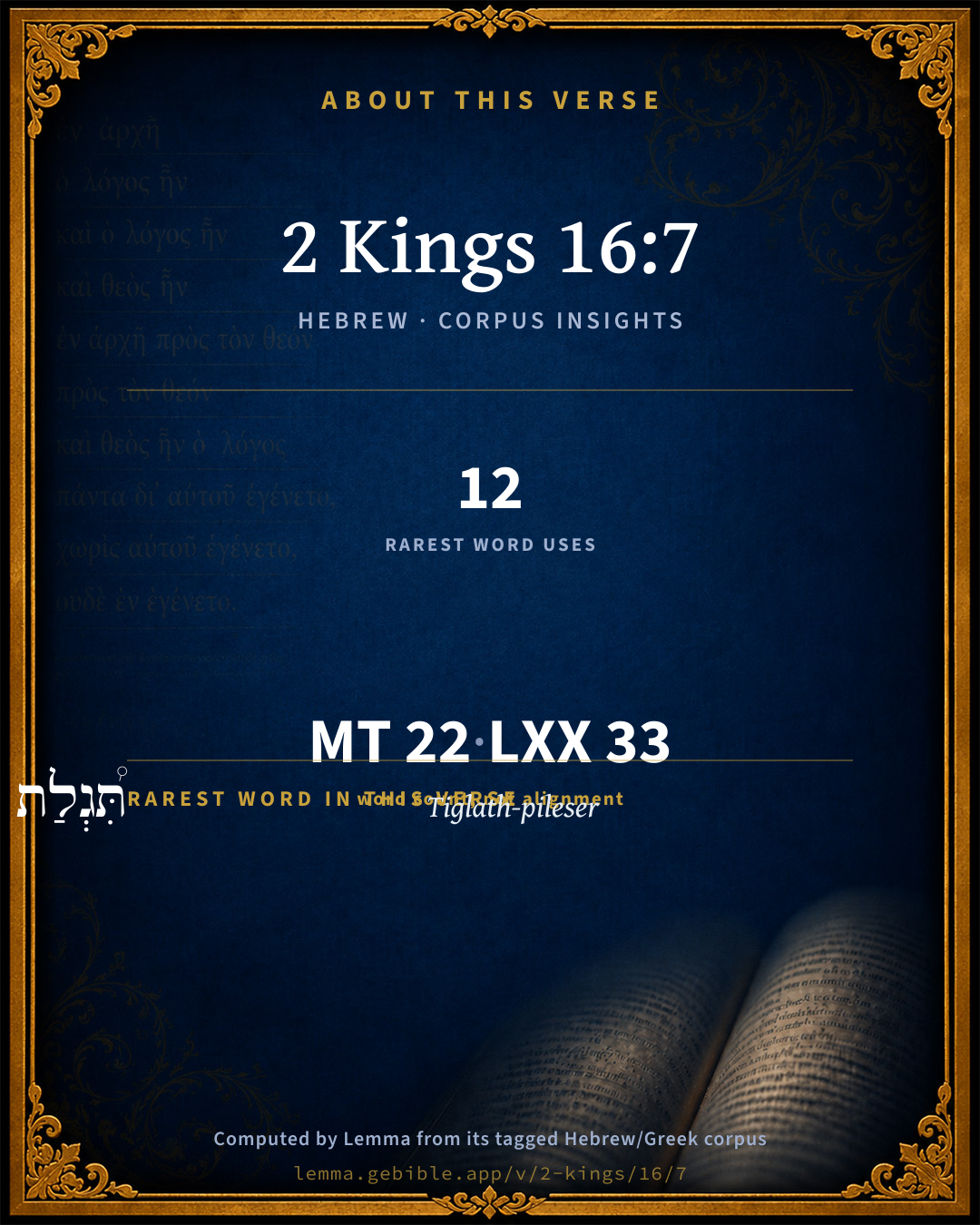
The rarest word here is תִּ֠גְלַת Tiglath-pileser H8407 — appearing just 12 times in the whole Hebrew Bible.

Shared distinctive vocabulary

תִּ֠גְלַת Tiglath-pileser H8407 occurs in 6 verses of the Hebrew Bible. Also found in:

Grammatical profile

  • 5 verbs
  • 14 nouns
  • 1 pronoun
  • 2 prepositions

Verb forms

  • וַיִּשְׁלַ֨ח Qal · Sequential Imperfect
  • לֵאמֹ֔ר Qal · Infinitive Construct
  • עֲלֵ֨ה Qal · Imperative
  • וְהוֹשִׁעֵ֜נִי Hiphil · Imperative
  • הַקּוֹמִ֖ים Qal · Participle Active

Repetition

Words recur within this verse — often emphatic in Hebrew:

  • מֶֽלֶךְ king H4428 ×3
  • תִּ֠גְלַת Tiglath-pileser H8407 ×2
  • מִכַּ֣ף palm H3709 ×2

Hebrew & Septuagint length

In English translation the verse runs 47 words from the Hebrew and 47 from the Septuagint (LXX English) — the same length.

A rough comparison of the two English renderings, which tokenize alike — not a word-level alignment.

Word counts can differ between the Hebrew and the Greek without any difference in meaning — e.g. the Hebrew direct-object marker אֵת has no separate Greek word, and Greek often adds the article ὁ.

In the original languages it is 22 Hebrew tokens and 33 Greek tokens — but the two are counted differently (Hebrew bundles its prefixes and suffixes into one token; the Greek is in lemma form), so that isn’t a like-for-like length.

Cross-references

10

Topical passages linked to 2 Kings 16:7 in the Treasury of Scripture Knowledge — connected by theme and wording, ordered by reader-vote popularity; previews shown in the World English Bible.

  • 2 Kings 15:29 In the days of Pekah king of Israel came Tiglath Pileser king of Assyria, and took Ijon, and Abel Beth Maacah, and Janoah, and Kedesh, and Hazor, and Gilead, and Galilee, all the land of Naphtali; and he carried them captive to Assyria.
  • 1 Kings 20:4 The king of Israel answered, It is according to your saying, my lord, O king; I am yours, and all that I have.
  • 1 Kings 20:32–33 So they girded sackcloth on their loins, and [put] ropes on their heads, and came to the king of Israel, and said, Your servant Ben Hadad says, please let me live. He said, Is he yet alive? he is my brother.
  • 1 Chronicles 5:26 The God of Israel stirred up the spirit of Pul king of Assyria, and the spirit of Tilgath Pilneser king of Assyria, and he carried them away, even the Reubenites, and the Gadites, and the half-tribe of Manasseh, and brought them to Halah, and Habor, and Hara, and to the river of Gozan, to this day.
  • 2 Chronicles 28:16 At that time did king Ahaz send to the kings of Assyria to help him.
  • 2 Chronicles 28:20 Tilgath Pilneser king of Assyria came to him, and distressed him, but didn't strengthen him.
  • Psalms 146:3–5 Don't put your trust in princes, Each a son of man in whom there is no help.
  • Jeremiah 17:5 Thus says Yahweh: Cursed is the man who trusts in man, and makes flesh his arm, and whose heart departs from Yahweh.
  • Lamentations 4:17 Our eyes do yet fail [in looking] for our vain help: In our watching we have watched for a nation that could not save.
  • Hosea 14:3 Assyria can't save us. We won't ride on horses; Neither will we say any more to the work of our hands, 'Our gods!' For in you the fatherless finds mercy."

Cross-references courtesy of OpenBible.info (CC BY 4.0).

Hebrew and Greek witnesses Masoretic Hebrew ↔ Greek Septuagint

The same verse in the two great witnesses to the Old Testament, shown verse-for-verse.

These are two independent witnesses, not word-aligned to each other, and the Septuagint is shown in lemma (dictionary) form.

Hebrew 2 Kings 16:7 Masoretic · Westminster Leningrad Codex

וַיִּשְׁלַ֨ח אָחָ֜ז מַלְאָכִ֗ים אֶל תִּ֠גְלַת פְּלֶ֤סֶר מֶֽלֶךְ אַשּׁוּר֙ לֵאמֹ֔ר עַבְדְּךָ֥ וּבִנְךָ֖ אָ֑נִי עֲלֵ֨ה וְהוֹשִׁעֵ֜נִי מִכַּ֣ף מֶֽלֶךְ אֲרָ֗ם וּמִכַּף֙ מֶ֣לֶךְ יִשְׂרָאֵ֔ל הַקּוֹמִ֖ים עָלָֽי

So Ahaz sent messengers to Tiglath Pileser king of Assyria, saying, I am your servant and your son: come up, and save me out of the hand of the king of Syria, and out of the hand of the king of Israel, who rise up against me.

World English Bible · Public Domain

Greek LXX 2 Kings 16:7 Septuagint · lemma form

καί ἀποστέλλω αχαζ ἄγγελος πρός θαγλαθφελλασαρ βασιλεύς ἀσσύριος λέγω δοῦλος σύ καί υἱός σύ ἐγώ ἀναβαίνω καί σώζω ἐγώ ἐκ χείρ βασιλεύς συρία καί ἐκ χείρ βασιλεύς ἰσραήλ ὁ ἐπι ἀναἵστημι ἐπί ἐγώ

And Achaz sent messengers to Thalgath-phellasar king of the Assyrians, saying, I am your servant and your son: come up, deliver me out of the hand of the king of Syria, and out of the hand of the king of Israel, who are rising up against me.

LXX2012 (modern English Septuagint) · Public Domain

Hebrew: Westminster Leningrad Codex (CC BY 4.0). Greek: Septuagint (public domain); English from LXX2012 (modern English Septuagint) (Public Domain). How the Septuagint differs from the Hebrew →

Targum (Aramaic paraphrase)

1

The Targum is the ancient Jewish Aramaic paraphrase of the Hebrew Scriptures — an interpretive translation, not the Hebrew text itself. Onkelos (literal) and Pseudo-Jonathan (expansive) render the Torah, and Jonathan the Prophets. Coverage is partial: where no permissively-licensed English translation exists for a verse, only the Aramaic is shown. This is verse-level text, not a word-by-word alignment to the Hebrew.

  1. Targum Jonathan Prophets (Joshua–Malachi)
    וּשְׁלַח אָחָז אִזְגַדִין לְוַת תִּגְלַת פְּלֶסֶר מַלְכָּא דְאַתּוּר לְמֵימָר עַבְדָךְ וּבְרָךְ אֲנָא סַק וּפְרוֹקְנִי מִיַד מַלְכָּא דַאֲרָם וּמִיַד מַלְכָּא דְיִשְׂרָאֵל דְקָמוּ עָלַי:

    (no public-domain English translation for this verse)

    Targum Jonathan — Aramaic: “Mikraot Gedolot” (public domain). English: “Sefaria Community Translation” (CC0 1.0 (public-domain dedication)); “London "Chaldee Paraphrase," 1871” (public domain). Text via Sefaria.

Commentary

Notes on 2 Kings 16:7 from classic Christian and Jewish commentators (each source and its license shown beneath its notes). The classic Christian expositions comment on the surrounding passage and are grouped to its opening verse, so a note may address several verses; the Jewish commentaries on the Tanakh (Rashi and others) are per-verse, so they appear only where the commentator wrote on this verse.

Lemma curates 59 commentaries, every one of them public domain or Creative Commons licensed, each selected and text-cleaned for this edition rather than reprinted as found. About our sources →

Trapp's Complete Commentary

John Trapp

2Ki 16:7 So Ahaz sent messengers to Tiglathpileser king of Assyria, saying, I [am] thy servant and thy son: come up, and save me out of the hand of the king of Syria, and out of the hand of the king of Israel, which rise up against me.

Ver. 7. So Ahaz sent messengers to Tiglathpileser.] God had offered him a sign for his better assurance, saying, Ask it either in the depth or height above. {Isa 7:11-12} Here was a fair offer to a foul sinner; that where sin abounded, grace might superabound. But Ahaz said, I will not ask, neither will I try the Lord, q.d., I will ask no asks, I will try no signs; I know a trick worth two of that; let God keep his signs to himself: I crave no such courtesy at his hands, I can otherwise relieve myself by sending to the Assyrian.

John Trapp, A Commentary or Exposition upon All the Books of the Old and New Testament (1647–1656) — public domain. Text from a community e-Sword module.

Joseph Benson's Commentary

2Ki 16:7. So Ahaz sent messengers to Tiglath-pileser — Having forsaken God, he had neither courage nor strength to make head against his enemies, and therefore made his court to the king of Assyria, and endeavoured to prevail on him to come to his relief. But was it because there was not a God in Israel that he sent to the Assyrian for help? The truth is, he could not with any confidence ask help of God, being conscious he had abandoned his worship, and in the grossest manner violated his laws. Observe, reader, they whose hearts condemn them will go any whither for help, in a day of distress, rather than to God. Saying, I am thy servant and thy son: come up, and save me — I yield myself to thee as thy vassal, to serve and obey thee, and pay thee tribute, upon condition that thou wilt assist me against my enemies. Had he thus humbled himself to God, and implored his favour, he might have been delivered upon easier terms, might have saved his money, and needed only to have parted with his sins. Out of the hand of the king of Syria, &c. — For though they were now gone from Jerusalem, yet he justly concluded they would return again, and, from time to time, molest and vex him.

Joseph Benson's Commentary on the Old and New Testaments (1811–1818) — public domain. Text from a community e-Sword module.

Tyndale Open Study Notes

Tyndale Open Resources

16:7-9 Rather than trusting in God’s provision (Isa 7:7-16), Ahaz petitioned Tiglath-pileser III of Assyria to rescue him from his enemies. Tiglath-pileser was successful, and his victory brought about the death of Rezin, the capture of Damascus, and the deportation of its citizens (732 BC). It also contributed to unseating Pekah as king of Israel in the same year (2 Kgs 15:29-30). The cost of the rescue was great, however; Ahaz paid a heavy tribute to Tiglath-pileser, and the Assyrian intervention reduced Judah to vassal status.

Tyndale Open Study Notes — © Tyndale Open Resources, licensed CC BY-SA 4.0. Text via the HelloAO Bible API.

Geneva Bible (1599)

Geneva Bible translators

Contrary to the admonition of the Prophet Isaiah, Isa. 7:4.

Geneva Bible (1599) marginal notes — public domain. Text via Bolls.life.

Jamieson, Fausset & Brown

Robert Jamieson, A. R. Fausset & David Brown

So Ahaz sent messengers to Tiglath-pileser--In spite of the assurance given him by Isaiah by two signs, the one immediate, the other remote (Isa 7:14; Isa 8:4), that the confederate kings would not prevail against him, Ahaz sought aid from the Assyrian monarch, to purchase which he sent the treasures of the palace and temple. Tiglath-pileser marched against Damascus, slew Rezin the king, and carried the people of Damascus into captivity to Kir, which is thought to have been the city Karine (now Kerend), in Media.

Jamieson, Fausset & Brown — Commentary Critical and Explanatory on the Whole Bible (1871) — public domain (CC PDM 1.0). Text via the HelloAO Bible API.

Adam Clarke's Commentary

Verse 7. I am thy servant and thy son] I will obey thee in all, and become tributary to thee; only help me against Syria and Israel.

Adam Clarke's Commentary on the Bible (1810–1826) — public domain. Text from a community e-Sword/MySword module.

Ellicott's Commentary for English Readers

(7) So Ahaz sent messengers.—See Notes on 2Ch_28:16; 2Ch_28:20.

Which rise up against me.—Or, which are assailing me. “The vain confidence of the rulers of Judah, described by Isaiah in his first prophetic book, was rudely shaken by the progress of the war with Pekah and Rezin. Unreasoning confidence had given way to equally unreasoning panic. They saw only one way of escape—namely, to throw themselves upon the protection of Assyria.” (Robertson Smith.)

A Bible Commentary for English Readers, edited by Charles John Ellicott (1878–1897) — public domain. Text from a community e-Sword module.

The Cambridge Bible for Schools and Colleges

gen. ed. J. J. S. Perowne

7. So Ahaz sent messengers to Tiglath-pileser king of Assyria] According to 2 Chron. (2Ch_28:17-18) it was not only by Rezin of Damascus and Pekah of Israel that Ahaz was straitened when he sent for help to Assyria. ‘The Edomites had again come and smitten Judah, and carried away captives. The Philistines also had invaded the cities of the low countries, and of the south of Judah, and had taken Beth-shemesh and Ajalon with Gederoth, and Socho with the villages thereof, and Timnah likewise and Gimzo, and they dwelt there.’ So that on north and south alike Ahaz was sorely beset. ‘For the Lord brought Judah low, because of Ahaz, for he made Judah naked, and transgressed sore against the Lord’.

I am thy servant and thy son] Ahaz, in return for the help he seeks, offers to make himself the vassal of Assyria. With the name ‘son’, as used in such an address, may be compared the ‘brother’ which Ahab uses of the conquered Benhadad (1Ki_20:32). Ahaz in his petition naturally only mentions those enemies on the north upon whom Tiglath-pileser could most readily fall. Perhaps he felt that, if relieved from them, he could dispose of the Edomites and Philistines by his own power.

The Cambridge Bible for Schools and Colleges (gen. ed. J. J. S. Perowne; Cambridge University Press, 1878–1918) — public domain. Text from a community e-Sword module.

John Gill's Exposition

And Ahaz took the silver and gold that was found in the house of the Lord,.... Which Uzziah and Jotham had put there; for all that was found there in the times of Amaziah was taken away by Jehoash king of Israel, Kg2 14:14.

and in the treasures of the king's house; whatever gold and silver he had of his own:

and sent it for a present to the king of Assyria; to obtain his help and assistance.

John Gill's Exposition of the Whole Bible (1746–1763) — public domain (CC PDM 1.0). Text via the HelloAO Bible API.

Albert Barnes' Notes on the Bible

Ahaz was threatened on all sides, on the north by Rezin and Pekah; on the southeast by Edom 2Ch 28:17; and on the southwest by the Philistines 2Ch 28:18. To these external dangers was added the still greater peril of disaffection at home. A large party in Judah was “weary” of the house of David Isa 7:13, ready to join the confederacy Isa 8:6, Isa 8:12, and to accept for king “the son of Tabeal.” Ahaz saw no hope of safety unless he could obtain a powerful protector; and, Egypt being particularly weak at this time, he turned to Assyria.

Albert Barnes' Notes on the Bible (1834–1885) — public domain. Text from a community e-Sword/MySword module.

Haydock's Catholic Bible Commentary

Son, vassal, or under thy protection. (Calmet) --- Save me. Achaz sinned by this placing his confidence in man, after the prophet had given him such assurance from the Lord. (Menochius) --- He has soon reason to repent of having brought this proud ally into his dominions, as he proved a great scourge; (2 Paralipomenon xxviii. 20.) no less than the Saxons did to the ancient Britons.

George Leo Haydock (1774–1849), Haydock's Catholic Family Bible and Commentary, 1859 edition — public domain. Excludes Psalms (Douay-Rheims chapter numbering differs from Protestant) and Deuterocanonical books (Catholic canon only).

Matthew Poole's English Annotations

I am thy servant and thy son; I yield myself to thee, as thy vassal, to serve and obey thee, and pay thee tribute, upon condition thou dost assist me against my enemies.

Out of the hand of the king of Syria, and out of the hand of the king of Israel; for though they were now gone from Jerusalem, yet he justly concluded they would return again, and from time to time molest and vex him.

Matthew Poole's English Annotations on the Holy Bible (1683–1685) — public domain. Text from a community e-Sword/MySword module.

Whedon's Commentary on the Bible

Daniel D. Whedon

7. Ahaz sent… to Tiglath-pileser — He placed no strong reliance on the word of the Lord by Isaiah that Rezin and Pekah were only like two smoking firebrands that would soon burn out and be harmless. He was probably led to apply to the Assyrian monarch because he had already greatly injured Israel. See note on 2Ki_15:29.

Thy servant and thy son — An acknowledgment of Judah’s dependency on Assyria. Compare note on 2Ki_14:5.

Daniel D. Whedon (gen. ed.), Commentary on the Old and New Testaments (1874–1909) — public domain. Text from a community e-Sword module.

The Pulpit Commentary

Vers. 7-9. Expedition of Tiglath-pileser against Pekah and Rezin. In the extremity of his danger, when the confederacy had declared itself, or perhaps later, when he had suffered terrible defeats, and was about. to be besieged in his capital, (2Ch_28:5, 2Ch_28:6) Ahaz invoked the aid of Tiglath-pileser, sent him all the treasure on which he could lay his hands (ver. 8), offered to place himself and his kingdom under the Assyrian monarch"s suzerainty, and entreated him to come and "save him out of the hands" of his enemies (ver. 7). Humanly speaking, he might be justified. He had not called in one foreign power until Pekah had called in another. There was no other prospect (again humanly speaking) of escape. But, had he accepted the offers of Isa_7:4-16, and relied wholly on Jehovah, his position would have been far better. However, he was unable to see this; he made his application; and Tiglath-pileser "came up," and utterly crushed the Syro-Israelite confederacy (ver. 9).

So Ahaz sent messengers to Tiglath-pileser King of Assyria, saying. This appeal to man rather than to God, this trust in "an arm of flesh," was exactly what Isaiah had been endeavoring to prevent, what he viewed as unfaithfulness, and as inevitably drawing down God"s wrath both upon king and kingdom. Ahaz was young, was weak, and had no doubt a large body of advisers, who considered the prophet to be a fanatic, who had no belief in supernatural aid, and who thought that in any emergency recourse was to be had to the measures which human prudence and human policy dictated. The aid of Tiglath-pileser seemed to them, under the circumstances, the only thing that could save them; and they persuaded the weak prince to adopt their views. I am thy servant and thy son. The offer of submission was unmistakable. "Servant," in the language of the time, meant "slave." Complete subjection, enrollment among Assyria"s feudatories, the entire loss of independence, was well understood to be the price that had to be paid for Assyria"s protection. Ahaz and his worldly advisers were prepared to pay it. They surrendered themselves, body and soul, into the hands of the great world-power of the period. Come up, and save me out of the hand of the King of Syria, and out of the hand of the King of Israel, which rise up against me. Syria is put forward as at once the more formidable of the two foes, and the one most open to Assyrian attack. Already Damascus had been more than once menaced by Assyrian armies ("Eponym Canon," pp. 113, 115, 116), while the kingdom of Samaria had only suffered at her extremities. (2Ki_15:29) Samaria could not well be approached excepting through Syria, and after Syria"s downfall.

The Pulpit Commentary (1880–1919), ed. H.D.M. Spence-Jones & Joseph S. Exell — public domain. Text from a community e-Sword module.

John Wesley's Explanatory Notes

Sent messengers, &c. - But was it because there was no God in Israel, that he sent to the Assyrian for help? The sin itself was its own punishment; for tho' it served his present turn, yet he made but an ill bargain, seeing he not only impoverished himself, but enslaved both himself and his people.

John Wesley, Explanatory Notes Upon the Whole Bible (1754–1765) — public domain. Text via the GEBible commentary corpus.

Keil & Delitzsch

C. F. Keil & F. Delitzsch

In this distress Ahaz turned to Tiglath-pileser, without regarding either the word of Isaiah in Kg2 7:4., which promised salvation, or the prophet's warning against an alliance with Assyria, and by sending the gold and silver which were found in the treasures of the temple and palace, purchased his assistance against Rezin and Pekah. Whether this occurred immediately after the invasion of the land by the allied kings, or not till after they had defeated the Judaean army and advanced against Jerusalem, it is impossible to discover either from this verse or from Ch2 28:16; but probably it was after the first great victory gained by the foe, with which Isa 7 and 8 agree. - On קומים for קמים see Ewald, 151, b.

Keil & Delitzsch — Biblical Commentary on the Old Testament (1861–1891) — public domain (CC PDM 1.0). Text via the HelloAO Bible API. (Old Testament only.)

unfoldingWord translationNotes

Door43 World Missions Community

Tiglath-Pileser

In 2 Kings 15:19 this man was called "Pul." See how you translated his name in 2 Kings 15:29. (See: How to Translate Names)

I am your servant and your son

Being a servant and a son represents submitting to someone's authority. AT: "I will obey you as if I were your servant or your son" (See: Metaphor)

from the hand of the king of Aram and from the hand of the king of Israel

The hand is a metonym that represents power. AT: "from the power of the king of Aram and from the power of the king of Israel" (See: Metonymy)

who have attacked me

The kings attacking Ahaz represent the armies of those kings attacking Ahaz and his people. AT: "who have attacked me with their armies" or "whose armies have attacked me" (See: Synecdoche)

the king of Assyria went up against Damascus

The word "king" represents the king and his army. Also, Damascus represents the people who live there. AT: "the king of Assyria and his army attacked the people of Damascus" (See: Synecdoche and Metonymy)

carried off its people as prisoners to Kir

Carrying off the people represents forcing them to go away. AT: "made the people his prisoners and forced them to go to Kir" (See: Metaphor)

Kir

Possible meanings are 1) this is the name of a city or 2) this word means "city" and refers to the capital city of Assyria. (See: How to Translate Names)

translationWords

send

messenger

Assyria

servant

son

save

hand

silver

gold

house of God

palace

gift

Damascus

prison

unfoldingWord translationNotes — © Distant Shores Media and the Door43 World Missions Community, licensed CC BY-SA 4.0. Source: git.door43.org/Door43/en_tn.

Lesson kit

Teaching starters — assembled from the data on this page, not authored interpretation. Every prompt links to the verse data it draws on. Edit before teaching.

2 Kings, in the Historical, opens this verse with 22 words (18 distinct Hebrew lemmas). Its most distinctive word is Tiglath Pilʼeçer (“Tiglath-pileser”). A historical commentator’s framing appears above. Read the whole chapter for the surrounding context.

Discussion questions

  1. What does “Tiglath-pileser” (Tiglath Pilʼeçer) contribute to the verse as a whole?
  2. 2 Kings 15:29 shares the word «Tiglath-pileser» with this verse. How do the two illuminate each other?
  3. “king” occurs 3× in this one verse. What is the effect of the repetition?
  4. These translations render this verse differently. What is at stake in choosing one wording over another?
  5. The verb «וַיִּשְׁלַ֨ח» is Qal Sequential Imperfect. How does its form color the action?
  6. Reading how Trapp's Complete Commentary and Joseph Benson's Commentary read this verse, where do the two commentators agree and where do they part?

Things to notice

Reading settings

Reading text

Shown beneath each verse's original-language words.

Old Testament
Old Testament edition

Read the OT as the Masoretic Hebrew (MT) or the Greek Septuagint (LXX).

English shown for the Greek Septuagint (in the Hebrew ↔ Greek comparison).

Comparing translations? Open the Compare panel on any verse page to stack up to four side by side.