
2 Kings 13:10

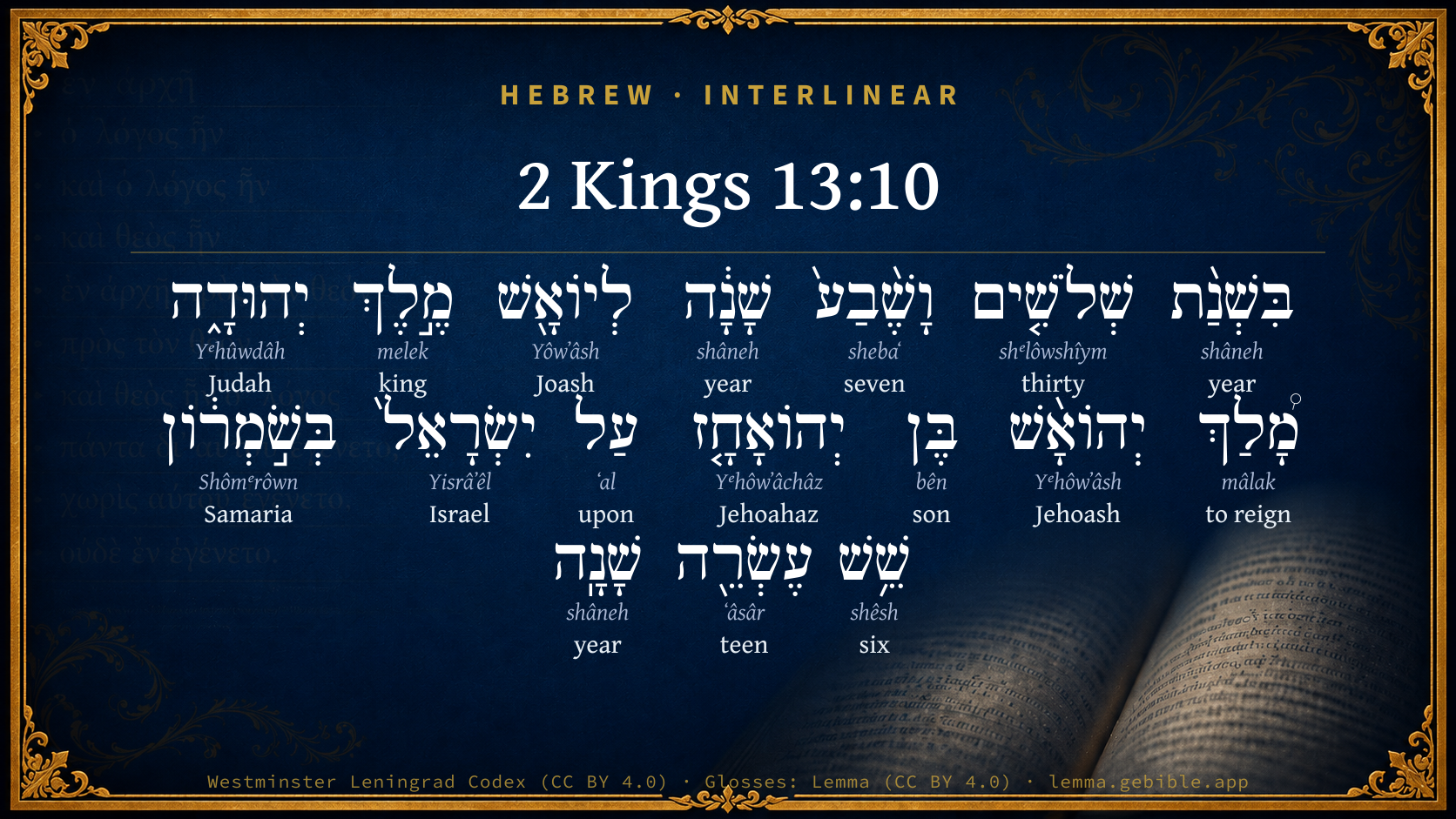
Hebrew (Westminster Leningrad Codex) 2 Kings 13:10 appears in the Hebrew Old Testament. The text above is from the Westminster Leningrad Codex. Each word links to its Strong’s number, a concise gloss, and parsing drawn from the Open Scriptures Hebrew Bible morphology. Click any word for its full Brown-Driver-Briggs (BDB) entry.
Download image
Cite this verse

2 Kings 13:10 (World English Bible). Public Domain. Lemma interlinear Bible study tool, https://lemma.gebible.app/v/2-kings/13/10.

Show BibTeX & RIS
BibTeX
RIS
English Translation
In the thirty-seventh year of Joash king of Judah began Jehoash the son of Jehoahaz to reign over Israel in Samaria, [and reigned] sixteen years.
World English Bible · Public Domain
Download a study sheet

One document with this verse’s original text, its word-by-word gloss line, the meaning frame, cross-references with their text, attributed commentary, and full source and license credits — printable, and it pastes into notes with its structure intact.

This verse Autodidact and up

Study sheet (.html) Plain text (.txt)

A passage Seminary Student

Up to 50 verses in one chapter. A passage sheet keeps up to 6 commentary sources and 12 cross-references per verse, in the order this page ranks them, and says so on the sheet whenever that leaves anything out. Ask for a single verse and you get the Autodidact verse sheet above.

Everything on this page stays free to read, with no account — the sheet is a download of what is already on screen, not access to it.

Want to remove ads? Support Godless Engineer
Compare translations 3

The same verse in 3 English versions, stacked beneath the original-language interlinear above. Click any original word for its lexicon entry.

Each is an independent rendering of the whole verse — the interlinear is not word-aligned to these translations.

Highlighted words mark where these versions differ — a whole-verse word diff, not a word-by-word alignment.

  • World English Bible Public Domain
    In the thirty-seventh year of Joash king of Judah began Jehoash the son of Jehoahaz to reign over Israel in Samaria, [and reigned] sixteen years.
  • King James Version Public Domain
    In the thirty and seventh year of Joash king of Judah began Jehoash the son of Jehoahaz to reign over Israel in Samaria, and reigned sixteen years.
  • unfoldingWord Literal Text CC BY-SA 4.0
    In the year of 37, the year to Joash, the king of Judah, Jehoash, the son of Jehoahaz, reigned over Israel in Samaria, 16 years.

unfoldingWord Literal Text — © unfoldingWord, licensed CC BY-SA 4.0. Word-aligned USFM3 via Door43 (git.door43.org/unfoldingWord/en_ult).

Versions to compare (up to 4)

3 of 4 selected

Show all 18 translations

Every available English version of this verse, each an independent rendering of the whole verse.

  • World English Bible Public Domain
    In the thirty-seventh year of Joash king of Judah began Jehoash the son of Jehoahaz to reign over Israel in Samaria, [and reigned] sixteen years.
  • Berean Standard Bible Public Domain
    In the thirty-seventh year of the reign of Joash over Judah, Jehoash son of Jehoahaz became king of Israel in Samaria, and he reigned sixteen years.
  • Majority Standard Bible Public Domain
    In the thirty-seventh year of the reign of Joash over Judah, Jehoash son of Jehoahaz became king of Israel in Samaria, and he reigned sixteen years.
  • King James Version Public Domain
    In the thirty and seventh year of Joash king of Judah began Jehoash the son of Jehoahaz to reign over Israel in Samaria, and reigned sixteen years.
  • American Standard Version (1901) Public Domain
    In the thirty and seventh year of Joash king of Judah began Jehoash the son of Jehoahaz to reign over Israel in Samaria, `and reigned' sixteen years.
  • Revised Version (1885) Public Domain
    In the thirty and seventh year of Joash king of Judah began Jehoash the son of Jehoahaz to reign over Israel in Samaria, and reigned sixteen years.
  • Geneva Bible (1599) Public Domain
    In the seuen and thirtieth yere of Ioash King of Iudah began Iehoash the sonne of Iehoahaz to reigne ouer Israel in Samaria, and reigned sixteene yeere,
  • Douay-Rheims (1899) Public Domain
    In the seven and thirtieth year of Joas king of Juda, Joas the son of Joachaz reigned over Israel in Samaria sixteen years.
  • Young's Literal Translation Public Domain
    In the thirty and seventh year of Joash king of Judah reigned hath Jehoash son of Jehoahaz over Israel, in Samaria -- sixteen years,
  • Literal Standard Version CC BY-SA 4.0
    In the thirty-seventh year of Joash king of Judah, Jehoash son of Jehoahaz has reigned over Israel in Samaria, sixteen years,
  • Unlocked Literal Bible CC BY-SA 4.0
    In the thirty-seventh year of Joash king of Judah, the reign of Jehoash son of Jehoahaz began over Israel in Samaria; he reigned sixteen years.
  • unfoldingWord Literal Text CC BY-SA 4.0
    In the year of 37, the year to Joash, the king of Judah, Jehoash, the son of Jehoahaz, reigned over Israel in Samaria, 16 years.
  • Darby Bible Public Domain
    In the thirty-seventh year of Joash king of Judah began Jehoash the son of Jehoahaz to reign over Israel in Samaria, for sixteen years.
  • World Messianic Bible Public Domain
    In the thirty-seventh year of Joash king of Judah, Jehoash the son of Jehoahaz began to reign over Israel in Samaria for sixteen years.
  • Webster's Bible Public Domain
    In the thirty and seventh year of Joash king of Judah began Jehoash the son of Jehoahaz to reign over Israel in Samaria, and he reigned sixteen years.
  • Free Bible Version CC BY-SA 4.0
    Jehoash, son of Jehoahaz, became king of Israel in Samaria in the thirty-seventh year of the reign of King Joash of Judah, and he reigned for sixteen years.
  • Bible in Basic English Public Domain
    In the thirty-seventh year of the rule of Joash, king of Judah, Joash, the son of Jehoahaz, became king over Israel in Samaria, ruling for sixteen years.
  • JPS Tanakh (1917) Public Domain
    In the thirty and seventh year of Joash king of Judah began Jehoash the son of Jehoahaz to reign over Israel in Samaria, and reigned sixteen years.

Literal Standard Version (2020), Covenant Press — licensed CC BY-SA 4.0. Text via the HelloAO Bible API (eBible.org). Unlocked Literal Bible (unfoldingWord) — licensed CC BY-SA 4.0. Text via the HelloAO Bible API (eBible.org). unfoldingWord Literal Text — © unfoldingWord, licensed CC BY-SA 4.0. Word-aligned USFM3 via Door43 (git.door43.org/unfoldingWord/en_ult). Free Bible Version, Dr. Jonathan Gallagher — licensed CC BY-SA 4.0. Text via the HelloAO Bible API (eBible.org).

Word by word

More ways to search: Search by grammar → Find every occurrence → Compare this word →

Practice this passage: Drill this verse → Learn its vocabulary →

יְהוֹאָ֨שׁ
Yᵉhôwʼâsh
H3060
“Jehoash”
Noun, Proper
Part of Speech
Noun
Type
Proper
Full BDB Definition

Origin: from H3068 and (perhaps) H784

TWOT: None

Jehoash = "given by the Lord" - son of king Ahaziah and the 8th king of Judah - son of king Jehoahaz and the 12th king of the northern kingdom of Israel
  1. בִּשְׁנַ֨ת shâneh H8141 “in/at · year of” Preposition + Noun, Common, Feminine, Singular, Construct
  2. שְׁלֹשִׁ֤ים shᵉlôwshîym H7970 “thirty” Adjective, Cardinal number, Both, Plural, Absolute
  3. וָשֶׁ֨בַע֙ shebaʻ H7651 “and · seven” Conjunction + Adjective, Cardinal number, Feminine, Singular, Absolute
  4. שָׁנָ֔ה shâneh H8141 “year” Noun, Common, Feminine, Singular, Absolute
  5. לְיוֹאָ֖שׁ Yôwʼâsh H3101 “to/for · Joash” Preposition + Noun, Proper
  6. מֶ֣לֶךְ melek H4428 “king of” Noun, Common, Masculine, Singular, Construct
  7. יְהוּדָ֑ה Yᵉhûwdâh H3063 “Judah” Noun, Proper
  8. מָ֠לַךְ mâlak H4427 “to reign” Verb, Qal, Perfect, 3rd Person, Masculine, Singular
  9. בֶּן bên H1121 “son of” Noun, Common, Masculine, Singular, Construct
  10. יְהוֹאָחָ֤ז Yᵉhôwʼâchâz H3059 “Jehoahaz” Noun, Proper
  11. עַל ʻal H5921 “upon” Preposition
  12. יִשְׂרָאֵל֙ Yisrâʼêl H3478 “Israel” Noun, Proper
  13. בְּשֹׁ֣מְר֔וֹן Shômᵉrôwn H8111 “in/at · Samaria” Preposition + Noun, Proper
  14. שֵׁ֥שׁ shêsh H8337 “six” Adjective, Cardinal number, Feminine, Singular, Absolute
  15. עֶשְׂרֵ֖ה ʻâsâr H6240 “teen” Adjective, Cardinal number, Feminine, Singular, Absolute
  16. שָׁנָֽה shâneh H8141 “year” Noun, Common, Feminine, Singular, Absolute

About this verse

These counts appear in no published source. They are computed here, from the morphology-tagged text and Lemma’s own curated glosses. What Lemma adds →

17
words
15
distinct lemmas
Historical
section

Notable vocabulary

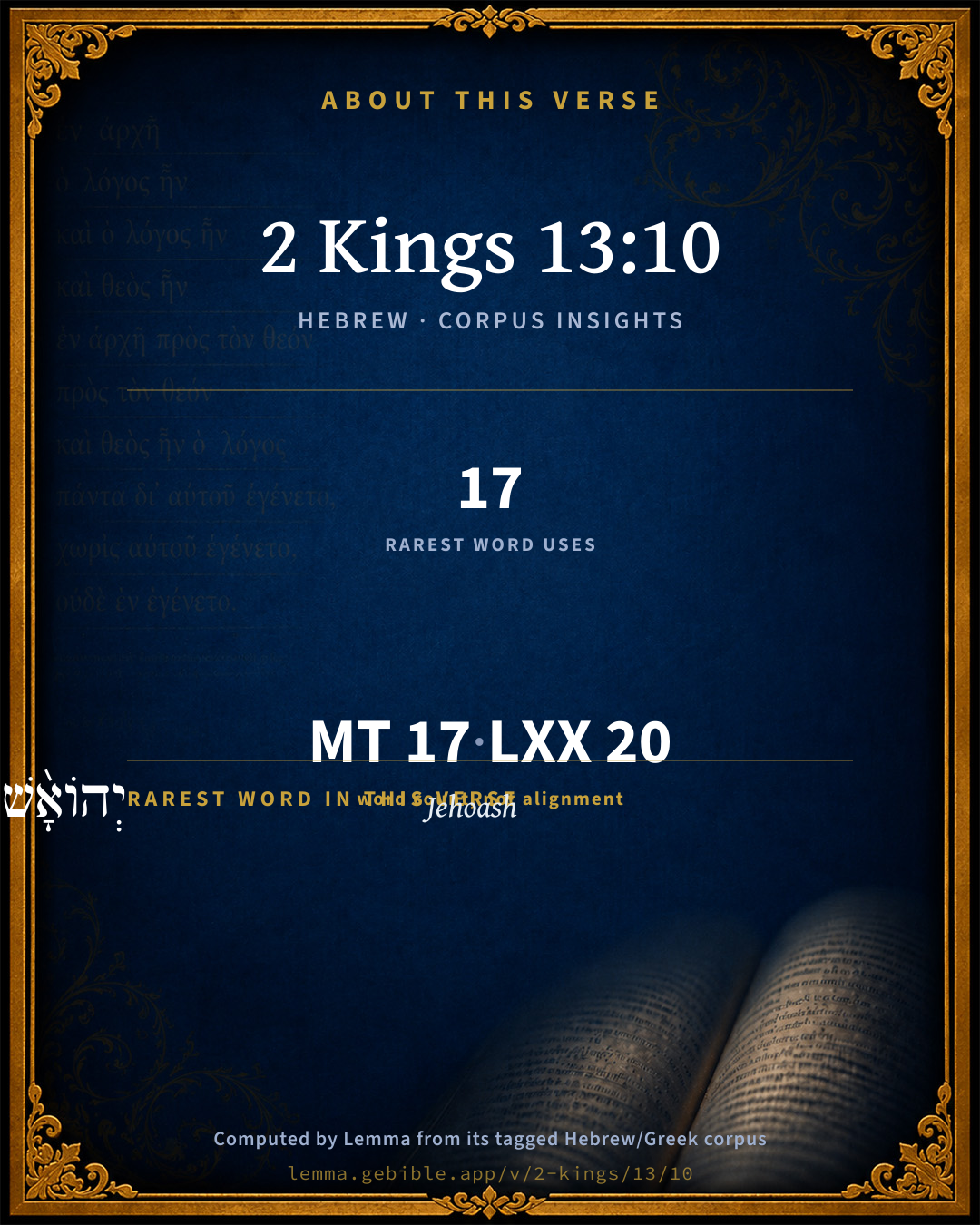
The rarest word here is יְהוֹאָ֨שׁ Jehoash H3060 — appearing just 17 times in the whole Hebrew Bible.

Shared distinctive vocabulary

יְהוֹאָ֨שׁ Jehoash H3060 occurs in 16 verses of the Hebrew Bible. Also found in:

Grammatical profile

  • 1 verb
  • 11 nouns
  • 4 adjectives
  • 1 preposition

Verb forms

  • מָ֠לַךְ Qal · Perfect

Repetition

A word recurs within this verse — often emphatic in Hebrew:

  • בִּשְׁנַ֨ת year H8141 ×3

Hebrew & Septuagint length

In English translation the verse runs 25 words from the Hebrew and 23 from the Septuagint (LXX English) — closely comparable.

A rough comparison of the two English renderings, which tokenize alike — not a word-level alignment.

Word counts can differ between the Hebrew and the Greek without any difference in meaning — e.g. the Hebrew direct-object marker אֵת has no separate Greek word, and Greek often adds the article ὁ.

In the original languages it is 17 Hebrew tokens and 20 Greek tokens — but the two are counted differently (Hebrew bundles its prefixes and suffixes into one token; the Greek is in lemma form), so that isn’t a like-for-like length.

Hebrew and Greek witnesses Masoretic Hebrew ↔ Greek Septuagint

The same verse in the two great witnesses to the Old Testament, shown verse-for-verse.

These are two independent witnesses, not word-aligned to each other, and the Septuagint is shown in lemma (dictionary) form.

Hebrew 2 Kings 13:10 Masoretic · Westminster Leningrad Codex

בִּשְׁנַ֨ת שְׁלֹשִׁ֤ים וָשֶׁ֨בַע֙ שָׁנָ֔ה לְיוֹאָ֖שׁ מֶ֣לֶךְ יְהוּדָ֑ה מָ֠לַךְ יְהוֹאָ֨שׁ בֶּן יְהוֹאָחָ֤ז עַל יִשְׂרָאֵל֙ בְּשֹׁ֣מְר֔וֹן שֵׁ֥שׁ עֶשְׂרֵ֖ה שָׁנָֽה

In the thirty-seventh year of Joash king of Judah began Jehoash the son of Jehoahaz to reign over Israel in Samaria, [and reigned] sixteen years.

World English Bible · Public Domain

Greek LXX 2 Kings 13:10 Septuagint · lemma form

ἐν ἔτος τριακοστός καί ἕβδομος ἔτος ὁ ιωας βασιλεύς ιουδα βασιλεύω ιωας υἱός ιωαχας ἐπί ἰσραήλ ἐν σαμαρεία ἑκκαίδεκα ἔτος

In the thirty-seventh year of Joas king of Juda, Joas the son of Joachaz began to reign over Israel in Samaria sixteen years.

LXX2012 (modern English Septuagint) · Public Domain

On this verse, Ellicott's Commentary for English Readers discusses the Septuagint’s reading. Read the note in Commentary ↓

Hebrew: Westminster Leningrad Codex (CC BY 4.0). Greek: Septuagint (public domain); English from LXX2012 (modern English Septuagint) (Public Domain). How the Septuagint differs from the Hebrew →

Targum (Aramaic paraphrase)

1

The Targum is the ancient Jewish Aramaic paraphrase of the Hebrew Scriptures — an interpretive translation, not the Hebrew text itself. Onkelos (literal) and Pseudo-Jonathan (expansive) render the Torah, and Jonathan the Prophets. Coverage is partial: where no permissively-licensed English translation exists for a verse, only the Aramaic is shown. This is verse-level text, not a word-by-word alignment to the Hebrew.

  1. Targum Jonathan Prophets (Joshua–Malachi)
    בִּשְׁנַת תְּלָתִין וּשְׁבַע שְׁנִין לְיוֹאָשׁ מֶלֶךְ שִׁבְטָא דְבֵית יְהוּדָה מְלַךְ יְהוֹאָשׁ בַּר יְהוֹאָחָז עַל יִשְׂרָאֵל בְּשֹׁמְרוֹן שִׁית עַסְרֵי שְׁנִין:

    (no public-domain English translation for this verse)

    Targum Jonathan — Aramaic: “Mikraot Gedolot” (public domain). English: “Sefaria Community Translation” (CC0 1.0 (public-domain dedication)); “London "Chaldee Paraphrase," 1871” (public domain). Text via Sefaria.

Commentary

Notes on 2 Kings 13:10 from classic Christian and Jewish commentators (each source and its license shown beneath its notes). The classic Christian expositions comment on the surrounding passage and are grouped to its opening verse, so a note may address several verses; the Jewish commentaries on the Tanakh (Rashi and others) are per-verse, so they appear only where the commentator wrote on this verse.

Lemma curates 59 commentaries, every one of them public domain or Creative Commons licensed, each selected and text-cleaned for this edition rather than reprinted as found. About our sources →

Matthew Henry's Commentary

We have here Jehoash, or Joash, the son of Jehoahaz and grandson of Jehu, upon the throne of Israel. Probably the house of Jehu intended some respect to the house of David when they gave this heir-apparent to the crown the same name with him that was then king of Judah.

I. The general account here given of him and his reign is much the same with what we have already met with, and has little in it remarkable, Kg2 13:10-13. He was none of the worst, and yet, because he kept up that ancient and politic idolatry of the house of Jeroboam, it is said, He did that which was evil in the sight of the Lord. That one evil was enough to leave an indelible mark of infamy upon his name; for, how little evil soever men saw in it, it was, in the sight of the Lord, a very wicked thing; and we are sure that his judgment is according to truth. It is observable how lightly the inspired penman passes over his acts, and his might wherewith he warred, leaving it to the common historians to record them, while he takes notice only of the respect he showed to Elisha. One good action shall make a better figure in God's book than twenty great ones; and, in his account, it gains a man a much better reputation to honour a prophet than to conquer a king and his army.

II. The particular account of what passed between him and Elisha has several things in it remarkable.

1. Elisha fell sick, Kg2 13:14. Observe, (1.) He lived long; for it was now about sixty years since he was first called to be a prophet. It was a great mercy to Israel, and especially to the sons of the prophets, that he was continued so long a burning and shining light. Elijah finished his testimony in a fourth part of that time. God's prophets have their day set them, some longer, others shorter, as Infinite Wisdom sees fit. (2.) All the latter part of his time, from the anointing of Jehu, which was forty-five years before Joash began his reign, we find no mention made of him, or of any thing he did, till we find him here upon his death-bed. He might be useful to the last, and yet not so famous as he had sometimes been. The time of his flourishing was less than the time of his living. Let not old people complain of obscurity, but rather be well pleased with retirement. (3.) The spirit of Elijah rested on Elisha, and yet he was not sent for to heaven in a fiery chariot, as Elijah was, but went the common road out of the world, and was visited with the visitation of all men. If God honour some above others, who yet are not inferior to them in gifts or graces, who shall find fault? May he not do what he will with his own?

2. King Joash visited him in his sickness, and wept over him, Kg2 13:14. This was an evidence of some good in him, that he had a value and affection for a faithful prophet; so far was he from hating and persecuting him as a troubler of Israel that he loved and honoured him as one of the greatest blessings of his kingdom, and lamented the loss of him. There have been those who would not be obedient to the word of God, and yet have the faithful ministers of it so manifested in their consciences that they could not but have an honour for them. Observe here, (1.) When the king heard of Elisha's sickness he came to visit him, and to receive his dying counsel and blessing; and it was no disparagement to him, though a king, thus to honour one whom God honoured. Note, It may turn much to our spiritual advantage to attend the sick-beds and death-beds of good ministers and other good men, that we may learn to die, and may be encouraged in religion by the living comforts they have from it in a dying hour. (2.) Though Elisha was very old, had been a great while useful, and, in the course of nature, could not continue long, yet the king, when he saw him sick and likely to die, wept over him. The aged are most experienced and therefore can worst be spared. In many causes, one old witness is worth ten young ones. (3.) He lamented him in the same words with which Elisha had himself lamented the removal of Elijah: My father, my father. It is probable he had heard or read them in that famous story. Note, Those that give just honours to the generation that goes before them are often recompensed with the like from the generation that comes after them. He that watereth, that watereth with tears, shall be watered, shall be so watered, also himself, when it comes to his own turn, Pro 11:25. (4.) This king was herein selfish; he lamented the loss of Elisha because he was as the chariot and horsemen of Israel, and therefore could be ill spared when Israel was so poor in chariots and horsemen, as we find they were (Kg2 13:7), when they had in all but fifty horsemen and ten chariots. Those who consider how much good men contribute to the defence of a nation, and the keeping off of God's judgments, will see cause to lament the removal of them.

3. Elisha gave the king great assurances of his success against the Syrians, Israel's present oppressors, and encouraged him to prosecute the war against them with vigour. Elisha was aware that therefore he was loth to part with him because he looked upon him as the great bulwark of the kingdom against that common enemy, and depended much upon his blessings and prayers in his designs against them. "Well," says Elisha, "if that be the cause of your grief, let not that trouble thee, for thou shalt be victorious over the Syrians when I am in my grave. I die, but God will surely visit you. He has the residue of the Spirit, and can raise up other prophets to pray for you." God's grace is not tied to one hand. He can bury his workmen and yet carry on his work. To animate the king against the Syrians he gives him a sign, orders him to take bow and arrows (Kg2 13:15), to intimate to him that, in order to the deliverance of his kingdom from the Syrians, he must put himself into a military posture and resolve to undergo the perils and fatigues of war. God would be the agent, but he must be the instrument. And that he should be successful he gives him a token, by directing him,

(1.) To shoot an arrow towards Syria, Kg2 13:16, Kg2 13:17. The king, no doubt, knew how to manage a bow better than the prophet did, and yet, because the arrow now to be shot was to have its significancy from the divine institution, as if he were now to be disciplined, he received the words of command from the prophet: Put thy hand upon the bow - Open the window - Shoot. Nay, as if he had been a child that never drew a bow before, Elisha put his hands upon the king's hands, to signify that in all his expeditions against the Syrians he must look up to God for direction and strength, must reckon his own hands not sufficient for him, but go on in a dependence upon divine aid. He teacheth my hands to war, Psa 18:34; Psa 144:1. The trembling hands of a dying prophet, as they signified the concurrence and communication of the power of God, gave this arrow more force than the hands of the king in his full strength. The Syrians had made themselves masters of the country that lay eastward, Kg2 10:33. Thitherward therefore the arrow was directed, and such an interpretation given by the prophet of the shooting of this arrow, though shot in one respect at random, as made it, [1.] A commission to the king to attack the Syrians, notwithstanding their power and possession. [2.] A promise of success therein. It is the arrow of the Lord's deliverance, even the arrow of deliverance from Syria. It is God that commands deliverance; and, when he will effect it, who can hinder? The arrow of deliverance is his. He shoots out his arrows, and the work is done, Psa 18:14. "Thou shalt smite the Syrians in Aphek, where they are now encamped, or where they are to have a general rendezvous of their forces, till thou have consumed those of them that are vexatious and oppressive to thee and thy kingdom."

(2.) To strike with the arrows, Kg2 13:18, Kg2 13:19. The prophet having in God's name assured him of victory over the Syrians, he will now try him and see what improvement he will make of his victories, whether he will push them on with more zeal than Ahab did when Benhadad lay at his mercy. For the trial of this he bids him smite with the arrows on the ground: "Believe them brought to the ground by the arrow of the Lord's deliverance, and laid at thy feet; and now show me what thou wilt do to them when thou hast them down, whether thou wilt do as David did when God gave him the necks of his enemies, beat them small as the dust before the wind," Psa 18:40, Psa 18:42. The king showed not that eagerness and flame which one might have expected upon this occasion, but smote thrice, and no more. Either out of foolish tenderness to the Syrians, he smote as if he were afraid of hurting them, at least of ruining them, willing to show mercy to those that never did, nor ever would, show mercy to him or his people. Or, perhaps, he smote thrice, and very coldly, because he thought it but a silly thing, that it looked idle and childish for a king to beat the floor with his arrows; and thrice was often enough for him to play the fool merely to please the prophet. But, by contemning the sign, he lost the thing signified, sorely to the grief of the dying prophet, who was angry with him, and told him he should have smitten five or six times. Not being straitened in the power and promise of God, why should he be straitened in his own expectations and endeavours? Note, It cannot but be a trouble to good men to see those they wish well to stand in their own light and forsake their own mercies, to see them lose their advantages against their spiritual enemies, and to give them advantage.

Matthew Henry's Commentary on the Whole Bible (1708–1710) — public domain (CC PDM 1.0). Text via the HelloAO Bible API.

Trapp's Complete Commentary

John Trapp

2Ki 13:10 In the thirty and seventh year of Joash king of Judah began Jehoash the son of Jehoahaz to reign over Israel in Samaria, [and reigned] sixteen years.

Ver. 10. Began Jehoash the son of Jehoahaz to reign.] Two years before his father’s death. See 2Ki 13:1.

John Trapp, A Commentary or Exposition upon All the Books of the Old and New Testament (1647–1656) — public domain. Text from a community e-Sword module.

Joseph Benson's Commentary

2Ki 13:10. In the thirty and seventh year of Joash, king of Judah, &c. — A difficulty arises in comparing this with 2Ki 13:1, where it is said, Jehoahaz began to reign in the twenty-third year of Joash, king of Judah, and reigned seventeen years: from whence it follows, that this Jehoash, son of Jehoahaz, began to reign, not in the thirty-seventh, but in the thirty-ninth or fortieth year of Joash, king of Judah. This difficulty, however, is solved by supposing, what is very probable, that Jehoahaz had made his son Jehoash king, jointly with himself, two or three years before his death. This is the more probable, because he was perpetually in a state of war, and consequently in danger of an untimely death; and because his son was a man of valour, as is implied, 2Ki 13:12, and declared, 2Ch 25:17-24.

Joseph Benson's Commentary on the Old and New Testaments (1811–1818) — public domain. Text from a community e-Sword module.

Whedon's Commentary on the Bible

Daniel D. Whedon

REIGN OF JOASH, SON OF JEHOAHAZ, KING OF ISRAEL, 2Ki_13:10-13.

The record here given of Joash’s reign is very brief, but is supplemented by the account of his visit to the dying prophet Elisha, (2Ki_13:14-19,) and his victories over Ben-hadad, (2Ki_13:25.) Though he walked too much after the evil examples of his predecessors, his reign was not without some redeeming and commendatory features. His visit to Elisha showed profound reverence for that prophet; and his successful wars against the Syrian oppressor showed him to be a God-sent saviour to Israel, though he failed to accomplish complete deliverance. 2Ki_13:5, note. His war with Amaziah is narrated in 2Ki_14:8-15, and 2Ch_25:17-24. His name is written both Joash and Jehoash, the former being only a contraction of the latter.

Daniel D. Whedon (gen. ed.), Commentary on the Old and New Testaments (1874–1909) — public domain. Text from a community e-Sword module.

Tyndale Open Study Notes

Tyndale Open Resources

13:10-13 The narrator atypically combines the accession statement for Jehoash with the usual closing notice concerning his reign. This arrangement allows him to focus attention on some final details about Elisha (13:14-21) and Israel’s continuing problem with Aram (13:22-25) before returning to Jehoash’s war with King Amaziah of Judah in 14:8-14. • The Book of the History of the Kings of Israel: See study note on 1 Kgs 14:19-20.

Tyndale Open Study Notes — © Tyndale Open Resources, licensed CC BY-SA 4.0. Text via the HelloAO Bible API.

Geneva Bible (1599)

Geneva Bible translators

His chief purpose is to describe the kingdom of Judah, and how God performed his promise made to the house of David: but by the way he showeth how Israel was afflicted and punished for their great idolatry, who though they had now degenerated, yet God both by sending them sundry Prophets and divers punishments, did call them unto him again.

Geneva Bible (1599) marginal notes — public domain. Text via Bolls.life.

Adam Clarke's Commentary

Verse 10. In the thirty and seventh year] Joash, the son of Jehoahaz, was associated with his father in the government two years before his death. It is this association that is spoken of here. He succeeded him two years after, a little before the death of Elisha. Joash reigned sixteen years, which include the years he governed conjointly with his father. - Calmet.

Adam Clarke's Commentary on the Bible (1810–1826) — public domain. Text from a community e-Sword/MySword module.

Ellicott's Commentary for English Readers

(10-25) THE REIGN OF JOASH, OR JEHOASH.ELISHA FORETELLS HIS SUCCESSES AGAINST THE SYRIANS.

(10) In the thirty and seventh year.—This does not agree with 2Ki_13:1. The Ald. LXX. reads,” thirty-ninth,” which is right.

Began . . . to reign, and reigned sixteen years.—The Hebrew is briefer, reigned sixteen years.

A Bible Commentary for English Readers, edited by Charles John Ellicott (1878–1897) — public domain. Text from a community e-Sword module.

The Cambridge Bible for Schools and Colleges

gen. ed. J. J. S. Perowne

10–13. Reign of Jehoash king of Israel (2Ch_25:17-24)

10. In the thirty and seventh year of Joash] See above on verse 1.

Jehoash the son of Jehoahaz] As in the case of Jehoash king of Judah (see 2Ki_12:2; 2Ki_12:19-20) so here the longer form, in the previous verse the shorter form of this name is written. This was the second of the four generations promised to Jehu.

The Cambridge Bible for Schools and Colleges (gen. ed. J. J. S. Perowne; Cambridge University Press, 1878–1918) — public domain. Text from a community e-Sword module.

John Gill's Exposition

In the thirty and seventh year of Joash king of Judah, began Jehoash the son of Jehoahaz to reign over Israel in Samaria,.... But inasmuch as his father began to reign in the twenty third of Joash, and reigned seventeen years, Kg2 13:1 this king must begin to reign in the thirty ninth or fortieth of Joash; for the reconciling of which it may be observed, that two of the years of his reign may be supposed to be imperfect; or rather that his son reigned two or three years in his lifetime, being raised up before his father's death to be a saviour of Israel from the Syrians; and so his father lived to see his prayer answered, Kg2 13:4,

and reigned sixteen years.

John Gill's Exposition of the Whole Bible (1746–1763) — public domain (CC PDM 1.0). Text via the HelloAO Bible API.

Haydock's Catholic Bible Commentary

Seven. To complete the number seventeen, (ver. 1.) it ought to be "nine" ending. (Houbigant, p. 109.) See chap. xiv. 23. --- Years. If Jeroboam reigned in the 15th year of Amasias, and his father in the 37th of Joas, and not in the 39th almost complete, this king would have held dominion eighteen years. (Ibid.[Houbigant, p. 109.?])

George Leo Haydock (1774–1849), Haydock's Catholic Family Bible and Commentary, 1859 edition — public domain. Excludes Psalms (Douay-Rheims chapter numbering differs from Protestant) and Deuterocanonical books (Catholic canon only).

Matthew Poole's English Annotations

By which, compared with 2Ki 13:1, it may be gathered that Jehoahaz had two or three years before his death made his son Jehoash king with him; which is very probable, because he was perpetually in the state of war, and consequently in danger of an untimely death, and because he was a man of valour, as is implied here, 2Ki 13:12, and declared 2Ch 25.

Matthew Poole's English Annotations on the Holy Bible (1683–1685) — public domain. Text from a community e-Sword/MySword module.

The Pulpit Commentary

Vers. 10-25. THE REIGN OF JOASH. The writer passes from the reign of Jehoahaz, Jehu"s son, to that of Joash, Jehu"s grandson, which he seems to have intended at first to dispatch in the short space of four verses (vers. 10-13). He afterwards, however, saw reason to add to his narrative, first, an account of an interview between Joash and Elisha, shortly Before the death of the latter (vers. 14-19); secondly, an account of a miracle wrought soon afterwards by means of Elisha"s corpse (vers. 20, 21); and thirdly, a brief notice of Joash"s Syrian war (vers. 22-25).

In the thirty and seventh year of Joash King of Judah. Three years before his death, since he reigned forty years. (2Ki_12:1) The two Joashes were thus contemporary monarchs for the space of three years. Began Jehoash the son of Jehoahaz to reign ever Israel in Samaria, and reigned sixteen years. The construction is the same as that of ver. 1, and is equally ungrammatical. Our translators again amend the faulty phrase by introducing the words "and reigned" The "sixteen years" of the reign of Joash are confirmed by Josephus ("Ant. Jud:," 9:8. but still present some difficulty. (see the comment on 2Ki_14:23)

The Pulpit Commentary (1880–1919), ed. H.D.M. Spence-Jones & Joseph S. Exell — public domain. Text from a community e-Sword module.

Keil & Delitzsch

C. F. Keil & F. Delitzsch

Reign of Jehoash or Joash of Israel. - On the commencement of his reign see at Kg2 13:1. He also walked in the sins of Jeroboam (compare Kg2 13:11 with Kg2 13:2 and Kg2 13:6). The war with Amaziah referred to in Kg2 13:12 is related in the history of this king in Kg2 14:8-14; and the close of the reign of Joash is also recorded there (Kg2 14:15 and Kg2 14:16) with the standing formula. And even here it ought not to be introduced till the end of the chapter, instead of in Kg2 13:12 and Kg2 13:13, inasmuch as the verses which follow relate several things belonging to the reign of Joash. But as they are connected with the termination of Elisha's life, it was quite admissible to wind up the reign of Joash with Kg2 13:13.

Keil & Delitzsch — Biblical Commentary on the Old Testament (1861–1891) — public domain (CC PDM 1.0). Text via the HelloAO Bible API. (Old Testament only.)

Kretzmann's Popular Commentary

Paul E. Kretzmann

Jehoash King of Israel

v. 10. In the thirty and seventh year of Joash, king of Judah, began Jehoash, the son of Jehoaha; to reign over Israel in Samaria, and reigned sixteen years.

v. 11. And he did that which was evil in the sight of the Lord; he departed not from all the sins of Jeroboani, the son of Nebat, who made Israel sin, the calf-worship was continued as before; but he walked therein, he not only tolerated the idolatry connected with this cult, but was guilty of it himself.

v. 12. And the rest of the acts of Joash, and all that he did, all his works in peace and war, and his might wherewith he fought against Amaziah, king of Judah, are they not written in the Book of the Chronicles of the Kings of Israel?

v. 13. And Joash slept with his fathers, a fact which is here inserted to round off the narrative; and Jeroboam sat upon his throne; and Joash was buried in Samaria with the kings of Israel. Some important events of his reign are next related.

v. 14. Now, Elisha was fallen sick of his sickness whereof he died, being severely ill for some time. And Joash, the king of Israel, came down unto him and wept over his face, for lie realized what a loss the death of Elisha would be to the entire nation, and said, O my father, my father, the chariot of Israel and the horsemen thereof! Elisha, like Elijah, had been a powerful defense of Israel against great and mighty enemies, as the history of the kingdom during the period had shown.

v. 15. And Elisha, having a last message for the king, said unto him, Take bow and arrows. And he took unto him bow and arrows.

v. 16. And he said to the king of Israel, Put thine hand upon the bow, literally, "Let thy hand rest on the bow"; for the left hand rests upon the bow as it is drawn. And he put his hand upon it. And Elisha put his hands upon the king’s hands, thus signifying that the impulse for the act came from the Lord, that it was performed in the name and by the authority of Jehovah.

v. 17. And he said, Open the window eastward, that being the direction in which the enemies lived. And he opened it. Then Elisha said, Shoot. And he shot. And he, Elisha, said, while the arrow was speeding forward, The arrow of the Lord’s deliverance and the arrow of deliverance from Syria; the arrow was a symbol of the deliverance which Jehovah would surely give, and it was a pledge of Jehovah against the forces of Syria; for thou shalt smite the Syrians in Aphek till thou have consumed them, they would suffer a decisive defeat.

v. 18. And he, Elisha, said, Take the arrows. And he took them. And he said unto the king of Israel, Smite upon the ground, hitting or shooting to the earth, to indicate that whosoever would be hit by the arrows would be stretched to the ground. And he smote thrice and stayed, stopping before the prophet had bidden him to.

v. 19. And the man of God was wroth with him and said, Thou shouldest have smitten five or six times; then hadst thou smitten Syria till thou hadst consumed it, till the might of the Syrians had definitely been broken; whereas now thou shalt smite Syria but thrice, administer only three defeats to its armies. Jehoash was lacking in that importunity which was and is necessary in asking any gifts from the Lord.

v. 20. And Elisha died, having reached a good old age, probably eighty years; and they buried him. And the bands of the Moabites Invaded the land at the coming in of the year, small bands which made incursions for the sake of plunder, on the order of Bedouin border raids, coming when the season of military campaigning opened.

v. 21. And it came to pass, as they were burying a man, that, behold, they, who were occupied with this work, spied a band of men, whom they took to be some of the raiders; and they cast the man into the sepulcher of Elisha, hastily depositing him there since they had no time to dig a grave. And when the man was let down, gradually approaching the corpse of Elisha, and touched the bones of Elisha, he revived, restored to life by a miracle of God, and stood up on his feet. The Lord wanted to remind His people once more that He has absolute power over death and can recall men to life as He chooses.

v. 22. But Hazael, king of Syria, oppressed Israel all the days of Jehoahaz, such had been the condition under his reign.

v. 23. And the Lord was gracious unto them, and had compassion on them, and had respect unto them, He regarded and treated them with merciful compassion, because of His covenant with Abraham, Isaac, and Jacob, and would not destroy them, neither cast He them from His presence as yet, His merciful patience was not yet exhausted, the promise of His kindness was still held out to them.

v. 24. So Hazael, king of Syria, died; and Benhadad, his son, reigned in his stead.

v. 25. And Jehoash, the son of Jehoahaz, took a gain out of the hand of Benhadad, the son of Hazael, the cities which he had taken out of the hand of Jehoahaz, his father, by war, in the campaigns during which he had almost conquered the entire country of Israel. Three times, according to the number of times that he shot at the ground, did Joash beat him, and recovered the cities of Israel. Like that of Elisha, the memory of all teachers is a testimony to later generations. Note also: The Lord is not slack concerning His promise, as some men count slackness, but is long-suffering to usward, not willing that any should perish, but that all should come to repentance, 2Pe 3:9.

Paul E. Kretzmann, Popular Commentary of the Bible (1921–1924) — public domain. Text from a community e-Sword module.

unfoldingWord translationNotes

Door43 World Missions Community

In the thirty-seventh year of Joash king of Judah

"After Joash had ruled Judah for almost 37 years" (See: Numbers)

the reign of Jehoash son of Jehoahaz began over Israel in Samaria

"Jehoash son of Jehoahaz began to rule over Israel in Samaria"

Jehoash

This was a king of Israel who was the son of Jehoahaz. (See: How to Translate Names)

He did what was evil in the sight of Yahweh

Here "sight" represents God's thoughts or judgment. AT: "He did things that Yahweh considers to be evil" (See: Metaphor)

He did not leave behind any of the sins of Jeroboam

To stop sinning is spoken of as if he left behind the sins. This can be stated in positive form. AT: "Jehoash did not stop committing the same sins as Jeroboam" or "Jehoash kept committing the same sins as Jeroboam" (See: Metaphor)

by which he had made Israel to sin

"by which Jeroboam had caused Israel to sin"

but he walked in them

To sin is spoken of as if he was walking along a sinful path. AT: "but Jehoash continued to do these same sins" (See: Metaphor)

translationWords

Joash

king

kingdom of Judah

reign

Yahweh

Jeroboam

unfoldingWord translationNotes — © Distant Shores Media and the Door43 World Missions Community, licensed CC BY-SA 4.0. Source: git.door43.org/Door43/en_tn.

Rashi

Rabbi Shlomo Yitzchaki (Rashi)

In the thirty-seventh year, etc. This verse is contradicted from two sides, and I have not found a reconciliation, for it should have said, “thirty-ninth [year],” because his father ascended [to the throne] in the twenty-third year of Yoash[’s reign], and reigned seventeen years, consequently, he died in the thirty-ninth year of Yoash[’s reign]. Also, it is stated below in this section, “In the second year of Yoash son of Y[eh]oachaz, king of Yisroel, Amatzyoh, son of Yoash became king.” —the king of Yehudah—Consequently, Yoash son of Yehoachaz, ascended [to the throne] in the fortieth year of Yoash, which was his last year, and in the second year of Yoash son of Yehoachaz, Amatzyoh became king. And even if you say that Amatzyoh became king in the year of his father’s death, and Scripture calls this the second year of Yoash[’s reign], [nonetheless,] you can deduce that Yoash the king of Yisroel did not become king until the thirty-ninth year of Yoash the king of Yehudah.

Rashi on the Tanakh — English translations: “The Judaica Press complete Tanach with Rashi, translated by A. J. Rosenberg” (CC BY 4.0); “Pentateuch with Rashi's commentary by M. Rosenbaum and A.M. Silbermann, 1929-1934” (public domain); “The Metsudah Tanach series, Lakewood, N.J” (CC BY 4.0); and “The Book of Joshua, Metsudah Publications, 1997” (CC BY 4.0). Text via Sefaria.

Lesson kit

Teaching starters — assembled from the data on this page, not authored interpretation. Every prompt links to the verse data it draws on. Edit before teaching.

2 Kings, in the Historical, opens this verse with 17 words (15 distinct Hebrew lemmas). Its most distinctive word is Yᵉhôwʼâsh (“Jehoash”). A historical commentator’s framing appears above. Read the whole chapter for the surrounding context.

Discussion questions

  1. What does “Jehoash” (Yᵉhôwʼâsh) contribute to the verse as a whole?
  2. How does 2 Kings 11:21, which shares the word «Jehoash», read alongside this verse?
  3. What does the repetition of “year” (3× in this one verse) do in this verse?
  4. These translations render this verse differently. What is at stake in choosing one wording over another?
  5. «מָ֠לַךְ» is a Qal Perfect verb. How does that grammatical form shape the action described?
  6. Compare how Matthew Henry's Commentary and Trapp's Complete Commentary read this verse. Where do they agree or differ?

Things to notice

Reading settings

Reading text

Shown beneath each verse's original-language words.

Old Testament
Old Testament edition

Read the OT as the Masoretic Hebrew (MT) or the Greek Septuagint (LXX).

English shown for the Greek Septuagint (in the Hebrew ↔ Greek comparison).

Comparing translations? Open the Compare panel on any verse page to stack up to four side by side.