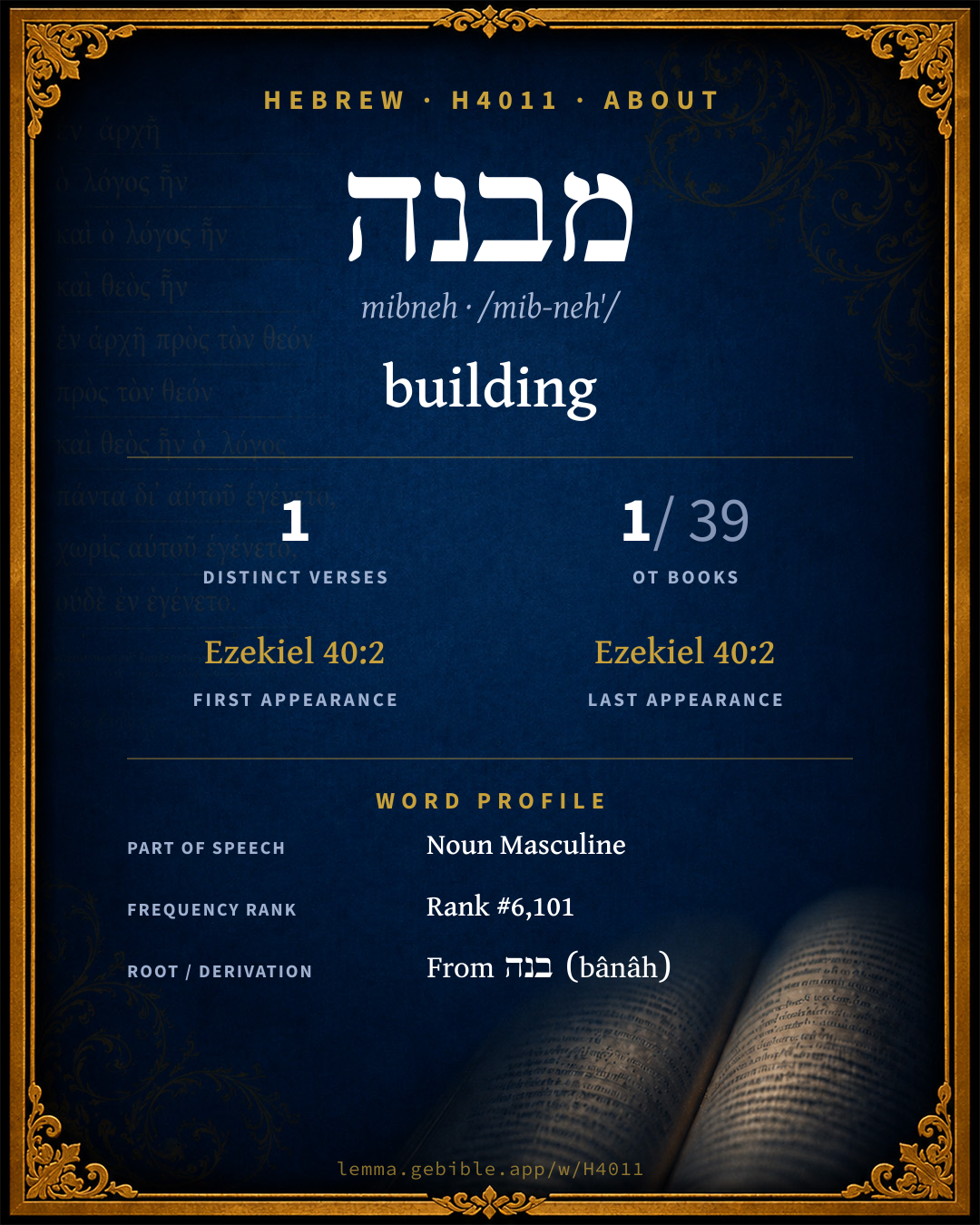
מִבְנֶה
building
Full lexicon entry — Brown-Driver-Briggs (BDB)
From Brown-Driver-Briggs (BDB)
Where this word appears
Grammar key — what these labels mean
Noun type
- Common
- A common noun — a general class of person, place, or thing (“king,” “city,” “water”), not a specific name.
State
- Construct
- A noun bound to a following noun in a possessive / “of” relationship (the construct chain).
Gender
- Masculine
- Grammatically masculine.
Number
- Singular
- One.
Every verse where H4011 appears — 1 distinct verse across 1 book. Click any verse to open its interlinear word-by-word view. Verse text shown in the World English Bible for context — . Each verse’s Hebrew form is shown with its reference; the English is not keyword-highlighted, since the data carries no word-level English alignment. Use “Compare translations” on any verse to read it across multiple English versions. This concordance covers the Hebrew Bible; Septuagint (Greek Old Testament) occurrences are not indexed here.
Ezekiel 1 verse
About this entry
At a glance — auto-summarized from this page’s data, not written by a person. Every figure links to its source below. This summary describes the numbers; it doesn’t interpret them.
מבנה (mibneh) is a Hebrew noun most often rendered “building.” With only 1 verse it sits in the long tail of Hebrew Bible vocabulary. Ezekiel dominates its distribution — 1 of 1 verses. Found nowhere else but Ezekiel 40:2. Related forms include בנה, אבן and בית. The sections below give every sense, occurrence, and version rendering.
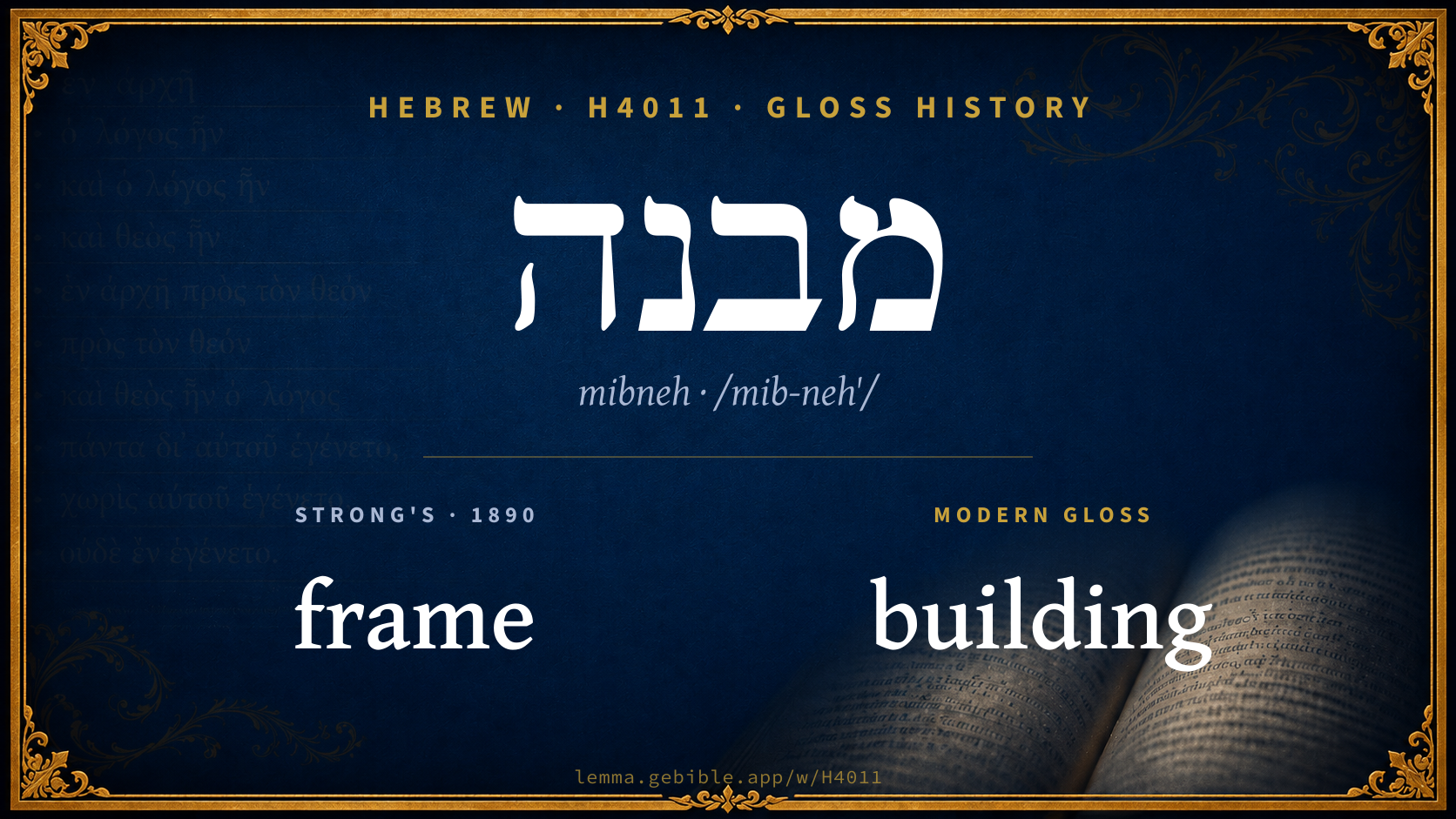
Gloss history
Strong's 1890 vs modern scholarship
About this word
Strong's H4011 catalogs a Hebrew word from the Hebrew Old Testament.
These counts are not copied from any lexicon or concordance. They are computed here, from the morphology-tagged Hebrew Old Testament. What Lemma adds →
- 1
- distinct verses
- The word appears in 1 distinct verse.
- 1 / 39
- OT books
- The word appears in 1 of 39 Old Testament books.
- #6,101
- by frequency
- Rank #6,101 (rank 6,101 of 8,640 Hebrew words by occurrence).
View all 1 occurrence in the concordance →
Most concentrated in
- Ezekiel 1 verse 100%
By section of the Old Testament
By traditional corpus
Conventional, traditional groupings — biblical authorship is debated, so this is a traditional corpus grouping, not an authorship claim. Each share is this word’s portion of its verses in that division of the Hebrew canon. Each figure is a share of the word’s 1 distinct verse.
- Prophets (Nevi'im) 1 verse · 100%
How translations render this word
Counts come from each version’s own published word-to-Strong’s tagging or interlinear alignment — an approximate guide to how each version renders this word, not a word-level alignment the data otherwise carries. Because each total is that version’s own tagged count, the per-version totals vary from one another and need not match the appearance or distinct-verse counts above. These counts may also differ from a printed concordance because Lemma counts each distinctly tagged rendering and does not collapse phrase taggings into a single head-word total. This is a fixed set of word-tagged versions (KJV, ASV, BSB, ULT) and does not change with the reading translation you choose elsewhere. Each version’s license is shown beside its name below (and on Sources).
- King James Version: Was as the frame 1×
- American Standard Version: Whereon was as it were the frame 1×
- Berean Standard Bible: Was a structure 1×
- unfoldingWord Literal Text: Were what appeared to be buildings 1×
King James Version Public Domain
Renders H4011 across 1 tagged occurrence — most commonly:
American Standard Version Public Domain
Renders H4011 across 1 tagged occurrence — most commonly:
Berean Standard Bible Public Domain
Renders H4011 across 1 tagged occurrence — most commonly:
unfoldingWord Literal Text CC BY-SA 4.0
Renders H4011 across 1 tagged occurrence — most commonly:
Senses in BDB
The 1 sense BDB distinguishes for this word, in lexicon order (not ranked by frequency or importance). The full entry — with sub-senses — is in the Lexicon Entry tab.
- structure, building
Word origin
[ מִבְנֶה ] n.m. structure Ez 40:2 like the structure of a city.
— Brown-Driver-Briggs (Oxford 1906, public domain), digitized via Sefaria, supplemented by the OpenScriptures HebrewLexicon (CC BY 4.0). See Sources.
Derived from בנה (bânâh) (H1129) — to build.
Jastrow Dictionary
A second Hebrew/Aramaic lexicon for comparison, covering Aramaic and post-biblical (Talmudic, Targumic, Midrashic) usage that the biblical-Hebrew BDB does not. Matched by lemma rather than by Strong’s number, so a lemma may carry more than one Jastrow headword (shown separately below), and the entries cover usage well beyond the Bible.
בני
- [to combine,] to build. Sabb. XII, 1 הַבּוֹנֶה he who builds (on the Sabbath). Ib.] 102ᵇ משום בונה (isguilty) because it is one of the labors classified under ‘building’; a. fr.—Metaph. to educate, train. Ber. 64ᵃ (ref. to Is. LIV, 93) א"ת בָּנַיִךְ אלא בוֹנַיִּךְ read not banayikh (thy children), but bonayikh (thy builders, trainers); v. בַּנָּאִים.—Ex. R. s. 23 (play on b’noth, Cant. I, 5) בּוֹנוֹת וכ׳ the authorities directing the building of Jerusalem; v. Pi.—Ḥull. 78ᵇ זה בנה אב, v. אָב, a. בִּנְיָן. [Tosef. Par. VII (VI), 4 בְּנָאוֹ ed. Zuck., v. כָּנַן.] e.g. Isaiah 54:93
- 1. to be built up. Y. B. Bath. III, 14ᵇ, a. fr. לְהִיבָּנוֹת, לִיבָּנוֹת.
- 2. (denom. of בֵּן) to get children. Gen. R. s. 71.
- (denom. of בֵּן) to be adopted, naturalized. Pesik. R. s. 43 נִתְבַּנּוּ בישראל they became full Israelitish citizens.
- to lay out, plan a city, determine its limits. Ex. R. l. c. the Great Sanedrin held sessions ומְבַנָּים אותה (not אותם) and determined the limits of Jerusalem; v. Snh. I, 5.—Part. Pu. מְבוּנֶּה cultivated; built (of human stature), well-proportioned. Keth. 112ᵃ; Sot. 34ᵇ היתה מְבוּנָּה על וכ׳ it (Hebron, in spite of the rocky nature of its soil) was seven times better cultivated than Zoan (one measure of its land yielding as much as did seven measures of the soil of Zoan). Ib. 42ᵇ (play on benayim, I Sam. XVII, 4) מב׳ מכל מום his build was without blemish. e.g. 1 Samuel 17:4
A Dictionary of the Targumim, the Talmud Babli and Yerushalmi, and the Midrashic Literature (Marcus Jastrow; London, Luzac, 1903) — Public Domain. Digitized via Sefaria. Digitized via Sefaria. Full attribution on Sources.
Same root — word family
Other BDB entries built from the same root as H4011, grouped by Strong’s listed origin. These share a root / origin per the lexicon — not necessarily a shared meaning. Each links to that word’s own entry.
Derives from
Shares the same root
- אבן ʼeben H68 stone
- בית bayith H1004 house
- בן bên H1121 son
- בנא bᵉnâʼ H1124 to build
- בניה binyâh H1140 building
- בנין binyân H1146 building
- בת bath H1323 daughter
- תבן teben H8401 stubble
- תבנית tabnîyth H8403 pattern
Proper names from this root
People and places named from this root — a name, not an additional meaning of the word.
- בנוי Binnûwy H1131 Binnui
- בני Bânîy H1137 Bani
- בני Bunnîy H1138 Bunni
- בניה Bᵉnâyâh H1141 Benaiah
- יבנאל Yabnᵉʼêl H2995 Jabneel
- יבנה Yabneh H2996 Jabneh
- יבניה Yibnᵉyâh H2997 Ibneiah
- יבניה Yibnîyâh H2998 Ibnijah
- מבני Mᵉbunnay H4012 Mebunnai
Compare all same-root words → Showing 4 of 20 — not the complete family. 9 of the same-root words are proper names (people or places). They share a root, not necessarily a meaning.
Septuagint verse parallels
This word appears in 1 verse that also exists in the Greek Old Testament (Septuagint), out of the 1 Hebrew verse it occurs in. You can read those verses in Greek by switching the Old Testament edition to the Septuagint.
Read these verses in the Septuagint
This is a verse-level parallel only — the same verses exist in both the Hebrew and Greek Old Testaments. No word-level Hebrew↔Greek correspondence is claimed: the data carries no such alignment, so no Greek word is shown as this Hebrew word’s translation. Coverage is not total — the Septuagint omits the deuterocanon and renumbers the Psalms, so some Hebrew verses have no direct Greek parallel.