
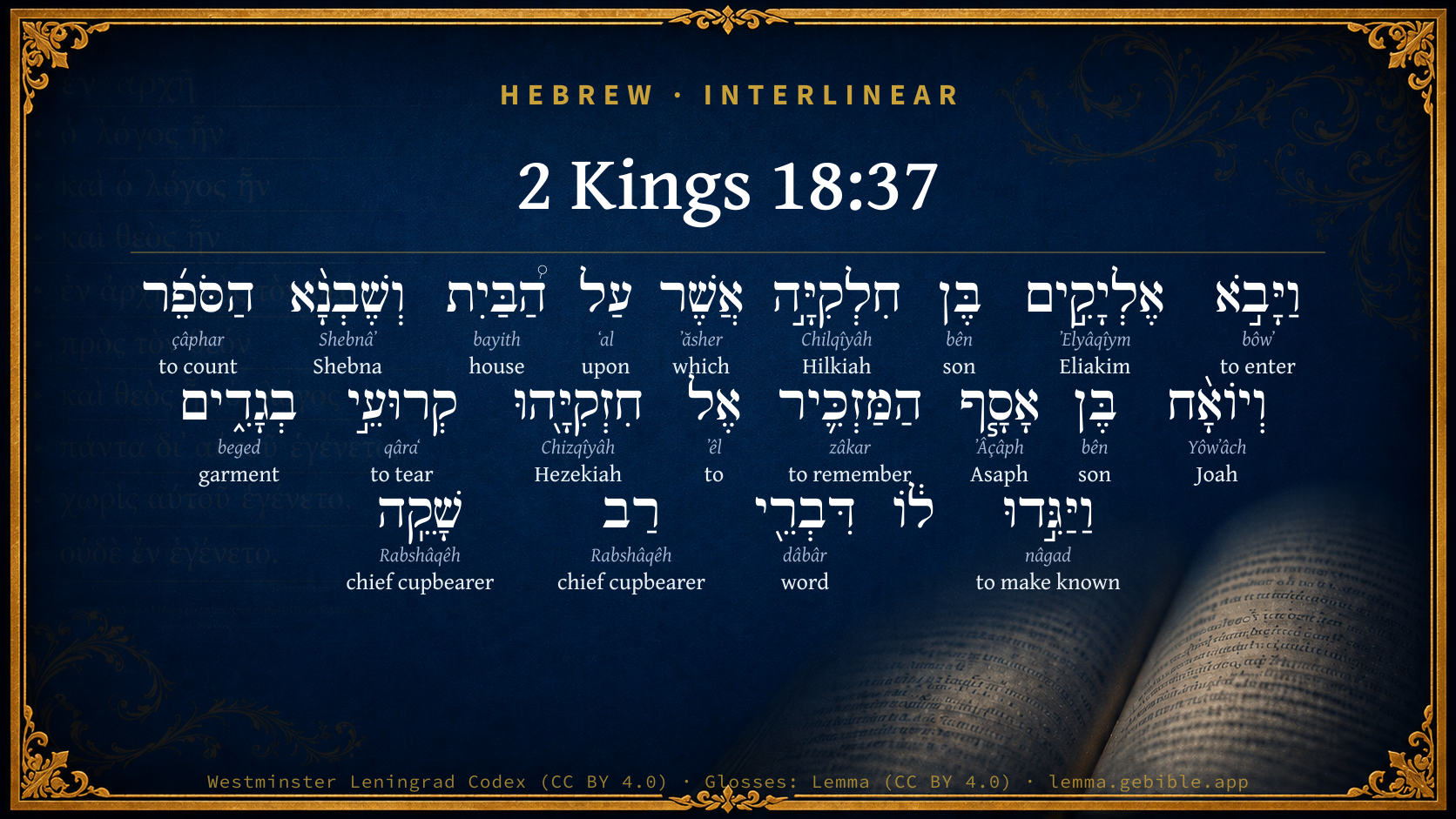
2 Kings 18:37

Hebrew (Westminster Leningrad Codex) 2 Kings 18:37 appears in the Hebrew Old Testament. The text above is from the Westminster Leningrad Codex. Each word links to its Strong’s number, a concise gloss, and parsing drawn from the Open Scriptures Hebrew Bible morphology. Click any word for its full Brown-Driver-Briggs (BDB) entry.
Download image
Cite this verse

2 Kings 18:37 (World English Bible). Public Domain. Lemma interlinear Bible study tool, https://lemma.gebible.app/v/2-kings/18/37.

Show BibTeX & RIS
BibTeX
RIS
English Translation
Then came Eliakim the son of Hilkiah, who was over the household, and Shebna the scribe, and Joah the son of Asaph the recorder, to Hezekiah with their clothes torn, and told him the words of Rabshakeh.
World English Bible · Public Domain
Download a study sheet

One document with this verse’s original text, its word-by-word gloss line, the meaning frame, cross-references with their text, attributed commentary, and full source and license credits — printable, and it pastes into notes with its structure intact.

This verse Autodidact and up

Study sheet (.html) Plain text (.txt)

A passage Seminary Student

Up to 50 verses in one chapter. A passage sheet keeps up to 6 commentary sources and 12 cross-references per verse, in the order this page ranks them, and says so on the sheet whenever that leaves anything out. Ask for a single verse and you get the Autodidact verse sheet above.

Everything on this page stays free to read, with no account — the sheet is a download of what is already on screen, not access to it.

Want to remove ads? Support Godless Engineer
Compare translations 3

The same verse in 3 English versions, stacked beneath the original-language interlinear above. Click any original word for its lexicon entry.

Each is an independent rendering of the whole verse — the interlinear is not word-aligned to these translations.

Highlighted words mark where these versions differ — a whole-verse word diff, not a word-by-word alignment.

  • World English Bible Public Domain
    Then came Eliakim the son of Hilkiah, who was over the household, and Shebna the scribe, and Joah the son of Asaph the recorder, to Hezekiah with their clothes torn, and told him the words of Rabshakeh.
  • King James Version Public Domain
    Then came Eliakim the son of Hilkiah, which was over the household, and Shebna the scribe, and Joah the son of Asaph the recorder, to Hezekiah with their clothes rent, and told him the words of Rabshakeh.
  • unfoldingWord Literal Text CC BY-SA 4.0
    Then Eliakim, the son of Hilkiah, who over the house, with Shebna the scribe and Joah, the son of Asaph, the recorder, came to Hezekiah, torn of clothes. And they declared to him the words of the Rabshakeh.

unfoldingWord Literal Text — © unfoldingWord, licensed CC BY-SA 4.0. Word-aligned USFM3 via Door43 (git.door43.org/unfoldingWord/en_ult).

Versions to compare (up to 4)

3 of 4 selected

Show all 18 translations

Every available English version of this verse, each an independent rendering of the whole verse.

  • World English Bible Public Domain
    Then came Eliakim the son of Hilkiah, who was over the household, and Shebna the scribe, and Joah the son of Asaph the recorder, to Hezekiah with their clothes torn, and told him the words of Rabshakeh.
  • Berean Standard Bible Public Domain
    Then Hilkiah’s son Eliakim the palace administrator, Shebna the scribe, and Asaph’s son Joah the recorder came to Hezekiah with their clothes torn, and they relayed to him the words of the Rabshakeh.
  • Majority Standard Bible Public Domain
    Then Hilkiah’s son Eliakim the palace administrator, Shebna the scribe, and Asaph’s son Joah the recorder came to Hezekiah with their clothes torn, and they relayed to him the words of the Rabshakeh.
  • King James Version Public Domain
    Then came Eliakim the son of Hilkiah, which was over the household, and Shebna the scribe, and Joah the son of Asaph the recorder, to Hezekiah with their clothes rent, and told him the words of Rabshakeh.
  • American Standard Version (1901) Public Domain
    Then came Eliakim the son of Hilkiah, who was over the household, and Shebna the scribe, and Joah the son of Asaph the recorder, to Hezekiah with their clothes rent, and told him the words of Rabshakeh.
  • Revised Version (1885) Public Domain
    Then came Eliakim the son of Hilkiah, which was over the household, and Shebna the scribe, and Joah the son of Asaph the recorder, to Hezekiah, with their clothes rent, and told him the words of Rabshakeh.
  • Geneva Bible (1599) Public Domain
    Then Eliakim, the sonne of Hilkiah which was steward of the house, and Shebnah the chanceller, and Ioah the sonne of Asaph the recorder came to Hezekiah with their clothes rent, and tolde him the wordes of Rabshakeh.
  • Douay-Rheims (1899) Public Domain
    And Eliacim the son of Helcias, who was over the house, and Sobna the scribe, and Joahe the son of Asaph the recorder, came to Ezechias, with their garments rent, and told him the words of Rabsaces.
  • Young's Literal Translation Public Domain
    And Eliakim son of Hilkiah, who `is' over the house, cometh in, and Shebna the scribe, and Joah son of Asaph the remembrancer, unto Hezekiah, with rent garments, and they declare to him the words of the chief of the butlers.
  • Literal Standard Version CC BY-SA 4.0
    And Eliakim son of Hilkiah, who [is] over the house, comes in, and Shebna the scribe, and Joah son of Asaph, the remembrancer, to Hezekiah, with torn garments, and they declare to him the words of the chief of the butlers.
  • Unlocked Literal Bible CC BY-SA 4.0
    Then Eliakim son of Hilkiah, who was over the household; Shebna the scribe; and Joah son of Asaph, the recorder, came to Hezekiah with their clothes torn, and reported to him the words of the chief commander.
  • unfoldingWord Literal Text CC BY-SA 4.0
    Then Eliakim, the son of Hilkiah, who over the house, with Shebna the scribe and Joah, the son of Asaph, the recorder, came to Hezekiah, torn of clothes. And they declared to him the words of the Rabshakeh.
  • Darby Bible Public Domain
    And Eliakim the son of Hilkijah, who was over the household, and Shebna the scribe, and Joah the son of Asaph, the chronicler, came to Hezekiah with their garments rent, and told him the words of Rab-shakeh.
  • World Messianic Bible Public Domain
    Then Eliakim the son of Hilkiah, who was over the household, came with Shebna the scribe and Joah the son of Asaph the recorder to Hezekiah with their clothes torn, and told him Rabshakeh’s words.
  • Webster's Bible Public Domain
    Then came Eliakim the son of Hilkiah, who was over the household, and Shebna the scribe, and Joah the son of Asaph the recorder, to Hezekiah with their clothes rent, and told him the words of Rab-shakeh.
  • Free Bible Version CC BY-SA 4.0
    Then Eliakim, son of Hilkiah, the palace manager, Shebna the scribe, and Joah, son of Asaph, the record-keeper, went to Hezekiah with their clothes torn, and they told him what the Assyrian army general had said.
  • Bible in Basic English Public Domain
    Then Eliakim, the son of Hilkiah, who was over the house, and Shebna the scribe, and Joah, the son of Asaph, the recorder, came to Hezekiah, with their clothing parted as a sign of grief, and gave him an account of what the Rab-shakeh had said.
  • JPS Tanakh (1917) Public Domain
    Then came Eliakim the son of Hilkiah, who was over the household, and Shebna the scribe, and Joah the son of Asaph the recorder, to Hezekiah with their clothes rent, and told him the words of Rab-shakeh.

Literal Standard Version (2020), Covenant Press — licensed CC BY-SA 4.0. Text via the HelloAO Bible API (eBible.org). Unlocked Literal Bible (unfoldingWord) — licensed CC BY-SA 4.0. Text via the HelloAO Bible API (eBible.org). unfoldingWord Literal Text — © unfoldingWord, licensed CC BY-SA 4.0. Word-aligned USFM3 via Door43 (git.door43.org/unfoldingWord/en_ult). Free Bible Version, Dr. Jonathan Gallagher — licensed CC BY-SA 4.0. Text via the HelloAO Bible API (eBible.org).

Word by word

More ways to search: Search by grammar → Find every occurrence → Compare this word →

Practice this passage: Drill this verse → Learn its vocabulary →

וְשֶׁבְנָ֨א
Shebnâʼ
H7644
“and · Shebna”
Conjunction + Noun, Proper
Part of Speech
Conjunction + Noun
Type
Proper
Full BDB Definition

Origin: from an unused root meaning to grow

TWOT: None

Shebna = "vigour" - a person of high position in the court of king Hezekiah of Judah; subsequently the secretary of Hezekiah
  1. וַיָּבֹ֣א bôwʼ H935 “and · to enter” Conjunction + Verb, Qal, Sequential Imperfect, 3rd Person, Masculine, Singular
  2. אֶלְיָקִ֣ים ʼElyâqîym H471 “Eliakim” Noun, Proper
  3. בֶּן bên H1121 “son of” Noun, Common, Masculine, Singular, Construct
  4. חִלְקִיָּ֣ה Chilqîyâh H2518 “Hilkiah” Noun, Proper
  5. אֲשֶׁר ʼăsher H834 “which” Particle, Relative
  6. עַל ʻal H5921 “upon” Preposition
  7. הַ֠בַּיִת bayith H1004 “the · house” Particle, Definite Article + Noun, Common, Masculine, Singular, Absolute
  8. הַסֹּפֵ֜ר çâphar H5608 “the · scribe” Particle, Definite Article + Noun, Common, Masculine, Singular, Absolute
  9. וְיוֹאָ֨ח Yôwʼâch H3098 “and · Joah” Conjunction + Noun, Proper
  10. בֶּן bên H1121 “son of” Noun, Common, Masculine, Singular, Construct
  11. אָסָ֧ף ʼÂçâph H623 “Asaph” Noun, Proper
  12. הַמַּזְכִּ֛יר zâkar H2142 “the · remembering” Particle, Definite Article + Verb, Hiphil, Participle Active, Masculine, Singular, Absolute
  13. אֶל ʼêl H413 “to” Preposition
  14. חִזְקִיָּ֖הוּ Chizqîyâh H2396 “Hezekiah” Noun, Proper
  15. קְרוּעֵ֣י qâraʻ H7167 “torn” Verb, Qal, Participle Passive, Masculine, Plural, Construct
  16. בְגָדִ֑ים beged H899 “garments” Noun, Common, Masculine, Plural, Absolute
  17. וַיַּגִּ֣דוּ nâgad H5046 “and · to make known” Conjunction + Verb, Hiphil, Sequential Imperfect, 3rd Person, Masculine, Plural
  18. דִּבְרֵ֖י dâbâr H1697 “words of” Noun, Common, Masculine, Plural, Construct
  19. רַב Rabshâqêh H7262 “chief cupbearer of” Noun, Common, Masculine, Singular, Construct
  20. שָׁקֵֽה Rabshâqêh H7262 “chief cupbearer” Noun, Proper

About this verse

These counts appear in no published source. They are computed here, from the morphology-tagged text and Lemma’s own curated glosses. What Lemma adds →

22
words
19
distinct lemmas
Historical
section

Notable vocabulary

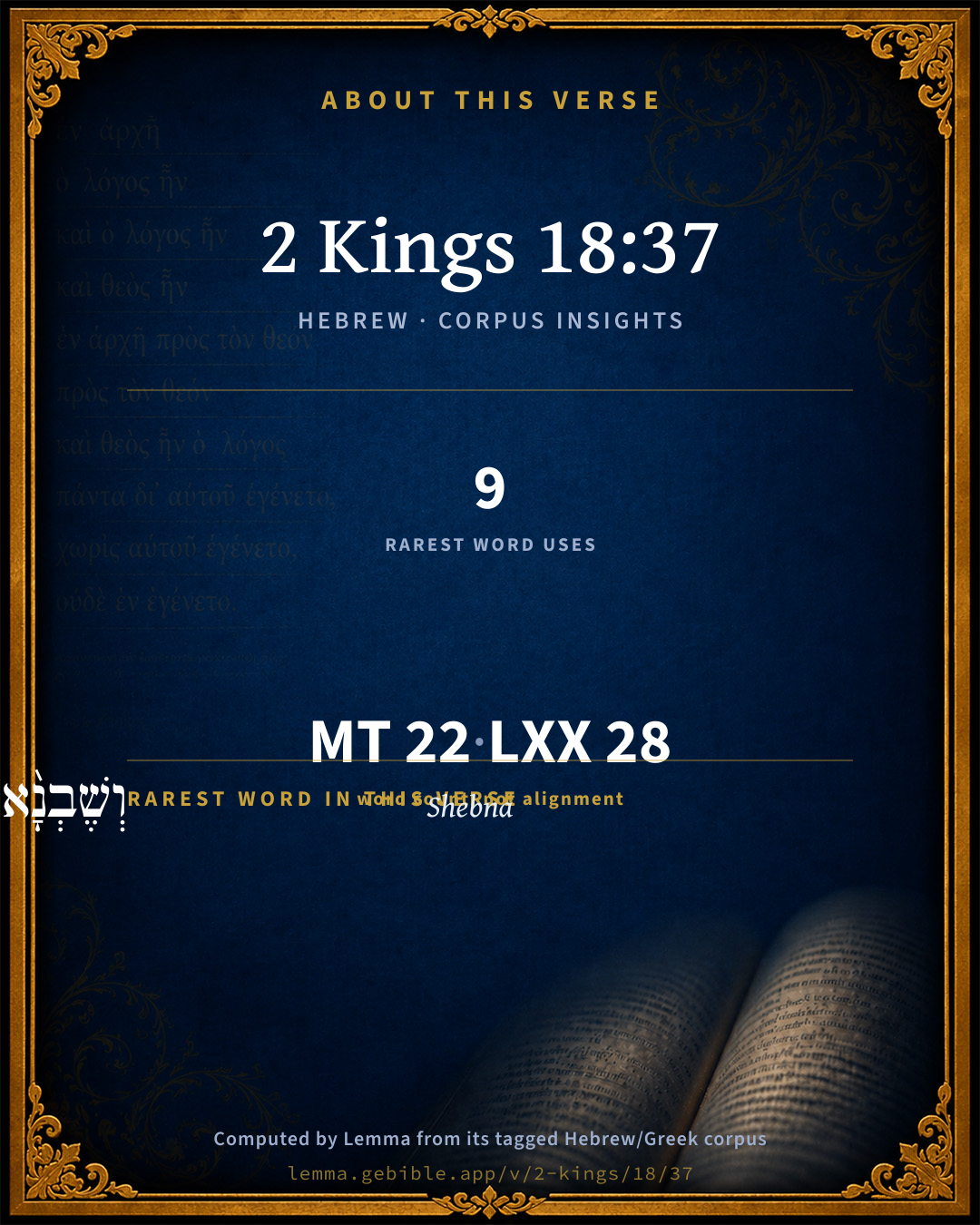
The rarest word here is וְשֶׁבְנָ֨א Shebna H7644 — appearing just 9 times in the whole Hebrew Bible.

Shared distinctive vocabulary

וְשֶׁבְנָ֨א Shebna H7644 occurs in 9 verses of the Hebrew Bible. Also found in:

Grammatical profile

  • 4 verbs
  • 14 nouns
  • 3 prepositions
  • 1 particle

Verb forms

  • וַיָּבֹ֣א Qal · Sequential Imperfect
  • הַמַּזְכִּ֛יר Hiphil · Participle Active
  • קְרוּעֵ֣י Qal · Participle Passive
  • וַיַּגִּ֣דוּ Hiphil · Sequential Imperfect

Repetition

Words recur within this verse — often emphatic in Hebrew:

  • בֶּן son H1121 ×2
  • רַב chief cupbearer H7262 ×2

Hebrew & Septuagint length

In English translation the verse runs 37 words from the Hebrew and 37 from the Septuagint (LXX English) — the same length.

A rough comparison of the two English renderings, which tokenize alike — not a word-level alignment.

Word counts can differ between the Hebrew and the Greek without any difference in meaning — e.g. the Hebrew direct-object marker אֵת has no separate Greek word, and Greek often adds the article ὁ.

In the original languages it is 22 Hebrew tokens and 28 Greek tokens — but the two are counted differently (Hebrew bundles its prefixes and suffixes into one token; the Greek is in lemma form), so that isn’t a like-for-like length.

Cross-references

12

Topical passages linked to 2 Kings 18:37 in the Treasury of Scripture Knowledge — connected by theme and wording, ordered by reader-vote popularity; previews shown in the World English Bible.

  • Genesis 37:29 Reuben returned to the pit; and saw that Joseph wasn't in the pit; and he tore his clothes.
  • Genesis 37:34 Jacob tore his clothes, and put sackcloth on his loins, and mourned for his son many days.
  • 2 Kings 5:7 It happened, when the king of Israel had read the letter, that he tore his clothes, and said, Am I God, to kill and to make alive, that this man does send to me to recover a man of his leprosy? but consider, I pray you, and see how he seeks a quarrel against me.
  • 2 Kings 6:30 It happened, when the king heard the words of the woman, that he tore his clothes (now he was passing by on the wall); and the people looked, and, behold, he had sackcloth within on his flesh.
  • 2 Kings 18:26 Then said Eliakim the son of Hilkiah, and Shebnah, and Joah, to Rabshakeh, Please speak to your servants in the Syrian language; for we understand it: and don't speak with us in the Jews' language, in the ears of the people who are on the wall.
  • 2 Kings 22:11 It happened, when the king had heard the words of the book of the law, that he tore his clothes.
  • 2 Kings 22:19 because your heart was tender, and you did humble yourself before Yahweh, when you heard what I spoke against this place, and against the inhabitants of it, that they should become a desolation and a curse, and have torn your clothes, and wept before me; I also have heard you, says Yahweh.
  • Job 1:20 Then Job arose, and tore his robe, and shaved his head, and fell down on the ground, and worshiped.
  • Isaiah 33:7 Behold, their valiant ones cry outside; the ambassadors of peace weep bitterly.
  • Isaiah 36:21–22 But they held their peace, and answered him not a word; for the king's commandment was, saying, Don't answer him.
  • Jeremiah 36:24 They were not afraid, nor tore their garments, neither the king, nor any of his servants who heard all these words.
  • Matthew 26:65 Then the high priest tore his clothing, saying, "He has spoken blasphemy! Why do we need any more witnesses? Behold, now you have heard his blasphemy.

Cross-references courtesy of OpenBible.info (CC BY 4.0).

Hebrew and Greek witnesses Masoretic Hebrew ↔ Greek Septuagint

The same verse in the two great witnesses to the Old Testament, shown verse-for-verse.

These are two independent witnesses, not word-aligned to each other, and the Septuagint is shown in lemma (dictionary) form.

Hebrew 2 Kings 18:37 Masoretic · Westminster Leningrad Codex

וַיָּבֹ֣א אֶלְיָקִ֣ים בֶּן חִלְקִיָּ֣ה אֲשֶׁר עַל הַ֠בַּיִת וְשֶׁבְנָ֨א הַסֹּפֵ֜ר וְיוֹאָ֨ח בֶּן אָסָ֧ף הַמַּזְכִּ֛יר אֶל חִזְקִיָּ֖הוּ קְרוּעֵ֣י בְגָדִ֑ים וַיַּגִּ֣דוּ ל֔וֹ דִּבְרֵ֖י רַב שָׁקֵֽה

Then came Eliakim the son of Hilkiah, who was over the household, and Shebna the scribe, and Joah the son of Asaph the recorder, to Hezekiah with their clothes torn, and told him the words of Rabshakeh.

World English Bible · Public Domain

Greek LXX 2 Kings 18:37 Septuagint · lemma form

καί εἰςἔρχομαι ελιακιμ υἱός χελκιας ὁ οἰκονόμος καί σομνας ὁ γραμματεύς καί ιωας υἱός ασαφ ὁ ἀναμιμνήσκω πρός εζεκιας διαῥήγνυμι ὁ ἱμάτιον καί ἀναἀγγέλλω αὐτός ὁ λόγος ραψακης

And Heliakim the son of Chelcias, the steward, and Somnas the scribe, and Joas the son of Saphat the recorder came in to Ezekias, having torn their garments; and they reported to him the words of Rapsakes.

LXX2012 (modern English Septuagint) · Public Domain

Hebrew: Westminster Leningrad Codex (CC BY 4.0). Greek: Septuagint (public domain); English from LXX2012 (modern English Septuagint) (Public Domain). How the Septuagint differs from the Hebrew →

Targum (Aramaic paraphrase)

1

The Targum is the ancient Jewish Aramaic paraphrase of the Hebrew Scriptures — an interpretive translation, not the Hebrew text itself. Onkelos (literal) and Pseudo-Jonathan (expansive) render the Torah, and Jonathan the Prophets. Coverage is partial: where no permissively-licensed English translation exists for a verse, only the Aramaic is shown. This is verse-level text, not a word-by-word alignment to the Hebrew.

  1. Targum Jonathan Prophets (Joshua–Malachi)
    וַאֲתָא אֶלְיָקִים בַּר חִלְקִיָה דִמְמַנָא עַל בֵּיתָא וְשֶׁבְנָא סַפְרָא וְיוֹאָח בַּר אָסָף דִמְמַנָא עַל דָכְרָנַיָא לְוַת חִזְקִיָהוּ מְבַזְעִין לְבוּשֵׁיהוֹן וַחֲוִיאוּ לֵיהּ יַת פִּתְגָמֵי רַבְשָׁקֵה:

    (no public-domain English translation for this verse)

    Targum Jonathan — Aramaic: “Mikraot Gedolot” (public domain). English: “Sefaria Community Translation” (CC0 1.0 (public-domain dedication)); “London "Chaldee Paraphrase," 1871” (public domain). Text via Sefaria.

Commentary

Notes on 2 Kings 18:37 from classic Christian and Jewish commentators (each source and its license shown beneath its notes). The classic Christian expositions comment on the surrounding passage and are grouped to its opening verse, so a note may address several verses; the Jewish commentaries on the Tanakh (Rashi and others) are per-verse, so they appear only where the commentator wrote on this verse.

Lemma curates 59 commentaries, every one of them public domain or Creative Commons licensed, each selected and text-cleaned for this edition rather than reprinted as found. About our sources →

Trapp's Complete Commentary

John Trapp

2Ki 18:37 Then came Eliakim the son of Hilkiah, which [was] over the household, and Shebna the scribe, and Joah the son of Asaph the recorder, to Hezekiah with [their] clothes rent, and told him the words of Rabshakeh.

Ver. 37. With their clothes rent.] To show how deeply they were affected with and offended at Rabshakeh’s blasphemies. Should not we be as much at the Ranters? See Mat 26:65.

John Trapp, A Commentary or Exposition upon All the Books of the Old and New Testament (1647–1656) — public domain. Text from a community e-Sword module.

Tyndale Open Study Notes

Tyndale Open Resources

18:37 tore their clothes in despair: This action could have been both a sign of sorrow over the situation in Jerusalem (see 6:30) and an indication of grief over the blasphemous insults of the Assyrian official (see 19:4-6).

Tyndale Open Study Notes — © Tyndale Open Resources, licensed CC BY-SA 4.0. Text via the HelloAO Bible API.

Adam Clarke's Commentary

Verse 37. Then came Eliakim - and Shebna - and Joah - to Hezekiah with their clothes rent] It was the custom of the Hebrews, when they heard any blasphemy, to rend their clothes, because this was the greatest of crimes, as it immediately affected the majesty of God, and it was right that a religious people should have in the utmost abhorrence every insult offered to the object of their religious worship. These three ambassadors lay the matter before the king as God's representative; he lays it before the prophet, as God's minister; and the prophet lays it before God, as the people's mediator.

Adam Clarke's Commentary on the Bible (1810–1826) — public domain. Text from a community e-Sword/MySword module.

The Cambridge Bible for Schools and Colleges

gen. ed. J. J. S. Perowne

37. with their clothes rent] See note on Chap. 2Ki_5:7.

The Cambridge Bible for Schools and Colleges (gen. ed. J. J. S. Perowne; Cambridge University Press, 1878–1918) — public domain. Text from a community e-Sword module.

Haydock's Catholic Bible Commentary

Rent, as was customary on such dismal occasions. Joakim is reprehended for not shewing this mark of consternation, when he heard the dreadful predictions of Jeremias, xxxvi. 24. (Calmet)

George Leo Haydock (1774–1849), Haydock's Catholic Family Bible and Commentary, 1859 edition — public domain. Excludes Psalms (Douay-Rheims chapter numbering differs from Protestant) and Deuterocanonical books (Catholic canon only).

The Pulpit Commentary

Then came Eliakim the son of Hilkiah, which was over the household, and Shebna the scribe, and Joah the son of Asaph the recorder, to Hezekiah with their clothes rent. They had rent their clothes, not so much in grief or in alarm, as in horror at Rabshakeh"s blasphemies. They were blasphemies, no doubt, arising from "invincible ignorance," and not intended as insults to the one Almighty Being who rules the earth, of whose existence Rabshakeh had probably no conception; but they struck on Jewish ears as insults to Jehovah, and therefore as dreadful and horrible. (comp. Gen_37:29; 1Sa_4:12; 2Sa_1:2; Ezr_9:3, etc.) And told him the words of Rabshakeh; reported to him, i.e. as nearly as they could, all that Rabshakeh had said. The three envoys would supplement, and perhaps correct, one another; and Hezekiah would have conveyed to him a full and, on the whole, exact account of the message sent to him through Rabshakeh by the Assyrian king, and of Rabshakeh"s method of enforcing it. The crisis of Hezekiah"s life was reached. As he acted under it would be fixed his own fate, his character in the judgment of all future time, and the fate of his own country.

The Pulpit Commentary (1880–1919), ed. H.D.M. Spence-Jones & Joseph S. Exell — public domain. Text from a community e-Sword module.

Rashi

Rabbi Shlomo Yitzchaki (Rashi)

With torn garments. Because they heard blasphemies of the Name [of God].

Rashi on the Tanakh — English translations: “The Judaica Press complete Tanach with Rashi, translated by A. J. Rosenberg” (CC BY 4.0); “Pentateuch with Rashi's commentary by M. Rosenbaum and A.M. Silbermann, 1929-1934” (public domain); “The Metsudah Tanach series, Lakewood, N.J” (CC BY 4.0); and “The Book of Joshua, Metsudah Publications, 1997” (CC BY 4.0). Text via Sefaria.

Lesson kit

Teaching starters — assembled from the data on this page, not authored interpretation. Every prompt links to the verse data it draws on. Edit before teaching.

2 Kings, in the Historical, opens this verse with 22 words (19 distinct Hebrew lemmas). Its most distinctive word is Shebnâʼ (“Shebna”). A historical commentator’s framing appears above. Read the whole chapter for the surrounding context.

Discussion questions

  1. The word Shebnâʼ carries the sense “Shebna.” How does it shape the verse?
  2. How does 2 Kings 18:18, which shares the word «Shebna», read alongside this verse?
  3. What does the repetition of “son” (2× in this one verse) do in this verse?
  4. The translations on this page render this verse differently — a whole-verse word diff, not a word-by-word alignment. What might account for the different wordings?
  5. «וַיָּבֹ֣א» is a Qal Sequential Imperfect verb. How does that grammatical form shape the action described?
  6. Compare how Trapp's Complete Commentary and Tyndale Open Study Notes read this verse. Where do they agree or differ?

Things to notice

Reading settings

Reading text

Shown beneath each verse's original-language words.

Old Testament
Old Testament edition

Read the OT as the Masoretic Hebrew (MT) or the Greek Septuagint (LXX).

English shown for the Greek Septuagint (in the Hebrew ↔ Greek comparison).

Comparing translations? Open the Compare panel on any verse page to stack up to four side by side.